


Cooling Conveyor: Complete Guide for Food, Electronics, and Industrial Manufacturing in Malaysia
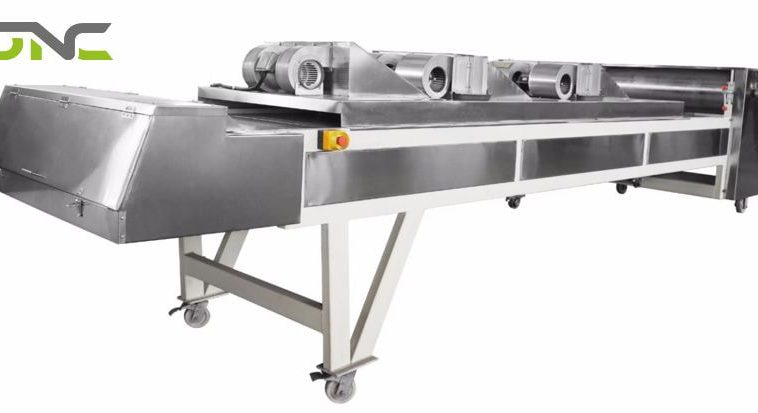
Cooling conveyors solve a specific production challenge that no standard transport conveyor addresses: moving products through a controlled cooling process while simultaneously transporting them forward in the production line — eliminating the static cooling racks, floor-space accumulation, and manual handling that constrain production throughput when products must cool before the next processing step.
In Malaysian manufacturing, cooling conveyors are critical infrastructure in food production (chocolate, biscuits, snack foods), electronics assembly (PCB post-reflow cooling), pharmaceutical manufacturing (tablet coating cooling), and industrial applications (die-cast metal parts cooling). The cooling conveyor’s role is not merely transport — it is an active process step that determines product quality, cycle time, and line throughput simultaneously.
What Is a Cooling Conveyor?
A cooling conveyor is a conveyor system that transports hot, freshly processed products through a controlled temperature reduction zone — using ambient air, forced air (fans or blowers), refrigerated air, or water spray/misting — while maintaining forward product movement. The cooling conveyor replaces the static cooling rack or floor accumulation area, converting what was idle cooling wait time into productive in-motion transport time.
Key characteristics that distinguish cooling conveyors from standard transport conveyors:
- Controlled dwell time: conveyor length and speed are engineered so products exit at target temperature — not just transported past cool air
- Process integration: cooling conveyor operates as part of the production line, synchronized with upstream process equipment (oven, fryer, die-cast machine, reflow oven) and downstream equipment (packaging, inspection, robot cell)
- Hygiene and contamination control: in food applications, the cooling conveyor is a food-contact process zone — construction and materials must meet HACCP and food safety standards
- Footprint optimization: cooling conveyors use spiral, U-turn, or multi-tier configurations to maximize cooling length within minimum floor space
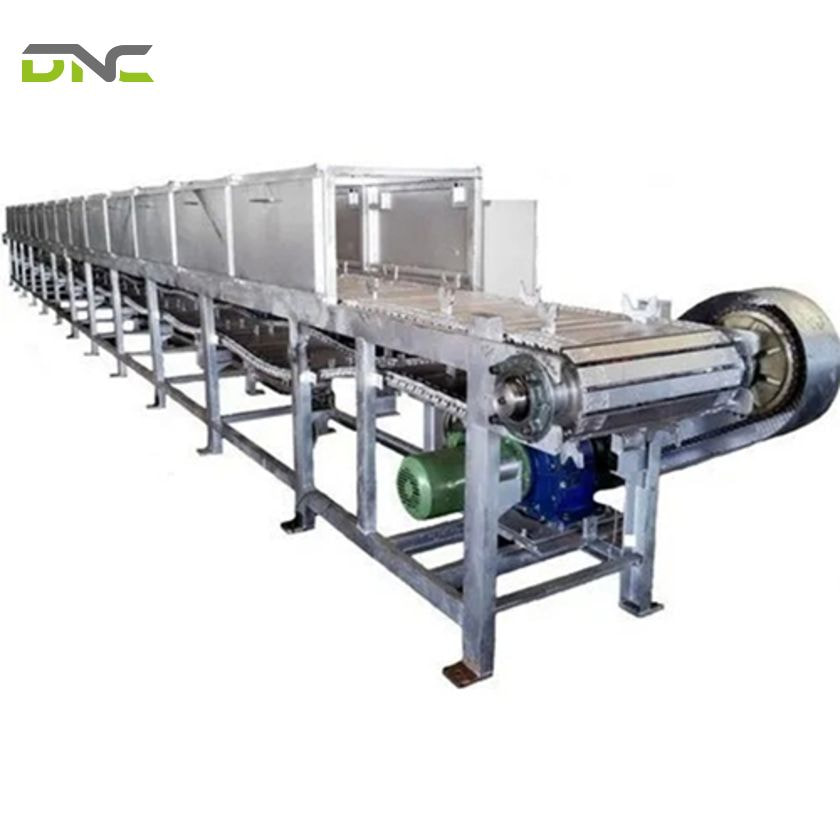
How a Cooling Conveyor Works
Heat Transfer Mechanism
Cooling conveyors remove heat from products through one or more heat transfer mechanisms:
- Natural Convection (Ambient Air)
The simplest cooling conveyor configuration — products are exposed to ambient air as they travel on the belt. Heat dissipates from the product surface by natural convection. Suitable for products requiring modest temperature reduction over long conveyor runs.
Limitation: Cooling rate depends on ambient temperature — in Malaysia’s tropical climate (28–35°C ambient), natural convection cooling conveyors require very long belt runs to achieve significant temperature reduction.
- Forced Air Cooling
Fans or blowers direct high-velocity air across and through the product on the cooling conveyor — increasing the convective heat transfer coefficient by 5–15× compared to natural convection. Forced air cooling conveyors reduce product temperature faster over the same belt length, enabling shorter conveyor footprints for the same target exit temperature.
Design parameters:
- Airflow velocity: 1–5 m/s across product surface
- Fan arrangement: overhead fans, side fans, or air knife arrays depending on product geometry
- Air temperature: ambient (economical) or chilled via refrigeration unit (for products requiring sub-ambient exit temperature)
- Refrigerated Cooling Conveyor
Forced air cooling conveyors enclosed in an insulated tunnel connected to a refrigeration unit. Chilled air (0°C to +15°C) circulates through the tunnel at controlled temperature — enabling rapid cooling to below-ambient exit temperatures. Required for products that must reach specific low temperatures before packaging (chocolate, confectionery, frozen food portions).
- Water Spray / Mist Cooling
Water spray or ultrasonic mist cooling conveyors cool products by evaporative heat transfer — the most efficient heat transfer method available. Water mist absorbs heat as it evaporates from the product surface, achieving very high cooling rates at relatively low airflow velocity.
Applications: Baked goods cooling, hot metal parts quenching, die-cast component cooling where surface oxidation must be controlled
Conveyor Path Design for Cooling
Cooling conveyors face a design tension: sufficient belt length for the required temperature reduction must fit within the available factory floor space. Three configurations solve this:
- Straight Run Cooling Conveyor
The simplest — a long straight belt conveyor with fans or refrigeration above. Requires floor space proportional to required cooling length. Suitable when space is available or cooling requirement is modest.
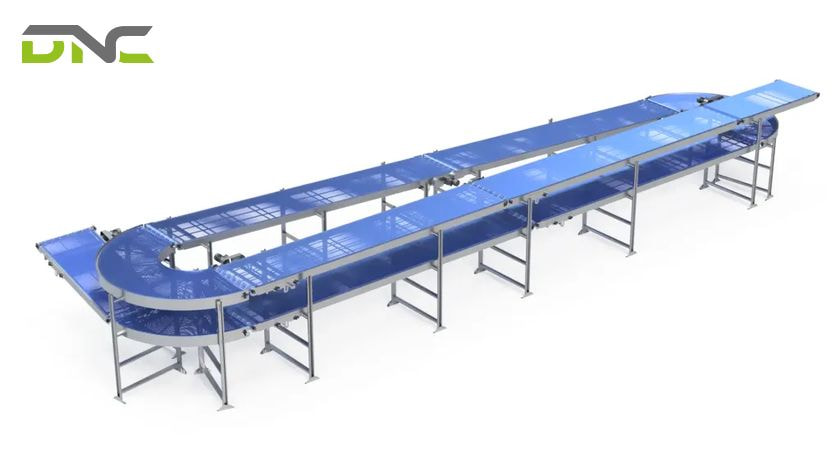
- U-Turn (Return Pass) Cooling Conveyor
The belt makes one or more 180° turns, doubling the effective cooling length in the same floor footprint. A 20 m floor-length cooling conveyor with two return passes provides 60 m of cooling belt in a 20 m × 3 m floor area.
- Spiral Cooling Conveyor
The most space-efficient cooling conveyor configuration — a continuous belt rises in a spiral helix, providing 30–100 m of cooling belt in a footprint as small as 3 m × 3 m. Spiral cooling conveyors are the standard solution for high-throughput food production in Malaysian factories where floor space is constrained.
Spiral cooling conveyor specifications:
- Cooling belt length: 30–200 m (depending on spiral height and tier count)
- Footprint: 2.5 m × 2.5 m to 5 m × 5 m
- Product weight: up to 5 kg per carrier (standard); up to 20 kg (heavy-duty)
- Temperature reduction: up to 40°C in a single spiral pass (with refrigerated air)
- Belt material: stainless steel mesh (for maximum airflow) or food-grade modular plastic
Types of Cooling Conveyors
1. Ambient Air Cooling Conveyor
Open belt conveyor with natural air exposure — lowest cost, simplest maintenance. Suitable for products requiring only modest cooling (10–15°C reduction) or products with long natural cooling times that align with available conveyor length.
Best applications: Large-format baked goods (bread loaves, cakes) with 20–30 minute natural cooling times; general industrial parts cooling where temperature target is not critical.
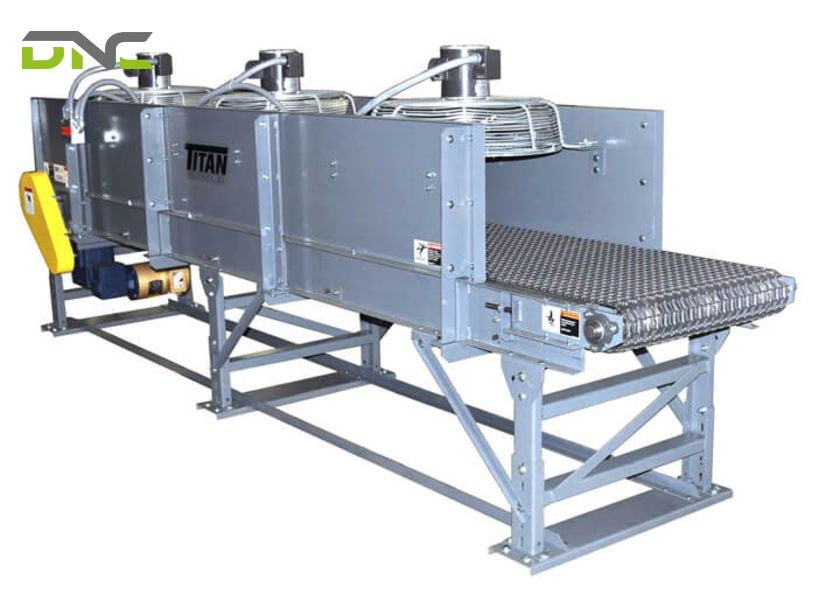
2. Forced Air Cooling Conveyor (Fan-Assisted)
Belt conveyor with overhead or side-mounted fans directing ambient air across the product. Fan velocity and positioning are engineered to the specific product geometry and target cooling rate. The most common industrial cooling conveyor type in Malaysia.
Specifications:
- Fan count: 2–20+ depending on conveyor length and cooling requirement
- Airflow: 1,000–10,000 m³/hour per fan unit
- Temperature reduction: 15–30°C for typical food products in Malaysian ambient conditions
- Belt material: mesh (maximum airflow) or solid (product support required)
Best applications: Snack food cooling, biscuit post-baking cooling, chocolate enrober outfeed cooling, electronics PCB post-reflow cooling
3. Refrigerated Cooling Conveyor Tunnel
An insulated tunnel enclosing a belt conveyor, with refrigerated air circulated internally by fans from a connected refrigeration unit. Products enter at oven/process exit temperature and leave the cooling conveyor at the specified packaging temperature.
Specifications:
- Tunnel temperature: 0°C to +15°C (adjustable)
- Refrigeration capacity: 5–100 kW depending on product heat load and throughput
- Insulation: 100–150 mm polyurethane foam panels
- Belt: food-grade stainless mesh or modular plastic (depending on product)
- Control: PLC manages tunnel temperature, belt speed, and alarm conditions
Best applications: Chocolate and confectionery (must reach 18–20°C before packaging), baked products that condensate if packaged warm, pharmaceutical tablets requiring below-ambient exit temperature
4. Spiral Cooling Conveyor
A space-optimizing cooling conveyor in which a continuous belt rises in a spiral helix within an insulated or open enclosure. Spiral cooling conveyors are the standard solution for high-volume food and confectionery production where cooling length requirements are high but floor space is limited.
Specifications:
- Belt width: 400–1,200 mm
- Spiral tiers: 4–20 tiers
- Effective belt length: 30–200 m
- Floor footprint: 2.5×2.5 m (small) to 6×6 m (large)
- Throughput: up to 2,000 kg/hour
- Drive: central cage drive (most common for food-grade); edge-drive (heavy-duty)
Best applications: Bread and bun production, snack food, meat products, confectionery — any high-throughput food production requiring extended cooling in minimal floor space
5. Mesh Belt Cooling Conveyor
A belt conveyor using an open stainless steel wire mesh belt — allowing forced air to flow through the belt and contact the product underside as well as the top surface, maximizing cooling rate per meter of conveyor.
Best applications: Products that are sticky on the bottom when hot (baked goods, candy), products requiring airflow on all surfaces (circuit boards, tablet coatings), products where condensate drainage is needed
6. Water Quench Cooling Conveyor
A cooling conveyor passing products through a controlled water spray or immersion zone for rapid temperature reduction — primarily for industrial metal parts cooling (die-cast aluminium, forged steel) rather than food applications.
Specifications:
- Water temperature: ambient to chilled (5–25°C)
- Water pressure: 1–5 bar (spray nozzles)
- Drainage: integrated drain pan with filtration recirculation
- Belt: stainless steel mesh or plastic-coated wire
Best applications: Die-cast aluminium part cooling (automotive, electronics housings), forged component quenching, rubber vulcanization cooling
Key Components of a Cooling Conveyor System
- Conveyor Belt
Cooling conveyor belt material must be matched to both the product and the cooling mechanism:
- Stainless steel wire mesh: maximum airflow, food-grade, high-temperature resistant, easy cleaning
- Modular plastic (PP/PE): food-grade, individual tile replacement, moderate airflow (open mesh designs available)
- Teflon-coated fiberglass: for products exiting ovens at up to 260°C; non-stick surface
- Fans and Air Distribution
Fan selection and positioning determines cooling efficiency. Centrifugal fans with ductwork provide high-velocity directed airflow. Axial fans provide high-volume low-pressure airflow for large enclosures. DNC Automation’s cooling conveyor designs use CFD (Computational Fluid Dynamics) analysis for complex cooling tunnel configurations.
- Refrigeration Unit (Where Required)
For refrigerated cooling conveyors: scroll or rotary compressor refrigeration units sized to the cooling load (product mass × specific heat × temperature reduction per hour). Malaysia’s tropical ambient conditions require oversized refrigeration capacity — the cooling tunnel must overcome both product heat load and ambient heat ingress through insulation.
- PLC Control System
The cooling conveyor PLC manages belt speed (which controls product dwell time and exit temperature), fan speed (via VFD — adjustable airflow for different products), tunnel temperature (for refrigerated tunnels), and alarm conditions (temperature deviation, belt jam). DNC Automation uses Siemens SIMATIC PLCs for cooling conveyor automation — enabling integration with upstream process equipment for synchronized production control.
- Hygienic Frame Design (Food Grade)
Food-grade cooling conveyor frames use AISI 304 stainless steel with sloped horizontal surfaces, no hollow sections, and open-frame construction — ensuring full washdown access and eliminating debris accumulation zones that violate HACCP requirements.
Applications: Cooling Conveyors in Malaysian Manufacturing
Food and Confectionery — Nationwide
Malaysia’s food manufacturing sector — including DNC Automation clients Guan Chong Berhad (cocoa processing, chocolate), F&N (beverages and snack foods), and Ramly Burger (ready meals) — uses cooling conveyors throughout production lines. Chocolate products must reach 18–20°C before packaging to prevent fat bloom; biscuits must cool from 180°C oven exit to below 40°C for packaging; snack foods require controlled cooling to set texture.
In Malaysia’s tropical ambient conditions (28–35°C), refrigerated cooling conveyors are often necessary where temperate-climate factories can use ambient air. This increases both capital cost and operating cost for Malaysian F&B cooling conveyor systems — making correct specification critical.
Electronics — PCB Post-Reflow Cooling
In SMT assembly lines, PCBs exit the reflow oven at 180–230°C (above solder liquidus temperature) and must cool to below 50°C before handling and further assembly. The cooling conveyor section immediately after the reflow oven uses forced ambient air — typically 3–5 m of mesh belt conveyor with fans — to reduce PCB temperature within the SMT line cycle time.
ESD-safe construction is mandatory: cooling conveyor belts and frames in electronics applications must prevent static charge buildup that damages components. DNC Automation designs ESD-safe cooling conveyor sections for SMT line integration.
Pharmaceutical — Tablet Coating Cooling
Tablet coating drums heat tablet cores during the coating process. After coating, tablets must cool to below 30°C before packaging — otherwise tablet-to-tablet sticking causes quality failures. Pharmaceutical cooling conveyors use refrigerated forced air in GMP-compliant stainless steel construction, with temperature logging for batch records.
Automotive and Industrial — Die-Cast Parts Cooling
Die-cast aluminium parts (automotive housings, electronics enclosures) exit die-casting machines at 300–400°C and must cool before robot handling, machining, or inspection. Industrial cooling conveyors for die-cast applications use water quench or forced ambient air on stainless steel mesh belts, with programmable cooling profiles via PLC.
Benefits of Cooling Conveyors in Malaysian Production
- Increase Line Throughput by Up to 50%
A cooling conveyor replaces static cooling racks — converting idle cooling wait time into productive transport time. Production lines with static cooling racks typically lose 30–50% of potential throughput to cooling bottlenecks. A correctly sized cooling conveyor eliminates this bottleneck, increasing overall line throughput by up to 50%.
- Consistent Product Quality
Manual handling between oven and packaging introduces temperature variation — products cooled at the front of a rack are over-cooled while those at the back are under-cooled when packaging begins. A cooling conveyor applies consistent, controlled cooling to every product at the same rate — eliminating quality variation from temperature inconsistency.
- Labor Reduction
Static cooling racks require operators to move products on and off racks manually — a labor-intensive, ergonomically demanding task. Cooling conveyors eliminate this manual handling entirely, freeing operators for value-adding tasks. DNC Automation’s automation systems reduce labor requirements by up to 50%.
- Compact Footprint — Especially Spiral Systems
Spiral cooling conveyors provide up to 200 m of effective cooling belt in a 5 m × 5 m footprint — equivalent to a 200 m straight belt cooling conveyor that would occupy an entire factory bay. For Malaysian factories where floor space in Selangor and Penang costs RM 3–8/sq ft/month, this footprint efficiency has direct cost impact.
- HACCP and Food Safety Compliance
An automated cooling conveyor with temperature monitoring and logging provides the data trail required for HACCP critical control point (CCP) verification — demonstrating that every product batch was cooled within the specified time-temperature window. Manual cooling rack systems cannot provide this documentation reliably.
How to Choose the Right Cooling Conveyor
- Define Target Exit Temperature and Cooling Time
Calculate the required temperature reduction: ΔT = entry temperature − target exit temperature. Calculate required dwell time from product heat transfer characteristics (mass, specific heat, surface area, initial temperature). These values determine required effective belt length and cooling intensity.
- Choose Cooling Mechanism
Malaysian ambient: 28–35°C. If your target exit temperature is above 40°C, forced ambient air may suffice. If target exit temperature is below 35°C, refrigerated cooling is required. For high-moisture products, avoid water spray unless the product is compatible.
- Optimize Footprint
If cooling time × belt speed requires more than 15 m of belt length, evaluate spiral or U-turn configurations. Spiral cooling conveyors are economically justified when the floor space they save has measurable cost (i.e., in Penang or Selangor industrial parks).
- Specify Food-Grade or Industrial Grade
Food or pharmaceutical contact → stainless steel frame, food-grade belt, IP65 motors, HACCP-compliant design.
Industrial (metal parts, electronics) → standard anodised aluminium or mild steel frame acceptable; belt material matched to part temperature.
- Integrate with Line PLC
Cooling conveyor belt speed should be adjustable from the main line PLC — enabling automatic speed adjustment when upstream throughput changes, and alarm integration when cooling tunnel temperature deviates from setpoint.
FAQ — Cooling Conveyor
What is a cooling conveyor used for in food manufacturing?
Cooling conveyors in food manufacturing reduce product temperature from process exit temperature to packaging-safe temperature while maintaining production flow. Chocolate must reach 18–20°C; biscuits must drop from 180°C+ to below 40°C; snack foods require controlled cooling to set texture and prevent packaging condensation. Cooling conveyors provide this temperature reduction in-line, eliminating static cooling rack bottlenecks.
How long does a cooling conveyor need to be?
Cooling conveyor length depends on: product heat load (mass × specific heat), target temperature reduction, belt speed, and cooling intensity (ambient air vs. forced air vs. refrigerated air). DNC Automation engineers calculate required belt length from these parameters — there is no single standard answer. A typical biscuit cooling conveyor for Malaysian ambient conditions (35°C) requires 20–40 m of belt with forced-air cooling.
What belt material is used in food cooling conveyors?
Food-grade cooling conveyors use either open stainless steel wire mesh (maximum airflow, direct contact, easy cleaning) or food-grade modular plastic belts (individual tile replacement, good airflow with open mesh designs). PTFE-coated belts are used when products exit at very high temperatures (>150°C). All food-contact belt materials comply with FDA 21 CFR food-contact requirements.
Can a cooling conveyor operate in Malaysia’s tropical climate?
Yes, but tropical ambient conditions require specific design adjustments. At 35°C ambient, forced air cooling conveyors cool products more slowly than in temperate climates — requiring either longer belt runs or refrigerated cooling for the same target exit temperature. DNC Automation’s cooling conveyor designs account for Malaysian climate conditions in heat transfer calculations.
How does a spiral cooling conveyor save floor space?
A spiral cooling conveyor rises in a helix — the belt travels upward in tiers, providing 30–200 m of effective cooling belt in a footprint as small as 3 m × 3 m. The equivalent straight-run cooling belt would require a 30–200 m floor length. For high-throughput Malaysian food factories, spiral cooling conveyors are the standard space-optimization solution.
Does DNC Automation supply cooling conveyors in Malaysia?
Yes. DNC Automation designs and integrates cooling conveyor systems for food, pharmaceutical, electronics, and industrial applications across Malaysia. Our engineering team sizes cooling conveyors from product heat transfer data, designs hygienic or industrial construction as required, and integrates Siemens PLC control with upstream and downstream production equipment. Contact us for a free pre-sales consultation.
Conclusion
Cooling conveyors are process equipment, not simply transport conveyors — their performance determines product quality, line throughput, and packaging compliance simultaneously. In Malaysia’s food, electronics, pharmaceutical, and industrial manufacturing sectors, correctly designed cooling conveyors eliminate the production bottlenecks and quality failures that static cooling methods create.
DNC Automation engineers cooling conveyor systems from heat transfer calculations through mechanical design, fabrication, PLC integration, and commissioning — all in-house at our 25,000 sq ft Selangor facility. With Siemens-certified automation engineering, ISO 9001:2015 quality management, and 24/7 local support across Malaysia, our cooling conveyor solutions deliver measurable production improvement from day one.
Ready to design your cooling conveyor system? Talk to Our Engineers for a free pre-sales consultation.
- 648 views
- 0 Comment
Recent Comments