


Polyurethane Conveyor Belt for Automated Systems
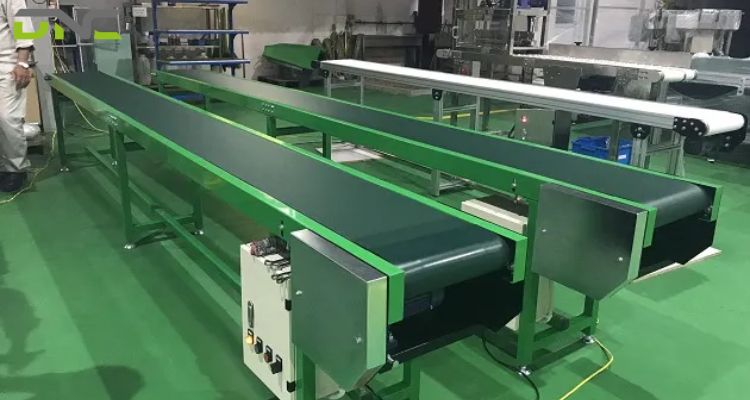
A single electrostatic discharge event of 100 volts — invisible to the naked eye, unfelt by the human hand — destroys a field-programmable gate array worth RM 500–2,000. Penang’s electronics manufacturing cluster processes billions of PCBs annually: 58% of Malaysia’s total E&E exports, 13% of global semiconductor assembly and test volume, flowing through facilities operated by Benchmark Electronics, ESCATEC, Flex, and dozens of smaller EMS operations. Every single board — from the smallest IoT sensor module to a 460 mm server motherboard — passes through a PCB conveyor at 6–12 stages of its manufacturing journey. PCB conveyors are not generic belt conveyors adapted for electronics use: they are engineered systems with ESD-safe carbon-loaded belts (surface resistance 10⁵–10¹¹ Ohms), edge-only board contact geometry that protects component areas, SMEMA electronic handshake interfaces, board bow prevention supports, and barcode/RFID traceability scanning at every conveyor station. DNC Automation — Malaysia’s Top #1 Factory Automation Company since 2005, ISO 9001:2015 certified, with direct Penang operations serving the EMS cluster — designs and commissions complete PCB conveyor systems integrated with Siemens SIMATIC PLC and SCADA for full production traceability. This guide covers every PCB conveyor type, critical specification, application, and selection criterion.
What Is a PCB Conveyor?
A PCB conveyor is a specialized material handling system designed to transport printed circuit boards (PCBs) through the manufacturing process while maintaining ESD protection, dimensional precision, contamination prevention, and machine interface compatibility at every processing stage. PCB conveyor is the broader category term — it covers all board-handling conveyors across the complete PCB manufacturing flow: surface mount technology (SMT) assembly, through-hole component insertion, wave soldering, selective soldering, automated optical inspection (AOI), in-circuit testing (ICT), conformal coating, final assembly, and functional testing.
SMT conveyor is the subset term referring specifically to conveyors between SMT-sequence machines (printer → SPI → pick-and-place → reflow oven → AOI). All SMT conveyors are PCB conveyors, but PCB conveyors extend beyond the SMT sequence to cover wave solder fingers, ICT fixture loaders, conformal coating conveyors, and magazine loaders at the beginning and end of every manufacturing sub-process. A complete PCB manufacturing line from bare board input to tested finished assembly may use 15–30 individual PCB conveyor units across all stages.
How Does a PCB Conveyor Work?
PCB conveyor operation requires strict adherence to principles that prevent the two most costly failure modes in electronics manufacturing: ESD damage and mechanical PCB damage. Understanding these principles at each operational step enables correct conveyor specification and installation.
Step 1 — ESD-Safe Environment Establishment
Before a PCB enters the conveyor system, the factory environment must establish ESD-safe conditions. ANSI ESD S20.20 defines the complete ESD Protected Area (EPA) environment: factory ambient temperature 20–24°C, relative humidity 40–60% RH, all personnel wearing ESD wrist straps or ESD footwear, and all conveyor belts, rails, and frames meeting defined resistance specifications. PCB conveyor belts must have surface resistance of 10⁵–10¹¹ Ohms — within the “dissipative” range that prevents charge accumulation without shorting PCB circuits. Conveyor frames must be earth-bonded to the facility ground, typically to less than 1 Ohm ground path resistance.
Step 2 — Board Loading and Edge Contact Registration
PCBs enter the PCB conveyor via magazine loaders (boards from stacked trays), manual loading positions, or direct machine-to-conveyor transfer. The board seats onto two adjustable edge rails — only the component-free zone (3–5 mm from PCB edge per IPC-2222) contacts the conveyor rails. Component areas above and below the board are in free air — no conveyor surface contacts solder joints, IC packages, or connector pins. Edge rail width is adjusted to PCB width (50–510 mm range for standard PCB conveyors) with 3 mm clearance per side.
Step 3 — Board Support and Bow Prevention
Thin PCBs (0.6–1.2 mm thickness) under their own weight exhibit bow deflection on unsupported spans. Board bow exceeding 0.5 mm causes solder paste print registration errors in SMT and solder joint opens in wave soldering. PCB conveyors support boards using either a center support bar (fixed height, for single-sided component boards) or adjustable support fingers (programmable height, for double-sided boards where underside components must clear the support). DNC Automation engineers calculate maximum allowable board span for each PCB thickness and component layout before specifying support bar positions.
Step 4 — Variable Speed Transport and SMEMA Handshake
PCB transport speed is variable: 0.5 m/min minimum for large heavy server boards undergoing precise registration, up to 20 m/min for small consumer electronics boards at maximum throughput. The PCB conveyor PLC synchronizes belt speed to the upstream machine’s output rate using SMEMA protocol signals. SMEMA handshaking prevents boards from colliding on the conveyor (the “Board Available” and “Machine Ready” signal exchange ensures single-board-at-a-time transfer) and prevents machines from trying to process boards that have not arrived (the “Board Conveyor Busy” signal holds the upstream machine’s eject).
Step 5 — Traceability Scanning at Conveyor Stations
Barcode readers or RFID antennas at PCB conveyor stations scan board serial numbers or lot codes as boards pass. Each scan event is logged with timestamp, machine station ID, operator ID, and environmental conditions to the MES or Siemens SCADA system. This traceability data satisfies automotive AEC-Q100, medical FDA 21 CFR Part 820, and military IPC-A-610 traceability requirements that Penang EMS clients must satisfy for their customers. DNC Automation integrates Cognex or Sick barcode readers with Siemens PLC at every PCB conveyor station requiring traceability — providing a complete electronic manufacturing genealogy record.
Step 6 — Machine Interface and Final Registration
At the destination machine, the PCB conveyor decelerates the board to a stop position within ±3 mm of the machine’s board input reference. The machine’s own internal transport takes over from the conveyor at this point, providing the precision final registration (±0.05 mm for pick-and-place machines) required for component placement. The SMEMA handshake confirms board transfer, and the PCB conveyor resets for the next board.
Types of PCB Conveyor
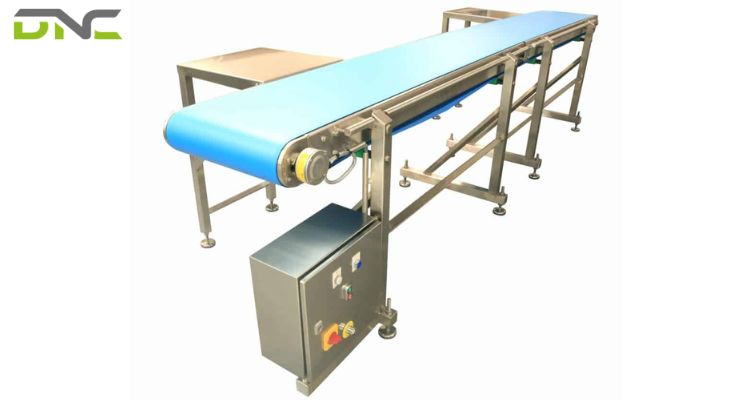
PCB manufacturing lines require multiple conveyor types — each optimized for specific process stage requirements. Using an edge belt conveyor where a dip solder finger conveyor is needed, or specifying a standard industrial belt where an ICT fixture conveyor is required, results in immediate production quality problems.
1. Edge Belt Conveyor (Standard Two-Rail PCB Transport)
Edge belt conveyors are the most common PCB conveyor type — two parallel belts (ESD-safe carbon-loaded polyurethane or PTFE-coated fiberglass) run along adjustable edge rails, carrying the PCB by its bottom edge surfaces. The belt surface contacts only the 3–5 mm component-free edge zone of the board underside. Edge belt conveyors are used between SMT machines, between reflow ovens and AOI stations, for ICT feed conveyors, and for most standard PCB transport applications. PCB width range: 50–510 mm. Belt surface resistance: 10⁶–10⁹ Ohms. Speed range: 0.5–20 m/min. SMEMA interface standard on both ends.
2. Overhead SMIF Pod Conveyor (Cleanroom PCB Transport)
SMIF (Standard Mechanical Interface) pod conveyors carry wafers and PCBs inside sealed SMIF pods — standard 200 mm or 300 mm compatible pods — through Class 100 and Class 10 cleanroom environments. Overhead conveyor routing eliminates floor-level particulate exposure. SMIF pod conveyors are used exclusively in semiconductor wafer fabrication and high-reliability PCB processing where environmental contamination control takes priority over cost. Penang’s wafer-level packaging and semiconductor backend facilities (Intel, AMD sites) use SMIF pod transport infrastructure integrated with broader PCB handling systems.
3. PCB Magazine Loader and Unloader (Automated Board Interface)
Magazine loaders automatically de-stack PCBs from cassette magazines and feed them one-at-a-time onto the PCB conveyor, while magazine unloaders receive processed boards and stack them into cassette magazines. Magazine capacity: 20–50 boards per magazine stack. Loader capacity: 10–30 magazine stacks per loading cycle, providing 2–5 hours of unattended operation. Magazine loaders and unloaders are essential for high-volume SMT lines processing 50,000+ boards per shift — manual board loading at this volume requires 2–4 dedicated operators per line, which magazine automation eliminates entirely.
4. Dip Solder Finger Conveyor (Wave Solder Transport)
Wave solder finger conveyors carry PCBs through flux spray tunnels, preheat ovens, and the molten solder wave bath at wave soldering machines. Titanium or stainless steel fingers grip PCB edges through the solder bath (tin-lead: 250°C; lead-free SAC305: 260–265°C) — conventional belt or roller conveyors would be destroyed by direct solder bath contact. Finger angle adjustment (typically 5–7° incline) controls solder drainage from PCB pads and prevents solder bridging between adjacent pins.
5. ICT Fixture Conveyor (Precision Test Positioning)
In-circuit test (ICT) conveyors deliver PCBs to ICT bed-of-nails test fixtures with positioning accuracy requirements tighter than standard PCB transport — ±1 mm or better to align PCB test pads with fixture probe tips. ICT fixture conveyors use pneumatic board clamping jigs (pneumatic cylinders clamp PCB edges against precision-machined reference stops) and bottom-side clearance to allow spring probe contact from below. DNC Automation integrates ICT conveyor systems with Siemens SCADA for real-time test result logging and production genealogy recording.
6. PCB Rack Conveyor (Reflow Oven Rack Handling)
PCB rack conveyors transport PCBs held vertically in heat-resistant wire racks through reflow ovens (230–260°C for lead-free soldering). Racked vertical transport through high-temperature reflow zones reduces the oven conveyor width required, allowing more boards per oven width than flat horizontal transport. Rack conveyors are specified for large or odd-shaped PCBs that cannot be transported flat through conventional reflow oven belt conveyors.
PCB Conveyor Type Comparison Table
| Type | Temperature Range | ESD Required | SMEMA | Key Application |
| Edge Belt | Ambient | Yes | Yes | SMT, AOI, ICT, general |
| SMIF Overhead | Ambient | Yes | Modified | Cleanroom wafer/PCB |
| Magazine Loader | Ambient | Yes | Yes | Line infeed/outfeed |
| Wave Solder Finger | Up to 265°C | No (solder bath) | Yes | Wave soldering |
| ICT Fixture | Ambient | Yes | Yes | In-circuit testing |
| Rack Conveyor | Up to 260°C | No (reflow oven) | Yes | Large PCB reflow |
──────────────────────────────────────────────────
Key Components of a PCB Conveyor System
ESD-Safe Belt System. Carbon-loaded polyurethane belt or PTFE-coated fiberglass belt provides ESD-dissipative transport surface. Belt surface resistance is tested at commissioning using a surface resistance meter per ANSI ESD STM4.1. Belt resistance re-testing is performed annually as part of DNC Automation’s PCB conveyor maintenance contracts — belt aging can shift resistance out of the dissipative range.
Adjustable Width Edge Rail System. Two edge rails hold the PCB during transport. Rail separation is adjustable from 50 mm to 510 mm to accommodate the full range of PCB sizes on the production line. Motorized width adjustment (servo actuated, programmable via PLC recipe) enables automatic width changeover between PCB designs in 10–30 seconds. Manual screw-adjustment width systems require 2–5 minutes for changeover — significant time cost in EMS facilities running 5–10 different PCB designs per shift.
Board Support System. Center support bars (fixed height for single-sided boards) or programmable support fingers (servo-adjustable height for double-sided boards with underside components) prevent board bow. Support bar material is ESD-safe nylon or PTFE-coated stainless steel. Support finger position is programmed in the conveyor recipe system alongside width settings — both width and support configuration change automatically on recipe selection.
Photoelectric Sensor Array. Through-beam or retroreflective photoelectric sensors at infeed, mid-conveyor, and outfeed positions detect board presence, board jam conditions, and board arrival at stop positions. Laser sensors with 0.5 mm detection threshold are specified for thin (0.4–0.6 mm) PCBs that may not reliably trigger standard photoelectric sensors. DNC Automation performs sensor selection and sensitivity calibration for each specific PCB type in the client’s product mix.
Siemens SIMATIC PLC. Siemens S7-1200 or S7-300 PLCs control all PCB conveyor parameters: belt speed, width setting, support position, SMEMA signal processing, sensor monitoring, alarm management, and SCADA data logging. DNC Automation programs PLC logic and SCADA integration using Siemens TIA Portal, providing production managers with real-time board count, throughput rate, jam event history, and machine utilization data.
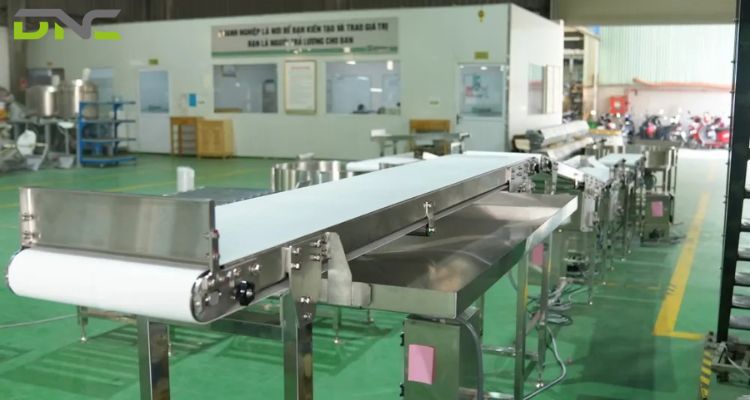
Applications: Where PCB Conveyors Are Used in Malaysian Manufacturing
Penang EMS Cluster — High-Reliability Electronics
Benchmark Electronics, ESCATEC, Flex, and QDOS in Penang process PCBs for automotive, medical, telecommunications, and defense customers — all requiring AEC-Q100, IPC-A-610 Class 3, or military-grade manufacturing standards with 100% traceability. PCB conveyor systems in these facilities incorporate barcode scanning at every station, ESD-monitored belt resistance (continuous monitoring, not just annual testing), nitrogen atmosphere wavered in reflow ovens, and Siemens SCADA genealogy databases accessible for customer quality audits. DNC Automation’s Penang operations serve these facilities with local engineering support and rapid spare parts availability.
Sony and Consumer Electronics Manufacturing
Sony’s Malaysian manufacturing operations — a confirmed DNC Automation client — assemble consumer electronics products on high-speed SMT and PCB assembly lines. Consumer electronics PCB conveyors balance throughput maximization (dual-lane configurations, 15–20 m/min belt speed) with Japanese quality standards requiring zero ESD incidents, zero contamination, and 100% board traceability. Japanese electronics manufacturers specify PCB conveyor cleanliness standards that exceed standard Malaysian factory practice — DNC Automation’s installation protocol meets Japanese JIS X 9009 electronics manufacturing environment standards.
Automotive ECU Assembly — Selangor
Toyota and Tier-1 automotive electronics suppliers in Selangor assemble engine control units (ECUs), body control modules, ADAS sensor processors, and infotainment systems on PCB assembly lines where every board is tracked from bare PCB receipt to final tested assembly. Automotive IATF 16949 quality management system requirements mandate PCB conveyor traceability data retention for a minimum of 15 years — covering the expected vehicle service life. DNC Automation implements SQL database-backed Siemens SCADA systems that archive PCB assembly genealogy data to IATF 16949 retention requirements.
Medical Device Electronics — Penang and Selangor
Medical device PCB assembly — Class II defibrillators, Class III pacemaker sub-assemblies, and ISO 13485 general medical electronics — requires FDA 21 CFR Part 820 Quality System Regulation compliance including Installation Qualification (IQ), Operational Qualification (OQ), and Performance Qualification (PQ) documentation for every PCB conveyor in the line. DNC Automation provides complete IQ/OQ/PQ documentation packages for medical device PCB conveyor installations, supporting clients’ FDA audit readiness and MDA (Medical Device Authority Malaysia) registration requirements.
Benefits of PCB Conveyor Integration for Malaysian Electronics Factories
ESD Control Prevents RM 500–2,000 Component Loss Per Incident. ESD damage is the costliest defect mode in Penang’s EMS sector — invisible at time of occurrence, manifesting as latent field failures weeks after product shipment. Properly specified ESD-safe PCB conveyors (10⁵–10¹¹ Ohm belt resistance, earth-bonded frames, EPA factory environment) eliminate belt-generated triboelectric charge as an ESD source. DNC Automation’s PCB conveyor installations deliver 80% reduction in ESD-attributed PCB failures compared to pre-installation baseline measurements.
50% Productivity Increase Through Automated Board Handling. Manual PCB transfer between assembly stages averages 3–5 seconds per board plus mishandling errors. SMEMA-integrated PCB conveyors with magazine loaders reduce inter-stage transfer time to under 1.5 seconds per board and eliminate the 2–4 dedicated board-handling operators per line that manual transfer requires. Penang EMS clients report 50% throughput increase per assembly line after implementing automated PCB conveyor systems versus manual transfer operations.
100% Traceability Supports Customer Audit Requirements. Automotive, medical, and defense customers conducting supplier quality audits require PCB manufacturing genealogy data — which machine processed each board, what parameters were applied, and which operator was assigned. Siemens SCADA integration in DNC Automation PCB conveyor systems provides barcode-linked genealogy records at every conveyor station, making complete board history retrieval a 30-second query rather than a manual paper record search.
ISO 9001:2015 Commissioning Documentation. DNC Automation’s ISO 9001:2015 certification ensures all PCB conveyor installations are documented with FAT (Factory Acceptance Test) protocols, commissioning records, calibration certificates for sensors and encoders, and as-built wiring diagrams — the complete documentation package required for IATF 16949, ISO 13485, and FDA 21 CFR audit submissions.
How to Choose the Right PCB Conveyor for Your Factory
Map Every PCB Manufacturing Stage. List every processing step from bare board receipt to finished tested assembly. Each stage transition requires a PCB conveyor segment — identify which stages require elevated temperature capability (wave solder, reflow oven), which require precision positioning (ICT, printing), and which are standard ambient transport. DNC Automation provides PCB line layout design as part of the pre-sale consultation — mapping the optimal conveyor type for each stage before quoting.
Define PCB Size Range and Future Product Mix. Specify the minimum and maximum PCB dimensions (width, length, thickness) for the full product mix — including products under development. Motorized width adjustment is recommended when width variation exceeds 50 mm across the product range. Over-specifying for current products while under-specifying for future larger boards is a common PCB conveyor design mistake that requires costly conveyor replacement within 2–3 years.
Verify ESD Control Requirements Against Product Sensitivity. CMOS and BiMOS ICs have ESD sensitivity below 100 volts (Human Body Model classification Class 0 or Class 1A). High-reliability products (automotive, medical, defense) require ESD conveyor belt resistance verified quarterly, not just annually. ESD control investment scales with the component value risk — a line producing PCBs with RM 1,000+ average component value per board justifies continuous ESD belt monitoring over annual-check installations.
Assess Malaysia’s NIMP 2030 Smart Factory Eligibility. PCB conveyor automation investments integrating Siemens PLC control, SCADA production monitoring, and MES traceability connectivity qualify as smart manufacturing investments under Malaysia’s National Investment Master Plan 2030. MIDA’s SAG Grant provides up to RM 1 million per facility at 70:30 matching for qualifying automation investments. DNC Automation’s 35-engineer team has assisted Penang EMS clients in securing SAG grants for PCB line automation projects, with project documentation support included in DNC’s project management scope.
Frequently Asked Questions About PCB Conveyors
Q: What is the required ESD belt resistance for PCB conveyor belts?
ANSI ESD S20.20 specifies belt surface resistance of 10⁵ to 10¹¹ Ohms for conveyor systems in ESD Protected Areas (EPAs). Resistance below 10⁵ Ohms (conductive) risks shorting PCB circuits if the belt contacts exposed pads or pins. Resistance above 10¹¹ Ohms (insulative) allows triboelectric charge to accumulate on the belt surface, creating electrostatic discharge sources near sensitive components. Carbon-loaded polyurethane belts typically measure 10⁶–10⁹ Ohms — centered in the safe dissipative window.
Q: How does board bow affect PCB assembly quality?
Board bow exceeding 0.5 mm in the print zone causes solder paste misregistration — the printer stencil does not make uniform contact across the full board surface, leaving insufficient paste deposits on bowed areas. In reflow, insufficient paste deposits result in solder joint opens (no-connect defects). In wave soldering, excessive bow causes uneven solder contact with the wave, producing bridging on some areas and opens on others. PCB conveyor center support bars prevent bow by supporting the board center — DNC Automation calculates support bar requirements for each PCB thickness and dimension.
Q: What is the difference between a PCB conveyor and an SMT conveyor?
SMT conveyor is the specific term for conveyors within the surface mount technology assembly sequence — connecting printer, SPI, pick-and-place, reflow, and AOI machines using SMEMA protocol. PCB conveyor is the broader category covering board-handling systems for all PCB manufacturing stages including through-hole assembly, wave soldering, selective soldering, ICT testing, conformal coating, and final assembly. All SMT conveyors are PCB conveyors; PCB conveyors include many applications beyond the SMT sequence.
Q: Can PCB conveyors handle both single-sided and double-sided boards on the same line?
Yes — PCB conveyors with programmable support finger height handle both single-sided (components on one side only, support fingers can contact the bare underside) and double-sided boards (components on both sides, support fingers must be set to clear underside components). DNC Automation programs support finger height as part of the PCB recipe stored in the conveyor PLC — recipe selection at changeover adjusts width, support height, and belt speed simultaneously.
Q: What traceability data does a DNC Automation PCB conveyor system capture?
DNC Automation’s standard Siemens SCADA integration captures: board serial number (barcode/RFID), machine station ID, arrival timestamp, departure timestamp, operator ID (if workstation operator login is integrated), environmental conditions (temperature, RH from factory monitoring), and alarm events. This data is stored in the Siemens WinCC database and can be exported to CSV, SQL, or REST API formats for integration with client MES or ERP systems.
Q: How long does PCB conveyor installation take in a Penang EMS facility?
Standard PCB conveyor installation scope: 6–10 conveyor units across a complete assembly line, with Siemens PLC programming and SCADA integration. DNC Automation’s typical installation timeline: 1 week mechanical installation (conveyor frames, belts, rails, sensors), 1 week electrical installation (PLC, wiring, SMEMA connections, SCADA network), 1 week commissioning and FAT (Factory Acceptance Testing). Total: 3 weeks from site mobilization to production release. DNC Automation schedules installation activities to minimize disruption to adjacent production lines.
Q: What ongoing maintenance does a PCB conveyor require?
Monthly: ESD belt resistance measurement, sensor cleaning and alignment check, SMEMA signal verification, width adjustment mechanism lubrication. Quarterly: belt tension measurement, drive motor current check, carriage rail lubrication, board support bar wear inspection. Annual: belt replacement if resistance drifts out of ESD-safe range, comprehensive mechanical inspection, Siemens PLC firmware update review. DNC Automation provides annual maintenance contracts covering all PCB conveyor maintenance activities for clients who prefer to outsource conveyor maintenance to the installation engineer.
PCB Conveyor Industry Standards Reference for Malaysian Engineers
Malaysian electronics manufacturing engineers working with PCB conveyors operate under multiple overlapping standards. Understanding which standard governs which aspect of PCB conveyor design and operation prevents compliance gaps that cause audit findings.
ANSI ESD S20.20 (ESD Control Program Standard). ANSI ESD S20.20 is the primary ESD control standard for electronics manufacturing facilities. For PCB conveyors, S20.20 specifies: conveyor belt surface resistance 10⁵–10¹¹ Ohms, conveyor frame grounding to less than 1 Ohm, factory environment temperature and humidity ranges (20–24°C, 40–60% RH), and periodic ESD audit requirements. Malaysian EMS facilities supplying to automotive (IATF 16949), medical (ISO 13485), and defense customers are typically required by their customers to maintain ANSI ESD S20.20 site certification — which includes conveyor compliance as a mandatory element.
IPC-2222 (Sectional Design Standard for Rigid Organic Printed Boards). IPC-2222 defines the component-free zone at PCB edges — minimum 3.175 mm (0.125 inch) from board edge to nearest component. This dimension directly determines PCB conveyor edge rail clearance settings. Non-compliance with IPC-2222 component placement results in components contacting conveyor edge rails — causing component damage, solder joint cracking, and intermittent electrical failures.
IPC-A-610 (Acceptability of Electronic Assemblies). IPC-A-610 Class 2 (general electronics) and Class 3 (high-reliability electronics) define acceptability criteria that include handling marks, board contamination, and ESD damage indicators. PCB conveyor-induced defects — belt contamination deposits, edge rail scratches, and ESD-damaged ICs — are identifiable and classifiable under IPC-A-610. DNC Automation’s PCB conveyor installations use only food-grade or electronics-grade lubricants in belt drive mechanisms, preventing lubricant contamination of PCB surfaces that would generate IPC-A-610 rejections.
SMEMA (Surface Mount Equipment Manufacturers Association) Interface Standard. SMEMA defines the PCB handoff protocol between machines in electronic assembly lines — the 26-pin connector, 24V DC signal levels, and timing requirements for Board Available, Machine Ready, and Board Conveyor Busy signals. SMEMA compliance is the baseline requirement for any PCB conveyor in an automated assembly line. DNC Automation verifies SMEMA signal timing against the specifications of each adjacent machine before commissioning — some machine manufacturers implement SMEMA with non-standard timing that requires relay adaptation.
Malaysia’s NIMP 2030 and MDA Requirements for Medical PCB Lines. The Medical Device Authority (MDA) Malaysia requires ISO 13485:2016 Quality Management System certification for medical device manufacturers, which includes equipment qualification requirements (IQ/OQ/PQ) for all production equipment — including PCB conveyors. DNC Automation provides complete IQ/OQ/PQ documentation packages for PCB conveyor installations in medical device manufacturing environments, including equipment description, installation verification checklist, operational parameter range testing, and performance acceptance criteria.
Conclusion
PCB conveyors are the precision infrastructure that makes Malaysian electronics manufacturing competitive globally. ESD protection, SMEMA integration, board bow prevention, and traceability at every conveyor station are the minimum requirements that separate a functional PCB manufacturing line from one generating latent ESD failures, machine stoppages, and rejected boards that can cost RM thousands per incident. Penang’s position as Southeast Asia’s premier electronics manufacturing hub — handling 58% of Malaysia’s E&E exports — depends on PCB conveyor systems that match the quality and reliability standards of Intel, AMD, Sony, and automotive customers.
DNC Automation — Malaysia’s Top #1 Factory Automation Company since 2005, ISO 9001:2015 certified, with 35 engineers and direct Penang operations — delivers complete PCB conveyor systems from magazine loaders through SMT transport to ICT fixture conveyors, all integrated with Siemens SIMATIC PLC and SCADA. Get a Free Consultation at dnc-automation.com to review your PCB line conveyor requirements.
- 178 views
- 0 Comment
Recent Comments