


Turntable Conveyor: Smart Solution for Automated Flow
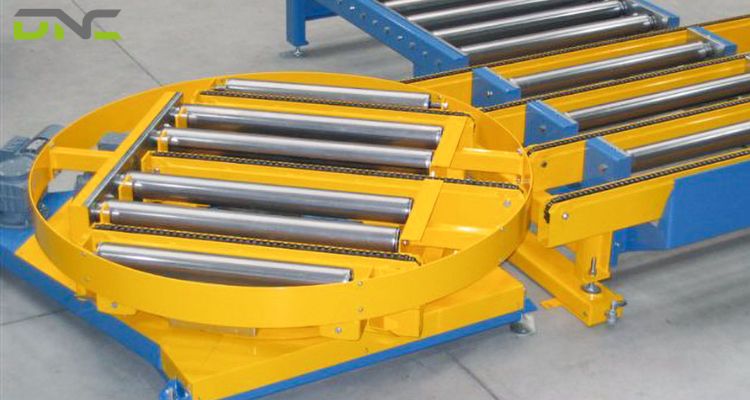
A factory manager at a Selangor automotive plant once replaced a corner curve conveyor with a standard belt curve to save RM 8,000 — and discovered that every engine component arriving at the torque station was rotated 90° from its required orientation. Assembly operators spent 3 seconds reorienting each component manually, adding 900 seconds of labor per 300-component shift. Over a 260-day production year, the RM 8,000 saving cost RM 195,000 in direct labor waste. Turntable conveyors exist precisely to prevent this problem: a turntable conveyor is a rotating horizontal platform integrated into a conveyor system that redirects product flow at 90°, 180°, or any programmed angle while maintaining the product’s original orientation — the label stays facing the same direction, the barcode remains scannable, the connector still faces the correct assembly station. Curve belt conveyors rotate the product as they change direction. Right-angle pop-up rollers transfer product without rotation but require 2–3× the floor space of a turntable. The turntable conveyor solves the direction-change problem in the smallest floor footprint with complete orientation preservation. DNC Automation — Malaysia’s Top #1 Factory Automation Company since 2005, ISO 9001:2015 certified, with 35 engineers fabricating custom systems in its 25,000 sq ft Selangor facility — designs, builds, and integrates turntable conveyors for Toyota, Comau robot palletizing cells, and manufacturing lines across Malaysia’s automotive, F&B, and electronics sectors.
What Is a Turntable Conveyor?
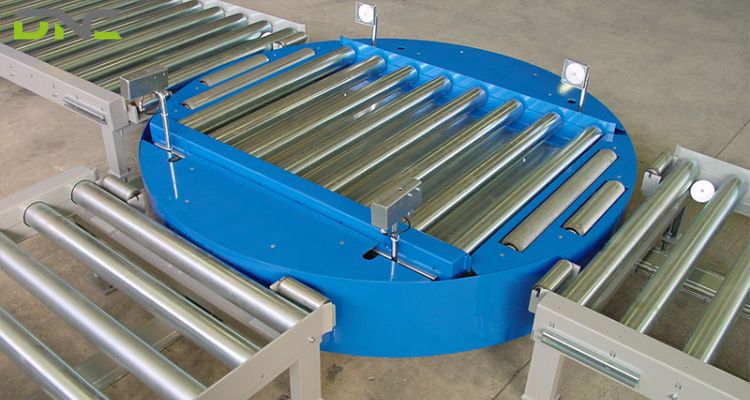
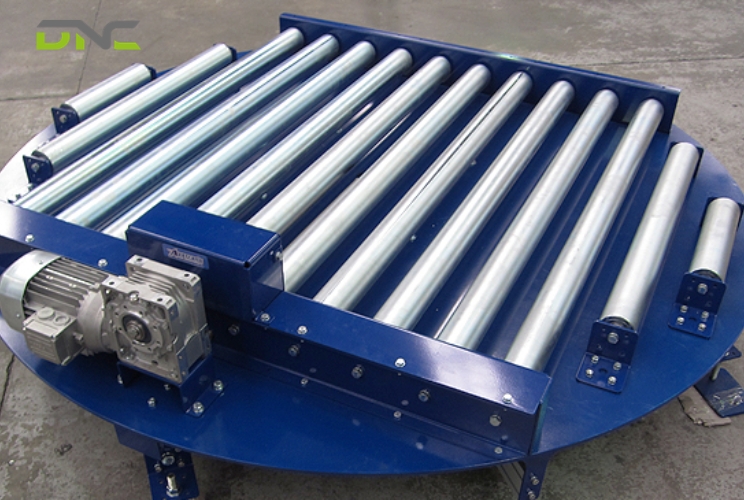
A turntable conveyor is a conveyor system component consisting of a rotating horizontal platform — carrying a belt, roller, or chain surface — mounted on a central bearing assembly, driven by a gear motor, and controlled by a PLC to rotate to programmable angular positions. The turntable receives a product from an upstream conveyor, rotates to the required angle (90°, 180°, or any intermediate angle), and transfers the product onto a downstream conveyor oriented in the new direction. Throughout the rotation, the product’s position on the turntable surface remains fixed — only the direction of travel changes, not the product’s facing orientation.
This orientation preservation distinguishes turntable conveyors from all alternative direction-change mechanisms. Curve belt conveyors change direction through curved belt geometry — the belt curves around a radius while the product stays on the belt surface, resulting in the product rotating relative to the factory floor (a box facing north enters a right-hand 90° curve belt and exits facing east, but rotated 90° clockwise). Turntable conveyors hold the product stationary relative to the turntable during rotation, then drive it off in the new direction — the box facing north enters a turntable, the turntable rotates 90° clockwise, and the box exits still facing north but traveling east.
How Does a Turntable Conveyor Work?
Turntable conveyor operation integrates mechanical rotation, product transfer, and PLC sequencing to achieve direction change with orientation preservation at cycle times fast enough for production line integration.
Step 1 — Product Arrival and Turntable Alignment
Before a product arrives, the turntable must be positioned (pre-indexed) to align its infeed edge with the upstream conveyor. A photoelectric sensor at the upstream conveyor detects the approaching product and signals the turntable PLC. If the turntable is not at the infeed position (it may have just completed a transfer and returned to infeed position), the PLC drives the turntable to the infeed alignment angle. Turntable rotation time for a 90° index is typically 2–5 seconds; pre-positioning before product arrival uses the inter-product gap time, keeping cycle time unaffected by rotation.
Step 2 — Product Transfer onto Turntable
The upstream conveyor belt drives the product onto the turntable surface. The turntable’s own belt, rollers, or CDLR surface is running at the same speed as the upstream conveyor during product arrival, ensuring smooth transfer without product impact or sliding. A stop sensor on the turntable surface (photoelectric or mechanical bump stop, depending on load and product type) detects that the product is fully on the turntable, stopping the turntable surface drive and confirming the “product in position” signal to the PLC.
Step 3 — Rotation to Target Angle
With product confirmed on the turntable surface, the rotation drive (gear motor with encoder feedback) accelerates the turntable platform to the programmed target angle. Rotation acceleration and deceleration profiles are programmed to prevent product sliding on the turntable surface during rotation — maximum rotational acceleration is calculated from the friction coefficient between product base and turntable surface, and the product’s center of gravity height. DNC Automation engineers calculate maximum safe rotation speed for each product type during system design.
Step 4 — Target Angle Lock and Downstream Alignment Verification
At the target rotation angle, the PLC verifies turntable position via encoder feedback (angular accuracy ±1°) and activates a mechanical or pneumatic indexing pin that locks the turntable platform against rotation during product transfer. The locking pin prevents turntable drift during the transfer phase — without locking, turntable surface drive torque can create reaction forces that rotate the platform slightly, misaligning the product with the downstream conveyor.
Step 5 — Product Transfer off Turntable
The turntable surface belt, rollers, or CDLR activates to drive the product off the turntable and onto the downstream conveyor. Transfer speed is matched to downstream conveyor speed. A “product clear” sensor confirms the product has fully left the turntable surface before the PLC initiates the return rotation to infeed position.
Step 6 — Return to Infeed Position
After product transfer confirmation, the indexing pin retracts and the turntable rotates back to the infeed alignment position for the next product. PLC cycle time monitoring tracks the complete turntable cycle (infeed arrival to outfeed departure) and generates predictive maintenance alerts if cycle times drift above the baseline — indicating bearing wear, drive chain stretch, or rotation drive degradation.
Types of Turntable Conveyor
Malaysian manufacturers encounter seven turntable configurations, each serving different load capacities, rotation requirements, and downstream conveyor types. Correct type selection determines whether the turntable reliably handles the product and integrates cleanly with adjacent conveyor systems.
1. Manual Turntable (Hand-Operated)
Manual turntables are hand-operated platforms rotating on low-friction bearings, used on manual assembly lines where an operator physically rotates the product for access to all sides without lifting. Manual turntables handle loads of 50–500 kg and are used in small-batch automotive component assembly, repair workstations, and manual inspection stations. Manual turntables require no electrical connections, making them the lowest-cost option for applications where automated cycle time is not required.
2. Powered Motor Turntable (Standard Industrial)
Powered motor turntables use a gear motor (0.1–2.2 kW typical) driving the turntable platform via chain, gear, or friction wheel, controlled by a PLC for programmable stop angles. This is the most common turntable conveyor specification for Malaysian industrial applications — food factories (F&N, Unilever), automotive sub-assembly (Selangor), and general manufacturing. Load capacity ranges from 50 kg to 2,000 kg depending on frame construction and bearing selection. Standard sizes: 800×800 mm, 1,000×1,000 mm, 1,200×1,200 mm (pallet size), and 1,500×1,500 mm.
3. Continuous Rotation Turntable (Centrifugal Transfer)
Continuous rotation turntables spin without stopping — product placed on the rotating surface is carried along until it reaches the desired exit point, where a deflector guide or the product’s own momentum carries it off the turntable tangentially onto an outfeed conveyor. Continuous rotation turntables are used for product distribution from a central point to surrounding workstations — operators take products from the rotating surface as needed. Throughput is limited by the time operators need to take products from the rotating surface.
4. Indexing / Programmable Turntable (Precision Multi-Stop)
Indexing turntables rotate to specific programmed stop angles — 45°, 90°, 180°, 270°, 360° and any intermediate angle programmable via PLC recipe. Servo-driven indexing turntables achieve angular accuracy of ±0.5°, sufficient for robotic pick-and-place operations where the turntable positions a pallet or product within the robot’s reach envelope. DNC Automation specifies servo-driven indexing turntables for Comau palletizing robot integrations — the turntable presents each pallet face to the Comau robot’s pick position, allowing the robot to place product on all four pallet sides without requiring the robot to move around the pallet.
5. Roller-Top Turntable (Gravity Roller Integration)
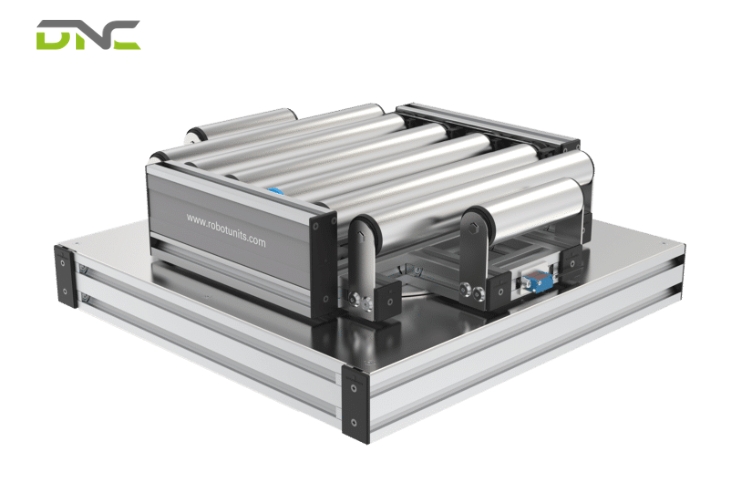
Roller-top turntables carry a set of gravity or powered rollers on the rotating platform surface, matching the roller conveyor height and direction on both infeed and outfeed sides. Roller-top turntables are specified for roller conveyor systems handling packages, cartons, and totes — the roller surface allows products to self-center on the turntable during infeed and slide off smoothly during outfeed without belt drive components. Load capacity up to 500 kg for powered roller-top versions; gravity roller-top versions up to 200 kg.
6. Belt-Top Turntable (Belt Conveyor Integration)
Belt-top turntables carry a continuously running belt surface on the rotating platform, integrating with belt conveyor lines for boxes, bags, and cartons. The belt surface provides positive product drive during infeed and outfeed transfers, accommodating products with non-flat bases (bags, irregular packages) that do not slide reliably on roller surfaces. Belt-top turntables in food factory packaging lines (Ramly Burger, F&N) handle flexible-pack products that cannot be conveyed on roller surfaces.
7. CDLR-Top Turntable (Heavy Pallet Handling)
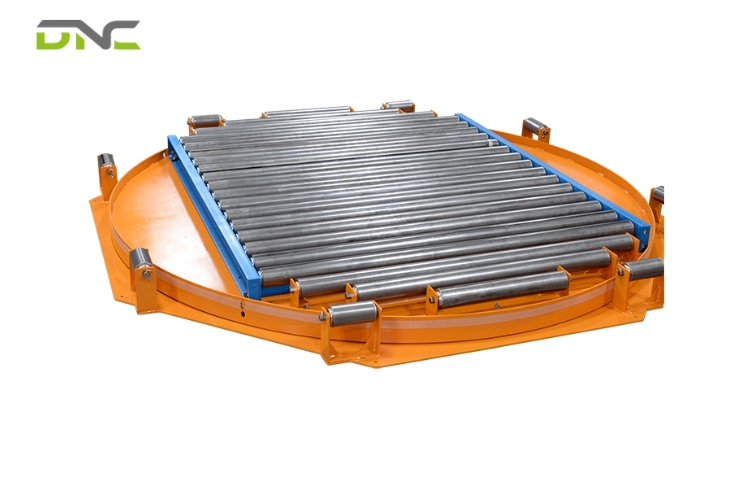
Chain-driven live roller (CDLR) top turntables carry heavy pallets (500–2,270 kg) using positive chain-driven roller drive, providing the high traction required to start and stop heavy pallet loads during turntable rotation. CDLR turntables are specified for end-of-line palletizing applications where full pallets (1,200×1,200 mm, up to 2,270 kg) are rotated for stretch wrapping, labeling, or loading into trucks. DNC Automation fabricates CDLR turntables in its 25,000 sq ft Selangor facility for Toyota’s and Comau-integrated palletizing applications.
Comparison Table: Turntable vs. Alternative Direction-Change Solutions
| Solution | Orientation Preserved | Floor Space | Load Capacity | Cycle Time | Cost |
| Turntable conveyor | Yes (fully) | Compact | 50–2,270 kg | 2–8 sec (90°) | Medium |
| Curve belt conveyor | No (product rotates) | Medium | 50–200 kg | Continuous | Low-Medium |
| Right-angle transfer (pop-up) | Yes | Large (L-junction) | 50–500 kg | 2–5 sec | Medium |
| Diverter arm | No | Small | 50–100 kg | 1–3 sec | Low |
| Manual reorientation | Yes | None | Unlimited | 3–8 sec | High (labor) |
Key Components of a Turntable Conveyor System
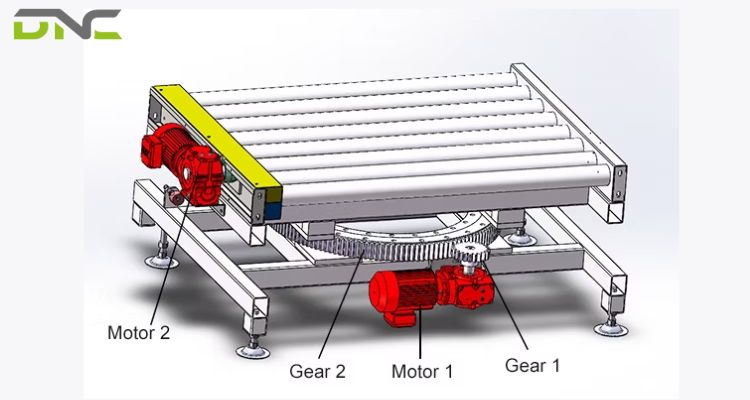
Central Bearing Assembly. The central bearing assembly supports the full turntable platform load and enables rotation. Single-axis slewing ring bearings (four-point contact ball type) are standard for loads above 200 kg — they handle combined radial, axial, and moment loads simultaneously. Slewing ring bearing bore sizes correspond to turntable diameter; typical bore diameters range from 300 mm to 1,500 mm for industrial turntable applications.
Rotation Drive System. Chain and sprocket drive (high torque, cost-effective, appropriate for heavy loads) connects the gear motor output sprocket to a turntable rim sprocket. Friction wheel drive (motor-driven wheel contacts the turntable rim) is used for medium loads where simplicity and quiet operation are prioritized. Servo motor with timing belt drive is specified for indexing turntables requiring ±0.5° angular accuracy. DNC Automation selects drive system based on load, accuracy requirement, and maintenance accessibility.
Indexing Lock Mechanism. Pneumatic piston indexing pins engage precision-machined sockets in the turntable rim at each programmed stop angle, locking the platform against rotation during product transfer. Lock engagement is verified by a proximity sensor confirming pin extension before the PLC allows the turntable surface drive to activate. Lock force must exceed the maximum lateral force the turntable surface drive applies to the product during acceleration — DNC Automation calculates lock force requirements during system design.
Turntable Surface Conveyor. Belt, powered roller, or CDLR surface provides the product transport drive on the turntable platform. The surface conveyor’s travel direction must align with the adjacent conveyor direction at each stop angle — this alignment is the critical geometric relationship in turntable design. Motorized surface conveyors are controlled by a separate motor drive (VFD or servo) integrated into the turntable PLC panel, enabling independent speed control from the rotation drive.
PLC and Safety System. Siemens SIMATIC S7-1200 PLC controls all turntable functions with recipe-based stop angle programming, rotation speed profiling, cycle time monitoring, and SCADA data logging. Safety requirements: motor overload protection, rotation overrun detection (if platform rotates past target angle), product presence monitoring during rotation (stopping rotation if product slides off the surface), and personnel access light curtains or safety fencing around the turntable operating radius.
Applications: Where Turntable Conveyors Are Used in Malaysian Manufacturing
Automotive Assembly — Toyota and Selangor Hub
Toyota’s Malaysian assembly operations and Selangor’s automotive component manufacturers use turntable conveyors at production line direction-change points — particularly where the main assembly line changes direction in the plant layout and orientation-critical components (engine brackets, body panels with specific assembly-side orientation) must arrive at the next station with consistent facing direction. Automotive assembly turntable specifications require cycle times under 4 seconds for 90° rotation at pallet conveyor line rates of 900+ units per shift. DNC Automation’s CDLR-top turntables for Toyota installations handle 1,200×1,200 mm automotive component pallets at 1,500 kg capacity.
Comau Palletizing Robot Integration
DNC Automation is Comau Italy’s only official Southeast Asia partner — providing the unique capability to engineer turntable conveyor systems specifically designed for Comau palletizing robot reach envelope geometry. The Comau palletizing robot operates within a defined work cell radius; a turntable conveyor positioned at the robot’s pallet input station presents each new empty pallet and rotates completed pallets for robot access to all four sides. Turntable angular accuracy (±0.5° servo positioning) ensures each pallet face is presented within the robot’s programmed pick approach trajectory. This integrated DNC Automation + Comau solution replaces 3–4 manual pallet laborers per shift.
F&B Packaging Lines — F&N, Unilever, Ramly Burger
Food and beverage packaging lines require direction changes at multiple points: at the end of filling/sealing lines where products turn 90° to enter the labeling section; at case packing stations where labeled bottles turn 90° to enter cartons in the correct orientation; and at end-of-line palletizing where full cases are oriented for pallet layer pattern formation. Belt-top turntables in F&N’s and Unilever’s Selangor packaging operations handle 1–20 kg cases at throughput rates of 20–40 cases per minute. Orientation preservation at labeling station turntables is critical — inverted or rotated cases cause label misalignment and packaging line rejection events.
Warehouse and Logistics — Johor 3PL Hubs
Johor’s 3PL logistics facilities serving cross-border SEA trade use pallet turntable conveyors at stretch wrapping stations — a full pallet must be rotated 360° for the stretch wrap film to encircle all four pallet faces. CDLR-top turntables with continuous 360° rotation capability (no mechanical stop required for full rotation) handle 1,000–2,000 kg pallet loads at 4–6 RPM rotation speed for stretch wrapping. DNC Automation integrates stretch wrap turntables with upstream palletizing conveyors and downstream stretch wrap machine controls for fully automated end-of-line palletizing and wrapping cells.
Benefits of Turntable Conveyors for Factory Operations
Orientation Preservation Eliminates 3–8 Second Manual Reorientation. Every manual product reorientation step on a production line adds labor cost and creates inconsistency — operators sometimes skip the step, causing misoriented products to reach downstream assembly stations. DNC Automation’s turntable conveyor installations eliminate manual reorientation entirely, with 80% reduction in human-error events at downstream assembly stations that previously dealt with incorrectly oriented product arrivals.
Compact 90° Direction Change in Minimum Floor Space. A right-angle transfer conveyor junction requires an L-shaped floor area equal to the full conveyor length on both legs. A turntable conveyor achieves the same 90° direction change in a floor area equal to a circle with diameter matching the turntable platform size — 40–60% less floor area than L-junction alternatives. Malaysian factory floor space costs RM 25–80/sq ft annually in Selangor and Penang industrial estates; floor space savings from turntable installations deliver measurable annual rent savings.
50% Operational Cost Savings Through Comau Robot Integration. Turntable conveyors integrated with Comau palletizing robots replace 3–4 manual pallet stacking laborers per robot cell. At RM 2,500–3,500 per worker per month, a 4-worker replacement saves RM 10,000–14,000/month — achieving payback on the turntable + Comau robot system investment within 24–36 months, with continuing savings thereafter.
SAG Grant Eligibility for Smart Factory Compliance. Turntable conveyor systems integrated with Siemens PLC control and SCADA monitoring qualify as smart factory automation investments under Malaysia’s NIMP 2030 program. MIDA’s SAG Grant provides up to RM 1 million per facility at 70:30 matching — significantly reducing the capital investment for turntable conveyor + Comau robot + Siemens SCADA systems that DNC Automation delivers as turnkey packages.
How to Choose the Right Turntable Conveyor for Your Factory
Define Product Characteristics and Load. Turntable platform size must accommodate the largest product footprint plus 50–100 mm clearance on all sides for rotation clearance. Turntable load capacity must exceed the heaviest product weight plus product carrier (pallet, tray) weight. For product stacks (cases on pallets), calculate the center of gravity height — high CG products require lower maximum rotation acceleration to prevent tipping.
Determine Required Rotation Angle and Cycle Time. Standard 90° rotation for L-junction line changes is the most common specification. 180° rotation for reversing product direction (infeed from one side, outfeed returning on the same side) is the second most common. Full 360° continuous rotation for stretch wrapping applications requires different mechanical design (no indexing pin required, continuous slip ring for electrical connections to the rotating surface motor). Required cycle time determines whether standard gear motor drive (3–8 sec per 90°) or servo drive (1–3 sec per 90°) is specified.
Select Surface Conveyor Type for Product Compatibility. Rigid flat-bottomed products (cases, cartons, pallets) are compatible with belt, roller, or CDLR surfaces. Flexible bags and irregular-base products require belt surfaces (positive drive). Heavy pallets require CDLR (chain positive drive). Products sensitive to surface marks (painted automotive panels, labeled bottles) require smooth belt surfaces, not roller surfaces.
Verify Integration Requirements with Adjacent Equipment. Turntable conveyor infeed and outfeed heights must match upstream and downstream conveyor heights within ±3 mm for smooth product transfer. Rail heights, belt surface heights, and center line elevations must be surveyed and matched during turntable mechanical design. DNC Automation performs on-site measurement surveys before committing to turntable specifications — dimensional errors discovered during installation are costly to correct.
Consider Malaysia’s NIMP 2030 and Penang/Selangor Industrial Context. Malaysia’s industrial geography concentrates automotive clients (Toyota, Inokom) in Selangor and electronics manufacturing (Sony, semiconductor assembly) in Penang, while F&B and consumer goods manufacturers (F&N, Unilever, Ramly Burger) operate across Selangor, Johor, and Penang. DNC Automation’s turntable conveyor experience spans all three clusters — matching turntable specifications to the distinct requirements of each industrial sector.
Frequently Asked Questions About Turntable Conveyors
Q: What is the difference between a turntable conveyor and a curve belt conveyor?
A turntable conveyor rotates the product while keeping the product’s facing orientation unchanged — a box labeled on the north face exits the turntable still labeled on the north face, just traveling in a new direction. A curve belt conveyor changes direction by curving the belt path — the product’s facing orientation rotates relative to the factory floor as it follows the curve. For applications where product orientation must be preserved (barcoded boxes, labeled containers, connectors with specific assembly orientation), turntable conveyors are required. For applications where product orientation is irrelevant (bulk material, unmarked components), curve belts are acceptable.
Q: What is the maximum load capacity for a turntable conveyor?
Heavy-duty CDLR-top turntable conveyors handle loads up to 2,270 kg (5,000 lbs) — the maximum capacity for standard forklift-compatible pallets. Custom-engineered turntables for automotive body-in-white applications (vehicle body panels on transfer fixtures) reach 5,000+ kg. Standard industrial turntables for box and carton handling range from 50 to 500 kg. DNC Automation fabricates turntables across the full capacity range at its 25,000 sq ft Selangor manufacturing facility.
Q: How fast can a turntable conveyor rotate?
Standard gear motor driven turntables complete 90° rotation in 3–5 seconds. Servo-driven indexing turntables complete 90° rotation in 1.5–3 seconds. The practical limit is product stability during rotation — high CG products (tall boxes, unstable stacks) require slower rotation to prevent tipping. DNC Automation calculates maximum safe rotation speed for each application during system design, accounting for product geometry and center of gravity position.
Q: Can turntable conveyors handle PCBs or sensitive electronics?
PCB turntable conveyors are a specialized application requiring ESD-safe turntable surface materials, gentle rotation speed (to prevent PCB sliding), and SMEMA interface compatibility. DNC Automation designs PCB-compatible turntable conveyors using ESD-safe belt surfaces (10⁵–10¹¹ Ohm resistance) and earth-bonded frames — identical ESD control requirements to standard PCB conveyors. PCB turntable applications are common in Penang EMS facilities where production lines change direction within the factory layout.
Q: What maintenance does a turntable conveyor require?
Monthly: rotation drive chain tension check (chain drive), indexing pin wear inspection, surface conveyor belt tension check, photoelectric sensor cleaning. Quarterly: gear motor oil level check, slewing ring bearing lubrication, PLC cycle time trend review, safety system functional test. Annual: slewing ring bearing load inspection (carry out under load measurement), full drive chain replacement assessment, comprehensive electrical panel inspection. DNC Automation provides maintenance contracts covering all turntable conveyor maintenance for clients operating multiple turntable units across large production facilities.
Q: What is the floor space required for a turntable conveyor installation?
The turntable platform itself requires a circular floor area with diameter equal to the turntable size plus 300–500 mm clearance on all sides for product rotation clearance and maintenance access. A 1,200×1,200 mm pallet turntable (1,700 mm diagonal) requires approximately 2,200–2,400 mm diameter floor space for operation plus 500 mm maintenance access perimeter. The total floor area (4–5 sq m) is 40–60% smaller than an equivalent L-junction right-angle transfer installation, which requires the full conveyor width on both legs of the L.
Turntable Conveyor Integration with Comau Palletizing Robots — DNC Automation’s Signature Solution
DNC Automation’s position as Comau Italy’s only official Southeast Asia partner creates a unique capability: designing turntable conveyors that are geometrically and electronically optimized for Comau palletizing robot integration — not generic turntables adapted after the fact to work with a robot that was specified separately.
Geometric Integration. Comau palletizing robots (Comau PAL range, Comau NJ range) have defined reach envelopes — the three-dimensional volume within which the robot end-effector can operate reliably. The turntable conveyor must be positioned so that each pallet face presented to the robot falls within the robot’s optimal reach zone (not at the extremes of the reach envelope, where positional accuracy degrades). DNC Automation’s robot simulation software (Comau authorized) models the exact turntable position, rotation angles, and pallet presentation geometry for each robot model before mechanical design begins.
Electronic Integration. Comau robots communicate with external equipment via Fieldbus (PROFINET, EtherNet/IP, or DeviceNet) or discrete I/O. DNC Automation programs turntable PLC (Siemens S7) to exchange status signals with the Comau robot controller: robot signals “pallet ready to palletize” → turntable locks at correct angle; robot signals “layer complete, rotate 90°” → turntable rotates to next face; robot signals “pallet complete” → turntable releases pallet to outfeed conveyor. This tight PLC-to-robot integration eliminates manual handoff timing guesswork that causes robot program aborts or collision events.
Pallet Presentation Accuracy. Comau palletizing robots place product at positions calculated from the pallet corner reference point — the robot assumes the pallet is at a precisely known position. Turntable positioning accuracy (±1° angular, ±5 mm linear at pallet edge) ensures the pallet corner reference is within the robot’s position tolerance after each turntable rotation. DNC Automation validates pallet position accuracy at all four presentation angles during commissioning — using a calibration target placed at the pallet corner and measuring robot TCP (tool center point) position error at each angle.
Case Study: Malaysian FMCG End-of-Line Palletizing. A Selangor-based FMCG manufacturer producing 8 SKUs of packaged goods (4 carton sizes, 2 label orientations per size) previously required 3 manual palletizers per shift. DNC Automation installed a Comau palletizing robot cell with a CDLR-top turntable conveyor — the turntable presents each empty pallet at the correct starting orientation for each SKU’s pallet pattern, rotates the pallet after each completed layer for the next layer’s pick approach, and routes completed pallets to the stretch wrap station. One Comau robot replaced all 3 manual palletizers, handling all 8 SKUs through recipe selection. Palletizing labor cost reduction: RM 30,000/month. Pallet pattern consistency improvement: from 78% (manual) to 99.8% (automated). Investment payback: 19 months.
Conclusion
Turntable conveyors solve a problem that no other conveyor component addresses: changing product direction while preserving product orientation, in the smallest possible floor footprint, at production line cycle rates. From Toyota’s automotive assembly direction changes in Selangor to Comau robot pallet rotation systems to F&N’s packaging line 90° transfers, turntable conveyors appear at every factory layout inflection point where direction must change without the cost of product reorientation labor.
- 105 views
- 0 Comment
Recent Comments