



Automated Pallet Racking System: AS/RS & Smart Storage Guide
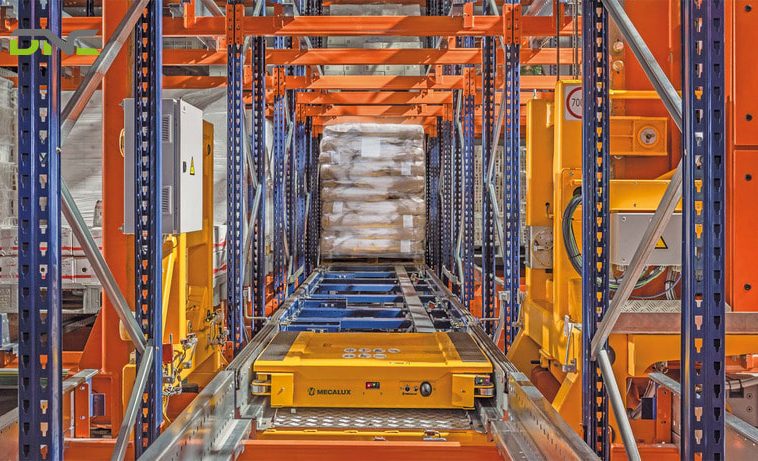
Automated pallet racking systems integrate motorised storage equipment — stacker cranes, shuttle carts, conveyors, and intelligent control software — with conventional racking structures to handle pallet storage and retrieval without direct human operation. For Malaysian manufacturers facing structural labour shortages, rising minimum wages (RM 1,500 as of 2023), and NIMP 2030 smart factory mandates, automated racking delivers 99.9% inventory accuracy, 24/7 unmanned operation, and storage density that manual systems cannot match. This guide covers the technology spectrum from semi-automated shuttle systems to fully automated AS/RS (Automated Storage and Retrieval Systems), including specifications, cost frameworks, integration requirements, and ROI models specific to Malaysian manufacturing. DNC Automation — as a Siemens and Comau partner with 20+ years of industrial automation expertise — designs automated storage solutions that connect racking infrastructure to the broader smart factory ecosystem.
What Is an Automated Pallet Racking System?
Automated pallet racking refers to any storage system where mechanical equipment replaces manual forklift operation for pallet placement and retrieval within the rack structure. The automation spectrum ranges from semi-automated (shuttle carts requiring forklift interaction at the rack face) to fully automated (stacker cranes handling pallets from the inbound conveyor to the storage position with zero human intervention).
All automated pallet racking systems share three foundational elements: a physical racking structure (the steel framework holding pallets), automated handling equipment (the machines moving pallets), and a warehouse control system (WCS) or warehouse management system (WMS) directing operations.
The defining advantage of automation over manual racking is consistency — an automated system places and retrieves pallets at the same speed, accuracy, and care at hour 23 of a 24-hour shift as it does at hour 1. Manual operations degrade with operator fatigue, shift changeovers, and labour availability fluctuations. In Malaysia’s manufacturing sector, where foreign labour policy changes and minimum wage increases create ongoing workforce uncertainty, automated racking converts a variable labour cost into a fixed capital asset.
Automated pallet racking traces its Malaysian adoption curve from early AS/RS installations in multinational semiconductor facilities (1990s) to broader manufacturing adoption driven by NIMP 2030 incentives (2020s). The technology has matured from custom-engineered megaprojects to modular, scalable systems accessible to mid-size manufacturers — DNC Automation delivers automated storage solutions starting from 500 pallet positions.
How Does an Automated Pallet Racking System Work?
System Architecture
Every automated pallet racking system operates through a hierarchical control architecture:
Level 1 — Field devices: Sensors, motors, encoders, and actuators on the automated equipment (cranes, shuttles, conveyors). These devices execute physical movements and report real-time status.
Level 2 — Equipment controller: PLC-based controllers managing individual equipment operation — crane positioning, shuttle navigation, conveyor speed. DNC Automation specifies Siemens S7-1500 PLCs for automated storage projects, leveraging our strategic Siemens partnership.
Level 3 — Warehouse Control System (WCS): Software coordinating all automated equipment into a unified operation — sequencing crane movements, routing pallets on conveyors, managing shuttle traffic, and optimising storage location assignments.
Level 4 — Warehouse Management System (WMS): Enterprise software managing inventory records, order processing, and operational reporting. The WMS tells the WCS which pallet to store or retrieve; the WCS directs the equipment to execute.
Pallet Flow Through the System
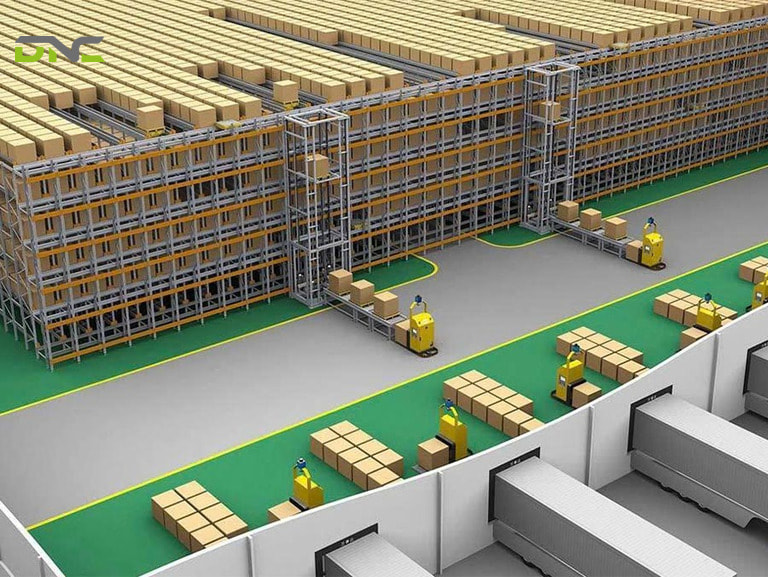
Inbound: Pallets arrive at the receiving dock and are placed on an inbound conveyor (by forklift or directly from production line). The conveyor transports the pallet to a check station (barcode scan, weight verification, dimension check). The WMS assigns a storage location based on product type, batch code, and optimisation algorithms. The WCS directs the crane or shuttle to collect the pallet and transport it to the assigned location.
Storage: The automated equipment (crane or shuttle) navigates to the assigned rack position, places the pallet, confirms placement via sensors, and reports completion to the WCS. The WMS updates inventory records in real time.
Outbound: The WMS receives a pick order (from ERP, customer order, or production request). The WCS identifies the pallet location, dispatches the crane or shuttle, retrieves the pallet, and routes it via conveyor to the outbound dock or production line.
Cycle time: A single-deep AS/RS crane completes 15–25 dual cycles per hour (one storage + one retrieval per cycle). A shuttle system handles 50–80 single cycles per hour per shuttle. Multi-crane and multi-shuttle configurations multiply throughput linearly.
Pallet Flow Through the System
Types of Automated Pallet Racking Systems
Stacker Crane AS/RS (Unit Load)
The classic AS/RS configuration: stacker cranes operate in dedicated aisles between rack rows. Each crane runs on floor rails and a top guide rail, travelling the full aisle length and height to access any pallet position. The crane’s telescoping fork (single or double deep) handles pallet placement and retrieval.
Specifications:
- Height: 10–40+ metres
- Aisle length: 30–150+ metres
- Crane speed: 2–4 m/s horizontal, 0.5–1.5 m/s vertical
- Fork type: single deep (1 pallet), double deep (2 pallets), or multi-deep
- Throughput: 15–25 dual cycles/hour per crane
- Cost: RM 800,000–2,500,000 per crane
Best for: High-throughput, 24/7 operations with 5,000–50,000+ pallet positions. Semiconductor fabs, large-scale F&B distribution, and pharmaceutical central warehouses in Malaysia.
Shuttle-Based AS/RS
Shuttle carts operating within rack channels, combined with automated shuttle lifts (vertical elevators) that transfer carts between levels. No stacker crane required — the shuttle cart handles horizontal travel within channels while the lift handles vertical travel between levels.
Specifications:
- Channel depth: 5–40 pallets
- Shuttle speed: 0.8–1.5 m/s
- Shuttle lift speed: 0.5–1.0 m/s
- Throughput: 50–80 cycles/hour per shuttle
- Cost: RM 30,000–80,000 per shuttle cart + system infrastructure
Best for: Dense buffer storage with moderate throughput requirements. Food manufacturing, cold chain, and operations seeking phased automation. DNC Automation’s preferred entry-level automation solution for Malaysian mid-size manufacturers.
AGV/AMR-Integrated Racking
Automated Guided Vehicles (AGVs) or Autonomous Mobile Robots (AMRs) replace forklifts for pallet transport to and from conventional racking. The racking structure remains standard (selective, double deep, or shuttle); the automation replaces the human-operated forklift with an autonomous vehicle.
Specifications:
- AGV payload: 1,000–3,000 kg
- Navigation: laser, magnetic tape, natural feature (SLAM)
- Speed: 1.0–2.0 m/s loaded
- Cost: RM 200,000–500,000 per AGV/AMR unit
Best for: Existing warehouses upgrading to automation without replacing racking infrastructure. The AGV/AMR handles aisle navigation while the existing racking remains unchanged. DNC Automation integrates Comau and Doosan AMR platforms with existing warehouse racking.
Miniload AS/RS (Tote/Carton Level)
Miniload systems handle totes, cartons, and small containers rather than full pallets. Included here because many automated warehouse projects combine pallet AS/RS (for bulk reserve) with miniload (for each-pick and carton-pick zones) in a single integrated facility.
Specifications:
- Container size: 200 × 300 mm to 800 × 600 mm
- Container weight: 10–100 kg
- Height: 8–25 metres
- Throughput: 50–120 dual cycles/hour per crane
Best for: E-commerce fulfilment, pharmaceutical distribution, and electronics component warehousing where order picking occurs at carton or each level.
Key Components of an Automated Racking System
Racking Structure
Automated racking uses standard steel frames and beams, but with tighter dimensional tolerances than manual racking. Stacker crane systems require rack position accuracy of ±5 mm (versus ±10–15 mm for manual selective racking) because the crane’s telescoping fork must align precisely with the pallet position without visual guidance from a human operator.
Stacker Cranes
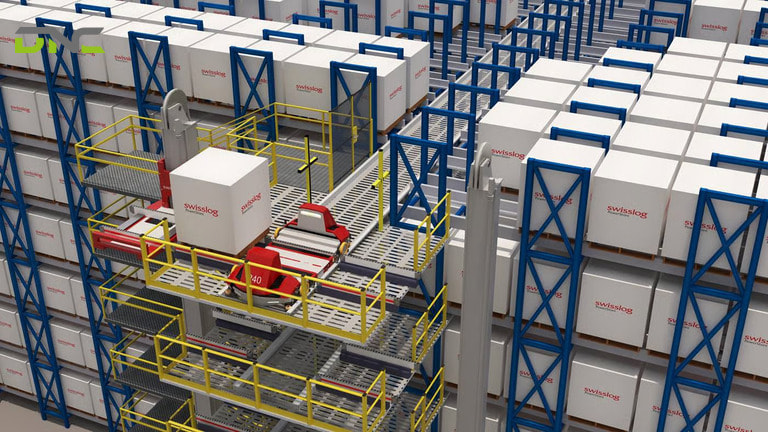
Single-mast or twin-mast steel structures running on floor rails. The crane’s carriage moves vertically on the mast; the telescoping fork extends horizontally to access pallet positions on either side of the aisle. Modern cranes incorporate regenerative braking (recovering kinetic energy during deceleration), reducing energy consumption by 20–30%.
Conveyors
Inbound and outbound conveyors transport pallets between the dock/production area and the AS/RS interface point. Roller conveyors, chain conveyors, and transfer cars form the conveyor network. DNC Automation designs conveyor systems as an integrated component of every automated racking project — leveraging our extensive conveyor engineering expertise.
Warehouse Control System (WCS)
Software managing equipment coordination, traffic control, and storage location optimisation. The WCS implements algorithms for storage location assignment (minimising crane travel distance), retrieval sequencing (batching picks for efficiency), and load balancing (distributing work evenly across multiple cranes or shuttles).
Sensors and Safety Systems
Pallet presence sensors at every rack position, crane position encoders, barcode or RFID readers at I/O points, and area scanners detecting personnel in automated zones. Safety systems comply with ISO 13849 (safety-related control systems) and EN 528 (stacker crane safety).
Key Components of an Automated Racking System
Applications: Where Automated Racking Serves Malaysian Industries
Automotive Manufacturing
Malaysian automotive OEMs (Proton, Perodua) and Tier-1 suppliers use automated pallet storage for production line-side supply. The AS/RS receives pallets from inbound goods reception, stores them in high-density racks, and delivers them to production conveyor systems on a JIT schedule directed by the MES (Manufacturing Execution System). DNC Automation has delivered integrated automation solutions for automotive manufacturers — connecting AS/RS with production line conveyors, robotic work cells, and quality inspection stations.
Food and Beverage
F&B companies require automated storage for high-throughput, temperature-controlled environments. Automated racking in cold rooms operates 24/7 without human exposure to sub-zero temperatures — improving both productivity and workplace safety. Multinational F&B companies in Malaysia (Nestle, F&N, Dutch Lady) use AS/RS for central distribution; regional manufacturers adopt shuttle-based automation as an entry point.
Electronics and Semiconductor
Semiconductor facilities require cleanroom-compatible automated storage with contamination control, ESD-safe handling, and 99.99% inventory accuracy. Automated racking systems in cleanroom environments use stainless steel components, HEPA-filtered crane cabins, and particle-free conveyor surfaces. Penang’s semiconductor cluster has the highest density of automated storage installations in Malaysia.
Pharmaceutical
GDP compliance, cold chain integrity, and serialisation tracking drive pharmaceutical warehouse automation. Automated racking provides audit-trail-grade inventory accuracy — every pallet movement is logged with timestamp, location, batch number, and temperature. This data supports NPRA (National Pharmaceutical Regulatory Agency) compliance audits without manual documentation.
E-Commerce and 3PL
E-commerce fulfilment centres and 3PL providers adopt automated racking for high-SKU, high-throughput operations. Combined pallet AS/RS (bulk reserve) and miniload (each-pick) systems handle the full order fulfilment cycle — from bulk inbound to individual customer shipment.
Benefits of Automated Pallet Racking
99.9% inventory accuracy — automated systems eliminate human picking and placement errors. Barcode or RFID verification at every transaction ensures the WMS record matches physical reality.
24/7 unmanned operation — automated equipment operates continuously without shift breaks, fatigue, or labour availability constraints. A system handling 1,000 pallets/day operates identically at 3 AM as at 3 PM.
70–90% reduction in warehouse labour — for a Malaysian warehouse employing 20 forklift operators across 3 shifts at RM 2,500/month each, automation saves RM 600,000/year in direct labour cost.
Up to 85–95% floor utilisation — stacker crane AS/RS with narrow aisles (1,500 mm) and heights up to 40 metres achieves extreme vertical density impossible with manual systems.
Reduced product damage — automated handling is consistent and calibrated. Product damage rates drop 50–80% compared to forklift-operated warehouses.
Real-time inventory visibility — WMS integration provides live stock positions, batch tracking, and expiry management. This data feeds ERP systems for demand planning, procurement, and financial reporting.
Energy efficiency — modern AS/RS cranes use regenerative braking, LED-lit (or dark) storage aisles, and optimised travel paths that reduce energy consumption by 30–50% versus manually operated warehouses with full lighting and HVAC.
NIMP 2030 alignment — automated warehouse systems qualify for Malaysian government smart factory incentives, including MIDA automation capital allowances and ITA (Investment Tax Allowance) for qualifying Industry 4.0 investments.
Cost Framework for Automated Pallet Racking in Malaysia
Capital Cost Ranges
| System Type | Cost per Position (RM) | Throughput | Minimum Scale |
| Shuttle-based (semi) | 1,000–2,000 | 100–300 pallets/hr | 500 positions |
| AGV/AMR integration | 800–1,500 + AGV cost | 50–150 pallets/hr | 300 positions |
| Stacker crane AS/RS | 2,000–5,000 | 200–600 pallets/hr | 2,000 positions |
| Multi-shuttle AS/RS | 2,500–4,000 | 300–800 pallets/hr | 1,000 positions |
| High-bay AS/RS (30m+) | 3,000–6,000 | 300–1,000 pallets/hr | 5,000 positions |
ROI Model
Investment: System capital cost + civil works + IT integration + commissioning
Annual savings: Labour reduction + space savings + damage reduction + accuracy improvement + energy savings
Typical ROI period: 3–5 years for shuttle-based systems; 5–8 years for full AS/RS
Malaysian incentive impact: MIDA capital allowances can accelerate ROI by 1–2 years
Phased Automation Approach
DNC Automation recommends phased automation for Malaysian manufacturers:
Phase 1 (Year 0–2): Shuttle racking + WMS integration. Capital: RM 2–5M for 2,000 positions. Immediate density and labour savings.
Phase 2 (Year 2–4): Add automated shuttle lifts, conveyor I/O interfaces. Capital: RM 1–3M. Throughput increase, further labour reduction.
Phase 3 (Year 4–7): Upgrade to full AS/RS with stacker cranes replacing shuttle-based retrieval. Capital: RM 5–15M. Full unmanned operation, maximum density.
This phased approach spreads capital investment, generates ROI at each phase, and allows the manufacturer to validate automation benefits before committing to full AS/RS.
How to Evaluate Automated Racking for Your Facility
Throughput Analysis
Calculate peak hourly pallet movements (inbound + outbound + internal transfers). If peak throughput exceeds 100 pallets/hour consistently, automation delivers measurable ROI. Below 50 pallets/hour, manual systems with WMS may be more cost-effective.
Labour Cost Assessment
Calculate current annual warehouse labour cost (operators × average salary × shifts × 365). If annual labour cost exceeds RM 500,000, automation ROI becomes viable within 5 years. Malaysian labour cost trends (minimum wage increases, foreign worker levy increases) accelerate automation payback annually.
Space Utilisation Assessment
If your current warehouse is above 85% capacity and expansion is constrained (no adjacent land, building height limits, zoning restrictions), automated racking’s 85–95% space utilisation may defer or eliminate the need for a new facility — avoiding RM 5,000,000–20,000,000 in new warehouse construction.
Integration Requirements
Automated racking connects to: ERP (SAP, Oracle, Microsoft Dynamics), WMS, MES (for manufacturing integration), and potentially production line automation (conveyors, robots). DNC Automation’s expertise spans all these systems — we design automated storage as a component of the broader smart factory, not as an isolated warehouse project.
How to Evaluate Automated Racking for Your Facility
FAQ — Automated Pallet Racking System
What is an automated pallet racking system?
An automated pallet racking system uses motorised equipment (stacker cranes, shuttle carts, AGVs, or conveyors) to store and retrieve pallets within a racking structure without direct human operation. A Warehouse Control System (WCS) coordinates equipment movements, and a Warehouse Management System (WMS) directs inventory operations. Automation delivers 99.9% inventory accuracy, 24/7 operation, and 85–95% floor utilisation.
How much does automated warehouse racking cost in Malaysia?
Costs range from RM 1,000 to RM 6,000 per pallet position depending on automation level. Semi-automated shuttle systems start at RM 1,000/position; AGV-integrated systems at RM 800–1,500/position plus RM 200,000–500,000 per AGV; stacker crane AS/RS at RM 2,000–5,000/position. A typical 3,000-position semi-automated system costs RM 3,000,000–6,000,000. Full AS/RS for the same capacity costs RM 8,000,000–18,000,000.
Is warehouse automation worth it for Malaysian manufacturers?
Automation ROI depends on labour cost, throughput volume, and space constraints. For warehouses with annual labour costs exceeding RM 500,000, throughput above 100 pallets/hour, or space constraints requiring expansion, automation typically achieves ROI within 3–5 years. Malaysian government incentives (MIDA capital allowances, ITA for Industry 4.0) further accelerate payback. DNC Automation provides free ROI analysis for every automation enquiry.
What is the difference between AS/RS and shuttle racking?
AS/RS uses stacker cranes running in dedicated aisles to access any pallet position in the rack — fully automated with no forklift involvement. Shuttle racking uses battery-powered carts within rack channels for pallet transport, with forklifts handling the rack-to-channel interface. AS/RS delivers higher throughput and full unmanned operation but costs 2–3× more. Shuttle racking costs less and provides a phased upgrade path to AS/RS.
Can I automate my existing warehouse racking?
Existing racking can be automated through AGV/AMR integration — replacing forklifts with autonomous vehicles that navigate existing aisles. This approach costs RM 200,000–500,000 per AGV and requires no racking modifications. For deeper automation, existing selective racking can be retrofitted with shuttle carts and channel rails. Full AS/RS requires purpose-built racking with tighter dimensional tolerances — typically a new installation.
What safety standards apply to automated racking?
Automated storage systems must comply with: EN 528 (stacker crane safety), ISO 13849 (safety-related control systems), EN 15095 (movable storage including shuttle systems), and local DOSH workplace safety requirements. Safety features include personnel detection sensors, light curtains at automated zone boundaries, emergency stop systems, and access control preventing human entry into crane operating zones during automatic operation.
How long does automated racking installation take?
Installation timeline: semi-automated shuttle systems install in 2–4 months; AGV integration in 1–3 months; full stacker crane AS/RS in 6–12 months (including civil works, equipment installation, software commissioning, and operational testing). DNC Automation manages the full project timeline — from initial concept through commissioning and operator training — using our in-house engineering team of 35+ specialists.
Conclusion
Automated pallet racking systems transform Malaysian warehouses from labour-dependent operations into intelligent, data-driven storage facilities that operate continuously, accurately, and efficiently. Whether the entry point is a semi-automated shuttle system at RM 1,000/position or a full stacker crane AS/RS at RM 5,000/position, automation delivers measurable returns in labour savings, space utilisation, inventory accuracy, and operational consistency.
DNC Automation’s unique position as both a Siemens automation partner and a Comau robotics integrator enables us to design automated storage solutions that connect seamlessly to production line automation, IoT monitoring, and enterprise systems — creating the smart factory infrastructure that NIMP 2030 envisions for Malaysian manufacturing.
- 6 views
- 0 Comment
Recent Comments