



Automated Palletizing Robot: Selection, Integration & ROI Guide
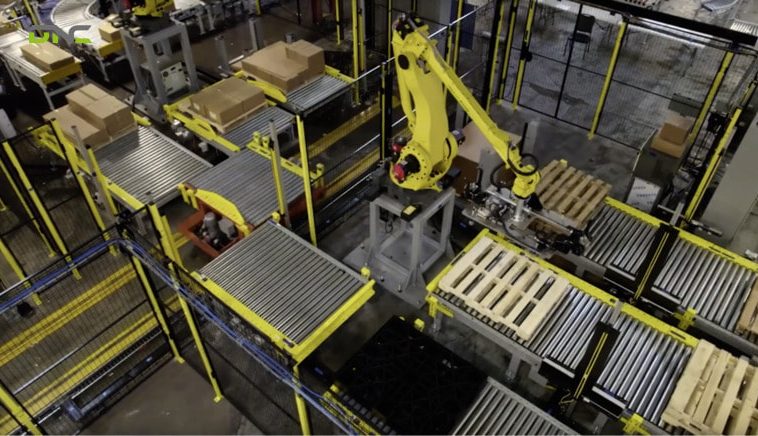
Automated palletizing robots — industrial articulated arms from Comau, FANUC, ABB, KUKA, and Yaskawa — are the core automation unit that transforms manual end-of-line stacking into continuous, precision-controlled pallet building at 8–30 cycles per minute. The robot itself represents 40–50% of the total palletizing system investment (RM 200,000–800,000 for the arm alone), and its selection — payload capacity, reach envelope, axis count, speed rating, and protection class — determines the performance ceiling of the entire palletizing cell. For Malaysian manufacturers evaluating palletizing automation under NIMP 2030 targets, understanding the robot as a standalone component is essential before specifying the complete system. DNC Automation, as Comau’s exclusive Southeast Asia robotics partner, provides direct access to Comau’s full palletizing robot range alongside deep integration expertise — 35+ engineers, 20+ years of factory automation, and a 25,000 sq ft facility for EOAT fabrication, cell assembly, and system testing.
What Is an Automated Palletizing Robot?
An automated palletizing robot is an industrial articulated manipulator — a multi-axis robotic arm with servo-driven joints — specifically selected or configured for the task of picking products from production line infeed points and placing them onto pallets in programmed stacking patterns. The robot arm is the motion engine of the palletizing cell: it provides the reach, payload capacity, speed, and positional accuracy that determine how fast, how heavy, and how precisely products are stacked.
Automated palletizing robots differ from general-purpose industrial robots primarily in their kinematic optimisation. Palletizing-specific models (Comau PAL series, FANUC M-410iC series, ABB IRB 660/760, KUKA KR QUANTEC PA) feature longer reach envelopes (2,500–3,500 mm), higher payload ratings (100–700 kg), and wrist configurations optimised for vertical pick-and-place motion rather than the complex multi-angle movements required in welding, machining, or assembly applications.
The robot arm is one component of a complete palletizing system — it must be paired with end-of-arm tooling (EOAT), infeed conveyors, pallet handling equipment, safety systems, and a cell controller to function as a production-ready palletizing solution. However, the robot selection decision has the greatest impact on system capability: an undersized robot constrains the entire system, while an oversized robot wastes capital. Understanding the robot as the core automation unit enables Malaysian manufacturers to make informed specification decisions before engaging system integrators.
DNC Automation’s role as Comau’s exclusive SEA partner means direct factory support for robot selection, application engineering, and lifecycle service — advantages that third-party distributors cannot match.
How Does an Automated Palletizing Robot Work?
Mechanical Architecture and Motion
Every automated palletizing robot operates through a series of rotary joints — servo motors driving precision gear reducers (cycloidal or RV reducers) — connected by rigid arm links. The base joint rotates the entire arm around a vertical axis (±180° to ±360° rotation). The shoulder joint raises and lowers the main arm. The elbow joint extends and retracts the forearm. Additional wrist joints (1–3 axes) orient the EOAT for product engagement and placement.
Four-axis palletizing robots use four joints: base rotation, shoulder lift, elbow extension, and wrist rotation. This configuration provides the four degrees of freedom sufficient for standard palletizing: move to X-Y position, adjust Z height, and rotate the tool for pattern orientation. The simplified kinematics enable faster cycle times and lower cost compared to 6-axis alternatives.
Six-axis palletizing robots add wrist pitch and wrist yaw joints, enabling the EOAT to approach products from any angle. This full spatial freedom is required when products need inversion (180° flip), when the robot must reach around obstacles in tight cell layouts, or when the same robot performs non-palletizing tasks (case packing, machine tending) in addition to palletizing.
Motion Planning and Cycle Execution
The robot controller (integrated into the robot base or mounted in a separate cabinet) executes motion programmes that define the pick-and-place sequence. Each programme specifies:
- Pick position: X, Y, Z coordinates and tool orientation at the product pickup point
- Transit path: waypoints defining the arm’s trajectory between pick and place — optimised for minimum cycle time while avoiding collisions with cell structures, conveyors, and pallet stacks
- Place position: X, Y, Z coordinates and orientation for each product position within the pallet pattern — calculated from the pattern definition (rows, columns, layer offsets, rotation angles)
- I/O signals: grip/release commands to the EOAT, conveyor start/stop signals, sensor reads for product detection
The controller calculates inverse kinematics (converting target X-Y-Z positions into joint angles), generates smooth motion profiles (trapezoidal or S-curve acceleration), and coordinates all joints simultaneously to move the EOAT along the programmed path. Modern palletizing robot controllers execute these calculations in 2–4 millisecond servo cycles, enabling precise high-speed motion.
Servo System and Speed Performance
Servo motors — AC permanent magnet synchronous motors with integral encoders — provide the torque, speed, and positioning resolution for each joint. Motor size increases from wrist (smallest) to base (largest) — the base motor may produce 200–500 Nm of torque to rotate the entire loaded arm structure. Absolute encoders on each motor provide position feedback with 20-bit or higher resolution (over 1,000,000 counts per revolution), enabling ±0.1 mm repeatability.
Maximum joint speeds determine the robot’s cycle time — and therefore its palletizing throughput. Palletizing robots achieve maximum TCP (tool centre point) speeds of 2,000–4,000 mm/s, with typical palletizing cycle speeds of 1,000–2,500 mm/s (reduced from maximum to manage acceleration forces on the payload). Cycle time for a standard palletizing pick-and-place (500 mm pick height, 1,500 mm horizontal travel, 1,000 mm place height) ranges from 3–8 seconds depending on payload weight, robot model, and motion profile aggressiveness.
Load Management and Inertia Control
Automated palletizing robots manage significant dynamic loads — the product weight plus EOAT weight, accelerated and decelerated through the pick-and-place cycle. The robot controller monitors motor currents and calculates inertial loads in real time, automatically limiting acceleration when loads approach joint torque limits. This dynamic load management prevents mechanical stress on reducers and arm structure while maximising speed within safe operating limits.
Proper load specification is critical: the robot’s rated payload is the maximum static load at the wrist flange, but the effective dynamic payload (the weight the robot can actually palletize at target speed) may be 70–85% of the static rating depending on the cycle geometry and required acceleration. DNC Automation verifies dynamic payload capability through simulation before robot selection, preventing the common error of specifying a robot that meets static payload but cannot achieve target cycle time at full load.
Understanding the robot’s mechanical operation leads directly to comparing the specific robot models and brands available for palletizing applications.
Types of Automated Palletizing Robots
Comau Palletizing Robots
Comau — an Italian robotics manufacturer and DNC Automation’s exclusive partner for Southeast Asia — produces palletizing-specific robots in the PAL series and general-purpose robots in the NJ/NS series frequently deployed for palletizing.
Comau PAL 180: 180 kg payload, 3,100 mm reach, 4-axis palletizing configuration. Purpose-built for high-speed bag and carton palletizing. Cycle time: 2,200 cases/hour maximum.
Comau NJ 220-2.7: 220 kg payload, 2,700 mm reach, 6-axis. Handles heavy palletizing plus multi-task applications (case packing, palletizing, depalletizing from one position).
Comau NJ 370-2.7: 370 kg payload, 2,700 mm reach, 6-axis. Heavy-duty applications: multi-bag picks, pail stacking, drum handling.
Comau robots feature the SmartPAD teach pendant with intuitive palletizing software, and the C5G Plus controller with integrated safety functions. DNC Automation stocks Comau spare parts in Malaysia, provides 24-hour technical support, and conducts preventive maintenance with Comau-certified procedures — advantages exclusive to DNC’s partnership agreement.
FANUC Palletizing Robots
FANUC’s M-410iC series is the global market leader in dedicated palletizing robots, with models ranging from 100 kg to 700 kg payload.
FANUC M-410iC/110: 110 kg payload, 2,403 mm reach, 4-axis. Workhorse for carton and bundle palletizing at 12–20 cycles/minute.
FANUC M-410iC/315: 315 kg payload, 3,143 mm reach, 4-axis. Heavy bags, multi-case picks.
FANUC M-410iC/700: 700 kg payload, 3,139 mm reach, 4-axis. The highest-payload palletizing robot available — handles full pallet layers in a single pick.
FANUC robots use the R-30iB Plus controller with iRVision integration and PalletPRO software for pattern generation. Widely available in Malaysia through multiple distributors.
ABB Palletizing Robots
ABB’s IRB 660 and IRB 760 are dedicated palletizing platforms optimised for speed and reach.
ABB IRB 660-250/3.15: 250 kg payload, 3,150 mm reach, 4-axis. PickMaster Twin software provides digital twin simulation for cycle time verification.
ABB IRB 760-450/3.2: 450 kg payload, 3,200 mm reach, 4-axis. Heavy-duty applications with ABB’s FlexGripper EOAT system.
ABB’s OmniCore controller provides advanced motion planning with TrueMove and QuickMove technology for optimised path accuracy and speed.
KUKA Palletizing Robots
KUKA’s KR QUANTEC PA series offers palletizing robots from 120 kg to 240 kg payload with 3,195 mm reach — positioned for medium to heavy carton, bag, and pail palletizing.
KUKA KR 180 R3200 PA: 180 kg payload, 3,195 mm reach, 5-axis (4+1 inline wrist). The 5th axis provides additional wrist tilt without full 6-axis complexity.
KUKA robots use the KR C5 controller with KUKA.PalletTech software for pattern programming.
Yaskawa (Motoman) Palletizing Robots
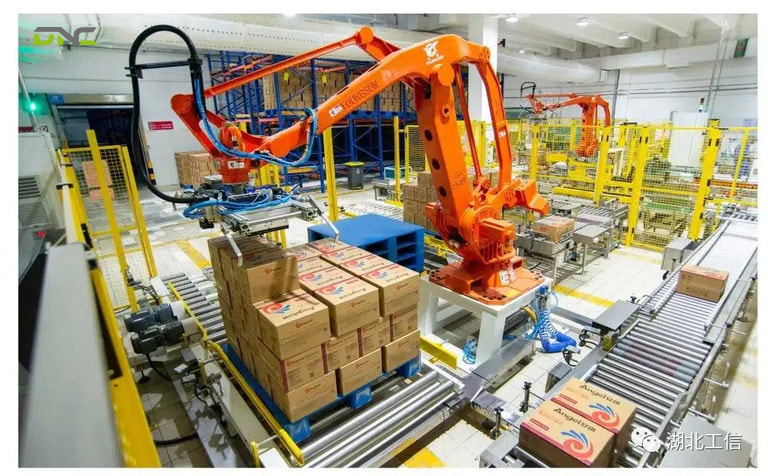
Yaskawa’s MPL series covers 80–800 kg payload for palletizing, with the YRC1000 controller and MotoSim simulation software.
Yaskawa MPL160II: 160 kg payload, 3,159 mm reach, 4-axis. Compact base footprint for space-constrained cells.
Yaskawa MPL500II: 500 kg payload, 3,159 mm reach, 4-axis. Heavy-duty applications.
Each robot brand offers distinct advantages, but the robot arm alone cannot palletize — the EOAT design is equally critical to system performance.
Yaskawa (Motoman) Palletizing Robots
Key Components of an Automated Palletizing Robot System
End-of-Arm Tooling (EOAT)
End-of-arm tooling is the robot’s physical interface with the product — and the component most responsible for palletizing reliability. EOAT design must match the specific product characteristics (weight, dimensions, surface texture, deformability, fragility) while remaining within the robot’s payload capacity after subtracting product weight.
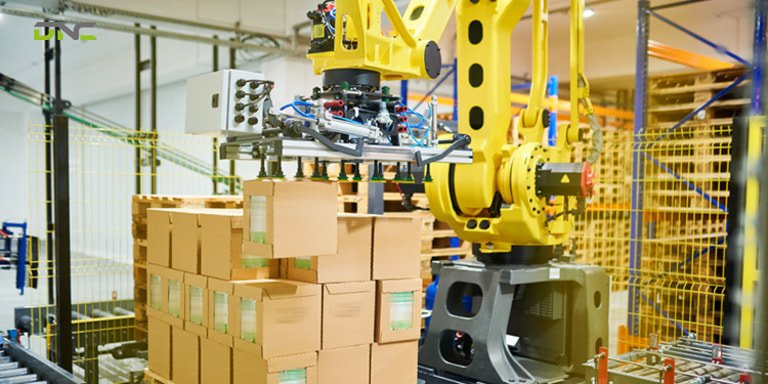
Vacuum EOAT: Arrays of vacuum cups (foam, bellows, or flat) connected to a vacuum generator (venturi or pump). Grips flat-top products — cartons, shrink bundles, trays. Cup selection depends on surface quality: porous surfaces (uncoated cardboard) require large-diameter foam cups; smooth surfaces (laminated cartons) suit smaller bellows cups. Vacuum level monitoring (pressure sensor on each cup zone) detects grip failure before the robot moves — preventing drops.
Clamp EOAT: Pneumatic or servo-driven jaws grip products from opposite sides. Handles bags (pillow bags, gusseted bags, valve bags), irregularly shaped products, and items without flat top surfaces. Jaw face material (rubber, polyurethane, textured steel) matches product surface for optimal friction.
Fork/Shovel EOAT: A flat platform slides beneath the product — used for heavy, unstable, or fragile products where top or side gripping risks damage. Common for bagged goods on conveyors where the bag sits on a flat surface.
Magnetic EOAT: Electromagnetic or permanent magnetic grippers for ferrous metal products — steel drums, cans, metal pails. DNC Automation designs switchable magnetic EOAT with fail-safe permanent magnets that hold the load even during power failure.
Hybrid EOAT: Combines two grip technologies (e.g., vacuum + clamp for products with both flat and irregular zones). Hybrid tools handle the widest product range from a single EOAT — reducing changeover requirements for multi-SKU lines.
DNC Automation’s in-house EOAT design and fabrication capability — 3D CAD modelling, FEA stress analysis, CNC machining, and assembly at the 25,000 sq ft facility — ensures every tool is optimised for the specific product before the palletizing cell enters production.
Robot Controller
The robot controller houses the motion planning computer, servo amplifiers, safety circuits, and communication interfaces. Modern controllers (Comau C5G Plus, FANUC R-30iB Plus, ABB OmniCore, KUKA KR C5) provide 4–8 millisecond servo cycle times, multi-robot coordination capability, integrated vision processing, and fieldbus connectivity (PROFINET, EtherNet/IP, EtherCAT) for PLC integration.
Teach Pendant and Programming Interface
The teach pendant is the operator’s primary interface for robot programming, monitoring, and diagnostics. Palletizing-specific software (Comau RoboShop, FANUC PalletPRO, ABB PickMaster, KUKA PalletTech) simplifies pattern programming through graphical interfaces — the operator defines product dimensions, pallet size, pattern type, and layer count; the software generates the complete motion programme.
Safety System
Automated palletizing robots require external safety systems — the robot itself does not incorporate force-limiting features like cobots. Safety fencing (welded mesh, 2,100 mm minimum height), interlocked access gates (ISO 14119 compliant), and light curtains at pallet entry/exit points form the safety perimeter per ISO 13849 Performance Level d. Safety-rated monitored stop (SLS, SOS functions integrated in the robot controller) and emergency stop circuits complete the safety architecture.
These components integrate into complete palletizing cells deployed across Malaysian manufacturing facilities where specific industry requirements shape system design.
Benefits of an Automated Palletizing Robot
Applications of Automated Palletizing Robots in Malaysian Manufacturing
Food and Beverage Production
F&B production lines represent the largest installed base of automated palletizing robots in Malaysia. Beverage manufacturers (F&N, Spritzer, Coca-Cola, Dutch Lady) palletize shrink-wrapped bottle packs, cartons, and multipack bundles at 15–25 cases per minute. Instant noodle producers (Mamee, Maggi Nestlé) handle lightweight cartons at maximum robot speed. Cooking oil producers palletize mixed-size containers — 1-litre bottles, 2-litre bottles, 5-litre jerrycans — requiring multi-pattern software capability.
Automated palletizing robots in Malaysian F&B operations must meet hygienic requirements: stainless steel EOAT, IP65 robot protection, and washdown-resistant cell construction. The robot’s consistent placement accuracy produces uniform pallet loads that maximise container density in cold chain storage — critical for dairy and frozen food logistics where warehouse space costs RM 15–25 per pallet position per month.
Pharmaceutical Manufacturing
Pharmaceutical palletizing demands serialisation integration — the automated palletizing robot’s vision system reads unique serial numbers on each carton during the pick cycle, verifying track-and-trace data before placement. This integrated verification eliminates the separate inspection station that manual palletizing requires, reducing line length and improving data accuracy.
Malaysian pharmaceutical manufacturers (Duopharma Biotech, CCM Pharmaceuticals, Hovid) deploy automated palletizing robots at the end of cartoning and case-packing lines where GMP documentation requirements make manual palletizing a compliance burden. The robot controller logs every placement — carton serial, pallet position, timestamp — providing the audit trail that manual operations cannot reliably generate.
Chemical and Petrochemical Industry
Chemical product palletizing exposes the automated palletizing robot to corrosive environments — chemical vapours, powder dust, and occasional spills. Robot protection class must meet IP67 minimum, with chemical-resistant coatings on exposed surfaces. ATEX-rated robots (FANUC, ABB, and KUKA offer ATEX options) serve Zone 2 explosive atmosphere classifications in Malaysian chemical plants.
Automated palletizing robots in Pasir Gudang, Gebeng, and Tanjung Langsat chemical zones handle 25–50 kg bags of chemical powders, 20-litre pails of solvents and adhesives, and 200-litre drums. The robot eliminates worker exposure to hazardous materials during the stacking process — directly addressing DOSH occupational exposure limit (OEL) compliance for chemical manufacturing facilities.
Building Materials
Cement bags (50 kg), tile adhesive, grout, and mortar bags challenge automated palletizing robots with their weight, dusty environment, and bag deformation characteristics. Four-axis palletizing robots with bag-specific clamp EOAT handle 8–12 bags per minute. The robot controller compensates for bag settling and dimensional variation through force-controlled placement — pressing each bag into a flat profile within the layer for stack stability.
Malaysian building materials producers (CIMA, YTL, Lafarge, Tasek) automate bag palletizing to address the near-impossible task of recruiting workers willing to stack 50 kg bags for eight-hour shifts. The automated palletizing robot delivers consistent stacking regardless of shift, weather, or workforce availability.
Consumer Goods and FMCG
Consumer goods manufacturers leverage the automated palletizing robot’s multi-SKU capability to build mixed pallets for retail distribution. Rainbow pallets — containing multiple product types destined for a single retail outlet — require the robot to switch between stacking patterns within a single pallet build. The robot’s software manages product sequencing, placement coordinates, and layer transitions across 20–50 SKUs without mechanical changeover.
The diverse applications of automated palletizing robots across Malaysian industries all deliver a common set of quantifiable benefits.
Benefits of an Automated Palletizing Robot
Productivity increase of 50–100% over manual palletizing results from the robot’s consistent speed (8–30 cycles per minute vs 4–8 cycles per minute manual), zero fatigue degradation, and elimination of break times, shift changes, and absenteeism. DNC Automation documents productivity gains from every installation — verified data, not theoretical projections.
Human error reduction by 80% — robotic placement accuracy (±0.5 mm) eliminates the misaligned layers, incorrect patterns, and unstable stacks that characterise manual palletizing. Every pallet is built to specification, every time.
Operational cost savings of up to 50% combine labour reduction (replacing 4–8 workers per shift), damage reduction (2–5% of product value saved), and throughput increase (more product per hour from the same packaging line). Total savings typically exceed RM 300,000–600,000 annually for a medium-volume Malaysian manufacturing operation.
MTBF of 50,000+ hours — modern palletizing robots deliver 50,000–100,000 hours mean time between failures. At typical 6,000 operating hours per year (3 shifts, 250 days), this equates to 8–15 years of reliable service. The automated palletizing robot is not a consumable; it is a long-term capital asset.
24/7 operation without overtime premiums, shift allowances, or productivity decline. The robot’s output at hour 23 equals its output at hour 1 — a consistency that manual operations cannot approach.
Multi-SKU flexibility — software-driven pattern changes in 10–30 seconds vs 15–30 minutes for conventional mechanical palletizer changeover. This flexibility directly supports Malaysian manufacturers’ trend toward higher product variety and shorter production runs.
Workforce upskilling — operators transition from manual lifting to robot supervision, monitoring, and basic maintenance. This transition aligns with NIMP 2030’s vision for upskilled Malaysian manufacturing workers and reduces dependence on foreign labour for physically demanding roles.
Achieving these benefits requires systematic robot selection matched to application requirements.
How to Choose an Automated Palletizing Robot
Determine Payload Requirement
Payload specification is the first and most critical selection parameter. Calculate total wrist load: maximum product weight + EOAT weight + any tooling accessories (sensors, quick-change adapters). Add a 15–20% safety margin. A product weighing 30 kg with a 25 kg EOAT and 5 kg accessories requires a robot with minimum 72 kg payload — specify 80–100 kg rated payload to ensure full-speed operation at this load.
Define Reach Envelope
Reach must cover the complete working area — from the infeed pick point to the farthest pallet placement position at maximum stack height. Measure horizontal distance from robot base to the farthest pallet corner, and vertical distance from the lowest pick point to the highest placement point. Add 200–300 mm margin. A reach requirement of 2,800 mm eliminates robots with 2,500 mm maximum reach — specify 3,000+ mm reach models.
Select Axis Count (4 vs 6)
Four-axis robots cost 15–30% less, cycle faster (simpler kinematics), and suffice for standard palletizing where products need only wrist rotation for pattern orientation. Six-axis robots are required when products need complex reorientation (inversion, tilting), when cell layout constraints demand non-standard approach angles, or when the robot will perform additional tasks beyond palletizing. DNC Automation recommends 4-axis for dedicated palletizing and 6-axis when multi-function capability or complex product handling is needed.
Verify Speed at Load
Published maximum TCP speed is achieved at zero payload. Actual palletizing speed at full load is 50–80% of maximum. Request cycle time simulation from the robot manufacturer or integrator, specifying actual product weight, pick/place positions, and motion profile. DNC Automation runs Comau simulation software to verify achievable cycle times before robot selection — ensuring the specified robot meets throughput targets at actual operating conditions.
Assess Protection Class
Standard palletizing robots are rated IP65 (dust-tight, protected against water jets). Dusty environments (cement, flour, chemical powders) may require IP67 with additional shaft seal protection. Washdown environments (F&B, pharmaceutical) require IP67 with stainless steel exposed surfaces. ATEX environments require explosion-proof certification. Specify protection class based on the actual operating environment — upgrading protection post-installation is expensive and often impossible.
Evaluate Total Investment
The robot arm costs RM 200,000–800,000 depending on brand, payload, and axis count. Total palletizing cell investment adds EOAT (RM 30,000–150,000), infeed conveyor (RM 40,000–120,000), pallet handling (RM 30,000–80,000), safety fencing (RM 20,000–50,000), control system integration (RM 50,000–150,000), and installation/commissioning (RM 30,000–80,000). The complete cell typically costs 2–3x the robot arm alone. Calculate ROI on the total cell cost, not the robot cost alone.
The following questions address the most common concerns Malaysian manufacturers raise when evaluating automated palletizing robots.
How to Choose an Automated Palletizing Robot
Frequently Asked Questions About Automated Palletizing Robots
How much does an automated palletizing robot cost in Malaysia?
An automated palletizing robot arm alone costs RM 200,000–800,000 in Malaysia. A 4-axis robot with 100–180 kg payload (Comau PAL 180, FANUC M-410iC/110) ranges from RM 200,000–400,000. A 6-axis robot with 220–370 kg payload (Comau NJ 220, ABB IRB 660) ranges from RM 350,000–600,000. Ultra-heavy models with 500–700 kg payload reach RM 600,000–800,000. The complete palletizing cell (robot + EOAT + conveyors + safety + controls + integration) costs 2–3x the robot alone, totalling RM 400,000–1,500,000. DNC Automation provides itemised quotations separating robot, tooling, and integration costs.
What is the difference between a 4-axis and 6-axis palletizing robot?
Four-axis palletizing robots have base rotation, shoulder, elbow, and wrist rotation — four degrees of freedom sufficient for standard vertical pick-and-place with tool rotation. They are faster, simpler, and 15–30% cheaper than 6-axis alternatives. Six-axis robots add wrist pitch and wrist yaw, enabling product inversion, angled approach, and reaching around obstacles. Choose 4-axis for dedicated palletizing of standard products. Choose 6-axis when products require complex reorientation, when cell layout demands non-standard robot positions, or when the robot must perform additional tasks beyond palletizing.
How long does an automated palletizing robot last?
Automated palletizing robots deliver 50,000–100,000 operating hours mean time between major failures — equivalent to 8–15 years at typical 3-shift operation (6,000 hours/year). Wearable components (reducer grease, cable harnesses, brake pads) follow scheduled maintenance intervals. DNC Automation’s preventive maintenance programme for Comau robots includes greasing (every 5,000 hours), cable inspection (every 10,000 hours), and reducer assessment (every 20,000 hours) — extending operational life toward the upper end of the MTBF range.
What EOAT type is best for my product?
EOAT selection depends on product characteristics. Vacuum grippers suit flat-top cartons, shrink bundles, and trays. Clamp grippers handle bags, irregular shapes, and products without flat surfaces. Fork/shovel tools manage heavy or unstable products. Magnetic grippers hold ferrous containers. DNC Automation conducts product testing — gripping trials with prototype EOAT using your actual products — before finalising tooling design. Testing verifies grip reliability at target cycle speed, identifies optimal cup/clamp sizing, and validates the EOAT weight budget within the robot’s payload.
Can one robot palletize products from multiple production lines?
One automated palletizing robot can serve 2–4 production lines simultaneously through multi-line cell design. The robot alternates picks between infeed conveyors based on product availability, with accumulation conveyors buffering products during serving of other lines. Multi-line operation increases robot utilisation from 60–70% (single line) to 85–95% (multi-line) and reduces per-line investment cost by 40–60%. DNC Automation uses cycle simulation to verify that combined multi-line throughput is achievable before designing multi-line cells.
What safety standards apply to automated palletizing robots in Malaysia?
Automated palletizing robots in Malaysia must comply with ISO 10218-1 (robot safety) and ISO 10218-2 (robot system integration safety). Safety fencing per ISO 13849 Performance Level d encloses the robot cell. Interlocked gates per ISO 14119 control human access. Light curtains per IEC 61496 protect pallet entry/exit zones. Emergency stops per IEC 60204-1 are mandatory. DOSH Malaysia references these international standards through the Occupational Safety and Health Act 1994 and the Factories and Machinery Act 1967. DNC Automation designs every safety system to meet or exceed ISO requirements and conducts documented risk assessments per ISO 12100.
How is an automated palletizing robot programmed?
Automated palletizing robot programming uses three methods. Teach pendant programming: the operator jogs the robot to key positions, records them, and builds the programme using palletizing software templates. Offline programming: engineers create and simulate programmes on a PC using the robot manufacturer’s simulation software (Comau RoboSim, FANUC RoboGuide, ABB RobotStudio) — no production interruption. Vision-guided programming: the robot uses camera input to automatically calculate pick positions for randomly presented products. DNC Automation programmes every robot during factory acceptance testing, delivers proven programmes at commissioning, and trains client operators on pattern modification and basic troubleshooting.
What maintenance does an automated palletizing robot require?
Automated palletizing robot maintenance follows the manufacturer’s schedule: servo motor greasing (every 5,000–10,000 hours), reducer oil check/change (every 10,000–20,000 hours), cable harness inspection (every 10,000 hours), brake testing (every 5,000 hours), and calibration verification (annually). EOAT maintenance is more frequent: vacuum cup replacement (monthly to quarterly), clamp pad replacement (quarterly to semi-annually), and sensor calibration (quarterly). Total annual maintenance cost: RM 15,000–40,000 for the robot; RM 5,000–20,000 for EOAT. DNC Automation offers comprehensive maintenance contracts covering robots, EOAT, conveyors, and control systems with guaranteed response times.
Conclusion
Automated palletizing robots are the proven, high-performance core of end-of-line palletizing automation — delivering 50,000+ hours of reliable operation, 8–30 cycles per minute throughput, and the multi-SKU flexibility that Malaysian manufacturers need to remain competitive under NIMP 2030 targets and persistent labour constraints. The robot selection decision — payload, reach, axes, speed, protection, and brand — shapes the performance ceiling of the entire palletizing system, making informed specification essential before investment commitment. DNC Automation, as Comau’s exclusive Southeast Asia robotics partner with 20+ years of integration expertise, provides direct access to the full Comau palletizing robot range alongside complete system design, EOAT fabrication, installation, commissioning, and lifecycle maintenance from a single accountable partner.
Get a Free Consultation — Talk to our engineers about selecting the right automated palletizing robot for your production requirements. Call DNC Automation or visit [dnc-automation.com](https://dnc-automation.com) to schedule a product assessment, review robot options, and receive a detailed proposal with ROI analysis.
- 8 views
- 0 Comment
Recent Comments