


Chain Conveyor Belt: Heavy-Duty Solutions for Malaysian Industry | DNC Automation
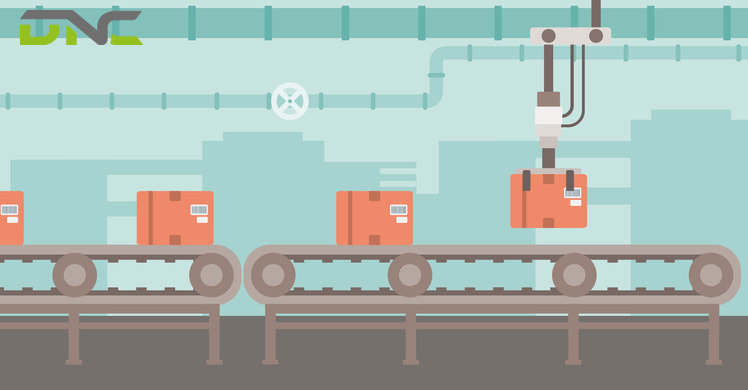
Chain Conveyor Belt — Heavy-Duty Conveying for Malaysia’s Harshest Industrial Environments
Chain conveyor belt systems solve the conveying challenges that eliminate rubber belts, plastic modular belts, and fabric conveyors from consideration: high temperatures that melt polymer materials, heavy loads that stretch and snap flexible belts, sharp-edged or abrasive materials that cut through belt surfaces in hours, and corrosive process environments where organic belt materials degrade rapidly. Toyota’s Selangor assembly plant moves car body stampings — steel panels weighing 80–150 kg each, with sharp sheared edges — on slat chain conveyors operating continuously through paint ovens at 200°C. No rubber belt survives that duty. Palm oil mills feed fresh fruit bunches (FFB) — dense, thorny clusters weighing 15–25 kg each — through sterilizer vessels at 140°C steam pressure on scraper chain conveyors. No modular plastic belt handles those conditions. DNC Automation, Malaysia’s Top #1 Factory Automation Company established in 2005, has designed and commissioned chain conveyor belt systems across Malaysia’s automotive hub in Selangor, palm oil mills in Sabah and Sarawak, foundry operations in Johor, and heavy manufacturing plants throughout the peninsula. This article provides Malaysian engineers and plant managers with a complete technical reference for chain conveyor belt systems — covering operation, types, components, applications, and selection criteria for every chain conveyor variant relevant to Malaysian industry.
What Is a Chain Conveyor Belt?
A chain conveyor belt is a conveyor system in which steel chains — rather than a fabric, rubber, or plastic belt — serve as both the structural member and the conveying surface. Steel chain links, connected in continuous strands, are driven by toothed sprockets mounted on the drive shaft. The chains either carry loads directly on their upper surface or support steel slat plates, cross members, or scraper flights that form the product-contact conveying surface.
Chain conveyor belts handle loads up to 10,000 kg per meter of conveyor length, operate at temperatures up to 400°C with alloy steel chain, maintain positional accuracy to within ±1mm over conveyor lengths of 50+ meters, and deliver decades of service life with minimal maintenance when correctly specified. The chain conveyor belt’s defining characteristic is its dimensional stability — unlike fabric or rubber belts that elongate under tension and temperature, steel chain exhibits near-zero stretch, maintaining consistent timing and positioning across the full conveyor length.
How Does a Chain Conveyor Belt Work?
Chain conveyor belt operation follows a mechanical sequence that differs fundamentally from belt conveyor operation in how drive force is applied, how tension is managed, and how the load is supported.
Step 1 — Drive Sprocket Engagement
The chain conveyor belt drive begins at the drive sprocket — a precision-machined steel wheel with tooth profiles matching the chain pitch. The sprocket teeth engage the chain links positively, unlike a pulley’s friction-based engagement with a rubber belt. Positive drive engagement means the chain conveyor belt does not slip under overload conditions; instead, it stalls (triggering the motor overload protection). DNC Automation specifies hardened and ground sprockets (surface hardness 58–62 HRC) on all chain conveyor drives to maximize sprocket service life and maintain chain engagement accuracy.
Step 2 — Chain Strand Travel
The loaded chain strands travel from the drive sprocket along the conveying run — typically supported by guide rails, support channels, or rollers at intervals of 300–800mm depending on chain type and load. The chain links rotate at every joint as the chain traverses the conveyor length — in a 20m conveyor with 50mm pitch chain, each link rotates approximately 800 times per hour at standard conveyor speed. This continuous articulation at each chain joint is the primary wear mechanism in chain conveyor belts; lubrication quality and frequency directly determine chain service life.
Step 3 — Load Support and Transfer
Loads are placed on the chain surface (roller chain applications), on slat plates bolted across twin chain strands (slat conveyor applications), or on cross-member flights (scraper chain applications). The chain conveyor belt carries the load in a horizontal, inclined, or overhead inverted path. At transfer points — where product moves from the chain conveyor to the next process stage — the chain passes around the driven or idler sprocket, and products slide or are lifted off by transfer plates or fingers that interdigitate with the chain links.
Step 4 — Return Strand and Tension
The empty return strand travels back from the discharge end to the drive sprocket, supported by return rollers or guide channels below the load-carrying upper strand. Chain tension — the force that pulls the chain through the load section — is maintained by a tensioning mechanism at the tail end: screw tensioners (adjustable manually), spring tensioners (self-adjusting), or gravity tensioners (heavy-duty long chains). Correct chain tension prevents chain sag on the return strand (which causes vibration and noise) and prevents chain climbing out of drive sprocket teeth (which causes mis-tracking and potential jam).
Step 5 — Lubrication System
Chain conveyor belts require lubrication at each chain joint — the pin-and-bushing contact surface where articulation wear occurs. Lubrication methods range from manual spot oiling (maintenance technician applies oil every 500–1,000 hours) to automatic lubrication systems (drip, mist, or brush lubrication synchronized with chain movement). DNC Automation specifies automatic chain lubrication systems on all high-duty chain conveyor belt installations — manual lubrication is inadequate for 24/7 automotive assembly line duty.
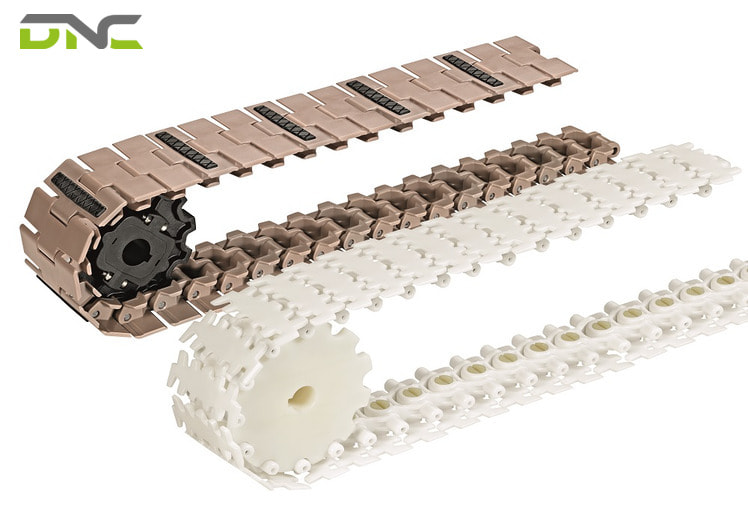
Chain conveyor belt
Types of Chain Conveyor Belt
Five chain conveyor belt variants cover the full range of Malaysian industrial conveying requirements, from precision automotive body transfer to bulk palm oil scraper conveying.
1. Roller Chain Conveyor Belt
Roller chain conveyor belts use standard roller chain (identical in principle to bicycle chain but at industrial scale — pitch 25.4mm to 100mm) with extended attachment plates or accumulation rollers. The chain itself forms the conveying surface, with products supported directly on chain top rollers or on attachments welded or bolted to chain links.
Roller chain conveyors are the general-purpose workhorse of Malaysian heavy manufacturing. General engineering, metal fabrication, and component manufacturing plants throughout Selangor’s industrial estates (Shah Alam, Subang, Petaling Jaya) use roller chain conveyors for in-process transfer of machined components, sub-assemblies, and work in progress between machining centers and assembly stations. Chain pitch selection — 25.4mm for light precision work; 50.8mm–101.6mm for general industrial; 152.4mm for heavy-duty large-load — matches the chain to the load and operating speed.
| Chain Pitch | Typical Load | Typical Speed | Application |
| 25.4–38.1mm | Up to 500 kg/m | 0.1–0.5 m/s | Precision assembly |
| 50.8mm | 500–2,000 kg/m | 0.05–0.3 m/s | General industrial |
| 76.2–101.6mm | 2,000–6,000 kg/m | 0.03–0.2 m/s | Heavy manufacturing |
| 152.4mm | 6,000–10,000 kg/m | 0.01–0.1 m/s | Very heavy/slow |
2. Slat and Plate Chain Conveyor Belt
Slat chain conveyors consist of flat steel slat plates bolted across twin parallel chain strands, forming a continuous flat conveying surface. Slat width ranges from 300mm to 3,000mm; slat material is mild steel (standard), stainless steel (food/chemical), or heat-resistant alloy (oven/furnace). The flat slat surface provides stable support for large, irregular, or heavy loads that would rock or tip on roller chain.
Automotive body-in-white (BIW) slat chain conveyors are the dominant material handling technology in Toyota’s Selangor production facility and comparable automotive assembly operations. Car body stampings, door panels, and full body shells travel on slat chain conveyors through welding bays, paint prep areas, and assembly stations — the slat width matching the wheelbase of the largest vehicle model in the plant’s production mix. Slat chain conveyor operating temperature for automotive paint ovens reaches 200–220°C; alloy steel chains and slats handle this temperature range without deformation.
3. Drag Chain Conveyor Belt
Drag chain conveyors use flights (cross-members, paddles, or scrapers) attached to chain strands to drag bulk material through a trough. Material slides along the trough floor, pushed by the flights behind it. Drag chain conveyors handle granular, lumpy, or sticky bulk materials — palm kernel shell, wood chips, coal, grain, sugar — in applications where belt conveyors cannot contain the material (inclined, enclosed) or where material temperature or abrasiveness would destroy belt surfaces.
Palm oil mills in Malaysia’s Sabah and Sarawak clusters use drag chain conveyors (specifically the scraper chain variant, with rubber-tipped or steel scrapers) for FFB transfer from weighbridge to sterilizer loading ramp. This is one of Malaysia’s highest-volume chain conveyor belt applications — hundreds of palm oil mills, each processing 30–120 FFB tonnes per hour, rely on drag chain conveyors as the primary receiving conveyor. The thorny, irregular surface of FFB clusters makes belt conveying impractical; the drag chain’s robust steel construction handles FFB without damage to the conveyor.
4. Accumulating Chain Conveyor Belt
Accumulating chain conveyors carry products on free-spinning rollers or low-friction slide shoes mounted on the chain surface. When a downstream blockage occurs (robot loading, manual inspection, gate), products stop accumulating behind the blockage while the chain continues moving underneath them — the product slides on the accumulation surface with minimal back-pressure force transmitted to upstream products. This zero-back-pressure (ZBP) accumulation protects fragile or unstable products from being pushed against each other.
Accumulating chain conveyors are the standard transfer system in Malaysian automotive final assembly lines. Engine assemblies, transmission units, and axle sub-assemblies accumulate at operator stations without being force-fed into the assembly station — protecting both the component and the assembly tool. DNC Automation has commissioned accumulating chain conveyor systems at automotive component plants in Selangor supplying Proton, Perodua, and Toyota.
5. Pallet Chain Conveyor Belt
Pallet chain conveyors use twin-strand heavy-duty chains (typically 100mm–152mm pitch) running in parallel at pallet width (800–1,200mm track spacing) to transport loaded pallets through warehouses, manufacturing cells, and storage systems. Pallet weights of 500–5,000 kg are standard; specialized pallet chain conveyors handle up to 20,000 kg for heavy manufacturing.
Malaysian heavy manufacturing — automotive stamping plants, heavy electrical equipment manufacturers, and steel fabricators in Johor’s Southern Industrial and Logistics Clusters (SILC) — use pallet chain conveyors to move WIP (work-in-progress) between production stations. The pallet chain conveyor integrates with forklift AGV (Automated Guided Vehicle) systems — a growing capability as Malaysian factories adopt NIMP 2030-aligned smart factory automation.
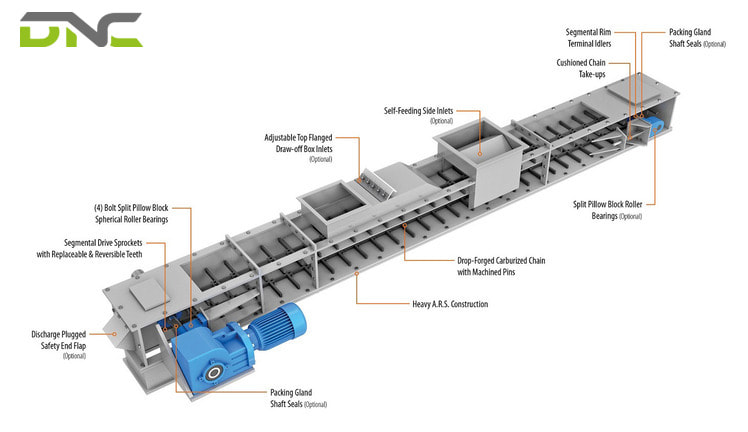
Detailed structure of chain conveyor
Key Components of a Chain Conveyor Belt System
Chain. Standard carbon steel chain (Grade 50 or Grade 80) serves general industrial applications. Stainless steel chain (SS304 or SS316L) is mandatory for food and chemical environments. Alloy heat-resistant chain (Cr-Mo or Ni-Cr alloy) handles furnace and oven temperatures to 400°C. Chain quality is graded by tensile strength (kN/m of chain width) and fatigue resistance — both deteriorate with inferior heat treatment. DNC Automation sources chain from established manufacturers with documented material certification to ensure consistent quality across replacement parts.
Sprockets. Drive and idler sprockets are precision-machined to chain pitch tolerance (typically ±0.05mm on tooth spacing). Hardened steel sprockets (surface hardness 58–62 HRC) provide 5–8× longer service life than mild steel sprockets in abrasive or high-load applications. Sprocket tooth profile — modified involute for roller chain; custom tooth for specialty attachments — must match the chain exactly; mismatched sprockets accelerate chain wear exponentially.
Support Structure. The conveyor frame — welded structural steel (I-beam, C-channel, or box section) — supports chain guide rails, drive and tail end assemblies, and return strand rollers. Frame deflection under rated load must not exceed L/600 (L = span length) to maintain chain track alignment. DNC Automation performs structural FEA (Finite Element Analysis) calculations on chain conveyor frames carrying loads above 5,000 kg/m.
Guide Rails and Return Rollers. Chain guide rails on the load-carrying run are UHMWPE wear strips (for noise, friction, and wear reduction) or hardened steel bars (for high-load applications). Return rollers support the empty return strand at 1,000–2,000mm spacing, preventing sag. In high-temperature applications (above 120°C), UHMWPE guide strips are replaced with sintered bronze or ceramics.
Drive Assembly. The motor-gearbox assembly determines chain speed and drive torque. DNC Automation specifies Siemens motors (direct partnership, Siemens Germany) for all chain conveyor drive assemblies, providing guaranteed motor quality, Malaysian service support, and compatibility with Siemens VFD (variable frequency drive) speed control. VFD-controlled drives deliver soft-start capability (critical for preventing chain shock loading at startup) and variable speed for flexible production rate adjustment.
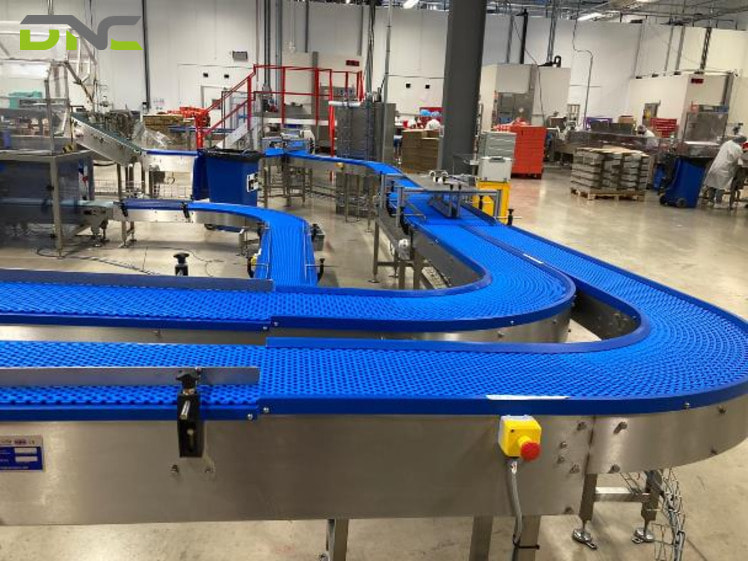
Plastic chain conveyors
Applications: Where Chain Conveyor Belt Is Used in Malaysian Manufacturing
Automotive Manufacturing — The Largest User
Selangor hosts Malaysia’s entire automotive manufacturing cluster: Proton (Shah Alam), Perodua (Rawang), Toyota (Bukit Raja, Setia Alam), Honda (Pegoh), and dozens of tier-1 and tier-2 component suppliers. Automotive assembly uses chain conveyor belt technology at multiple stages: floor-mounted slat chain in body welding shops (carrying body-in-white assemblies between robot welding stations); overhead power-and-free chain conveyors in paint shops (carrying body shells through pre-treatment, prime, and top-coat ovens); floor-mounted accumulating chain conveyors in final assembly lines (carrying body shells or trim assemblies between operator workstations). DNC Automation has a documented client relationship with Toyota and delivers chain conveyor systems engineered to automotive-grade reliability standards.
Palm Oil Mill Processing
Malaysia’s palm oil industry — concentrated in Sabah, Sarawak, and Johor — processes over 20 million tonnes of FFB annually. Every palm oil mill requires chain conveyor belt systems at multiple processing stages: FFB receiving and weighbridge transfer (drag/scraper chain); sterilizer loading (scraper chain or roller chain); digester and press feeding (drag chain); shell and fiber separation (chain and flight conveyors). The tropical operating environment — high humidity, steam condensation, palm oil contamination — requires chain conveyor belt components with appropriate corrosion protection; galvanized chain and epoxy-painted frames are standard for exposed outdoor sections.
Foundry and Die Casting
Malaysia’s foundry sector — primarily aluminium and zinc die casting for automotive components — operates in Selangor’s industrial estates, particularly Klang Valley industrial parks. Foundry operations generate extremely challenging conveyor conditions: abrasive metal swarf, temperatures of 200–400°C near furnaces and casting stations, and aggressive fluxing chemicals. Alloy steel chain conveyors (with heat-resistant chain and ceramic guide inserts) are the only viable transfer technology for parts moving between casting, trimming, and heat treatment stations in Malaysian foundry plants.
Cement and Ceramics Manufacturing
Johor and Perak host significant cement and ceramics manufacturing operations. Cement chain drag conveyors (bucket elevator and drag chain combinations) transfer clinker between kiln and grinding stations. Ceramics plants use roller chain conveyors to carry kiln cars (loaded with green ware) into and out of tunnel kilns at 1,200–1,400°C — a duty for which only refractory-grade chain assemblies are suitable.
Heavy General Manufacturing
Unilever’s Malaysian manufacturing operations (DNC Automation client) and comparable heavy consumer goods manufacturers use pallet chain and roller chain conveyor belts for WIP transfer between production areas. The ability to handle pallet loads of 1,000–3,000 kg continuously, without belt stretch causing positioning errors, makes chain conveyor belts the specified technology for heavy manufacturing cell transfers.
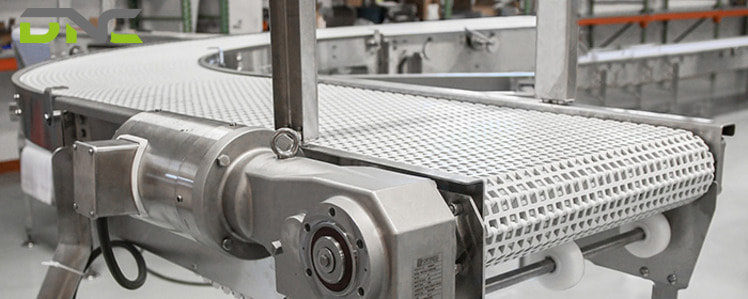
Stainless steel chain conveyors
Benefits of Chain Conveyor Belt for Factory Operations
Temperature Performance. Steel chain conveyor belts operate at process temperatures where every alternative belt material fails. Rubber belts degrade above 80°C; modular plastic belts deform above 120°C; fabric belts lose tensile strength above 150°C. Alloy steel chain conveyor belts continue operating at 400°C — covering the full range of Malaysian industrial oven, furnace, and autoclave applications.
Zero Belt Stretch. Rubber and fabric belts elongate by 1–3% under working tension — enough to misalign tooling interfaces, cause timing errors on assembly lines, and require frequent tensioner adjustment. Steel chain exhibits essentially zero elongation under working loads. Toyota’s Selangor body shop robots are programmed to ±1mm positional tolerance at the chain conveyor stop position — achievable only with the dimensional stability of steel chain.
Heavy Load Capacity. Chain conveyor belts carry 10,000 kg/m of conveyor length — 10–20× the capacity of comparable rubber belt conveyors. Heavy automotive assemblies, pallet loads, and bulk aggregate volumes that destroy rubber belts move continuously on correctly specified chain conveyor belt systems.
Long Service Life. Properly lubricated and maintained steel chain in a clean industrial environment delivers 15,000–25,000 operating hours before chain replacement. This compares to 8,000–15,000 hours for quality rubber belt conveyors in equivalent applications. DNC Automation documents 50% operational cost reduction for clients who migrate from rubber belt to chain conveyor belt on high-temperature or heavy-load applications.
Human Error Reduction. Chain conveyor belt systems with VFD speed control and PLC integration reduce operator intervention requirements by 80% compared to manually managed transfer operations — consistent with DNC Automation’s documented 80% human error reduction across automation projects.
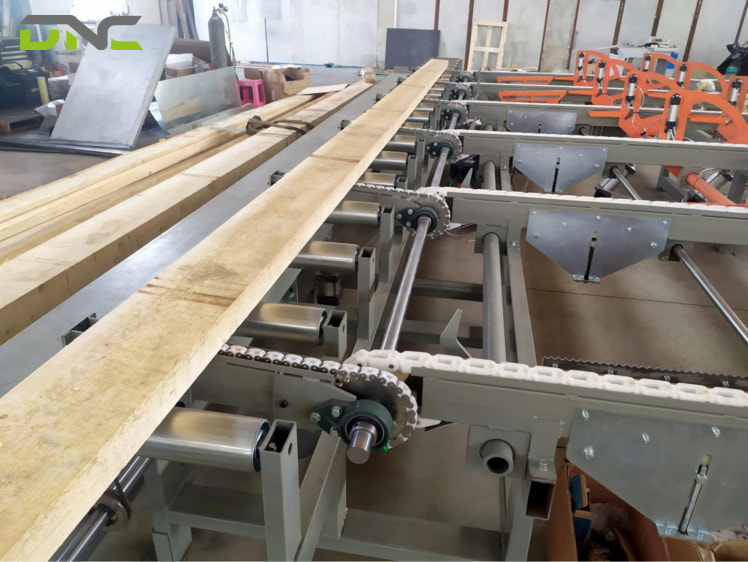
Wooden chain conveyors
How to Choose the Right Chain Conveyor Belt for Your Factory
- Operating Temperature. Below 80°C: standard carbon steel chain is acceptable. 80–200°C: heat-resistant alloy chain required (standard automotive oven grade). 200–400°C: high-alloy heat-resistant chain with ceramic guide inserts mandatory. Above 400°C: consult DNC Automation engineers — specialized refractory conveyor designs apply.
- Load Per Meter. Calculate total load (product + carrier weight) per meter of conveyor length. For loads below 2,000 kg/m, standard roller chain pitch of 50.8mm is usually appropriate. Loads above 5,000 kg/m require large-pitch chain (76.2–152.4mm) or twin-strand wide-plate chain; DNC Automation provides chain tension calculations before finalization.
- Material Contact Conditions. Abrasive materials (metal swarf, aggregate, palm kernel shell) require case-hardened chain and wear-resistant flight/slat materials. Corrosive materials or washdown environments require stainless steel. Sticky materials (wet biomass, clay) require self-cleaning chain profiles with minimal horizontal surfaces.
- Conveyor Speed. Chain conveyor belt speed is limited by chain fatigue life — faster speed means more chain articulation cycles per unit time, accelerating joint wear. Standard speeds: 0.05–0.3 m/s for heavy-duty; 0.3–0.5 m/s for medium-duty; above 0.5 m/s is unusual for chain (belt conveyors are preferred at higher speeds). Match required throughput (kg/hr or items/hr) to chain speed and conveyor loading density.
- Grant Eligibility. Malaysian manufacturers investing in chain conveyor belt systems as part of factory automation upgrades qualify for SAG Grant (MIDA Smart Automation Grant), which provides 70% matching funding up to RM 1M. Under NIMP 2030, automated chain conveyor belt systems that replace manual handling or improve production line efficiency qualify as automation investments. DNC Automation prepares grant application documentation for all qualifying projects.
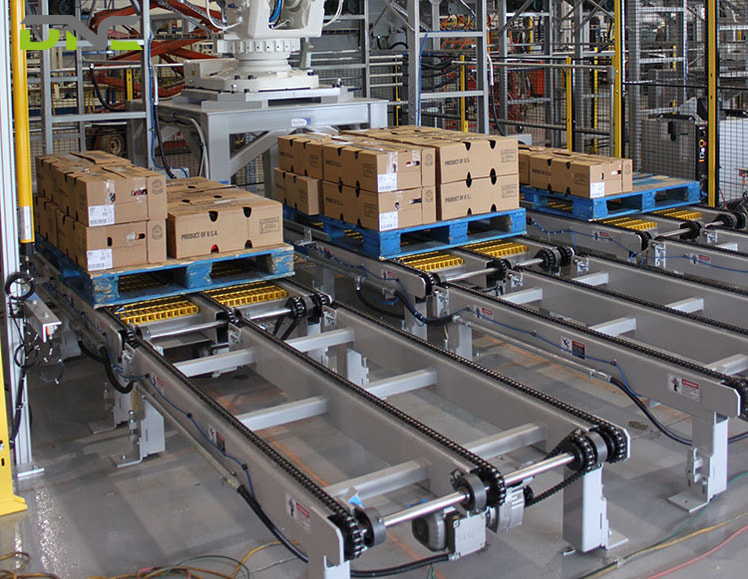
Compare the difference between chain conveyors and belt conveyors
Frequently Asked Questions About Chain Conveyor Belt
Q: What is the difference between a chain conveyor belt and a regular belt conveyor?
A chain conveyor belt uses steel chain as the structural and conveying element, driven by toothed sprockets that engage the chain positively. A regular belt conveyor uses a rubber, PVC, or fabric belt driven by friction from a smooth drive pulley. Chain conveyor belts handle higher temperatures, heavier loads, and more abrasive materials than belt conveyors. Belt conveyors are preferred for higher speeds (above 0.5 m/s), lighter loads, longer distances, and applications where a smooth continuous surface is needed for product handling.
Q: How often does a chain conveyor belt need lubrication?
Chain lubrication interval depends on chain speed, load, temperature, and environment. DNC Automation’s standard guideline: lightly loaded indoor chain at ambient temperature — re-lubricate every 500 operating hours; heavily loaded chain in hot or contaminated environment — every 100–200 hours or continuous auto-lubrication. Automatic chain lubrication systems (drip or mist type) are recommended for all 24/7 operating chain conveyor belts — the labor cost and downtime risk of missed manual lubrication intervals exceeds the cost of automatic lubrication system installation within 12–18 months.
Q: Can a chain conveyor belt handle wet or oily materials?
Standard carbon steel chain corrodes in persistently wet or oily environments unless protected. For Malaysian palm oil mill applications (wet, oily, humid), galvanized chain with SS304 or galvanized flights provides 3–5 years service life versus 6–12 months for unprotected carbon steel chain in the same environment. For direct food contact or pharmaceutical applications, SS316L chain is mandatory. DNC Automation specifies chain material grade based on the full chemical and moisture exposure profile of the specific application.
Q: What causes premature chain conveyor belt failure?
Three failure modes account for over 80% of premature chain conveyor belt failures: (1) Lubrication failure — inadequate lubrication causes pin-and-bushing wear, visible as chain elongation (pitch increase) and eventual link fracture; (2) Incorrect chain tension — loose chain causes impact loading at sprocket engagement, shattering link plates; overtight chain causes excessive bearing and sprocket loads; (3) Contamination — abrasive dust, scale, or chemical compounds entering chain joints accelerates wear by an order of magnitude. DNC Automation’s preventive maintenance programs for chain conveyor belt systems address all three failure modes with specific inspection intervals and corrective action thresholds.
Q: How do I calculate the right chain pitch for my application?
Chain pitch selection starts with four inputs: required conveyor speed (m/s), required sprocket speed (RPM) based on motor/gearbox selection, maximum chain tension (calculated from load and friction), and chain speed (m/s = pitch × sprocket RPM × number of teeth / 1,000). Standard engineering practice: maximum chain speed for roller chain is 3 m/s (standard application) to 5 m/s (maximum, with lubrication). DNC Automation engineers perform these calculations as part of project specification, along with chain factor of safety verification (minimum 6:1 on rated tensile strength versus working load).
Q: Does chain conveyor belt qualify for Malaysian industry grants?
Chain conveyor belt systems installed as part of a factory automation project qualify for SAG Grant funding under MIDA. The grant covers up to 70% of investment cost (manufacturer contributes 30%), capped at RM 1M total project value. Chain conveyor belt projects that integrate with PLC control, production monitoring, or robotic work cells are particularly well-positioned for grant approval under NIMP 2030’s smart factory mandate. DNC Automation has assisted multiple clients in securing SAG Grant approval for chain conveyor belt-based automation projects.
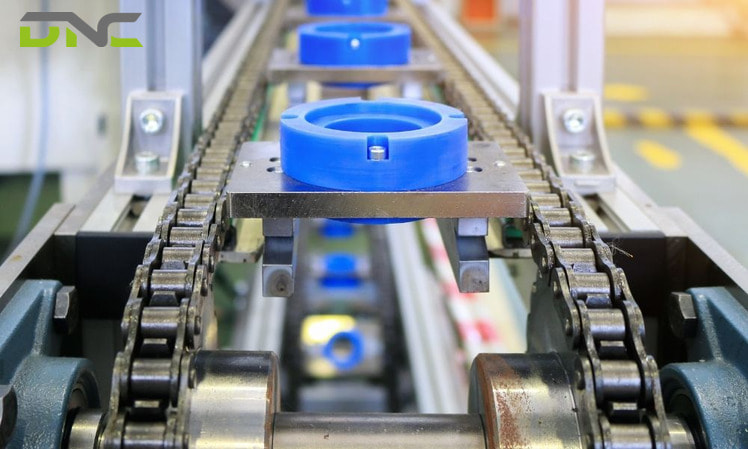
Chain conveyor price
Conclusion
Chain conveyor belt systems are the enabling technology for Malaysia’s most demanding manufacturing environments: Toyota’s automotive body shops operating at 200°C, palm oil mills processing thousands of tonnes of thorny fresh fruit bunches, foundry operations handling metal at 400°C, and heavy manufacturing cells moving 5,000 kg pallet loads continuously through production. Where rubber, plastic, and fabric conveyor belts reach their performance limits, steel chain conveyor belt systems begin their operating range.
DNC Automation — Malaysia’s Top #1 Factory Automation Company since 2005 — engineers chain conveyor belt systems with 35 dedicated engineers, ISO 9001:2015 quality certification, and a 25,000 sq ft fabrication facility. Siemens Germany drive systems, Comau Italy robotics integration for automated loading/unloading interfaces, and DNC’s own structural and mechanical engineering capability combine in every chain conveyor belt project.
Talk to Our Engineers today — Get a Free Consultation at dnc-automation.com and let DNC Automation design the chain conveyor belt system your operation demands.
- 235 views
- 0 Comment
Recent Comments