



Conveyor Wear Strips: UHMW Guide for Malaysian Factories
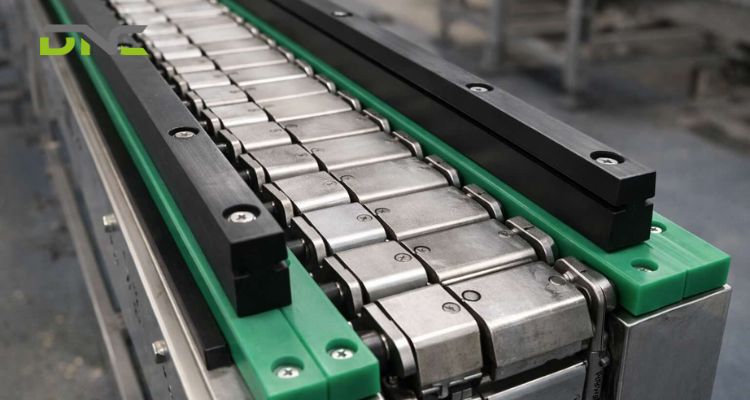
A 5-meter length of UHMW-PE conveyor wear strip costs between RM 40 and RM 120 depending on profile and material grade. Neglecting to replace worn wear strips costs a Selangor automotive factory RM 15,000–80,000 in chain replacement, motor rewinding, bearing failure, and unplanned downtime — every time. Conveyor wear strips are the sacrificial components of any chain or belt conveyor system: replaceable plastic strips mounted on the conveyor frame that the chain, belt, or product slides along, protecting the metal frame from abrasion and the chain from contact with hard steel surfaces. UHMW-PE (Ultra-High Molecular Weight Polyethylene) is the dominant material — with a dry coefficient of friction of 0.10–0.22, 10 times the impact resistance of Nylon 6, and FDA food-grade grades that satisfy HACCP requirements in Malaysian food factories. DNC Automation — Malaysia’s Top #1 Factory Automation Company since 2005, ISO 9001:2015 certified — supplies and installs wear strip systems as part of conveyor maintenance contracts and new conveyor installations across Toyota, Sony, F&N, Hartalega, Unilever, and Ramly Burger production facilities. This guide covers every wear strip type, material, replacement protocol, and selection criterion.
What Is a Conveyor Wear Strip?
A conveyor wear strip is a replaceable, low-friction plastic strip mounted on the conveyor frame rails, support channels, or guide surfaces that sliding chains, belts, or products contact during conveyor operation. Conveyor wear strips function as sacrificial wear components — they absorb the abrasive wear from continuous chain or belt sliding, protecting the metal conveyor frame and the chain itself from direct metal-to-metal contact. The plastic wear strip degrades predictably over time and is replaced at planned maintenance intervals; the metal frame and chain are preserved indefinitely.
UHMW-PE (Ultra-High Molecular Weight Polyethylene) is the primary material for conveyor wear strips in Malaysian industrial use, with molecular weight above 3.5 million g/mol creating exceptional abrasion resistance, low friction, and impact toughness that standard HDPE and Nylon cannot match. UHMW-PE wear strips exhibit dry coefficient of friction of 0.10–0.22 (versus 0.30–0.50 for steel on steel), Shore D hardness of 60–65, and maximum continuous service temperature of 82°C for standard grade (138°C for reinforced UHMW-HT grade). FDA food-grade UHMW-PE meets 21 CFR 177.1520 requirements for direct food-contact applications.
How Do Conveyor Wear Strips Work?
Conveyor wear strip performance depends on material selection, installation fit, and replacement timing. Understanding the mechanics of wear strip function prevents the cascade of failures — increased chain tension, motor overload, bearing failure, chain stretch — that result from operating conveyors past the wear strip replacement threshold.
Step 1 — Contact and Friction Load Distribution
A chain conveyor operating at 0.5–2.0 m/s drags the chain’s bottom face along the wear strip surface continuously. Chain contact pressure against the wear strip surface ranges from 0.1 to 2.0 N/cm² depending on chain weight, product load, and conveyor incline. UHMW-PE wear strips distribute this contact pressure across the full contact area, maintaining consistent low friction (CoF 0.10–0.22) that allows the chain drive to operate at design tension without excessive motor load.
Step 2 — Abrasive Wear Absorption
Chain side plates, rollers, and pin ends are all harder than UHMW-PE wear strips (chain components are typically case-hardened steel at 55–62 HRC; UHMW-PE Shore D hardness is 60–65). The softer UHMW-PE wear strip surface abrades preferentially, sacrificing itself to protect the harder chain components. Wear strip material removed by abrasion appears as white UHMW-PE powder — visible during inspection and a reliable indicator of wear rate.
Step 3 — Lateral Chain Guidance
Chain guide wear strips (T-slot profile) restrain the chain laterally, preventing the chain from drifting off the conveyor drive sprockets under side load. Without lateral guide wear strips, chains under side loading (inclined conveyors, curved sections, product lateral forces) migrate off the sprocket teeth, causing chain derailment and immediate line stoppage. Lateral guide function requires that the T-slot profile maintain sufficient depth — once wear reduces the guide wall depth below 50% of original thickness, lateral guidance becomes unreliable.
Step 4 — Progressive Wear and Warning Phase
UHMW-PE wear strips exhibit predictable linear wear rates — typically 0.1–0.5 mm per 1,000 operating hours depending on chain speed, chain type, and load. Standard wear strip profiles have 8–15 mm of usable wear depth. At 30–50% wear depth consumed, the wear strip enters the warning phase: chain tension begins increasing (up to 10% above baseline), motor current draw increases slightly (3–5%), and chain lateral movement increases marginally. These are measurable indicators, detectable during scheduled maintenance inspections.
Step 5 — Critical Wear Threshold and Cascade Failure
At 70–80% wear depth, the chain begins contacting the metal frame beneath the wear strip. Metal-to-metal contact generates friction coefficients of 0.30–0.50 — two to five times higher than UHMW-PE contact. Motor load increases 15–25% above baseline, accelerating bearing wear and increasing electricity consumption. Chain tension rises sharply, accelerating chain elongation (stretch). Within 200–500 operating hours of reaching metal-to-metal contact, bearing failure and chain replacement become unavoidable. The RM 50 wear strip neglect has now caused a RM 15,000–80,000 failure event.
Step 6 — Replacement Protocol
DNC Automation’s wear strip replacement protocol: (1) measure remaining wear depth at three points per strip segment using a calibrated depth gauge; (2) compare to the 30% remaining wear (replace now) threshold; (3) clean the frame channel of all debris and old wear strip material; (4) insert new wear strip — press-fit (snap-in) profiles require no fasteners; (5) verify correct seating and clip engagement; (6) restart conveyor and verify chain tension returns to baseline specification.
Types of Conveyor Wear Strips
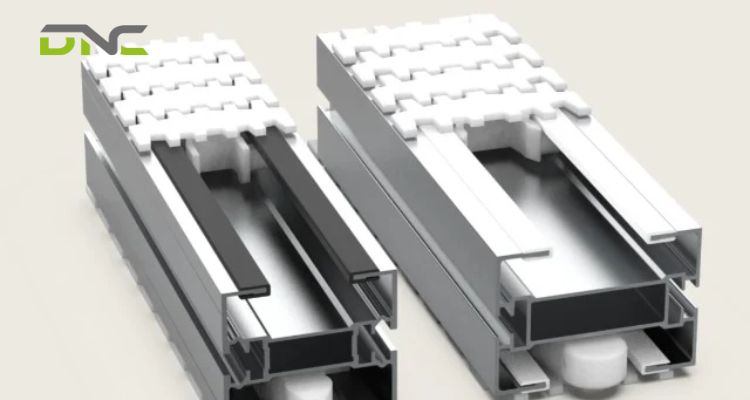
Malaysian factories encounter five primary wear strip configurations, each serving a distinct functional role in the conveyor system. Installing the wrong profile type — for example, using a flat slide rail where a T-slot chain guide is required — fails to provide lateral chain guidance and results in chain derailment.
1. Chain Guide Wear Strip (T-Slot Profile)
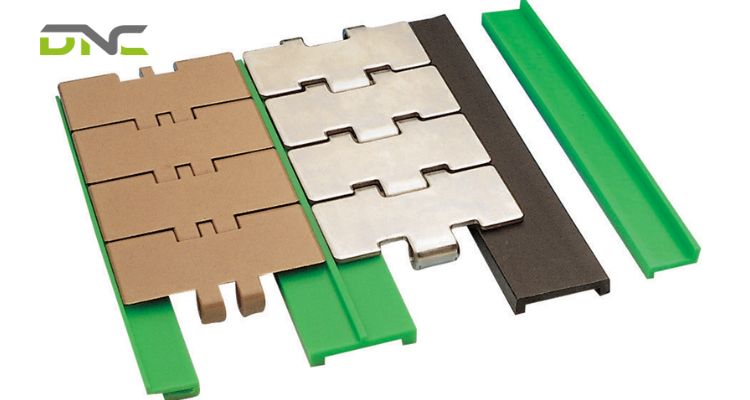
Chain guide wear strips use a T-slot or U-channel profile that wraps around the chain’s outside link plates, providing both vertical support and lateral guidance simultaneously. T-slot profiles are the most common wear strip configuration in Malaysian factories, used on steel chain conveyors in food processing (F&N, Ramly Burger), automotive assembly (Toyota), and general manufacturing. UHMW-PE T-slot profiles are available in standard widths matching all major chain manufacturers’ specifications: 882-series, 815-series, 820K series (Rexnord, Habasit, and equivalents). DNC Automation stocks the 12 most common T-slot profile sizes for rapid installation turnaround.
2. Slide Rail / Wear Rail (Flat Strip Profile)
Flat slide rail wear strips provide a low-friction sliding surface for products, pallets, or belt undersides that travel directly on the conveyor frame rail. Flat profiles (rectangular cross-section) are mounted in machined channels or attached to frame rails using stainless steel screws or press-fit retention clips. Slide rails are specified for pallet conveyors (automotive and warehouse applications), flat belt conveyors where the belt underside contacts the frame, and product accumulation zones where products temporarily rest on static slide surfaces.
3. Guide Rail (Vertical Product Guide Strip)
Vertical guide strips mount on the sides of conveyor frames to guide product laterally, preventing containers, bottles, boxes, and cartons from falling off the conveyor edge. Guide rails experience lower continuous wear loads than chain guide strips (product contact is intermittent, not continuous chain sliding) but must maintain dimensional accuracy — guide rails that wear beyond their tolerance allow products to jam against the narrowed guide gap or fall off the conveyor edge. UHMW-PE vertical guide strips in food and beverage lines (Unilever, F&N) must meet FDA/HACCP food-grade requirements.
4. Dead Plate (Transition Sliding Surface)
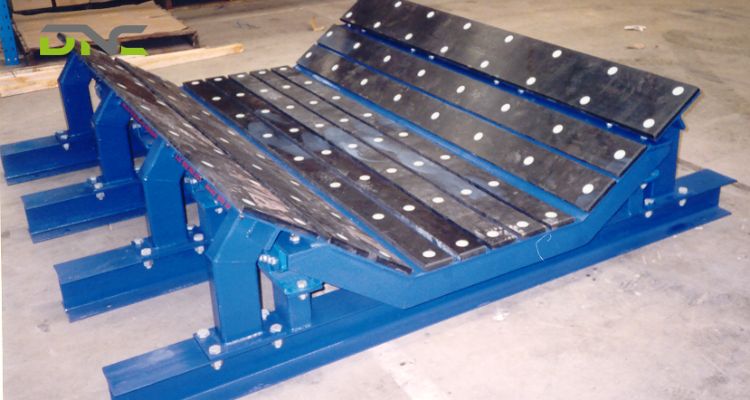
Dead plates are static flat panels of UHMW-PE, HDPE, or nylon installed at transitions between conveyors — where products slide from the outfeed of one conveyor across a fixed surface onto the infeed of the next conveyor. Dead plates are subject to high wear rates because products with sharp corners, rough bottoms, or high mass sliding across them generate concentrated wear at transition edges. UHMW-PE dead plates in high-throughput packaging lines require replacement every 6–18 months depending on product type and throughput volume.
5. Sprocket Wear Strip (Sprocket Housing Protection)
Sprocket wear strips protect the interior of sprocket housings and conveyor end frames from chain lateral contact during turns and direction changes. Chain conveyors negotiating curves generate centrifugal forces that push the chain against the outer guide surface of the curve section — UHMW-PE curve guide strips absorb this lateral chain load. Without curve guide wear strips, chains on curved conveyor sections wear through steel frame members within 6–12 months of continuous operation.
Material Comparison Table for Conveyor Wear Strips
| Material | Max Temp (°C) | CoF (Dry) | Impact Resistance | FDA Grade | Relative Cost | Best For |
| UHMW-PE (standard) | 82 | 0.10–0.22 | Excellent (10× Nylon) | Yes | Low-Medium | General industrial, food |
| UHMW-PE (HT grade) | 138 | 0.12–0.25 | Excellent | Yes | Medium | Elevated temp applications |
| Nylon 6/6 | 120 | 0.20–0.35 | Good | Food grades | Medium | High temperature, precision |
| HDPE | 60 | 0.15–0.30 | Good | Yes | Low | Economy applications |
| PTFE | 260 | 0.04–0.10 | Low-Medium | Yes | High | Food/pharma, ultra-low friction |
| UHMW+Oil (impregnated) | 82 | 0.08–0.15 | Excellent | Food grades | Medium-High | High-speed chains, no lubrication |
Key Components of a Conveyor Wear Strip System
Wear Strip Profiles. Wear strip cross-sectional profiles are standardized to chain manufacturer specifications — DIN 8167 (European), ANSI B29.1 (American), and ISO 1977 chain standards each have corresponding wear strip profile dimensions. Profile selection must match the specific chain series in use; incorrect profile width causes chain-to-strip contact at pin ends rather than link plates, causing accelerated and uneven wear.
Retention and Mounting System. UHMW-PE wear strips mount to conveyor frame channels using three methods: (1) press-fit snap clips that engage T-slots in the frame channel — tool-free installation and removal, fastest replacement; (2) stainless steel countersunk screws through the wear strip into tapped frame channels — more secure for high-vibration applications; (3) adhesive mounting for flat slide rail strips on smooth frame surfaces. DNC Automation specifies press-fit retention for all food and pharma applications where tool-free replacement supports HACCP sanitization protocols.
Frame Channel Preparation. The conveyor frame channel that accepts wear strip retention clips must be clean, undamaged, and within dimensional tolerance. Worn or deformed frame channels do not retain wear strips securely — vibration dislodges improperly seated wear strips, causing them to jam in the chain. DNC Automation inspects frame channels during wear strip replacement and restores channel dimensions by welding and re-machining if deformation exceeds 0.5 mm tolerance.
Lubricant Compatibility. Chain lubrication systems in food factories use food-grade lubricants (NSF H1 certified, mineral or synthetic). UHMW-PE wear strips are compatible with all NSF H1 lubricants. UHMW-PE+Oil (oil-impregnated) wear strips self-lubricate — releasing trapped oil during chain contact — reducing chain lubrication intervals by 50–75% on high-speed conveyors where lubricant throw-off is a contamination risk.
Applications: Where Conveyor Wear Strips Are Used in Malaysian Manufacturing
Food and Beverage Processing — HACCP-Critical Applications
Malaysian food manufacturers — Ramly Burger, F&N, Unilever (all DNC Automation clients) — operate chain conveyors in environments requiring HACCP food safety compliance. FDA food-grade UHMW-PE wear strips (21 CFR 177.1520 compliant) are mandatory for chain guides and product contact surfaces in food processing zones. Tropical Malaysia’s humidity range of 30–95% RH has zero adverse effect on UHMW-PE performance — the material absorbs less than 0.01% moisture and maintains dimensional stability in high-humidity environments. Standard nylon wear strips absorb 2–8% moisture and swell significantly in humid Malaysian food factories, causing chain jamming. UHMW-PE’s humidity insensitivity makes it the material of choice for Malaysian food factory wear strips.
Automotive Assembly — Toyota and Selangor Hub
Toyota’s Malaysian assembly operations and Selangor’s automotive Tier-1 suppliers run overhead and floor-mounted chain conveyors transporting body panels, engine components, and sub-assemblies through painting, welding, and assembly stations. Conveyor wear strips in automotive assembly environments must withstand splash contact with cutting oils, rust inhibitors, and paint overspray solvents. UHMW-PE’s broad chemical resistance handles all standard automotive chemicals. DNC Automation supplies UHMW-PE wear strip systems for Toyota conveyor maintenance under long-term maintenance contracts.
Glove Manufacturing — Hartalega
Hartalega — one of the world’s largest nitrile glove manufacturers and a DNC Automation client — operates continuous dipping lines where latex formers travel on chain conveyors through chemical dipping tanks, vulcanization ovens (up to 120°C), and stripping stations. High-temperature UHMW-HT or Nylon 6/6 wear strips are specified for oven sections (above 82°C standard UHMW-PE limit). Chemical resistance to latex, ammonia, and sulfur compounds (present in vulcanization chemistry) is a critical material requirement — UHMW-PE and Nylon 6/6 both satisfy this requirement.
Semiconductor and Electronics — Penang Facilities
Penang semiconductor backend facilities use conveyor systems for IC package transport between processing stations. ESD-dissipative UHMW-PE wear strips (carbon-loaded, surface resistance 10⁵–10¹¹ Ohms) are specified for IC package conveyors in ESD-protected areas. Standard (non-ESD) UHMW-PE generates triboelectric charges during IC package sliding contact — replacing standard wear strips with ESD-dissipative grades eliminates this ESD generation mechanism at the belt support surface.
Benefits of Proper Conveyor Wear Strip Maintenance
20% Motor Load Reduction from Wear Strip Renewal. Replacing worn wear strips (at 70% wear depth) with new UHMW-PE strips reduces chain conveyor motor current draw by 15–25% — directly reducing electricity consumption. For a 5.5 kW conveyor motor running 20 hours/day, 25% load reduction saves approximately 27.5 kWh/day — approximately RM 10–14/day in Malaysian industrial electricity tariff savings.
50% Operational Cost Reduction Through Planned Replacement. DNC Automation’s conveyor maintenance data shows that facilities on planned wear strip replacement schedules (replace at 50% wear depth) spend 50% less on total conveyor maintenance versus facilities that replace wear strips reactively after chain failure. Planned replacement avoids chain stretch, bearing replacement, and unplanned downtime costs that multiply the wear strip’s RM 50–120 replacement cost by factors of 100–1,000.
80% Reduction in Unplanned Downtime Events. Conveyor failures caused by worn wear strips account for 30–40% of all unplanned conveyor stoppages in Malaysian factories without planned maintenance programs. DNC Automation’s maintenance contract clients report 80% reduction in wear-strip-related stoppages within the first year of implementing planned replacement intervals.
ISO 9001:2015 and HACCP Compliance. Documented wear strip replacement records — material grade, installation date, replacement date, wear measurement readings — satisfy ISO 9001:2015 maintenance record requirements and HACCP’s equipment maintenance documentation requirements for food factories. DNC Automation provides standardized maintenance forms with all wear strip supply contracts.
How to Choose the Right Conveyor Wear Strips for Your Factory
Identify Chain Type and Profile Requirements. Measure existing wear strip cross-sectional dimensions (width, height, T-slot depth) or provide DNC Automation with the chain manufacturer’s part number — DNC’s engineers identify the correct wear strip profile from the chain specification. Mismatched profiles cause premature wear and chain derailment.
Assess Operating Temperature. Standard UHMW-PE is limited to 82°C continuous service. Ovens, hot wash tunnels, and steam cleaning zones above 82°C require UHMW-HT (138°C) or Nylon 6/6 (120°C) wear strips. Failing to specify elevated-temperature grades in hot zones causes UHMW-PE softening and deformation within weeks — creating dangerous chain jamming conditions.
Determine Food-Grade and Chemical Resistance Requirements. Malaysian food factories must specify FDA 21 CFR 177.1520 compliant UHMW-PE for all wear surfaces in product zones. Document the cleaning chemicals used (caustic CIP concentration, sanitizer type) and verify wear strip material compatibility — PTFE offers the broadest chemical resistance where aggressive cleaning chemistry is used.
Evaluate Lubrication Strategy. Oil-impregnated UHMW-PE wear strips are specified for high-speed conveyors (above 1.0 m/s chain speed) where conventional liquid lubrication creates spray contamination or where lubrication frequency is operationally difficult. Oil-impregnated strips release lubricant through the wear surface, eliminating external lubrication requirements for the wear strip contact zone.
Consider Malaysia’s NIMP 2030 Smart Maintenance Integration. Malaysia’s National Investment Master Plan 2030 targets 3,000 factories upgrading to smart factory status. Smart conveyor maintenance — wear strip replacement integrated with IoT chain tension monitoring, motor current trend analysis (Siemens SIMATIC CM vibration monitoring modules), and predictive maintenance scheduling — qualifies as smart factory investment eligible for SAG grants of up to RM 1 million at 70:30 MIDA matching.
Frequently Asked Questions About Conveyor Wear Strips
Q: How do I know when to replace conveyor wear strips?
Replace conveyor wear strips when wear depth reaches 50% of original profile depth — measured using a calibrated depth gauge at three points along each strip segment. Visual indicators include: white UHMW-PE powder accumulation under the conveyor (accelerated abrasion), increased motor current draw on VFD monitoring displays (10% above baseline), audible chain chatter (chain contacting frame through worn strip), and visible chain rocking or lateral movement exceeding 3 mm.
Q: Can I use any plastic for conveyor wear strips?
Material selection matters significantly. Standard HDPE (high-density polyethylene) has lower abrasion resistance than UHMW-PE and requires more frequent replacement — economy choice only. PVC wear strips are unsuitable for food applications due to plasticizer contamination risk. Acetal (Delrin) offers higher hardness but lower impact resistance than UHMW-PE — brittle fracture under impact is a risk in vibration-heavy environments. DNC Automation recommends UHMW-PE as the baseline material for 85% of Malaysian industrial conveyor applications.
Q: Do conveyor wear strips need to be lubricated?
Standard UHMW-PE wear strips do not require separate lubrication — their inherently low coefficient of friction (0.10–0.22 dry) is adequate for most applications. Chain lubrication is still required for chain pin-and-bushing wear, but the wear strip surface itself does not require oil or grease. Oil-impregnated UHMW-PE wear strips are self-lubricating and actively reduce chain lubrication requirements.
Q: What is the typical replacement interval for UHMW-PE conveyor wear strips?
Replacement interval depends on chain speed, chain type, product load, and temperature. Typical industrial replacement intervals: light duty (0.3 m/s, 10 kg/m chain load) = 18–36 months; medium duty (0.5–1.0 m/s, 30 kg/m) = 12–24 months; heavy duty (1.0–2.0 m/s, 50+ kg/m) = 6–12 months. High-temperature applications (above 60°C) halve typical service life. DNC Automation calculates application-specific wear rate estimates based on factory operating conditions.
Q: How do UHMW-PE wear strips perform in Malaysia’s tropical humidity?
UHMW-PE absorbs less than 0.01% moisture by weight — dimensional change in Malaysia’s 70–95% RH environment is negligible. This is a critical advantage over Nylon 6 (absorbs 3–4% moisture, causing 0.3–0.6% dimensional expansion that jams conveyor chains in tight-tolerance channels) and over Nylon 6/6 (absorbs 2–3%, causing similar issues). DNC Automation specifies UHMW-PE as the standard material for Malaysian food and beverage factories specifically because of this humidity stability advantage.
Q: Can DNC Automation supply wear strips for all conveyor brands?
DNC Automation supplies UHMW-PE and specialty wear strip profiles compatible with conveyors from all major manufacturers — Rexnord, Habasit, FlexLink, Bosch Rexroth, Intralox, Dorner, and OEM custom conveyors. Profile matching is done from existing wear strip measurements or chain manufacturer part numbers. DNC maintains a stock of the 25 most common Malaysian industrial conveyor wear strip profiles for same-week delivery.
Q: What is ESD-dissipative UHMW-PE and when is it required?
ESD-dissipative UHMW-PE wear strips incorporate carbon black filler into the base polymer matrix, achieving surface resistance of 10⁵–10¹¹ Ohms — the same dissipative range required for ESD Protected Area (EPA) compliance under ANSI ESD S20.20. Standard UHMW-PE (without carbon loading) has surface resistance exceeding 10¹³ Ohms — classified as insulative, meaning triboelectric charge generated by IC package or PCB sliding contact accumulates on the wear strip surface and discharges into sensitive components. ESD-dissipative UHMW-PE wear strips are mandatory in Penang’s semiconductor and EMS facilities, and in any conveyor zone where unprotected ICs, PCBs, or sensitive electronic assemblies contact the conveyor wear surface.
Q: How does DNC Automation’s conveyor maintenance contract work?
DNC Automation’s conveyor maintenance contracts include: (1) quarterly on-site inspection of all wear strips, chains, bearings, and drive components with documented condition reports; (2) scheduled wear strip replacement at defined wear thresholds — not reactive replacement after failure; (3) emergency response within 4–8 hours for unplanned conveyor stoppages at Selangor, Penang, and Johor facilities; (4) annual conveyor performance audit including motor current trend analysis, chain tension measurement, and alignment survey; and (5) OEM-equivalent spare parts supply with full material certification. Maintenance contract clients report 80% reduction in unplanned conveyor downtime compared to reactive maintenance operations.
Wear Strip Specification Checklist for Malaysian Factory Engineers
Malaysian factory engineers specifying conveyor wear strip replacements or new conveyor installations should verify seven parameters before ordering:
Chain series and pitch. Wear strip profile width and T-slot dimensions must match the specific chain series. Common Malaysian industrial chain series include DIN 8167 (M Series) and ANSI 881 — both require different wear strip profile dimensions. Ordering the wrong series results in chain derailment on first use.
Operating temperature range. Standard UHMW-PE covers ambient to 82°C. Above 82°C, specify UHMW-HT (to 138°C) or Nylon 6/6 (to 120°C). Below 0°C (cold storage, freeze tunnel), standard UHMW-PE remains fully functional — its cold temperature performance is superior to Nylon, which becomes brittle below -40°C.
Food-grade certification requirement. Malaysian HACCP-certified food factories require FDA 21 CFR 177.1520 compliant UHMW-PE for all product-contact chain guide and slide surfaces. The certification number must be verifiable on material test certificates — DNC Automation provides full traceability documentation from raw material supplier.
Chemical environment. Cleaning chemical compatibility must be verified: caustic CIP (NaOH up to 5%), acidic CIP (HNO₃ up to 2%), chlorine sanitizers (200–500 ppm), peracetic acid (PAA), and hydrogen peroxide are all commonly used in Malaysian food and pharmaceutical factories. UHMW-PE resists all of these; Nylon 6 is attacked by concentrated acids; HDPE degrades in strong oxidizing agents.
Strip length and quantity. Wear strip lengths are typically supplied in standard 3-meter or 6-meter lengths, cut to required installation lengths on site. Calculate total running length per profile type per conveyor, adding 10% for waste from cuts at conveyor junction points. DNC Automation calculates exact bill-of-materials quantities during pre-installation conveyor surveys.
ESD requirements. Verify whether the conveyor zone is classified as an ESD Protected Area. EMS, semiconductor, medical device, and defense electronics conveyors in Penang and Selangor require ESD-dissipative (carbon-loaded) wear strip materials throughout the EPA zone.
Retention system compatibility. Confirm the existing conveyor frame channel dimensions before ordering snap-fit (press-fit) wear strips — different frame channel widths and depths require specific snap-fit retention profiles. Mis-sized snap clips either fall out (loose) or crack during installation (too tight), neither of which is acceptable in a production environment.
Conclusion
Conveyor wear strips represent the lowest-cost, highest-leverage maintenance component in any chain or belt conveyor system. Neglecting UHMW-PE wear strip replacement until metal-to-metal contact occurs multiplies maintenance costs by 100–1,000 times while causing unplanned downtime in Malaysian factories where every production hour lost carries significant cost. Implementing planned wear strip replacement programs — with FDA-grade materials for food factories, ESD-dissipative grades for electronics facilities, and elevated-temperature grades for oven applications — is the foundation of conveyor reliability in Selangor, Penang, and Johor manufacturing clusters.
DNC Automation — Malaysia’s Top #1 Factory Automation Company since 2005, ISO 9001:2015 certified, 35 engineers — supplies, installs, and maintains conveyor wear strip systems as part of comprehensive conveyor maintenance contracts for Toyota, Ramly Burger, F&N, Hartalega, and Unilever. Get a Free Consultation at dnc-automation.com to assess your conveyor wear strip condition and replacement schedule.
- 5 views
- 0 Comment
Recent Comments