



Hydraulic Pallet Truck: Types, Specs & Selection Guide
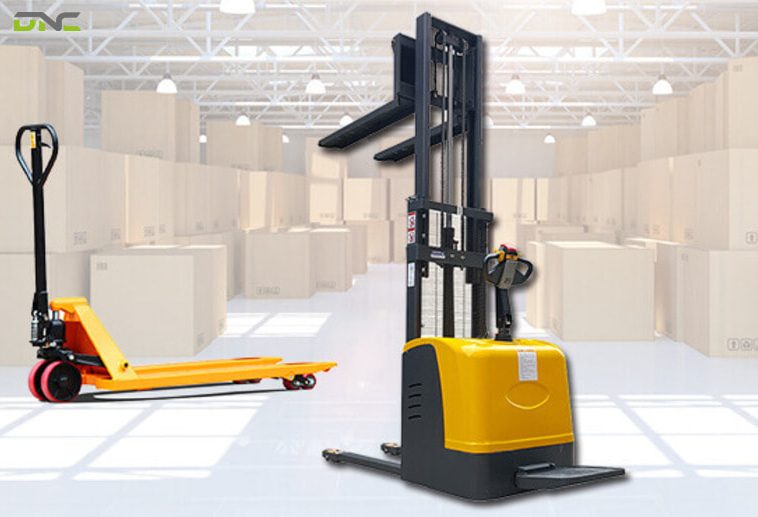
Hydraulic pallet trucks — the most fundamental pallet handling tool in every Malaysian warehouse — lift and transport pallets using a hydraulic pump mechanism operated by hand or electric power. With load capacities ranging from 1,000 kg for lightweight models to 5,000 kg for heavy-duty industrial units, hydraulic pallet trucks move an estimated 80% of all palletised goods at floor level in Malaysian manufacturing and distribution facilities. This guide covers the hydraulic operating principle, truck types (manual, electric, weigh-scale, low-profile, stainless steel), specifications, selection criteria, and the integration point where manual pallet trucks transition to automated handling systems. DNC Automation — while primarily an automation integrator — designs material handling solutions that identify where manual pallet trucks remain appropriate and where automation delivers superior ROI.
What Is a Hydraulic Pallet Truck?
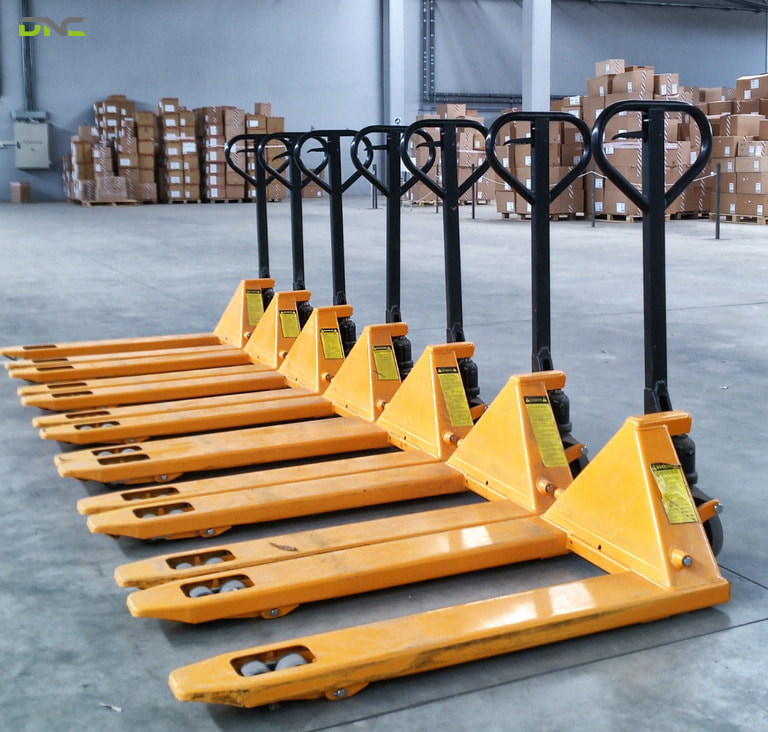
A hydraulic pallet truck (also called a pallet jack) is a wheeled platform tool that slides its forks under a pallet, raises the pallet off the floor using a hydraulic pump, and allows an operator to push or pull the loaded pallet to a destination. The hydraulic mechanism converts manual pumping action (or electric motor force) into lifting force through a sealed hydraulic cylinder and fluid system.
Hydraulic pallet trucks are classified as “Class III” industrial trucks under ISO 5053 — pedestrian-operated, ground-level handling equipment. They are the simplest, most cost-effective pallet handling tool available: no fuel, no battery (manual versions), no licence requirement, and no maintenance beyond periodic hydraulic fluid checks and wheel replacement.
The standard manual hydraulic pallet truck has remained fundamentally unchanged for 60+ years — a testament to the effectiveness of its simple engineering. However, the Malaysian market now offers variants that significantly extend the basic tool’s capability: electric-powered trucks (eliminating operator fatigue on long transport routes), weigh-scale trucks (integrating weighing into the transport cycle), low-profile trucks (handling pallets with reduced clearance), and stainless steel trucks (for food-grade and washdown environments).
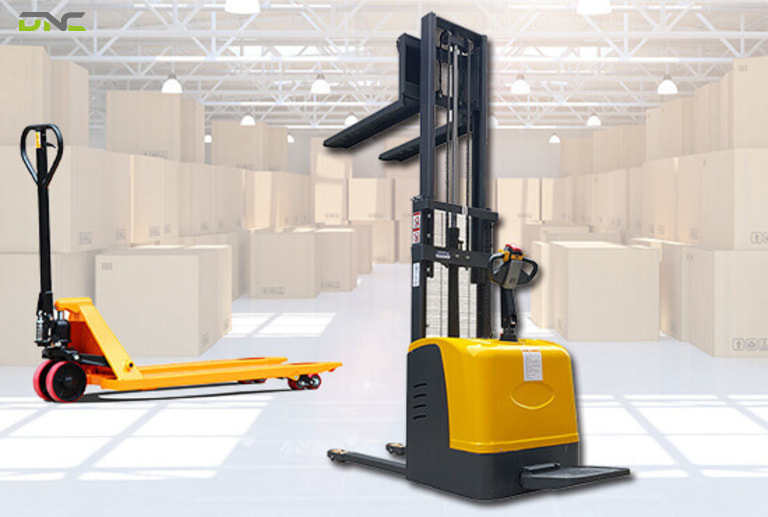
In the context of warehouse automation, hydraulic pallet trucks serve as the “last metre” handling tool — moving pallets between conveyor endpoints, racking locations, and staging positions where automated systems cannot economically reach. Even highly automated facilities maintain fleets of hydraulic pallet trucks for flexibility, backup, and short-distance handling.
What Is a Hydraulic Pallet Truck?
How Does a Hydraulic Pallet Truck Work?
Hydraulic Lifting Mechanism
The hydraulic pallet truck’s lifting mechanism uses Pascal’s principle: pressure applied to a confined fluid transmits equally in all directions. When the operator pumps the truck handle, a small piston in the pump cylinder pressurises hydraulic fluid (typically ISO VG 32 hydraulic oil). This pressurised fluid flows to a larger lift cylinder under the truck fork assembly. Because the lift cylinder has a larger diameter than the pump cylinder, the mechanical advantage multiplies the operator’s pumping force — typically by 10–25×.
Pumping mechanics: A standard manual pump requires 15–25 pump strokes to raise a loaded pallet 200 mm. Each stroke delivers 10–20 ml of hydraulic fluid at 10–15 MPa pressure. The lift cylinder converts this hydraulic energy into vertical force — generating 20,000–50,000 N (2–5 tonnes) of lifting force from hand-operated pumping.
Lowering mechanism: A release valve (operated by the truck handle lever) opens the hydraulic circuit, allowing fluid to flow back from the lift cylinder to the reservoir. The pallet lowers under its own weight at a controlled rate governed by the valve orifice size. Quality trucks include a proportional lowering valve — faster opening = faster descent — for precise positioning.
Fork Entry and Pallet Engagement
The truck’s forks (tines) are tapered at the leading edge to slide under pallet openings. Standard fork dimensions: 1,150–1,220 mm length × 160–180 mm width × 55–85 mm thickness (lowered height). Fork spacing: 520–685 mm adjustable or fixed, matching standard pallet entry dimensions.
Fork height range: 55–85 mm (lowered) to 190–205 mm (raised). This 115–150 mm lift height is sufficient to clear the pallet off the floor for transport while keeping the centre of gravity low for stability.
Steering and Transport
Manual pallet trucks use a tiller handle for steering — the operator pushes, pulls, and steers from the rear of the truck. The front wheels (fork-end) are load-bearing rollers or polyurethane wheels; the rear wheels (handle-end) are steering wheels that swivel 180°+ for manoeuvrability.
Turning radius: 1,500–2,100 mm depending on truck length and steering geometry. Electric-powered pallet trucks use a drive motor on the steering wheel — the operator walks behind or rides on a fold-down platform while the motor provides propulsion.
Types of Hydraulic Pallet Trucks
Manual Hydraulic Pallet Truck (Standard)
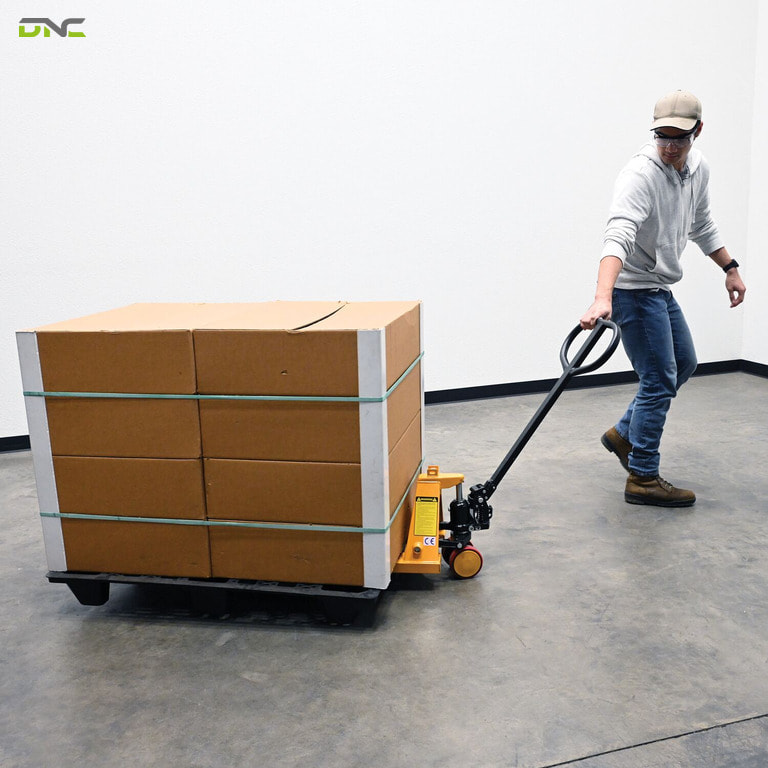
The basic hand-operated pallet jack. The operator pumps the handle to lift and manually pushes/pulls to transport. No motor, no battery, no charger.
Specifications:
- Load capacity: 2,000–3,000 kg (standard); 5,000 kg (heavy-duty)
- Fork length: 1,150 mm (standard) or 1,220 mm
- Fork width: 160–180 mm per fork
- Lowered height: 55–85 mm
- Raised height: 190–205 mm
- Weight: 55–75 kg
- Cost: RM 500–2,500
Best for: Short-distance transport (< 30 m), low-volume operations (< 50 pallets/shift), loading dock work, retail backroom handling.
Electric Hydraulic Pallet Truck (Powered)
Battery-powered motor provides both lifting (electric hydraulic pump) and propulsion (drive wheel motor). The operator walks behind and steers; some models include a fold-down ride-on platform for longer transport distances.
Specifications:
- Load capacity: 1,500–3,000 kg
- Travel speed: 4–6 km/h (walk-behind); 6–8 km/h (ride-on)
- Battery: 24V lead-acid or lithium-ion, 8–12 hour operation
- Weight: 100–250 kg
- Cost: RM 5,000–25,000
Best for: Medium-distance transport (30–100 m), moderate volume (50–200 pallets/shift), operators handling pallets continuously through a shift. Eliminates operator fatigue from pumping and pushing heavy loads.
Weigh-Scale Pallet Truck
Manual or electric pallet truck with an integrated weighing system — load cells in the fork assembly measure pallet weight during lifting. A digital display shows weight in real time, and some models transmit data wirelessly to WMS.
Specifications:
- Weighing capacity: 500–3,000 kg
- Accuracy: ±0.1–0.5% of full scale
- Display: LED/LCD with tare, hold, and total functions
- Data output: Bluetooth, Wi-Fi, or RS-232 to WMS
- Cost: RM 3,000–15,000
Best for: Receiving inspection (verify incoming pallet weights), shipping verification, inventory counting, production batching. Eliminates separate floor scale weighing — saving 30–60 seconds per pallet and eliminating double handling.
Low-Profile Pallet Truck
Reduced fork height (33–51 mm lowered) for handling pallets with minimal ground clearance — including display pallets, printer pallets, and custom low-profile pallets.
Specifications:
- Lowered height: 33–51 mm (versus 55–85 mm standard)
- Load capacity: 1,000–2,500 kg
- Cost: RM 1,500–5,000
Best for: Handling pallets with less than 80 mm opening height. Common in retail, print/packaging, and display logistics.
Stainless Steel Pallet Truck
Fully stainless steel construction (304 or 316 grade) for food-grade environments, pharmaceutical clean areas, and chemical handling where corrosion resistance and washdown capability are required.
Specifications:
- Material: 304 SS (food-grade) or 316 SS (chemical-resistant)
- Load capacity: 1,000–2,500 kg
- IP rating: Suitable for washdown environments
- Cost: RM 3,000–12,000
Best for: Food manufacturing (MeSTI, HACCP compliance), pharmaceutical (GDP environments), chemical handling, and any application requiring regular washdown cleaning. Malaysian F&B manufacturers increasingly specify stainless steel pallet trucks for halal-certified production areas.
Scissor Lift Pallet Truck
Combines standard pallet truck mobility with a scissor lift mechanism that raises pallets to ergonomic working height (300–800 mm). Used for pallet-level picking, assembly feeding, and workstation supply.
Specifications:
- Lift height: 300–800 mm above floor
- Load capacity: 500–1,500 kg
- Cost: RM 2,000–8,000
Best for: Order picking, production line feeding, ergonomic workstation supply. Reduces bending and reaching — addressing the musculoskeletal injury risk that is the leading warehouse workplace health issue in Malaysia.
Types of Hydraulic Pallet Trucks
Key Components
Hydraulic Pump Assembly
The pump is the core mechanism converting operator effort into lifting force. Quality differentiators: pump piston material (chromed steel for durability), seal material (polyurethane for leak resistance), and valve precision (determines lowering control quality). Premium pumps deliver 30,000+ cycle life; budget pumps may fail at 10,000 cycles.
Fork Assembly
Stamped or welded steel fork tines carrying the pallet load. Fork material: high-strength structural steel (S355 equivalent). Fork tip profile: tapered for easy pallet entry. Weld quality at the fork-to-chassis junction is the primary structural failure point — inspect welds annually for cracks on heavily used trucks.
Wheels
Load wheels (fork end): Single or tandem polyurethane or nylon rollers, 80–100 mm diameter. Polyurethane provides quieter operation and better floor protection; nylon handles higher loads in dirty environments.
Steering wheels (handle end): Larger polyurethane or rubber wheels, 160–200 mm diameter, providing traction and manoeuvrability. Steering wheel bearing quality determines turning effort — sealed precision bearings reduce operator fatigue significantly.
Chassis and Frame
Welded steel chassis connecting the hydraulic pump, forks, and steering assembly. Chassis design determines truck durability — critical dimensions include fork root thickness (where forks meet the chassis) and pump mounting reinforcement. Standard powder coat finish; galvanised or stainless for corrosive environments.
Applications in Malaysian Warehouses
Loading Dock Operations
Pallet trucks are the primary tool for loading and unloading trucks at Malaysian warehouse docks. Dock workers use manual pallet trucks to pull pallets from truck beds onto the dock — a task requiring 200–500 pallet movements per dock door per day. Electric pallet trucks reduce operator fatigue on high-volume docks; weigh-scale trucks enable receiving weight verification without separate scale stations.
Production Line Material Supply
Manufacturing operators use pallet trucks to move material pallets from staging areas to production line-side positions. Short-distance transport (10–30 m) at moderate frequency suits manual trucks. Longer routes or continuous supply requirements justify electric trucks.
Warehouse Internal Transport
General pallet movement within the warehouse: aisle-to-aisle transfer, zone-to-zone relocation, inventory reorganisation. Pallet trucks serve as the flexible handling tool that goes where conveyors cannot justify the infrastructure cost.
Retail Backroom and Store Operations
Malaysian retail chains (AEON, Tesco, Giant) use pallet trucks in store backrooms and distribution centres for receiving, staging, and floor replenishment. Low-profile trucks handle retail display pallets; weigh-scale trucks verify shipment weights at receiving.
“Last Metre” in Automated Facilities
Even highly automated facilities use pallet trucks for the final short-distance movements that automation cannot economically cover: moving pallets from conveyor endpoints to final storage positions, transferring pallets between automated zones during maintenance, and handling exception pallets that the automated system rejects.
Benefits
Lowest cost pallet handling. Manual pallet trucks cost RM 500–2,500 — less than a single day’s forklift rental. The total cost of ownership for a manual truck is RM 100–300/year (replacement wheels and hydraulic fluid).
Zero infrastructure requirement. Pallet trucks operate on any smooth floor surface — no rails, no guide wires, no charging stations, no floor preparation.
Immediate deployment. No installation, no commissioning, no programming. Pallet trucks are operational the moment they arrive at the facility.
Operator safety. Ground-level operation with walking speed eliminates the tipping, collision, and falling load hazards associated with forklift operation. DOSH incident data shows pallet truck injuries are 90% less severe than forklift incidents.
Versatility. A single pallet truck handles any standard pallet in any warehouse zone — production floor, cold room, loading dock, clean room (stainless steel models). No zone restrictions, no aisle width constraints.
Applications in Malaysian Warehouses
When to Transition from Pallet Trucks to Automation
Hydraulic pallet trucks are the right tool for low-volume, short-distance, and flexible pallet handling. However, three indicators signal the transition point to automated handling:
Volume exceeds 100 pallets/shift per operator. At this volume, manual pallet truck operation causes operator fatigue, repetitive strain injury risk, and throughput bottlenecks. Electric pallet trucks extend the transition point; beyond 200 pallets/shift, conveyor or AGV automation delivers superior economics.
Transport distance exceeds 50 m per trip. Long-distance pallet transport by manual truck is physically unsustainable across a shift. Electric trucks extend the distance threshold to 100 m. Beyond 100 m, conveyors or AGVs provide faster, more efficient transport.
Consistency is critical. If pallet delivery timing must be predictable (JIT production feeding, dock scheduling, automated storage interface), manual pallet trucks introduce too much variability. Conveyors deliver fixed cycle times; AGVs deliver predictable routes.
DNC Automation evaluates material handling operations to identify which zones benefit from continued manual pallet truck use and which zones justify automation investment — ensuring every ringgit of automation budget delivers maximum ROI.
FAQ — Hydraulic Pallet Truck
What is a hydraulic pallet truck?
A hydraulic pallet truck (pallet jack) is a floor-level pallet handling tool that uses a hydraulic pump to lift pallets 115–150 mm off the ground for horizontal transport. The operator pumps the handle to lift and pushes/pulls to move. Standard load capacity: 2,000–3,000 kg. Cost: RM 500–2,500 for manual; RM 5,000–25,000 for electric models.
How much weight can a hydraulic pallet truck carry?
Standard manual pallet trucks carry 2,000–3,000 kg. Heavy-duty models carry up to 5,000 kg. Electric pallet trucks carry 1,500–3,000 kg. The rated capacity applies when the load centre is within the fork length and the load is evenly distributed. Overloading damages the hydraulic pump seal and may cause fork structural failure — never exceed the rated capacity displayed on the truck’s data plate.
What is the difference between manual and electric pallet trucks?
Manual pallet trucks use hand-pumped hydraulics for lifting and operator push/pull for transport — no battery, no motor, RM 500–2,500 cost. Electric pallet trucks use battery-powered hydraulic pumps and drive motors — RM 5,000–25,000 cost, 4–8 km/h travel speed, 8–12 hour battery life. Choose manual for short distance (< 30 m), low volume (< 50 pallets/shift). Choose electric for longer distances, higher volumes, or operator fatigue reduction.
How much does a pallet truck cost in Malaysia?
Manual hydraulic: RM 500–2,500. Electric walk-behind: RM 5,000–15,000. Electric ride-on: RM 15,000–25,000. Weigh-scale: RM 3,000–15,000. Stainless steel: RM 3,000–12,000. Low-profile: RM 1,500–5,000. Scissor lift: RM 2,000–8,000. Price varies by load capacity, brand, and special features.
How do I maintain a hydraulic pallet truck?
Monthly: check hydraulic oil level, inspect fork tips for damage, verify wheel condition. Quarterly: test lowering valve operation, grease steering pivot, check chain/linkage tension. Annually: replace hydraulic oil (ISO VG 32), inspect all welds for cracks, replace worn wheels. Wheel replacement is the most common maintenance item — polyurethane load wheels typically last 12–24 months under standard use.
What is a weigh-scale pallet truck?
A weigh-scale pallet truck integrates load cells into the fork assembly, displaying pallet weight on a digital indicator during lifting. Accuracy: ±0.1–0.5% of full scale. Features: tare function, weight hold, cumulative total, and wireless data transmission to WMS. Cost: RM 3,000–15,000. Eliminates separate floor scale weighing — saving 30–60 seconds per pallet and reducing double handling.
When should I upgrade from pallet trucks to automated handling?
Consider automation when: pallet volume exceeds 100–200 per shift per operator, transport distance exceeds 50–100 m per trip, delivery timing must be consistent (JIT feeding, dock scheduling), or operator injury risk from repetitive handling becomes a safety concern. DNC Automation provides free material handling assessments that identify the cost-optimal transition point between manual and automated handling for your specific operation.
Conclusion
Hydraulic pallet trucks remain the essential, irreplaceable foundation tool for pallet handling in every Malaysian warehouse and factory — handling short-distance, flexible, and low-volume pallet movements that automated systems cannot economically address. Understanding the full range of available types — manual, electric, weigh-scale, low-profile, stainless steel, and scissor lift — ensures every handling requirement is matched to the optimal tool.
DNC Automation designs material handling solutions that integrate manual pallet truck zones with automated conveyor, AGV, and robotic handling — creating hybrid systems where each technology handles the task it does best. Our assessment identifies where RM 1,000 pallet trucks are the right answer and where RM 500,000 conveyor systems deliver superior ROI — ensuring every automation ringgit generates maximum return.
- 6 views
- 0 Comment
Recent Comments