



Motorised Roller Conveyor: MDR Zones, ZPA Accumulation, and Selection Guide
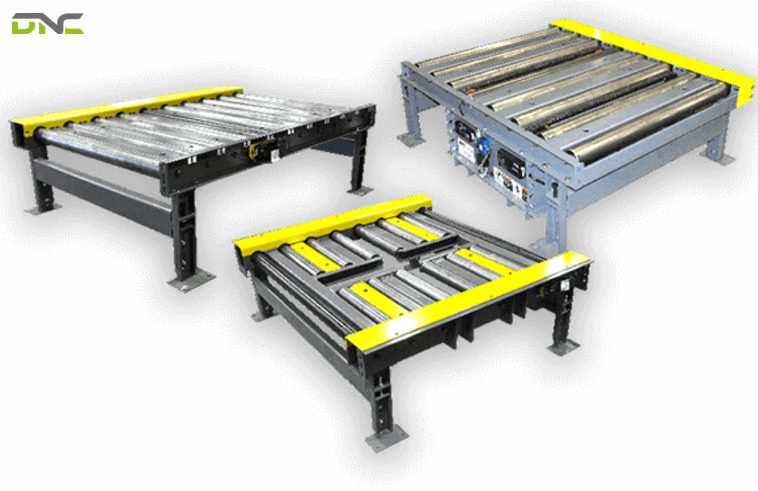
A motorised roller conveyor (also spelled motorized roller conveyor) uses individually powered rollers — each containing a 24VDC or 48VDC brushless motor inside the roller tube — to transport products along a conveyor without a central drive shaft or overhead chain. Each motorised roller drives a zone of 3–6 passive rollers via O-rings or poly-V belts, creating independently controllable conveyor zones that start, stop, accelerate, and decelerate on demand.
This zone-based motor-driven roller (MDR) architecture is the enabling technology for zero pressure accumulation (ZPA) — where products accumulate on the conveyor without touching each other and without back-pressure damage. For Malaysian warehouse operators, e-commerce fulfilment centres, and electronics assembly lines, MDR conveyor systems have replaced conventional line-shaft and belt-under-roller conveyor systems as the standard for intelligent, energy-efficient product transport.
Motor-Driven Roller (MDR) Technology: How It Works
Each MDR zone consists of:
Drive roller: A standard roller with a brushless 24VDC or 48VDC motor sealed inside the tube. The motor stator is fixed to the roller shaft (fixed to the conveyor frame); the motor rotor drives the roller tube. Power and signal are connected through the fixed shaft ends via cables — no brushes, no maintenance.
Passive rollers: 3–6 additional rollers in the zone, driven by O-rings or poly-V belts connected to the drive roller. The drive roller turns; its neighbours turn at the same speed via the mechanical coupling.
Zone controller/driver card: A small electronic board mounted on the conveyor frame converts 24VDC supply power into the motor drive signal and communicates with the PLC or conveyor controller via I/O or network bus (24VDC I/O, AS-i, PROFINET, EtherNet/IP). The controller starts and stops the zone based on product presence sensor signals.
Photosensor: Typically a reflective photoelectric sensor detects whether a product is present at the zone’s downstream end. If the downstream zone is occupied (product waiting), the upstream zone stops. If the downstream zone clears, the upstream zone starts — passing the product forward.
Result: Products travel from zone to zone, stopping and starting independently. A product waiting in Zone 3 does not push against or contact the product in Zone 2 — zero pressure accumulation.
Zero Pressure Accumulation (ZPA): Why It Matters
Conventional accumulation conveyors (live roller with friction clutch zones) allow products to accumulate, but with contact pressure between stopped products and slow-moving rollers. Back-pressure — the force accumulated products exert on each other — causes:
- Carton crushing for lightweight or fragile packaging
- Label smearing and barcode damage from sustained contact pressure
- Product shifting inside cartons from the force of accumulation
ZPA eliminates all three: Because each zone stops completely when its downstream zone is occupied, there is zero contact force between accumulated products. This makes ZPA MDR conveyors mandatory for:
- Fragile electronics (PCB panels, assembled products in retail packaging)
- Lightweight cartons that would be crushed by 10–20 kg of accumulated pressure
- Products where barcode readability after accumulation is a scan-rate requirement
- High-value products where any damage triggers recall or rework costs
ZPA zone types (control logic variations):
Standard ZPA (Single Zone Release): One product releases per zone trigger. When downstream clears, the directly upstream zone releases one product, then waits for the next zone-clear signal.
Slug (Batch) Release: Multiple zones release simultaneously on a single downstream clear signal — moving a batch of products forward at once. Used when throughput is more important than individual product separation.
Singulation: Products enter at random spacing; the MDR system automatically spaces them at defined intervals for sorter or scanning operations. Requires higher-speed zones and inter-zone timing logic.
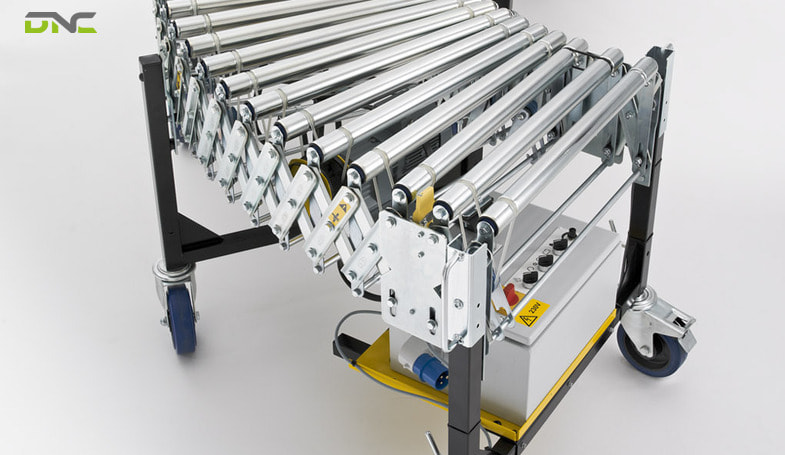
Zero Pressure Accumulation (ZPA): Why It Matters
MDR Conveyor Specifications
Motor Voltage: 24VDC vs 48VDC
24VDC MDR: The dominant standard for light-to-medium conveyor loads. Motor output: 35–50W per drive roller. Maximum zone load capacity: 50–100 kg per zone (depending on roller diameter and zone length). Maximum belt speed: 0.5–1.5 m/s. Safe voltage for personnel — no lockout-tagout required for roller access in most jurisdictions.
48VDC MDR: Higher voltage = higher power per motor without increasing current draw. Motor output: 100–200W per drive roller. Zone load: 150–500 kg. Speed: up to 2.5 m/s. Used for heavy cartons, totes, and warehouse operations with high throughput requirements.
Roller Specifications
| Parameter | Light Duty | Medium Duty | Heavy Duty |
| Roller OD | 50 mm | 60 mm | 89 mm |
| Roller pitch | 75–100 mm | 100–150 mm | 150–250 mm |
| Zone load | 20–50 kg | 50–200 kg | 200–500 kg |
| Drive voltage | 24VDC | 24VDC or 48VDC | 48VDC |
| Speed range | 0.1–1.0 m/s | 0.1–1.5 m/s | 0.1–2.5 m/s |
Roller pitch selection: The product must always be in contact with at least 3 rollers simultaneously to maintain stable orientation and transfer. Minimum zone length = 3 × roller pitch. Minimum product dimension (in direction of travel) ≥ 3 × roller pitch + 50 mm clearance.
Zone Length
Minimum zone length = product length in direction of travel + 150 mm (50 mm front clearance + 100 mm sensor dead zone). If products vary in size, size the zone to the longest product. Standard zone lengths: 600 mm, 900 mm, 1,200 mm, 1,500 mm, 1,800 mm.
MDR Conveyor Types
Flat Zone Roller Conveyor (Standard MDR)
The baseline configuration: straight, horizontal sections of MDR zones. Suitable for most distribution centre and light manufacturing applications.
Frame: Aluminium profile (light duty, quick assembly) or galvanised steel channel (heavy duty, long-term installation).
Standard widths: 300, 400, 500, 600, 750, 900, 1,050 mm between frames.
Curve MDR Conveyor
Horizontal curves (30°, 45°, 60°, 90°) using tapered rollers — wider at the outside of the curve than the inside — to maintain constant product speed across the curve width without the product spinning or sliding.
Minimum curve radius: 600 mm (tight curve, small products); 1,500 mm (standard); 2,000 mm (large cartons or pallets).
Curve MDR note: Curve zones require separate drive rollers on inside and outside rails to compensate for different travel distances — not simple O-ring coupling.
Incline / Decline MDR Conveyor
MDR incline conveyors typically handle grades up to 15° with standard O-ring drives; steeper inclines (up to 20°) require cleated belts or higher-friction roller surfaces.
Decline ZPA: Critical for safe operation — products must decelerate at the bottom of a decline rather than accelerating under gravity. MDR decline zones use controlled braking (motor regeneration) to maintain constant speed on declines.
Merge and Divert MDR
MDR zones integrate with 30°/45° merge and divert units — pop-up transfers, belt transfers, or shoe sorters — to route products between conveyor lines. Zone control logic manages timing and spacing to prevent product jams at merge points.PLC and Controls Integration
Standalone zone control: Each zone driver card handles ZPA logic independently using sensor inputs — no PLC required for basic accumulation operation. Simple, low-cost, fast commissioning.
PLC integration: For complex routing (merge/divert, multiple destinations), tracking (product serial number to zone position), and MES connectivity, MDR zones connect to Siemens S7-1500 or Allen-Bradley PLC via PROFINET, EtherNet/IP, or DeviceNet. Each zone driver reports its status (running, stopped, fault, product present) and accepts speed and run/stop commands.
Warehouse Control System (WCS): Large distribution centres run MDR conveyor networks under a WCS layer — software that manages flow between receiving, storage, picking, pack, and dispatch zones. The WCS integrates with WMS (Warehouse Management System) to direct carton routing based on order data.
DNC Automation integrates MDR conveyor systems with Siemens S7-1500 PLCs and WinCC SCADA, providing real-time zone status monitoring, throughput counting, and fault diagnostics — with OPC-UA connectivity to customer WMS/MES.
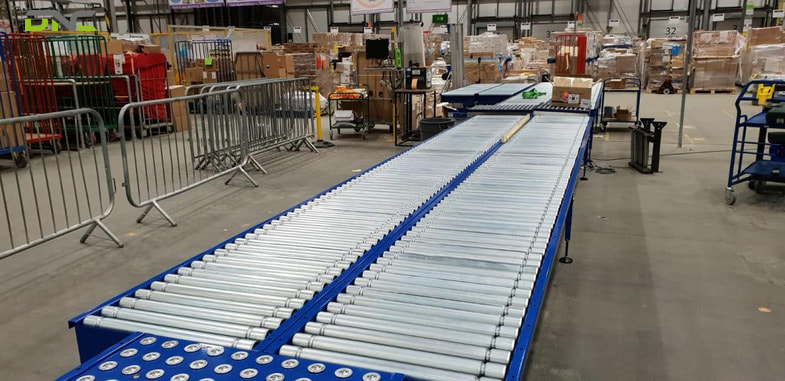
The baseline configuration: straight, horizontal sections of MDR zones. Suitable for most distribution centre and light manufacturing applications.
Energy Efficiency: MDR vs. Conventional Conveyor
Conventional line-shaft or belt conveyor: All rollers run continuously regardless of product presence — motor runs at full load even on an empty conveyor. A 50-metre empty conveyor consumes the same power as a fully loaded one.
MDR ZPA: Each zone motor runs only when its zone is occupied or when a product is passing through. Empty zones consume zero power (motor stopped). Measured energy savings versus continuous-run conveyors: 50–70% reduction in conveyor energy consumption for typical e-commerce distribution centre load profiles (where conveyors are empty 30–60% of the time).
For a 100-zone MDR conveyor system at Malaysian industrial electricity rates (RM 0.30–0.45/kWh), the energy saving can amount to RM 20,000–50,000/year versus an equivalent conventional conveyor.
Malaysian Applications
E-Commerce and Logistics Fulfilment
Malaysia’s e-commerce sector — Shopee, Lazada, PG Mall, and thousands of brand direct-to-consumer operations — drives demand for high-throughput order fulfilment conveyors in Klang Valley, Penang, and Johor distribution centres.
MDR ZPA conveyors in fulfilment centres handle:
- Receiving sorter infeed (5–20 kg totes and cartons)
- Pick zone accumulation (zero back-pressure on fragile product cartons)
- Pack station accumulation (products queue without contact while being packed)
- Dispatch sorter infeed (100–2,000 cartons/hour throughput)
Electronics Assembly (Penang, Selangor)
Electronics manufacturers use MDR conveyors for finished product transfer from assembly to testing and packaging — where PCB assemblies in retail packaging require zero-pressure accumulation before scan-and-pack stations to prevent barcode damage.
Automotive Parts Distribution
Tier-1 and Tier-2 automotive parts suppliers in Shah Alam and Subang use MDR conveyors in their aftermarket parts distribution operations — handling mixed carton sizes and weights with ZPA to prevent crushing of lighter cartons under heavier ones.
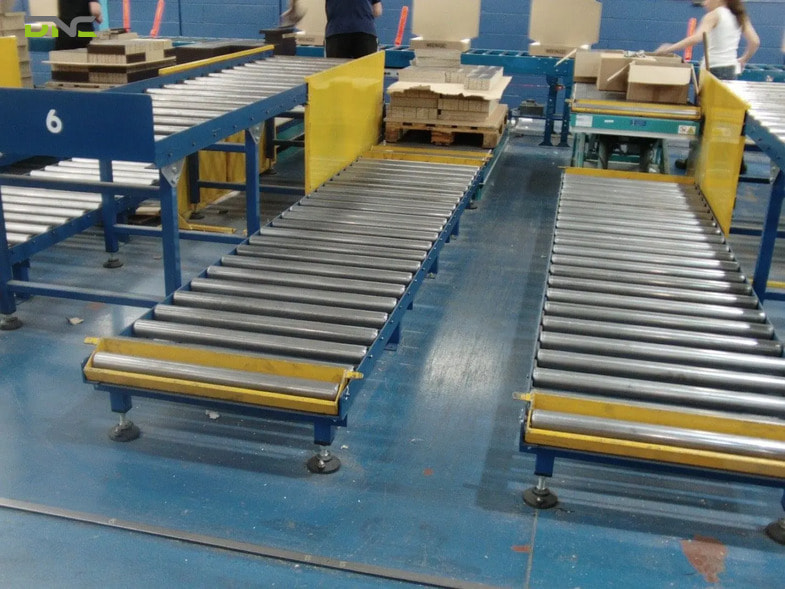
Malaysian Applications
Maintenance
MDR conveyor maintenance is substantially lower than conventional conveyors:
No drive shaft, no shaft bearings to lubricate, no V-belts or timing belts to tension and replace. The primary maintenance items:
O-rings and poly-V belts: Inspect monthly; replace when stretched beyond 15% elongation or when showing cracking. Standard replacement interval: 24–36 months at 2-shift operation.
Drive rollers: Brushless motors are sealed for life — no internal lubrication. The primary failure mode is bearing wear (5–10 years at rated load). Failed drive rollers are replaced as a unit (roller + motor assembly) in under 10 minutes without tools.
Zone sensors: Clean photosensor lenses monthly in dusty environments; verify sensing distance at product change. Failed sensors replaced in <5 minutes with plug-in connectors.
Zone driver cards: Low failure rate (typically <0.1%/year in clean environments). Failed cards plug-and-play replacement — no programming required.
DNC Automation’s MDR Conveyor Solutions
DNC Automation designs and integrates motorised roller conveyor systems for Malaysian distribution centres, electronics manufacturers, and automotive logistics operations.
System design scope: Layout design and simulation, zone length calculation for product mix, speed and throughput analysis, ZPA logic configuration, PLC integration (Siemens S7-1500/PROFINET), and WMS/MES connectivity.
Products supplied: Hytrol, Interroll, and Itoh Denki MDR conveyor systems — 24VDC and 48VDC, light to heavy-duty, standard and food-grade (stainless steel and aluminium profile options).
MIDA SAG grant: MDR conveyor systems for distribution and logistics automation qualify for MIDA’s Strategic Automation Grant (up to RM 1 million, 50% qualifying capex). DNC assists clients with grant application and technical documentation.
Contact DNC Automation for MDR conveyor layout design, throughput simulation, and turnkey system proposals.
Summary
Motorised roller conveyors with zone-based MDR technology deliver zero pressure accumulation, 50–70% energy savings, and substantially lower maintenance than conventional conveyor systems — at the cost of higher initial per-metre investment. The architecture is the standard choice for Malaysian e-commerce fulfilment, electronics assembly, and automotive logistics operations where product safety, intelligent routing, and energy efficiency outweigh the initial cost premium. Correct zone sizing, voltage selection, and PLC integration determine whether the system achieves its full throughput and reliability potential.
- 7 views
- 0 Comment
Recent Comments