



Overhead Conveyor Systems: Types, Applications & Integration Guide
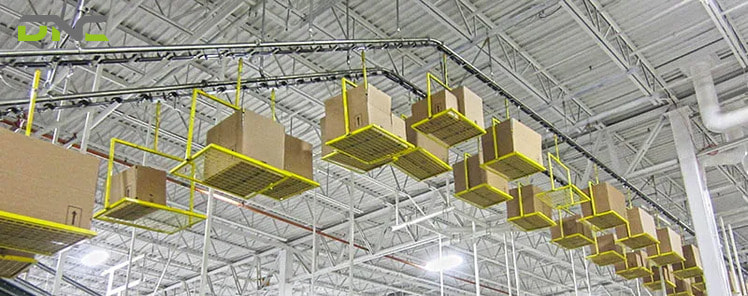
Overhead conveyor systems move products through the vertical dimension of a factory — suspending loads from ceiling-mounted tracks and freeing the floor space below for workers, forklifts, and other equipment. In Malaysian manufacturing, overhead conveyors are the enabling infrastructure for automotive paint lines, rubber glove dipping operations, garment handling, and any production process where floor-based conveyors cannot serve: where products must be coated, cured, dried, or processed while hanging, or where factory layouts demand transport paths that cross over other production activities.
This guide covers how overhead conveyor systems work, the configurations used in Malaysian industries, the specifications that determine load capacity and throughput, and the integration requirements that turn a suspended chain into a controlled, PLC-driven production system.
What Is an Overhead Conveyor?
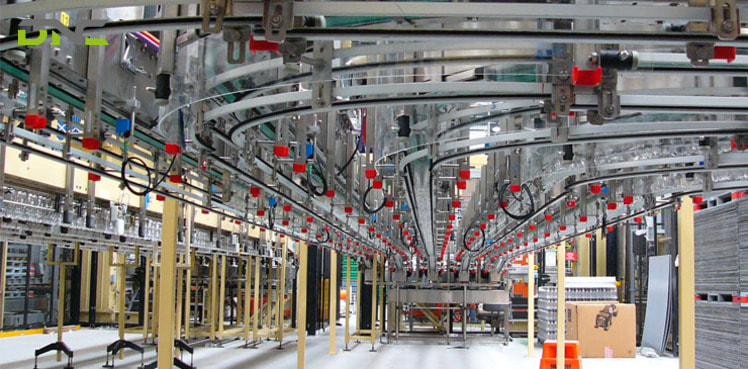
An overhead conveyor is a material handling system that suspends loads from carriers or trolleys running along a ceiling-mounted track — moving products through a factory at height, above floor-level operations. The track is mounted to the building structure (ceiling, columns, or dedicated overhead steel framework), with the transport chain or cable running within or along the track profile.
Overhead conveyors serve applications that floor-based conveyor systems cannot:
- Coating and painting — products hang freely for full 360° coating access, with no belt or roller contact that would mar the surface
- Drying and curing — products travel through oven tunnels suspended, allowing hot air circulation on all surfaces simultaneously
- Cooling — overhead loops in ambient or cooled areas allow products to cool while in transit, saving floor space
- High-density transport — carriers on overhead tracks use ceiling space that would otherwise be unused, increasing factory throughput per square meter of floor
The overhead conveyor system’s defining characteristic — suspending the load from above — creates a fundamentally different transport dynamic from floor conveyors. Product access from all sides, gravity-assisted dripping and drainage, and complete floor clearance are operational advantages no floor-based conveyor can replicate.
How an Overhead Conveyor System Works
Drive Mechanism
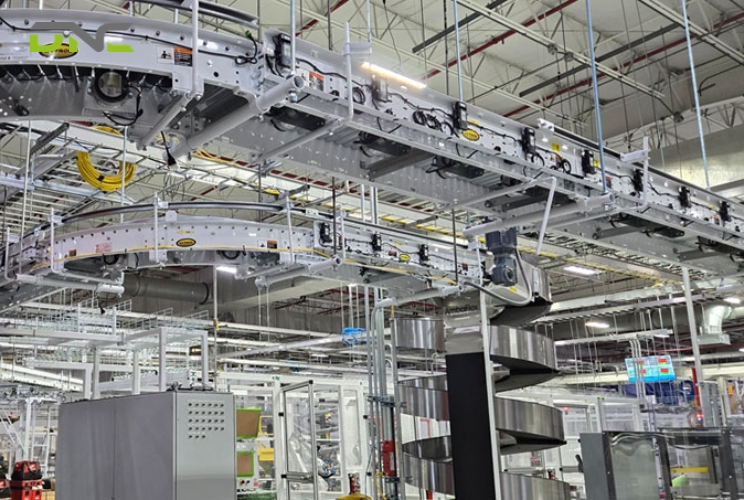
Overhead conveyor systems use a continuous chain, cable, or drive tube running within a C-section or I-beam track. A drive unit (motorized sprocket or drive wheel assembly) pulls the chain continuously; trolleys or carriers are attached to the chain at defined intervals and carry the load hooks or product fixtures.
Chain speed: Typically 1–15 m/min for process lines (paint, dip, cure); up to 30 m/min for transport-only overhead conveyors.
Drive unit location: Usually at a high-tension point in the loop — typically at a horizontal curve or vertical incline. Large overhead conveyor systems use multiple drive units at intervals to manage chain tension across the full circuit.
Load Carriers and Hooks
The carrier is the mechanical interface between the overhead conveyor chain and the suspended product. Carrier design is critical — it must support the product weight, maintain correct product orientation throughout the conveyor path (including inclines, declines, and horizontal curves), and withstand process temperatures and chemical exposure (for paint or dip operations).
Carrier types:
- Simple hook carrier — a straight hook for hanging garments, parts, or fixtures
- Crossbar carrier — horizontal bar with multiple hanging points; distributes load and carries multiple items
- Platform carrier (bucket/cradle) — enclosed carrier for products that cannot be hung (bottles, small parts)
- Adjustable-pitch carrier — spacing between carriers adjusts on-the-fly for varying load sizes
Track and Path Design
Overhead conveyor tracks are designed in three-dimensional paths — horizontal turns, vertical inclines, declines, and dips — allowing the conveyor circuit to navigate around building columns, pass through oven tunnels at elevated temperature zones, and return empty carriers to the loading point in a continuous loop.
Track types:
- I-beam monorail — simple load-bearing I-beam; trolleys roll on the lower flange. Most economical, limited to power-and-free applications.
- Enclosed track (C-channel) — chain runs inside the track; trolleys extend below. Protected from contamination; common in paint applications.
- Tubular track — round tube profile; used for light-duty applications and cleanroom environments.
Types of Overhead Conveyor Systems
1. Power-Only (Continuous Chain) Overhead Conveyor
The simplest overhead conveyor type — all carriers are attached to a continuously moving chain at fixed spacing. All loads move at the same constant speed and cannot be stopped independently.
Characteristics:
- All carriers move at chain speed simultaneously
- No accumulation capability — if one carrier stops, the whole circuit stops
- Lowest cost and maintenance overhead
- Suitable for: continuous-flow processes (dip coating, drying tunnels, painting), garment handling, simple part transport
Applications in Malaysia:
- Automotive paint lines (sealer, primer, topcoat)
- Rubber glove dipping lines — carriers move continuously through latex dip tanks
- Garment factories — hanging transport of cut fabric or finished garments
- Dry-cleaning operations
Specifications:
- Chain load: 50–5,000 kg total chain pull
- Carrier spacing: fixed, 100 mm–2,000 mm
- Speed: 1–15 m/min
- Track gauge: 3″ (76 mm) most common for light-medium loads; 4″ (102 mm) heavy duty
2. Power-and-Free (P&F) Overhead Conveyor
The power-and-free overhead conveyor separates the drive chain from the load carriers — a continuously moving powered chain runs in the upper track, while free trolleys carrying loads travel in a lower track. Pusher dogs on the powered chain engage with the free trolleys to drive them; a stop mechanism can disengage the trolley, allowing accumulation while the drive chain continues moving.
Key advantages over power-only:
- Individual carriers can stop, accumulate, and re-engage independently
- Carriers can be switched between conveyor lines (diverts)
- Buffer accumulation before workstations without stopping the drive chain
- Load sequencing and routing based on carrier ID tags (RFID)
Applications:
- Automotive assembly (body-in-white, trim assembly, final assembly)
- Heavy industrial component processing (sandblasting, painting, powder coating)
- Any process requiring carrier accumulation or routing to multiple destinations
Specifications:
- Carrier load: 100–10,000 kg per carrier (heavy-duty P&F for automotive)
- Accumulation: unlimited (within track length)
- Control: PLC with carrier ID reading (RFID or barcode) for routing decisions
3. Inverted Overhead Conveyor (Floor-Level Track, Elevated Load)
The inverted overhead conveyor runs the track at floor level with the carrier arm extending upward — the inverse of standard overhead conveyors. This configuration allows heavy, unstable loads to be transported stably at floor level while the track infrastructure remains on the ground.
Applications: Automotive body transport between paint and assembly buildings, heavy equipment manufacturing
4. Electric Monorail System (EMS)
EMS uses individually motorized carriers on a fixed overhead track — each carrier contains its own motor, communicates with the central WMS/MES via RFID, and can travel at variable speed, stop at workstations, or divert to side spurs independently.
Advantages:
- Completely flexible routing — each carrier independent
- No chain — no chain pull limitations
- Carrier can carry payloads from 50 kg to 2,000 kg
- Direct WMS/MES integration for production sequencing
Applications: Just-in-time automotive body sequencing, high-mix manufacturing, hospital supply systems
5. Enclosed Track Overhead Conveyor (Paint Line Specific)
Designed specifically for paint and coating operations — the drive chain runs fully enclosed within a sealed track profile, preventing contamination of the product below with chain lubricant, debris, or metal particles. Critical in automotive topcoat applications where paint contamination causes costly rework.
Specifications:
- Enclosed chain path: no exposed lubricant
- Track material: carbon steel (standard), stainless (cleanroom/pharma)
- Heat resistance: up to 250°C for oven zone sections
- Product weight: up to 500 kg per carrier (automotive parts)
Key Components of an Overhead Conveyor System
- Drive Unit
The overhead conveyor drive unit consists of a drive sprocket, motor, gearbox, and tensioning mechanism. Motor power ranges from 0.37 kW (light-duty garment systems) to 37+ kW (heavy automotive body lines). VFD control enables variable speed and soft-start. DNC Automation uses Siemens-controlled drives for overhead conveyor automation, enabling precise speed synchronization with oven, dip tank, and robot cell cycles.
- Take-Up Unit (Tensioner)
The take-up unit maintains correct chain tension throughout the conveyor circuit. As chain elongates with wear, the take-up unit automatically or manually compensates — preventing chain sag, skipping, or disengagement from trolleys. Gravity take-ups (weighted) maintain constant tension automatically; screw take-ups require periodic manual adjustment.
- Trolleys and Carriers
Trolleys are the rolling elements that run within the track — typically 4-wheel designs for stability in curves. Load-bearing capacity per trolley: 50–5,000 kg depending on wheel diameter, bearing rating, and track gauge. In heated zones (paint ovens), trolley wheel bearings use high-temperature lubricants rated for continuous exposure at 200–250°C.
- Track and Curved Sections
Horizontal curves (90°, 45°, 180° return), vertical inclines and declines, and special transition sections connect the straight track runs into the 3D circuit. Track design must balance conveyor path requirements with building structure limitations — DNC Automation uses SolidWorks 3D modelling to design overhead conveyor track layouts within actual facility plans, identifying conflicts before fabrication.
- PLC Control and Safety Systems
Overhead conveyor PLCs manage: chain speed (via VFD), zone stop commands (for P&F systems), load tracking (via RFID/barcode), oven temperature synchronization (product dwell time control), and safety interlocks. Emergency stop systems, anti-collision sensors, and overload protection devices are mandatory under Malaysia’s OSHA requirements for overhead material handling systems.
Applications: Overhead Conveyor in Malaysian Manufacturing
Automotive Paint Lines — Selangor
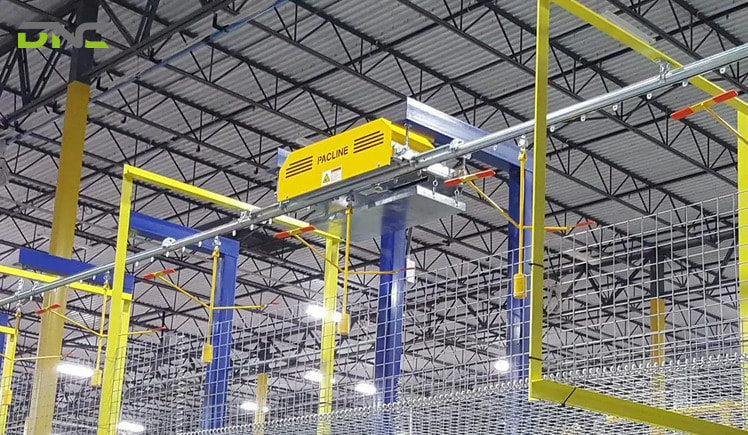
Malaysia’s automotive manufacturers — Toyota (UMW), Inokom, DRB-Hicom — operate paint lines where overhead conveyors are the sole viable transport solution. Vehicle bodies suspended from overhead conveyor carriers pass sequentially through pre-treatment (phosphate), electrocoat (e-coat), sealer, primer, topcoat, and clear coat booths. The overhead conveyor speed controls the dwell time in each booth — precisely synchronized with paint application equipment.
Automotive paint line overhead conveyors in Malaysia typically run at 2–4 m/min, with total circuit lengths of 500–2,000 m including oven sections at 160–200°C.
Rubber Glove Dipping Lines — Klang Valley
Malaysia supplies approximately 65% of the world’s nitrile gloves. The glove manufacturing process is almost entirely overhead-conveyor-dependent: glove formers (ceramic hand-shaped molds) are mounted on carriers attached to a continuous overhead chain conveyor, traveling through coagulant dip tanks, latex dip tanks, stripping stations, and vulcanization ovens in a continuous loop.
DNC Automation’s named client Hartalega — Malaysia’s largest nitrile glove manufacturer — represents exactly the type of overhead conveyor application where integration with automation systems (stripping robots, inspection vision systems) creates measurable productivity gain over manual operations.
Overhead conveyor in glove dipping:
- Carrier spacing: 100–200 mm (high-density)
- Speed: 3–8 m/min (continuous through all dip stations)
- Former load: 0.5–2 kg per carrier
- Total circuit: typically 200–500 m per production line
Powder Coating Lines — General Manufacturing
Powder coating operations across Malaysian metal fabrication, furniture, and component manufacturing use overhead conveyors to carry parts through pre-treatment, spray booth, and curing oven in sequence. The overhead conveyor transport path is the production line — there is no floor-level alternative for parts suspended for electrostatic powder application and oven curing at 180–220°C.
Automotive Assembly — P&F Systems
Toyota, UMW, and other automotive assemblers in Selangor use power-and-free overhead conveyors for vehicle body transfer between major assembly zones — body shop to paint shop, paint shop to trim assembly. P&F systems allow bodies to accumulate at zone entry points while upstream and downstream operations continue, providing the buffer flexibility essential for high-mix automotive production.
Garment and Textile — Klang Valley and Johor
Overhead chain conveyors in garment factories transport cut fabric panels and finished garments between sewing stations, pressing, quality inspection, and packing. Garment overhead conveyors carry very light loads (under 5 kg per carrier) at low speeds (1–3 m/min), but must handle high carrier density and frequent operator interaction at workstations.
Benefits of Overhead Conveyor Systems
- 100% Floor Space Recovery
An overhead conveyor system transporting 500 garments or 20 car bodies simultaneously uses zero floor space — the production area beneath remains fully accessible for workers, forklifts, and AGVs. For Malaysian factories where factory space in Selangor or Penang costs RM 3–8/sq ft/month, eliminating floor-level conveyors in high-density transport sections directly reduces space cost.
- 360° Product Access for Coating and Processing
Suspended product orientation is the only configuration enabling complete coating coverage — electrostatic spray, dip coating, or powder coating on all surfaces including the bottom face. No floor support, no masking required for contact points. Overhead conveyor transport is not an option for many coating processes — it is the only process-compatible solution.
- Process Integration — Precise Dwell Time Control
Overhead conveyor speed directly controls product dwell time in each process zone — oven, dip tank, spray booth. VFD-controlled overhead conveyor speed synchronized with process parameters (oven temperature, bath chemistry) ensures consistent product quality. DNC Automation integrates Siemens SIMATIC PLC systems with overhead conveyor drives for precise speed-process synchronization.
- High Throughput at Low Per-Unit Cost
Power-only overhead conveyor systems can carry hundreds of products simultaneously at continuous speed — delivering very low transport cost per unit. A 300 m circuit at 5 m/min carrying 200 garments has a 60-minute cycle time with very low motor power (typically 1.5–3.7 kW). Operating cost per unit is fractions of a cent.
- Reduce Handling Damage by Up to 80%
Products suspended from overhead carriers are not contacted, gripped, or slid across surfaces during transport. Paint finishes, coated surfaces, and finished products arrive at downstream stations in the condition they left upstream — eliminating the surface damage that floor-based conveyor contact or manual handling creates. DNC Automation’s automation systems reduce human error and handling damage by up to 80%.
- Integration with Robotic Systems
Overhead conveyor carriers serve as synchronized infeed to robotic paint spray cells, robotic stripping systems, and automated inspection stations. PLC-to-robot handshake protocols ensure the robot only operates when a carrier is correctly positioned at the robot working envelope — preventing collision and enabling consistent robot performance. DNC Automation integrates Comau and Doosan robots with overhead conveyor systems.
How to Choose the Right Overhead Conveyor System
- Define Load Weight and Carrier Spacing
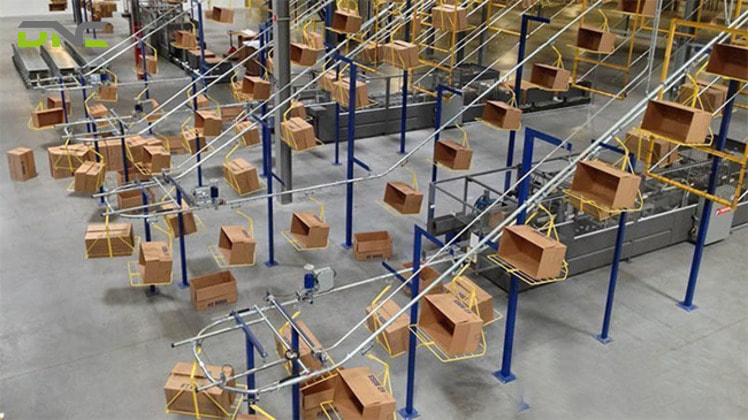
Maximum load weight per carrier determines trolley bearing size, track gauge, and chain pull calculation. Carrier spacing (distance between loads on the chain) determines system throughput: throughput = chain speed ÷ carrier spacing. Both parameters must be defined before any component selection.
- Map Your Process Path in 3D
Overhead conveyor track design is a 3D engineering problem — horizontal curves, vertical elevation changes, oven zone entry/exit points, and building structure conflicts must all be resolved in the track layout design. DNC Automation uses SolidWorks 3D CAD for overhead conveyor layout engineering within actual facility models.
- Identify Process Temperature Zones
If the overhead conveyor passes through oven zones above 80°C, specify high-temperature trolley bearings (greased for 200–250°C continuous), heat-rated chain lubricant, and track material compatible with thermal expansion at process temperature.
- Choose Power-Only or Power-and-Free
Power-only: lower cost, simpler, suitable for continuous-flow processes with no accumulation requirement.
Power-and-free: required when carriers must stop independently, divert to multiple destinations, or accumulate at workstations.
- Plan PLC Integration and Load Tracking
For production processes requiring load tracking (which body gets which paint sequence, which former gets which glove specification), specify RFID carrier identification and PLC-WMS integration from the design stage. DNC Automation engineers these systems end-to-end — track and carrier design through PLC programming and MES interface.
- Engage a Turnkey Integrator with Overhead Conveyor Experience
Overhead conveyor systems involve structural engineering (ceiling load calculations), mechanical engineering (chain, trolley, track), electrical engineering (VFD, PLC), and process engineering (oven synchronization, dip line chemistry compatibility). DNC Automation’s 35+ engineers cover all four disciplines under one project, delivering ISO 9001:2015-certified overhead conveyor solutions with 24/7 local support across Malaysia.
FAQ — Overhead Conveyor Systems
What types of products can an overhead conveyor carry?
Overhead conveyors carry any product that can be hung from a hook, clamped to a carrier, or placed in a cradle. Common products in Malaysian manufacturing: vehicle bodies and sub-assemblies (automotive), rubber glove formers, painted metal parts, garments and fabric panels, finished goods (electronics housings, appliance parts), and general manufacturing components. Products must not exceed carrier weight rating and must maintain stable orientation when suspended.
What is the difference between a power-only and power-and-free overhead conveyor?
Power-only: all carriers are attached to a single continuously moving chain — all products move at the same speed simultaneously; no independent stopping or accumulation. Power-and-free: drive chain and load carriers are separate — carriers can stop, accumulate, and divert independently while the drive chain keeps moving. Power-and-free is required for complex routing, accumulation buffers, and mixed-product production.
How much weight can an overhead conveyor carry?
Light-duty overhead conveyors handle 10–50 kg per carrier (garment lines, small part processing). Medium-duty handles 50–500 kg (painted parts, equipment components). Heavy-duty power-and-free automotive systems handle 1,000–10,000+ kg per carrier (full vehicle bodies). Load rating is determined by trolley bearing selection, track gauge, and chain specification.
Can overhead conveyors operate in oven and high-temperature zones?
Yes. Overhead conveyor systems are specifically designed for oven zone operation — it is one of their primary applications. High-temperature specifications include: trolley bearings rated for 200–250°C continuous, heat-stable chain lubricant, track material with controlled thermal expansion, and electrical components located outside the oven zone with only mechanical elements inside.
How is an overhead conveyor speed controlled?
VFD (Variable Frequency Drive) controls the drive unit motor speed — enabling variable chain speed across the full operating range. For processes requiring precise dwell time control (oven curing, dip coating), the PLC calculates required speed based on zone length and target dwell time, adjusting VFD output accordingly. DNC Automation programs these speed-process relationships as part of the overhead conveyor control system.
What maintenance does an overhead conveyor require?
Daily: visual chain tension check; inspect carriers for damaged hooks or worn trolley wheels.
Weekly: lubricate chain (automatic lubricators recommended for continuous operation).
Monthly: check drive unit motor current and gearbox oil level; inspect take-up unit tension.
Quarterly: measure chain elongation (replace chain when elongation exceeds 2% of nominal pitch length); inspect curved track sections for wear.
Annual: full trolley bearing replacement in oven zones; drive unit overhaul.
Does DNC Automation supply overhead conveyor systems in Malaysia?
Yes. DNC Automation designs, fabricates, and installs overhead conveyor systems across Malaysia, including power-only and power-and-free configurations for automotive, glove, paint line, and general manufacturing applications. Our Selangor production facility and branch offices in Johor Bahru and Penang provide local project delivery and 24/7 support. Contact us for a free pre-sales consultation.
Conclusion
Overhead conveyor systems are indispensable infrastructure for Malaysian manufacturers in automotive, glove, and surface finishing industries — enabling production processes that no floor-based conveyor can replicate, recovering 100% of floor space for other operations, and delivering the process control precision that consistent quality requires. The engineering challenge in overhead conveyor projects lies in integrating three-dimensional track design, process engineering (oven synchronization, dip line parameters), PLC automation, and robot cell interface into a single, coherent production system.
DNC Automation’s 35+ engineers deliver this integration. With 20+ years of experience serving Toyota, Hartalega, Sony, and other leading Malaysian manufacturers, we engineer overhead conveyor systems from facility layout through commissioning — ISO 9001:2015 certified, Siemens-authorized, with 24/7 local support across Malaysia.
Ready to engineer your overhead conveyor system? Talk to Our Engineers today for a free consultation and layout review.
- 95 views
- 0 Comment
Recent Comments