



Pallet Roller Systems: Heavy-Duty Conveyor Solutions Guide
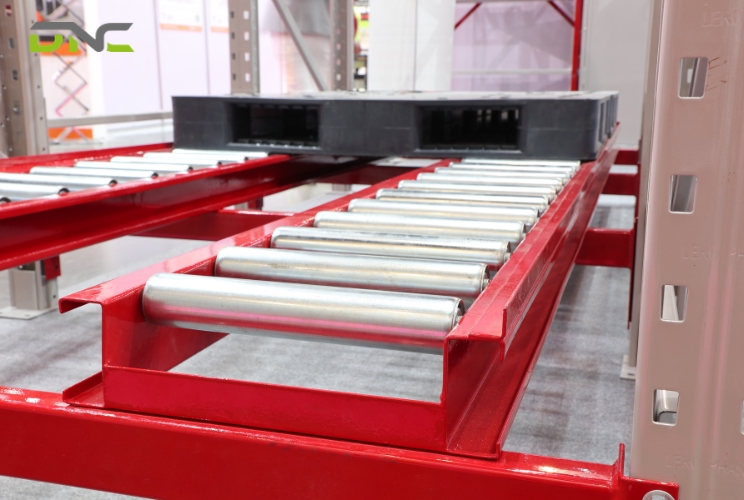
Pallet roller systems are heavy-duty roller conveyors engineered to transport loaded pallets weighing 500–3,000 kg between production zones, palletizing stations, wrapping machines, storage areas, and shipping docks. For Malaysian manufacturers processing 100–2,000+ pallets daily, pallet roller systems replace intermittent forklift transport with continuous, automated material flow — reducing pallet transport labour by 60–80% while eliminating the product damage, traffic congestion, and safety hazards that manual forklift operations create. This guide covers pallet roller conveyor engineering, specifications, layout configurations, motor sizing, and integration strategies for Malaysian manufacturing and warehouse applications. DNC Automation designs and fabricates pallet roller systems in-house — from individual conveyor sections to complete end-of-line material flow architectures.
What Is a Pallet Roller System?
Pallet roller systems are powered or gravity-driven conveyor platforms using heavy-duty steel rollers (89–114 mm diameter) to transport full-size pallets along defined paths within a facility. The system handles standard 1,200 × 1,000 mm pallets loaded with 500–2,000 kg (standard) or up to 3,000 kg (heavy-duty) at controlled speeds of 0.1–0.5 m/s.
Pallet roller systems differ from package-handling roller conveyors in three critical specifications: roller diameter (89–114 mm versus 50–60 mm for packages), roller wall thickness (3–5 mm versus 1.5–2.5 mm), and frame construction (structural steel channel versus light-gauge formed steel). These differences reflect the 10–30× weight increase: a loaded pallet at 1,200 kg generates roller contact forces that would instantly fail package-grade rollers.
The system serves as the physical backbone of automated material flow — connecting automated islands (palletizers, wrappers, labellers, racking I/O points) into a continuous production-to-shipping pipeline. Without pallet roller systems, each automation investment operates in isolation, and manual forklift trips become the bottleneck between them.
In the Malaysian market, pallet roller systems are specified across every manufacturing sector: F&B production (post-palletizing transport), automotive (JIT production line feeding), electronics (cleanroom-compatible pallet transfer), pharmaceutical (GDP-compliant material flow), and warehouse/logistics (dock-to-racking transport).
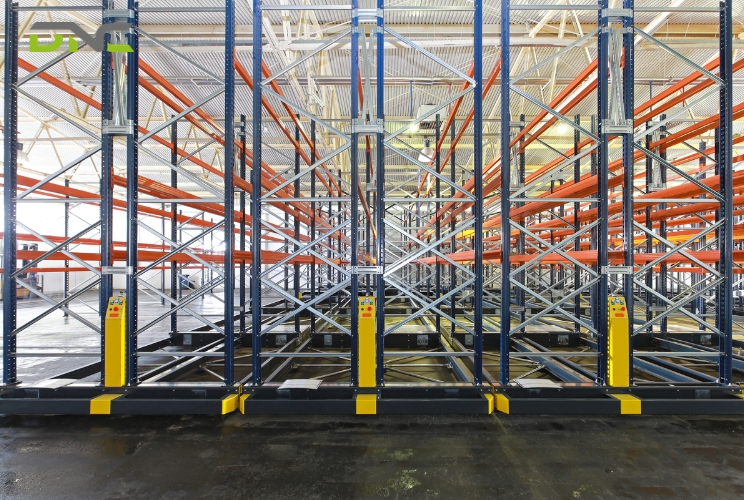
How Do Pallet Roller Systems Work?
Powered Roller Operation
Powered pallet roller conveyors use motorised rollers or chain-driven roller groups to transport pallets at controlled speeds. The motor drives a chain or belt connecting multiple rollers in a “zone” — each zone operates independently, enabling accumulation (stopping a pallet at a specific position while upstream pallets continue moving).
Zone-controlled accumulation is the standard operating mode for pallet roller systems. Photoelectric sensors at each zone detect pallet presence. When a downstream zone is occupied, the upstream zone stops — preventing pallet collision. When the downstream zone clears, the upstream zone restarts — feeding the next pallet forward. This zero-pressure accumulation protects products from impact damage.
Drive options:
- Gearmotor + chain drive: External gearmotor drives a roller chain connecting 4–8 rollers per zone. Most common for heavy-duty applications (1,000 kg+). Motor power: 0.37–2.2 kW per zone.
- Motorised roller (MDR): Internal motor embedded within selected rollers. Quieter operation, less maintenance, easier zone control. Common for medium-duty applications (up to 1,000 kg).
- Lineshaft drive: A continuous spinning shaft beneath the conveyor drives all rollers through rubber O-ring bands. Cost-effective for non-accumulation applications.
Gravity Roller Operation
Gravity pallet roller systems use unpowered rollers on a slight incline (1–3%) to move pallets by gravitational force. Speed controllers and end stops regulate flow. Gravity systems are used for pallet staging, accumulation lanes, and pallet flow racking — where continuous powered operation is not required.
Advantage: Zero energy cost, zero motor maintenance.
Limitation: Only works for downhill transport; pallet weight determines flow reliability.
Pallet Tracking and Control
Modern pallet roller systems integrate barcode scanners or RFID readers at key positions to identify pallet contents. The PLC routes each pallet to the correct destination based on its identity — directing pallet A to wrapping station 1 and pallet B to wrapping station 2, or routing product X to racking aisle 3 and product Y to aisle 7.
DNC Automation integrates pallet tracking with Siemens SCADA systems for real-time material flow visibility — plant managers see every pallet’s location, speed, and destination on a central dashboard.
Types of Pallet Roller Systems
Straight Pallet Roller Conveyor
Standard straight-run roller conveyor sections forming the primary transport paths. Modular design: 1.5 m, 3.0 m, and 6.0 m standard section lengths joined together. Frame: structural C-channel or welded box section. Support legs adjustable for 600–1,000 mm conveyor height.
Specifications: Roller diameter 89 mm (standard) or 114 mm (heavy); roller pitch 150 mm (heavy) or 200 mm (standard); frame width 1,200–1,400 mm; speed 0.1–0.5 m/s.
Pallet Chain Conveyor
Dual-strand or triple-strand chain conveyors for heavy loads (2,000–3,000 kg) and at transfer/intersection points where pallets must move perpendicular to their entry direction. Chains engage the pallet bottom boards directly — more positive engagement than rollers, especially for damaged or non-standard pallets.
Applications: Right-angle transfers, heavy load transport, pallet orientation changes.
Pallet Turntable
Rotating platform conveyor that turns pallets 90° or 180° at intersection points. Roller-top turntables allow pallets to roll on and off; chain-top turntables handle heavier loads. Rotation time: 3–5 seconds per 90° turn.
Applications: Conveyor direction changes, pre-wrapper orientation, racking interface alignment.
Pallet Lift / Elevator
Hydraulic or chain-driven lift platform connecting conveyor levels at different heights. Lift capacity: 1,000–3,000 kg. Travel height: 1–6 m. Cycle time: 10–30 seconds per lift cycle. Integrates with roller or chain conveyors at each level.
Applications: Mezzanine access, multi-floor facilities, height transitions between production zones.
Transfer Car (Pallet Shuttle Car)
Rail-guided or free-running transfer vehicle carrying pallets between parallel conveyor lines. The car receives a pallet from one line, travels laterally to the destination line, and discharges the pallet. Travel speed: 0.5–1.5 m/s.
Applications: Multi-line manufacturing feeding a single palletizer, multi-aisle warehouse racking connections, dock-to-storage transfer.
Pallet Stacker / Destacker
Automated machines that build or dismantle stacks of empty pallets. The destacker feeds individual empty pallets to the production line or palletizer; the stacker collects empty pallets from return conveyors and builds stacks for storage or return shipping.
Specifications: Stack height: 10–20 pallets; cycle time: 8–15 seconds per pallet; handles standard 1,200 × 1,000 mm pallets.
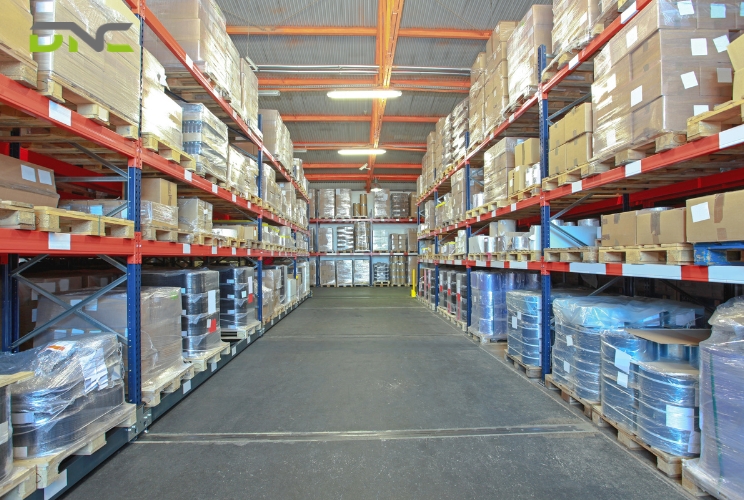
Key Components
Rollers
Heavy-duty steel tube rollers, 89 mm (standard) or 114 mm (heavy) diameter, 3–5 mm wall thickness. Shaft diameter: 20 mm (standard) or 25 mm (heavy). Bearings: sealed precision ball bearings rated for 1,000–3,000 kg radial load per roller. Galvanised finish (standard) or stainless steel (food-grade, cold room).
Load calculation: Roller load = (Pallet weight ÷ number of rollers supporting the pallet). For a 1,200 kg pallet resting on 8 rollers: 150 kg per roller. Roller radial load rating must exceed this with safety factor 2×.
Drive System
Gearmotor: SEW-Eurodrive, Nord, or Siemens inline helical gearmotor. Power: 0.37–2.2 kW per zone. VFD (variable frequency drive) for speed control and soft start/stop — preventing pallet shift during acceleration. DNC Automation specifies Siemens VFDs for consistent drive performance across the entire conveyor network.
Frame and Support Structure
Structural steel C-channel (200 × 80 mm typical) or welded box section frame. Hot-dip galvanised finish for food-grade or outdoor applications; powder-coated for standard industrial. Adjustable-height support legs with floor-mounting base plates.
Sensors and Controls
Photoelectric sensors (diffuse reflective type) at each accumulation zone detect pallet presence/absence. Barcode readers or RFID antennas at identification points. Emergency stop pull-cables along conveyor length. Zone controller PLC modules manage individual zone operation.
Safety Equipment
Emergency stop buttons at 25 m intervals. Safety pull-cord switches along full conveyor length. Safety fencing or guardrails where conveyors cross pedestrian paths. Light curtains at pallet entry/exit points where operators interact. Compliant with EN ISO 13857 (safety distances) and DOSH workplace safety requirements.
Applications in Malaysian Manufacturing
End-of-Line Packaging
The most common pallet roller application: connecting the palletizer output to the stretch wrapper, then to the labelling station, and finally to the forklift staging area or shipping dock. This continuous end-of-line flow replaces 3–5 forklift trips per pallet — across 500 pallets/day, that eliminates 1,500–2,500 forklift movements daily.
DNC Automation designs complete end-of-line pallet roller systems integrating palletizer discharge, turntable, wrapper infeed, wrapper discharge, labeller, and staging conveyor into a single automated flow.
Production Line Feeding
Automotive and electronics manufacturers use pallet roller systems to deliver component pallets from the warehouse to production line-side positions. The conveyor system creates a continuous supply pipeline replacing intermittent forklift delivery — supporting JIT production schedules at Toyota, Honda, Perodua, and electronics manufacturers in Penang.
Warehouse Dock-to-Racking Transport
Pallet roller conveyors connecting loading dock receiving positions to warehouse racking aisles (or to AS/RS I/O points). Incoming pallets are scanned, weighed, and routed to the correct storage zone via conveyor and transfer car — reducing dock-to-rack cycle time from 5–10 minutes (forklift) to 2–3 minutes (conveyor).
Cold Room Material Flow
Pallet roller systems in cold rooms use galvanised or stainless steel rollers and frames, sealed bearings rated for –25°C, and heated sensor housings. The conveyor minimises cold room door open time — pallets enter and exit through rapid-cycling doors with minimal temperature breach. Malaysian cold chain operators save RM 50,000–200,000/year in refrigeration energy by replacing forklift access (door open 30–60 seconds per trip) with conveyor access (door open 5–10 seconds per pallet).
Chemical and Hazardous Materials
Chemical manufacturers use pallet roller systems for safe, consistent transport of hazardous materials — eliminating the variable handling quality of manual forklift operations. Spill containment trays integrated into the conveyor frame capture leaks. Explosion-proof motors and sensors serve ATEX-rated environments.
Benefits of Pallet Roller Systems
Continuous automated transport replacing intermittent forklift trips. A single conveyor line running 30 pallets/hour provides the same throughput as 2–4 forklift operators — consistently, without breaks or shift changes.
60–80% reduction in forklift traffic. Fewer forklifts = fewer pedestrian-forklift interactions = fewer workplace injuries. This safety improvement is significant in Malaysian facilities where DOSH records forklift incidents as the leading warehouse injury category.
50–70% reduction in pallet transport damage. Conveyor handling at controlled 0.2 m/s is dramatically gentler than forklift handling with its acceleration, deceleration, and placement impacts.
Predictable cycle time. Conveyor transport time is fixed and calculable — 30 m at 0.3 m/s = 100 seconds, every time. Forklift transport time varies 50–200% depending on traffic, operator availability, and routing.
Floor space efficiency. Pallet roller systems occupy 1.2–1.5 m width versus 3.5–4.0 m aisle width for forklift traffic. Conveyors can run overhead (elevated systems) freeing floor space entirely.
Energy efficiency. A pallet roller conveyor motor consumes 0.5–2.0 kW; a forklift consumes 10–25 kW equivalent (diesel or electric). Per-pallet energy cost: conveyor RM 0.01–0.03 versus forklift RM 0.10–0.30.
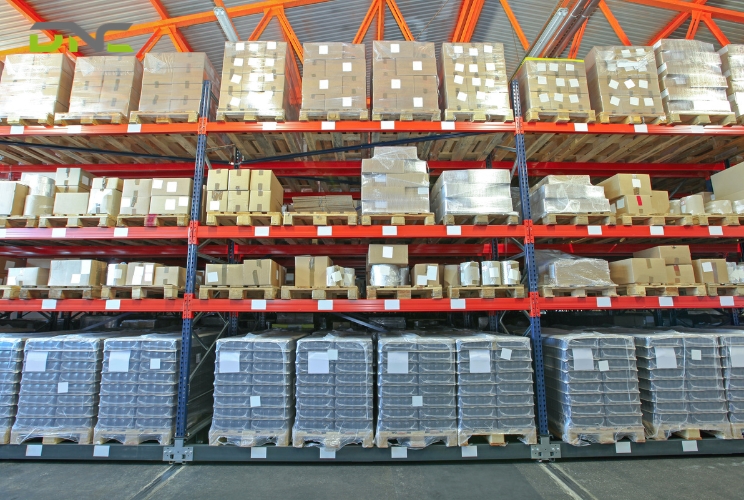
How to Design a Pallet Roller System
Define Transport Routes
Map every pallet movement: origin point, destination point, distance, height change, direction change, and throughput (pallets/hour). Prioritise routes by volume — automate the highest-frequency routes first for maximum ROI.
Size Rollers and Drive
Select roller diameter based on maximum pallet weight. Calculate drive power per zone: P = (F × v) / η, where F = friction force (pallet weight × rolling friction coefficient), v = conveyor speed, η = drive efficiency. Add 50% safety margin for starting torque.
Plan Accumulation Zones
Place accumulation zones at every decision point (merge, divert, stop, go) and at every equipment interface (palletizer output, wrapper input, lift entry). Zone length = pallet length + 300 mm clearance (1,500 mm for standard pallets).
Integrate Controls
Design the PLC program for zone-controlled accumulation with barcode/RFID routing logic. Connect to the existing plant PLC network or install a dedicated conveyor controller. DNC Automation uses Siemens TIA Portal for all conveyor control programming — ensuring consistency with the broader plant automation architecture.
FAQ — Pallet Roller Systems
What is a pallet roller system?
A pallet roller system is a heavy-duty roller conveyor designed to transport loaded pallets (500–3,000 kg) between operational zones in manufacturing facilities and warehouses. It uses steel rollers (89–114 mm diameter) powered by gearmotors or gravity, with zone-controlled accumulation preventing pallet collision. The system replaces manual forklift transport with continuous, automated material flow.
How much does a pallet roller conveyor cost in Malaysia?
Pallet roller conveyor costs RM 3,000–8,000 per linear metre for standard powered systems and RM 5,000–12,000 for heavy-duty chain conveyor sections. A complete end-of-line system (palletizer → wrapper → staging, approximately 30–50 linear metres) costs RM 150,000–400,000 installed. Turntables add RM 15,000–50,000; lifts add RM 30,000–150,000; transfer cars add RM 50,000–200,000 each.
What load capacity do pallet roller systems handle?
Standard pallet roller systems handle 500–2,000 kg per pallet using 89 mm diameter rollers. Heavy-duty systems handle 2,000–3,000 kg using 114 mm rollers or chain conveyor sections. Load capacity depends on roller diameter, wall thickness, bearing rating, roller pitch, and frame construction. Always specify the maximum pallet weight including product, packaging, and pallet.
Can pallet roller systems work in cold rooms?
Pallet roller systems operate in cold room environments (–25°C to +5°C) with appropriate specifications: galvanised or stainless steel rollers, sealed bearings rated for sub-zero temperatures, heated sensor housings, and cold-rated drive motors (IP65 minimum). Cold room conveyors reduce energy costs by minimising door open time — pallets transit through rapid-cycling doors in 5–10 seconds versus 30–60 seconds for forklift access.
How fast do pallet roller conveyors operate?
Standard operating speed: 0.1–0.5 m/s (6–30 metres per minute). Speed selection depends on throughput requirements and downstream equipment capacity. Higher speeds increase throughput but require longer accumulation zones for safe pallet stopping. VFD-controlled motors allow adjustable speed to match different operational requirements.
What maintenance do pallet roller systems need?
Weekly: visual inspection for roller damage, chain tension check, sensor alignment verification. Monthly: lubricate chain drives, check gearmotor oil level, test emergency stops. Quarterly: measure roller bearing play, check frame alignment, verify VFD parameters. Annually: replace worn chains, inspect gearmotor gearbox, service all safety devices. Expected roller life: 30,000–50,000 operating hours; motor life: 50,000+ hours with proper maintenance.
Conclusion
Pallet roller systems transform intermittent, variable forklift-based pallet transport into continuous, predictable automated material flow — reducing transport labour by 60–80%, product damage by 50–70%, and workplace safety incidents from forklift traffic. For Malaysian manufacturers processing 100+ pallets daily, pallet roller systems deliver immediate operational improvement and create the conveyor infrastructure that connects individual automation investments into a unified smart factory.
DNC Automation designs and fabricates pallet roller systems in-house — from individual conveyor sections to complete material flow architectures connecting production lines, palletizers, wrappers, racking, and shipping docks. Our Siemens controls integration, 20+ years of conveyor engineering, and 25,000 sq ft fabrication facility ensure every pallet roller system meets Malaysian manufacturing performance and safety requirements.
- 6 views
- 0 Comment
Recent Comments