



Screw Conveyor Feeder: Precision Dosing Guide | DNC Automation Malaysia
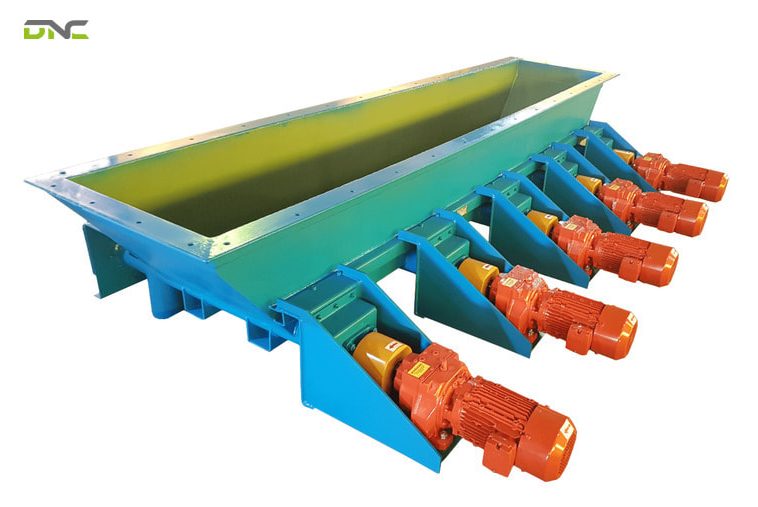
Screw Conveyor Feeder — Precision Bulk Dosing for Malaysian Process Industries
Screw conveyor feeders are the backbone of precision bulk material handling in Malaysian manufacturing. Every time a food factory doses flour into a mixer, a pharmaceutical plant meters excipient powder into a capsule filler, or a palm oil mill feeds palm kernel expeller cake into a boiler — a screw conveyor feeder is doing the work. Without controlled, metered feeding, batch consistency fails, product quality degrades, and production losses accumulate across every shift.
Malaysian manufacturers face a specific challenge: high-humidity tropical environments (80–95% RH), halal production requirements demanding zero cross-contamination, and increasingly stringent quality standards driven by NIMP 2030’s push toward smart factory operations. A screw conveyor feeder that works in Germany may need adaptation for Selangor or Johor’s climate and industry context. This guide covers every type of screw conveyor feeder, how each works, where each excels in Malaysian manufacturing, and how to select the right system for your application.
What Is a Screw Conveyor Feeder?
A screw conveyor feeder is a metered bulk material handling device that combines a rotating helical screw (auger) inside an enclosed trough or tube with a controlled drive system to deliver precise, consistent flow rates of powder, granule, or bulk solid material. Unlike standard screw conveyors — which simply move material from point A to point B — a screw conveyor feeder integrates speed control, and often weighing, to regulate how much material is delivered per unit time.
Screw conveyor feeders control material flow rate by adjusting the rotational speed of the auger via a Variable Frequency Drive (VFD). Slower rotation delivers less material; higher rotation delivers more. This makes screw feeders ideal wherever a consistent feed rate directly affects product quality, batch accuracy, or downstream process stability.
The core components are a hopper or bin (material source), a rotating auger/helix screw inside an enclosed trough or tube, a gearmotor with VFD speed control, an inlet opening (where material enters from the hopper), an outlet opening (where material discharges), and a control system — ranging from a basic speed potentiometer to a full Siemens PLC with loss-in-weight integration.
How Does a Screw Conveyor Feeder Work?
Screw conveyor feeders operate through a straightforward mechanical principle, but the precision of modern implementations involves several integrated stages.
Step 1: Material Loading into the Hopper
Screw conveyor feeder operation begins at the supply hopper. Bulk material — flour, sugar, calcium carbonate, palm kernel shell, pharmaceutical excipient — sits in a hopper positioned directly above the screw inlet. Hopper geometry matters: steep walls (60° minimum for cohesive powders) and agitation devices (vibrators or internal agitators) prevent bridging and rat-holing, which would interrupt consistent feed.
Step 2: Material Engagement with the Screw Flight
As the auger rotates, the helical flight (the screw spiral) engages material at the inlet and pushes it forward along the trough. The pitch of the screw flight — the distance between successive flight surfaces — determines how much material advances per revolution. Standard pitch equals the screw diameter; short pitch (half the diameter) handles cohesive powders without over-compression; long pitch (1.5× the diameter) suits fast-flowing free materials.
Step 3: Controlled Conveying Through the Trough
Screw conveyor feeders convey material at controlled fill levels — typically 15–45% of the trough cross-section for accurate metering. Over-filling causes compaction and rate inconsistency; under-filling reduces capacity. The enclosed trough prevents dust escape, preserving hygiene in food and pharmaceutical applications.
Step 4: VFD Speed Control and Rate Regulation
A Variable Frequency Drive adjusts the motor frequency — and therefore the auger RPM — to regulate the feed rate. In simple volumetric feeders, the operator sets a target RPM corresponding to a desired throughput (L/hr or kg/hr). In gravimetric (loss-in-weight) systems, load cells continuously weigh the feeder and material, and the Siemens PLC automatically adjusts RPM to maintain the target feed rate regardless of material density variations.
Step 5: Discharge to Process
Material discharges at the screw outlet into the downstream process: a mixer, a reactor, a conveyor, a packaging machine, or a boiler. Discharge geometry (drop chute, rotary valve, flexible connector) is engineered to maintain flow without material bridging at the transition point.
Step 6: PLC Integration and Process Control
Modern screw conveyor feeders integrate with Siemens TIA Portal-based plant control systems via Modbus TCP or PROFINET. The PLC receives target feed rate setpoints from the MES or SCADA system, monitors actual feed rate from the loss-in-weight system, and triggers alarms for empty-hopper, over-rate, or under-rate conditions. DNC Automation delivers complete PLC-programmed feeder control as part of turnkey process line installations.
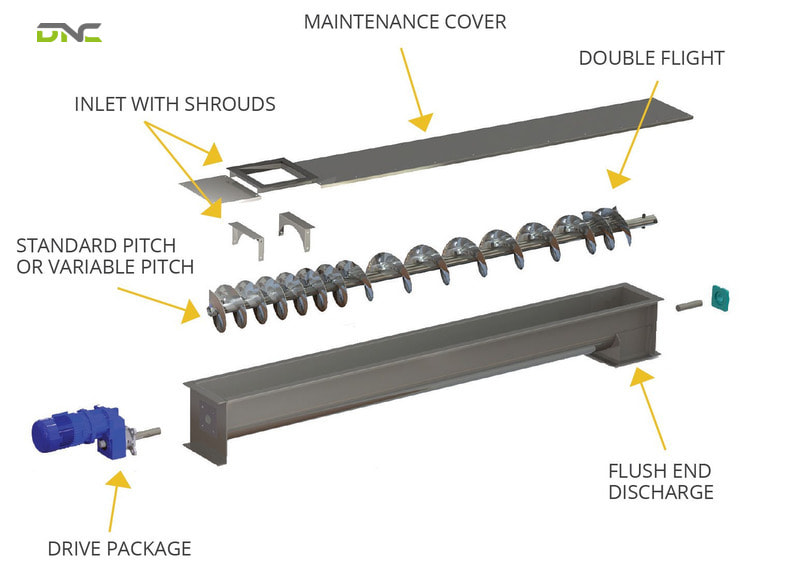
How Does a Screw Conveyor Feeder Work?
Types of Screw Conveyor Feeders
Screw conveyor feeder selection depends on material characteristics, required accuracy, layout constraints, and operating environment. Six primary types serve Malaysian industrial applications.
1. Horizontal Screw Feeder
Horizontal screw feeders are the most common type in Malaysian manufacturing — a straight, level screw in an enclosed U-trough or tubular housing. Horizontal feeders suit free-flowing to moderately cohesive powders and granules where the material source and discharge point are at the same elevation.
| Parameter | Specification |
| Incline angle | 0–15° |
| Capacity range | 0.1 L/hr – 100 m³/hr |
| Accuracy (volumetric) | ±2–5% |
| Typical applications | Flour, sugar, salt, plastics pellets, sand |
2. Inclined Screw Feeder
Inclined screw feeders operate at angles from 15° to 45°, gaining elevation while metering material. Inclined feeders require shorter-pitch flights and higher torque motors to prevent material from sliding backward against the screw. Incline angle above 45° risks material regression and rate inconsistency.
Inclined screw feeders are common in Malaysian F&B factories where space is constrained and a compact, combined elevation-plus-feeding solution is needed — replacing separate horizontal feeder plus bucket elevator.
3. Vertical Screw Feeder
Vertical screw feeders (90° orientation) lift material directly upward into overhead hoppers, mixers, or elevated process equipment. Vertical feeders use centrifugal force from high auger speed combined with continuous material supply to maintain flow. They handle free-flowing granules well but are less effective for fine cohesive powders.
In Malaysian palm oil mills, vertical screw feeders transport palm kernel expeller cake (PKE) and loose fiber from ground-level conveyors into elevated boiler feed hoppers.
4. Flexible Screw Feeder
Flexible screw feeders enclose the auger in a flexible polymer tube that can be routed around obstacles, through walls, or in complex paths — impossible with rigid trough conveyors. The rotating flexible screw inside the tube both propels material and maintains tube shape.
Flexible screw feeders suit Malaysian F&B and pharmaceutical plants with constrained layouts, where routing material from a remote storage silo to a process point requires navigating structural columns, pipes, and existing equipment.
5. Twin-Screw Feeder
Twin-screw feeders use two intermeshing screws in a figure-8 cross-section trough. The intermeshing action continuously breaks up material bridges and agglomerates, making twin-screw feeders essential for cohesive, sticky, hygroscopic, or poor-flowing powders that would bridge in single-screw designs.
Malaysian pharmaceutical manufacturers in Selangor’s pharma corridor use twin-screw feeders for direct compression excipients — materials like microcrystalline cellulose (MCC) and hydroxypropyl methylcellulose (HPMC) that clump in single-screw systems.
6. Loss-in-Weight Screw Feeder (Gravimetric)
Loss-in-weight (LIW) screw feeders are the precision standard for applications requiring ±0.25–0.5% feed rate accuracy. The entire feeder — hopper, screw, motor — sits on load cells. The Siemens PLC continuously monitors the weight of the system and adjusts auger speed to maintain the target mass flow rate (kg/hr) regardless of material density variations, hopper level changes, or environmental conditions.
| Type | Accuracy | Best For |
| Volumetric horizontal | ±2–5% | Low-cost, free-flowing materials |
| Volumetric inclined | ±3–6% | Elevated compact layouts |
| Volumetric vertical | ±4–8% | Free-flowing granule elevation |
| Flexible screw | ±3–7% | Complex routing, moderate accuracy |
| Twin-screw | ±1–3% | Cohesive powders |
| Loss-in-weight | ±0.25–0.5% | Pharma, nutraceutical, high-value dosing |
──────────────────────────────────────────────────
Key Components of a Screw Conveyor Feeder System
Screw conveyor feeder performance depends on the integration of six primary components, each engineered for the specific material and process requirements.
Hopper and agitation system: The hopper stores bulk material above the screw inlet. Agitation — via mechanical vibrators, rotating agitators, or pneumatic fluidization pads — prevents bridging and rat-holing in cohesive materials. Hopper geometry (steep walls, rounded interior corners) reduces dead zones.
Screw/auger assembly: The helical flight on a central shaft is the heart of the feeder. Flight type (standard, short pitch, long pitch, cut-and-folded, ribbon, paddle) is selected for the specific material. Screw materials range from carbon steel (general) to SS304/316 (food/pharma) to hardened chrome steel (abrasive materials).
Trough or tube housing: The enclosed housing contains the material during conveying. U-trough housings are standard for most applications. Tubular housings provide complete enclosure for dust-sensitive or hygiene-critical materials. SS304 or SS316 construction for food, pharma, and chemical applications.
Drive system — gearmotor and VFD: A gearmotor (typically 0.1–15 kW, 4-6 pole) drives the screw. A Variable Frequency Drive adjusts motor speed to control feed rate. Siemens SINAMICS drives integrate seamlessly with Siemens SIMATIC PLC systems in DNC Automation’s installations.
Load cells (LIW systems): Three or four load cells support the entire feeder assembly. Load cell capacity ranges from 5 kg (lab-scale) to 5,000 kg (industrial). IP67-rated load cells are specified for Malaysian humid and wash-down environments. DNC’s Laumas weighing partnership provides certified industrial load cell systems.
Control system — PLC and HMI: Siemens S7-1200 or S7-1500 PLC controls the VFD, monitors load cells, executes PID feed rate control, and communicates with SCADA/MES. The Siemens HMI touchscreen displays feed rate, cumulative dosing, alarm status, and trend graphs.
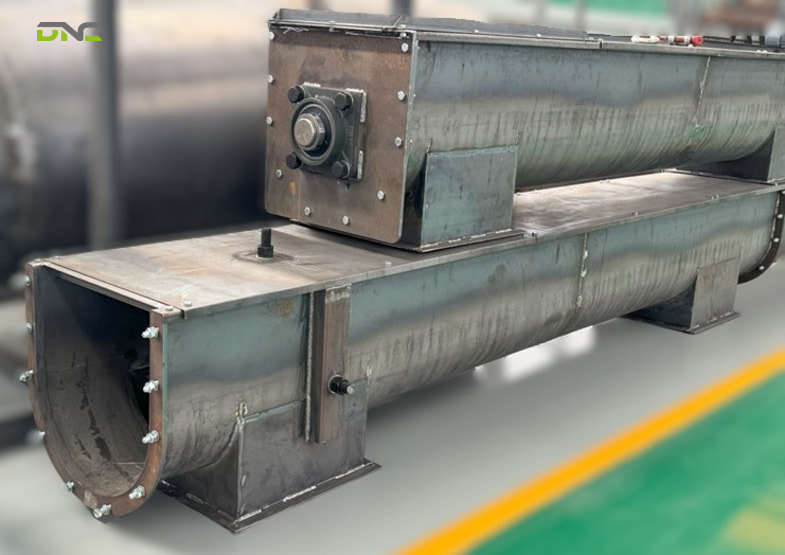
Key Components of a Screw Conveyor Feeder System
Applications: Where Screw Conveyor Feeders Are Used in Malaysian Manufacturing
Food and Beverage Manufacturing
Screw conveyor feeders are standard in Malaysian F&B production wherever dry ingredients are dosed into mixers, blenders, or packaging machines. F&N Malaysia, Ramly Burger, and Guan Chong Berhad — all DNC Automation clients — operate process lines where screw feeders dose flour, sugar, cocoa powder, spice blends, and food additives with ±2–5% volumetric accuracy.
For halal production, SS316 screw feeders with dedicated product contact parts eliminate cross-contamination risk between halal and non-halal ingredient lines — a critical compliance requirement for Malaysian halal certification.
Pharmaceutical Manufacturing
Selangor’s pharmaceutical corridor — housing Malaysia’s leading pharma manufacturers — relies on loss-in-weight screw feeders for precise excipient dosing in direct compression tablet manufacturing. Accuracy requirements of ±0.5% or better are non-negotiable in GMP environments. Twin-screw feeders handle cohesive excipients (MCC, HPMC, lactose); loss-in-weight single-screw feeders dose lubricants (magnesium stearate) at <0.5% of blend weight.
Palm Oil Processing
Palm oil mills in Pahang, Johor, Perak, Sabah, and Sarawak use screw conveyor feeders at multiple points in the milling process. Vertical screw feeders transport palm kernel expeller cake (PKE) and palm kernel shell (PKS) to elevated boiler feed points. Screw feeders dose lime (calcium oxide) into effluent treatment ponds. DNC Automation’s Siemens-controlled feeder systems provide PLC-integrated dosing with SCADA monitoring — enabling operators to verify and log every dose from the control room.
Plastics and Compounding
Polymer compounding operations across Selangor and Johor use gravimetric loss-in-weight screw feeders to dose masterbatch colorants, stabilizer packages, and flame retardants into twin-screw extruders at precisely controlled percentages — typically 0.5–5% of base polymer.
Feed Mills and Agriculture
Animal feed mills in Johor and Pahang — Malaysia’s agricultural belt — use horizontal screw feeders to dose mineral and vitamin premixes into feed formulations. The SAG Grant (Smart Automation Grant, RM 1M max, 70:30 MIDA matching) is available to feed mill SMEs upgrading from manual scooping to automated feeder systems.
Benefits of Screw Conveyor Feeder Systems for Factory Operations
Dosing accuracy eliminates giveaway: Manual scooping in F&B and pharma achieves ±5–10% accuracy. A volumetric screw feeder achieves ±2–5%; a loss-in-weight feeder achieves ±0.25–0.5%. For a 500 kg batch with a 2 kg expensive active ingredient, eliminating 5% overfill saves RM 12,000–80,000/year in raw material cost depending on ingredient value.
Continuous operation with zero manual labor: A screw conveyor feeder runs unattended for entire shifts — 8, 12, or 24 hours — feeding material consistently without operator involvement. DNC Automation feeder systems reduce material handling labor by up to 80% compared to manual dosing.
Dust containment improves safety: Enclosed screw feeder housings contain fine powders that would otherwise create respirable dust, explosion risk (for combustible powders like flour, sugar, starch), and OSHA non-compliance. Malaysian DOSH (Department of Occupational Safety and Health) regulations require dust control measures in food and chemical processing.
Traceability and batch records: Siemens PLC-controlled loss-in-weight feeders log every dose — weight, time, date, batch number — to SCADA/MES. This digital batch record satisfies GMP, HACCP, and halal certification traceability requirements without manual record-keeping.
NIMP 2030 compliance pathway: Screw conveyor feeder automation replaces manual dosing as a direct entry point toward NIMP 2030 smart factory transformation. SAG Grant funding reduces the net CAPEX to 30% of investment cost for eligible SMEs.
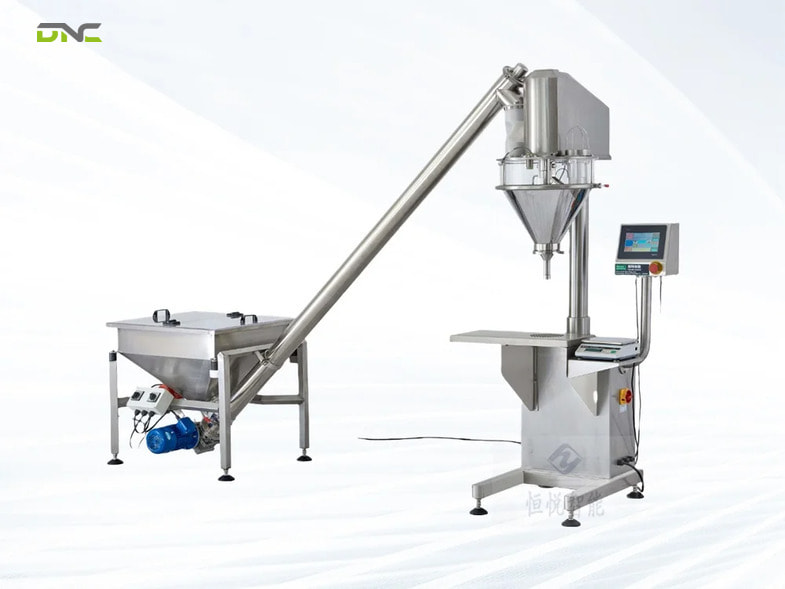
Benefits of Screw Conveyor Feeder Systems for Factory Operations
How to Choose the Right Screw Conveyor Feeder for Your Factory
Step 1 — Define material characteristics: Free-flowing granule (sugar, pellets) → horizontal volumetric works. Cohesive or sticky powder (MCC, gummy materials) → twin-screw. Fine, aerated powder (flour, talc) → agitated hopper + standard screw. Abrasive (sand, ceramics) → hardened flight + SS trough.
Step 2 — Set accuracy requirement: Commodity dosing (±5%) → volumetric feeder. Ingredient dosing (±2%) → volumetric with calibrated VFD. Active ingredient or high-value material (±0.5%) → loss-in-weight gravimetric.
Step 3 — Determine layout constraints: Straight horizontal path → U-trough horizontal feeder. Elevation gain needed → incline or vertical feeder. Complex routing around obstacles → flexible screw feeder.
Step 4 — Confirm hygiene requirements: General industrial → carbon steel. Food contact, HACCP → SS304, FDA-compliant seals. Pharma GMP → SS316, CIP-compatible design, EHEDG certification. Halal production → dedicated product contact parts, no shared lines.
Step 5 — Specify integration requirements: Standalone speed control → basic VFD potentiometer. PLC-integrated batching → Siemens S7 + PROFINET. Full loss-in-weight with SCADA → Siemens TIA Portal + Laumas load cells.
DNC Automation provides free pre-sales consultation to assess your specific material and process, recommend the correct feeder type, and provide a full quotation — including PLC programming, installation, and commissioning.
Frequently Asked Questions About Screw Conveyor Feeders
What is the difference between a screw conveyor and a screw conveyor feeder?
A screw conveyor simply transports material from point A to point B at a fixed, uncontrolled rate. A screw conveyor feeder adds rate control — via VFD speed adjustment and/or weighing — to deliver precise, regulated flow. Feeders are used where the feed rate directly affects product quality or batch accuracy.
What materials can a screw conveyor feeder handle?
Screw conveyor feeders handle powders, granules, pellets, flakes, and short-fiber bulk solids. Common materials in Malaysian manufacturing: flour, sugar, salt, cocoa powder, spice blends, pharmaceutical excipients, plastics pellets and masterbatch, calcium carbonate, lime, sand, palm kernel shell, and animal feed ingredients. Very coarse, lumpy, or fibrous materials require special flight configurations.
What is a loss-in-weight feeder and when do I need one?
A loss-in-weight feeder places the entire feeder assembly on load cells and continuously monitors weight reduction (loss) to calculate real-time feed rate. The PLC automatically adjusts auger speed to maintain the target rate. Loss-in-weight feeders are required when accuracy better than ±1% is needed — typically for pharmaceutical dosing, expensive colorant dosing, and any application where overfill or underfill has significant quality or cost consequences.
How accurate is a volumetric screw feeder?
Volumetric screw feeders achieve ±2–5% accuracy under stable conditions (consistent material density, no bridging). Accuracy degrades if material density varies (due to moisture pickup, segregation, or hopper level changes). For ±0.5–1% accuracy, a loss-in-weight gravimetric system is required.
Can a screw conveyor feeder handle high-humidity environments like Malaysia?
Yes — with proper specification. Malaysian ambient humidity (80–95% RH) can cause hygroscopic powders to clump and bridge. Solutions include: agitated hoppers with vibrators, twin-screw flights for cohesive materials, nitrogen blanketing for oxidation-sensitive materials, and SS304/316 construction with food-grade seals. DNC Automation specifies tropical-grade designs for all Malaysian installations.
What is the typical ROI for installing a screw conveyor feeder in a Malaysian factory?
ROI varies by application, but typical Malaysian F&B factories achieve payback in 12–24 months from: raw material savings (eliminated overfill), labor cost reduction (removed manual dosing), quality improvement (fewer batch rejections), and compliance value (traceable batch records for HACCP and halal certification). The SAG Grant reduces net CAPEX by 70%, compressing payback to 4–8 months for eligible SMEs.
Does DNC Automation supply and install screw conveyor feeders in Malaysia?
Yes. DNC Automation designs, fabricates, installs, and commissions screw conveyor feeder systems across Malaysia — Selangor, Penang, Johor, and East Malaysia. As a Siemens authorized partner and Laumas weighing systems representative, DNC delivers complete PLC-controlled feeder systems with full SCADA integration and 24/7 local support.
Conclusion
Screw conveyor feeders deliver the controlled, precise bulk material flow that Malaysian process industries require — from HACCP-compliant F&B dosing to GMP pharma feeding to palm oil mill process metering. Choosing the right feeder type — horizontal, inclined, vertical, flexible, twin-screw, or loss-in-weight — depends on your specific material characteristics, accuracy requirements, layout constraints, and hygiene standards.
DNC Automation’s team of 35+ engineers has designed and commissioned screw conveyor feeder systems across Malaysia’s manufacturing sectors since 2005. As Siemens Germany’s authorized partner and Laumas Italy’s certified weighing systems representative, DNC delivers complete, PLC-integrated feeder solutions with 24/7 local support.
Get a Free Consultation — contact DNC Automation to have our engineers assess your dosing requirements and recommend the optimal screw conveyor feeder solution for your factory.
Explore related solutions: [Weighing Conveyor Systems](#), [PLC Conveyor Control](#), [Conveyor Belt Scales](#)
- 38 views
- 0 Comment
Recent Comments