



Tubular Chain Conveyor: Dust-Free Bulk Handling Malaysia | DNC Automation
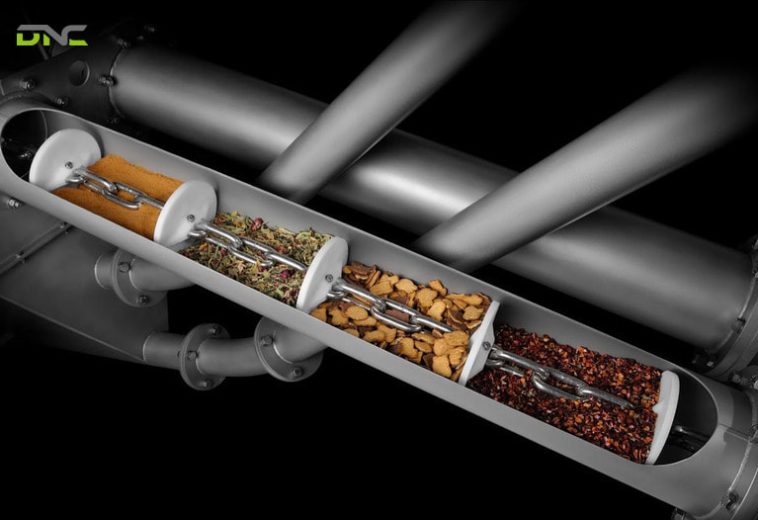
Tubular Chain Conveyor — Enclosed, Dust-Free Bulk Conveying for Malaysian Factories
Tubular chain conveyors solve a conveying problem that no other technology addresses as completely: moving fragile, hygroscopic, or hazardous bulk powders and granules through complex three-dimensional routing — horizontal, vertical, and directional changes — within a single fully enclosed circuit that generates zero dust and causes zero material degradation. Guan Chong Berhad, Malaysia’s largest cocoa processor and one of the world’s largest outside the USA, handles cocoa powder and cocoa mass that demands both hygiene containment and gentle handling. A screw conveyor grinding fine cocoa particles into smaller fragments is unacceptable in that context. A tubular chain conveyor — with its low-velocity disc flights moving product through a sealed steel tube — handles cocoa powder at the required throughput with no measurable particle size reduction and no hygiene breach. DNC Automation, Malaysia’s Top #1 Factory Automation Company established in 2005, has engineered tubular chain conveyor systems for food processing, pharmaceutical manufacturing, cement operations, and biomass energy plants across Peninsular Malaysia and East Malaysia. This article covers everything Malaysian engineers and plant managers need to know about tubular chain conveyors — operation, types, components, applications, and selection criteria.
What Is a Tubular Chain Conveyor?
A tubular chain conveyor is an enclosed bulk material handling system in which a continuous steel chain, fitted with disc-shaped flights (also called discs or pucks), moves through a steel or stainless steel tube of matching internal diameter, dragging bulk material along with it. The enclosed tube eliminates dust emissions, atmospheric contamination of the product, and spillage at any point along the routing.
Tubular chain conveyors handle bulk capacities from 0.5 to 100 m³/hour, operate over horizontal distances up to 60m (and unlimited distance with multiple circuits), and route through horizontal, inclined, vertical, and curved sections within a single continuous circuit. The conveying temperature range spans -10°C to +300°C depending on chain and tube material specification. The defining characteristic is the combination of full enclosure with multi-directional routing capability — two attributes no other conveyor technology delivers simultaneously.
How Does a Tubular Chain Conveyor Work?
Understanding tubular chain conveyor operation requires following the material flow from inlet to outlet across the complete circuit.
Step 1 — Material Inlet
Bulk material enters the tubular chain conveyor through one or more inlet ports positioned at designated points on the circuit. Each inlet port is fitted with a flanged connection accepting material gravity-fed from a hopper, silo, or upstream process. Multiple inlets on a single circuit allow one tubular conveyor to collect material from several sources simultaneously — a capability screw conveyors cannot match without multiple separate units.
Step 2 — Chain and Disc Flight Engagement
The continuous chain, with disc flights spaced at 300–600mm intervals, passes through the inlet zone. Incoming material falls in front of (behind the direction of travel) a disc flight and fills the space between adjacent flights. The disc-to-tube internal diameter clearance is 1–3mm, sufficient to drag the bulk material plug forward without contact grinding. Material rides between flights rather than being squeezed or cut — the fundamental reason tubular chain conveyors protect fragile materials from degradation.
Step 3 — Multi-Direction Routing
The loaded chain travels through the tube circuit, which incorporates 90° horizontal bends, inclined sections, and vertical rises as dictated by plant layout. Bend sections use curved tube segments with radii of 500mm to 1,000mm (larger radius reduces chain wear at the bend). The chain articulates through bends at each chain link joint — standard drag chain pitch is 63–160mm. No belts, no rubber, no components susceptible to particulate damage exist within the sealed conveying zone.
Step 4 — Material Outlet
At designated outlet ports, gravity or a pneumatic deflector diverts material from the tube circuit into the receiving vessel — hopper, bin, mixer, or process vessel. Multiple outlets on one circuit allow simultaneous distribution to several destinations, with individual outlet valve control enabling selective routing. This multi-outlet capability eliminates the need for separate transfer conveyors between distribution points.
Step 5 — Empty Chain Return
After material discharges at the final outlet, the chain continues through the return leg of the circuit — still enclosed within the tube but now empty — back to the drive station. The return leg carries no material; this section handles only chain weight and tension. The circuit is fully sealed at all points, including the return leg, preventing any atmospheric contamination or dust emission.
Drive Station Components
The drive station consists of a drive sprocket (sized to chain pitch), a motorized gearbox (typically 0.75–15 kW depending on circuit length and material bulk density), and a torque arm. An automatic chain tensioner maintains correct chain tension as the chain elongates through wear over service life. Chain elongation beyond 2–3% of original pitch is the standard replacement trigger — most tubular chain systems provide accessible chain length measurement markings.
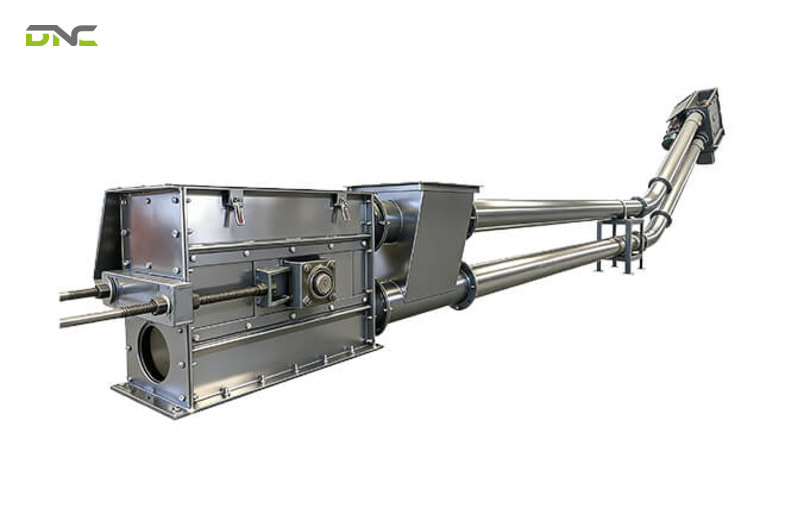
How Does a Tubular Chain Conveyor Work?
Types of Tubular Chain Conveyor
Five distinct tubular chain conveyor configurations cover the full range of Malaysian industrial bulk handling requirements.
1. Standard Tubular Drag Chain Conveyor
Standard tubular drag chain conveyors use a carbon steel tube (typically 80–250mm internal diameter) with carbon steel chain and cast iron disc flights. This configuration handles general industrial bulk materials — cement, aggregates, mineral powders, biomass pellets — where hygiene is not the primary requirement but full enclosure and dust containment are.
Tube internal diameters of 80mm, 100mm, 120mm, 150mm, 168mm, 200mm, and 250mm are the most commonly available sizes in Malaysia. Conveying capacity scales with tube diameter and chain speed: a 168mm tube at standard chain speed delivers approximately 15 m³/hour; a 250mm tube at the same speed delivers 35–40 m³/hour.
| Tube ID | Typical Capacity | Primary Application |
| 80–100mm | 0.5–3 m³/hr | Laboratory, pilot plant |
| 120–150mm | 3–10 m³/hr | Pharma, food (small batches) |
| 168mm | 10–20 m³/hr | F&B production, cement |
| 200–250mm | 20–50 m³/hr | Industrial bulk |
| 300mm+ | 50–100 m³/hr | Heavy industrial |
2. Stainless Steel Tubular Chain Conveyor
Stainless steel tubular chain conveyors use SS304 or SS316L tube, chain, and disc flights throughout all product-contact surfaces. SS316L provides superior chloride corrosion resistance for washdown environments with cleaning chemicals. Disc flights are manufactured from food-grade UHMWPE (ultra-high-molecular-weight polyethylene) or SS316L — UHMWPE flights offer lower chain pull (less power) and zero metallic contamination risk.
Stainless steel tubular chain conveyors are the standard specification for Malaysian food and pharmaceutical plants operating under HACCP, GMP, and halal certification requirements. The tube circuit is fully CIP (Clean-in-Place) compatible — cleaning water and sanitizing solution circulate through the tube without disassembly. Guan Chong Berhad’s cocoa powder handling, flour and sugar transfer in halal-certified F&B factories throughout Selangor, and pharmaceutical powder transfer in Penang’s medical manufacturing cluster all use SS tubular chain conveyors of this type.
3. High-Temperature Tubular Chain Conveyor
High-temperature tubular chain conveyors handle bulk materials at process temperatures from 150°C to 300°C. The tube is carbon steel or heat-resistant alloy; chain is alloy steel heat-treated for high-temperature service; disc flights are cast alloy or ceramic-filled compounds rated for the operating temperature.
Malaysian cement plants in Johor (Johor Bahru and surrounding industrial zones have significant cement and building materials manufacturing) use high-temperature tubular conveyors to transfer clinker and hot cement powder at temperatures that would destroy standard chain and flights. Chemical processing plants handling hot catalyst powder or ash also use this variant.
4. Vertical Tubular Chain Conveyor (Z-Conveyor)
Vertical tubular chain conveyors — commonly called Z-conveyors or vertical-circuit tubular conveyors — route the chain circuit through a horizontal infeed section, a vertical rise section (up to 20m height gain), and a horizontal outfeed section, all within one continuous sealed circuit. This Z-routing profile allows a single tubular chain conveyor to receive material at floor level and discharge at elevated hopper, silo, or process vessel height without any intermediate transfer point.
Floor-level receiving to 10–15m discharge height is the most common Z-conveyor specification in Malaysian factories. This single unit eliminates the elevator plus transfer conveyor combination previously required for vertical lift — reducing maintenance points, reducing dust emission risk, and reducing equipment cost. DNC Automation has commissioned Z-conveyor tubular chain systems in palm oil seed processing facilities in Sabah and Sarawak.
5. Heavy-Duty Tubular Chain Conveyor
Heavy-duty tubular chain conveyors use hardened alloy steel chain (Rockwell C45–C55 surface hardness), wear-resistant tube liner inserts, and cast alloy disc flights for handling highly abrasive materials — aggregate fines, mining ore dust, recycled glass, foundry sand. Chain pitch is increased (100–160mm) to reduce chain articulation frequency and wear at bends.
Malaysian quarrying and mining operations in Kelantan, Perak, and Pahang use heavy-duty tubular chain conveyors where standard carbon steel chain would wear to replacement within 3–6 months. Hardened chain in the same application delivers 18–30 months service life, reducing maintenance cost and production downtime proportionately.
Key Components of a Tubular Chain Conveyor System
Each component in a tubular chain conveyor system performs a specific function, and specifying the correct component grade for the application determines both performance and total cost of ownership.
Chain. The conveyor chain is the highest-wear component in any tubular drag chain system. Standard carbon steel (Grade 40 or equivalent) suits non-abrasive food and chemical powders. Stainless steel (SS316) chains are mandatory for food/pharma washdown environments. Hardened alloy chains (used in heavy-duty models) extend service life in abrasive applications by 3–5 times. Chain pitch — the distance between chain links — ranges from 63mm (fine powder, tight bends) to 160mm (heavy industrial, straight runs).
Disc Flights. Disc flights transfer the chain motion to the bulk material. Flight diameter is specified to leave 1–3mm clearance with tube inner wall — sufficient to drag material without grinding. UHMWPE flights are standard for food and pharma: non-toxic, low friction, self-lubricating, and capable of minor deformation to pass small lumps without chain overload. Cast iron flights suit general industrial. Alloy or ceramic flights handle high-temperature service.
Tube and Bends. The tube is the structural and containment element of the system. Standard wall thickness is 3–6mm carbon steel for industrial service; 3mm SS304/316L for food/pharma. Bend sections (90° and 45°) are the highest-wear tube segments; DNC Automation specifies replaceable wear inserts at all bend locations for long-service industrial installations to avoid replacing the entire bend when wear-through occurs.
Drive Unit. The drive unit comprises a motorized gearbox (typically 0.75–15 kW) mounted at the drive station. The gearbox output shaft drives the chain sprocket at a speed delivering 0.1–0.5 m/s chain speed for most applications. Low chain speed is deliberate — it minimizes material degradation and reduces chain and disc wear rates.
Inlets and Outlets. Gravity-drop inlets are the most common inlet type — flanged ports in the top of the tube accept material from hoppers or chutes. Rotary valve inlets (for pressurized or airtight feeding) are used in pharma and fine powder applications. Outlets are gravity-drop through the tube bottom, controlled by flap valves or rotary diverters.
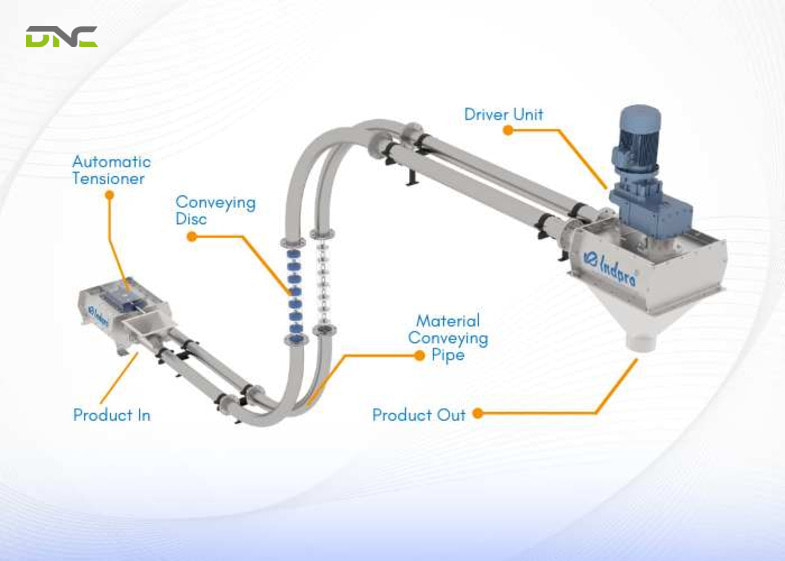
Key Components of a Tubular Chain Conveyor System
Applications: Where Tubular Chain Conveyor Is Used in Malaysian Manufacturing
The tubular chain conveyor’s combination of full enclosure, multi-direction routing, and gentle handling makes it the preferred conveyor for a defined set of Malaysian industries where other conveyor types fail on hygiene, dust, or material integrity grounds.
Food and Beverage — Cocoa, Flour, Sugar
Malaysian F&B manufacturing is concentrated in Selangor and Johor — collectively hosting the majority of the country’s FMCG and food processing plants. Guan Chong Berhad, DNC Automation’s client and Malaysia’s largest cocoa processor, processes thousands of tonnes of cocoa beans, cocoa mass, and cocoa powder weekly. Tubular chain conveyors move cocoa powder from spray dryer discharge to packaging hoppers, maintaining full dust containment and preventing cross-contamination between product batches. Flour and sugar transfer in halal-certified food factories requires equivalent dust containment — SS316L tubular chain systems with HACCP-compliant surfaces are the specifying standard for new halal F&B plants under Malaysia’s NIMP 2030 smart factory program.
Pharmaceutical Powder Handling
Penang hosts Malaysia’s highest concentration of pharmaceutical manufacturers, operating under NPRA (National Pharmaceutical Regulatory Agency) GMP requirements and international FDA/CE standards. Pharmaceutical powder handling demands zero cross-contamination, fully traceable cleaning validation, and explosion-proof electrical equipment for certain compounds. Stainless steel tubular chain conveyors with ATEX-rated drives and CIP-compatible tube circuits meet all these requirements. Transfer from granulation to tablet press, from blending to filling, and from spray dryer to packaging all represent standard tubular chain applications in Malaysian pharma plants.
Cement and Building Materials
Johor’s cement manufacturing and building materials sector uses tubular chain conveyors for cement powder and lime transfer in zones where screw conveyors would be too long to span without intermediate bearings (and where intermediate bearings in abrasive cement powder have unacceptably short service life). High-temperature tubular chain models handle clinker transfer from kiln to grinding ball mill. Carbon steel, heavy-duty configuration with hardened chain and ceramic-lined bend inserts is the standard specification for cement plant duty.
Biomass and Palm Kernel Shell
Palm oil mills in Sabah and Sarawak generate palm kernel shell (PKS) as a by-product. PKS is used as boiler fuel for steam generation within the mill. Tubular chain conveyors transfer PKS from shell-nut separator output to biomass boiler feed hopper, a route that often involves multiple floor levels and direction changes through the mill structure. The enclosed tube prevents fire risk from PKS dust accumulation — a real and documented hazard in conventional open conveyor installations in palm oil mills.
Chemical Powder Processing
Chemical plants handling titanium dioxide, carbon black, activated charcoal, silica, and other fine industrial powders require both dust containment (worker safety, product purity) and corrosion resistance (aggressive chemistry). Tubular chain conveyors in SS316L with PTFE-lined bends handle acidic or alkaline chemical powders without contamination of the product from chain or tube corrosion products.
Benefits of Tubular Chain Conveyor for Factory Operations
Tubular chain conveyors deliver a specific set of performance benefits that directly address the operational and regulatory challenges Malaysian manufacturers face.
Zero Dust Emission. The fully enclosed tube circuit generates no atmospheric dust at any point — not at inlets, not at bends, not at outlets between routing sections. This satisfies both DOSH (Department of Occupational Safety and Health Malaysia) worker exposure limits and Malaysia’s Clean Air Regulations for industrial facilities. DNC Automation clients report elimination of visible dust in processing areas following tubular chain conveyor installation — compared to the visible powder clouds generated by open screw and belt conveyors in equivalent applications.
Fragile Material Integrity. Chain speed of 0.1–0.3 m/s and disc-to-tube clearance of 1–3mm result in near-zero shear or impact forces on individual particles. Cocoa powder, freeze-dried food granules, pharmaceutical granules, and encapsulated products maintain their particle size distribution through the tubular circuit. Material degradation (fines generation, clumping, color change from friction heat) — a documented problem with screw conveyors at high throughput — does not occur in tubular chain systems operated within design parameters.
Complex Routing in One Unit. A single tubular chain circuit can replace three or four separate conveyors (horizontal belt, elevator, second horizontal belt, second elevator) required to achieve the same routing. Each eliminated conveyor removes transfer points, eliminates dust emission locations, and removes maintenance items. DNC Automation’s tubular chain installations have reduced equipment maintenance item counts by 60–70% compared to the multi-unit configurations they replaced.
Multiple Inlets and Outlets. One tubular circuit accepts material from up to 6–8 inlet points and distributes to up to 6–8 outlet points, enabling one conveyor to serve an entire plant floor’s powder distribution network. This multi-point capability, which no screw or belt conveyor can replicate, eliminates the complex network of transfer conveyors and valves in conventional powder handling plant designs.
Low Operating Cost. Low chain speed reduces wear rates dramatically compared to high-speed pneumatic or mechanical conveyors. Chain replacement intervals of 24–48 months (in non-abrasive food/pharma applications) result in low consumable cost. DNC Automation clients report 50% operational cost reduction versus the pneumatic dense-phase conveying systems that tubular chain often replaces in food powder applications.
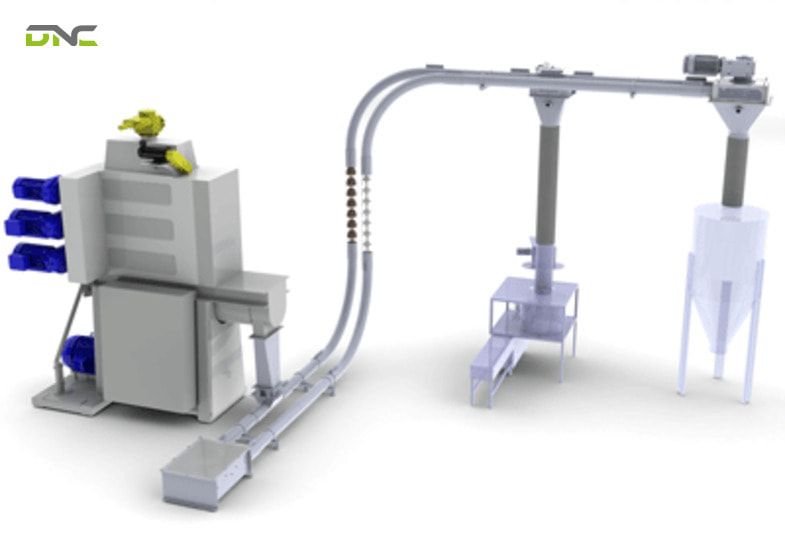
Where Tubular Chain Conveyor Is Used in Malaysian Manufacturing
How to Choose the Right Tubular Chain Conveyor for Your Factory
Selecting a tubular chain conveyor requires matching material properties, throughput, routing geometry, and regulatory requirements to the correct configuration.
- Material Bulk Density and Flowability. Tubular chain conveyors handle bulk densities from 0.1 kg/L (light powders — puffed food products, loose fibers) to 2.5 kg/L (dense minerals, cement). Material above 2.5 kg/L bulk density is borderline for tubular chain — heavy industrial materials may require heavy-duty configuration with drive power above 15 kW. Free-flowing materials (angle of repose below 35°) are easy to handle; cohesive, sticky materials (angle of repose above 50°) require agitator inlets or injection purge at inlets to prevent bridging.
- Required Capacity and Circuit Length. Match tube internal diameter and chain speed to required m³/hour. For circuits longer than 60m horizontal equivalent length, consult DNC Automation engineers to verify drive power and chain tension calculations — long circuits may require a second drive unit or reduced chain speed.
- Hygiene and Regulatory Grade. Food, pharma, and halal-certified products require SS304 minimum (SS316L recommended for washdown), UHMWPE or SS flights, CIP-compatible construction, and ATEX rating for dust-explosive materials. Non-food industrial applications use carbon steel standard grade. Regulatory requirements in Malaysia — NPRA GMP, HACCP, Jabatan Kemajuan Islam Malaysia (JAKIM) halal certification — specify the material grade; DNC Automation provides certification documentation for each tubular chain system it supplies.
- Operating Temperature. Standard tubular chain handles -10°C to +80°C. High-temperature variants (alloy chain, heat-resistant flights) cover up to 300°C. Verify material inlet temperature at the conveyor entry point, not just process temperature — materials may arrive significantly hotter than expected from upstream equipment.
- Explosion Risk Assessment. Cocoa powder, flour, starch, sugar, and pharmaceutical intermediates are all combustible dusts. Malaysian DOSH requires ATEX (or equivalent) equipment zoning for enclosed conveyor systems handling combustible dusts. DNC Automation specifies ATEX Zone 20/21 rated motors, drives, and electrical components for all tubular chain systems handling combustible dust materials — this is not optional under Malaysian industrial safety regulations.
How to Choose the Right Tubular Chain Conveyor for Your Factory
Frequently Asked Questions About Tubular Chain Conveyor
Q: What is the difference between a tubular chain conveyor and a screw conveyor?
A tubular chain conveyor and a screw conveyor both handle bulk powders and granules, but they differ fundamentally in how they contact and move material. A screw conveyor rotates a helical flight against material in a trough or tube, generating shear stress that degrades fragile particles and produces fines. A tubular chain conveyor moves disc flights slowly through material, exerting drag force without significant shear. The tubular chain conveyor also routes through multi-direction circuits without intermediate transfer points — a screw conveyor cannot change direction within a single unit. For fragile materials (cocoa powder, pharmaceutical granules, cereal flakes), the tubular chain is categorically superior. For simple short transfers of non-fragile powders, screw conveyors remain simpler and lower-cost.
Q: How far can a tubular chain conveyor transport material?
A single-drive tubular chain circuit handles horizontal distances up to 60m equivalent length (including vertical rise and bend conversions). For longer distances, DNC Automation recommends a two-drive circuit (second drive station at the midpoint) or a series of circuits with an intermediate discharge/inlet point. Pneumatic conveying handles longer distances in straight-line applications, but the tubular chain conveyor’s advantage in multi-inlet/multi-outlet distribution networks and fragile material protection makes it the preferred choice within the 60m range.
Q: Can a tubular chain conveyor handle wet or sticky materials?
Tubular chain conveyors handle moderately moist or slightly sticky materials within limits. Materials with moisture content above 15–20% (wet-cake products, highly hygroscopic powders in high-humidity environments) may bridge in the tube circuit between flights, causing chain overload and potential jam. DNC Automation addresses sticky material applications with heated tube sections (maintain material below sticky temperature), nitrogen purge circuits (prevent hygroscopic materials from absorbing moisture during transfer), and aggressive agitation at inlets. Highly sticky materials — molasses, wet sludge, pastes — are not suitable for tubular chain and require a different conveyor technology.
Q: What maintenance does a tubular chain conveyor require?
Tubular chain conveyor maintenance intervals are longer than comparable screw or belt conveyors because the enclosed circuit protects chain and flights from atmospheric contamination. DNC Automation’s recommended maintenance schedule for standard food-grade tubular chain conveyors is: monthly chain elongation check (remove inspection cover, measure 10 pitches against nominal); quarterly disc flight visual inspection for wear, cracking, or deformation; annual bend section internal inspection with bore camera; chain replacement at 3% elongation (industry standard trigger). Total maintenance person-hours average 4–6 hours per year for a standard 15m circuit in F&B service.
Q: Is a tubular chain conveyor suitable for ATEX/explosive dust environments?
Tubular chain conveyors are inherently superior to open conveyors in explosive dust environments because the fully sealed tube circuit eliminates dust cloud generation during normal operation — removing the primary explosion initiation condition. ATEX-rated tubular chain systems (Zone 20 internal, Zone 21 external) use ATEX-certified drive motors, controls, and switches. Malaysia’s DOSH requires ATEX compliance for enclosed conveyor systems handling dusts with Kst >0 (the vast majority of organic powders including flour, cocoa, starch, and pharmaceutical intermediates). DNC Automation provides ATEX-certified tubular chain systems with complete zone classification documentation and DOSH submission support.
Q: How does tubular chain conveyor compare in cost to pneumatic conveying?
Tubular chain conveyors have higher upfront fabrication cost than simple dilute-phase pneumatic conveying for the same throughput, but significantly lower energy consumption and operating cost. Pneumatic dense-phase systems consume 3–8 kW/tonne·m of material transported; tubular chain systems consume 0.3–1.5 kW/tonne·m — a 3–5× energy cost advantage at comparable throughputs. Over a 10-year plant operating life with Malaysian electricity costs of RM 0.35–0.57/kWh, the tubular chain energy cost saving typically exceeds the capital cost differential. DNC Automation provides lifecycle cost comparison calculations for clients evaluating tubular chain versus pneumatic options.
Q: Does a tubular chain conveyor qualify for Malaysian NIMP 2030 or SAG Grant funding?
Tubular chain conveyor installations qualify for SAG Grant (Smart Automation Grant) under MIDA when the installation is part of a broader factory automation upgrade that reduces manual handling or improves process control. The SAG Grant provides 70:30 matching funding up to RM 1M — meaning Malaysian manufacturers contribute 30% and receive 70% grant funding for qualifying automation investments. DNC Automation’s project team prepares SAG Grant application documentation, technical justification reports, and ROI calculations as part of its standard project delivery service, significantly reducing the administrative burden on client project teams.
Conclusion
Tubular chain conveyors deliver what no other bulk handling technology matches: fully enclosed, dust-free, multi-directional conveying that protects fragile materials from degradation while simultaneously meeting the strictest hygiene and containment requirements in Malaysian food, pharmaceutical, and industrial manufacturing. From Guan Chong Berhad’s cocoa processing to halal F&B factories throughout Selangor and pharmaceutical plants in Penang, the tubular chain conveyor has become the technology of choice wherever material integrity and dust containment are non-negotiable.
DNC Automation — Malaysia’s Top #1 Factory Automation Company since 2005 — designs, supplies, and commissions tubular chain conveyor systems with 35 engineers, a 25,000 sq ft fabrication facility, ISO 9001:2015 certification, and proven partnerships with world-class component suppliers. Laumas Italy weighing integration, Siemens Germany drive systems, and DNC’s own fabrication capability combine in every tubular chain conveyor project.
Get a Free Consultation — Talk to Our Engineers at dnc-automation.com and let DNC Automation specify the right tubular chain conveyor system for your factory.
- 6 views
- 0 Comment
Recent Comments