



V Belt Conveyor: Drive Transmission & Product Centering Guide Malaysia
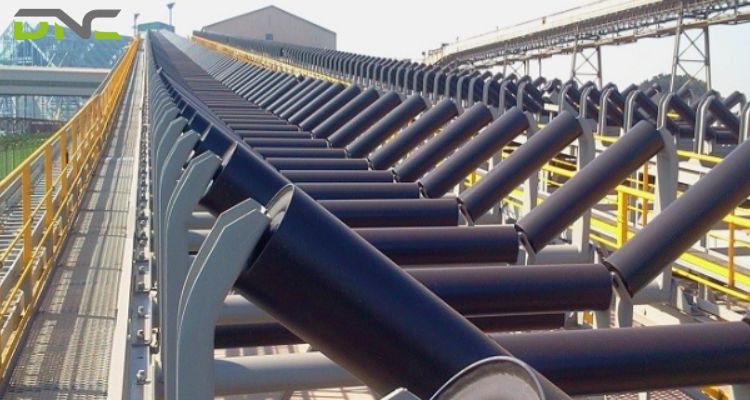
V belt conveyor technology covers two fundamentally different engineering applications that share only the “V” in their names but serve completely different purposes in Malaysian factory automation. The first — V-belt power transmission — refers to the trapezoidal rubber belts (A, B, C, D, or SPZ/SPA/SPB/SPC cross-section) that transmit motor torque to a conveyor’s drive pulley. Nearly every conveyor system in Malaysia uses V-belt drives: they are the dominant power transmission method for conveyors up to 50 kW, available at every electrical and mechanical supply shop in Selangor, Penang, and Johor, and maintainable by any factory technician with a wrench. The second — V-groove belt conveyor (also called V-profile belt or V-shaped conveyor belt) — refers to a conveyor belt with a molded V-groove or V-shaped cross-section profile that centers, grips, and orients round, irregular, or cylindrical products along the production line. F&N’s bottling lines (DNC Automation client) use V-groove centering belts to stabilize PET bottles for labeling. Malaysian halal poultry processors use V-groove conveyor belts to center poultry carcasses for precise cutting. Fresh produce growers in Cameron Highlands use V-groove belts to singulate and orient round vegetables for inspection and packing. DNC Automation, Malaysia’s Top #1 Factory Automation Company since 2005, engineers both V-belt drive systems and V-groove centering conveyor systems for clients across Malaysia’s food processing, beverage, and general manufacturing sectors. This article addresses both applications completely — with specifications, types, selection criteria, and Malaysian-specific application guidance for each.
What Is a V Belt Conveyor?
A V belt conveyor encompasses two distinct but related technologies:
Application 1 — V-Belt Power Transmission Drive: A V-belt is a trapezoidal rubber belt that fits into a corresponding V-groove on a drive pulley and driven pulley, transmitting rotational power from a motor to a conveyor drive shaft through wedge action. The V-shaped cross-section wedges deeper into the pulley groove as tension increases, increasing the friction force — this self-energizing effect allows V-belts to transmit significantly more power per belt unit width than flat belts.
Application 2 — V-Groove Belt Conveyor (Product Centering): A V-groove belt conveyor uses a conveyor belt with a longitudinal V-shaped groove molded into its surface, or a V-profile belt that runs between two inclined surfaces forming a V-trough, to center, stabilize, and orient products as they travel along the conveyor. The V-groove acts as a geometric guide that self-centers round, cylindrical, or irregular products regardless of their lateral entry position.
Both technologies are critical in Malaysian factory operations — V-belt power transmission as the nearly universal conveyor drive mechanism, and V-groove centering belts as precision product handling tools in F&B and agricultural processing.
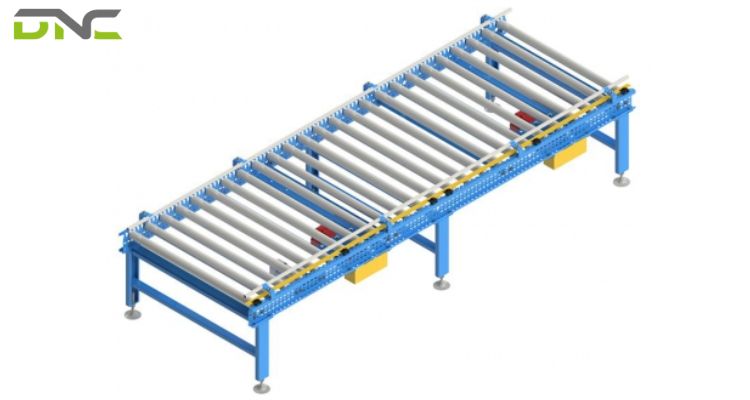
How Does V-Belt Power Transmission Work?
Step 1 — Drive Layout and Sheave Selection
V-belt power transmission begins at the motor pulley (drive sheave) and ends at the conveyor drive shaft pulley (driven sheave). The speed ratio between motor and conveyor shaft equals the ratio of sheave diameters: if the motor sheave is 100mm and the conveyor sheave is 300mm, the conveyor shaft rotates at 1/3 of motor speed. The center distance between sheaves determines belt length and wrap angle — wrap angle above 150° on the smaller sheave is ideal; below 120° requires a V-belt set with higher capacity rating to compensate for reduced wedging effectiveness.
Step 2 — Belt Cross-Section and Grade Selection
V-belt cross-sections are standardized: Classical A, B, C, D, E (A = lightest, D = heaviest). Narrow (Wedge) sections SPZ, SPA, SPB, SPC (30% more power capacity in the same width as classical). The cross-section is selected based on the transmitted power and speed combination using a V-belt drive design chart — every belt manufacturer (Gates, Bando, Optibelt, Fenner) provides these charts. Malaysian factory engineers commonly select classical B-section as a default for general industrial use; narrow SPA/SPB sections are recommended by DNC Automation for new installations above 5 kW where space efficiency and belt quantity reduction are priorities.
Step 3 — Wedge Action and Power Transmission
V-belts transmit power through wedge action: as belt tension increases (from the motor driving the load), the belt wedges more deeply into the sheave groove, increasing the normal force on both groove flanks, and thereby increasing the friction force available to transmit torque. This wedge action provides 3–5× higher power transmission efficiency per unit cross-section than a flat belt at the same tension — explaining why V-belts can transmit 50–500 kW from a compact sheave set.
Step 4 — Belt Tension Management
V-belt drive performance is highly tension-sensitive. Under-tensioned V-belt drives slip under load — generating heat, accelerating belt wear, and reducing drive efficiency. Over-tensioned drives overload shaft bearings and reduce belt service life through fatigue. Correct V-belt tension is verified using a tension gauge (deflection method: 1/64 inch per inch of span per 1 kg/cm² of span length force) or a sonic tension meter (belt vibration frequency method). DNC Automation’s maintenance protocol for V-belt conveyors includes tension verification at installation, at 24 hours (initial seating allowance), and every 500 operating hours thereafter.
Step 5 — Multiple Belt Sets
When power transmission requirements exceed the capacity of a single V-belt, multiple matched belts run in parallel on multi-groove sheaves. “Matched” sets (belts from the same manufacturing batch or with measured lengths within ±0.3% of each other) are mandatory — mismatched belt lengths cause unequal load sharing, overloading the shorter belts and under-loading the longer ones, resulting in progressive failure of the shortest belt followed by rapid sequential failure of the remaining set.
How Does V-Groove Belt Conveyor (Product Centering) Work?
V-groove centering belt conveyors operate on a different principle: product geometry and gravity, not friction, provide the centering force.
Step 1 — Product Placement and Self-Centering
A round or irregular product (PET bottle, poultry carcass, round vegetable) placed anywhere across the V-groove belt surface rolls or slides to the center of the V-groove under gravity. The V-groove angle (typically 60–90°) determines how strongly the centering force acts: a 60° V-groove provides stronger centering than a 90° groove for the same product weight.
Step 2 — Stable Transport at Production Speed
Once centered in the V-groove, the product travels along the conveyor at belt speed (typically 0.1–1.5 m/s) without lateral drift. Products maintain their centered position even through gentle curves, speed transitions, and slight conveyor inclinations. The stable, repeatable position of each product at the discharge end is the key production benefit: a labeling head, camera inspection system, or cutting tool positioned above the discharge point encounters every product at exactly the same lateral position.
Step 3 — Discharge and Handoff
Products discharge from the V-groove belt conveyor over the end pulley, where gravity overcomes the V-groove centering action and the product rolls off in a controlled, repeatable trajectory. Transfer to an accumulation table, packaging machine infeed, or next process stage occurs at the same position every time — enabling reliable synchronization with downstream automatic equipment.
Types of V-Belt for Power Transmission
1. Classical V-Belt (A, B, C, D, E Cross-Section)
Classical V-belts (A, B, C, D, E sections, in increasing cross-section size) have been the standard conveyor drive belt in Malaysian factories since the country’s manufacturing sector developed in the 1970s and 1980s. Classical B-section is the most commonly stocked V-belt in Malaysia — available in every length from 25 inches to 240 inches (in 1-inch increments) at electrical and mechanical supply distributors throughout Selangor, Penang, and Johor. Classical V-belts suit conveyor drives up to 15 kW for B-section; up to 30 kW for C-section; up to 75 kW for D-section.
| Section | Top Width | Height | Power Range |
| A | 12.7mm | 8mm | Up to 5 kW |
| B | 16.7mm | 11mm | Up to 15 kW |
| C | 22mm | 14mm | Up to 30 kW |
| D | 32mm | 19mm | Up to 75 kW |
| E | 38mm | 23mm | Up to 150 kW |
2. Narrow/Wedge V-Belt (SPZ, SPA, SPB, SPC)
Narrow (wedge) V-belts — designated SPZ, SPA, SPB, SPC in ISO/DIN standard — have a higher height-to-width ratio than classical belts, providing up to 30% more power capacity per belt compared to the equivalent classical section. Narrow V-belts run cooler (less internal bending stress) and last longer than classical belts at the same power level.
DNC Automation specifies narrow V-belts as standard for all new conveyor drive designs above 5 kW. The additional cost versus classical section (approximately 15–20% higher unit price) is recovered through extended belt service life and improved drive efficiency. Malaysian factories upgrading conveyor drives as part of NIMP 2030 smart factory programs frequently switch from classical to narrow V-belts simultaneously, capturing both efficiency and maintenance interval improvements.
3. Cogged (Notched) V-Belt
Cogged V-belts have transverse notches cut into the inner (bending) surface at regular intervals, reducing the bending stiffness of the belt and allowing smaller sheave diameters without exceeding rubber fatigue limits. Cogged V-belts also run cooler than solid V-belts because the notches allow heat dissipation from the belt’s compressed inner surface.
Cogged V-belts are specified for conveyor drives where center distance constraints force small sheave diameters (below the recommended minimum for standard V-belts) or where ambient temperatures above 35°C (common in Malaysian outdoor or non-air-conditioned factory environments) would cause excessive thermal degradation of standard belt compound.
4. Variable Speed V-Belt
Variable speed V-belts are used with variable-pitch sheaves (sheaves with adjustable groove angle) that change the effective sheave diameter while the drive is running. As the sheave opens (groove angle increases), the belt rides lower (smaller effective diameter) — changing the speed ratio continuously without stopping.
Variable speed V-belt drives are found in Malaysian rice mills, feed mills, and certain textile machinery where production rate adjustment during operation is required. VFD (variable frequency drive) speed control has largely replaced variable-pitch V-belt drives in new Malaysian factory installations — VFDs provide more precise speed control and eliminate the mechanical wear of variable-pitch sheaves — but legacy variable-speed belt drive systems remain common in older facilities.
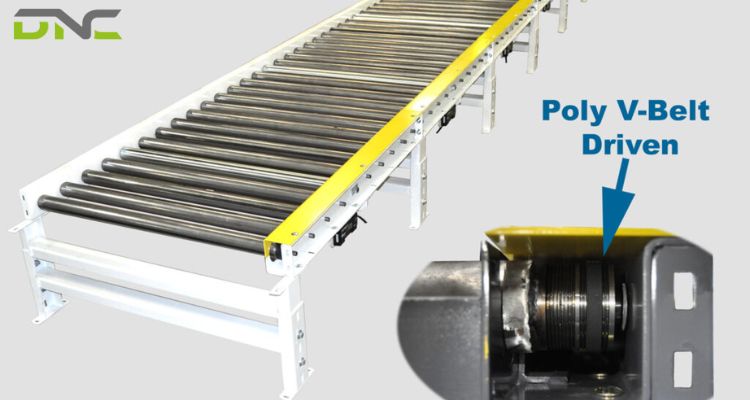
5. Poly-V (Ribbed) Belt
Poly-V belts (also called serpentine belts) have multiple longitudinal V-ribs on the inner surface, providing a high contact area-to-width ratio for compact, high-power transmission at high belt speeds. Poly-V belts operate at belt speeds up to 50 m/s — far above the 30 m/s limit of classical and narrow V-belts.
Poly-V belts appear in Malaysian factory conveyor applications requiring compact drive geometry with high power density — particularly in packaging machinery, automated assembly systems, and precision conveyor drives where minimizing drive envelope size is a priority.
Types of V-Groove Belt Conveyor for Product Centering
1. Single-Groove V-Profile Centering Belt
Single-groove V-profile centering belts have one longitudinal V-groove molded into a flat belt surface. The groove depth (10–50mm) and angle (60–90°) match the diameter range of the product being centered. PET beverage bottles in 0.5L to 2L sizes use V-groove depths of 20–35mm; poultry carcasses require 40–50mm grooves for stable support.
F&N’s Malaysian bottling operations — DNC Automation client — use single-groove V-profile centering belts to stabilize PET bottles at the labeling station. Bottle centering accuracy of ±2mm at the label application point is achievable with correctly sized V-groove belts, enabling label placement accuracy that meets retail shelf presentation standards.
| Product Type | V-Groove Depth | V-Groove Angle | Belt Material |
| 0.5L PET bottle | 20–25mm | 70–80° | Food-grade PVC white |
| 1.5L PET bottle | 30–35mm | 75–85° | Food-grade PVC white |
| Poultry carcass | 40–50mm | 60–70° | Food-grade PU white |
| Round produce (tomato, onion) | 15–25mm | 80–90° | PVC green or natural |
| Tin cans (beverage) | 18–22mm | 75–80° | Food-grade PVC |
2. Twin-Belt V-Trough Conveyor
Twin-belt V-trough conveyors use two flat belts inclined toward each other at a V-angle (typically 60–90°), running in parallel side by side to form a V-shaped trough between them. Products rest in the V-trough between the two belts, centered by gravity. Both belts run at the same speed — the product is carried forward by friction contact with both belt surfaces.
Twin-belt V-trough conveyors are used in Malaysian halal poultry processing plants for carcass transport and orientation. Poultry carcasses hanging from their legs or resting in the V-trough are carried to the cutting and portioning stations at precisely controlled spacing, enabling automated cutting heads to apply cuts at consistent anatomical positions. The halal poultry processing sector in Malaysia — a significant export industry under the halal certification framework administered by JAKIM (Jabatan Kemajuan Islam Malaysia) — uses twin-belt V-trough conveyors as standard production equipment.
3. V-Groove Spiral Return Belt
V-groove spiral return conveyor belts have a V-groove profile on the load-carrying surface and a flat or ribbed underside for conventional return-side idler roller support. The spiral variant introduces a gentle helical twist to the belt routing, allowing the conveyor to change elevation while maintaining product orientation in the V-groove — used in height-gain sections of bottling and canning lines.
4. V-Profile Accumulating Conveyor
V-profile accumulating conveyors combine the V-groove centering function with low-back-pressure accumulation capability. The V-groove surface is made from individual UHMWPE pucks or low-friction acetal tiles that allow products to stop accumulating when the downstream equipment is full, while the belt underneath continues to move. This accumulating V-groove belt is used in Malaysian automated packaging lines where bottles or cans accumulate at an inspection station or packaging machine infeed without the conveyor pressure from accumulated products pushing the front items into the machine.
Key Components of a V Belt Conveyor System
V-Belt Drive Components
V-Belt Sheaves (Pulleys). Sheave material is cast iron (standard industrial), fabricated steel (large diameter, custom), or aluminium (light duty, high speed). Sheave groove angle must match belt section: 34–40° for classical sections; 36–38° for narrow sections. Incorrect groove angle (mismatched sheave to belt) causes belt to ride too high (wear on top face) or too low (reduced wedge contact) in the groove.
Motor and Gearbox. DNC Automation specifies Siemens electric motors for all V-belt conveyor drive applications — leveraging DNC’s direct partnership with Siemens Germany. Siemens motors provide IE3 or IE4 energy efficiency ratings that reduce electricity cost versus standard-efficiency motors — a meaningful saving given Malaysian industrial electricity tariffs and the NIMP 2030 energy efficiency objectives.
Belt Tensioner. Adjustable motor base (slide rails with locking bolts) provides V-belt tension adjustment by moving the motor away from the driven sheave. Jockey pulley tensioners (a movable idler pulley pressing against the belt’s slack side) are used when center distance adjustment is not possible. DNC Automation specifies automatic belt tensioners on high-duty applications to eliminate the manual tension-checking requirement.
V-Groove Belt Conveyor Components
V-Groove Belt. Food-grade PVC (standard for beverages, dry food products) and food-grade PU (polyurethane, for oily or moist food products, better chemical resistance) are the two material options for V-groove centering belts in Malaysian F&B applications. White belt compounds are standard for food hygiene traceability. Belt hardness 65–75 Shore A for most V-groove belts — harder rubber provides more precise centering geometry retention over belt service life.
Drive Pulley and Idler Rollers. The drive pulley for a V-groove belt requires a crowned or V-grooved profile that matches the belt’s V-groove underside to prevent belt wander. Supporting idler rollers may be standard flat (for V-profile belts with flat undersides) or V-groove match rollers (for twin-belt V-trough systems where belt edge support is required).
Frame and Guard. Stainless steel SS304 frame is standard for food processing environments; powder-coated mild steel for general industrial. Side guards prevent product rollout from the V-groove at speed transitions. Clean-in-place (CIP) design — smooth surfaces, minimal horizontal ledges, drainable frame construction — is mandatory for Malaysian HACCP-certified food processing lines.
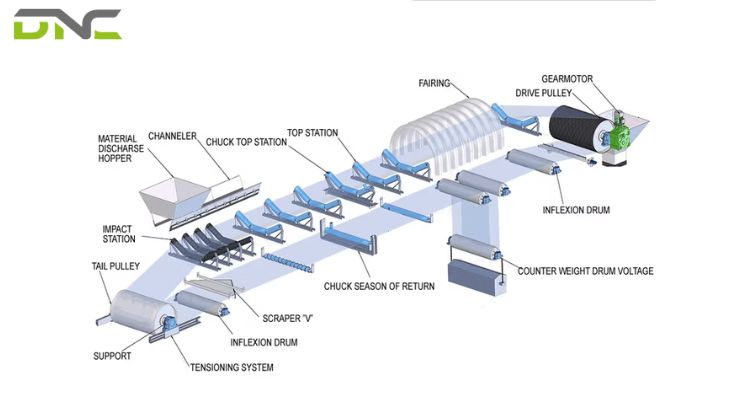 Applications: Where V Belt Conveyor Is Used in Malaysian Manufacturing
V-Belt Drive — Universal Malaysian Factory Application
V-belt drives power virtually every conveyor in Malaysia that is not gear-coupled or chain-driven directly. Selangor’s manufacturing cluster — the highest concentration of Malaysian factories — runs tens of thousands of V-belt conveyor drives from simple PVC carton conveyors in small component factories to multiple-belt classical D-section drives on 50 kW aggregate conveyors. The Malaysian V-belt market benefits from fully local supply chain: Malaysian distributors stock all standard classical and narrow V-belt sizes, and engineering workshops throughout the country perform sheave turning and replacement within 24 hours for most standard sizes.
NIMP 2030’s drive toward energy-efficient manufacturing is accelerating Malaysian factories’ transition from classical to narrow V-belts and from V-belt to direct-coupled (VFD + motor) drives for new installations. DNC Automation advises clients to retain V-belt drives for conveyor applications below 50 kW where the simplicity, serviceability, and cost advantages of V-belt drives outweigh direct coupling efficiency gains.
F&N Bottling Lines — V-Groove Centering
F&N Malaysia — DNC Automation client — operates beverage bottling lines at its Malaysian production facilities producing carbonated drinks, juices, and water in PET, glass, and can formats. V-groove centering belts at the labeling station, cap inspection station, and fill-level camera inspection station ensure each container presents at a consistent lateral position to the inspection or application device. PET bottle lines running at 36,000 bottles per hour (600 bottles per minute) require V-groove belt centering accuracy of ±1.5mm to maintain labeling quality standards at that throughput.
Halal Poultry Processing
Malaysian halal poultry processors — producing chicken products for domestic consumption and export under JAKIM certification — use twin-belt V-trough conveyors throughout their evisceration, cutting, and portioning lines. Poultry carcasses transported in the V-trough maintain consistent orientation (breast-down or back-down, depending on process stage) that enables automated cutting heads to make anatomically consistent cuts. Consistent cut accuracy is a food safety and yield optimization requirement: a poorly oriented carcass entering an automated saw generates wasted yield and potential bone fragment contamination.
Cameron Highlands Produce Supply Chain
Cameron Highlands — Malaysia’s primary highland vegetable and fruit growing region — supplies fresh produce to Klang Valley and Singapore daily through a cool chain that begins with packing house conveyor lines. Round produce (tomatoes, cabbage heads, onions, bell peppers) uses V-groove centering belts for singulation, orientation, and size-grading before packing. V-groove belts in this application use food-contact-safe PVC or PU compound, sized for the specific produce type.
General Malaysian Manufacturing — V-Belt Drives
Sony’s Malaysian electronics manufacturing operations, Unilever’s consumer goods production, and Hartalega’s glove manufacturing all use V-belt drives on countless utility conveyors — material transfer between production stages, finished goods to packaging, raw material receiving from dock. V-belt drives in these applications are maintained by factory maintenance teams using locally purchased replacement belts — one of the most labor-efficient maintenance activities in any Malaysian factory.
Benefits of V Belt Conveyor for Factory Operations
Universal Availability — V-Belt Drive. Classical and narrow V-belts are available at over 200 distributors across Malaysia. Any Malaysian factory maintenance team can replace a failed V-belt in under 30 minutes using stock parts and basic tools, without external contractor involvement. This availability makes V-belt drives the most maintenance-resilient power transmission method for Malaysian conveyor systems, particularly in locations distant from major industrial centers (Sabah, Sarawak, Kelantan).
Cost-Effective Power Transmission. V-belt drive installation cost is 30–50% lower than equivalent gear-coupled or chain-coupled drive systems for the same power level. The combination of lower first cost, local availability, and simple maintenance makes V-belt drives the economically optimal power transmission choice for Malaysian conveyor drives below 50 kW. DNC Automation’s conveyor system designs include V-belt drives as the default specification for this power range, switching to direct coupling only where specific precision, cleanliness, or noise requirements justify the higher cost.
Precision Product Centering — V-Groove Belt. V-groove centering belts eliminate manual product alignment at inspection, labeling, and processing stations — a labor-intensive function in factories that have not automated this step. DNC Automation clients using V-groove centering belts report 50% productivity increase at the stations immediately downstream of the centering belt, as automated equipment alignment replaces manual operator positioning. Human error — a product presented at the wrong lateral position causing misaligned labels, missed inspection, or incorrect cuts — is reduced by 80% or more, consistent with DNC Automation’s documented automation performance across its client installations.
NIMP 2030 Compliance. Energy-efficient narrow V-belt drives (30% power reduction versus classical equivalents) contribute to Malaysian manufacturers’ NIMP 2030 energy efficiency targets. V-groove centering systems that enable automated downstream processing replace manual labor at labor-shortage-sensitive production stages — directly addressing the labor shortage and rising minimum wage challenges that are the primary automation ROI drivers under NIMP 2030.
How to Choose the Right V Belt Conveyor for Your Factory
For V-Belt Drive Selection:
- Calculate the design power: motor rated power × service factor (1.0–1.8 depending on shock load, daily operating hours, and driven machine type).
- Determine speed ratio from motor RPM and required conveyor drive shaft RPM.
- Select belt cross-section from power-speed chart (narrow section preferred for new designs).
- Calculate center distance and belt length from sheave diameters and center-to-center distance.
- Verify minimum wrap angle (above 150° on small sheave); if below 120°, upsize belt section or use idler/jockey tensioner.
For V-Groove Belt Conveyor Selection:
- Define product dimensions: minimum and maximum diameter, length, and weight for all products the conveyor must handle.
- Select V-groove depth: groove depth should be 40–60% of product minimum diameter for stable centering without product jamming in groove.
- Select belt material: food-grade PVC for dry food/beverage; food-grade PU for oily or moist food products; standard PVC for non-food.
- Define required belt speed: product spacing × products per minute = belt speed in m/min. Verify that this speed is within the V-groove belt’s rated speed range.
- Plan downstream interface: define the position and orientation handoff requirement to labeling machine, cutting station, camera, or packaging machine.
Frequently Asked Questions About V Belt Conveyor
Q: What is the difference between a V-belt and a flat belt for conveyor drives?
A V-belt and a flat belt both transmit power through friction between belt and pulley, but V-belts use wedge action to multiply the effective friction force. A V-belt generates 3–5× more friction force per unit of belt tension than a flat belt of equivalent width, because the V-shape wedges into the groove under load. This means a V-belt drive can transmit the same power as a flat belt drive with much less belt tension — reducing shaft bearing loads and belt fatigue. V-belt drives dominate Malaysian industrial conveyor applications below 50 kW because of this power efficiency advantage combined with local availability of all standard sizes.
Q: How do I know when a V-belt needs replacing?
V-belt replacement indicators include: visible cracking or fraying on the belt outer surface; belt sides (flanks) showing shiny, hardened, or polished appearance (glazing — indicates slippage and heat damage); belt riding high in the sheave groove (indicating wear of belt flanks has reduced belt cross-section); belt slip under load (motor runs but conveyor is sluggish); and excessive vibration from the drive belt. In Malaysian factory tropical conditions, rubber aging (hardening and cracking) typically limits V-belt service life to 12–24 months for drive belts, regardless of mechanical wear — DNC Automation recommends scheduling belt replacement at 18-month maximum intervals for all V-belt conveyor drives.
Q: Can a V-groove belt conveyor handle wet or oily products?
V-groove belt conveyors handle wet and oily products when specified with the correct belt material. Food-grade PU (polyurethane) belts are preferred for oily food products (poultry, fish, palm oil-contaminated produce) because PU resists oil absorption and swelling better than PVC. Oil-contaminated PVC belts absorb the oil compound, causing belt surface softening, dimensional change, and loss of V-groove geometry over 3–6 months. DNC Automation specifies PU V-groove belts for all Malaysian halal meat and poultry processing applications and for any application involving oil-contaminated product contact.
Q: What is the maximum speed for a V-belt conveyor drive?
Classical and narrow V-belts operate optimally at belt speeds of 5–30 m/s (speed at the pitch circle of the driving sheave). Below 5 m/s, V-belts are less efficient (centrifugal force effects become dominant over friction at speeds below this range — actually centrifugal effects reduce effective clamping at high speeds, not low speeds; at low speeds, the drive works well but motor sheave size becomes large). Above 30 m/s, centrifugal force reduces the effective belt tension in the groove, reducing power transmission capacity. Classical V-belts should not exceed 25 m/s; narrow wedge belts handle up to 30 m/s. Poly-V belts extend to 50 m/s for high-speed applications.
Q: How many V-belts should a drive use — one or multiple?
Multiple-belt drives are used when the power requirement exceeds the capacity of a single belt in the selected cross-section, or when redundancy for critical drives is needed (if one belt breaks in a multiple-belt set, the remaining belts may carry the load temporarily, preventing immediate shutdown). DNC Automation recommends: single belt for drives below 5 kW (any section); 2–3 belts matched set for 5–30 kW; 3–6 belts matched set for 30–75 kW; above 75 kW, consider narrow section or direct coupling. Always replace the complete set simultaneously — never replace only the broken belt in a multiple-belt set, as the remaining worn belts will not share load equally with a new belt.
Q: Does a V-groove belt conveyor work for non-round products?
V-groove centering belts are optimized for round or approximately round cross-section products — bottles, cans, cylinders, balls, and roughly spherical produce. Products with square or rectangular cross-section do not self-center in a V-groove; they present on a flat face or an edge, not a stable position. For rectangular products requiring centering, parallel guide rails or a different product centering mechanism is appropriate. Irregularly shaped products (chicken pieces, oddly shaped vegetables) need product-specific groove profiles rather than standard V-groove — DNC Automation’s engineering team designs custom groove profiles for non-standard product centering applications.
Q: Can I access SAG Grant funding for V belt conveyor automation in Malaysia?
V-groove belt conveyor systems installed as part of a broader automation project — typically as the centering/orientation stage enabling automated downstream inspection, labeling, or processing — qualify for SAG Grant (Smart Automation Grant) under MIDA. The grant provides 70:30 matching funding up to RM 1M for qualifying automation investments, with V-groove belt systems qualifying when they replace manual product orientation labor or enable automated process steps. V-belt drive upgrades alone (replacing old belts with energy-efficient narrow V-belts) may qualify under NIMP 2030 energy efficiency incentives rather than SAG Grant, depending on the scope of the overall project. DNC Automation provides grant eligibility assessment and application support as part of project planning.
Conclusion
V belt conveyor technology serves Malaysian factory operators at two critical levels: V-belt power transmission drives are the universal, locally-available, low-cost power delivery mechanism for nearly every conveyor in the country; V-groove centering belt conveyors are the precision product handling technology that enables F&N’s 600-bottle-per-minute labeling lines, Malaysia’s halal poultry processing automation, and Cameron Highlands’ fresh produce packing lines to operate with the consistency and accuracy that automated downstream equipment demands. Understanding both applications — and specifying each correctly for the Malaysian operating environment, product, and regulatory context — separates factories that run efficiently from those that suffer belt slip, product misalignment, and premature component failure.
DNC Automation — Malaysia’s Top #1 Factory Automation Company since 2005 — engineers complete V belt conveyor solutions with 35 dedicated engineers, Siemens Germany motor and drive partnerships, ISO 9001:2015 quality certification, and a 25,000 sq ft facility. From specifying the correct SPB narrow V-belt set for a new conveyor drive to designing a custom V-groove PU centering belt for a halal poultry line, DNC Automation has the expertise, components, and proven client track record — Toyota, Sony, F&N, Hartalega, Unilever — to deliver the right V belt conveyor solution for your Malaysian factory.
- 11 views
- 0 Comment
Recent Comments