


Spiral conveyor belt best price 2026
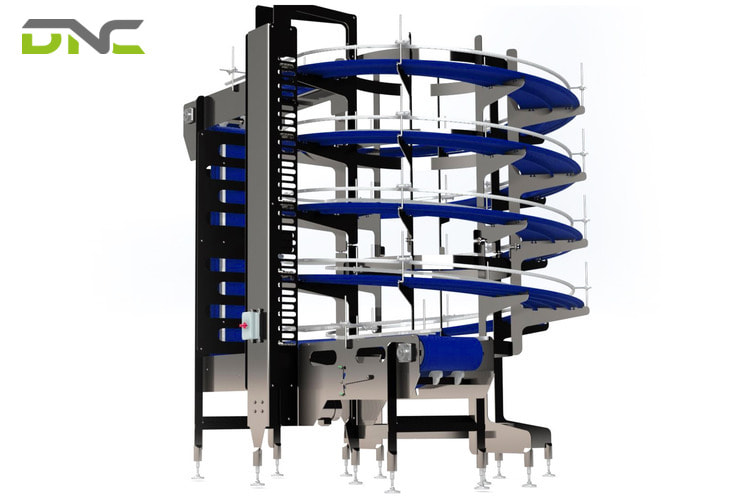
The spiral conveyor is a specialized machine in many production facilities that helps move goods automatically over long distances. The device has a vertical spiral structure, is compact and extremely suitable for many production facilities with limited space.
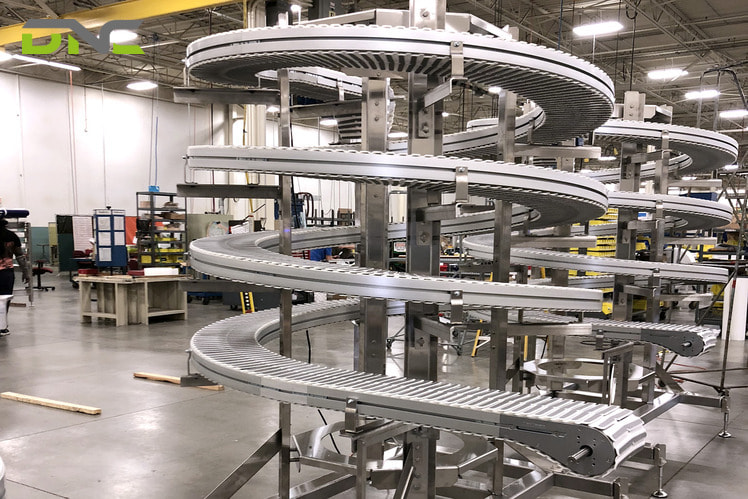
What is the spiral conveyor?
Compared to the efficiency that the spiral conveyor brings, the initial investment cost is completely worth it. The device has used many advanced technologies such as spiral accumulation, continuous spiral chain, and two-lane spiral technology… to create a very smooth, uninterrupted operating process and become the ideal device for many warehouses.
How much does it cost to install a spiral conveyor?
It is difficult to give a general price for a conveyor system. The price of this system depends on many factors such as the size, design, operating capacity and function of the machine.
However, the current market for conveyor solutions ranges from $7,000 to $20,000.
More expensive solutions tend to consume less energy, save time and provide efficient work performance.
Key Components of a Spiral Conveyor System
A spiral conveyor system is built from precisely engineered components that work together to ensure stable vertical transport, consistent product flow, and reliable long-term performance in automated industrial environments.
- Spiral Conveyor Belt or Slat Chain: The conveyor belt or slat chain forms the primary conveying surface, designed to provide sufficient grip and stability as products move vertically. Material selection depends on load weight, product type, hygiene standards, and environmental conditions such as moisture or temperature.
- Central Support Column: The central column serves as the structural backbone of the spiral conveyor, supporting the spiral track and maintaining precise alignment. This component ensures smooth motion, minimizes vibration, and contributes to long-term system durability.
- Drive and Tensioning System: The drive motor and tensioning mechanisms control belt speed and maintain proper belt tension. This ensures consistent movement, prevents slippage, and reduces uneven wear on conveyor components.
- Safety Guards and Side Frames: Safety guards and side frames protect operators while keeping products securely positioned on the conveyor path, reducing the risk of product fall-off and ensuring safe, compliant operation.
How Spiral Conveyor Systems Work
Spiral conveyors operate by guiding products along a helical path using a continuous belt or slat system supported by a central column and outer framework. This design enables smooth vertical movement while maintaining product stability.
- Continuous vertical movement: Products move seamlessly along the spiral track without stopping or transferring between separate conveyor sections. This continuous flow helps reduce bottlenecks and supports high-throughput automation lines.
- Controlled product stability: The spiral design maintains consistent product orientation during elevation changes, minimizing the risk of tipping, slipping, or product damage during transport.
- Upward or downward conveying capability: Spiral conveyors can be configured to move products either upward or downward, allowing flexible integration into different production layouts and material flow requirements.
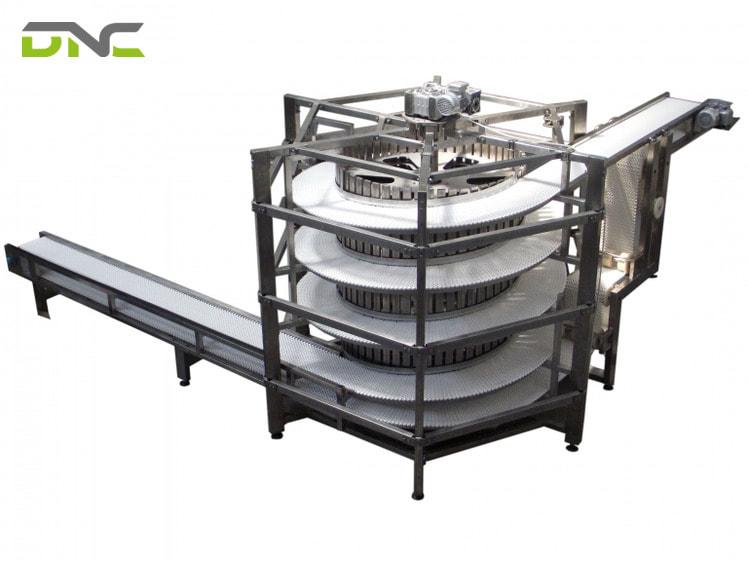
How does the spiral conveyor work?
What technology is applied in spiral conveyors?
Spiral conveyors are designed to integrate many modern technologies that can solve many warehouse requirements such as spiral accumulation technology, continuous spiral chain technology, two-lane spiral technology, and Helix spiral technology…
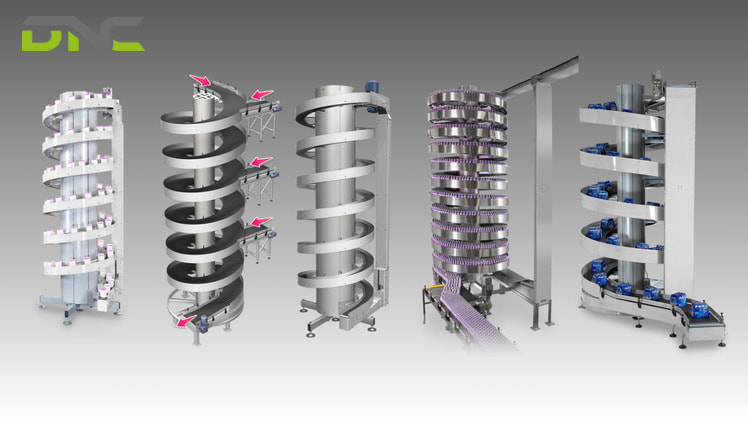
Technology applied in spiral conveyor
- Spiral accumulation technology: is applied to divide accumulation areas into separate and independently controlled areas. This technology allows for more buffer time for product movement and is also a technology that helps optimize floor space effectively.
- Continuous spiral chain technology: This type of technology sounds simple but is an extremely powerful machine. They are controlled and monitored through a drive, when fully connected to the power source, the device is brought to a certain location, and the device will begin to operate cyclically and continuously.
- Two-lane spiral technology: helps save money and warehouse space, in some production facilities, many runways are needed to go up and down, so this technology is one of the best options.
- Helix spiral technology: similar to continuous chain spiral technology, will include 90 or 181-degree conveyor sections connected, at each section there will be different sensor and monitoring systems, ensuring safe distance during movement.
What Are the Industrial Applications of Spiral Conveyors?
Spiral conveyor systems are widely used across industries that require efficient vertical material movement while maintaining continuous production flow.
- Manufacturing and assembly lines: Spiral conveyors transport components or finished products between different process stages, supporting multi-level production layouts without excessive floor space usage.
- Packaging operations: These systems are commonly used to feed products into packaging machines, accumulate items between processes, or transfer packaged goods to higher-level conveyors.
- Warehousing and distribution centers: Spiral conveyors enable smooth movement of cartons, totes, or parcels between floors, mezzanines, and sorting systems in automated logistics environments.
- Food and beverage processing: With appropriate belt materials and hygienic design, spiral conveyors are suitable for moving packaged food products while maintaining sanitation standards.
What are the advantages and disadvantages of spiral conveyors?
The advantages and disadvantages of spiral conveyors
Advantages
Spiral conveyors have become the optimal solution for production warehouses thanks to their outstanding advantages such as:
- Flexible design: the equipment has a unique vertical interface, sturdy structure, and high precision. Therefore, the conveyor can withstand large volumes of goods on the same runway.
- Overlapping slats: connecting and stacking the bars together, creating a smooth-moving runway, suitable for many types of goods.
- Space saving: the cylindrical spiral design is an ideal solution for warehouses with limited area, helping manufacturing facilities maximize the use of vertical space
- Superior operating capacity: based on the automatic, continuous operation mechanism at high speed. The equipment can handle large volumes of products easily without any problems, which has made it a reliable device in many production facilities.
- Easy to use and customizable: the interface is easy to use and can be customized according to different needs, helping to meet many manufacturers’ requirements.
Disadvantages
Despite their efficiency and space-saving benefits, spiral conveyors also present certain technical and economic limitations that should be carefully evaluated during system selection and design.
- Limited Directional Movement: Spiral conveyors are designed primarily for vertical transport, moving products either upward or downward. They are not suitable for complex routing or frequent directional changes within a conveying system.
- Long Belt or Chain Length: Due to the tall spiral structure, the conveyor belt or slat chain is relatively long, increasing wear points and resulting in more frequent inspection and maintenance requirements.
- Higher Initial Investment Cost: The specialized structure and engineering of spiral conveyors lead to higher upfront costs compared to conventional incline conveyors, especially for customized applications.
- Complex Maintenance and Repairs: Maintenance tasks can be more time-consuming and require skilled technicians, particularly when servicing the drive system or replacing long belt sections.
Spiral Conveyor vs Incline Conveyor Systems
Choosing between a spiral conveyor and an incline conveyor depends on layout constraints, throughput requirements, and available space.
| Comparison Factor | Spiral Conveyor | Incline Conveyor |
|---|---|---|
| Footprint & Layout Efficiency | Uses a compact circular footprint, significantly reducing horizontal space requirements and supporting space-constrained layouts | Requires long conveyor lengths to achieve elevation changes, increasing floor space consumption |
| Elevation Change Capability | Achieves vertical transport over short distances with a continuous spiral path | Needs extended conveyor length to maintain safe incline angles for product stability |
| Throughput Consistency | Maintains continuous, steady product flow, supporting high-throughput automation lines | Throughput may vary due to speed adjustments based on incline angle and product characteristics |
| System Integration | Easily integrates into multi-level automation systems with minimal transfer points | Often requires additional transfer conveyors or transitions |
| Operational Flexibility | Suitable for both upward and downward conveying within compact layouts | More limited when space constraints restrict conveyor length |
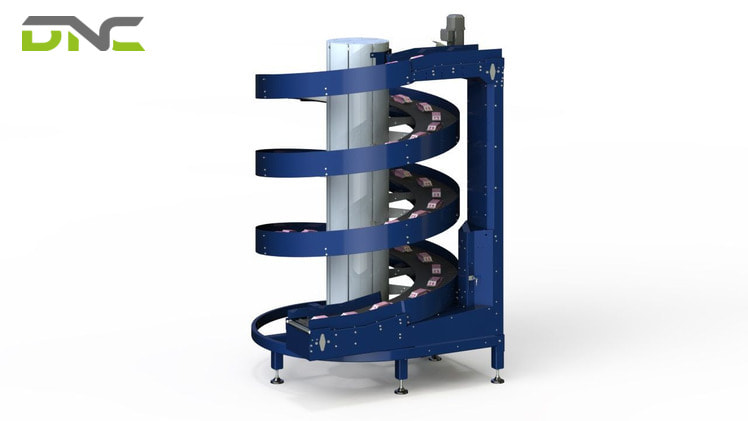
Spiral conveyor
Why Is DNC Automation a Trusted Partner for Spiral Conveyor Solutions?
Choosing the right automation partner is just as important as selecting the right spiral conveyor system. A trusted partner ensures that the conveyor solution aligns with operational goals, layout constraints, and long-term automation strategies.
DNC Automation delivers spiral conveyor solutions through:
- Automation-focused system design: Each spiral conveyor is engineered to integrate seamlessly with automated production lines, control systems, and material handling workflows.
- Customized application solutions: Conveyor systems are tailored to specific product characteristics, throughput requirements, and facility layouts rather than relying on generic designs.
- End-to-end project support: From system design and integration to commissioning and after-sales support, DNC Automation provides comprehensive assistance throughout the project lifecycle.
If you are planning to upgrade or implement a spiral conveyor system, contact DNC Automation now to discuss your application requirements and receive a solution designed for long-term automation performance and operational efficiency.
- 239 views
- 0 Comment
Recent Comments