


Scraper Conveyor: Types, Applications & Engineering Guide for Malaysian Industry
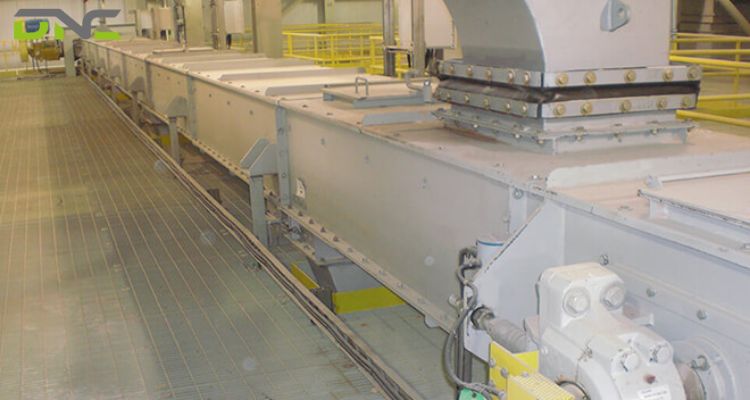
Scraper conveyors are the engineered solution for bulk material handling tasks that belt conveyors cannot perform — moving abrasive, hot, wet, or sticky materials through enclosed troughs in environments where open belts would spill, contaminate, or deteriorate within weeks. A scraper conveyor uses a continuous chain or chains fitted with scraper flights (blades) to push or drag bulk material along a steel trough — enclosed or open — from inlet to discharge point.
Malaysian manufacturers rely on scraper conveyor systems across the highest-demand industrial applications: palm oil mills moving Fresh Fruit Bunches (FFB) at 60–150 TPH through steam-sterilizer environments, cement plants conveying clinker at 400°C, biomass and chip processing plants handling wet organic material, and water treatment facilities managing sludge and screenings. These applications share one characteristic — the material being conveyed would destroy a rubber or plastic belt conveyor within days. Scraper conveyors handle what belt conveyors cannot.
This guide covers every scraper conveyor type used in Malaysian industry — horizontal, inclined, enclosed, and heavy-duty configurations — with engineering specifications, drive system selection, failure mode analysis, maintenance protocols, and a structured selection framework for Malaysian bulk material handling conditions. DNC Automation designs and delivers complete turnkey scraper conveyor systems across Malaysia’s palm oil, cement, biomass, and industrial sectors.
What Is a Scraper Conveyor?
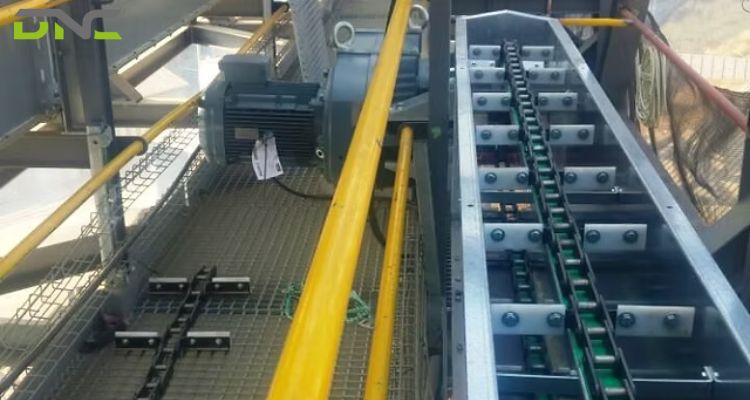
A scraper conveyor is a mechanical conveyor system that uses a chain-driven series of scraper flights to push or drag bulk material along a trough or enclosed casing. Unlike belt conveyors where material rests on a moving belt surface, scraper conveyors embed the material in the trough — the scraper flights push the material pile forward while the trough floor provides the sliding surface.
Core components:
- Chain: Single or double-strand heavy-duty roller chain or palm chain — the drive element connecting all scraper flights
- Scraper flights: Steel or UHMW-PE blades attached to the chain at regular intervals — the material-moving element
- Trough: U-section or rectangular carbon steel trough — the material containment structure
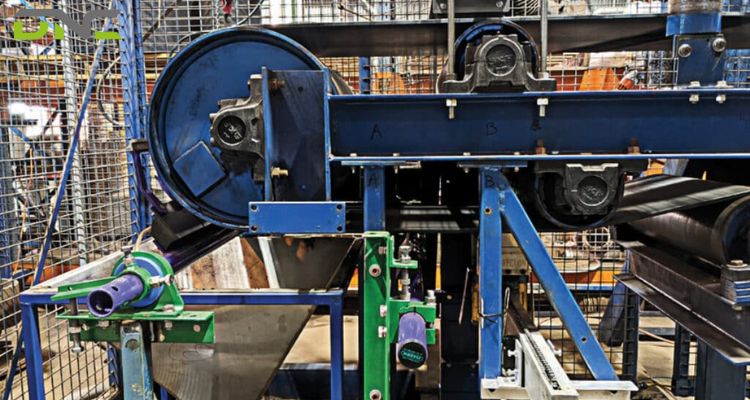
- Drive unit: Motor + gearbox driving the head shaft and sprockets
- Head section: Drive end with sprocket, drive shaft, and material discharge opening
- Tail section: Return end with take-up mechanism for chain tension adjustment
- Return run: Chain and flights return below the material trough (double-strand configuration)
How scraper conveyors differ from belt conveyors:
| Parameter | Scraper Conveyor | Belt Conveyor |
| Drive principle | Chain + flights push material | Belt friction carries material |
| Material containment | Fully enclosed in trough | Open (unless skirted) |
| Abrasion handling | Excellent (steel trough and flights) | Limited (belt cover wears) |
| Temperature limit | 400°C+ (carbon steel construction) | 80–120°C (belt dependent) |
| Wet/sticky material | Excellent | Poor (belt adhesion, mistracking) |
| Maintenance access | Moderate (enclosed design) | Easy (open belt) |
| Dust control | Excellent (enclosed trough) | Requires external skirting |
| Typical capacity | 5–1,000+ TPH | 50–50,000+ TPH |
| Conveyor length | Up to 100 m | 10 m to several km |
What Is a Scraper Conveyor?
Types of Scraper Conveyors
1. Horizontal Scraper Conveyor
The horizontal scraper conveyor moves bulk material on a flat or near-flat path (0–5° incline) — the most common configuration for plant internal material transfer at a single elevation.
Key specifications:
- Capacity: 10–500 TPH depending on trough width and chain speed
- Trough widths: 300 mm to 1,500 mm
- Chain speed: 0.1–0.5 m/s (slow speed = gentle material handling, reduced wear)
- Chain pitch: 100–200 mm (standard industrial); 152.4 mm (palm chain — specific to palm oil mills)
- Power: 2.2 kW to 55 kW depending on load and trough length
Applications in Malaysia: Inter-equipment transfer in cement plants (clinker transfer between mill and silo), coal handling in power plants, palm kernel and shell handling in palm oil mills, grain and seed transfer in feed mills and rice mills
2. Inclined Scraper Conveyor
Inclined scraper conveyors elevate bulk material at angles from 5° up to 45° — handling applications where belt conveyors would allow material rollback and bucket elevators would require more capital investment.
Maximum incline angle: 25–30° for most materials; up to 45° with deep flights and reduced chain speed for coarser materials that interlock under compression
Critical application — FFB to Sterilizer Loading (Palm Oil Mills):
The inclined scraper conveyor is the most critical conveyor in a Malaysian palm oil mill. Fresh Fruit Bunches — averaging 20–25 kg each — must be elevated from the reception hopper (ground level) to the sterilizer cage loading platform at height 8–12 m above floor. The conveyor must handle 60–150 TPH FFB throughput continuously, resist steam sterilizer condensate and palm oil contamination, and withstand the abrasion of sandy, gritty FFB surfaces.
FFB inclined scraper conveyor specifications:
- Capacity: 60–150 TPH FFB
- Chain speed: 0.3–0.5 m/s
- Chain type: Double-strand palm chain (152.4 mm pitch, 60,000 lbf tensile strength)
- Maximum incline: 25°
- Inlet horizontal section: 7.5 m
- Vertical lift: 8–12 m
- Drive: 15–37 kW gearmotor with VFD
DNC Automation has delivered FFB inclined scraper conveyor systems to palm oil mills across Peninsular Malaysia, Sabah, and Sarawak — with Siemens S7 PLC control, VFD soft-start, and 24/7 local engineering support.
3. Enclosed (Sealed) Scraper Conveyor
Enclosed scraper conveyors fully seal the material conveying zone within a welded steel casing — preventing dust escape, product contamination, and material spillage. The enclosed design is mandatory for fine powder materials (cement, fly ash, flour, chemical powders) and regulated materials (food ingredients, pharmaceutical raw materials) where dust emission is a health, safety, or contamination concern.
Construction: Fully welded carbon steel or stainless steel casing; access covers at regular intervals for maintenance; inlet and discharge connections with flanged or bolted connection for dust-tight sealing
Pressure rating: Atmospheric to slight positive pressure (dust collection systems); negative pressure variants available (vacuum conveying integration)
Applications: Cement clinker and raw meal transfer (Malaysia’s cement industry — LafargeHolcim, CIMA); fly ash handling at coal-fired power plants; flour and starch transfer in food factories; ferrous sulphate and industrial chemical conveying
4. Heavy-Duty Scraper Conveyor
Heavy-duty scraper conveyors are purpose-engineered for extreme duty — abrasive materials, high temperatures, very high throughput rates, or continuous 24/7 operation in demanding industrial environments.
Reinforced specifications:
- Trough floor plate: 8–16 mm carbon steel (vs. standard 5–8 mm)
- Replaceable wear plates bolted to trough floor (replaced in sections without full trough replacement)
- Hardened steel flights (Brinell 400+ hardness) or chrome-moly steel for abrasion resistance
- Heavy-duty double-strand chain with forged steel links
- Oversize drive gearbox with service factor 2.0+
- Temperature-rated for up to 400°C (carbon steel construction)
Applications in Malaysia: Palm oil FFB primary conveyors (highest duty cycle in palm oil mills), cement clinker conveying (400°C material from kiln exit), foundry slag and sand handling, coal and coke handling in industrial boiler plants
How Does a Scraper Conveyor Work
Key Engineering Specifications
Chain Selection
Chain is the most critical component in a scraper conveyor — its strength, pitch, and material must match the conveying application:
| Chain Type | Pitch (mm) | Tensile Strength | Application |
| Palm chain | 152.4 | 60,000 lbf | Palm oil mill FFB handling |
| Standard roller chain | 100–200 | 10,000–80,000 lbf | General industrial |
| Forged link chain | 150–300 | 100,000+ lbf | Heavy-duty mining/industrial |
| Engineering steel chain | 100–300 | 50,000–150,000 lbf | Cement, aggregate |
Chain elongation: Chains elongate through pin and bushing wear during service. Standard allowable elongation before replacement: 2% (standard duty), 1.5% (precision indexing). Monitor chain length at regular intervals using chain sag measurement or chain wear gauge.
Trough Design and Material
Trough material specification depends on conveyed material temperature and chemical properties:
- Standard carbon steel (MS plate): General industrial, temperatures up to 400°C; most common in Malaysian bulk handling applications
- Stainless steel (SS304 / SS316): Food processing, chemical, pharmaceutical — corrosion resistance and hygiene compliance
- Wear-lined trough: Carbon steel trough with AR400 or AR500 abrasion-resistant wear plate liner bolted to trough floor — for highly abrasive materials (aggregate, clinker, ore)
- Insulated trough: Carbon steel trough with external ceramic fiber insulation — for high-temperature clinker and foundry applications
Drive System
Scraper conveyor drives must handle high startup torque — moving a stationary chain fully loaded with material from rest requires 3–5× the running torque. VFD soft-start is mandatory for scraper conveyors with drives above 7.5 kW.
Drive configuration:
- Motor: Three-phase AC induction, IE3, IP65 minimum
- Gearbox: Helical or bevel-helical parallel shaft gearbox (worm gearbox not recommended for high-duty cycle — efficiency loss increases running cost); service factor 2.0+
- VFD: Essential for soft-start; also enables chain speed adjustment for variable throughput rates
- Torque arm: Shaft-mounted reducer with torque arm prevents gearbox rotation under reaction torque
Head shaft and sprockets:
Sprocket teeth must precisely match chain pitch — worn sprockets with elongated chain cause “chain skip” (sprocket teeth jumping out of engagement, creating a catastrophic chain jam). Inspect sprocket tooth profile at every 500 operating hours.
Key Industrial Applications of Scraper Conveyors
Common Scraper Conveyor Failure Modes in Malaysian Operations
1. Chain Wear and Elongation
Cause: Abrasive material particles contaminate chain pins and bushings; insufficient lubrication; overload from jammed material.
Detection: Measure chain length against original — more than 1.5–2% elongation requires chain replacement. Visible looseness in chain catenary between sprocket engagements.
Prevention: Correct lubrication interval and lubricant selection (high-pressure, high-temperature grease for palm oil mill applications); install chain wear indicators; design chain tensioner take-up with sufficient travel to absorb elongation.
2. Trough Floor Wear
Cause: Continuous sliding contact between abrasive material and trough floor; improper material (standard MS plate instead of AR wear plate for abrasive applications).
Detection: Floor plate thinning below 50% of original thickness; breakthrough holes in trough floor.
Prevention: Specify replaceable AR400/AR500 wear plate sections on trough floor; replace in sections before breakthrough; monitor floor thickness at inspection intervals.
3. Flight (Scraper Blade) Damage
Cause: Hard object ingestion (stones, metal pieces, wire); impact at discharge end; fatigue from repeated loading.
Detection: Broken or deformed flights visible during inspection; material spillage from gaps at flight positions.
Prevention: Install grid screen at inlet to exclude oversize objects; hardened steel flights for abrasive applications; UHMW-PE flight inserts for food or non-abrasive applications (reduce trough wear).
4. Chain Jam (Seizure)
Cause: Hard object (stone, bolt, piece of wire) lodged between chain and trough, preventing chain movement; material overloading at inlet; motor drives chain past blockage until stall.
Consequence: Seized chain causes motor overcurrent trip; potential chain breakage; high restart torque may damage sprocket teeth.
Prevention: PLC motor current monitoring with automatic shutdown at preset overcurrent level — DNC Automation integrates jam detection and automatic emergency stop on all scraper conveyor PLC systems; install access covers at potential jam points for rapid clearing.
5. Chain Derailment
Cause: Chain elongation beyond sprocket engagement tolerance; worn sprocket teeth; excessive lateral loading from uneven inlet distribution.
Prevention: Monitor chain elongation; replace chain before 2% elongation; inspect sprocket tooth wear profile at 500-hour intervals; design inlet to distribute material evenly across trough width.
Maintenance Schedule for Malaysian Scraper Conveyors
| Interval | Inspection / Action |
| Daily | Visual inspection during operation: unusual noise, chain sag, flight damage visible, material spillage |
| Weekly | Chain tension check (take-up position); lubrication check (automatic lubricator refill if installed) |
| Monthly | Chain elongation measurement; flight inspection (damage, wear); drive shaft and sprocket visual inspection |
| 3-monthly | Full access cover opening; trough floor thickness measurement; bearing lubrication; head shaft alignment check |
| 6-monthly | Sprocket tooth profile measurement; chain link inspection (pin/bushing wear gauge); motor and gearbox oil level |
| Annual | Full system re-commissioning; drive alignment check; chain replacement assessment; trough floor replacement assessment |
Predictive maintenance via DNC SCADA: DNC Automation integrates motor current trending, drive vibration monitoring, and chain speed feedback into SCADA systems — detecting developing jams, chain wear, and drive faults before unplanned shutdown. Sensor-based predictive maintenance reduces scraper conveyor unplanned downtime by 70%+ versus reactive maintenance.
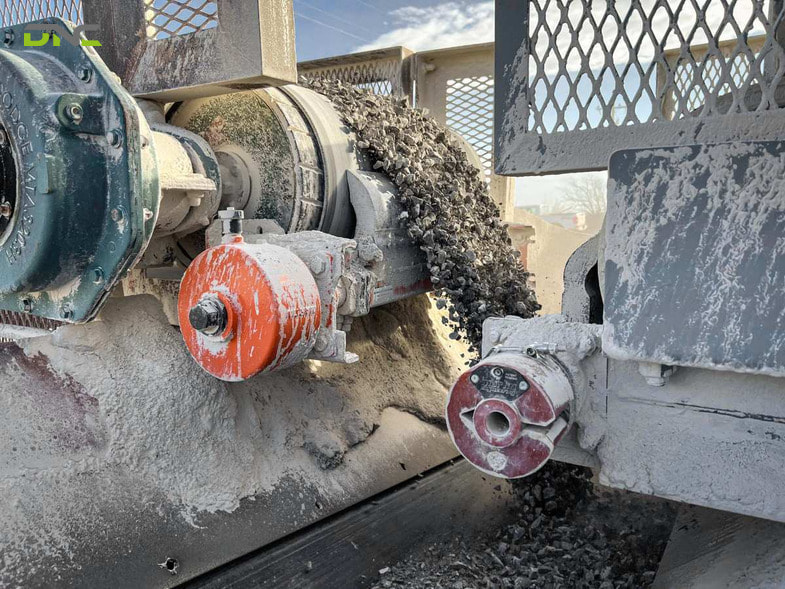
Maintenance Schedule for Malaysian Scraper Conveyors
Scraper Conveyor Applications in Malaysian Manufacturing
Palm Oil Milling — The Primary Malaysian Application
Malaysia’s 450+ palm oil mills — processing 18.55 million metric tonnes of CPO annually across Sabah, Sarawak, Pahang, and Johor — deploy scraper conveyors as the critical FFB handling backbone. Every palm oil mill contains multiple scraper conveyors:
- FFB reception conveyor: Receives FFB from trucks; steel floor conveys to weighbridge (horizontal, 20–40 TPH)
- FFB to sterilizer loading conveyor: The most critical — inclined scraper elevating FFB from reception hopper to sterilizer cage platform (inclined, 60–150 TPH, chain speed 0.3–0.5 m/s)
- Kernel and shell conveyors: After pressing and separation, kernel and shell are conveyed to storage (horizontal, 5–30 TPH)
- OPEFB (empty bunch) conveyors: Empty fruit bunches conveyed to boiler or composting facility
DNC Automation has delivered complete palm oil mill scraper conveyor systems with Siemens SIMATIC S7 PLC control, VFD soft-start drives, and 24/7 local support — serving mills in Johor, Pahang, and East Malaysia.
Cement Industry
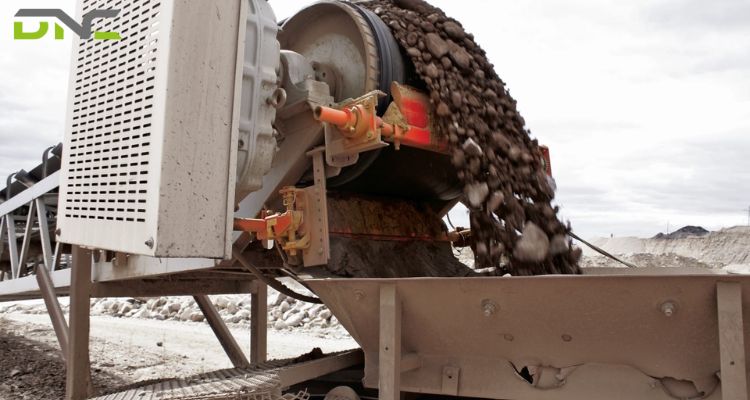
Malaysia’s cement industry (LafargeHolcim, Tasek, CIMA) uses heavy-duty enclosed scraper conveyors for clinker transfer from kiln exit (material at 200–400°C) to clinker cooler and cement mills. Carbon steel construction with insulated trough sections and AR500 wear-lined floors withstand continuous clinker handling.
Biomass and Renewable Energy
Malaysia’s growing biomass energy sector — burning palm kernel shell, wood chips, and bagasse for steam and electricity generation — uses scraper conveyors to transfer fuel from storage to boiler feed systems. Wet biomass and irregular particle size make scraper conveyors the appropriate choice over belt conveyors.
Water Treatment and Municipal
Wastewater treatment facilities across Malaysian cities use stainless steel enclosed scraper conveyors for sludge and screenings removal — the corrosive, wet, biological material is incompatible with belt conveyor systems.
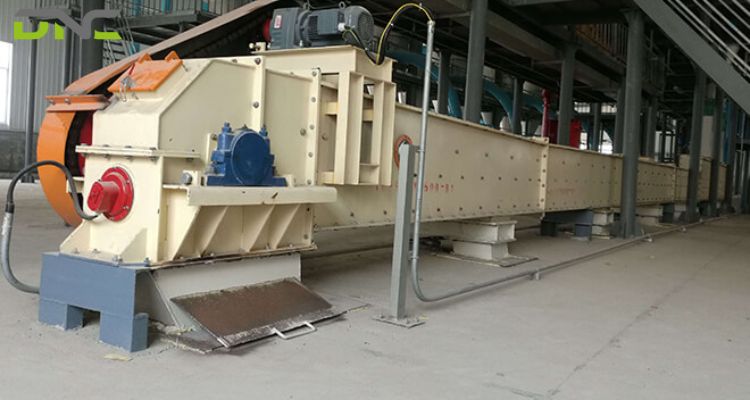
Design and Automation Considerations
How to Choose the Right Scraper Conveyor
Step 1: Define material properties
- Particle size, bulk density (kg/m³), moisture content, temperature, abrasiveness (Moh hardness), chemical corrosivity
- Palm oil FFB: Irregular 5–25 cm bunches, 700–800 kg/m³, wet, abrasive grit surface
- Clinker: 10–50 mm particles, 1,200–1,500 kg/m³, 200–400°C, abrasive
Step 2: Determine capacity requirement (TPH)
Capacity = Belt width (m) × Chain speed (m/s) × Material bulk density (kg/m³) × Material loading factor (0.7 for practical operation) × 3,600
Step 3: Select trough width
Minimum trough width = largest particle size × 3 (rule of thumb for irregular lumps). Adjust for required capacity at selected chain speed.
Step 4: Specify chain type and strength
Calculate chain tension from: material weight in trough, scraper flight weight and friction, return chain weight. Safety factor minimum 8:1 on chain breaking strength.
Step 5: Size drive gearmotor
Calculate running power from chain tension × speed. Apply service factor 2.0 for heavy duty (abrasive, high-temperature, high-start-frequency). Add VFD for soft-start and speed control.
Step 6: Select trough material and wear lining
Standard MS plate for general applications. AR400/AR500 wear plate lining for abrasive materials. SS304/316 for food, chemical, or corrosive applications.
FAQ — Scraper Conveyor
Q1: What is the difference between a scraper conveyor and a drag chain conveyor?
Scraper conveyor and drag chain conveyor are terms often used interchangeably — both describe chain-driven conveyors where flights push or drag bulk material along a trough. The distinction in Malaysian industry practice: “scraper conveyor” typically refers to systems where flights scrape material along an open or partially enclosed trough (palm oil FFB, grain); “drag chain conveyor” typically refers to fully enclosed systems where material is dragged through an enclosed housing (grain, flour, chemical). Both share the same operating principle and engineering design considerations.
Q2: What is the correct chain specification for a palm oil mill FFB scraper conveyor?
Malaysian palm oil mill FFB scraper conveyors specify palm chain (also called engineering steel chain) with 152.4 mm pitch and minimum 60,000 lbf (267 kN) tensile strength. Double-strand configuration (two parallel chains) is standard for FFB conveyors — single strand is insufficient for the dynamic loading of irregular FFB bunches.
Q3: How do I prevent my scraper conveyor from jamming on palm oil FFB?
FFB scraper conveyor jams are caused by: stones and sand from FFB surface, overloading the inlet beyond design capacity, hard objects (bolts, wire, timber) from FFB lorries. Prevention: (1) Install a receiving grid at the inlet hopper to screen out oversize objects; (2) PLC-monitored drive motor current with automatic shutdown at 130% of rated current — prevents minor jams becoming chain seizures; (3) Limit inlet feed rate to 90% of design capacity; (4) Conduct regular access cover inspections to identify and remove accumulating foreign objects. DNC Automation integrates jam detection and automatic shutdown as standard on all scraper conveyor PLC systems.
Q4: What maintenance interval is required for scraper conveyor chains in Malaysian palm oil mill conditions?
Palm oil mill scraper conveyor chains require: daily lubrication check (automatic lubricator system recommended for continuous mills); monthly chain elongation measurement (replace when elongation exceeds 1.5%); sprocket tooth profile inspection every 500 operating hours; full chain replacement typically every 18–24 months at 60–100 TPH continuous duty. Trough floor wear plate replacement: every 2–3 years depending on grit contamination level. DNC Automation provides preventive maintenance contracts that include chain inspection, elongation measurement, and proactive replacement scheduling.
Q5: Can scraper conveyors handle wet and sticky materials in Malaysian factory conditions?
Yes — scraper conveyors are specifically suited for wet and sticky materials that belt conveyors cannot handle. The steel flight pushes sticky material forward regardless of surface adhesion; the trough contains the material even if it sticks to the walls; the enclosed design prevents wet material spillage and contamination. For highly sticky materials (wet palm biomass, moist chemical cake), specify UHMW-PE flight inserts to reduce material adhesion to flights and trough floor.
Q6: What is the maximum temperature that a scraper conveyor can handle?
Standard carbon steel scraper conveyors handle material temperatures up to 400°C — covering cement clinker and foundry slag applications common in Malaysia’s cement industry. Above 400°C: specify high-alloy steel trough construction and chain materials rated for the specific temperature. For comparison, rubber belt conveyors are limited to 80–120°C (heat-resistant rubber grade) — scraper conveyors extend bulk material conveying capability 3–4 times beyond belt conveyor temperature limits.
Q7: How does DNC Automation integrate scraper conveyors with factory automation systems?
DNC Automation integrates all scraper conveyor systems with Siemens SIMATIC S7 or Xinje PLC control panels — providing: VFD soft-start control, motor current jam detection, chain speed monitoring via encoder, SCADA connectivity for plant-wide monitoring, automatic shutdown sequences (preventing chain seizure damage), and remote alarm notification via IoT gateway. For palm oil mill applications, DNC integrates the scraper conveyor PLC with the mill’s central SCADA — coordinating FFB feed rate with sterilizer cycle timing to maximize throughput without overloading the conveyor.
Q8: Is a scraper conveyor system from DNC Automation eligible for Malaysia’s Smart Automation Grant?
Yes. Scraper conveyor systems with PLC control, VFD, and IoT or SCADA integration qualify as automation technology under MIDA’s Smart Automation Grant. The SAG provides up to RM 1,000,000 in matching funding (70:30 government: company ratio). Eligible costs include conveyor hardware, PLC and VFD, SCADA software, wiring, and commissioning. DNC Automation structures proposals to maximize SAG eligibility and provides full documentation support for the MIDA application process.
Conclusion
Scraper conveyors handle the bulk material conveying tasks that define the operational backbone of Malaysia’s highest-demand industries — palm oil processing, cement manufacturing, biomass energy, and water treatment. Where belt conveyors fail on abrasion, temperature, moisture, and sticky material, scraper conveyors are engineered to succeed — through the combination of steel chain, hardened flights, and wear-resistant trough construction that matches the material being conveyed.
DNC Automation designs and delivers complete turnkey scraper conveyor systems across Malaysia — with ISO 9001:2015 quality management, Siemens-integrated PLC control, in-house fabrication and pre-commissioning at DNC’s 25,000 sq ft facility, and 24/7 local engineering support across Selangor, Johor Bahru, and Penang.
Talk to Our Engineers about your bulk material handling challenge — FFB, clinker, biomass, grain, or industrial material. DNC Automation will specify the correct scraper conveyor configuration, size the drive and chain, and advise on Smart Automation Grant eligibility.
- 260 views
- 0 Comment
Recent Comments