


Belt Conveyor: Types, Specifications & Factory Applications in Malaysia | DNC Automation
Belt conveyors are the backbone of material transport in Malaysian manufacturing — continuously moving products, components, and bulk materials across production lines, packaging systems, and logistics facilities throughout the country. The belt conveyor’s defining advantage is versatility: the same mechanical principle — a continuous belt running between end pulleys — handles everything from a 5-gram pharmaceutical tablet to a 2-tonne pallet of palm oil drums, simply by scaling belt width, belt material, and drive specification to the application.
This guide covers every dimension of belt conveyor systems relevant to Malaysian manufacturing: construction, types, belt materials, technical specifications, industry applications, and the selection criteria that production engineers must evaluate before committing to a belt conveyor investment.
What Is a Belt Conveyor?
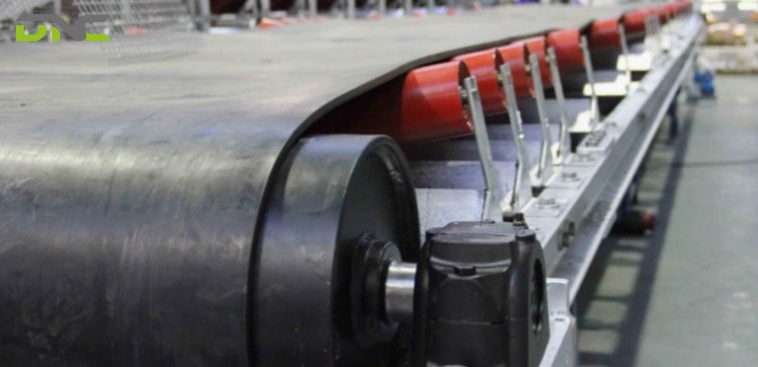
A belt conveyor is a continuous transport system in which a flexible belt — looped around two or more pulleys — carries products or bulk materials on its upper surface from one point to another. The drive pulley at the discharge end rotates the belt; the tail pulley at the infeed end guides the belt’s return path. Idler rollers support the belt between the two pulleys, preventing sagging and maintaining consistent transport surface geometry.
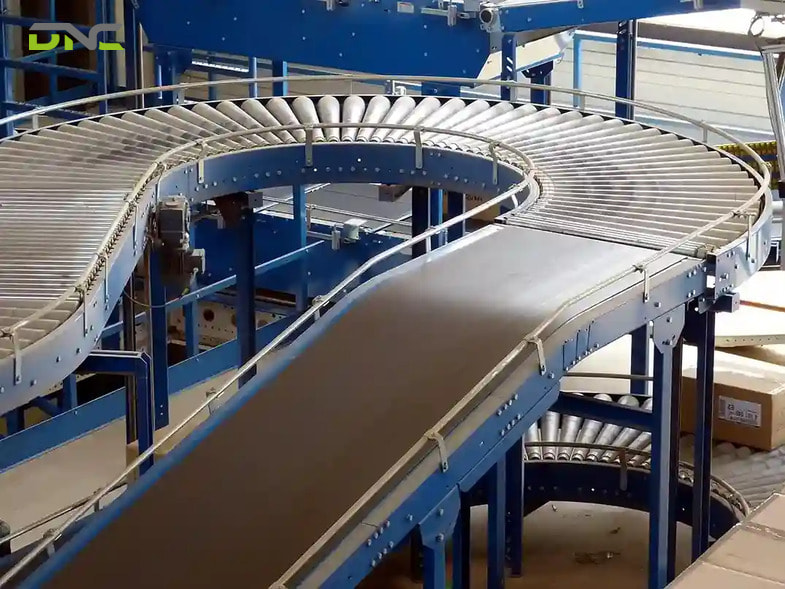
Belt conveyors differ from roller conveyors in one fundamental way: the belt is the transport surface, not the product-contact rollers underneath. This continuous surface capability means belt conveyors can transport products that roller conveyors cannot — fine bulk materials, small individual items, irregular-shaped products, and anything that would fall between or catch on exposed roller gaps.
Belt conveyors in Malaysia range from 100 mm wide mini conveyor belts transporting PCBs in Penang’s electronics factories, to 1,800 mm wide heavy rubber conveyor belts transporting FFB in palm oil mills — the same fundamental principle, scaled across six orders of magnitude of load and throughput.
How a Belt Conveyor Works
Drive System
The drive pulley at the discharge end of the belt conveyor receives torque from a motor-gearbox assembly — rotating the pulley surface, which drives the belt forward via friction. Belt tension is the critical variable: insufficient tension causes belt slippage on the drive pulley; excessive tension accelerates belt and bearing wear.
Belt tension components:
- Tight side tension (T1): tension on the loaded belt run (upper surface)
- Slack side tension (T2): tension on the return belt run (underside)
- Effective belt pull (T1 – T2): the net force driving the load forward
Drive options:
- Head drive: motor and gearbox at the discharge end (standard for most belt conveyors)
- Centre drive: motor positioned at belt mid-point; useful for long reversible belt conveyors
- Motorized drive pulley: motor integrated inside the drive pulley shell — eliminates external gearbox, reduces maintenance points, preferred for food-grade and compact belt conveyors
Belt Return Path
The return belt run travels beneath the conveyor frame on return idler rollers — carrying no load. Belt scrapers at the drive pulley remove material adhering to the belt surface before it enters the return path, preventing build-up on return idlers.
Incline Operation
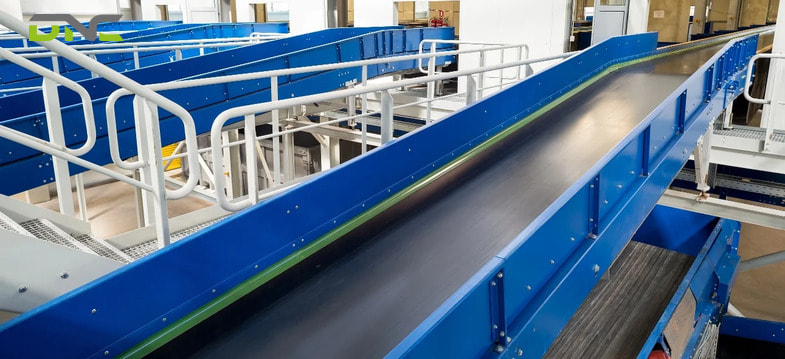
Belt conveyors handle inclines up to 20°–22° for bulk material (depending on material angle of repose) and up to 30°+ for unit loads with cleated belt profiles. Beyond maximum incline angle, products slide backward — requiring alternative conveyor types (bucket elevator, steep-angle conveyor) or belt with cross-cleats.
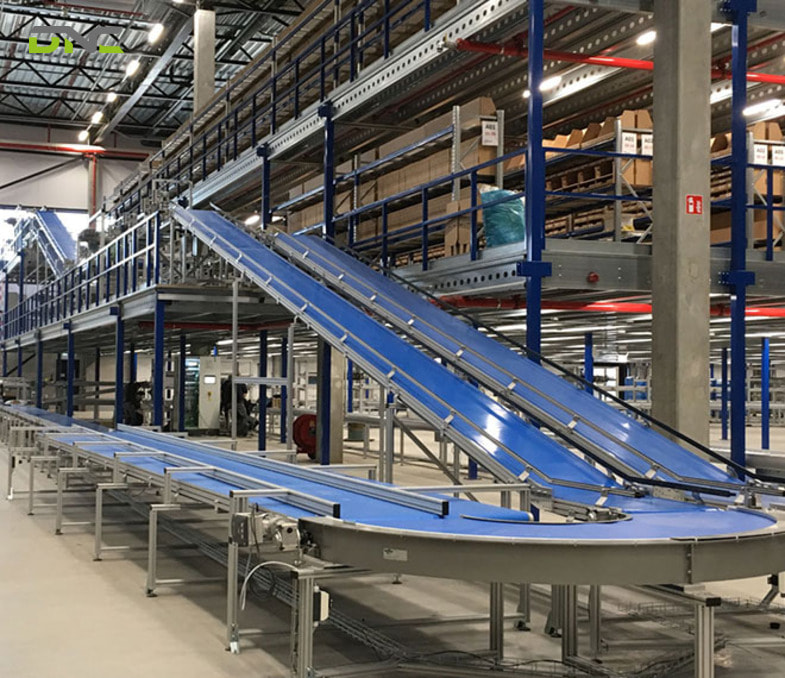
The performance of a belt conveyor is directly influenced by the manufacturer’s engineering decisions.
Types of Belt Conveyors
1. Flat Belt Conveyor
The standard belt conveyor configuration — a flat, horizontal or inclined belt surface transporting unit loads or bulk material. Flat belt conveyors are the most versatile and widely deployed type in Malaysian manufacturing.
Specifications:
- Belt width: 100–2,000 mm
- Speed: 5–120 m/min (VFD-adjustable)
- Load capacity: 5–5,000 kg/m distributed load (depending on belt and frame spec)
- Incline: 0°–20° (smooth belt); 0°–35° (cleated belt)
- Belt material: rubber, PVC, polyurethane, PTFE, modular plastic
Applications: Packaging lines, warehouse conveying, F&B production, assembly line transport
2. Modular Belt Conveyor
A belt conveyor using interlocking plastic modules instead of a continuous flat belt. Modular belts are assembled from individual tiles — any damaged tile is replaced in minutes without removing the entire belt.
Key advantages:
- Individual module replacement (no full belt change)
- Open mesh options for drainage, airflow, or inspection-through-belt applications
- Wide temperature range: -40°C to +120°C (standard); up to +260°C (special grades)
- Hygienic design — no fabric reinforcement that harbors bacteria
- Available in food-grade PP, PE, or acetal copolymer materials
- Color-coded for allergen zone separation (common in Malaysian food factories)
Applications: Food processing (particularly F&B where belt cleaning is critical), pharmaceutical packaging, beverage lines, bakery and snack food production
3. Cleated Belt Conveyor
A belt conveyor fitted with transverse rubber or polyurethane cleats (raised barriers) across the belt width — preventing products or bulk material from sliding backward on steep inclines.
Cleat types:
- T-cleat (T-shaped profile): general-purpose, bulk material
- L-cleat: higher-retention for unit loads
- V-cleat: for very small items or granular material
Specifications:
- Maximum incline: up to 50° (depending on cleat height and product)
- Cleat height: 10–100 mm (matched to product dimensions)
- Cleat spacing: 100–500 mm (matched to product width or bulk material flow rate)
Applications: Elevation of packaged goods between floor levels, steep-angle bulk material conveying (grain, pellets, crushed aggregate)
4. Trough Belt Conveyor
A belt conveyor where idler rollers are arranged in a 3-roll configuration (wing-and-center) — bending the belt into a trough cross-section that contains bulk material during transport and prevents spillage.
Specifications:
- Trough angle: 20°, 35°, or 45° (steeper trough = higher capacity, lower spillage risk)
- Belt width: 400–2,400 mm (standard bulk handling range)
- Belt speed: 1–6 m/s
- Capacity: up to 10,000+ tonnes/hour on large bulk belt conveyors
Applications: Palm oil mill FFB transport, cement raw material conveying, coal handling, quarry aggregate transport, grain elevator feeding
5. Slider Bed Belt Conveyor
A belt conveyor where the belt slides on a flat steel or UHMW-PE plate (slider bed) instead of riding on support idler rollers. Slider bed belt conveyors provide a completely flat, stable transport surface — essential for small, lightweight, or unstable products that would tip or fall between roller gaps.
Applications: Small package postal sorting, product accumulation before checkweigher, label application station infeed
6. Sanitary Belt Conveyor (Food and Pharmaceutical Grade)
A belt conveyor engineered specifically for food contact and pharmaceutical manufacturing environments — with stainless steel frame, sealed bearings, IP65 drive motor, no horizontal surfaces that accumulate debris, and belt materials with FDA food-contact compliance.
Design requirements:
- AISI 304 stainless steel frame minimum; AISI 316 for chloride or acid environments
- Open-frame construction: no hollow sections, tubes, or crevices
- All fasteners: stainless steel
- Belt: food-grade PVC, polyurethane, or modular PP (no fabric reinforcement)
- IP65 or IP67 motor and gearbox
- CIP (clean-in-place) compatible design for beverage and dairy lines
Applications: Food processing (meat, poultry, seafood, produce), pharmaceutical tablet conveying, beverage filling lines, dairy production
Key Components of a Belt Conveyor System
- Conveyor Belt
The belt is the most maintenance-critical component of any belt conveyor system. Belt selection must match product characteristics (weight, surface, temperature), operating environment (moisture, chemical exposure, temperature), and required belt life.
| Belt Material | Temperature Range | Key Properties | Applications |
| Rubber | -20°C to +80°C | Impact resistant, grip, durability | Bulk material, heavy industrial |
| PVC | -10°C to +60°C | General purpose, food-grade options | F&B packaging, light manufacturing |
| Polyurethane | -30°C to +85°C | Chemical resistant, food-grade, oil-resistant | Pharma, food processing, light industrial |
| PTFE (Teflon) | -200°C to +260°C | Non-stick, high temperature | Oven/tunnel applications, food drying |
| Modular PP/PE | -40°C to +120°C | Hygiene, individual module replacement | Food processing, pharma |
| ESD-safe | Ambient | Static dissipative (10⁵–10⁹ Ω) | Electronics, semiconductor |
- Drive Pulley
The drive pulley transmits motor torque to the belt through friction. Lagging — rubber or ceramic coating on the pulley surface — increases friction coefficient and prevents slippage. Diamond-pattern rubber lagging is standard for general belt conveyors; ceramic lagging is used in wet or high-tension applications.
- Tail Pulley and Take-Up Assembly
The tail pulley at the infeed end guides the belt onto the return path. A take-up assembly (gravity or screw type) maintains belt tension as the belt stretches with use. Correct take-up adjustment is critical — insufficient tension causes slippage; excess tension accelerates belt and bearing wear.
- Idler Rollers (Carrying and Return)
Carrying idlers support the loaded belt run at intervals of 0.5–1.5 m (shorter spacing for heavier loads). Return idlers support the empty belt return run at 2–3 m intervals. Idler quality — bearing specification, shell straightness, and balance — directly determines belt conveyor noise and belt wear rate.
- Belt Scrapers (Primary and Secondary)
Primary scrapers (polyurethane or carbide-tipped) clean material from the belt surface at the drive pulley. Secondary scrapers clean the belt return surface. Inadequate belt scraping causes material build-up on return idlers — a primary cause of belt conveyor misalignment and premature failure.
- PLC Control and VFD
Industrial belt conveyors in Malaysia operate under PLC control — managing start/stop sequences, speed adjustment via VFD, motor protection, and integration with upstream and downstream systems. DNC Automation uses Siemens SIMATIC PLCs with IoT sensor integration — providing real-time motor current monitoring, belt tension measurement, and predictive maintenance alerting.
What Types of Belt Conveyor Solutions Do Manufacturers Commonly Deliver?
Applications: Belt Conveyors Across Malaysian Industries
Palm Oil — Bulk Trough Belt Conveyors
Malaysia’s 450+ palm oil mills rely on heavy-duty rubber trough belt conveyors for FFB reception, inter-process bulk transfer, and kernel/shell handling throughout the milling process. Belt widths of 600–1,200 mm handle throughputs of 20–90 tonnes/hour of FFB. The highly abrasive, corrosive palm oil mill environment — steam, fruit acids, and constant moisture — demands robust rubber belts with minimum 6-ply construction and steel cord reinforcement for the longest runs.
Food and Beverage — Sanitary and Modular Belt Conveyors
DNC Automation clients F&N, Ramly Burger, and Guan Chong Berhad — Malaysia’s largest cocoa processor — use belt conveyors throughout their production and packaging operations. Food-grade polyurethane and modular belt conveyors carry product through packaging, checkweighing, metal detection, and palletizing stations. All belt conveyors in food-contact areas comply with Malaysia’s Food Hygiene Regulations 2009 and HACCP prerequisites.
Electronics — ESD-Safe Belt Conveyors
Penang’s semiconductor and EMS factories use ESD-safe belt conveyors throughout SMT lines, component assembly, and final inspection. Belt surface resistance maintained in the 10⁵–10⁹ Ohm dissipative range prevents static charge build-up that can destroy electronic components. DNC Automation serves Sony and Panasonic with electronics conveyor integration from its Penang branch office.
Automotive — Slat Chain and Rubber Belt Conveyors
Malaysian automotive manufacturers (Toyota, UMW, DRB-Hicom) use flat rubber belt conveyors for parts feeding, component transport between assembly stations, and sub-assembly line integration. Long-run belt conveyors (50–200 m) with distributed drive units carry body panels and assemblies through production buildings.
Logistics and E-Commerce — PVC and Modular Belt Conveyors
E-commerce fulfillment centers in Selangor use high-speed flat belt conveyors (up to 120 m/min) for parcel transport, sortation infeed, and packaging station connections. Malaysia’s NIMP 2030 programme and growing Lazada/Shopee fulfillment infrastructure are driving rapid investment in belt conveyor automation across the Klang Valley logistics corridor. DNC Automation’s clients Pos Malaysia and POS Aviation represent this sector.
Benefits of Belt Conveyor Systems
- Versatility — One System for Almost Any Product
The belt conveyor’s continuous surface handles the widest product range of any conveyor type — from fine powder on a trough belt to heavy pallets on a wide flat belt conveyor. No other single conveyor type serves as many applications across Malaysian manufacturing.
- Continuous, High-Speed Transport
Belt conveyors run continuously at defined speed — unlike roller conveyors, which may have zone stop cycles. For bulk material applications (palm oil, cement, grain), belt conveyors deliver throughputs up to 10,000+ tonnes/hour on large industrial installations — far beyond any alternative transport system.
- Incline Capability
Flat belt conveyors with cleated surfaces handle inclines up to 50° — enabling elevation between floor levels without the space requirement of a bucket elevator or spiral conveyor. Cleated belt conveyors serve as the lowest-cost solution for moderate-incline elevation in Malaysian factories.
- Reduce Human Error by Up to 80%
Automated belt conveyor systems eliminate the manual handling errors — product damage, misrouting, data entry mistakes — that occur when operators physically transfer products between workstations. DNC Automation’s belt conveyor systems reduce human error by up to 80% and increase throughput consistency across all production shifts.
- Energy Efficiency with VFD Control
VFD-controlled belt conveyor drives reduce energy consumption by 20–35% compared to fixed-speed motors — adjusting speed to actual load rather than running at full power during low-throughput periods. For 24/7 production environments, this represents significant operating cost reduction.
- Low Maintenance Cost per Tonne Conveyed
Heavy-duty rubber trough belt conveyors transporting bulk material at 60–120 m/min have a transport cost measured in fractions of a cent per tonne-kilometer — the lowest mechanical transport cost of any system other than gravity flow. For Malaysian palm oil mills and cement plants conveying millions of tonnes annually, this operational cost advantage is substantial.
A belt conveyor manufacturer in industrial automation is defined not only by the ability to fabricate conveyors
How to Choose the Right Belt Conveyor for Malaysian Factories
- Define Product and Environment First
Belt material selection drives every other specification. Food contact or wash-down? → Stainless steel, food-grade belt, IP65. Electronics? → ESD-safe belt, aluminium frame. High-temperature? → PTFE belt, heat-rated components. Bulk abrasive material? → Heavy rubber, steel-cord reinforced.
- Calculate Required Belt Width and Speed
Belt width must accommodate the widest product with minimum 50 mm clearance each side. Required speed = throughput (units/hour) ÷ products per meter of belt. Always verify the calculated speed against the belt material’s maximum rated speed.
- Specify Correct Belt Tension System
Short belt conveyors (under 5 m) use screw take-up tensioners. Medium belt conveyors use gravity take-up weights for automatic tension compensation. Long-run belt conveyors require engineered take-up systems with tension monitoring — especially important for Malaysia’s climate where thermal expansion cycles affect belt length.
- Plan Belt Cleaning for Your Material
Belt scrapers are not optional on any belt conveyor handling sticky, wet, or adhesive materials. In Malaysian food factories, inadequate belt cleaning creates hygiene failures and belt mistracking. Specify primary and secondary scrapers with polyurethane blades as standard on all F&B belt conveyors.
- Integrate from Day One
Specify PLC control, sensor points, and communication interfaces at the belt conveyor design stage. DNC Automation designs belt conveyor control systems with built-in WMS/MES interface capability — open-protocol (OPC-UA, Modbus TCP) to connect with any enterprise platform.
- Engage DNC Automation for Turnkey Delivery
DNC Automation’s 35+ engineers design, fabricate, and commission belt conveyor systems under ISO 9001:2015 quality management at our 25,000 sq ft Selangor facility. From palm oil mill trough belt conveyors to pharma-grade sanitary belt systems, our end-to-end capability — mechanical design, electrical engineering, PLC programming, and commissioning — delivers production-ready belt conveyor systems with 24/7 local support across Malaysia.
FAQ — Belt Conveyor Systems
What is the difference between a belt conveyor and a conveyor belt?
Technically: a “belt conveyor” is the complete system (belt, frame, drive, pulleys, idlers, controls). A “conveyor belt” is just the belt component itself. In practice, the terms are used interchangeably in Malaysian manufacturing. When requesting a quote, clarifying whether you need the complete system or just the replacement belt avoids scope misunderstanding.
What belt material should I use for food production in Malaysia?
For direct food-contact belt conveyor applications in Malaysia: food-grade polyurethane (PU) or white food-grade PVC for general food products; FDA-compliant modular PP belts for applications requiring individual tile replacement; PTFE mesh belts for oven and drying tunnel applications. All food-contact belt materials must comply with Malaysia’s Food Hygiene Regulations 2009 and relevant HACCP or ISO 22000 prerequisites.
How do I prevent belt conveyor mistracking?
Belt mistracking (belt running off-center) is caused by: uneven belt tension, material build-up on pulleys or idlers, frame misalignment, or worn idler rollers. Prevention: regular belt tension checks (monthly), belt scraper maintenance (weekly), frame squareness verification (annual), and idler inspection (quarterly). For persistent mistracking, center guide rollers or training idlers provide corrective force without manual adjustment.
Can belt conveyors operate at inclines?
Yes. Smooth surface belt conveyors handle inclines up to 20°–22° for most industrial products. Rough-top or cleated belts extend this to 30°–50°. Beyond these angles, products slide backward — requiring cleated belts with appropriate cleat height, or alternative conveyor types (bucket elevator, steep-angle conveyor). DNC Automation engineers inclined belt conveyor systems to exact angle, product, and throughput requirements.
What causes premature belt conveyor belt failure?
Primary causes: (1) Incorrect belt material for the product/environment — particularly chemical incompatibility causing belt hardening or swelling; (2) Excessive belt tension — accelerates fabric ply delamination and edge cracking; (3) Material build-up on pulleys — causes localized wear and belt camber; (4) Overloading — exceeds belt’s rated tensile strength; (5) Misaligned idler rollers — causes edge wear. DNC Automation conducts pre-installation belt compatibility analysis to prevent specification errors.
Does DNC Automation supply belt conveyors across Malaysia?
Yes. DNC Automation designs, fabricates, and integrates belt conveyor systems across Malaysia — from Selangor and Penang to Johor and East Malaysia. Our ISO 9001:2015-certified production facility manufactures custom belt conveyor systems to exact application requirements, with our engineering team handling design, installation, commissioning, and 24/7 ongoing support.
Conclusion
Belt conveyors are the universal transport medium of Malaysian manufacturing — their continuous belt surface, incline capability, and adaptability across virtually every product and environment make them irreplaceable in factories from palm oil mills to pharmaceutical packaging lines. The performance difference between a correctly specified belt conveyor and a mis-specified one compounds daily: wrong belt material causes premature failure, incorrect tension causes slippage, and inadequate cleaning causes hygiene non-compliance and belt damage.
DNC Automation’s 35+ engineers bring 20+ years of belt conveyor system experience to every project — specifying correctly, fabricating to ISO 9001:2015 standards, and commissioning with the precision that Malaysia’s demanding manufacturing environments require. Siemens-authorized control systems, 24/7 local support, and free pre-sales consultation make DNC Automation the partner of choice for belt conveyor projects across Malaysia.
Ready to specify your belt conveyor system? Get a Free Consultation from DNC Automation’s engineering team today.
- 90 views
- 0 Comment
Recent Comments