


Mesh Conveyor Belt: Types, Applications & Selection Guide for Malaysian Factories
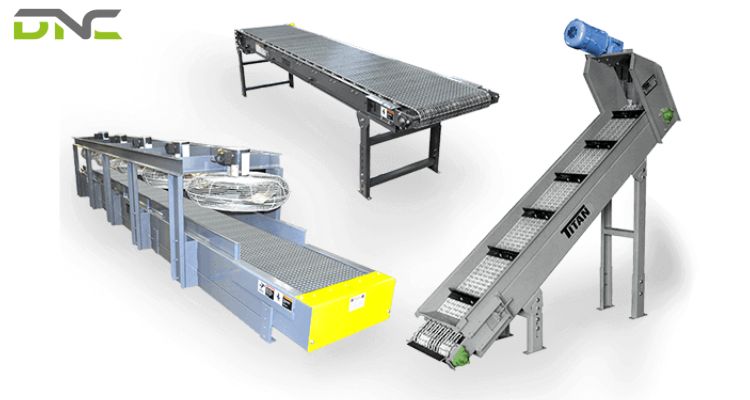
Mesh conveyor belts define the performance ceiling for factory processes where solid belts fail — baking, heat treatment, parts washing, cooling, and drainage-critical food processing lines across Malaysian manufacturing. A mesh conveyor belt is an open-surface belt constructed from interwoven wire strands, interlocking plastic modules, or PTFE-coated fiberglass fabric: the permeable structure allows air, heat, steam, and liquid to pass freely through the belt while product travels forward on the production line.
Malaysian manufacturers selecting a mesh conveyor belt face immediate decisions that determine whether the belt survives 3–5 years of productive service or fails within months: material grade, open area percentage, weave pattern, drive configuration, and hygiene compliance level. Each variable is determined by your specific process — the 260°C PTFE belt that works in a Penang biscuit oven will fail catastrophically in an automotive paint curing tunnel that reaches 200°C with chemical exposure.
This guide covers every critical factor: types and specifications, operating principles, common failure modes, maintenance protocols, industry applications across Malaysian manufacturing sectors, and a structured selection framework — engineered for real factory conditions under Malaysia’s NIMP 2030 industrial transformation agenda.
What Is a Mesh Conveyor Belt?
A mesh conveyor belt is an open-surface conveyor belt whose defining characteristic is its permeable construction — open space (void area) accounts for 30% to 70% of the total belt surface, depending on design. This open area enables airflow circulation, liquid drainage, heat penetration, and steam passage through the belt — functions that solid rubber, PVC, or PU belts cannot deliver.
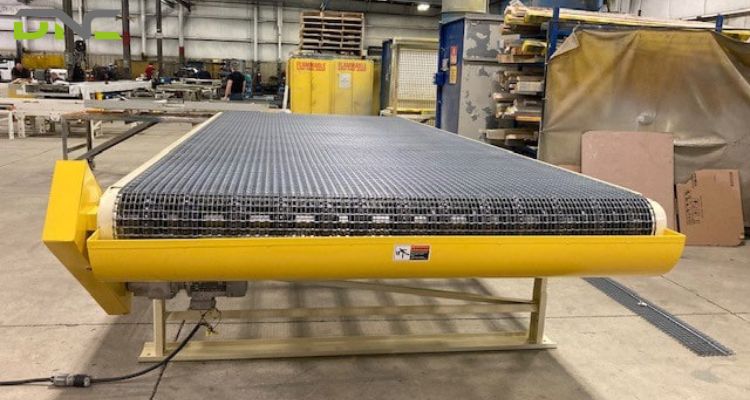
Mesh conveyor belts are manufactured in widths from 300 mm to 3,000 mm, in any required length, and in materials spanning polypropylene plastic (food-grade, up to 110°C) through stainless steel (up to 870°C) and high-alloy wire (up to 1,150°C). The correct material is determined by process temperature, chemical exposure, product contact requirements, and hygiene certification obligations.
Core functional differences from solid belts:
| Attribute | Mesh Conveyor Belt | Solid Belt (Rubber/PVC/PU) |
| Airflow | Full through-belt circulation | Blocked; surface only |
| Drainage | Free drainage through open area | Pools on belt surface |
| Heat transfer | Radiant + convective from below | Surface contact only |
| Hygiene | Easy through-belt washdown | Moisture traps beneath belt |
| Product visibility | Inspectable from below | Not visible from below |
| Temperature range | Up to 1,150°C (high-alloy wire) | Typically -20°C to 120°C |
Types of Mesh Conveyor Belts
1. Balanced Weave Wire Mesh Belt
The most widely used mesh belt type in Malaysian manufacturing. Balanced weave belts consist of alternating left-hand and right-hand wire spirals joined by straight or crimped connecting rods. The “balanced” designation means the spirals alternate direction — creating a belt with equal tension distribution across its width and straight, predictable tracking.
Construction variants:
- Standard balanced weave: Wire diameter 1.2–3.0 mm; cross rod diameter 1.2–4.0 mm; spiral pitch 2.8–40 mm; rod pitch 5–50.8 mm
- Double (compound) balanced weave: Two sets of interlocked spirals per row — provides 40–60% greater tensile strength than standard balanced weave; used for heavy loads and high-speed applications
Material grades:
- AISI 304: Standard food-grade; -20°C to 870°C; resistant to most food acids and cleaning chemicals
- AISI 316: Marine-grade; superior chloride resistance for seafood processing and coastal factory environments
- AISI 310 / 330: High-temperature alloys for heat treatment furnaces up to 1,100°C
- High-alloy (Inconel, Incoloy): Up to 1,150°C for extreme thermal cycling applications
Applications in Malaysia: Automotive paint curing ovens, parts washing machines (Toyota, UMW), food cooling conveyors, palm oil palm fruit sterilizer loading systems
2. Flat Wire Mesh Belt
Flat wire belts use flat coil wire (cross-section: 1.0 mm × 0.7 mm to 6.0 mm × 3.0 mm) instead of round wire. The flat wire surface provides a wider, more stable carrying surface — reducing product marking on sensitive items and improving support for small or irregular products.
Key advantages over round wire:
- Wider product contact area reduces pressure marks on soft products
- Higher open area percentage possible (up to 70%) with equivalent strength
- Flatter profile reduces snagging risk for small product features
Applications: Biscuit and cookie baking lines (Malaysia’s snack food exporters — Munchy’s, Hwa Tai), vegetable and fruit processing, PCB support conveyors, pharmaceutical tablet handling
3. Spiral Wire Belt
Spiral wire belts are constructed from individual wire coils (spirals) linked by connecting cross-rods — creating a belt with exceptional lateral flexibility and the ability to travel in curved paths or wrap around small-diameter drums.
Critical application: Spiral conveyor systems use spiral wire belts to create vertical stacking — multiple belt tiers wrap around a central drum or tower structure. A spiral conveyor achieves 15–25 m of conveyor length within a 3 m × 3 m floor footprint — critical for Malaysian factories in Penang electronics parks and Selangor industrial zones where floor space commands premium rent rates.
Applications: Freezer spiral conveyors (food factories), proofer towers (bakery), cooling spiral towers (confectionery, biscuit lines), accumulation buffers between production and packaging lines
4. Modular Plastic Mesh Belt
Modular plastic mesh belts are built from injection-molded plastic tiles (modules) linked by pivot rods — creating a belt that flexes around sprockets, absorbs impacts without permanent deformation, and allows individual module replacement instead of full belt replacement.
Material grades:
- Polypropylene (PP): Most common; FDA/EU food-grade standard; -20°C to 110°C; resistant to most food acids, oils, detergents
- Acetal/POM: Higher stiffness, lower friction coefficient; -40°C to 140°C; preferred for wash tunnel applications
- Nylon (PA): High strength; up to 120°C; used in elevated-temperature wash and rinse systems
Critical advantage for food factories: No metal contamination risk. Wire mesh belts shed microscopic wire fragments over service life — a critical failure mode for food factories with downstream metal detection. Modular plastic belts eliminate this risk entirely. DNC Automation specifies modular plastic belts for all food lines where metal detection is installed downstream.
Open area: 25–50% (determined by module design) — sufficient for wash drainage and air circulation in most F&B applications.
Applications: F&B production lines (F&N, Ramly Burger), poultry and seafood processing, pharmaceutical tablet conveying, beverage can washing
5. PTFE-Coated Fiberglass Mesh Belt (Teflon Belt)
PTFE-coated fiberglass mesh belts are manufactured from woven fiberglass fabric uniformly coated with PTFE (polytetrafluoroethylene). The combination delivers non-stick performance at high temperatures — filling the gap between plastic modular belts (limited to 110–140°C) and stainless steel wire belts (which cause product adhesion in baking applications).
Specifications:
- Temperature range: -200°C to 260°C continuous; short-term peaks to 280°C
- Non-stick surface: eliminates product adhesion without release agents or manual scraping
- Chemical resistance: resistant to all food-processing acids, oils, cleaning chemicals
- Open area: 20–45% depending on weave tightness
- Non-toxic, odorless, tasteless — FDA and EU food contact compliant
Applications in Malaysia:
- Biscuit and cracker ovens (flat wire PTFE belt — flat surface prevents biscuit marks from round wire)
- Chocolate enrobing tunnels — Guan Chong Berhad (Malaysia’s largest cocoa processor) requires PTFE belts to prevent chocolate adhesion at 30–35°C enrobing temperature
- Shrink wrap tunnels and heat seal machines
- Pharmaceutical tablet coating drum exits
How Does a Mesh Conveyor Belt System Work?
Drive Mechanism
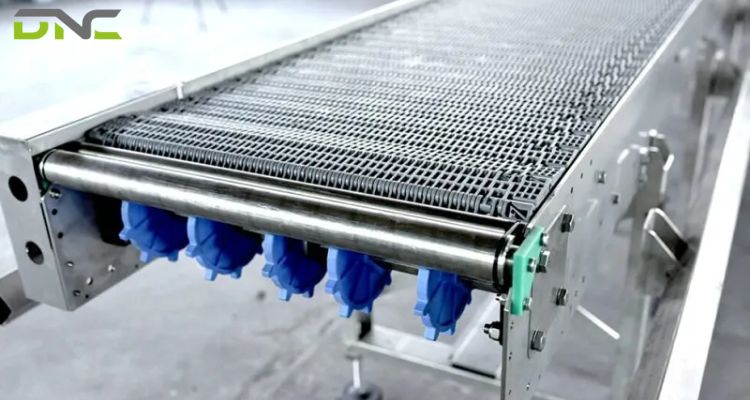
Sprocket Drive (Positive Drive): Hardened steel or plastic sprockets with teeth engage directly with the belt’s cross-rods or modular link pins. Sprocket drive physically prevents belt slippage — the teeth mechanically interlock with the belt structure. DNC Automation specifies sprocket drive for all high-load, high-temperature, or precision-indexing mesh conveyor applications.
Friction Drive (Drum Drive): A smooth drum pulley drives the belt through surface friction. Simpler and lower cost, but requires consistent belt tension. Slippage increases in high-temperature environments where friction coefficient drops. Limited to lighter, lower-speed applications.
Belt Support and Tensioning
Mesh belts cannot slide on flat pans like thin solid belts — they require matched support systems:
- UHMW-PE wear strips: Low-friction sliding support across belt width; standard to 82°C; replaced with ceramic wear strips for oven applications above 100°C
- Return rollers: Support the underside return run, spaced 1.5–2.5 m depending on belt weight
- Take-up units: Screw take-up (manual adjustment) or gravity take-up (automatic) — maintain correct belt tension as the belt stretches over service life. DNC Automation installs automatic gravity take-up on all conveyors exceeding 10 m length.
PLC Integration
DNC Automation integrates Siemens SIMATIC S7 or Xinje PLCs into mesh conveyor control panels — delivering:
- Speed control via VFD (0.5–50 m/min, adjustable per recipe)
- Motor current monitoring (jam detection and overload protection)
- Belt tension monitoring via load cells
- Edge sensor tracking (automatic lateral correction)
- SCADA connectivity for plant-wide OEE calculation and predictive maintenance
Common Failure Modes and Maintenance Protocols
Malaysian factories lose an average of USD 260,000 per hour during unplanned production downtime (Aberdeen Group benchmark). Sensor-based predictive maintenance on mesh conveyor systems reduces unplanned downtime incidents by 70%+. Understanding failure modes is the first step to eliminating them.
Failure Mode 1: Belt Mistracking (Drift)
Cause: Misaligned drive or idler shafts, uneven loading across belt width, incorrect initial tension, worn sprocket teeth.
Detection: Visual belt edge drift toward one side; edge wear marks on frame; belt edge damage.
Prevention: Laser-align all shafts to within 1–2 mm across full belt width during installation. Install PLC-monitored edge sensors. Apply even loading across full belt width — avoid side-loading at product infeed.
DNC standard: All DNC Automation conveyor installations include laser shaft alignment and edge sensor integration as standard — eliminating the most common mesh belt failure mode.
Failure Mode 2: Cross-Rod Fatigue (Wire Mesh Belts)
Cause: Excessive belt tension, worn or mismatched sprocket tooth profile, repeated thermal cycling, or operation beyond load rating.
Detection: Visible cross-rod cracking or breakage; belt section collapse; sudden belt failure.
Prevention: Correct sprocket tooth profile specification (must match belt rod pitch precisely). Do not exceed rated belt tension. For high-temperature applications, specify thermal-cycling-rated belt grades.
Failure Mode 3: Premature Wear Strip Depletion
Cause: Running belt without adequate lubrication (where applicable), incorrect wear strip material for temperature range, belt mistrack causing concentrated edge loading.
Detection: Metal-to-metal contact noise; belt surface scoring; increased motor current draw.
Prevention: Inspect wear strips every 1,000 operating hours. Replace before depletion reaches metal frame. Match wear strip material to process temperature — UHMW-PE for standard, ceramic for oven applications.
Failure Mode 4: Corrosion (Food and Palm Oil Environments)
Cause: Chloride exposure in food processing (cleaning chemicals), steam condensate in palm oil sterilizer environments, incorrect material grade selection.
Detection: Surface rust on wire strands; wire pitting; reduction in tensile strength.
Prevention: Specify AISI 316 (not 304) for high-chloride environments. Ensure complete drainage after CIP cleaning — do not allow cleaning chemicals to pool on belt surface. For palm oil sterilizer applications, specify high-alloy or AISI 316L grades.

Applications: Mesh Conveyor Belts in Malaysian Manufacturing
Food and Beverage Processing
Malaysia’s F&B manufacturing sector — growing 4.2% in 2024 and contributing to a national manufacturing GDP of RM 382 billion — requires mesh conveyor belts across three critical process stages:
Baking and Cooking: PTFE-coated and flat wire mesh belts carry product through tunnel ovens at 160–260°C. Open mesh enables hot air circulation above and below product, producing uniform baking without adhesion. DNC Automation has delivered conveyor systems to F&N, Ramly Burger, and Guan Chong Berhad — Malaysia’s largest cocoa processor, whose chocolate enrobing lines demand PTFE belts with verified food-contact compliance.
Cooling: Wire mesh cooling conveyors reduce product temperature after baking, frying, or cooking before packaging. Open mesh allows forced-air cooling to reach product from all directions — reducing cooling time by 40–60% versus solid belt systems and enabling faster line speed without product quality compromise.
Washing and Blanching: Modular plastic mesh belts carry fresh produce, seafood, and poultry through wash tunnels and blanching systems. Complete drainage through the open mesh eliminates wash water pooling — a mandatory requirement under Malaysia’s Food Hygiene Regulations (FHR 2009) and HACCP (MS 1480) certification framework.
Automotive Manufacturing
Malaysia’s automotive sector — serving Toyota, UMW, Inokom, Bridgestone, and DRB-Hicom — relies on wire mesh conveyor belts in two applications where solid belts cannot operate:
Paint Curing Ovens: Body components travel through curing ovens at 160–200°C on AISI 304 or 316 wire mesh belts. The belt must maintain dimensional stability at temperature while allowing hot air circulation for complete, uniform cure cycle completion.
Parts Washing: Engine components and transmission housings pass through aqueous wash systems on stainless steel wire mesh belts. Open mesh allows complete drainage of wash solution and rinse water — preventing water spots and residue that cause downstream surface treatment failures.
Electronics and EMS Manufacturing
Penang’s electronics manufacturing cluster — contributing 5% of global semiconductor sales — uses mesh conveyor belts in SMT reflow oven lines. PCBs travel through reflow ovens at 260°C peak temperature on flat wire stainless steel mesh belts with precise edge rail adjustment. Belt requirements: ESD-safe (grounded stainless steel frame + ESD coating), dimensionally stable at reflow temperature, and flat PCB support to prevent board warpage during the thermal profile.
Under NIMP 2030, Malaysia’s semiconductor sector is a strategic priority — government investment is increasing, creating growing demand for high-specification EMS conveyor systems in Penang’s Bayan Lepas and Batu Kawan industrial parks.
Palm Oil Processing
Malaysia is the world’s second-largest palm oil producer — 18.55 million metric tonnes of CPO in 2023, with 450+ mills operating primarily in Sabah, Sarawak, Pahang, and Johor. Mesh conveyor belts appear at multiple stages of the Fresh Fruit Bunch (FFB) processing cycle: reception and transfer conveyors, sterilizer loading systems, and empty bunch (OPEFB) handling conveyors. High-alloy or AISI 316 grades are specified for the high-humidity, steam-laden sterilizer environment where standard AISI 304 grades corrode prematurely.
Benefits of Mesh Conveyor Belts for Factory Operations
- Hygiene and Compliance: Open mesh construction allows CIP spray bars to clean the belt from above and below simultaneously — achieving HACCP, ISO 22000, and FSSC 22000 compliance required by Malaysia’s export-oriented F&B manufacturers.
- Up to 40–60% Faster Cooling: Forced-air cooling systems operating through open mesh deliver 40–60% faster product cooling than solid belt alternatives — directly increasing line throughput without extending the cooling tunnel footprint.
- Reduce Human Error by Up to 80%: PLC-controlled mesh conveyor systems eliminate manual product transfer between process stations, reducing operator handling errors by up to 80% — a documented DNC Automation performance outcome across multiple Malaysian F&B and automotive deployments.
- Increase Productivity by Up to 50%: Continuous automated conveying at consistent speed and tension replaces variable-rate manual handling — increasing production line throughput by up to 50% for repetitive transfer tasks.
- Energy Savings via VFD Control: Variable Frequency Drive integration on mesh conveyor motors reduces energy consumption by 20–35% versus fixed-speed drives — contributing to factory energy efficiency KPIs under NIMP 2030’s sustainability mission.
- MIDA Smart Automation Grant Eligibility: Mesh conveyor belt systems with PLC, VFD, and IoT integration qualify for Malaysia’s Smart Automation Grant (SAG) — up to RM 1,000,000 on a 70:30 matching basis (government: company). DNC Automation structures all conveyor proposals to maximize SAG eligibility and supports clients through the MIDA application process.
How to Choose the Right Mesh Conveyor Belt
Step 1: Define Operating Temperature
Temperature is the primary selection driver — specifying the wrong material grade for your process temperature results in premature belt failure:
| Process Temperature | Belt Type |
| Up to 110°C | Modular plastic (PP) |
| Up to 140°C | Modular plastic (POM/Nylon) |
| Up to 260°C | PTFE-coated fiberglass mesh |
| Up to 870°C | Wire mesh AISI 304 or 316 |
| Up to 1,100°C+ | High-alloy wire (AISI 310, Inconel) |
Step 2: Determine Hygiene and Certification Requirements
- Metal detection downstream? → Specify modular plastic mesh (no metal contamination risk)
- HACCP / ISO 22000 required? → Specify FDA/EU food-grade belt; stainless steel frame; CIP-compatible design
- Halal certification? → Verify belt material has no animal-derived components; specify PP or PTFE belts
- FSSC 22000? → Require full traceability documentation for belt material
Step 3: Calculate Open Area Percentage
| Application | Recommended Open Area |
| Baking (oven airflow) | 45–60% |
| Forced-air cooling | 55–70% |
| Washing / blanching | 40–55% |
| Parts support (heavy) | 30–40% |
| Freezer (air blast) | 55–65% |
Step 4: Specify Drive Type
- High load, high temperature, precision indexing → Sprocket drive (mandatory)
- Light load, standard temperature, simple speed control → Friction drum drive acceptable
Step 5: Confirm Integration Requirements
- PLC brand compatibility (Siemens, Mitsubishi, Omron, Xinje — DNC handles all major brands)
- SCADA/IoT connectivity protocol (OPC-UA, Modbus TCP, MQTT for cloud integration)
- MES data feeds required (throughput, OEE, product traceability)
Wire Mesh vs. Modular Plastic: At a Glance
| Parameter | Wire Mesh (SS304) | Modular Plastic (PP) |
| Max temperature | 870°C | 110°C |
| Food-grade | Yes (correct grade) | Yes (standard) |
| Metal contamination | Possible (wire fatigue) | None |
| Repairability | Full belt replacement | Module-by-module |
| Initial cost | Higher | Lower–Medium |
| CIP cleaning | Good | Excellent |
| Service life | 3–5 years | 3–5 years |
FAQ — Mesh Conveyor Belt
Q1: What is the difference between balanced weave and flat wire mesh conveyor belts?
Balanced weave belts use round wire spirals alternating left and right, joined by connecting rods — providing a durable, versatile belt suitable for the widest range of applications. Flat wire belts use flat (rectangular cross-section) wire coils, creating a wider, smoother carrying surface with less product marking. Choose flat wire when product marks from round wire are a quality concern — common in biscuit and cookie baking lines.
Q2: How do I prevent a mesh conveyor belt from tracking off-center?
Belt mistracking is caused by misaligned shafts, uneven loading, or incorrect tension. Prevention requires: precise parallel alignment of all drive and idler shafts (within 1–2 mm across belt width), even product distribution across the full belt width, correct take-up tension, and edge guide rollers along the conveyor frame. DNC Automation integrates PLC-monitored edge sensors that alert operators before drift causes edge damage — eliminating the most common mesh belt unplanned downtime cause.
Q3: What open area percentage should I specify for a baking oven conveyor?
Specify 45–60% open area for most baking oven conveyors. Higher open area delivers better hot air circulation — enabling more uniform baking. However, minimum mesh aperture must be large enough to support your smallest product without it falling through. For biscuit baking, flat wire belts with 48–55% open area are the standard specification in Malaysian food factories.
Q4: Can mesh conveyor belts pass through metal detection systems?
Modular plastic mesh belts pass through metal detectors without false positives — they contain no metal. Wire mesh belts require careful positioning of the metal detector: typically, detection occurs before product reaches the wire mesh zone, or the detector aperture is calibrated to subtract the known belt signal. DNC Automation designs conveyor line layouts that accommodate downstream metal detection without production line interruption.
Q5: How long does a mesh conveyor belt last, and what affects service life?
A correctly specified and maintained stainless steel wire mesh belt delivers 3–5 years of continuous service. Modular plastic belts deliver equivalent service life, with the advantage of module-level replacement. The five factors that most reduce belt service life are: (1) incorrect tension — under or over; (2) mismatched sprocket tooth profile; (3) abrasive product contamination (sand, stones, bone fragments); (4) incorrect material grade for the chemical environment; (5) neglected wear strip replacement. DNC Automation’s pre-commissioning tensioning and alignment procedures extend belt service life by 30–40% compared to field-installed systems.
Q6: Are mesh conveyor belt systems eligible for Malaysia’s MIDA Smart Automation Grant?
Yes. Mesh conveyor belt systems with PLC control, VFD drive, IoT sensors, and SCADA or MES connectivity qualify as automation technology under MIDA’s Smart Automation Grant (SAG). The SAG provides matching funding of up to RM 1,000,000 on a 70:30 government-to-company basis. Eligible costs include hardware (conveyor system), control systems (PLC, VFD), software (SCADA, MES integration), consultancy, and commissioning. DNC Automation advises clients on SAG eligibility and structures project proposals to maximize grant coverage.
Q7: What is the minimum order quantity for a custom mesh conveyor belt system from DNC Automation?
DNC Automation designs and fabricates custom mesh conveyor systems from single units upward — there is no minimum order quantity. DNC’s 25,000 sq ft in-house manufacturing facility handles single custom conveyors as readily as multi-line batch production. Every system is pre-commissioned and fully tested at DNC’s facility before delivery to your site — eliminating installation errors and reducing on-site commissioning time by 30–40%.
Q8: How does DNC Automation support mesh conveyor belt systems after installation?
DNC Automation provides 24/7 local support across Malaysia — including Selangor (HQ), Johor Bahru, and Penang branch offices. Support services include: scheduled preventive maintenance contracts, emergency breakdown response, spare parts supply (cross-rods, wear strips, drive components), belt re-tensioning and realignment, and remote monitoring via SCADA/IoT where installed. Unlike foreign OEM suppliers, DNC’s local engineering team responds within hours — not days — reducing the impact of unplanned downtime on your production schedule.
- 135 views
- 0 Comment
Recent Comments