


Portable Conveyor Systems for Flexible Automation
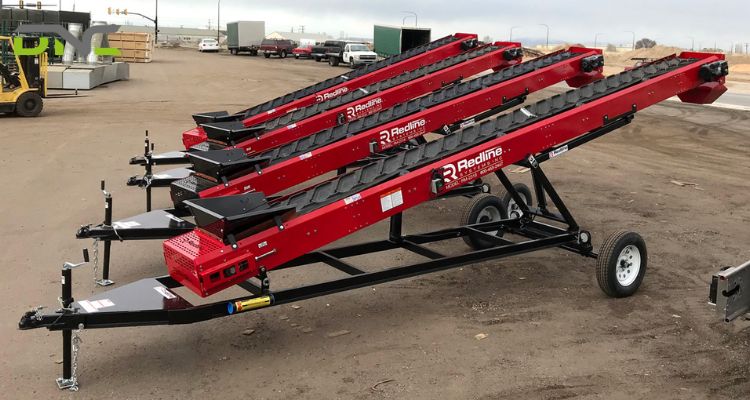
In today’s industrial operations, material handling systems must adapt quickly to changing production demands and space limitations. Portable conveyor systems are designed to deliver flexible, efficient material movement without the constraints of permanent installation. By enabling fast deployment, easy repositioning, and seamless integration with automation equipment, portable conveyors support continuous workflow optimization.
These systems are widely used across manufacturing, warehousing, and logistics environments where operational agility and productivity are critical. As automation strategies evolve, portable conveyors play an increasingly important role in supporting scalable, cost-effective material handling solutions.
What Is a Portable Conveyor?
A portable conveyor is a movable material handling system designed to transport products, components, or bulk materials between locations without permanent installation. Unlike fixed conveyor systems, portable conveyors can be easily repositioned, adjusted in length or height, and deployed for temporary or changing production layouts.
These systems typically use belt, roller, or modular designs and are engineered to support efficiency while minimizing downtime. Portable conveyors are widely used in manufacturing, warehousing, loading and unloading operations, and automation lines where flexibility, scalability, and space optimization are critical.
How Portable Conveyor Systems Work
Portable conveyor systems operate by combining a lightweight structural frame with a motor-driven conveying surface that allows materials to move smoothly between workstations.
These systems are designed for quick deployment and integration into existing workflows without complex civil work or long installation times.
Key working principles include:
- Motor-driven movement: Electric motors drive belts or rollers to ensure consistent material flow. Speed control allows operators to match conveyor output with upstream and downstream processes.
- Adjustable structure: Height, angle, and length adjustments allow the conveyor to align with machines, pallets, or workstations, reducing manual handling.
Mobility features: Wheels or casters enable fast repositioning, making portable conveyors ideal for dynamic layouts or temporary operations.
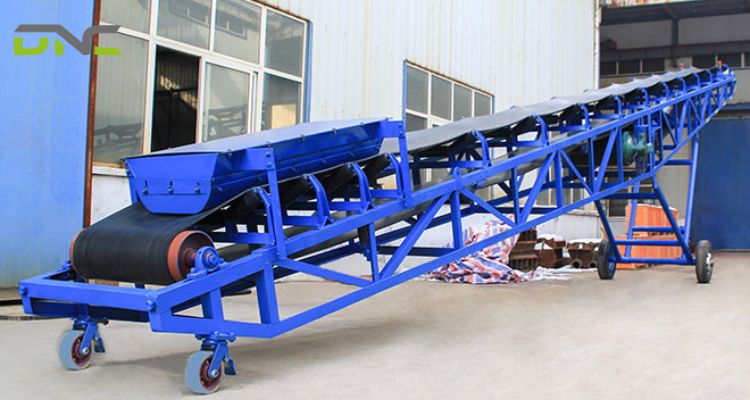
What Types of Portable Conveyors Are Available?
Portable conveyors are versatile material-handling systems designed for easy movement and quick setup, helping industries transfer materials efficiently across short or long distances with minimal labor.
Belt Portable Conveyors
Belt portable conveyors use a continuous belt made of rubber, PVC, or fabric to move materials smoothly. They are widely used in construction, mining, agriculture, and warehouses. These conveyors handle bulk materials like sand, gravel, grain, as well as packaged goods. Their adjustable length and incline make them suitable for both indoor and outdoor applications.
Roller Portable Conveyors
Roller portable conveyors consist of a series of rollers mounted in a frame to transport items with flat bottoms. They can be gravity-operated or motor-driven. Commonly used in logistics, shipping, and warehouses, they are ideal for cartons, boxes, and pallets. Their lightweight and expandable design allows easy repositioning and efficient loading or unloading operations.
Screw (Auger) Portable Conveyors
Screw portable conveyors use a rotating helical screw enclosed in a tube or trough to move materials. They are especially effective for powders, grains, cement, and other fine or semi-solid materials. These conveyors prevent material spillage and contamination. Their compact and enclosed design makes them suitable for agricultural, food-processing, and industrial environments.
Chain Portable Conveyors
Chain portable conveyors operate using chains or slats to move heavy or bulky materials. They are designed for rugged applications involving pallets, metal parts, or industrial components. These conveyors are known for their strength, durability, and ability to handle high loads. They are commonly used in manufacturing plants and heavy-duty industrial operations.
Flexible / Expandable Portable Conveyors
Flexible or expandable portable conveyors are designed to extend, curve, and retract as needed. They are commonly used in parcel handling, distribution centers, and airports. Their mobility allows quick adjustments to changing layouts. These conveyors are lightweight, easy to store, and ideal for environments where space efficiency and frequent repositioning are required.
Key Applications of Portable Conveyors
Portable conveyors support a wide range of industrial and automation-related applications where fixed systems may not be practical. Their adaptability makes them a valuable asset across different operational environments.
- Manufacturing and assembly lines: Portable conveyors enable temporary production setups, pilot lines, or flexible assembly stations without permanent infrastructure.
- Warehousing and distribution: These systems improve picking, sorting, and order fulfillment by reducing manual handling and speeding up material movement.
- Loading and unloading operations: Portable conveyors simplify truck and container loading processes, improving safety and reducing labor intensity.
- Maintenance and retrofit projects: During system upgrades or maintenance shutdowns, portable conveyors provide temporary material flow solutions.
Benefits of Using Portable Conveyor Systems
Portable conveyors offer significant operational advantages, particularly in automation-focused environments that demand efficiency and scalability.
Their benefits extend beyond mobility to include productivity, safety, and cost efficiency.
- Operational flexibility: Portable conveyors can be relocated and reconfigured quickly, allowing operations to adapt to changing production demands or layouts.
- Reduced manual handling: By automating short-distance material movement, these systems help minimize labor strain and improve workplace safety.
- Lower installation costs: Since portable conveyors do not require permanent foundations, installation time and capital investment are significantly reduced.
- Scalable automation support: Portable conveyors can be integrated gradually into automation strategies, making them suitable for both small-scale and expanding operations.
Portable Conveyor vs. Fixed Conveyor Systems
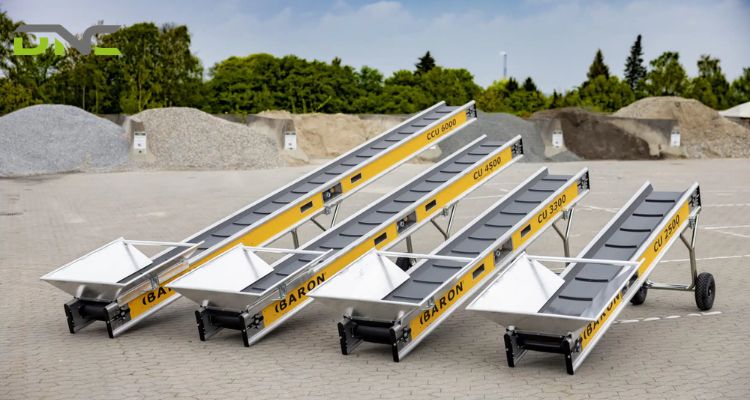
Portable conveyors are designed for mobility and quick deployment, making them ideal for dynamic environments or temporary workflows. In contrast, fixed conveyor systems are permanently installed and optimized for continuous, high-volume material handling. Understanding the key differences helps businesses select the most suitable solution based on efficiency, scalability, and investment requirements.
| Comparison Criteria | Portable Conveyor Systems | Fixed Conveyor Systems |
|---|---|---|
| Mobility & Flexibility | Easily movable and reconfigurable to adapt to changing layouts or temporary operations | Permanently installed with limited flexibility once commissioned |
| Installation Requirements | Minimal installation, no civil work required, fast setup | Requires structural support, civil work, and longer installation time |
| Initial Investment | Lower upfront cost, suitable for phased automation | Higher initial cost due to infrastructure and system complexity |
| Scalability | Easily scalable by adding or repositioning units | Expansion often requires system redesign or major modification |
| Operational Capacity | Best for light to medium-duty applications | Designed for high-volume, continuous material flow |
| Maintenance Impact | Simple maintenance with minimal disruption | Maintenance may affect entire production line |
| Best Use Cases | Temporary lines, flexible automation, retrofit projects | Permanent production lines, large-scale automation systems |
How to Choose the Right Portable Conveyor
Selecting the right portable conveyor requires careful consideration of material characteristics, operational goals, and automation compatibility. A well-matched system ensures long-term performance and efficiency.
- Material type and load capacity: The conveyor must be designed to handle the weight, size, and surface properties of the materials being transported.
- Required mobility and adjustability: Consider how often the conveyor will be moved and whether height or angle adjustments are necessary.
- Integration with automation systems: Portable conveyors should support sensors, PLC control, and speed synchronization with other equipment.
- Maintenance and durability: High-quality materials and modular components reduce downtime and simplify long-term maintenance.
How Portable Conveyors Support Automation Systems
Portable conveyors play a strategic role in modern automation by bridging gaps between machines and processes.
They enable flexible automation without sacrificing control or efficiency.
- Seamless system integration: Portable conveyors can be equipped with sensors, variable speed drives, and control interfaces to align with automated workflows.
- Improved process continuity: They help maintain consistent material flow between robotic cells, inspection stations, and packaging lines.
- Future-ready scalability: As automation requirements grow, portable conveyors can be upgraded or repositioned without major system redesign.
Why Is DNC Automation a Trusted Partner for Portable Conveyor Solutions?
Choosing the right partner is essential when implementing a portable conveyor system that supports both operational efficiency and long-term automation goals.
DNC Automation delivers engineered portable conveyor solutions designed to integrate seamlessly into modern industrial environments.
- Automation-focused system design: Each portable conveyor solution is developed with automation compatibility in mind, ensuring smooth integration with control systems and production equipment.
- Customized conveying solutions: DNC Automation tailors portable conveyor designs to match specific materials, layouts, and operational requirements rather than offering generic systems.
- End-to-end project support: From system design and engineering to installation and technical support, DNC Automation provides comprehensive assistance throughout the project lifecycle.
- Long-term performance commitment: Solutions are engineered for reliability, safety, and scalability, supporting continuous improvement and future automation expansion
- 64 views
- 0 Comment
Recent Comments