


Conveyor Metal Detector: Complete Guide for Malaysian Food & Industrial Factories
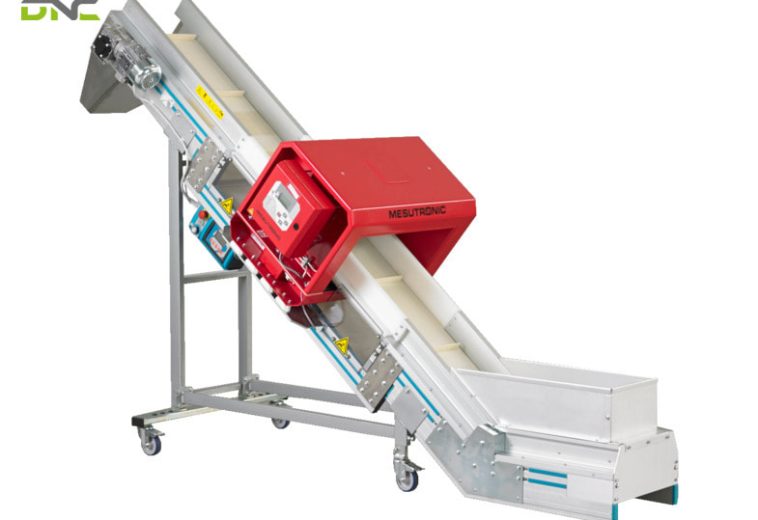
A conveyor metal detector is not an optional quality improvement tool in Malaysian food manufacturing — it is a mandatory Critical Control Point (CCP) under HACCP (MS 1480), required by every major food safety certification standard (BRC Global Standard, FSSC 22000), and a non-negotiable requirement for export F&B products to EU, UK, US, and Japanese markets. For companies like Ramly Burger, Guan Chong Berhad, and F&N, an inline conveyor metal detector is the last line of defence against metal contamination entering finished product — a contamination event that triggers product recall, regulatory action, and permanent damage to export market relationships.
Beyond food manufacturing, conveyor metal detectors serve pharmaceutical tablet and capsule lines, rubber glove production (pin and mold fragment detection before export), palm oil processing (foreign body detection), and plastics manufacturing (mold fragment detection for automotive supply chains). This guide covers the complete conveyor metal detector specification: detection physics, all system types, sensitivity specifications, wet product challenges, rejection mechanisms, Malaysian food safety compliance requirements, belt compatibility, PLC integration, and a selection guide for engineers and quality managers.
What Is a Conveyor Metal Detector?
A conveyor metal detector is an inline inspection system mounted on or integrated into a conveyor that uses electromagnetic field technology to detect ferrous metal, non-ferrous metal, and stainless steel contaminants within product passing through the detector aperture at line speed.
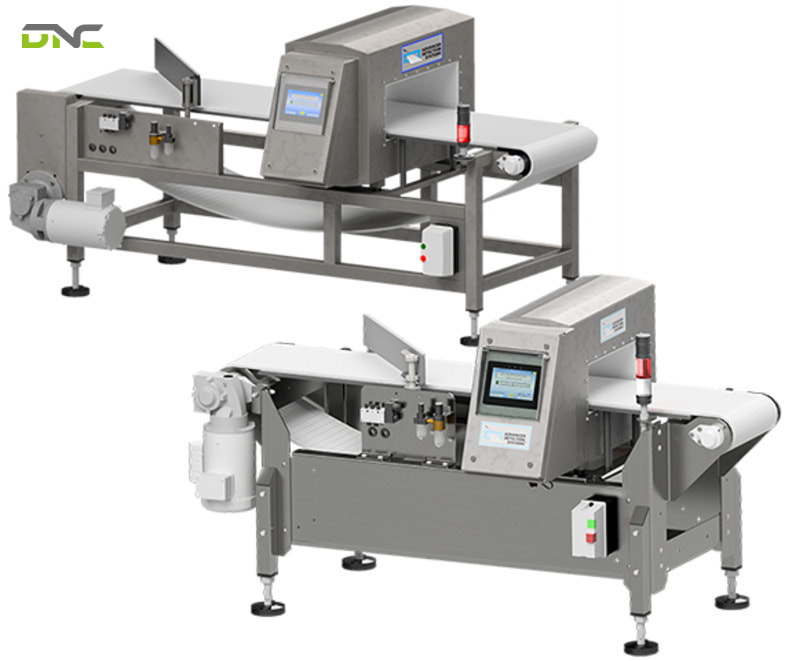
The conveyor metal detector consists of three functional elements: the search head (the detector aperture through which product passes), the conveyor belt passing through the aperture (carrying product), and the rejection mechanism (which removes detected contaminated product from the production line). All three elements function together as an integrated system — not separately specifiable components.
E-A-V Definition Framework:
| Entity | Attribute | Value |
| Conveyor Metal Detector | Detection technology | Balanced coil electromagnetic field (standard); multi-frequency (wet product) |
| Conveyor Metal Detector | Detectable metals | Ferrous, non-ferrous (aluminium, copper, brass), stainless steel (SS316) |
| Conveyor Metal Detector | Minimum detectable sphere (Fe) | 0.5 – 1.5 mm diameter (aperture-size dependent) |
| Conveyor Metal Detector | Minimum detectable sphere (Non-Fe) | 1.0 – 2.0 mm |
| Conveyor Metal Detector | Minimum detectable sphere (SS316) | 1.5 – 2.5 mm |
| Conveyor Metal Detector | Operating speed | 20 – 120 m/min |
| Conveyor Metal Detector | Aperture size range | 100×100 mm – 600×250 mm (H×W) |
| Conveyor Metal Detector | IP rating (food) | IP65 (splash-proof) to IP69K (high-pressure washdown) |
| Conveyor Metal Detector | Belt material requirement | Non-metallic (modular plastic PP/PE or PU flat belt) |
How a Conveyor Metal Detector Works
The Detection and Rejection Sequence (FWS Pattern)
A conveyor metal detector system operates through the following functional workflow:
- Electromagnetic field generation — The search head generates a balanced electromagnetic field across the aperture. The transmitter coil in the centre of the search head generates the field; two balanced receiver coils on either side of the transmitter measure the field. In undisturbed condition, the two receiver coil signals cancel — the system reads zero (balanced state).
- Metal passage disturbance — A metal contaminant passing through the electromagnetic field distorts the balanced field. The distortion is proportional to the metal mass, conductivity, and magnetic permeability. The two receiver coil signals become unbalanced — the system reads a differential signal.
- Signal processing — The differential signal is processed by the detector electronics. Phase angle analysis determines the metal type (ferrous vs. non-ferrous vs. stainless steel based on signal phase). Amplitude determines metal size relative to the sensitivity threshold. A detection event is triggered when the signal amplitude exceeds the threshold setting.
- Detection-to-reject timing — The Siemens S7 PLC (or the metal detector’s internal controller) starts a timing sequence at the moment of detection. The timing is calculated from: (distance from detection point to reject mechanism) / (conveyor belt speed in mm/ms). This ensures the rejection mechanism activates precisely as the contaminated product — not adjacent product — reaches the reject point.
- Rejection mechanism activation — At the calculated reject moment, the PLC activates the rejection mechanism (air blast, pusher arm, diverter flap, or flip-top trap). The contaminated product is diverted from the production stream into a secured reject bin.
- SCADA event logging — Every detection and rejection event is logged by the Siemens WinCC SCADA system with: timestamp, product batch number, signal amplitude and phase (metal type indicator), conveyor speed, and rejection status (confirm/rejected). This log forms the HACCP CCP monitoring record.
- Sensitivity check protocol — At the start of each production shift and at defined intervals during production (typically every 2 hours per HACCP plan), a test piece (standard test sphere of defined size and metal type) is passed through the aperture to verify the detector is operating at specified sensitivity. The SCADA system records the test result — pass or fail — with timestamp and operator ID.

Why Stainless Steel Is the Hardest Metal to Detect
Stainless steel (SS304, SS316) is the most challenging metal type for conveyor metal detectors to detect — a fact critical to understand for Malaysian food factories that use extensive stainless steel equipment, utensils, and fittings.
Detection sensitivity depends on two material properties: electrical conductivity (higher = easier to detect) and magnetic permeability (ferromagnetic metals with high permeability are easier to detect than non-magnetic metals).
- Ferrous metals (iron, steel): High magnetic permeability (ferromagnetic) → strong detector signal → smallest detectable sphere (0.5–1.5 mm)
- Non-ferrous metals (aluminium, copper, brass): High electrical conductivity, non-magnetic → moderate detector signal → 1.0–2.0 mm minimum sphere
- Stainless steel 316: Low magnetic permeability (austenitic, non-magnetic), moderate conductivity → weakest detector signal → 1.5–2.5 mm minimum sphere
This means a stainless steel wire fragment from a food processing brush, or a stainless steel fragment from processing equipment, is the hardest contaminant to detect — and also one of the most common metal contamination sources in food factories. The correct sensitivity validation must always include SS316 test sphere specification — not only the easier-to-detect ferrous sphere.
Types of Conveyor Metal Detector Systems
1. Tunnel / Aperture Conveyor Metal Detector (Most Common)
The tunnel conveyor metal detector is the standard configuration for packaged food, pharmaceutical, and general industrial inline inspection. The product travels on the conveyor belt through a rectangular aperture (the tunnel) in the search head. The aperture is sized to fit the product with minimum clearance on all sides.
- Aperture size: Product height × product width + 40–80 mm clearance (minimum for detection field uniformity)
- Sensitivity rule: Sensitivity decreases as aperture size increases — a 100×100 mm aperture detects smaller contaminants than a 600×250 mm aperture for the same detector technology. Specify the smallest aperture that product can pass through.
- Malaysian application: Ramly Burger (packaged beef patties), Guan Chong (bagged cocoa powder, chocolate bars), F&N (canned beverages, PET bottle packs), biscuit and confectionery exporters — all use tunnel aperture conveyor metal detectors as mandatory HACCP CCPs
2. Gravity Fall Metal Detector
The gravity fall metal detector inspects free-falling bulk product — powder, granules, grain, or pellets — as it falls through the detector aperture under gravity between process stages (e.g., from a bulk hopper or screw conveyor discharge to a packaging machine infeed).
- No conveyor belt — product is inspected in free-fall; no belt contamination of detection field
- Highest sensitivity — the absence of a conveyor belt (which generates a background EM signal) allows maximum detector sensitivity; smallest detectable sphere is 30–50% smaller than tunnel conveyor metal detector for the same product
- Rejection mechanism: Flip-top trap or diverter valve in the product chute — diverts contaminated bulk product to a separate reject container while allowing clean product to continue to packaging
- Malaysian application: Grain mills (paddy, maize), sugar and flour processing, spice powder packaging (detecting metal from grinding equipment), animal feed processing — all use gravity fall metal detectors for bulk powder and granule inspection
3. Pipeline (Liquid) Metal Detector
The pipeline metal detector inspects liquid, paste, or semi-liquid product flowing through a metal-free pipe section. Not belt-mounted — liquid product flows through the detector. Used in liquid food processing (sauces, beverages, palm oil), pharmaceutical liquid/paste processing, and personal care product manufacturing.
- Not conveyor-mounted — integrated into pipeline flow; covered here for completeness
- Malaysian application: Palm oil CPO (crude palm oil) pipeline inspection for metal fragments from processing equipment before bulk tanker loading; sauce and condiment processing before filling machines
4. Integrated Metal Detector and Rejection System
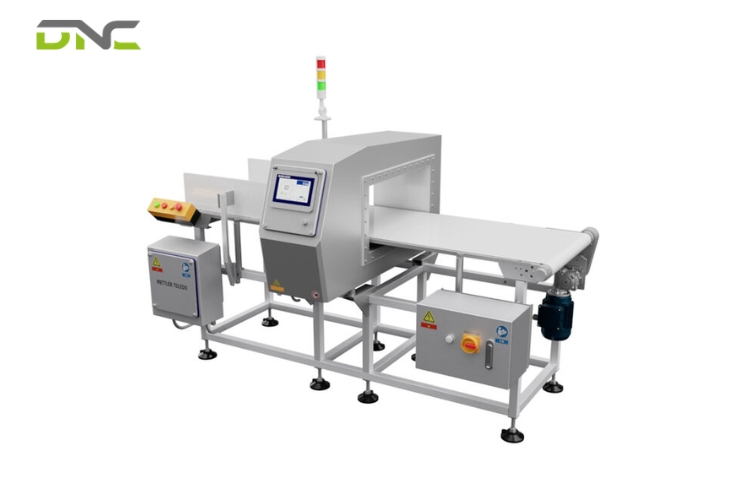
The integrated metal detector and rejection system combines the detector search head, conveyor, rejection mechanism, and reject confirmation sensor into a single pre-engineered unit — simplifying installation and ensuring correct timing calibration between detection and rejection.
- Standard integrated rejection options: Air blast ejector (standard for packaged goods <5 kg), pusher arm (heavy or large products 5–30 kg), diverter flap (continuous flow bulk or high-speed single-file lines)
- Reject confirmation: A second sensor (photoelectric or weight sensor) downstream of the reject mechanism confirms that the contaminated product was physically removed — not just that the rejection mechanism activated. Reject confirmation is a BRC Global Standard requirement.
- Malaysian application: All DNC Automation conveyor metal detector installations are integrated systems — detector + conveyor + rejection + SCADA logging — not standalone detectors
Detection Sensitivity Specifications
Sensitivity specification is the most technically critical element of conveyor metal detector selection. Sensitivity must be validated — not merely specified — for each product type and production condition.
Standard Sensitivity Reference Values (Tunnel Aperture, 100×200 mm Aperture)
| Metal Type | Typical Min. Detectable Sphere |
| Ferrous (iron/carbon steel) | 0.5 – 0.8 mm diameter |
| Non-ferrous (aluminium, copper, brass) | 0.8 – 1.2 mm diameter |
| Stainless steel 316 | 1.2 – 1.8 mm diameter |
Sensitivity Reduction with Aperture Size
| Aperture Size (H×W) | Fe Sensitivity | Non-Fe | SS316 |
| 100×100 mm | 0.5 mm | 0.8 mm | 1.2 mm |
| 150×200 mm | 0.7 mm | 1.0 mm | 1.5 mm |
| 250×300 mm | 0.9 mm | 1.3 mm | 2.0 mm |
| 400×400 mm | 1.2 mm | 1.8 mm | 2.5 mm |
Aperture size should always be minimised to the smallest dimension that product can reliably pass through — maximising sensitivity. Do not over-specify aperture size for convenience of product loading; do specify the aperture based on maximum product cross-section dimensions.
Effect of Wet and Conductive Products on Sensitivity
Wet, saline, or high-moisture products (fresh meat, fish, bread, cheese, vegetables) are the most challenging products for conveyor metal detectors. These products have high electrical conductivity — they generate their own electromagnetic field signal as they pass through the detector aperture. This “product effect” signal can mask or be mistaken for a metal contamination signal.
Detection challenge mechanisms:
- High-moisture product signal interferes with SS316 detection (similar signal phase to SS316 in some detector configurations)
- Product signal variation (non-uniform moisture distribution) generates false alarm signals at high sensitivity settings
- Temperature-dependent conductivity — fresh meat conductivity changes with temperature, causing sensitivity drift during a production run
Solutions implemented in modern conveyor metal detectors:
- Multi-frequency detection: Operating simultaneously at multiple frequencies characterises the product signal signature across frequencies, distinguishing product effect from metal signal with higher accuracy
- Phase rejection (product effect compensation): Software analysis of signal phase angle rejects the product-effect phase while maintaining sensitivity to the metal signal phase — allowing higher sensitivity in wet product applications without increasing false alarm rate
- Automatic frequency selection: Detector automatically selects the optimal operating frequency for the product being inspected — maintaining maximum sensitivity with minimum false alarms
Malaysian food factories should validate wet product metal detector performance using actual production product (not dry sample) at production temperature, before specifying sensitivity thresholds in HACCP plans.
Rejection Mechanisms for Conveyor Metal Detectors
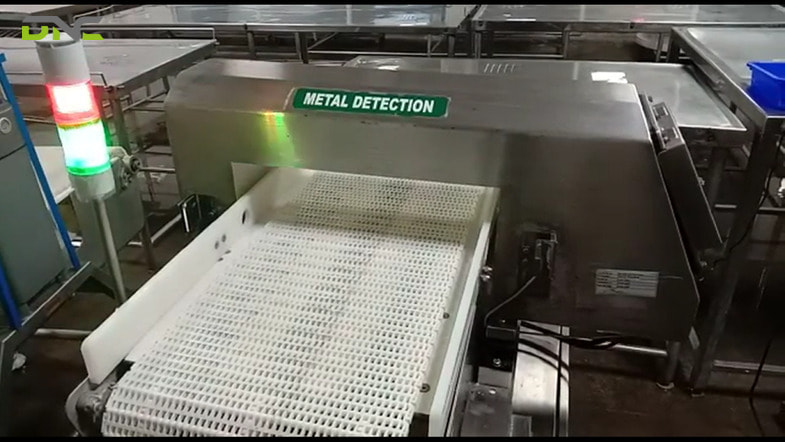
The rejection mechanism removes the detected contaminated product from the production stream. Selection of the correct rejection mechanism is as important as selection of the detector — an incorrectly specified rejection mechanism that fails to physically remove the contaminated product makes the metal detection system worthless.
Air Blast Ejector
An air blast ejector uses a high-pressure air jet (from a solenoid-controlled pneumatic nozzle) to blow the contaminated product off the conveyor belt into a reject bin or reject chute.
- Best for: Lightweight packaged products up to 2 kg; high conveyor speeds (60–120 m/min); individual item products (not merged or touching)
- Air pressure: 4–6 bar supply pressure, 1–50 ms blast duration depending on product weight
- Timing precision: Air blast timing is calculated by the PLC from detection event to nozzle activate — with 1 ms accuracy at high speed, timing precision is critical
- Limitation: Not suitable for heavy products (>2 kg) — air blast force insufficient; not suitable for products stacked or touching each other (blast ejects multiple products)
- Malaysian application: Confectionery packs, biscuit packs, beverage cans, pharmaceutical blister packs — all within air blast weight range on Malaysian packaging lines
Pusher Arm (Rejecter)
A pneumatic or servo-actuated pusher arm sweeps the contaminated product off the conveyor belt laterally into a reject bin.
- Best for: Heavy packaged products (2–30 kg), large cartons, products where air blast force is insufficient
- Actuation time: 100–500 ms (pneumatic), 50–200 ms (servo) — slower than air blast; requires minimum product spacing for accurate single-product rejection
- Limitation: Requires minimum product spacing at least equal to product width to avoid sweeping adjacent (clean) products along with contaminated product
- Malaysian application: Ramly Burger frozen patty trays (3–5 kg per tray), F&N beverage multi-packs (4–8 kg), heavy food pouches — all require pusher arm rejection on Malaysian food conveyor lines
Diverter Flap
A motor-actuated hinged flap in the conveyor frame or at the conveyor discharge point diverts the product stream between two paths: normal (downstream processing) and reject (reject bin/bin).
- Best for: High-speed continuous product flow; situations where individual product identification is not required (bulk redirection of the product stream when contamination is detected); free-fall or chute-mounted systems
- Malaysian application: Gravity fall metal detectors in grain mills and powder processing — the diverter flap redirects the bulk product flow from the normal filling chute to a reject container when a metal contaminant is detected
Flip-Top Trap (Gravity Fall Systems)
The flip-top trap is the standard rejection mechanism for gravity fall metal detectors. A spring-loaded or motor-actuated trap door in the product chute opens momentarily to divert the contaminated bulk material fraction into a reject container, then closes to allow clean product to continue.
- Timing: Matched to product fall velocity through the detector aperture — typically 50–200 ms trap open time
- Malaysian application: Grain and seed gravity fall metal detectors at rice mills (Kedah), spice powder processing lines
Malaysian Food Safety Compliance Requirements for Conveyor Metal Detectors
Conveyor metal detector specification, validation, and record-keeping requirements in Malaysia are governed by multiple overlapping food safety standards. Understanding which standards apply to a specific Malaysian food manufacturer determines the minimum specification required.
HACCP (MS 1480, SIRIM) — Mandatory for Export F&B Manufacturers
HACCP (Hazard Analysis and Critical Control Points) under Malaysian Standard MS 1480 requires:
- Identification of metal contamination as a physical hazard at relevant process stages
- Establishment of metal detection as a Critical Control Point (CCP) with defined Critical Limits (minimum detectable metal size per metal type)
- Monitoring procedure: sensitivity verification at start of each production run and minimum every 2 hours during production (using calibrated test pieces)
- Corrective action procedure: what to do when sensitivity check fails or when a detection event occurs
- Complete monitoring records: every sensitivity check result, every detection/rejection event, with timestamp, product batch, operator ID
The Siemens WinCC SCADA integration on DNC Automation’s conveyor metal detector systems automatically generates all HACCP CCP monitoring records — eliminating manual record error and reducing audit preparation time.
BRC Global Standard (Version 9) — Required for UK/EU Retailer Supply
BRC Global Standard for Food Safety (the standard required to supply major UK and EU supermarket retailers) imposes additional requirements beyond HACCP:
- Metal detection as a listed control measure for physical contamination prevention
- Reject confirmation mechanism — not only must the metal detector activate rejection, but a downstream sensor must confirm the contaminated product was physically removed (reject confirmation sensor mandatory)
- Validated sensitivity thresholds — stated in the factory’s HACCP plan and validated with product under production conditions (not just empty belt tests)
- Segregated reject bin — reject bin must be clearly identified, access-controlled, and its contents reviewed before disposal
Malaysian biscuit exporters to the UK and EU, confectionery manufacturers supplying international retailers, and food ingredient exporters all operate under BRC and require BRC-grade conveyor metal detector systems.
FSSC 22000 — Increasingly Required for Global F&B Supply Chains
FSSC 22000 (ISO 22000 + PAS 220 or equivalent) requires metal detection or X-ray inspection as a prerequisite program for physical hazard control. FSSC 22000 certification is increasingly required for supply of ingredients, semi-finished goods, and finished products to multinational food companies operating in Malaysia (Unilever, Nestlé, and similar) and for direct supply to global private label retailers.
Halal Certification (JAKIM) — No Metal in Halal Product
JAKIM Halal certification for Malaysian food manufacturers requires prevention of cross-contamination and foreign body contamination throughout the production process. A metal detector CCP on the conveyor line provides the documented evidence that no metal contamination — including metal from equipment wear, maintenance tools left in product, or broken food contact surfaces — entered the halal-certified product stream. Metal detection records support Halal audit documentation.
Pharmaceutical GMP (MYGxP/PIC/S) — Tablet and Capsule Lines
Pharmaceutical manufacturers in Selangor and Johor operating under Malaysian Good Manufacturing Practice (GMP, equivalent to PIC/S) requirements specify metal detection (or X-ray inspection) on tablet and capsule production lines to detect stainless steel tablet press punch fragments, machine-wear particles, and maintenance tools.
Pharmaceutical conveyor metal detector specifications: higher sensitivity than food grade (SS316 detection threshold 0.8–1.2 mm); IP65 minimum; GMP documentation including equipment qualification (IQ/OQ/PQ) records and 21 CFR Part 11-compliant data integrity for electronic records.
Belt Compatibility: Why Non-Metallic Belts Are Mandatory
The most common installation error on conveyor metal detector systems is the incorrect belt specification. A metal-containing belt — wire mesh belt, metal modular belt, or belt with metal fasteners — passing through a metal detector tunnel generates a continuous large EM signal that either saturates the detector (making detection impossible) or triggers constant false alarms.
Mandatory belt specifications for conveyor metal detector systems:
- Modular plastic belt (PP or PE): The standard belt for conveyor metal detector installations in Malaysian food factories. Polypropylene or polyethylene modular belt links contain no metal — zero EM signal interference. The open hinge design allows product contact with belt surface. Selected for product handling through the metal detector aperture and downstream rejection zone.
- PU flat belt (polyurethane): Food-grade PU flat belt with no metal fasteners (vulcanised or thermally welded splice only) is compatible with metal detector operation. Mechanical belt splice fasteners (metal staples or clips) must not be used in or upstream of the metal detector zone. PU flat belt is specified where a continuous flat surface is required (small products, fragile packaging) and modular belt gaps are unacceptable.
- PVC flat belt: General PVC belt with vulcanised splice (no metal fasteners) is compatible. Not recommended for direct food contact but acceptable for secondary packaged goods.
Incompatible belt types — never specify in metal detector zones:
- Wire mesh belt (steel or SS woven wire) — constant false alarm
- Metal modular belt — constant false alarm
- Any belt with metal mechanical splice fasteners (staples, wire clips) — repeated false alarm each belt revolution
- Rubber belt with steel cord reinforcement — strong continuous background EM signal
If an existing conveyor with an incompatible belt must be retrofitted with metal detection, the belt in the detector zone and rejection zone must be replaced with a non-metallic alternative.
PLC and SCADA Integration for Conveyor Metal Detector Systems
DNC Automation integrates all conveyor metal detector systems with Siemens S7 PLC and WinCC SCADA for full HACCP compliance, production monitoring, and data integrity.
Siemens S7 PLC Integration Functions
Detection-to-reject timing: The metal detector sends a digital pulse (or Profinet message) to the Siemens S7 PLC on every detection event. The PLC starts a timer calculated from (conveyor speed × distance from detection to reject point). At timer completion, the PLC activates the rejection mechanism solenoid valve or servo. Timing recalculates automatically when conveyor speed changes — maintaining correct reject targeting at all operating speeds.
Reject confirmation input: A photoelectric or weight sensor downstream of the rejection mechanism confirms product was physically removed. If the rejection mechanism activated but the confirmation sensor does not detect product in the reject bin within the expected time window, the PLC triggers a “missed reject” alarm — halting the line until the contaminated product is located and removed manually.
Sensitivity check management: The PLC receives the sensitivity check test piece pass/fail signal from the metal detector controller. If a sensitivity check fails, the PLC: (a) logs the failure event to WinCC with timestamp and operator ID, (b) triggers a production line hold, and (c) initiates HACCP corrective action: product produced since the last passing sensitivity check is placed on hold for reinspection.
Production data logging to WinCC SCADA: All detection events, rejection events, sensitivity check results, conveyor speed, and line status are logged to Siemens WinCC SCADA in real time. WinCC exports HACCP CCP monitoring records on demand (per shift, per batch, per day) — formatted for HACCP audit documentation.
MIDA SAG Qualification
Conveyor metal detector systems integrated with Siemens S7 PLC, SCADA logging, and rejection confirmation as part of a food safety automation investment qualify for MIDA Smart Automation Grant (up to RM 1,000,000, 70:30 matching). The conveyor metal detector must be part of an integrated automation system — not a standalone instrument. DNC Automation assists Malaysian food manufacturers with complete MIDA SAG application documentation for conveyor metal detector automation projects.
Selection Guide: Specifying the Right Conveyor Metal Detector System
Step 1: Define the Product and Aperture Size (APS Pattern)
The product dimensions and pack size determine the minimum aperture required:
- Measure maximum product height (H) and width (W) in the orientation it passes through the detector
- Add minimum clearance: 40 mm on all four sides (for field uniformity and product passage reliability)
- Required aperture: (H + 80) mm × (W + 80) mm
- Minimise aperture size — sensitivity decreases as aperture increases
Step 2: Define the Sensitivity Requirement
Sensitivity requirements are set by the applicable food safety standard and HACCP CCP critical limits:
| Standard | Typical Minimum Sensitivity Requirement |
| HACCP (MS 1480, basic) | Fe 1.5 mm / Non-Fe 2.0 mm / SS316 2.5 mm |
| BRC Global Standard | Fe 1.0 mm / Non-Fe 1.5 mm / SS316 2.0 mm |
| FSSC 22000 (stricter retailers) | Fe 0.8 mm / Non-Fe 1.2 mm / SS316 1.5 mm |
| Pharmaceutical GMP (PIC/S) | SS316 0.8 – 1.2 mm (product-specific) |
Always validate sensitivity with actual production product under production conditions (not empty belt) before accepting the system.
Step 3: Assess Wet Product Challenge
If the product is wet, high-moisture, or saline (fresh meat, fish, wet vegetables, bread):
- Specify multi-frequency detection technology
- Specify phase rejection (product effect compensation)
- Validate sensitivity in wet product condition at production temperature
- Accept that SS316 sensitivity will be 20–40% lower than dry product — adjust HACCP CCP critical limits accordingly
Step 4: Select Rejection Mechanism
| Product Weight | Rejection Mechanism |
| <0.5 kg (light packs, sachets) | Air blast ejector |
| 0.5 – 5 kg (standard packs) | Air blast ejector (preferred) or pusher arm |
| 5 – 30 kg (heavy cartons, trays) | Pusher arm |
| Bulk gravity flow (powder, grain) | Flip-top trap or diverter valve |
| Any product (BRC grade) | Rejection mechanism + reject confirmation sensor |
Step 5: Define IP Rating and Hygiene Specification
| Environment | IP Rating | Frame Material |
| Dry packaging area | IP54 | Mild steel or SS304 |
| Wet processing area (food, pharma) | IP65 | SS304 or SS316 |
| High-pressure washdown | IP69K | SS304 or SS316, hygienic design |
| Pharmaceutical GMP | IP65 minimum | SS316, hygienic design (no crevices) |
Step 6: Define Belt Specification
Non-metallic belt is mandatory in and upstream of the detector zone. Specify:
- Modular plastic PP belt (open hinge, food contact) — standard food factory choice
- PU flat belt, vulcanised splice (no metal fasteners) — where flat surface required
- Belt must extend minimum 1,500 mm upstream of detector aperture entry (to stabilise product orientation before detection)
Applications in Malaysian Manufacturing
F&B Sector: Ramly Burger, Guan Chong, F&N, Biscuit Exporters
Every HACCP-certified and BRC-certified Malaysian F&B manufacturer operates conveyor metal detectors as mandatory CCPs. Ramly Burger uses conveyor metal detectors (pusher arm rejection, IP69K SS316 washdown specification) on frozen beef patty lines before packaging — detecting metal from mincer blades, forming machine components, and maintenance tools.
Guan Chong Berhad uses conveyor metal detectors (gravity fall and tunnel aperture) on cocoa powder, cocoa butter, and chocolate product lines — detecting equipment wear fragments from grinding and mixing machinery before packaging for export to EU buyers requiring BRC certification.
F&N integrates conveyor metal detectors as a mandatory HACCP CCP on all beverage and food packaging lines — PP modular belt non-metallic conveyors, air blast rejection, SCADA-logged sensitivity checks every 2 hours per HACCP plan.
Pharmaceutical Sector
Pharmaceutical manufacturers in Selangor and Johor specify conveyor metal detectors (or equivalent X-ray systems) on tablet and capsule production lines under Malaysian GMP requirements. The primary contamination risk is stainless steel punch and die fragments from tablet press tooling. Sensitivity specification: SS316 ≤1.2 mm sphere. IP65, SS316 hygienic frame, 21 CFR Part 11 electronic records compliance.
Rubber Glove Manufacturing: Hartalega
Hartalega exports rubber gloves to EU and US markets where medical device regulatory requirements include foreign body (metal pin, mold fragment) detection before export. Conveyor metal detectors on glove inspection conveyor lines detect broken dipping form pin fragments, mold components, and maintenance metal before gloves are packed for export. Air blast rejection is specified for the lightweight glove product. PP modular belt (non-metallic) is mandatory on the detector zone conveyor.
Palm Oil Processing: CPO Foreign Body Detection
Palm oil processing plants use pipeline metal detectors on CPO (crude palm oil) lines before bulk tanker loading — detecting metal fragments from screw press augers, kernel cracking machines, and processing equipment that could contaminate crude palm oil shipments and damage downstream refinery equipment.
Plastics Manufacturing: Mold Fragment Detection for Automotive
Injection moulding facilities supplying Toyota, DRB-Hicom, and other automotive customers detect broken mold pin fragments and machine wear particles in plastic components before delivery. Automotive supply chain quality requirements (IATF 16949) require documented foreign body detection controls. Conveyor metal detectors on the finished component exit conveyor (pusher arm rejection for heavy plastic parts) provide the documented inspection record.
Failure Modes and False Alarms
Product Effect False Alarm (Most Common)
Description: The metal detector triggers a rejection on clean product — no metal present — due to the product’s own electromagnetic signature being misidentified as metal.
Causes (DOS Pattern):
- Product effect compensation not correctly tuned for the current product at current production temperature
- Product moisture or salt content variation beyond the tuning range (batch-to-batch product variation)
- Product contains conductive packaging materials (metalised film, foil packaging) — high EM signal
- Belt splice or belt joint with metal fasteners passing through detector aperture
Prevention: Product effect compensation tuning during commissioning with actual production product at production temperature; re-tune at product changeover; specify non-metallic belt with vulcanised splice; validate with actual product before setting HACCP sensitivity thresholds.
Sensitivity Drift
Description: The metal detector’s effective sensitivity decreases over time — previously detectable test spheres are no longer detected at the specified sensitivity threshold.
Causes: Electronic component drift (temperature-related); search head coil vibration (from conveyor operation or external vibration sources); external electromagnetic interference (nearby variable frequency drives, motors, welding equipment); product buildup on search head aperture interior surfaces.
Prevention: Regular sensitivity check (every 2 hours per HACCP plan); install the metal detector on an independent conveyor section isolated from heavy vibration sources; maintain minimum 500 mm clearance from VFDs and large motors; clean aperture interior surfaces at each production changeover.
Frequently Asked Questions: Conveyor Metal Detector
Q1: Is a conveyor metal detector mandatory for Malaysian food manufacturers?
A conveyor metal detector is mandatory as a HACCP Critical Control Point (CCP) for Malaysian food manufacturers producing for export markets (EU, UK, US, Japan, Australia) and for any manufacturer certified under BRC Global Standard or FSSC 22000. Under Malaysian Standard MS 1480 (HACCP), physical hazard control including metal contamination must be addressed at CCPs identified in the HACCP plan. For most food production processes, metal detection is the designated CCP. Failure to operate and document metal detection CCPs results in HACCP certification failure and export market access suspension.
Q2: What is the difference between a ferrous and stainless steel metal detection sensitivity specification?
Ferrous metals (iron, carbon steel) have high magnetic permeability — they strongly disturb the metal detector’s electromagnetic field and are detectable at the smallest sphere sizes (0.5–1.5 mm depending on aperture). Stainless steel (SS304, SS316) is non-magnetic (austenitic) and has moderate conductivity — it produces a much weaker detector signal than ferrous metals and requires 1.5–3× the sphere diameter to reach the same detection reliability. For Malaysian food factories using extensive stainless steel equipment (knives, brushes, screens), always validate SS316 sensitivity specifically — and include SS316 test pieces in the HACCP sensitivity check procedure, not only ferrous test pieces.
Q3: Why does my conveyor metal detector generate false alarms on certain products?
False alarms from clean product (false positives) indicate a product effect compensation issue. Wet, high-moisture, or saline products (fresh meat, bread, cheese, marinated products) generate their own electromagnetic signals that can be mistaken for metal signals. Additionally, foil-lined or metalised film packaging creates strong EM signals. Solutions: use a modern multi-frequency detector with phase rejection (product effect compensation); re-tune the detector with actual production product at production temperature; verify that no metal fasteners are present in the belt splice passing through the aperture.
Q4: What belt type must I specify for a conveyor metal detector installation in Malaysia?
The belt must be non-metallic. Specify: modular plastic belt (polypropylene or polyethylene, no metal components) — the standard for Malaysian food factory metal detector conveyor installations; or PU flat belt with vulcanised splice (no metal fasteners in the belt loop). Wire mesh belts, metal modular belts, and any belt with metal mechanical splice fasteners (staples, clips) are incompatible — they generate continuous EM signals that saturate the detector or cause constant false alarms. If retrofitting metal detection to an existing conveyor, replace the belt in and upstream of the detector zone with a non-metallic type.
Q5: How does SCADA integration with a conveyor metal detector support HACCP audits?
Siemens WinCC SCADA logs every metal detection event, every rejection event, and every sensitivity check result with timestamp, product batch number, conveyor speed, and operator ID. For HACCP audits (BRC, FSSC 22000, SIRIM, retailer audits), the SCADA system generates complete CCP monitoring records on demand — per shift, per batch, per production day. These electronic records satisfy the HACCP record-keeping requirements of MS 1480, BRC Global Standard, and FSSC 22000 without manual data entry, eliminating the transcription errors that cause audit non-conformances. Electronic records also provide timestamped data integrity that auditors increasingly require.
Q6: What is the correct sensitivity check procedure for a Malaysian food factory?
The sensitivity check procedure for a Malaysian food factory metal detector CCP: (1) At production start and every 2 hours during production (minimum — HACCP plan may specify higher frequency), pass the calibrated test piece (standard metal sphere of defined size and type: Fe, Non-Fe, SS316) through the detector aperture on the production conveyor belt at production speed. (2) The test piece must trigger a detection and rejection event. (3) Record the result (pass/fail), time, product batch, and operator ID in the HACCP monitoring record (manual or SCADA-automatic). (4) If any test fails: stop production, hold all product since the last passing check, investigate the cause, repair and re-validate before resuming. SCADA integration automates steps 3 and 4.
Q7: Can a conveyor metal detector detect glass, plastic, or bone contamination?
A conveyor metal detector detects metal only — ferrous, non-ferrous, and stainless steel. It cannot detect glass, ceramic, bone, stone, or plastic contaminants. For detection of non-metallic dense contaminants (bone fragments, stone, glass, dense plastic), X-ray inspection systems are required. Many Malaysian food manufacturers for export markets specify both metal detection (mandatory CCP) and X-ray inspection (for bone, glass, and stone) on the same conveyor line — with metal detection upstream of X-ray, since X-ray does not replace metal detection under BRC or FSSC 22000 requirements.
Q8: What is the MIDA SAG eligibility for conveyor metal detector systems in Malaysia?
A conveyor metal detector system qualifies for MIDA Smart Automation Grant (up to RM 1,000,000, 70:30 matching) when installed as part of an integrated food safety automation system — including the conveyor, PLC control (Siemens S7), SCADA logging (WinCC), rejection mechanism, and reject confirmation. The conveyor metal detector must be integrated into a broader automation investment (packaging line, production line) rather than installed as a standalone instrument without automation integration. DNC Automation designs conveyor metal detector systems with full Siemens S7 PLC and WinCC SCADA integration as standard, ensuring MIDA SAG eligibility, and supports clients through the full application and documentation process.
Why Malaysian Manufacturers Choose DNC Automation for Conveyor Metal Detector Systems
DNC Automation has designed and commissioned integrated conveyor metal detector systems for Malaysian food manufacturers, pharmaceutical producers, rubber glove manufacturers, and industrial processors since 2005. Every DNC Automation conveyor metal detector installation is a complete integrated system — non-metallic belt, search head, rejection mechanism, reject confirmation sensor, and Siemens S7 PLC with WinCC SCADA — not a standalone instrument requiring separate integration.
Measurable results delivered:
- Reduce human error by up to 80% through automated metal detection and PLC-controlled rejection replacing manual inspection and visual checking
- Increase productivity by up to 50% through continuous inline inspection at full production speed replacing periodic manual sampling and production holds
- Save up to 50% in operational cost — one integrated conveyor metal detector system replaces 2–3 manual inspection operators per shift, while simultaneously generating HACCP records automatically
HACCP compliance as standard: Every DNC Automation conveyor metal detector installation is configured to generate automatic HACCP CCP monitoring records through Siemens WinCC SCADA — covering every detection event, rejection confirmation, and sensitivity check. These records are formatted for BRC, FSSC 22000, SIRIM, and export retailer audit requirements.
MIDA SAG support: DNC Automation assists Malaysian food manufacturers in qualifying conveyor metal detector automation investments for MIDA Smart Automation Grant (up to RM 1,000,000, 70:30 matching) — from technical application documentation through commissioning verification records.
24/7 local support: DNC Automation provides 24/7 local engineering support for conveyor metal detector faults — sensitivity alarms, rejection mechanism failures, SCADA integration issues, and HACCP record queries. Local Malaysian engineering support means production-critical metal detection CCPs are restored in hours, protecting your food safety compliance and production continuity.
Free pre-sales consultation: DNC Automation’s engineers assess your product, aperture requirements, food safety certification standard, and production line layout to recommend the correct conveyor metal detector specification — before any procurement commitment.
Get a Free Consultation from DNC Automation. Talk to our engineers about your metal detection requirement — whether HACCP CCP compliance, BRC certification support, pharmaceutical GMP inspection, or industrial foreign body detection.
- 411 views
- 0 Comment
Recent Comments