


Bucket Elevator Conveyor Solutions for Efficient Vertical Material Handling
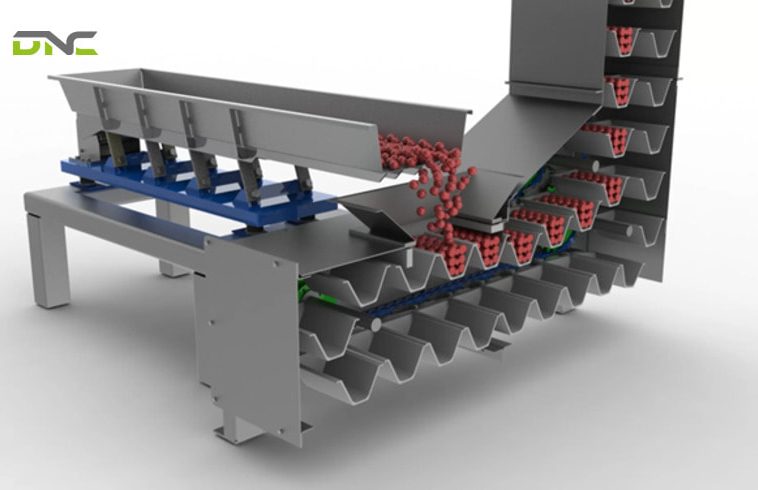
A bucket elevator conveyor lifts bulk materials vertically using buckets attached to a continuous belt or chain loop running inside an enclosed casing. It is the most efficient method for vertical elevation of dry bulk solids — grain, cement clinker, palm kernel, sugar, minerals, and animal feed — achieving throughputs of 20–1,000 tonnes per hour at lift heights from 5 to 80 metres in a compact, dust-tight footprint.
In Malaysia, bucket elevators are critical infrastructure at grain terminals (Port Klang, Johor Bahru, Penang Butterworth), cement plants (Ipoh, Kanthan, Langkawi), palm oil mills (palm kernel silo loading), and animal feed mills — wherever bulk materials must be lifted efficiently in a vertical run with minimal floor space and contained dust emission.
How a Bucket Elevator Works
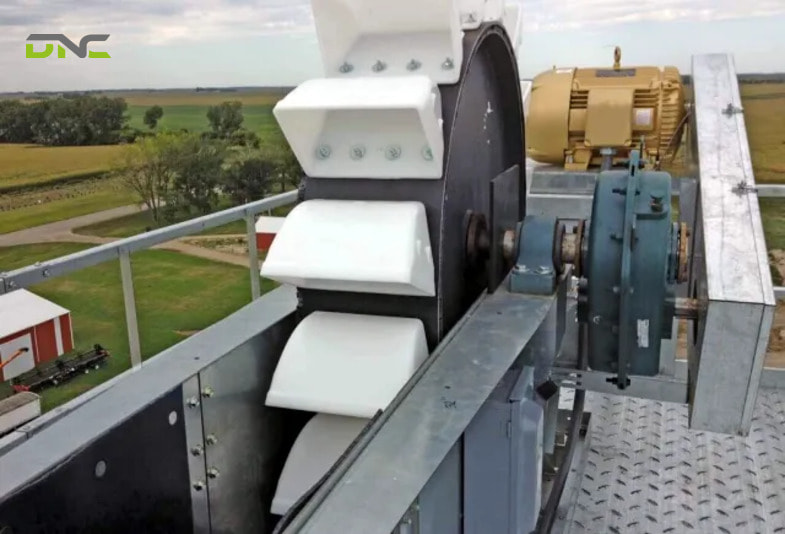
A bucket elevator consists of a continuous belt or chain — the “leg” — running inside an enclosed casing. Buckets are bolted to the belt or chain at regular intervals. The head (top) drive pulley or sprocket pulls the loaded buckets upward. At the head, material discharges into the outlet chute by centrifugal force or gravity. Empty buckets return down the return side of the casing to the boot (bottom), where they scoop or receive fresh material.
Key operating parameters:
- Belt/chain speed: 1.0–3.5 m/s (centrifugal); 0.4–1.5 m/s (continuous)
- Bucket spacing: 250–800 mm — closer spacing = higher capacity
- Lift height: Practical maximum 60–80 m for belt; up to 150 m for chain
- Boot design: Scooping boot (standard — buckets scoop from the material pool at bottom); feed boot (material fed by chute into passing buckets — for fragile or sticky materials)
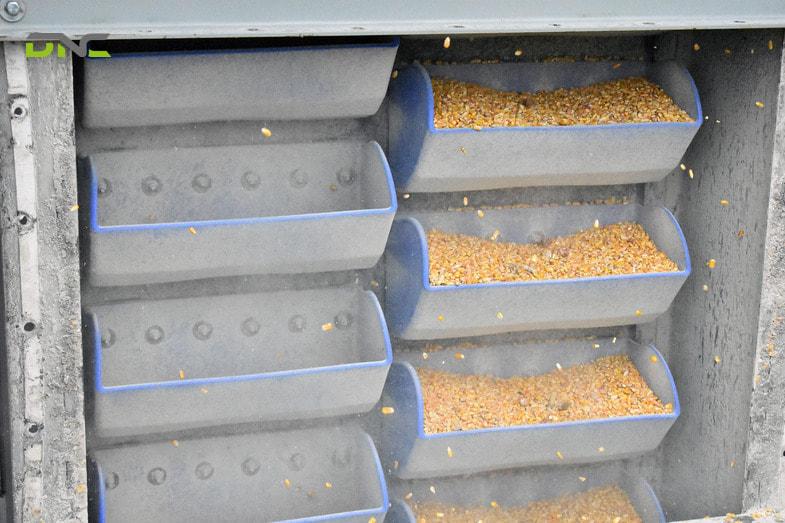
Key material properties that influence system design
Bucket Elevator Types
1. Centrifugal Discharge Bucket Elevator
The standard configuration for free-flowing granular materials. The belt or chain runs at high speed (1.5–3.5 m/s). As buckets pass over the head pulley, centrifugal force projects material outward into the discharge chute without the bucket fully inverting.
Bucket profile: Rounded back, deep cup — maximises centrifugal projection.
Best for: Grain (rice, wheat, maize, soybean), granular fertiliser, pellets, seeds, dried food ingredients.
Capacity: 20–500 tonnes/hour depending on bucket size, spacing, and speed.
Malaysian application: Grain terminals at Port Klang (Bernas, Tradewinds) use centrifugal belt bucket elevators rated 200–500 t/h to lift imported grain from ship unloaders to storage silos at 25–40 m height.
2. Continuous (Gravity) Discharge Bucket Elevator
Runs at lower speed (0.4–1.5 m/s). Buckets are closely spaced so that material discharging from one bucket falls into the back of the preceding bucket — guiding flow into the discharge chute instead of projecting it centrifugally. This inter-bucket guidance prevents material scattering and breakage.
Bucket profile: Flat-back, shallow cup — material slides along the preceding bucket’s back during discharge.
Best for: Dense, lumpy, fragile, or abrasive materials — clinker, limestone, phosphate rock, coke, foundry sand.
Capacity: 30–800 tonnes/hour. Higher capacity achievable for dense materials because larger closely-spaced buckets can be used at lower speed.
Malaysian application: Cement plants at Ipoh and Kanthan use continuous chain bucket elevators to lift hot clinker (120–180°C) from kiln conveyors to clinker silos at 40–60 m height. Chain is mandatory — temperature exceeds belt’s 130°C limit.
3. Positive (Snub-Pulley) Discharge Elevator
A third pulley or sprocket installed below the head creates a “snub” that fully inverts each bucket at discharge — ensuring 100% material release for sticky or cohesive materials that would not self-discharge by centrifugal or gravity means.
Best for: Moist, sticky, or cohesive materials — wet minerals, sticky feed ingredients, wet biomass, moist palm kernel.
Malaysian application: Palm oil mills use positive-discharge elevators for wet kernel transport between depericarping and kernel silo, where 12–15% kernel moisture makes reliable discharge from standard buckets unreliable.
4. High-Capacity / Supercapacity Elevator
Designed for very high throughput at large bulk terminals. Belt speeds up to 4.5 m/s, bucket volumes up to 50 litres, capacity up to 1,000 t/h in a single leg.
Malaysian application: Johor Port Bulk Terminal uses high-capacity belt bucket elevators for grain unloading at 1,000–2,000 t/h throughput (imported maize and soybean from South America and USA).
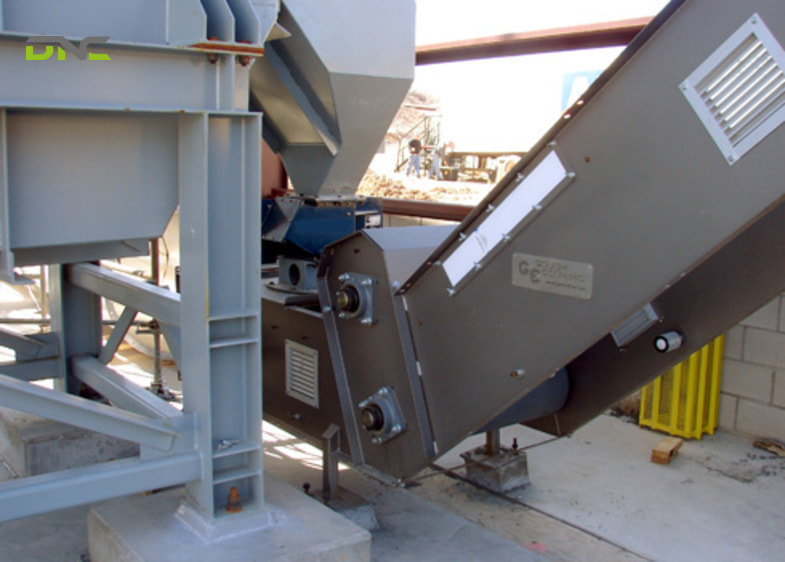
A bucket elevator conveyor consists of several integrated components working together as a system
Belt vs. Chain Bucket Elevator: Selection Guide
The single most important design choice after elevator type is whether to use belt or chain as the bucket-carrying element:
| Selection Criterion | Belt Elevator | Chain Elevator |
| Max operating temperature | 130°C continuous | 250°C continuous; 350°C peak |
| Material abrasiveness | Low–medium | Medium–high |
| Particle size | Fine–medium (<50 mm) | Medium–large (up to 200 mm) |
| Typical materials | Grain, seeds, pellets, powder | Clinker, limestone, coke, ore |
| Operating speed | 1.5–4.5 m/s | 0.5–1.5 m/s |
| Noise level | Lower (belt absorbs vibration) | Higher (chain link engagement) |
| Initial cost | Lower | 20–40% higher |
| Life in abrasive service | 2–5 years | 5–15 years |
Decision rules:
- Temperature >130°C → chain (no exception)
- Particle size >75 mm → chain
- Material corrosive to steel (acids, chlorides) → belt with chemical-resistant buckets
- Free-flowing grain/pellets at ambient temperature → belt (lower cost, quieter, faster)
- Sticky material requiring positive discharge → chain with snub pulley
Bucket Elevator Capacity Calculation
Volumetric Throughput
Q (m³/h) = (V × v × 3,600) / s
Where:
- V = bucket volume in m³ (convert litres ÷ 1,000)
- v = belt/chain speed in m/s
- s = bucket spacing in m
Example: 10-litre buckets, 500 mm spacing, 2.0 m/s belt speed:
Q = (0.010 × 2.0 × 3,600) / 0.5 = 144 m³/h
Mass Throughput
T (t/h) = Q × bulk density (t/m³) × fill factor
Fill factor: 0.75 for centrifugal; 0.85 for continuous (controlled loading = better fill).
Example: 144 m³/h × 0.76 t/m³ (rice) × 0.75 = 82 t/h
Drive Power
P (kW) = (T × H × 9.81) / (3,600 × η)
Where H = lift height in metres; η = drive efficiency (0.90–0.94).
Example: 82 t/h = 82,000 kg/h, H = 30 m:
P = (82,000 × 30 × 9.81) / (3,600 × 0.92) = 72.7 kW
→ Select 75 kW motor + 15% service factor = specify 90 kW installed.
Add 15–25% to theoretical power for: start-up acceleration, belt flexing resistance, and friction losses in the boot and casing.
Key Components
Buckets
Mild steel (Q235/Q345): Standard for industrial materials — clinker, limestone, minerals.
AR400 wear-resistant steel: For highly abrasive materials — quartz, silica sand, iron ore fines.
Malleable iron: Higher abrasion resistance than mild steel — cement, lime, phosphate.
HDPE/nylon: Food-grade applications — grain, salt, sugar, food ingredients. No metal contamination; lighter (reduces belt tension load).
Always match bucket profile to discharge method — centrifugal buckets (rounded back) and continuous buckets (flat back) are not interchangeable.
Belt
Multi-ply EP rubber belt: 4–8 plies of polyester/nylon fabric, rubber covers. EP400 to EP1000 depending on lift height. Splice: mechanically fastened for bucket attachment; vulcanised splice at belt join — never metal clips at splice.
Steel cord belt: For tall elevators (>40 m) where accumulated belt weight exceeds fabric belt tension limits.
Chain
Roller chain: Standard for lower loads and moderate temperatures.
Forged/cast chain: Heavy-duty, high-temperature applications — cement and clinker elevators. Forged Redler-type chain for continuous duty at 200–300°C.
Casing
Standard mild steel: 3–6 mm plate, bolted 1.5–3 m sections for field assembly. Internal dust seals at head and boot.
Dust-tight design: Sealed joints with neoprene gaskets; slightly negative pressure inside casing (extraction fan at head) prevents dust emission for cement, flour, mineral powders — required for DOSH dust exposure compliance in Malaysia.
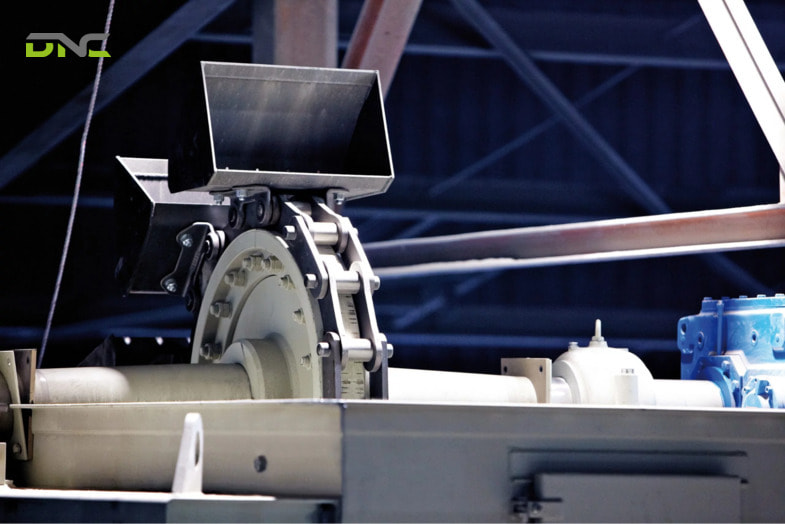
The operation follows a continuous and controlled process
Failure Modes and Prevention
Belt Slip on Head Pulley
Cause: Insufficient belt tension; worn head pulley lagging; belt contaminated with oil or material.
Symptoms: Slipping noise; throughput drop; belt overheating at contact zone.
Prevention: Maintain correct tension via take-up weight; replace lagging at 50% wear; clean spillage from boot.
Chain Jump
Cause: Chain elongation causing incorrect pitch engagement with sprocket teeth; worn sprocket profile.
Symptoms: Clunking at head; vibration in casing; risk of chain derailment.
Prevention: Monthly chain elongation measurement — replace at 2% elongation; replace sprockets at 25% tooth wear.
Boot Plugging
Cause: Feed rate exceeds capacity; wet or sticky material accumulating at boot; foreign material blockage.
Symptoms: Drive motor overload trip; material backing up in feed chute.
Prevention: Boot level sensor with auto feed cutoff; overload torque protection on drive; cleanout access door.
Bucket Cracking / Loss
Cause: Fatigue at bolt holes from cyclic loading; impact from tramp metal or stones; corrosion.
Prevention: Monthly crack inspection at bolt holes; magnetic separator or inlet grate to remove tramp metal; replace at first crack detection.
Maintenance Schedule
| Interval | Tasks |
| Daily | Drive motor temperature + current check; listen for abnormal noise; check discharge pattern at head |
| Weekly | Belt tension/take-up position; boot spillage clearance; boot bearing temperature |
| Monthly | Chain elongation measurement; bucket crack inspection + wear measurement; bearing lubrication; boot/head seal check |
| Annual | Full bucket replacement assessment; belt/chain replacement; head/boot shaft bearing renewal; casing internal corrosion inspection; full drive overhaul |
Advantages of Bucket Elevator Conveyors
Malaysian Industry Applications
| Industry | Material | Elevator Type | Lift Height | Capacity |
| Grain terminals | Paddy, maize, soybean | Belt centrifugal | 25–45 m | 200–500 t/h |
| Cement | Hot clinker | Chain continuous | 40–65 m | 100–500 t/h |
| Palm oil | Wet palm kernel | Belt positive discharge | 15–30 m | 20–100 t/h |
| Animal feed | Pellets, mash | Belt centrifugal | 15–25 m | 30–150 t/h |
| Sugar | Raw cane sugar | Belt centrifugal | 15–30 m | 100–300 t/h |
| Fertiliser | Granular NPK | Belt centrifugal | 15–25 m | 50–200 t/h |
| Flour milling | Wheat grain | Belt centrifugal | 20–35 m | 50–150 t/h |
DNC Automation’s Bucket Elevator Systems
DNC Automation supplies and integrates bucket elevator conveyor systems for Malaysian bulk material handling — mechanical design, structural support, drive sizing, PLC integration (Siemens S7-1500), and commissioning.
Capabilities: Belt and chain elevators for grain, feed, and food (food-grade HDPE buckets, dust-tight casing); chain elevators for cement, clinker, and high-temperature materials; elevator-to-silo integration with level sensors and SCADA throughput monitoring; MIDA SAG documentation for qualifying capital investments.
Contact DNC Automation for capacity calculations, belt vs. chain selection, and turnkey bucket elevator proposals.
Summary
Bucket elevators achieve vertical bulk material elevation with the lowest floor space requirement of any conveying technology. Belt elevators are lower cost, faster, and quieter for ambient-temperature free-flowing materials; chain elevators handle temperatures above 130°C, coarse particles, and abrasive loads that would destroy belt systems. Capacity is sized by bucket volume, spacing, and speed — with drive power calculated from throughput × lift height. Correct belt/chain selection, boot level protection, and monthly elongation monitoring are the primary factors governing service life and reliability.
- 247 views
- 0 Comment
Recent Comments