



Aluminium Profile Conveyor Systems: Modular Design for Automated Production Lines
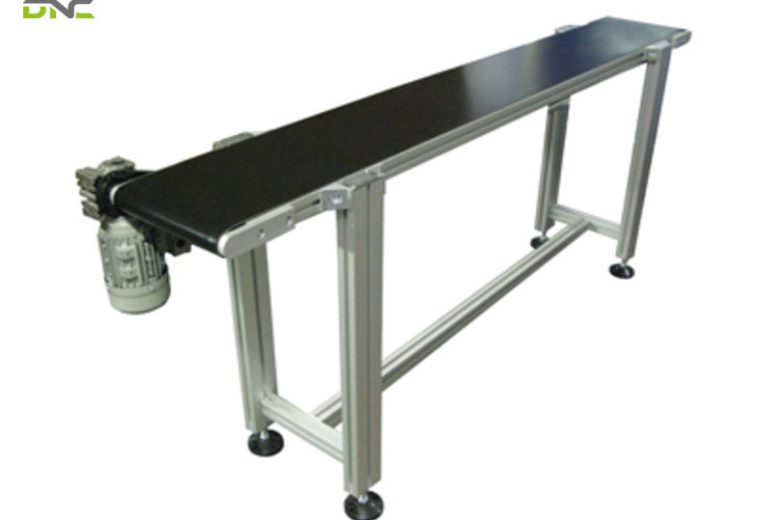
Walk onto any Penang EMS factory floor — Benchmark, ESCATEC, Flex, or QDOS — and the material handling infrastructure has a consistent visual signature: silver-anodized aluminium profile frames supporting belt conveyors at ergonomic working height, with T-slot channels running the full length of each frame section, populated with sensor mounts, cable management clips, light curtain brackets, and adjustable side rails. The aluminium profile conveyor is not merely a conveyor frame material choice — it is the manufacturing infrastructure standard that enables Malaysian electronics factories to change PCB formats in hours rather than days, add automation modules without structural modification, and maintain the dimensional accuracy that precision electronics assembly demands.
Aluminium profile conveyors beat welded steel in every dimension that matters to modern Malaysian manufacturing: dimensional stability without heat distortion from welding, rapid reconfiguration without metalworking, corrosion resistance in tropical humidity, and ESD-safe grounding capability for electronics environments. This guide covers all 6 aluminium profile conveyor types used in Malaysian manufacturing, standard profile dimensions, key advantages over welded steel, and the specific Penang EMS applications where DNC Automation has delivered aluminium profile conveyor systems for Malaysia’s most demanding electronics manufacturers.
What Is an Aluminium Profile Conveyor?
An aluminium profile conveyor is a conveyor system built on a structural frame made from extruded aluminium T-slot profiles — standardized aluminium extrusion shapes with longitudinal T-slot channels that accept T-slot nuts and bolt-together accessories without drilling or welding. The T-slot profile system, standardized at 45×45 mm (the most common global standard, compatible with 1,500+ catalog accessories), creates a universal building block for conveyor frames, workstations, robot cells, and assembly lines that can be assembled, modified, and extended using only standard hand tools. An aluminium profile conveyor frame is not just a frame — it is a configurable infrastructure platform that carries the conveyor belt drive system, motor, sensors, side guides, work surfaces, overhead tool rails, cable management, safety guarding, and operator interface components, all mounted using T-slot accessories that add without drilling holes in the profile. The eliminating of welding is the critical difference: welded steel frames distort under heat during fabrication, requiring post-weld straightening and machining to achieve dimensional accuracy, while aluminium T-slot frames assembled from precision-extruded profiles maintain ±0.5 mm dimensional accuracy across 6-meter assembly lengths — adequate for even semiconductor packaging and optical inspection conveyor applications.
How Does an Aluminium Profile Conveyor Work?
Aluminium profile conveyors function on the same belt or roller drive principles as any conveyor, but the T-slot frame system determines how they are assembled, extended, and modified across their operational life.
Step 1: Profile Selection and Frame Design
Aluminium profile conveyor frame design begins with profile cross-section selection based on load requirement and conveyor width. Standard profiles for conveyor applications: 40×40 mm (light duty, belt widths to 200 mm, loads to 15 kg/m), 45×45 mm (standard duty, belt widths to 400 mm, loads to 30 kg/m), 40×80 mm (medium duty, belt widths to 600 mm, loads to 50 kg/m), 80×80 mm (heavy duty, belt widths to 800 mm, loads to 75 kg/m). Global standard brands integrated by DNC Automation include Item (Germany), Bosch Rexroth (MiniTec), FlexLink (Sweden), and mk Technology Group (Germany). Profile compatibility is standardized at the 8 mm T-slot width (Item 8 standard) — accessories from any manufacturer conforming to this standard are interchangeable, giving Malaysian factories purchasing flexibility without frame incompatibility.
Step 2: Bolt-Together Assembly Without Welding
Frame cross-members, legs, bracing, and brackets connect to the aluminium profiles using T-slot nuts inserted into the profile channels before or after assembly. T-slot nuts slide to any position along the profile length, allowing accessory mounting at any point without drilling. Connection brackets (90° L-brackets, 3-way angle connectors, and gusset plates) bolt through the T-slot to the profile web, creating rigid structural joints that achieve 90% of the strength of welded steel joints without heat distortion. For longer conveyor sections — 3 m to 6 m per module — internal connector plugs align adjacent profile ends with ±0.1 mm precision, maintaining straight belt path alignment across module joints.
Step 3: Belt or Roller Installation
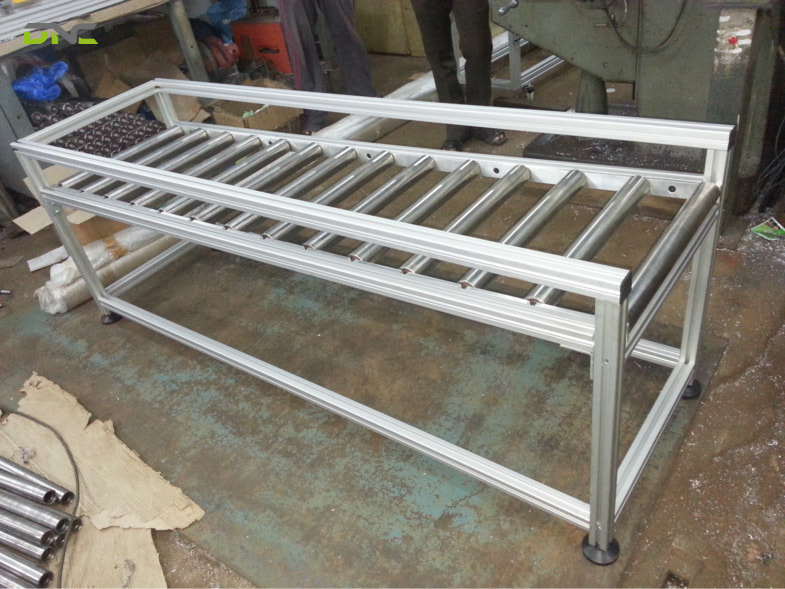
Belt conveyors on aluminium profile frames use the same flat belt, modular belt, or roller transport media as any other conveyor construction. The aluminium frame provides precisely machined belt drive shaft mounting points (from standard pillow block bearings bolted into T-slots) that maintain shaft parallelism and belt alignment. Motor and gearbox mounting uses L-bracket or swing base accessories that enable belt tension adjustment by pivoting the drive motor without loosening frame bolts. Roller conveyors on aluminium frames use roller mounting brackets that insert into T-slots on both sides of the frame, maintaining roller squareness to ±0.5° and supporting roller loads to 100 kg per roller.
Step 4: Sensor and Accessory Integration
T-slot channels on aluminium profile conveyor frames accept sensor mounting brackets that position photoelectric sensors, inductive proximity sensors, RFID readers, and vision camera mounts at any position along the conveyor without drilling. Cable management clips, conduit holders, and drag chain mounting brackets clip into T-slots, routing power and signal cables inside the conveyor frame profile to protect them from mechanical damage and maintain the clean external appearance expected in Malaysian electronics manufacturing environments. Side guide rails — adjustable to match product width — mount in T-slots and slide to any position along the frame for rapid product changeover.
Step 5: PLC and Motion Control Integration
Aluminium profile conveyor motor drives — Siemens SINAMICS G110M or G120 VFDs — mount in compact IP54-rated control panels bolted to the conveyor frame using T-slot angle brackets, integrating motor speed control within the conveyor structure without separate control cabinet floor space. Siemens S7-1200 or S7-1500 PLC modules connect to conveyor zone drives, sensors, and stoppers via PROFINET or IO-Link, providing zone-by-zone speed control and product tracking across multi-section aluminium profile conveyor lines. DNC Automation programs all aluminium profile conveyor PLC logic using pre-validated function blocks in Siemens TIA Portal, with HMI screens on Siemens SIMATIC touchpanels providing operators with real-time conveyor status, zone control, and fault diagnostics.
Types of Aluminium Profile Conveyor
Six primary aluminium profile conveyor types serve Malaysian manufacturing applications from precision electronics assembly to robot integration cells.
1. Belt Conveyor on Aluminium Profile Frame
Belt conveyors on aluminium T-slot frames are the most common aluminium profile conveyor type in Malaysian manufacturing — a flat PVC, PU, or modular belt drive on a bolt-together aluminium frame that replaces welded steel for all applications where load requirements allow aluminium construction (up to 50 kg/m distributed load). Standard belt widths: 50 mm to 600 mm (standard catalogue modules), custom to 800 mm. Module lengths: 500 mm to 6,000 mm per section. Standard belt speed: 0.1–1.5 m/s with Siemens VFD control. Aluminium profile belt conveyors are specified wherever dimensional accuracy, clean appearance, rapid reconfiguration, or ESD-safe grounding is required — which describes the majority of Malaysian electronics, pharmaceutical, and precision manufacturing applications. DNC Automation manufactures aluminium profile belt conveyors at its 25,000 sq ft Selangor facility to project-specific configurations, with standard module designs available from stock for rapid delivery.
2. Roller Conveyor on Aluminium Profile Frame
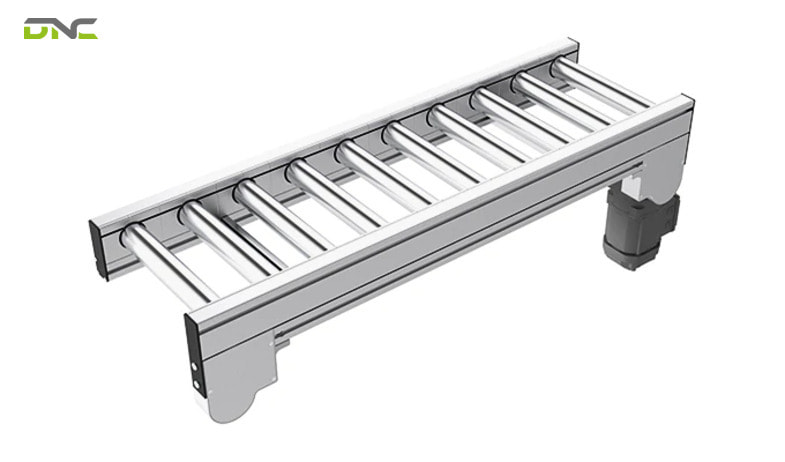
Roller conveyors on aluminium profile frames transport heavier products — cartons, trays, fixtures, and pallets weighing 10–100 kg — on free-spinning or driven roller arrays mounted in aluminium frames. Roller mounting in T-slot frames eliminates the frame drilling required for conventional roller conveyor construction, allowing roller pitch adjustment (50 mm to 200 mm) to be set or changed to match different product footprint requirements by repositioning roller brackets in the T-slots without tools beyond a socket wrench. Aluminium profile roller conveyors at electronics workstations provide gravity-flow accumulation for product trays between process steps — a cost-effective, zero-power transport solution for short station-to-station distances.
3. Assembly Workstation Conveyor
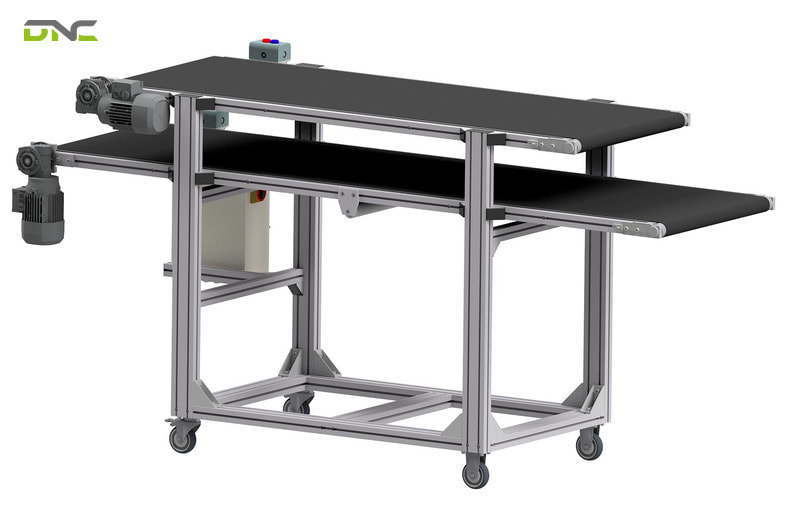
Assembly workstation conveyors combine an aluminium profile belt conveyor with integrated work surfaces, tool rail overhead structures, cable management, and adjustable-height legs — all assembled from the same T-slot profile system as the conveyor frame. The integrated workstation approach — where the conveyor, work surface, and overhead infrastructure form a single T-slot assembly — enables operator ergonomic height adjustment (680–1,050 mm work surface height) without modifying the conveyor belt path, and allows additional accessories (monitor arms, tool holders, component bins, light bars) to be added at any time by inserting T-slot accessories. Malaysian electronics manufacturers and automotive component assemblers use integrated assembly workstation conveyors as the standard cell infrastructure for manual assembly operations, with the aluminium T-slot system enabling cell layout changes within a single work shift.
4. Lean Manufacturing Line Conveyor (Toyota Production System)
Lean manufacturing line conveyors implement the one-piece-flow production philosophy of the Toyota Production System on aluminium profile infrastructure — each operator works on a single product for their designated task as the conveyor advances at a takt-time-synchronized rate. Aluminium profile lean line conveyors feature adjustable belt speed (takt time control via VFD), andon light systems mounted in T-slots above each station, operator call buttons on T-slot mounted brackets, and inventory supermarket shelving on the back side of the same T-slot frame that holds the conveyor. Toyota — a DNC Automation client — uses lean line aluminium profile conveyors as the assembly line infrastructure for its Selangor automotive manufacturing operations, where rapid cell reconfiguration enables production mix changes between vehicle model variants within a single shift.
5. Robot Integration Cell Conveyor
Robot integration cell conveyors combine an aluminium profile belt or roller conveyor with robot mounting structures, safety guarding panels, vision system brackets, and operator safety light curtains — all integrated on the same T-slot frame system. DNC Automation designs robot integration cells where the Comau (Italy — DNC’s exclusive SEA partner) or KUKA robot arm mounts directly to a heavy aluminium profile gantry structure that also carries the conveyor, creating a rigid, pre-aligned, pre-wired robot cell that ships as a complete unit and commissions without on-site fabrication work. Cell dimensions are pre-engineered to position the robot’s working radius relative to the conveyor product stop position, ensuring reach and interference-free operation. Malaysian automotive and electronics manufacturers deploy DNC Automation robot integration cells for welding, dispensing, pick-and-place, and vision inspection operations where the combined robot-conveyor cell performance is guaranteed as a system.
6. Cleanroom Conveyor on Aluminium Profile Frame
Cleanroom conveyors use anodized aluminium profile frames (which shed no particles unlike painted steel), stainless steel fittings (no exposed mild steel fasteners that could generate iron oxide particles), flat belt surfaces without exposed mechanical joints, and fully enclosed motor enclosures (IP65 minimum) that prevent bearing particle emission. Aluminium T-slot profile conveyors for ISO 7 (Class 10,000) and ISO 6 (Class 1,000) cleanrooms are specified with: smooth anodized frame surfaces that wipe clean without particle trapping in surface texture, NSF H1 certified belt lubricants (for food-equivalent particle emission control), ULPA-filtered motor housings (for sub-100 nm particle environments), and ESD-safe static dissipative belt materials (for semiconductor applications where electrostatic discharge damages product).
Aluminium Profile Conveyor Type Comparison Table
| Type | Belt Width | Load Capacity | Speed | Application | ESD Safe |
| Belt on Al Profile | 50–600 mm | Up to 50 kg/m | 0.1–1.5 m/s | Electronics, packaging, F&B | Yes (grounded frame) |
| Roller on Al Profile | 200–800 mm | Up to 100 kg/m | Gravity–0.5 m/s | Heavier products, workstation | Yes |
| Assembly Workstation | 100–400 mm | Up to 30 kg/m | 0.05–0.3 m/s | Manual assembly, lean lines | Yes |
| Lean Line | 200–600 mm | Up to 50 kg/m | Takt-time VFD | Automotive, electronics assembly | Yes |
| Robot Integration Cell | Custom | System-dependent | 0.1–1.0 m/s | Welding, dispensing, P&P | Yes |
| Cleanroom | 100–400 mm | Up to 20 kg/m | 0.1–0.5 m/s | Semiconductor, pharma, optics | Mandatory |
Key Components of an Aluminium Profile Conveyor System
An aluminium profile conveyor system’s total performance is determined by the precision and specification of its constituent components — from the profile extrusion tolerances through the drive and control integration.
Aluminium Profile Extrusion. Precision-extruded 6063-T5 or 6060-T5 aluminium alloy profiles provide yield strength of 215 MPa and elongation of 8%, sufficient for all standard conveyor structural loads. Dimensional tolerances: ±0.3 mm on external profile dimensions per ISO 755 — maintaining straight conveyor paths without shimming over 6-meter module lengths. Anodizing layer thickness: 15–25 μm (Type II), providing 350–500 HV surface hardness and corrosion protection.
T-Slot Accessories — Nuts, Bolts, and Brackets. M8 T-slot nuts (spring-loaded or hammer-head) accept M8 socket head cap screws at any position along the T-slot, providing clamping force to 8 kN per fastener. Standard connection bracket materials: die-cast zinc (light duty), cast aluminium (medium duty), stamped steel (heavy duty). Bracket selection follows load charts provided in the Item or Bosch Rexroth catalog, matching fastener type and bracket size to the joint load.
Belt and Drive System. Flat PVC or PU belts for smooth-surface applications; modular PP or POM belts for food and washdown applications. Drive pulley diameters: 30–80 mm for aluminium profile belt widths. Motor power: 0.09 kW to 0.55 kW for standard widths and loads. Siemens SINAMICS G110M distributed VFD mounts directly on the motor for IP65 protection and Profibus/IO-Link connectivity to the conveyor PLC.
Legs and Height Adjustment. Telescoping aluminium profile leg sets adjust from 680 mm to 1,050 mm work surface height in 10 mm increments — set by loosening a clamping collar, extending to the required height, and re-tightening. Locking leveling feet provide 30 mm height fine-adjustment and ±5° floor tilt compensation for uneven factory floors. Castor wheels (lockable) are available for mobile conveyor configurations — common in Malaysian EMS factories where equipment is repositioned between customer orders.
Applications: Where Aluminium Profile Conveyors Are Used in Malaysian Manufacturing
Aluminium profile conveyors serve Malaysian manufacturing sectors where dimensional accuracy, clean appearance, rapid reconfiguration, and ESD safety are production-critical requirements.
Penang Electronics Manufacturing — SMT and Assembly
Penang’s EMS sector — responsible for 58% of Malaysia’s E&E exports and serving global brands including Intel, AMD, HP, and Flex — has adopted aluminium profile conveyors as the de facto standard for post-SMT assembly, testing, and packaging lines. SMT post-process conveyors handle PCBs from 100 mm × 80 mm (small format) to 610 mm × 559 mm (maximum SMEMA standard panel) at belt speeds coordinated with reflow oven exit rates. ESD-safe static dissipative belt surfaces and frame grounding straps prevent electrostatic discharge to sensitive board components worth RM 50–5,000 per board. SMEMA-standard conveyor-to-machine communication (discrete signal handshaking) is pre-programmed in DNC Automation’s Siemens PLC function blocks, enabling plug-and-play connectivity to SMT line equipment from any manufacturer. Penang EMS factories change PCB product formats every 2–4 weeks — aluminium profile conveyor side rail repositioning for different board widths takes under 20 minutes per conveyor section, versus 4–6 hours for equivalent side rail changes on welded steel frame conveyors.
Selangor Automotive Component Assembly
Toyota and Selangor automotive component manufacturers use aluminium profile lean line conveyors for door panel assembly, instrument cluster assembly, and electrical harness assembly operations where takt-time-controlled belt speed, ergonomic workstation height, and andon system integration are required. The aluminium T-slot frame carries the belt conveyor and the andon light tower, the overhead part supply rail, and the operator torque tool balancer arm from a single integrated structure — reducing the number of separate structural elements in each assembly cell and enabling rapid cell layout changes between production model variants.
Johor Logistics and Cross-Docking
Johor’s logistics sector — serving port operations at Johor Bahru and cross-docking facilities supporting Singapore trade — uses aluminium profile roller conveyors for parcel sorting, labeling, and staging operations where product variety is extreme and conveyor sections must be repositioned regularly. Aluminium profile roller conveyor sections on castor wheels create mobile sorting lanes that can be repositioned within hours to match daily parcel volume distribution, a flexibility requirement that fixed welded steel conveyor installations cannot meet without complete reinstallation.
Pharmaceutical and Medical Device — Selangor
Hartalega and pharmaceutical manufacturers in Selangor use cleanroom aluminium profile conveyors for glove, tablet, and medical device packaging in ISO 7 and ISO 8 cleanroom environments. Aluminium profile conveyors satisfy pharmaceutical facility cleanroom qualification requirements — IQ (installation qualification), OQ (operational qualification), and PQ (performance qualification) — more readily than welded steel frame alternatives because their dimensional accuracy, surface finish, and material composition are certified to tight specifications by the profile manufacturer, reducing IQ documentation burden.
Benefits of Aluminium Profile Conveyors for Malaysian Factory Operations
Aluminium profile conveyors deliver six categories of measurable benefits that justify their specification over welded steel alternatives for Malaysian manufacturing applications.
No welding — no heat distortion. Welded steel conveyor frames distort during manufacture, requiring post-weld straightening, grinding, and re-machining to achieve acceptable dimensional accuracy. Aluminium T-slot frames assembled from precision-extruded profiles maintain ±0.5 mm dimensional accuracy across 6-meter lengths without any post-assembly correction — critical for PCB conveyor alignment in SMT lines and for robot integration cell tool center point (TCP) positioning accuracy.
Reconfiguration speed. Aluminium profile conveyor sections reconfigure in hours — adding a 500 mm extension, repositioning side rails for a new product format, or repositioning a sensor bracket takes 20–60 minutes with hand tools. Equivalent modifications to welded steel conveyors require metalworking trades, hot work permits, and shutdown times of 2–8 hours. For Malaysian EMS factories with bi-weekly product changeovers, this difference represents 40–60 hours of production time saved annually per conveyor line.
Corrosion resistance in Malaysian tropical climate. Anodized aluminium profile requires no painting, no galvanizing, and no anti-rust maintenance in Malaysian tropical humidity environments. Anodized aluminium maintains its appearance and structural properties for 15+ years at 95% RH — the service life of the conveyor system itself. Painted steel frames in equivalent environments require repainting every 3–5 years, with rust formation under paint bubbles creating contamination risk in electronics and food environments.
ESD safety for electronics manufacturing. Aluminium T-slot frames provide inherent electrical conductivity — connecting a single earth bonding wire from the frame to the factory electrical earth grounds the entire conveyor system, providing ESD protection for the full length of the conveyor. This simplicity of ESD earthing is a significant advantage over painted or powder-coated steel frames, where the coating must be carefully cut away at each earth bonding point to achieve metal-to-metal contact.
NIMP 2030 smart factory alignment. NIMP 2030’s flexible manufacturing requirements — accommodating multiple product variants on a single production line — are most efficiently met with aluminium profile conveyor infrastructure. The T-slot system’s ability to add sensors, cameras, robot interfaces, and automation modules without frame modification makes aluminium profile conveyors the preferred infrastructure for the progressive automation that NIMP 2030 mandates. DNC Automation has supported Malaysian factories in securing SAG Grant funding (RM 1 million, 70:30 MIDA matching) for aluminium profile conveyor-based automation investments.
Cost saving of 50% through reduced labor. DNC Automation’s documented client data shows a 50% reduction in manufacturing labor cost for lines where manual transport has been replaced with aluminium profile belt conveyor automation. At a Malaysian average operator salary of RM 2,500/month, replacing 4 material handlers with a single aluminium profile conveyor system saves RM 120,000/year in direct labor cost alone — delivering full conveyor ROI within 12–24 months.
How to Choose the Right Aluminium Profile Conveyor for Your Factory
Selecting the correct aluminium profile conveyor system for a Malaysian manufacturing application involves four engineering decisions that determine system performance, cost, and reconfigurability.
Profile size selection. Match profile size to the maximum load per meter of conveyor. Light duty (loads to 15 kg/m, belt widths to 200 mm): 40×40 mm profile. Standard duty (loads to 30 kg/m, belt widths to 400 mm): 45×45 mm profile. Medium duty (loads to 50 kg/m, belt widths to 600 mm): 40×80 mm profile. Heavy duty (loads to 75 kg/m, belt widths to 800 mm): 80×80 mm profile. Under-specifying profile size causes frame deflection that misaligns the belt drive and creates premature belt edge wear.
Profile brand compatibility. Specify a single profile standard throughout the facility to ensure full accessory interoperability. DNC Automation recommends the Item 8 (45×45 mm, 8 mm T-slot) standard for Malaysian electronics manufacturing — the broadest accessor catalog, most competitive pricing from multiple Malaysian distributors, and compatibility with accessories from Bosch Rexroth, Minitec, mk Technology, and FlexLink. Mixing T-slot standards (6 mm, 8 mm, 10 mm) within a facility creates stocking and compatibility problems that increase maintenance cost over the conveyor’s operational life.
ESD and cleanroom requirements. Standard anodized aluminium profiles are ESD-safe when grounded and satisfy ISO Class 7 cleanroom requirements. For ISO Class 6 and cleaner environments, specify profiles with additional sealing of internal T-slot channels to prevent particle accumulation, and specify drives with ULPA-filtered housing or remote motor mounting outside the cleanroom.
PLC integration and connectivity. Specify Siemens SINAMICS G110M distributed VFDs (IP65 rated, PROFINET connected) for aluminium profile conveyor motor drives in multi-zone systems where central control cabinet space is limited. Distributed VFDs mounted at each conveyor zone eliminate long motor cable runs and centralize zone intelligence at the zone level, simplifying PLC program structure. Consult DNC Automation’s engineering team for a complete aluminium profile conveyor specification matched to your Malaysian factory’s production requirements — Get a Free Consultation today.
Frequently Asked Questions About Aluminium Profile Conveyors
Why do Penang EMS factories use aluminium profile conveyors instead of steel frame conveyors?
Penang EMS factories specify aluminium profile conveyors for four primary reasons: ESD safety (aluminium grounds easily to protect sensitive electronics), dimensional accuracy (no welding distortion affects PCB alignment), rapid reconfiguration (bi-weekly product format changes require side rail adjustment in minutes, not hours), and cleanroom compatibility (anodized surfaces shed no particles, satisfying cleanroom particle count requirements). Welded steel frame conveyors fail on all four criteria — they are harder to ground uniformly, distort during welding, require metalworking to reconfigure, and generate iron oxide particles from rust.
What is the T-slot standard and are different brands compatible?
The T-slot standard defines the cross-sectional geometry of the slot channel in the aluminium profile — specifically the slot width and depth that determine which T-slot nuts and accessories fit. The most common global standard is the “8 mm slot” (Item 8), used by Item Germany, mk Technology, and Minitec. Bosch Rexroth uses a compatible 8 mm slot standard. FlexLink uses a proprietary system. DNC Automation recommends specifying Item 8 standard throughout Malaysian facilities to ensure full cross-brand accessory compatibility and the broadest available accessory catalog.
How heavy can products be for an aluminium profile conveyor?
Standard 45×45 mm aluminium profile belt conveyors handle distributed loads up to 30 kg/m — sufficient for PCBs, pharmaceutical packaging, and light automotive components. 80×80 mm heavy profile systems handle up to 75 kg/m — sufficient for automotive sub-assemblies and heavier machined components. For products above 75 kg/m distributed load, DNC Automation specifies carbon steel frame roller conveyors with aluminium profile workstation accessories, combining the load capacity of steel with the reconfigurability of T-slot accessories at workstation height.
Does DNC Automation supply aluminium profile conveyors to Penang manufacturers?
DNC Automation has a dedicated Penang engineering team that supplies, installs, and commissions aluminium profile conveyor systems for Penang EMS manufacturers, including SMEMA-compliant PCB conveyors, ESD-safe assembly cell transport, and robot integration cells with Siemens PLC and TIA Portal programming. DNC’s Penang engineers provide local support with response times of 2–4 hours for production-critical faults — eliminating the week-long response delays from foreign conveyor OEMs that are common in Penang’s fast-paced electronics manufacturing environment.
Can aluminium profile conveyors be used outdoors in Malaysia?
Standard anodized aluminium profile conveyors tolerate outdoor Malaysian environments (35°C, 95% RH, direct sunlight) without frame corrosion for 10+ years. UV radiation causes aluminium anodizing to fade cosmetically but does not affect structural performance. Belt materials for outdoor applications: PU (UV-stable) or modular PP (UV-stabilized grades). Drive enclosures for outdoor use: IP66 minimum. DNC Automation specifies outdoor aluminium profile conveyors for loading dock transfer applications and covered outdoor logistics operations at Malaysian distribution centers.
What is the lead time for a custom aluminium profile conveyor from DNC Automation?
Standard aluminium profile belt conveyors (width to 300 mm, length to 3 m, standard motor and drive): available from DNC Automation’s Selangor facility stock in 1–2 weeks. Custom configurations (special widths, lengths, belt materials, multi-zone PLC control, robot integration): 4–10 weeks design and manufacturing lead time at DNC’s 25,000 sq ft production facility. Complex multi-cell systems (5+ conveyor sections with integrated robot cells, vision systems, and full Siemens TIA Portal programming): 10–20 weeks. Talk to Our Engineers for a specific lead time quotation based on your project requirements.
Conclusion
Aluminium profile conveyors are the infrastructure standard for Malaysian electronics and precision manufacturing — and for good reason. No welding means no heat distortion and ±0.5 mm dimensional accuracy. T-slot construction means sensor mounts, side rails, and robot brackets add in minutes without drilling. Anodized aluminium resists Malaysian tropical humidity for the full conveyor service life. ESD grounding protects every board that travels down the line. DNC Automation has delivered aluminium profile conveyor systems to Penang’s EMS sector, Selangor’s automotive assembly lines, and Malaysia’s pharmaceutical facilities — with Siemens PLC automation, Comau robot integration, and 24/7 local support. Get a Free Consultation with DNC Automation’s engineers to design the aluminium profile conveyor system that matches your production requirements, timeline, and NIMP 2030 automation roadmap. Explore our related guide on [PLC Conveyor Systems](/blog/plc-conveyor) for the complete Siemens control integration perspective.
- 19 views
- 0 Comment
Recent Comments