



Conveyor Line: Design, Layout Types, Integration, and Turnkey Systems for Malaysian Factories
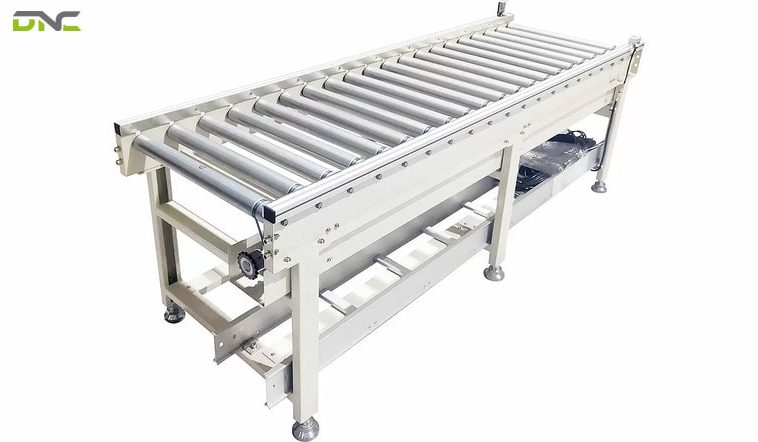
A conveyor line is an integrated system of multiple conveyor sections, transfer units, sensors, drives, and controls that connects production, assembly, inspection, packaging, and dispatch operations into a continuous, controlled product flow. Unlike a single conveyor (point-to-point product transfer), a conveyor line links every stage of a production process — coordinating speeds, accumulation, routing, and throughput across tens or hundreds of metres of interconnected conveying equipment.
Malaysian manufacturers implementing Industry 4.0 under NIMP 2030 are investing in conveyor lines that replace manual inter-station product movement with automated, controlled flow — reducing labour, eliminating quality variation from inconsistent manual handling, and providing the real-time throughput data that MES and SCADA systems require for production management.
What Separates a Conveyor Line from Individual Conveyors
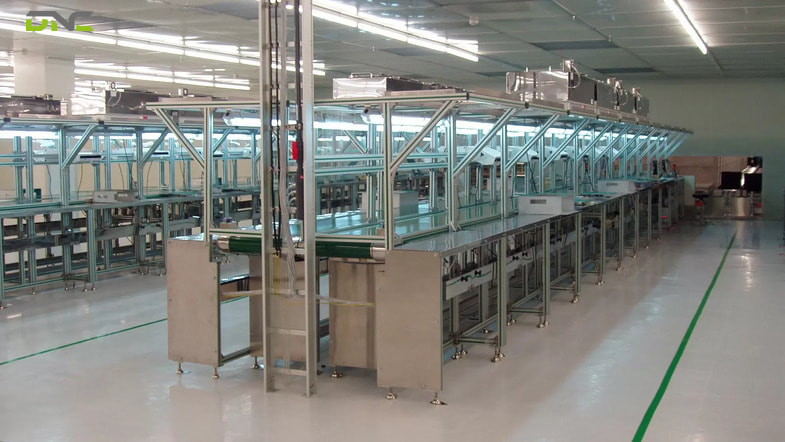
A single conveyor moves product from Point A to Point B. A conveyor line coordinates multiple conveyors, each performing a specific function, into a system where:
Speed matching: Each conveyor section runs at a speed matched to the upstream and downstream process — preventing product accumulation (upstream too fast) or product starvation (upstream too slow).
Accumulation buffering: Buffer zones between process stages absorb speed variations — if the packager runs at 80 cartons/minute and the filler occasionally pauses, a buffer accumulation zone holds cartons waiting for the packager to restart, preventing the filler from stopping.
Routing and sorting: Switch conveyors, pushers, pop-up transfers, or shoe sorters route products to multiple destinations — multiple lines, rejection stations, or different packaging formats.
Traceability: Each product’s position on the line is tracked by the PLC — barcode or RFID readers at key points link product identity to its journey through the line.
PLC-coordinated control: All conveyor drives (VFDs, MDR zone controllers, servo drives) are coordinated by a central PLC — startup sequences, emergency stops, speed changes, and fault responses are managed system-wide, not machine-by-machine.
What Separates a Conveyor Line from Individual Conveyors
Conveyor Line Layout Types
Straight Line (Linear Layout)
Products flow in a single straight direction — infeed at one end, outfeed at the other. Every station is on the same axis.
Advantages: Simplest material flow, easiest supervision (one operator can watch the full line), easiest to extend (add stations at either end).
Limitations: Long floor footprint — a 10-station line at 2 m per station = 20 m minimum. May not fit in square factory layouts.
Best for: Packaging lines (filling → weighing → sealing → labelling → casing → palletising), single-product high-volume production.
Malaysian application: F&N beverage canning lines (filler → rinser → seamer → pasteuriser → dryer → labeller → packer) are typically straight-line layouts in dedicated buildings.
L-Shaped Layout
The line turns 90° at one point — connecting two perpendicular production sections. A transfer unit (belt transfer, pop-up roller, or 90° curve belt) at the corner changes product direction.
Advantages: Fits into corner or L-shaped floor space; supervisor can see both legs of the line from the corner position; allows two separate production processes to feed a common outfeed.
Malaysian application: Electronics box-build lines in Penang where PCB assembly (long axis) feeds into final assembly (perpendicular axis) through an L-shaped transfer — fitting into factory buildings with 2:1 aspect ratio floor plans.
U-Shaped (Horseshoe) Layout
The line enters and exits from the same end — operators at the base of the U can manage both infeed and outfeed. Popular for lean manufacturing cells where one operator manages the full production cycle.
Advantages: Infeed and outfeed at same end (same logistics access point); shorter walking distance for material replenishment; one operator covers start and end.
Malaysian application: Assembly lines for consumer electronics sub-assemblies — where a single multi-skilled operator loads components at infeed and removes finished assemblies at outfeed, both accessible from the same work position.
Circular (Closed-Loop) Layout
The conveyor runs in a closed loop — product carriers (pallets or fixtures) circulate continuously. At each workstation, product is loaded, processed, and released back to the loop. Unused fixtures accumulate in the buffer section between stations.
Key advantage: No return conveyor needed — the loop itself returns empty fixtures.
Applications: Multi-station assembly with variable cycle times between stations — automotive sub-assembly (alternator winding, instrument cluster assembly), medical device assembly.
Malaysian application: Hartalega’s glove dipping line is fundamentally a closed-loop overhead conveyor — dipping formers circulate through coagulant, latex, leaching, and stripping stations continuously.
Parallel Lines
Multiple identical lines running in parallel — either for redundancy (if one line fails, production continues on the other) or for capacity (each line is one capacity unit; add lines to scale throughput).
Malaysian context: High-volume consumer goods manufacturers (Nestlé, Mondelēz) typically run 3–8 parallel packaging lines fed from a common production floor — allowing individual line maintenance without stopping total output.
Conveyor Type Selection by Production Stage
Different stages of a production or packaging line have specific conveyor requirements:
| Stage | Typical Conveyor Type | Key Requirement |
| Infeed / raw material supply | CDLR (pallets), drag chain (bulk), bucket elevator (vertical) | Heavy load, reliable supply |
| Primary processing infeed | Flat belt, timing belt, modular belt | Product stability, cleanability |
| Assembly stations | Timing belt or pallet indexer | Positioning accuracy |
| Weighing | Flat belt or roller on weigh platform | No vibration transfer |
| Inspection (vision/metal detector) | Non-metallic flat belt | Zero vibration during inspection |
| Packaging (filling/sealing) | Timing belt or servo-driven | Precise positioning |
| Accumulation (buffer) | MDR roller ZPA, flat belt | Zero pressure accumulation |
| Labelling | Flat belt | Constant speed, no slippage |
| Sorting / routing | Belt sorter, shoe sorter, pop-up transfer | Throughput, gentle handling |
| Outfeed / palletising infeed | CDLR, flat belt | High throughput, pallet handling |
──────────────────────────────────────────────────
Conveyor Line Control Architecture
PLC Layer (Siemens S7-1500)
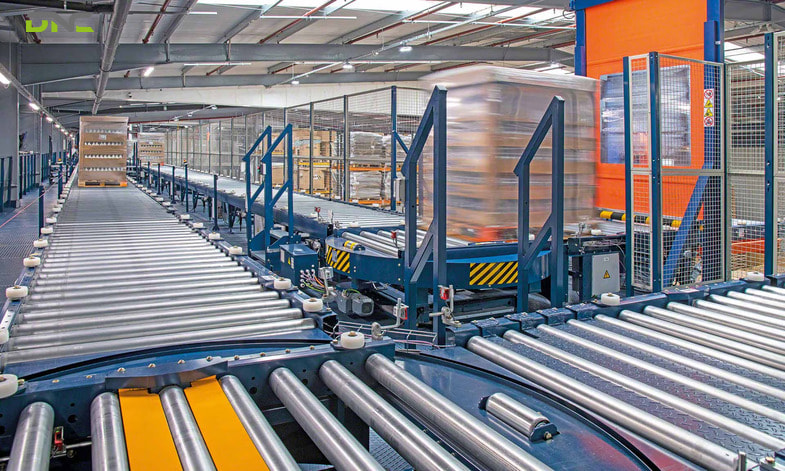
The central Siemens S7-1500 PLC runs the entire line control logic:
- Motor start/stop sequencing (downstream before upstream on start; upstream before downstream on stop)
- Speed setpoints to VFDs via PROFINET
- Accumulation zone logic (zone sensors → zone motor commands)
- Fault response: which conveyors stop when a fault occurs upstream or downstream
- Interlock management: metal detector reject → upstream conveyor stop → hold product
PROFINET network: All VFDs (Siemens SINAMICS G120), MDR zone controllers, and I/O modules communicate on PROFINET — enabling remote parameter setting, fault diagnostics, and real-time status monitoring from PLC.
SCADA Layer (Siemens WinCC)
WinCC SCADA provides:
- Real-time conveyor line visualisation (animated mimic showing product flow)
- Throughput counters per station (actual vs. target)
- Accumulated downtime per zone (availability tracking for OEE calculation)
- Alarm history (conveyor faults, sensor failures, overload events)
- Production batch recording (batch start/stop, total output, quality events)
MES Integration (OPC-UA)
OPC-UA interface from S7-1500 connects WinCC data to the factory MES (SAP ME, Siemens Opcenter, or customer-developed MES) — providing real-time production data for production scheduling, OEE monitoring, and traceability.
Conveyor Line ROI Calculation
For Malaysian manufacturers evaluating conveyor line investment:
Labour saving: A 10-station manual assembly line with 2 inter-station material handlers per station = 20 material handlers. Automated conveyor line: 2 operators (monitoring and maintenance). Saving: 18 FTE × RM 2,200/month = RM 39,600/month = RM 475,200/year.
Throughput increase: Manual lines typically achieve 70–80% of theoretical throughput due to variation in manual movement speed. Automated conveyor lines achieve 90–95% availability with controlled cycle time. For a 100 units/hour line: 80% vs. 92% efficiency = 12 extra units/hour × 16 hours/day × 250 days = 48,000 extra units/year.
Quality improvement: Consistent product positioning on automated conveyors reduces assembly defect rate by 30–50% (typical) by ensuring tools contact products at designed coordinates. Defect reduction saves rework cost and material waste.
MIDA SAG grant impact: Capital investment in conveyor line automation qualifies for MIDA’s Strategic Automation Grant — up to RM 1 million or 50% of qualifying capital expenditure. A RM 600,000 conveyor line system becomes RM 300,000 effective cost after grant — compressing payback from 18 months to 9 months.
Conveyor Line Control Architecture
DNC Automation’s Conveyor Line Delivery Process
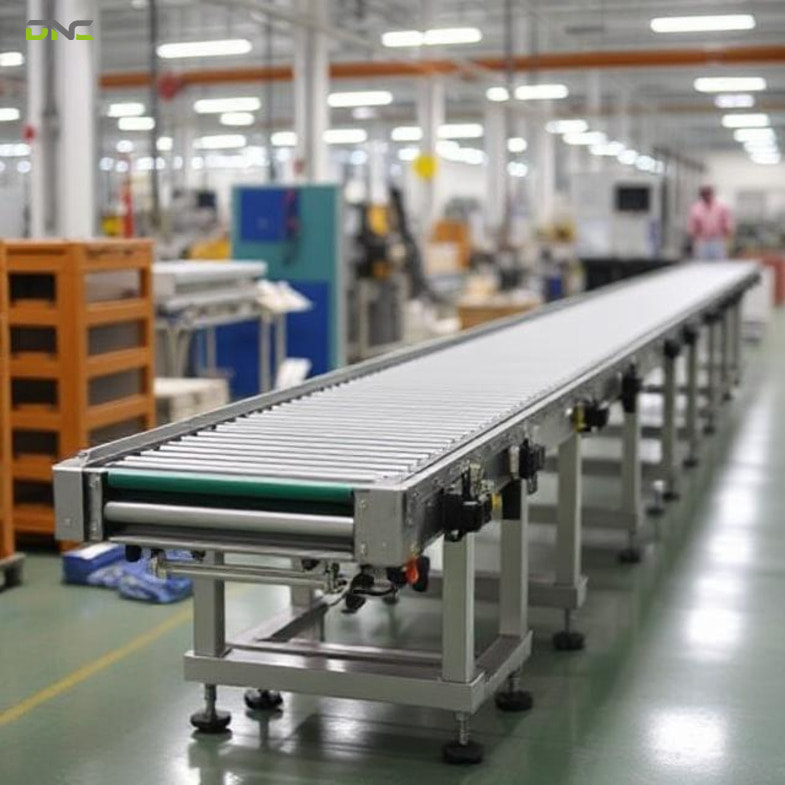
DNC Automation delivers complete turnkey conveyor line systems for Malaysian manufacturers through a seven-phase process:
Phase 1 — Requirements: Product dimensions, weight, throughput target, process sequence, floor layout, regulatory requirements (food grade, cleanroom, DOSH).
Phase 2 — Concept design: Layout type selection, conveyor type per station, accumulation zone sizing, product flow simulation (Arena or DNC in-house tools).
Phase 3 — Engineering: Mechanical design (CAD 3D), electrical design (panel schematics, I/O list), PLC program design (function block diagram, Siemens TIA Portal).
Phase 4 — Fabrication: Steel frame and conveyor fabrication in DNC’s Shah Alam workshop; electrical panel fabrication; PLC programming and panel testing.
Phase 5 — FAT (Factory Acceptance Test): Full system assembled at DNC workshop; PLC program verified against test cases; throughput simulation with product mock-ups; customer witness test.
Phase 6 — Installation: Site installation by DNC’s 35-engineer field team; cable and instrument connections; field PLC commissioning.
Phase 7 — SAT (Site Acceptance Test) and handover: Full production run testing with customer product; OEE measurement vs. design target; operator and maintenance training; documentation handover (mechanical drawings, electrical schematics, PLC program backup, spare parts list).
Post-commissioning support: Preventive maintenance contracts, 24-hour emergency response, annual recalibration, and control system upgrade services.
DNC Automation’s Conveyor Line Delivery Process
Malaysian Industry Applications
Electronics Assembly Lines (Penang, Selangor)
DNC Automation has delivered conveyor lines for PCB assembly, box-build, and test operations at electronics manufacturers in Penang and Selangor — integrating timing belt PCB transport, MDR accumulation, robotic pick-and-place, vision inspection, and automated test stations into coordinated Siemens PLC-controlled lines.
Key metrics achieved: 92–95% line availability; throughput increase 18–35% over previous manual lines; defect rate reduction 25–40%.
Pharmaceutical Packaging Lines
Tablet, capsule, and blister pack packaging lines for pharmaceutical manufacturers in Selangor — integrating stainless belt infeed, tablet counting, blister packing, cartoning, and batch coding in a single SCADA-monitored line with full 21 CFR Part 11 audit trail.
Food Processing Lines
HACCP-compliant conveyor lines for Malaysian food manufacturers — SS316 modular belt production conveyors, flat belt weighing and packaging infeed, metal detector integration with automatic rejection, labelling, and palletiser infeed — with SCADA throughput and quality monitoring.
Automotive Sub-Assembly
Multi-station assembly conveyor lines for Tier-1 suppliers — pallet indexing conveyors with lift-locate stations, robot integration (Comau and Fanuc), torque-controlled assembly tools, and functional test stations integrated with Toyota Production System takt time requirements.
Summary
A conveyor line is not a collection of individual conveyors — it is an integrated system where layout, conveyor selection by stage, speed matching, accumulation buffering, routing, and PLC-coordinated control combine to deliver consistent throughput, controlled product flow, and real-time production visibility. For Malaysian manufacturers, conveyor line investment under MIDA SAG delivers measurable ROI through labour reduction, throughput increase, and quality improvement — with payback periods of 12–24 months for properly designed and executed systems.
- 6 views
- 0 Comment
Recent Comments