


Airport Baggage Conveyor Belt | DNC Automation Malaysia
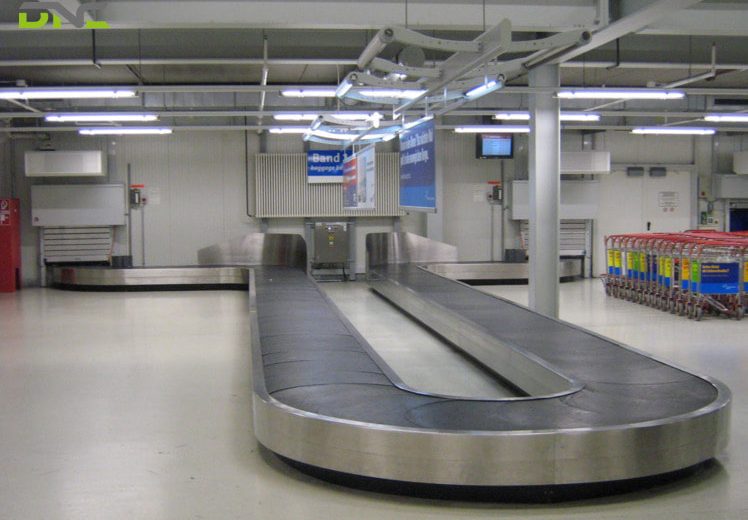
Airport baggage conveyor belt systems are the operational backbone of every major airport — moving thousands of bags per hour through check-in, security screening, sortation, and claim with zero tolerance for downtime. In Malaysia’s aviation sector, where KLIA alone handles over 48 million passengers annually, a single conveyor failure can cascade into passenger delays, missed connections, and measurable revenue loss. For airport engineers and operations managers, selecting and integrating the right baggage conveyor system determines not just throughput, but the entire passenger experience.
This guide covers how airport baggage conveyor belt systems work, the types deployed across Malaysian airports, the technical specifications that determine performance, and what sets a reliable Baggage Handling System (BHS) apart from one that creates chronic maintenance headaches.
What Is an Airport Baggage Conveyor Belt?
An airport baggage conveyor belt is a purpose-engineered conveyor system designed to transport checked luggage from passenger check-in counters through security screening, automated sortation, and ultimately to the correct aircraft loading bay — or back to the baggage claim area for arriving passengers. Unlike standard industrial conveyors, airport baggage conveyor belts operate continuously, 24 hours a day, 365 days a year, under strict IATA (International Air Transport Association) performance standards.
The complete system is more accurately called a Baggage Handling System (BHS) — a network of interconnected conveyor types, each performing a defined function within the airport’s operational flow. The airport baggage conveyor belt is the primary transport mechanism within this network, connecting every processing point from the check-in counter to the aircraft hold.
Key distinctions from standard industrial conveyors:
- Continuous 24/7 operation — maintenance must occur without full-system shutdowns
- IATA RP 1740e compliance — standardized performance metrics for misrouting rate (<0.01%), jam rate, and availability (>99.5%)
- RFID/barcode integration — every bag carries an IATA 10-digit Baggage Tag, scanned at multiple read points for tracking
- Variable load handling — bags range from 2 kg carry-on to 50 kg+ oversized luggage on the same belt
How an Airport Baggage Conveyor Belt System Works
Step 1: Check-In Conveyor (Bag Induction)
The airport baggage conveyor belt journey begins at the check-in counter. When a passenger places their bag on the check-in conveyor, a flat belt moves it beneath a weigh scale — measuring and recording weight in real time — before transporting it into the secure baggage makeup area. At this point, the bag’s IATA barcode tag is scanned by an overhead tunnel scanner, linking the physical bag to the passenger’s booking record in the Departure Control System (DCS).
Check-in conveyor specifications:
- Belt width: 600–800 mm (standard suitcase width clearance)
- Speed: 0.3–0.5 m/s (controlled for weight measurement accuracy)
- Drive: motorized drum belt conveyor with integrated load cell
Step 2: Security Screening Conveyor
From check-in, the airport baggage conveyor belt transfers each bag through automated security screening — typically an EDS (Explosive Detection System) or CTX machine. The screening conveyor must match the throughput of the security equipment while maintaining precise positioning for scan accuracy.
Security conveyor requirements:
- Stop-and-go capability (PLC-controlled indexing for CTX scan positions)
- Smooth transfer belts to prevent bag tipping
- Automatic diversion of flagged bags to manual inspection lane
- Integration with security screening software via BHS middleware
Step 3: Sortation Conveyor
After security clearance, the bag enters the sortation system — the most technically complex component of a BHS. Sortation conveyors route each bag by reading its barcode/RFID tag and directing it to the correct makeup bay for the departing flight.
Primary sortation technologies:
- Tilt Tray Sorter — individual trays tilt to divert bags at high speed (up to 2.0 m/s); handles up to 3,600 bags/hour per lane
- Crossbelt Sorter — small embedded belts on carriers redirect bags laterally; gentler on fragile items
- Pop-up Wheel/Roller Diverter — lower-cost option for smaller airports; redirects bags at 90° to side lanes
Step 4: Transfer Conveyor (Makeup to Aircraft)
Sorted bags travel via transfer conveyor to the makeup area, where ground handlers load them onto Unit Load Devices (ULDs) or baggage carts for transport to the aircraft. For inter-terminal transfers, long-run horizontal conveyor sections or Destination Coded Vehicles (DCVs) handle the distance.
Step 5: Reclaim Conveyor (Baggage Claim Carousel)
For arriving flights, the airport baggage conveyor belt runs in reverse function — transferring bags from the aircraft hold through the arrivals baggage hall to the reclaim carousel. The carousel is a closed-loop inclined conveyor that presents bags continuously to waiting passengers at a comfortable retrieval height (typically 900–1,000 mm from floor level).
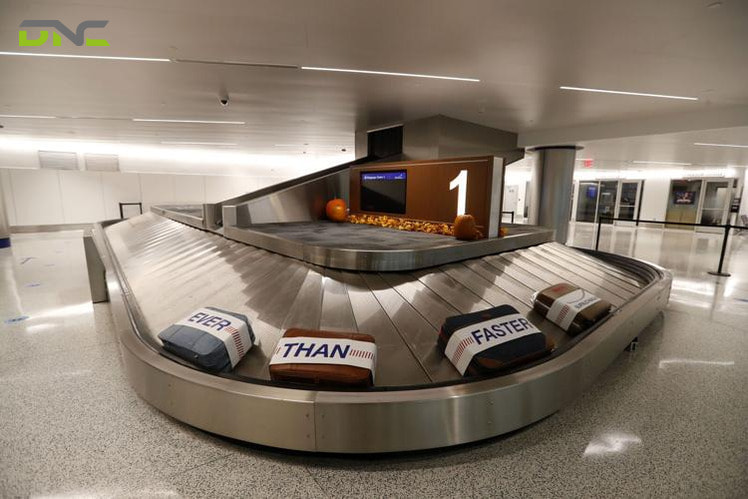
The application of automation solutions for baggage conveyor belts brings many significant benefits
Types of Airport Baggage Conveyor Belt Systems
1. Flat Belt Check-In Conveyor
The most common airport conveyor type — a straight-run flat belt that moves bags from the check-in counter into the baggage handling area. Available in single-tier (standard) and dual-tier configurations for airports with high check-in density.
Specifications:
- Belt width: 600–1,000 mm
- Belt speed: 0.3–0.6 m/s
- Load capacity: 50 kg per bag maximum
- Belt material: rubber or PVC (high-grip surface to prevent bag sliding)
- Length: 3–15 m per counter section
2. Security Screening Integration Conveyor
Short, precision-controlled conveyor sections linking check-in conveyors to EDS machines. These airport baggage conveyor belt segments must synchronize perfectly with screening machine throughput — typically 400–600 bags/hour per lane.
Key feature: Automatic stop-and-go indexing via PLC, ensuring each bag is fully within the scanner aperture before advancing.
3. High-Speed Sortation Conveyor
The intelligent core of any BHS. High-speed sortation conveyors classify and route bags based on real-time flight data, with RFID/barcode confirmation at every decision point.
Tilt Tray specifications:
- Throughput: up to 3,600 trays/hour
- Carrier speed: 1.5–2.5 m/s
- Tilt angle: 25–35° for positive bag diversion
- Read rate: 98%+ first-pass RFID read (IATA RP 1755)
Crossbelt sorter specifications:
- Throughput: up to 4,000 items/hour
- Belt speed: 1.5–2.0 m/s
- Suitable for: irregular shaped bags, fragile items, oversized luggage
4. Claim Carousel (Baggage Reclaim Belt)
The baggage claim carousel uses an inclined airport baggage conveyor belt to present arriving luggage to passengers. The incline (typically 15°–20°) feeds bags from the arrivals-side conveyor to the carousel surface at the correct presentation height.
Specifications:
- Width: 800–1,000 mm belt width
- Loop length: 15–50 m per carousel
- Speed: 0.3–0.5 m/s (matching passenger retrieval pace)
- Load: up to 500 kg distributed load on carousel at any time
- Frame: stainless steel or powder-coated carbon steel
5. Transfer and Connecting Conveyors
Horizontal run conveyors linking major processing zones within the BHS. In large airports like KLIA, transfer conveyor runs can extend over 1 km within the baggage basement level. These airport baggage conveyor belt sections use heavy-duty belt conveyors with distributed drive units to manage long distances without belt stretch.
Key Components of an Airport Baggage Conveyor Belt System
- Drive Unit (Motorized Drum or Gearmotor)
The motorized drum is the dominant drive solution for airport baggage conveyor belt systems — the motor is integrated inside the head pulley, eliminating external gearboxes and reducing maintenance access requirements. Power range: 0.37–7.5 kW per drive unit, depending on load and speed.
- PLC Control System
Every airport baggage conveyor belt section operates under PLC control — start/stop commands, speed regulation, jam detection, and safety interlock management. Siemens SIMATIC S7 PLCs are the industry standard for large BHS deployments, providing the deterministic response times required for high-speed sortation. DNC Automation is an authorized Siemens partner, enabling certified PLC design and commissioning for baggage handling applications.
- Variable Frequency Drive (VFD)
VFDs control motor speed on airport baggage conveyor belt sections — enabling soft-start (reducing mechanical shock on startup), variable speed (adjusting to flight peak loads), and energy savings during low-traffic periods. A properly configured VFD on a conveyor drive motor reduces energy consumption by 20–30% compared to direct-on-line starters.
- RFID and Barcode Scanner Array
IATA Standard RP 1755 requires baggage tracking at check-in, security, sortation, makeup, and loading. Each tracking point uses a combination of barcode tunnel scanners (for IATA 10-digit tags) and RFID readers (for IATA resolution 753 RF tags). Read rate targets: >98% first-pass for barcode; >99.5% for RFID.
- Safety and Jam Detection Sensors
Airport baggage conveyor belt systems deploy photoelectric sensors, emergency stop pull cords, and pressure-sensitive safety edges at all pinch points and transfer points. Any jam or obstruction triggers an automatic zone stop within 200ms — the affected section stops while adjacent sections continue, preventing cascade failure.
- BHS Control Software (SCADA + BHS Middleware)
Above the PLC layer, a SCADA system provides operators with a real-time graphical view of the entire BHS — showing bag count per zone, conveyor status, jam locations, and system throughput metrics. BHS middleware interfaces with the airport’s Departure Control System (DCS) to receive live flight data and update sortation rules in real time.

What are the precautions when using baggage conveyor belt?
Applications: Airport Baggage Conveyor Belt in Malaysian Aviation
KLIA and klia2 — Malaysia’s Primary Aviation Hub
Kuala Lumpur International Airport (KLIA) and klia2 together form Southeast Asia’s third-busiest airport complex by passenger traffic. The BHS at KLIA Terminal 1 handles peak flows of over 3,000 bags/hour during morning and evening bank periods, requiring high-speed sortation conveyors with RFID tracking at every transfer point. klia2, serving AirAsia’s high-frequency short-haul network, operates a compact BHS designed for rapid turnaround baggage handling.
Malaysia Airports Holdings Berhad (MAHB) manages 39 airports across Malaysia — each representing a BHS maintenance and integration requirement.
Penang International Airport
Penang’s airport handles over 7 million passengers annually, with a BHS optimized for regional routes and cargo transfer. Penang’s E&E manufacturing context means a significant proportion of checked cargo includes electronic components — requiring gentle-handling conveyor specifications to avoid impact damage during transfer.
Senai International Airport (Johor Bahru)
Senai serves the growing Johor logistics corridor — increasingly strategic as Iskandar Malaysia attracts manufacturing and logistics investment from Singapore. BHS requirements here focus on cargo integration alongside passenger baggage handling.
Kota Kinabalu International Airport
As a gateway to Sabah’s tourism sector, Kota Kinabalu handles seasonal baggage volume spikes. BHS systems at regional airports like Kota Kinabalu require sufficient peak throughput capacity and reliable uptime during peak holiday periods — especially Chinese New Year and school holiday windows when volumes surge 40–60% above baseline.
POS Aviation — DNC Automation’s Client in Aviation Logistics
DNC Automation’s work with POS Aviation demonstrates direct experience in Malaysia’s aviation logistics sector. Aviation logistics demands the same core conveyor reliability as airport BHS — 24/7 uptime, accurate sortation, and PLC-SCADA integration for complete operational visibility. This operational experience positions DNC Automation to support airport baggage conveyor belt projects across Malaysia with proven aviation-sector competency.
Benefits of a Properly Integrated Airport Baggage Conveyor Belt System
- Passenger Experience — On-Time Bag Delivery
IATA data shows 7.6 bags per 1,000 passengers are mishandled globally. A properly designed airport baggage conveyor belt with RFID tracking reduces misrouting to below 0.01% — fewer delayed bags, fewer passenger complaints, and lower compensation costs for airlines.
- Throughput Capacity — Up to 3,600 Bags/Hour Per Lane
High-speed sortation conveyors handle peak bank periods without bottlenecks. For a 300-passenger widebody aircraft at a 45-minute turnaround, this means 270+ bags sorted, delivered, and loaded within the window — a target impossible to achieve with manual or semi-automated systems.
- Labor Cost Reduction — Up to 50% Savings
Manual baggage handling requires one handler per 60–80 bags/hour. An automated BHS with sortation conveyors processes 3,600 bags/hour per lane with minimal floor staff — reducing operational labor cost by up to 50% while increasing sortation accuracy. With Malaysia’s minimum wage at RM 1,700/month and ongoing labor shortages in the aviation ground handling sector, automation ROI compounds year over year.
- Error Reduction — Up to 80% Fewer Mishandled Bags
PLC-controlled sorting with RFID verification at multiple read points eliminates human routing errors. DNC Automation’s automation systems deliver up to 80% reduction in human error — directly applicable to baggage sortation, where a single misrouted bag costs airlines RM 800–1,200 in recovery costs.
- Predictive Maintenance — 70% Reduction in Unplanned Downtime
IoT sensors on airport baggage conveyor belt drives monitor motor temperature, belt tension, vibration, and current draw in real time. Anomalies trigger maintenance alerts before failure occurs — reducing unplanned downtime incidents by up to 70% and enabling scheduled maintenance during low-traffic windows.
- NIMP 2030 Alignment — Smart Airport Infrastructure
Malaysia’s NIMP 2030 programme targets 3,000 smart factories by 2030, with the smart infrastructure mandate extending to aviation logistics. Airport operators investing in SCADA-integrated baggage handling systems align with Malaysia’s national digitalization roadmap — and may qualify for MIDA’s Smart Automation Grant (SAG) of up to RM 1 million for qualifying automation investments.
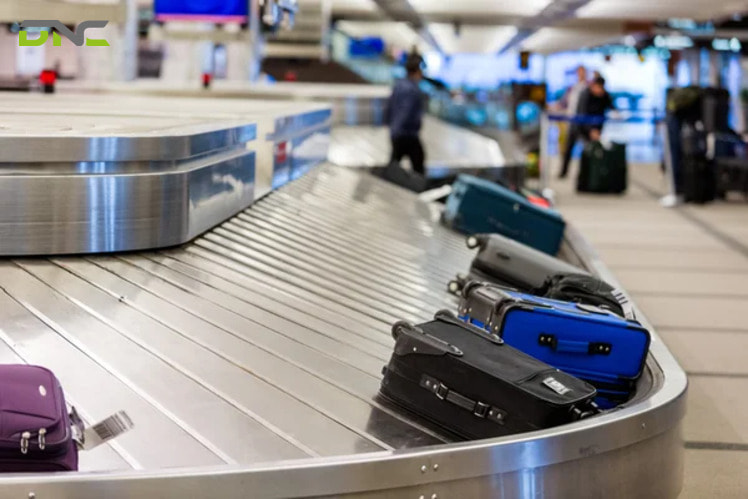
Application in airports
How to Choose the Right Airport Baggage Conveyor Belt System
- Peak Hourly Throughput
Calculate the maximum bags-per-hour for your peak bank period — typically the 60-minute window with the highest simultaneous departures. Size the BHS to handle this peak at 80% capacity, leaving 20% headroom for surges.
- Bag Size and Weight Profile
Standard BHS specifications assume 50 kg maximum per bag, 800 mm × 500 mm × 300 mm maximum dimensions. If your airport handles oversized items (surfboards, bicycles, golf bags), specify oversize lanes with 1,000 mm+ belt width and reinforced drive units.
- IATA Compliance Requirements
Any BHS serving IATA-member airlines must comply with IATA RP 1740e (BHS design), RP 1755 (RFID), and RP 1797 (baggage reconciliation). Specify these compliance requirements explicitly when tendering BHS projects.
- Integration with Existing Airport Systems
New airport baggage conveyor belt installations must interface with your DCS, check-in systems, and SCADA infrastructure. Specify open-protocol integration (OPC-UA, Modbus TCP, or MQTT) to avoid vendor lock-in and enable future expansion.
- Maintenance Access and Local Support
Choose BHS components with local Malaysia service capability. A conveyor drive failure at 2 AM requires same-day response — not a week-long international parts shipment. DNC Automation provides 24/7 local support across Malaysia, with in-house engineering for both planned maintenance and emergency callouts.
- Turnkey vs. Component Supply
For greenfield airport projects or major terminal upgrades, a turnkey BHS integrator — responsible for design, supply, installation, programming, and commissioning — delivers better outcomes than assembling components from multiple vendors. DNC Automation’s 35+ engineers, 25,000 sq ft production facility, and ISO 9001:2015 certification enable full end-to-end BHS project delivery.
FAQ — Airport Baggage Conveyor Belt
What belt material is used for airport baggage conveyor belts?
Airport baggage conveyor belt surfaces are typically rubber (for grip and durability on main transfer sections), PVC (for lighter-duty check-in sections), or modular plastic (for reclaim carousels). Belt selection is driven by load, speed, and the specific zone within the BHS. Reclaim carousels typically use thick rubber or PVC with reinforced fabric carcass to handle continuous load.
What is the standard speed of an airport baggage conveyor belt?
Check-in conveyors operate at 0.3–0.6 m/s for controlled bag induction and weight measurement. Transfer conveyors run at 0.8–1.5 m/s for efficient baggage basement transport. High-speed sortation systems (tilt tray, crossbelt) operate at 1.5–2.5 m/s. Claim carousels run at 0.3–0.5 m/s for comfortable passenger retrieval.
How long does an airport baggage conveyor belt system last?
With proper maintenance, an airport baggage conveyor belt system has a design life of 15–25 years for structural frames and major components. Belt surfaces require replacement every 2–5 years depending on throughput. PLC and control system upgrades are typically needed every 8–12 years to maintain software compatibility and spare parts availability.
What is the IATA standard for baggage handling system performance?
IATA RP 1740e defines BHS performance standards: system availability >99.5% (excluding planned maintenance), misrouting rate <0.01% of bags processed, and jam rate <0.1%. RFID tracking performance under IATA RP 1755 requires >99.5% read rate at all tracking points.
How does RFID improve airport baggage conveyor belt performance?
RFID baggage tags contain a chip and antenna that respond to scanner queries without line-of-sight — unlike barcodes requiring direct optical alignment. At conveyor speeds of 1.5+ m/s, RFID achieves >99.5% read rates versus 85–95% for barcode scanners. This eliminates no-read diversions that send unidentified bags to manual inspection, reducing sortation errors and improving overall throughput.
Can an airport baggage conveyor belt system integrate with existing airport software?
Yes. Modern BHS control systems use open communication protocols — OPC-UA, Modbus TCP, Ethernet/IP, or MQTT — to interface with airport DCS, SCADA, and warehouse management systems. DNC Automation designs PLC-SCADA systems with open-protocol architecture, enabling integration with existing airport infrastructure without proprietary lock-in.
How much does an airport baggage conveyor belt system cost in Malaysia?
BHS investment varies by airport size, throughput requirements, and sortation technology. Small regional airport systems start from RM 2–5 million. Full BHS for a major terminal can exceed RM 50 million. DNC Automation provides free pre-sales consultation and detailed engineering proposals — contact our team for a project-specific assessment.
What maintenance is required for an airport baggage conveyor belt?
Preventive maintenance schedules include: daily visual inspections and sensor checks; weekly belt tension measurement and alignment verification; monthly drive unit servicing (bearing lubrication, motor current checks); quarterly belt condition assessment; and annual full-system audit. DNC Automation’s IoT-enabled predictive maintenance captures anomaly data before failures occur, reducing reactive maintenance costs by up to 70%.
Conclusion
Airport baggage conveyor belt systems are precision-engineered logistics networks — not commodity conveyors. They determine airline on-time performance, passenger satisfaction scores, and airport operational costs simultaneously. For Malaysian airports managing growing passenger volumes under regional aviation competition, investing in the right BHS design, integration, and local support is a measurable business decision.
DNC Automation brings 20+ years of industrial automation expertise, Siemens-certified PLC engineering, and a 35-engineer in-house team to airport baggage conveyor belt projects across Malaysia. From Selangor to Sabah, our engineers deliver turnkey BHS integration with 24/7 local support — reducing operational risk and maximising system uptime from day one.
Ready to discuss your airport baggage conveyor belt project? Talk to Our Engineers today for a free pre-sales consultation.
- 878 views
- 0 Comment
Recent Comments