



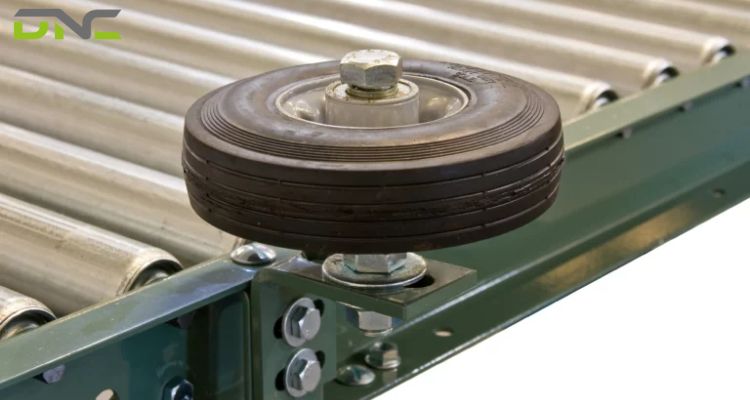
Every automated manufacturing line in Malaysia — from Toyota’s body welding cells in Shah Alam to PCB ICT test stations in Penang — depends on one fundamental mechanism that most factory managers take for granted until it fails: the conveyor stop. A conveyor stop is the precision positioning device that halts a product, pallet, or carrier at an exact location on the conveyor line so that a robot, sensor, operator, or automated tool can interact with it with repeatable accuracy. Mispositioned products cost Malaysian manufacturers millions of ringgit annually in scrapped assemblies, failed ICT tests, welding defects, and labeling errors. This guide covers all 6 primary conveyor stop types — pneumatic retractable stoppers, electric/servo stoppers, magnetic brake stoppers, swing gate stoppers, hard mechanical stops, and zero-pressure accumulation zones — with specifications, PLC integration sequences, and selection criteria refined through DNC Automation’s 20 years of Malaysian factory automation projects.
What Is a Conveyor Stop?
A conveyor stop is a mechanical, pneumatic, electric, or magnetic device mounted on or adjacent to a conveyor that intercepts a moving product and holds it at a defined position with repeatable positioning accuracy, typically ±0.5 mm for precision manufacturing and ±2–5 mm for general manufacturing applications. Conveyor stops range from simple fixed steel bars at end-of-line stations to servo-actuated precision positioners that arrest products at multiple programmable positions within a single conveyor zone. The defining characteristic of a conveyor stop — as distinguished from a simple end-barrier — is controlled release: the stop holds the product precisely until an external signal (from a PLC, sensor, or operator input) triggers its retraction or disengagement, releasing the product to proceed to the next station. Without conveyor stops, automated manufacturing is impossible — every robot, vision system, ICT tester, and dispensing machine requires products to be stopped at a defined, repeatable position before it can perform its function.
How Does a Conveyor Stop Work?
Conveyor stop operation follows a precise PLC-controlled sequence that integrates proximity sensors, pneumatic or electric actuators, and communication protocols to deliver accurate, reliable product positioning at production-rated cycle times.
Step 1: Product Detection
A proximity sensor — photoelectric (PNP, 24V DC), inductive, or capacitive depending on product material — detects the approaching product and sends a 24V DC signal to the Siemens SIMATIC S7 PLC that controls the conveyor zone. Detection occurs 100–300 mm before the stop position, giving the PLC processing time and the actuator time to confirm its extended/ready state before product arrival. Sensor selection is critical: photoelectric sensors work for all products; inductive sensors detect metal pallets only; capacitive sensors detect both metal and non-metal products. DNC Automation specifies Siemens SIRIUS or SICK sensor families for high-reliability applications, with IO-Link connectivity for diagnostic feedback integrated into the TIA Portal HMI.
Step 2: PLC Logic Execution
The Siemens PLC executes the conveyor stop control logic in the same scan cycle as the sensor signal — typically 1–10 ms scan time for S7-1200 and S7-1500 series. The ladder logic or structured text program checks: (a) is the stop pin in the extended (ready) position? (b) is the downstream station clear? (c) is the current station ready to receive? If all conditions are TRUE, the PLC confirms the stop is ready to catch the product. If the downstream station is occupied, the PLC holds the current stop extended, creating a queue. This logic is the basis of zero-pressure accumulation — a series of stop-and-hold zones that buffer products without product-on-product contact pressure.
Step 3: Product Arrest and Positioning
The product contacts the stop pin, paddle, or gate at controlled speed — conveyor belt speeds at stop zones are typically 0.1–0.3 m/s, reduced from the standard 0.5–2.0 m/s line speed to ensure gentle product arrest. Pneumatic stoppers generate 500 N of holding force, sufficient to arrest pallets weighing up to 150 kg at standard conveyor speeds without belt slip or product damage. The stop pin, once contacted, holds the product precisely against a fixed reference face, achieving the required positioning repeatability. For pallet-based systems, a secondary locating pin or V-groove locator engages simultaneously with the stop, constraining the product in both X and Y axes to ±0.5 mm.
Step 4: Work Station Process Execution
With the product stopped and positioned, the PLC signals the downstream device — robot, operator call, vision system, ICT tester, dispensing head, or label applicator — that the product is ready. The work station process executes: the robot welds, the ICT tester probes, the operator assembles, or the label applicator dispenses. Process complete signals return to the PLC via a digital output from the work station controller, operator pushbutton, or sensor confirmation. Process time ranges from 3 seconds (simple label application) to 300+ seconds (complex robotic welding operations), during which the conveyor stop holds the product motionless.
Step 5: Product Release and Line Flow
On process complete confirmation, the PLC de-energizes the pneumatic solenoid (or energizes the electric actuator) to retract the stop pin below the conveyor surface. The belt drive re-engages or the accumulation zone releases, and the product moves forward to the next station. Retraction time for standard pneumatic stoppers is under 0.5 seconds. The next product in queue — which has been held by the upstream stop in a zero-pressure accumulation buffer — is simultaneously released and begins moving to the now-cleared station. The entire cycle — detect, stop, process, release — repeats at the rated throughput of the manufacturing line, typically 1–5 parts per minute for precision assembly and 10–60 parts per minute for high-speed F&B packaging.

Types of Conveyor Stops
Six primary conveyor stop types cover the full range of Malaysian manufacturing applications, from high-speed food packaging lines to precision automotive body welding cells.
1. Retractable Pneumatic Stopper
Retractable pneumatic stoppers are the most common conveyor stop type in Malaysian manufacturing, combining low cost, high cycle life, fast response, and easy PLC integration into a compact unit suitable for most production environments. A pneumatic stopper uses a double-acting or spring-return air cylinder to raise and lower a hardened steel stop pin through a slot in the conveyor frame or between conveyor roller surfaces. Standard specifications: 500 N maximum holding force, IP65 environmental protection, 24V DC solenoid valve, ±0.5 mm positioning repeatability, 10 million cycle rated life. Pneumatic stoppers cycle in under 0.5 seconds, enabling line throughput rates to 120 products/minute with appropriate air supply (minimum 5 bar, 10 L/min per stopper). Air consumption is the primary operating cost — a single pneumatic stopper at 30 cycles/minute consumes approximately 0.3 m³/hour of compressed air. DNC Automation integrates pneumatic stoppers with Festo or SMC solenoid valve islands connected to the Siemens S7 PLC I/O modules, enabling centralized control and diagnostic feedback for all stoppers on the line from a single HMI screen.
2. Electric / Servo Stopper
Electric and servo-actuated conveyor stops replace pneumatic cylinders with brushless DC motors or servo drives, enabling programmable force, programmable position, and real-time force feedback during product arrest. Servo stoppers are specified where product fragility demands controlled arrest force — glass bottles, ceramic components, assembled electronics — or where multiple stop positions within a single zone are required. A servo stopper can be programmed to decelerate its stop pin at a controlled rate (soft arrest) rather than presenting a rigid stop face, reducing impact forces on delicate products by 60–80% compared to pneumatic stoppers. Siemens SINAMICS V90 servo drives integrated with the S7-1500 PLC enable servo stopper position control at ±0.05 mm repeatability — ten times more precise than standard pneumatic stoppers. Electric stoppers require no compressed air, eliminating air supply infrastructure costs and air consumption operating costs in factories where compressed air is expensive to generate and distribute. DNC Automation specifies servo stoppers for PCB assembly lines in Penang where component damage from rigid stop contact is not acceptable.
3. Magnetic Brake Stopper
Magnetic brake stoppers use eddy current braking or electromagnet clamping to decelerate and hold metal pallets without physical contact, eliminating wear on both the stop mechanism and the pallet. Eddy current brakes generate a braking force proportional to pallet speed — the faster the pallet moves, the stronger the braking force — providing smooth, progressive deceleration without impact. Electromagnet clamp stoppers energize a powerful electromagnet beneath the conveyor surface that attracts and holds the steel pallet base plate at the stop position. Magnetic stoppers are specified for heavy steel pallets (50–500 kg) used in automotive body panel and engine component assembly lines where the pallet mass and speed make pneumatic stop contact forces excessive. Holding force for electromagnet stoppers ranges from 1,000 N to 10,000 N, determined by the electromagnet coil size and excitation current. DNC Automation integrates magnetic brake stoppers on automotive conveyor systems at DNC client Toyota’s Selangor facility, where body-in-white pallet positioning for robotic welding requires zero-impact arrest to prevent frame distortion.
4. Swing Gate Stopper
Swing gate stoppers use a pivoting arm or paddle that gently sweeps into the product path on a controlled arc, making first contact with the side of the product rather than its leading face. This lateral-first contact geometry is advantageous for round, cylindrical, or fragile products that would tip or shatter on frontal impact with a rigid stop pin. The swing gate pivots on a vertical or horizontal axis driven by a pneumatic or electric actuator, sweeping the product to rest against a reference face. Gravity return versions retract the gate by gravitational force alone after the stop solenoid de-energizes, eliminating the need for a double-acting actuator. Swing gate stoppers are specified for beverage bottles on bottling lines (F&N — DNC client in Selangor), cylindrical aerosol cans, fragile cosmetic packaging, and spherical produce on food processing conveyors. Cycle speed is limited by the gate’s sweep arc — typically 30–60 products/minute maximum versus 120/minute for pneumatic pin stoppers. DNC Automation designs custom swing gate geometries for non-standard product shapes where catalog stoppers cannot provide adequate lateral contact.
5. Hard Mechanical Stop
Hard mechanical stops are fixed steel bars, blocks, or plates mounted to the conveyor frame that provide a permanent, rigid end-of-travel reference point requiring no power, no control signal, and no actuation. Mechanical stops are specified for end-of-line stations where products accumulate and are manually removed, for infrequently changed final positions, and for safety backstops that prevent product from traveling beyond the conveyor end. A mechanical stop requires zero maintenance beyond periodic inspection for wear or loosening of mounting hardware. Positioning accuracy of a hard stop against a flat-face product is ±1–3 mm, depending on product orientation consistency as it arrives at the stop. Mechanical stops cannot release products automatically — manual removal or upstream belt reversal is required. DNC Automation includes hard mechanical stops as secondary safety backstops on all conveyor systems, positioned 50 mm beyond the primary controllable stop as a fail-safe against stop retraction failure during product approach.
6. Zero-Pressure Accumulation Zone
Zero-pressure accumulation (ZPA) zones are not a single stop device but a system of multiple coordinated conveyor stops that create a buffer zone where products queue without contacting each other, preventing product damage from accumulated back-pressure. Each ZPA zone consists of a short conveyor section (300–600 mm long) with an independently controlled drive and a retractable pneumatic stopper at its downstream end. When the downstream zone is occupied, the ZPA control logic holds the current zone’s stopper extended and stops the zone’s belt drive — the product in the current zone is held stationary with no belt friction beneath it and no contact force from the upstream product (which is held in its own ZPA zone). Thirty or more ZPA zones can operate in series, creating an accumulation buffer of 9–18 m that absorbs production rhythm differences between upstream and downstream processes. ZPA systems are standard in Malaysian F&B and pharmaceutical lines where product fragility prohibits conventional back-pressure accumulation. DNC Automation delivers complete ZPA conveyor systems with Siemens S7-1500 PLC control, IO-Link sensor/actuator connectivity, and TIA Portal HMI visualization showing each zone’s status in real time.
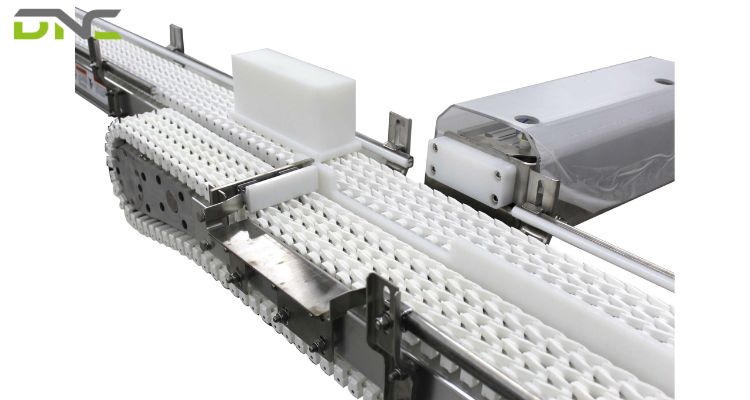 Conveyor Stop Type Comparison Table
| Stop Type | Force | Accuracy | Cycle Rate | Power | Best Application |
| Pneumatic Retractable | 500 N | ±0.5 mm | 120/min | Compressed air | General manufacturing, F&B |
| Electric/Servo | Programmable | ±0.05 mm | 60/min | 24V DC | Fragile products, precision electronics |
| Magnetic Brake | 1,000–10,000 N | ±1.0 mm | 30/min | 24V DC | Heavy steel pallets, automotive |
| Swing Gate | 200–500 N | ±2.0 mm | 30–60/min | Air or DC | Round/fragile/cylindrical products |
| Hard Mechanical | N/A (rigid) | ±1–3 mm | None (manual) | None | End-of-line, safety backstop |
| ZPA Zone System | 500 N per zone | ±0.5 mm | Continuous | Air + DC | Fragile buffering, accumulation |
Key Components of a Conveyor Stop System
A complete conveyor stop system integrates mechanical, pneumatic, electronic, and software components that must be precisely matched to deliver reliable, repeatable product positioning at production throughput rates.
Stop Pin / Paddle / Gate Body. The physical product contact element — hardened steel (HRC 55+) for metal pallet contact, polyurethane-faced for direct product contact, or anodized aluminum for lightweight applications. Contact face geometry (flat, V-groove, radius) determines how the product references against the stop. V-groove faces provide self-centering for pallet locating pins; flat faces provide simple end-stop positioning; radius faces provide gentle first contact for fragile products.
Actuator — Pneumatic or Electric. The pneumatic cylinder or electric motor that raises, lowers, or swings the stop element. Bore sizes for pneumatic cylinders range from 16 mm (light-duty, 150 N) to 50 mm (heavy-duty, 2,000 N). Double-acting cylinders provide positive control of both extension and retraction; spring-return cylinders retract automatically on air loss (fail-safe for safety applications). Electric linear actuators provide programmable stroke and force with feedback.
Solenoid Valve / Motor Driver. The 24V DC solenoid valve controls compressed air flow to the pneumatic cylinder; the servo drive or DC motor controller powers electric actuators. Siemens SIRIUS solenoid valves with IO-Link provide diagnostic feedback (coil resistance, switching cycles) directly to the TIA Portal PLC program, enabling predictive maintenance alerts before solenoid failure.
Position Sensor. Reed switches or inductive sensors on the cylinder body confirm stop pin position (extended or retracted) and provide status feedback to the PLC. Position confirmation is mandatory before releasing the upstream product — a retracted confirmation signal that arrives before the pin fully clears the product path causes product collision.
PLC Program Logic. Siemens S7-1200 or S7-1500 PLC ladder logic manages all stop control sequences: detection, stop command, position confirmation, process trigger, process complete wait, release command, and next-zone coordination. DNC Automation’s standard conveyor stop control library — developed over 20 years of Malaysian factory automation projects — provides pre-tested function blocks for all 6 stop types, reducing PLC commissioning time by 40–60% versus custom-coded solutions.

Applications: Where Conveyor Stops Are Used in Malaysian Manufacturing
Conveyor stops are universal in Malaysian automated manufacturing, with specific stop type selection driven by the product, process accuracy requirement, and throughput rate of each application.
Automotive Body Positioning — Selangor
Toyota and other Selangor automotive manufacturers use conveyor stops at every robotic welding station on body-in-white and underbody assembly lines. Robotic welding requires product positioning accuracy of ±0.5 mm to achieve weld quality within specification — insufficient positioning accuracy causes weld displacement, resulting in structural defects that fail quality inspection. DNC Automation delivers complete body-positioning cells comprising heavy-duty conveyor with magnetic brake stoppers for initial arrest, servo-actuated precision locating pins for ±0.1 mm final positioning, and Siemens S7-1500 PLC integration with the robot controller via PROFINET. Cycle time from product arrival to weld-ready positioning is under 3 seconds for standard body panel cells.
PCB Positioning for ICT Test — Penang
PCB (Printed Circuit Board) in-circuit test (ICT) requires ±0.5 mm board positioning accuracy to land test probes on specific pads without missing contacts or damaging board components. Penang EMS factories — processing PCBs for Intel, AMD, and global electronics brands — use pneumatic retractable stoppers with secondary edge-guide alignment rails to achieve the required positioning accuracy at throughput rates of 120–180 boards per hour per test lane. DNC Automation’s Penang team has commissioned conveyor stop systems for PCB ICT lines achieving ±0.3 mm positioning repeatability — better than the ±0.5 mm test probe specification — providing a process capability index (Cpk) of 1.67 that ensures zero probe-miss defects under normal production variation.
F&B Carton Positioning for Labeling — Selangor and Johor
F&N and Ramly Burger use conveyor stop systems to position cartons, trays, and product containers at labeling machines, check-weighers, and coding stations. Label application accuracy requires stop positioning to ±2–3 mm — achievable with standard pneumatic stoppers. Throughput requirements of 30–120 packages/minute demand pneumatic stoppers with 10-million-cycle rated life and 0.5-second cycle time. DNC Automation integrates conveyor stops with Siemens S7-1200 PLC and label applicator trigger signals, ensuring label application occurs only when the product is confirmed at the correct position — preventing misapplied labels that cause labeling compliance failures under Malaysia’s Food Regulations 1985.
Pharmaceutical and Medical Device — Penang and Selangor
Hartalega, Malaysia’s leading glove manufacturer and a DNC Automation client, uses zero-pressure accumulation zones on powder donning conveyor lines where glove pouches must be buffered without contact pressure that could deform or damage the packaging. Pharmaceutical clients use servo stoppers for blister pack positioning at vision inspection stations, where ±0.1 mm positioning accuracy enables cameras to detect missing tablets at individual tablet-well resolution.
Benefits of Conveyor Stop Systems for Factory Operations
Conveyor stop systems deliver measurable productivity, quality, and safety improvements that justify their installation cost within months of commissioning in most Malaysian factory applications.
Positioning accuracy. Pneumatic conveyor stops achieve ±0.5 mm repeatability, enabling fully automated assembly and inspection operations that require products to be at a precise location. Without stops, manual positioning by operators introduces ±5–15 mm variation — inadequate for robotic welding, ICT testing, vision inspection, or precision dispensing.
Throughput increase. Automated conveyor stop systems eliminate operator positioning time — typically 3–8 seconds per product — from the production cycle. At 60 products per hour, eliminating 5 seconds of manual positioning saves 5 minutes per hour, increasing theoretical throughput by 8.3%. DNC Automation’s client data from Selangor automotive installations shows throughput increases of 15–25% following conveyor stop automation, as operators previously engaged in product positioning are redeployed to value-added tasks.
Error reduction. Conveyor stops with PLC integration enforce process sequence — products cannot proceed past a station until the required process is confirmed complete. This interlocking eliminates the human error of releasing products before process completion, reducing defect rates by up to 80% in DNC Automation’s documented client installations. For Malaysian factories pursuing NIMP 2030 smart factory compliance, measurable quality improvements enabled by automation like conveyor stops are a key validation metric for SAG Grant applications.
Safety. Conveyor stops prevent uncontrolled product movement that creates struck-by hazards for operators at workstations. Malaysian DOSH (Department of Occupational Safety and Health) requirements for machinery guarding mandate that moving products in operator work zones be controlled — conveyor stops with PLC interlocks satisfy this requirement while maintaining production flow.
ROI within 12–18 months. A typical DNC Automation conveyor stop installation for a 10-station assembly line — including 10 pneumatic stoppers, sensors, PLC programming, and commissioning — costs RM 80,000–RM 150,000. Throughput improvement of 20% on a RM 5,000/hour production line yields RM 1,000/hour additional value, delivering full ROI in under 150 hours of operation — approximately 3 weeks of double-shift production.
How to Choose the Right Conveyor Stop for Your Factory
Selecting the correct conveyor stop type for a Malaysian manufacturing application requires evaluating five key parameters that determine which stop design delivers the required performance at the appropriate cost.
Product weight and speed. Pallet systems with products weighing 50–500 kg traveling at 0.3–0.5 m/s require high-force stoppers (magnetic brake or heavy-duty pneumatic, 1,000–5,000 N) to arrest the pallet without bounce-back. Light carton lines at 0.1–0.3 m/s with products under 10 kg are adequately served by standard pneumatic stoppers rated at 200–500 N.
Positioning accuracy requirement. ICT test and robotic assembly require ±0.5 mm or better — specify pneumatic stoppers with secondary locating pins. Vision inspection and label application require ±2–3 mm — standard pneumatic pin stoppers suffice. Manual operator stations require only ±5–10 mm — mechanical stops may be adequate.
Product fragility. Glass, ceramics, assembled electronics, and soft-packaged goods require servo stoppers (programmable soft-arrest) or swing gate stoppers (lateral-first contact) to prevent stop-impact damage. Robust steel pallets and corrugated cartons accept direct pneumatic pin contact without damage.
Throughput rate. High-speed lines at 60+ products/minute require pneumatic stoppers (0.5-second cycle time) or servo stoppers (1-second cycle time). Swing gate stoppers at 30 products/minute maximum are suitable only for lower throughput applications.
Consult DNC Automation’s automation engineers. DNC Automation delivers complete conveyor stop systems — conveyor + stops + sensors + robot + PLC program — as integrated cells, eliminating the integration risk of combining components from multiple suppliers. Our engineers have designed and commissioned conveyor stop systems for the most demanding Malaysian manufacturing applications, from Toyota welding cells to Penang ICT test lines. Get a Free Consultation to identify the correct stop system for your production line.
Frequently Asked Questions About Conveyor Stops
What is a conveyor stopper and how does it differ from a conveyor brake?
A conveyor stopper is a device that stops a product at a specific position on the conveyor — it acts on the product, not the conveyor belt itself. A conveyor brake acts on the belt drive motor or belt directly to stop the entire conveyor. In most production applications, conveyor stoppers operate on a running belt — the belt continues moving beneath the product while the stopper holds the product stationary. This allows the conveyor to continue transporting other products upstream and downstream simultaneously, enabling the zone-by-zone flow control that makes automated assembly lines efficient.
What force does a pneumatic conveyor stop generate?
Standard pneumatic retractable stoppers generate 500 N of holding force at 5 bar air pressure, sufficient to arrest products up to approximately 150 kg at conveyor belt speeds of 0.3 m/s. Heavy-duty pneumatic stoppers with 50 mm bore cylinders generate up to 2,000 N. For pallet systems above 150 kg or belt speeds above 0.5 m/s, DNC Automation engineers calculate the required arrest force using the formula F = m × a + friction, where deceleration distance and product mass determine the peak force requirement. Sizing the stopper cylinder correctly prevents both insufficient arrest force (product pushes through the stop) and excessive force (product damage on contact).
Can conveyor stops be integrated with Siemens PLC systems?
Conveyor stops integrate directly with Siemens SIMATIC S7-1200 and S7-1500 PLC systems via standard 24V DC digital I/O — sensor input signals and solenoid valve output signals use the same I/O modules as any other conveyor control device. DNC Automation, as Siemens’ official partner in Malaysia, programs conveyor stop control logic in Siemens TIA Portal using pre-validated function blocks from DNC’s 20-year conveyor automation library. IO-Link connectivity is available for advanced applications — pneumatic stopper solenoid valves with IO-Link capability provide real-time diagnostic data (coil temperature, switching cycles, response time) back to the TIA Portal HMI.
What is zero-pressure accumulation and why does it matter for Malaysian F&B factories?
Zero-pressure accumulation (ZPA) is a conveyor buffering technique that queues products without the upstream products pushing against downstream products. Conventional accumulation — where the belt drives all products against a stopped product at the front of the queue — generates back-pressure forces of 50–500 N per product in the queue, crushing soft packaging, deforming labels, and damaging fragile products. ZPA eliminates this back-pressure by stopping each product in its own zone, with the belt stopped beneath it, so no drive force is transmitted to downstream products. Malaysian F&B factories handling individually-wrapped snacks, soft-packaged confectionery, and glass-bottled beverages require ZPA systems to prevent packaging damage during accumulation. DNC Automation’s ZPA systems for Ramly Burger and F&N incorporate Siemens S7-1500 PLC zone coordination that maintains product buffer levels automatically, absorbing upstream speed variations of up to 40% without line stoppage.
How many conveyor stops does a typical Malaysian assembly line require?
A typical 10-station Malaysian assembly line requires one primary stop per workstation (10 stops minimum), plus additional stops for incoming accumulation (2–4 ZPA zones per station on high-value products), quality rejection diverters (1–2 per line), and end-of-line accumulation (4–10 ZPA zones). Total stop count for a 10-station precision assembly line typically ranges from 25 to 50 individual stoppers, controlled by a single Siemens S7-1500 PLC. DNC Automation provides complete engineering, supply, installation, and commissioning of all conveyor stops on a turnkey basis, with a single point of responsibility for system performance.
What maintenance does a conveyor stop system require?
Pneumatic retractable stoppers rated for 10 million cycles require minimal scheduled maintenance — monthly inspection of stop pin wear (replace at >0.5 mm wear), quarterly solenoid valve filter element replacement, and annual seal replacement in the air cylinder. With Siemens IO-Link diagnostics integrated into DNC Automation’s TIA Portal HMI, cycle count-based maintenance alerts replace time-based schedules, triggering maintenance at actual wear thresholds rather than arbitrary intervals. DNC Automation’s 24/7 maintenance support team, based in Selangor with engineers also stationed in Penang, provides on-site response within 4 hours for any conveyor stop system fault across Malaysian manufacturing clients.
Does the SAG Grant cover conveyor stop system installation?
Malaysia’s Smart Automation Grant (SAG), administered by MIDA on a 70:30 matching basis up to RM 1 million, covers automation investments that measurably improve productivity and reduce labor dependency. Conveyor stop systems that replace manual product positioning — documenting labor reduction, positioning accuracy improvement, and throughput increase — qualify as eligible automation investments. DNC Automation provides full SAG application documentation, including baseline productivity measurement, automation system specification, and post-commissioning productivity validation reports that satisfy MIDA’s grant disbursement requirements. Contact DNC Automation for a Free Consultation on SAG-fundable conveyor stop automation for your Malaysian factory.
Conclusion
Conveyor stops are the foundation of every automated manufacturing and assembly line — without precise product positioning, no robot, vision system, tester, or automated tool can perform its function reliably. From pneumatic retractable stoppers delivering ±0.5 mm positioning accuracy at 120 products/minute to zero-pressure accumulation zones protecting fragile Malaysian F&B products across 30-meter buffer lines, the correct conveyor stop system determines whether automation investments deliver their promised ROI. DNC Automation delivers complete integrated systems — conveyor, stops, sensors, robot, and PLC program — as a single turnkey solution that eliminates integration risk and accelerates Malaysian factory automation. Talk to Our Engineers today to design the conveyor stop system your production line requires. Explore our related guide on [PLC Conveyor Systems](/blog/plc-conveyor) for the complete automation integration picture.
- 7 views
- 0 Comment
Recent Comments