



Conveyor Trolley System: A Detailed Guide for Industrial Material Handling
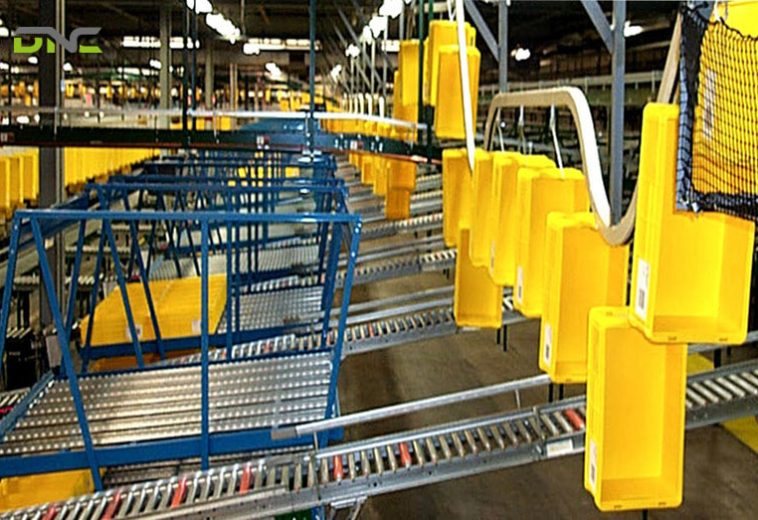
A conveyor trolley system is a flexible material handling solution designed to transport products along a fixed track using individual trolleys. Commonly applied in overhead and automated production lines, trolley conveyors are well suited for handling heavy or irregular loads while optimizing floor space and supporting multi-stage manufacturing processes.
What Is a Conveyor Trolley System?
A conveyor trolley system is an overhead or rail-guided material handling solution in which products are transported by individual trolleys running along a fixed track. Each trolley carries the load via hooks, hangers, or custom fixtures, allowing products to move through production processes while suspended rather than placed on a conveyor surface.
This design is especially suitable for heavy, bulky, or irregularly shaped products and helps free floor space, improve plant layout, and support continuous multi-stage processing.
How Does a Conveyor Trolley System Work?
The system works by guiding trolleys along a predefined track layout that mirrors the production process. Trolleys move smoothly on wheels and bearings engineered to handle both static load (product weight) and dynamic load (movement, acceleration, stopping).
Movement methods typically include:
- Manual movement, suitable for low-volume or flexible workstations
- Gravity-driven movement, using slight track inclines to reduce energy consumption
- Powered movement, using chains, belts, or motorized trolleys for automated flow
The track system can incorporate curves, slopes, elevation changes, accumulation zones, and transfer points, allowing products to move seamlessly between processes such as assembly, inspection, coating, drying, or packaging.
What Are the Main Components of a Conveyor Trolley System?
A conveyor trolley system is made up of several interdependent components, each contributing to system stability and performance:
- Track / Rail System: Provides the structural path for trolley movement. Tracks are designed to withstand continuous loads and maintain precise alignment.
- Trolley Units: Each trolley includes wheels, bearings, and a load attachment interface. The design determines load capacity, speed, and durability.
- Drive Mechanism: Can be chain-driven, friction-driven, or motorized depending on automation level and throughput requirements.
- Load Carriers and Fixtures: Hooks, hangers, or custom fixtures designed to hold products securely and maintain orientation during movement.
- Switches and Routing Elements: Enable product routing, buffering, merging, or diverting within complex production layouts.
- Safety and Control Devices: Include stops, sensors, guards, and emergency systems to ensure safe operation.
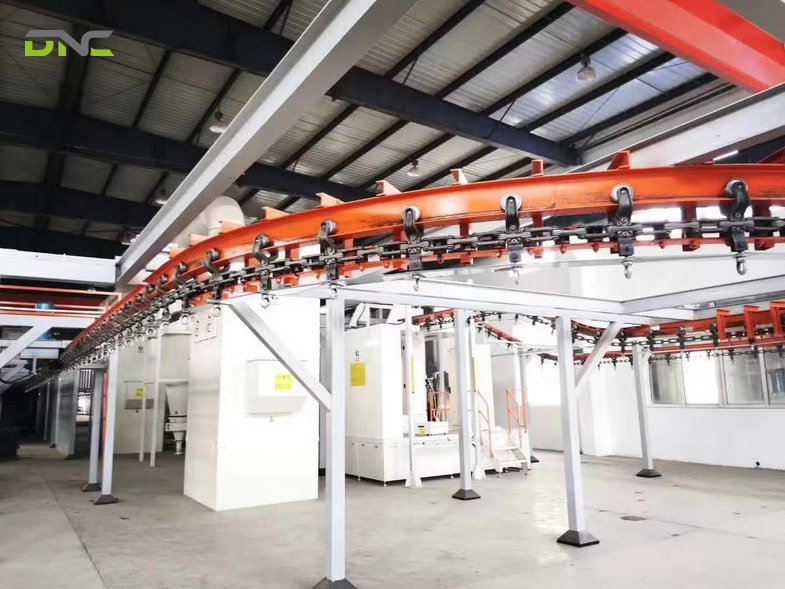
What Are the Main Components of a Conveyor Trolley System?
What Types of Conveyor Trolley Systems Are Commonly Used?
Different trolley conveyor types are selected based on production complexity and control requirements:
- Manual Trolley Systems: Used where flexibility and low capital cost are priorities.
- Gravity Trolley Systems: Suitable for continuous flow lines where energy efficiency is important.
- Powered Trolley Systems: Provide consistent speed and throughput in automated environments.
- Overhead Trolley Conveyors: Maximize floor space and allow free movement of people and equipment below.
- Power-and-Free Trolley Systems: Allow individual trolleys to stop, accumulate, or bypass stations without stopping the entire line.
What Industries Commonly Use Conveyor Trolley Systems?
Conveyor trolley systems are widely used across industries due to their flexibility and load-handling capability:
- Automotive Manufacturing – body parts, sub-assemblies, and components
- Surface Treatment and Paint Lines – coating, curing, and drying processes
- Garment and Textile Production – hanging garments through sewing and finishing
- Warehousing and Order Fulfillment – order picking and sequencing
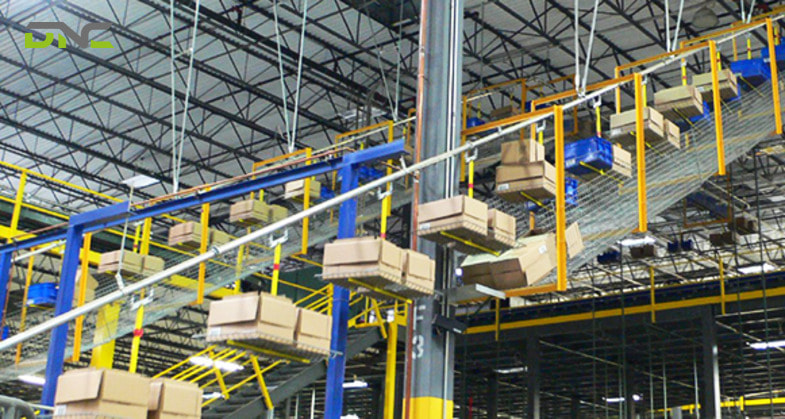
Conveyor trolley systems are widely used across industries due to their flexibility and load-handling capability
What Are the Advantages of Conveyor Trolley Systems?
Conveyor trolley systems offer several technical and operational advantages, especially in production environments where space efficiency, load stability, and process integration are critical.
- Efficient Utilization of Vertical Space: One of the most significant advantages of trolley conveyor systems is their ability to operate overhead. By suspending products from a rail system, factories can free up valuable floor space for workstations, machinery, and personnel movement.
- Ability to Transport Heavy or Irregular Products: Trolley systems are designed to carry loads via fixtures, hooks, or custom hangers, making them ideal for heavy, bulky, or irregularly shaped products that are difficult to support on traditional belt or roller conveyors.
- Reduced Manual Handling and Product Damage: By automating the movement of products between processes, conveyor trolley systems significantly reduce the need for manual lifting, pushing, or repositioning.
- Flexible Routing Through Complex Layouts: Trolley conveyor tracks can incorporate curves, inclines, declines, switches, and elevation changes.
- High Compatibility with Automation and Multi-Stage Processes: Modern trolley conveyor systems integrate easily with automation technologies such as PLC controls, sensors, robotic stations, and process equipment.
What Are the Limitations of Conveyor Trolley Systems?
Despite their strengths, conveyor trolley systems also involve technical and operational challenges that must be carefully considered during system design.
- Higher Initial Engineering and Installation Complexity: Compared to simple belt or roller conveyors, trolley systems require more detailed engineering.
- Fixed Track Layout That Is Difficult to Modify After Installation: Once the rail system is installed, modifying the layout can be challenging and costly. Changes often require structural adjustments, track replacement, or downtime.
- Structural Load Requirements for Overhead Mounting: Overhead trolley systems place continuous static and dynamic loads on building structures.
- Need for Regular Inspection and Maintenance of Moving Parts: Trolleys rely on wheels, bearings, chains, and drive components that experience continuous motion and load.
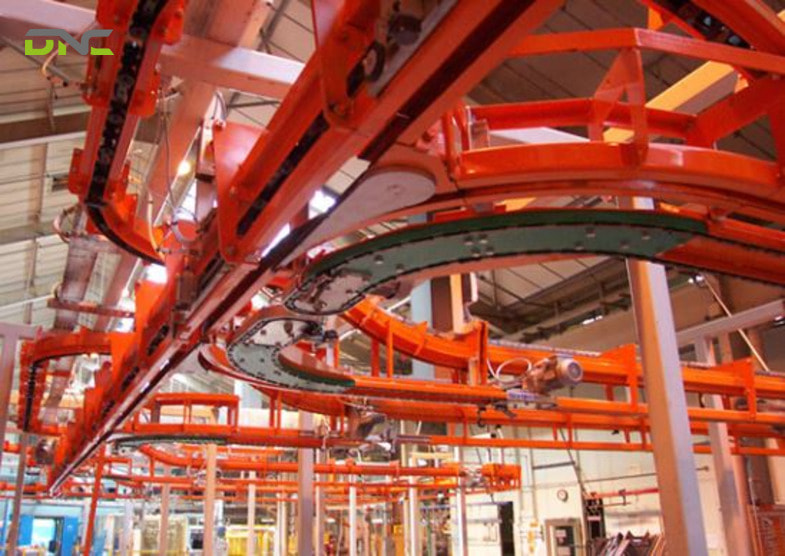
Limitations of Conveyor Trolley Systems
Key Technical Factors to Consider When Selecting a Conveyor Trolley System
Selecting the right conveyor trolley system requires careful evaluation of both mechanical and operational factors to ensure stable, long-term performance.
- Maximum Load per Trolley and Total System Load: Each trolley must be designed to handle not only the product weight but also dynamic forces during movement. In addition, total system load affects track strength, drive selection, and structural requirements.
- Required Production Rate and Trolley Spacing: Throughput is determined by trolley speed and spacing. Insufficient spacing can cause congestion at workstations, while excessive spacing reduces system efficiency and line balance.
- Track Material, Radius, and Elevation Changes: Track design influences trolley stability and wear. Tight curves, steep inclines, or frequent elevation changes require specialized track profiles and reinforced support structures.
- Control Level (Manual vs Automated): Manual systems prioritize flexibility and low cost, while automated systems offer precise control, synchronization, and higher productivity. The control strategy should align with production goals and future automation plans.
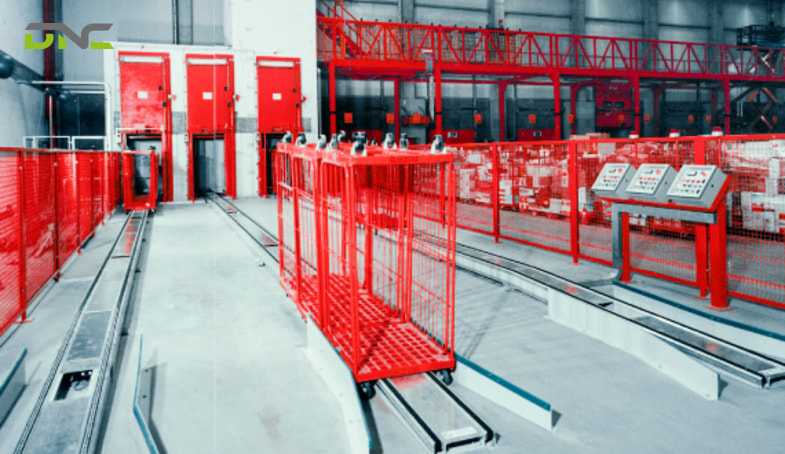
Selecting the right conveyor trolley system requires careful evaluation of both mechanical and operational factors
Common Design and Application Mistakes with Conveyor Trolley Systems
Even well-intentioned designs can fail if key engineering principles are overlooked.
- Underestimating Dynamic Loads During Acceleration or Stops: Loads increase significantly during start-stop cycles. Ignoring these forces can lead to premature wear or structural failure.
- Inadequate Track Support or Poor Alignment: Insufficient support spacing or misalignment causes vibration, noise, and uneven trolley movement, reducing system lifespan.
- Incorrect Trolley Spacing Causing Congestion: Poor spacing disrupts production flow, leading to accumulation issues and inconsistent cycle times.
- Insufficient Safety Features or Maintenance Access: Lack of guards, emergency stops, or access points increases operational risk and maintenance downtime.
- Designing Systems Without Considering Future Expansion: Systems designed only for current needs often become bottlenecks when production volume or product types change.
How Does DNC Automation Deliver Conveyor Trolley Solutions?
DNC Automation delivers conveyor trolley systems using a system-level engineering approach focused on reliability and scalability.
- Detailed Application and Load Analysis: Each project starts with a thorough evaluation of product characteristics, process flow, and operational constraints.
- Engineering-Driven Layout and Trolley Selection: Track layout, trolley type, and drive systems are engineered to match real production requirements rather than standard configurations.
- Integration with PLC Controls and Automation Systems: Conveyor systems are designed to work seamlessly with sensors, robots, and control platforms for synchronized operation.
- Professional Installation and Commissioning: Precise installation and testing ensure smooth operation, correct alignment, and stable throughput from day one.
- Long-Term Support, Upgrades, and Optimization: Ongoing technical support and system optimization help customers maintain performance and adapt to future production needs.
- 19 views
- 0 Comment
Recent Comments