



Double Deep Pallet Racking System: Specs, Layout & ROI Guide
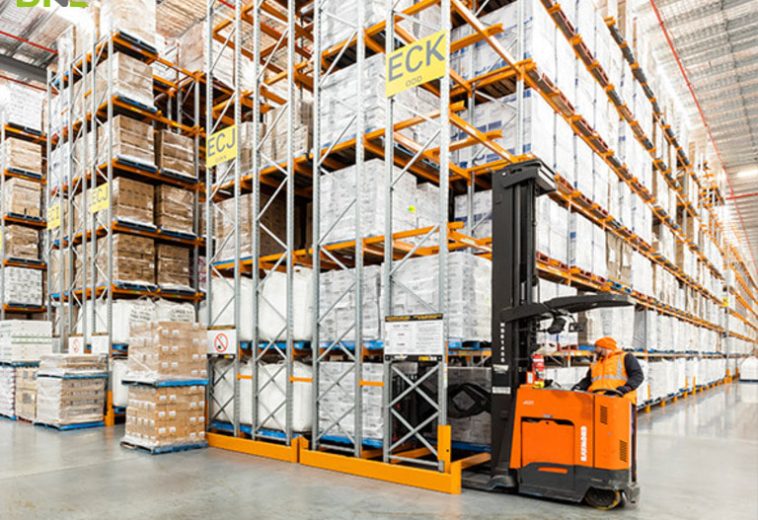
Double deep pallet racking systems store pallets two-deep on each side of the aisle — effectively doubling storage density compared to standard selective racking while retaining partial selectivity for each storage position. For Malaysian warehouses managing moderate SKU counts (10–100 products) with 5–50 pallets per SKU, double deep racking delivers the optimal balance between storage density and access speed at a cost of RM 400–650 per pallet position. This guide covers the engineering principles, specifications, layout configurations, forklift requirements, and ROI calculations that factory managers need to evaluate double deep racking against competing systems. DNC Automation has integrated double deep systems across food manufacturing, chemical storage, and general warehousing projects — the data here reflects verified field performance.
What Is a Double Deep Pallet Racking System?
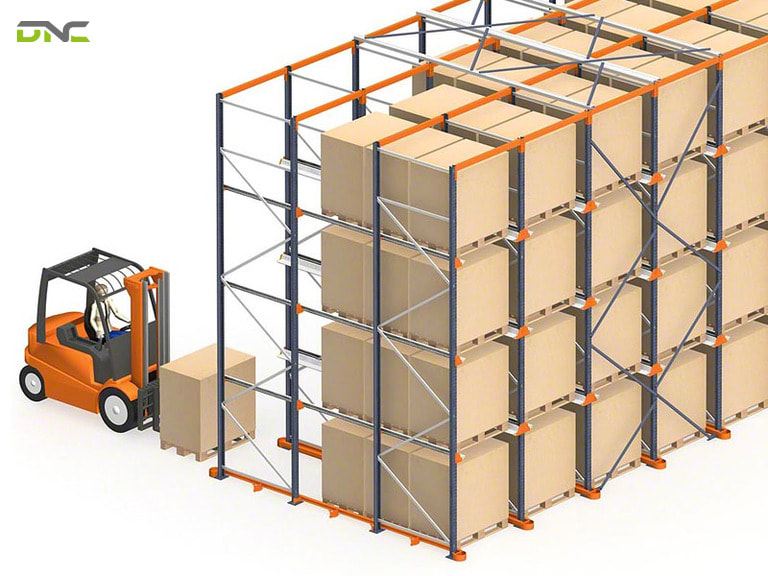
Double deep pallet racking is a storage system that positions two pallets deep on each side of the aisle by placing two selective rack rows back-to-back without an intermediate aisle between them. A specialised deep-reach forklift extends its forks past the front pallet to access the back position — a capability that standard counterbalance forklifts cannot perform.
The system occupies a middle ground in the storage density spectrum: more dense than single-deep selective racking (which wastes 45–50% of floor area on aisles) but less dense than drive-in racking (which stores 6–12 pallets deep with limited selectivity). Double deep achieves approximately 55–60% floor utilisation — a 15–20 percentage point improvement over selective racking.
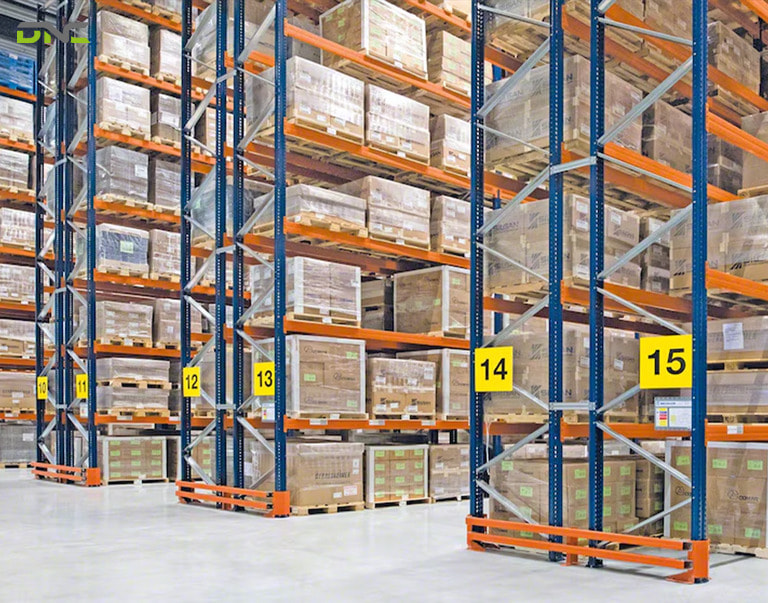
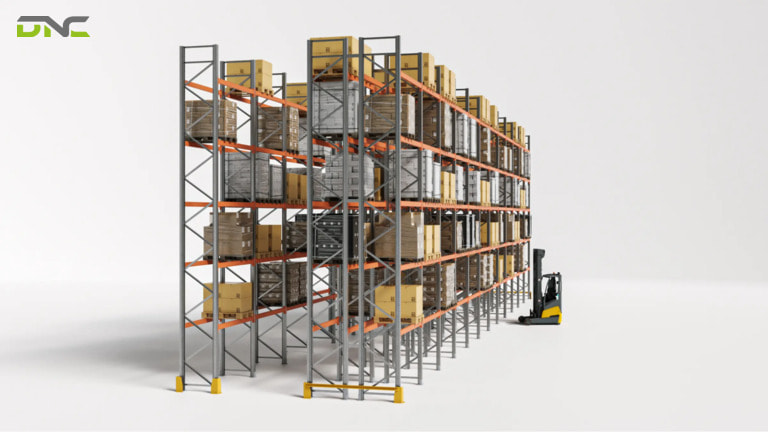
Double deep racking uses the same structural components as selective racking — upright frames, load beams, connectors, base plates — making it structurally familiar and compatible with existing warehouse infrastructure. The primary difference is the paired row arrangement and the forklift specification. Beams, frames, and safety accessories from selective racking suppliers (Mecalux, SSI Schaefer, TTF, SKB Shutters) are directly applicable; only the forklift fleet changes.
In Malaysia, double deep racking is most commonly installed in food ingredient warehouses, chemical raw material stores, and beverage distribution centres — operations where bulk quantities of moderate SKU ranges require efficient storage without sacrificing all pallet accessibility.
How Does a Double Deep Pallet Racking System Work?
Double deep racking operates through a two-row configuration where the front row is directly accessible from the aisle and the back row is accessible only by reaching past the front position. This reach-past operation requires a deep-reach forklift — a specialised truck with telescoping forks that extend 1,200–1,400 mm beyond the standard fork length.
Storage and Retrieval Process
Storing a pallet in the back position: The deep-reach truck approaches the front face of the rack, extends its forks past the empty front position, enters the back row, and places the pallet on the back beams. The truck then retracts its forks and stores a second pallet in the front position.
Retrieving from the back position: The front pallet must be removed first (relocated to a temporary position or picked for an order). The truck then extends its forks to reach the back pallet and retrieves it. This two-step retrieval is the operational trade-off for double deep’s increased density.
Selectivity Trade-Off
Double deep racking delivers approximately 50% immediate selectivity — only front pallets are directly accessible. When the front and back pallets contain the same SKU, selectivity is effectively 100% for that product (either pallet satisfies the pick). When front and back pallets contain different SKUs, the back SKU requires front pallet relocation — adding 30–60 seconds per pick.
Inventory management software addresses this constraint through optimised slotting: assigning high-velocity SKUs to front positions and low-velocity SKUs to back positions. WMS integration with double deep racking tracks front/back occupancy status in real time, preventing “honeycomb” inefficiency where back positions remain empty because front positions are occupied with different SKUs.
Load Path Engineering
The structural load path in double deep racking is identical to selective racking — pallet load transfers through beams to connectors to upright columns to base plates to the floor slab. The difference is that back-row frames carry load from both directions (front beams and back beams connect to the same intermediate frame), requiring frames rated for bidirectional loading.
Standard frame specifications handle this naturally — a frame rated at 15,000 kg total supports loads from beams on both faces. However, the design must account for asymmetric loading conditions where one face is fully loaded and the other empty, creating lateral forces that the frame bracing must resist.
Types of Double Deep Configurations
Double deep racking adapts into several configurations based on warehouse layout and operational requirements.
Standard Double Deep
Two selective rack rows placed back-to-back with 150 mm clearance. Access from one aisle face per pair. This is the most common configuration — delivering 55–60% floor utilisation with minimal structural complexity.
Double Deep with Cross-Aisle Access
Some warehouse layouts provide cross-aisles at intervals (every 10–15 bays), allowing forklift access from perpendicular aisles. This configuration improves traffic flow in large warehouses with 50+ bays per row, reducing forklift travel distance for pickers operating across multiple aisle blocks.
Double Deep in Cold Room Environments
Cold room installations require hot-dip galvanised frames (standard powder coat corrodes within 3–5 years in sub-zero conditions) and cold-rated deep-reach trucks with heated operator cabins and low-temperature hydraulic systems. Malaysian cold chain operators — particularly in seafood (Penang, Johor), dairy (Selangor), and frozen food (Klang Valley) — adopt double deep racking to reduce cold room footprint without the higher cost of mobile racking.
Double Deep with Wire Decking
Adding wire mesh decking to double deep beam levels provides two advantages: support for pallets with damaged bottom boards (preventing pallet fall-through) and compliance with Bomba fire code requirements for sprinkler water penetration between rack levels. Decking adds RM 80–150 per bay level but is often mandatory in food, pharma, and chemical storage facilities.
Double Deep with Wire Decking
Key Components of a Double Deep System
Upright Frames
Double deep uses the same frame types as selective racking — but the intermediate frames (between front and back rows) carry bidirectional beam loads. Frame specifications must account for this: a frame supporting four beam levels at 3,000 kg per pair on each face carries 24,000 kg total. Standard heavy-duty frames (2.0–2.5 mm gauge) rated at 25,000–30,000 kg accommodate this load.
Frame depths: 800 mm or 1,000 mm matching the pallet depth stored. Standard 1,200 × 1,000 mm Malaysian pallets use 1,000 mm deep frames.
Load Beams
Beam specifications are identical to selective racking. Standard 2,700 mm box beams rated at 2,500–3,000 kg per pair accommodate standard Malaysian pallet loads. Beam connectors must be compatible with the upright perforation pattern — matching hook-in systems from the same manufacturer.
Deep-Reach Forklift
The deep-reach forklift is the defining equipment requirement for double deep racking. Standard reach trucks cannot access back positions; only trucks with telescoping fork carriages provide the 1,200–1,400 mm extended reach needed.
Specifications:
- Extended fork reach: 1,200–1,400 mm beyond standard position
- Load capacity at full extension: 1,000–2,000 kg (derated from standard capacity)
- Mast height: matches rack height (typically 6–10 m in Malaysian warehouses)
- Aisle width requirement: 2.8–3.2 m (slightly wider than standard narrow-aisle reach trucks)
- Cost: RM 180,000–280,000 per unit (30–50% premium over standard reach trucks)
Key consideration: Deep-reach trucks have reduced load capacity at full extension due to the extended load centre. A truck rated at 2,500 kg at 600 mm load centre may only handle 1,500 kg at the 1,800 mm load centre required for double deep back position. Always verify the derated capacity against your heaviest pallet weight.
Safety Accessories
Standard safety accessories (column guards, beam safety clips, anti-collapse mesh, load signage) apply identically to double deep installations. Additional consideration: back-to-back row spacers are critical in double deep configurations to maintain the 150 mm clearance between paired rows — preventing frame-to-frame contact that would compromise structural integrity.
Applications: Where Double Deep Racking Serves Malaysian Manufacturing
Double deep pallet racking occupies a specific operational niche: moderate SKU counts with moderate-to-high pallet volumes per SKU, where 50% selectivity is acceptable and the 15–20% density improvement over selective racking justifies the deep-reach truck investment.
Food Manufacturing and Ingredients
Food manufacturers storing raw ingredients — flour, sugar, cooking oil, spices, packaging materials — typically manage 20–80 SKUs with 10–50 pallets per SKU. Double deep racking’s density improvement reduces warehouse footprint by 15–20%, and LIFO access is acceptable for non-perishable ingredients with long shelf lives. Companies like Ramly Burger and regional flour mills in Johor use double deep for ingredient storage zones.
Chemical and Industrial Raw Materials
Chemical warehouses storing resins, solvents, additives, and industrial chemicals operate with similar SKU-to-volume ratios. Double deep racking combined with proper ventilation, spill containment at floor level, and chemical-resistant coatings provides density improvements without the operational complexity of drive-in systems — where forklift entry into narrow channels creates hazardous chemical exposure risks.
Beverage Distribution
Beverage distributors handling 30–60 SKUs (brands × pack sizes) with seasonal volume fluctuations benefit from double deep’s flexibility. Peak season inventory (Chinese New Year, Hari Raya) stores deeper; off-peak periods leave front positions empty for easier access. F&N and other major Malaysian beverage companies use double deep in regional distribution centres.
General Warehousing (Overflow and Buffer Zones)
Many Malaysian warehouses combine selective racking in primary picking zones with double deep racking in reserve or overflow zones. This hybrid approach maximises density for bulk reserve stock while maintaining full selectivity for active picking — a configuration DNC Automation frequently designs for multi-function warehouses.
Automotive Spare Parts (Bulk Storage)
Automotive parts distributors storing high-volume items (filters, brake pads, lubricants) in bulk reserve use double deep to maximise density, with selective racking feeding the forward pick area. The JIT replenishment cycle moves pallets from double deep reserve to selective forward pick on a scheduled basis.
Benefits of Double Deep Pallet Racking
Benefits of Double Deep Pallet Racking
15–20% more pallet positions than selective racking within the same floor area. For a warehouse paying RM 3.50/sq ft monthly rent, double deep’s space savings translate to RM 30,000–80,000 annual rental reduction for a 30,000 sq ft facility.
50% fewer aisles than selective racking. Fewer aisles mean more rack bays — and fewer aisles also reduce forklift travel distance by 10–15%, improving picking productivity.
Lower cost per position than high-density alternatives. At RM 400–650 per position, double deep costs 30–50% less than pallet flow (RM 800–1,500) and 50–70% less than mobile racking (RM 1,200–2,500).
Same structural components as selective racking. No proprietary hardware, specialised rails, or motorised systems — replacement parts are universally available from any compatible manufacturer.
Gradual density upgrade path. Warehouses can convert selective racking to double deep by rearranging existing frames and beams into back-to-back pairs and adding deep-reach trucks — a retrofit that costs 30–40% less than a new racking installation.
Lower cold room construction cost. In Malaysian cold chain facilities where floor space costs RM 3,000–5,000/m² to build, double deep’s 15–20% footprint reduction saves RM 500,000–1,500,000 in cold room construction for a 5,000-position facility.
How to Choose Double Deep Over Alternatives
When Double Deep Is the Right Choice
- SKU count: 10–100 products (too many for drive-in, manageable for partial selectivity)
- Pallets per SKU: 5–50 (sufficient volume to fill front and back positions with the same product)
- Stock rotation: LIFO acceptable or mixed (non-perishable goods, long-shelf-life products)
- Floor space: constrained but not severely limited (double deep’s 55–60% utilisation is adequate)
- Budget: moderate (deep-reach truck investment of RM 180,000–280,000 is justifiable)
When to Choose Something Else
- SKU count > 200: Choose selective racking — 100% selectivity is essential for high-SKU operations
- Strict FIFO required: Choose pallet flow racking — double deep cannot guarantee FIFO
- Maximum density needed: Choose mobile or shuttle racking — double deep’s 55–60% utilisation falls short for cold rooms where 80–90% is needed
- Budget below RM 400/position: Choose standard selective — avoid the deep-reach truck investment
ROI Calculation Framework
Investment: Racking cost + deep-reach truck(s) + installation
Savings: Floor space reduction × rental cost + reduced forklift travel time + reduced aisle lighting/HVAC cost
ROI period: Typically 24–36 months for ambient warehouses; 12–18 months for cold rooms
Example for a 2,000-position Malaysian warehouse:
- Selective alternative: 2,000 positions × RM 500 = RM 1,000,000 racking + 40,000 sq ft floor
- Double deep: 2,000 positions × RM 550 = RM 1,100,000 racking + RM 250,000 deep-reach truck + 32,000 sq ft floor
- Floor savings: 8,000 sq ft × RM 3.50/sq ft × 12 months = RM 336,000/year
- Net additional investment: RM 350,000
- ROI: 12.5 months
How to Choose Double Deep Over Alternatives
FAQ — Double Deep Pallet Racking System
What is double deep pallet racking?
Double deep pallet racking stores pallets two-deep on each side of the aisle by placing two rack rows back-to-back. A deep-reach forklift with telescoping forks accesses both front and back pallet positions. The system delivers 55–60% floor utilisation — 15–20% more than standard selective racking — while maintaining approximately 50% selectivity. It is the most common upgrade path for warehouses that have outgrown selective racking’s storage density.
What forklift do I need for double deep racking?
Double deep racking requires a deep-reach forklift (also called a double-deep reach truck) with telescoping fork carriages that extend 1,200–1,400 mm beyond the standard position. Standard counterbalance forklifts and standard reach trucks cannot access back pallet positions. Deep-reach trucks cost RM 180,000–280,000 per unit — 30–50% more than standard reach trucks. Key specification: verify the truck’s derated load capacity at full extension, which is typically 30–40% lower than the rated capacity at standard load centre.
How does double deep compare to drive-in racking?
Double deep stores pallets 2-deep per side (4 pallets across two rows) with 50% selectivity. Drive-in stores pallets 6–12 deep with near-zero selectivity (only the front pallet in each lane is accessible). Double deep suits operations with 10–100 SKUs; drive-in suits operations with fewer than 20 SKUs and very high volume per SKU. Double deep preserves forklift operation in a standard aisle; drive-in requires forklifts to enter the rack structure — increasing frame damage risk and reducing safety.
Can double deep racking support FIFO stock rotation?
Double deep racking primarily operates on LIFO (last in, first out) — the front pallet is always accessed first. FIFO is possible only when front and back pallets contain the same SKU (either pallet satisfies the pick) or when WMS-directed slotting ensures date-coded stock occupies front positions. For industries requiring guaranteed FIFO (food with short shelf life, pharmaceuticals), pallet flow racking is the recommended alternative.
How much does double deep racking cost in Malaysia?
Double deep racking costs RM 400–650 per pallet position for components (frames, beams, connectors). Deep-reach trucks add RM 180,000–280,000 per unit. Installation, wire decking, and safety accessories add 15–20%. A complete 1,000-position double deep system with one deep-reach truck costs approximately RM 750,000–1,000,000 fully installed — compared to RM 450,000–700,000 for equivalent selective racking.
What is the maximum height for double deep racking?
Double deep racking reaches the same heights as selective racking — up to 12 metres in standard configurations. The limiting factor is the deep-reach truck’s mast height at full extension with derated load capacity. Most deep-reach trucks handle full-rated loads up to 8–9 metres and derated loads up to 11–12 metres. Malaysian warehouses typically install double deep at 6–8 metre frame heights supporting 3–4 beam levels.
Can I convert my existing selective racking to double deep?
Conversion is possible if the existing selective racking uses compatible frame widths and beam connectors. The process involves rearranging single-row racks into back-to-back pairs, adding row spacers, and purchasing deep-reach trucks. This retrofit costs 30–40% less than a new double deep installation. DNC Automation conducts structural assessments of existing racking before conversion to verify frame load ratings support bidirectional beam loading.
Is double deep racking suitable for cold rooms?
Double deep racking works well in cold room environments and is one of the most popular cold storage configurations in Malaysia. Requirements: hot-dip galvanised frames (standard paint corrodes in sub-zero temperatures), cold-rated deep-reach trucks with heated cabins and low-temperature hydraulic fluid, and condensation-resistant beam connectors. Double deep’s 15–20% density improvement over selective racking reduces cold room floor area — saving RM 3,000–5,000 per square metre in construction costs.
Conclusion
Double deep pallet racking systems deliver the most cost-effective density upgrade for Malaysian warehouses that have outgrown selective racking’s floor utilisation but do not require the extreme density (or extreme cost) of mobile or shuttle systems. The 15–20% space saving, combined with familiar structural components and a straightforward deep-reach truck specification, makes double deep the practical middle ground for food manufacturing, chemical storage, beverage distribution, and general bulk warehousing.
DNC Automation engineers double deep racking layouts that account for your specific SKU profile, pallet weights, forklift fleet, cold room requirements, and future automation plans. Our 35+ engineers, ISO 9001:2015 processes, and 25,000 sq ft production facility ensure every project is designed, pre-assembled, and tested before delivery — reducing on-site installation time by up to 40%.
- 3 views
- 0 Comment
Recent Comments