



Flexible Conveyor: Telescopic, Expandable, and Snake Curve Types for Warehouses and Factories
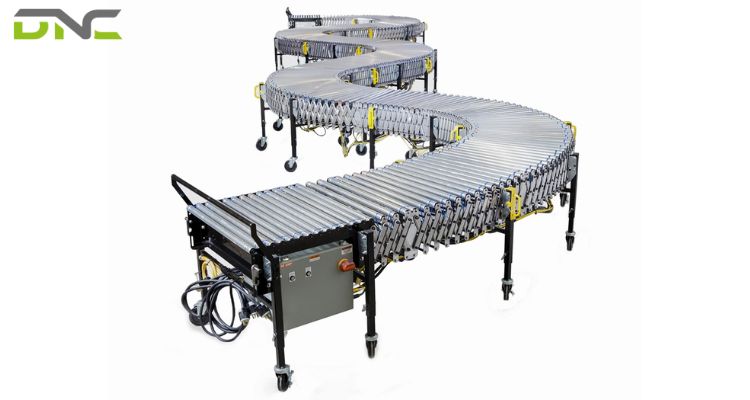
Flexible Conveyor: Telescopic, Expandable, and Snake Curve Types for Warehouses and Factories
A flexible conveyor is any conveyor system that can change its length, path, or configuration to adapt to variable working conditions — extending into truck containers for loading and unloading, snaking around obstacles on the factory floor, or reconfiguring between production runs. Unlike fixed conveyors installed permanently between two defined points, flexible conveyors provide temporary or reconfigurable material handling paths where installation of a fixed conveyor system is not practical or cost-effective.
In Malaysian logistics operations — where e-commerce fulfilment centres, 3PL warehouses, and port container terminals face variable dock and floor layouts — flexible conveyors reduce manual labour for truck loading and unloading while avoiding the capital commitment of permanent fixed conveyor infrastructure.
Types of Flexible Conveyors
1. Telescopic Belt Conveyor (Extendable Boom)
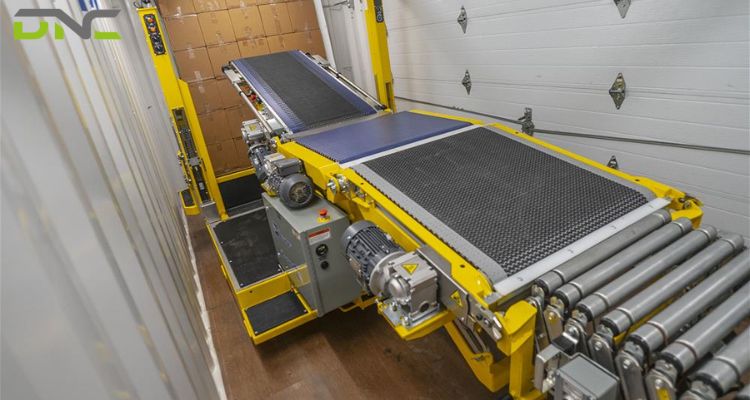
A telescopic belt conveyor consists of nested conveyor sections that slide inside each other — like a telescope — to extend the belt from a minimum collapsed length (typically 2–4 m) to a maximum extended length (8–30 m). The conveyor extends into a truck container or trailer during loading/unloading, retracts when the vehicle departs, and extends again for the next vehicle.
Extension mechanism: Motorised extension drive extends or retracts the boom sections on rolling tracks. Extension speed: 0.2–0.5 m/s (slower than product belt speed to avoid tangling).
Key specifications:
- Collapsed length: 2–5 m
- Maximum extended length: 8–30 m (depending on model and container size)
- Belt width: 600–1,000 mm
- Belt speed: 0.3–1.2 m/s (VFD variable speed)
- Load capacity: 15–40 kg per item; up to 30–60 kg/m of belt
- Height adjustment: 700–1,400 mm at boom tip (adjustable for truck floor height)
- Extension ratio: 1:2 to 1:4 (1 m collapsed = 2–4 m extended)
Malaysian application: Klang Valley 3PL warehouses use telescopic belt conveyors at loading docks to reduce manual case-picking into trucks. A single operator with a telescopic conveyor can load 400–600 cartons/hour versus 150–200 cartons/hour manually — reducing truck turnaround time at busy distribution centres.
Container unloading: The telescopic conveyor extends into the container; the operator at the far end places cartons on the belt, which carries them back to the warehouse. Eliminates the repetitive reach-and-carry motion that causes musculoskeletal injuries — relevant to Malaysia’s DOSH Occupational Safety requirements.
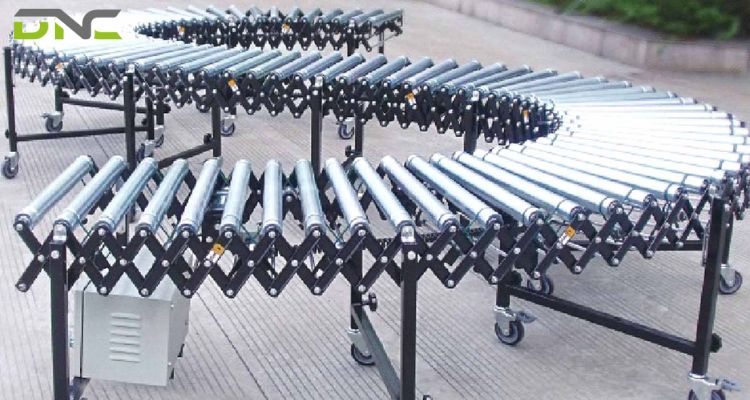
2. Expandable Gravity Roller Conveyor
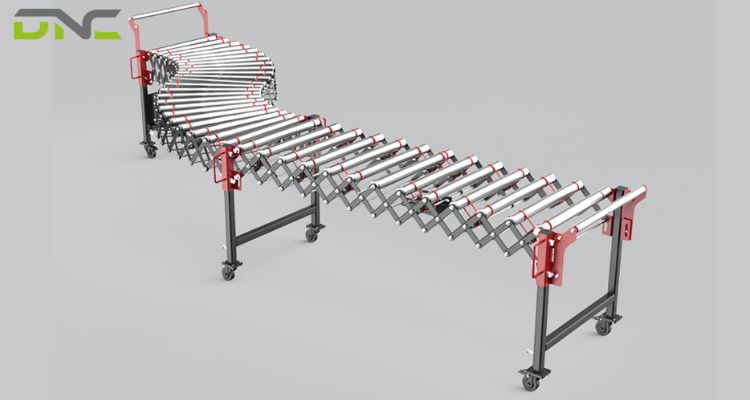
An expandable roller conveyor uses a scissor-link or accordion frame that collapses for storage and expands to create a conveyor path 4–8× its collapsed length. Unlike telescopic belt conveyors, expandable roller conveyors use gravity — the product rolls along inclined rollers without a powered belt.
Key specifications:
- Roller material: Steel or PVC-coated
- Frame: Galvanised steel or aluminium
- Collapsed length: 0.8–1.5 m
- Extended length: 3–10 m (4–8× collapsed)
- Width: 460–760 mm between frames
- Load capacity per roller: 30–60 kg
- Incline for gravity operation: minimum 3–5° depending on product weight
Applications: Supermarket and retail warehouse goods-in and goods-out; temporary assembly line extensions; exhibition and event logistics; small e-commerce fulfilment operations.
Limitation: Gravity only — product must roll freely (cartons, boxes with flat bottoms). Not suitable for bags, irregularly shaped items, or heavy items that require forced stopping.
3. Expandable Skatewheel Conveyor
Similar to expandable roller conveyor but uses individual skate wheels (small disc wheels on axles) instead of full-width rollers. Lighter, easier to handle, and suitable for lighter products (bags, soft packs, retail cartons under 15 kg).
Weight: 10–20 kg collapsed (much lighter than roller version) — one operator can deploy and reposition.
Applications: Parcel sorting, retail receiving, light e-commerce fulfilment.
Limitation: Wheels require flat, rigid product base — unsuitable for soft, round, or irregular products.
4. Powered Expandable (MDR) Roller Conveyor
An expandable frame with motorised rollers (24VDC MDR) — provides powered transport on an expandable path without gravity incline requirement. Can operate on flat surfaces and on declines.
Applications: Level-floor truck unloading, flexible manufacturing lines where product cannot roll by gravity (too heavy, too light, or odd-shaped for reliable gravity roll).
5. Snake Curve / Flex Curve Conveyor
A conveyor system that navigates horizontal curves by using flexible frame sections, articulating at joints to create custom curved paths. Not telescopic (it doesn’t extend/retract) but flexible in the sense that it can be reconfigured to different curved paths for different floor layouts.
Applications: Factory floor installation around obstacles (columns, machine bodies, doors) where a fixed straight conveyor cannot be routed; temporary production layout changes between product campaigns.
Frame: Hinged aluminium or steel frame sections, jointed at defined curve angles (typically 15° per section). Curve radius from 300 mm (tight curve) to 3,000 mm (gentle curve) by combining sections.
Common Types of Flexible Conveyor Systems
Telescopic Conveyor vs. Fixed Dock Conveyor: Selection Comparison
| Parameter | Telescopic Flexible Conveyor | Fixed Dock Conveyor |
| Dock flexibility | 1 unit serves multiple docks | 1 unit per dock |
| Vehicle types | Containers, vans, rigid trucks | Fixed height vehicles only |
| Installation | Portable (wheels); quick reposition | Permanent |
| Capital cost | Higher per unit | Lower per dock |
| Operating cost | Lower (1 operator vs. 3–4 manual) | Depends on automation level |
| Container reach | Full container depth (8–12 m) | Typically dock only |
| Product types | Cartons, totes, bags | Fixed product range |
| Malaysian context | Ideal for flexible 3PL operations | Best for dedicated single-product docks |
How Flexible Conveyor Systems Work in Automation
Flexible Conveyor Applications in Malaysian Logistics
E-Commerce Fulfilment (Klang Valley)
Shopee, Lazada, and J&T Express fulfilment centres in Subang, Shah Alam, and Puchong use telescopic conveyors at truck docks. Key metrics:
- Container unloading: 45 minutes with telescopic conveyor vs. 120 minutes manual
- Loading: 400+ cartons/hour vs. 160 manual
- Labour reduction: 3 operators (manual) → 1 operator + telescopic = 67% labour saving
Port and Logistics Terminals
Port Klang and Johor Port container terminals use heavy-duty telescopic belt conveyors for bulk parcel and general cargo loading/unloading — extending 20–25 m into 40-foot containers with 60 kg/m load capacity.
Retail Distribution
Retailer (Tesco, AEON, Lotus’s) distribution centres across Peninsular Malaysia use expandable gravity roller conveyors for goods-in at receiving docks — quick to deploy, store, and redeploy between vehicle arrivals.
Factory Floor Flexible Routing
Electronics factories in Penang use snake-curve flexible conveyor sections to route PCB panels between assembly islands where fixed conveyor would require dismantling for layout changes between product campaigns — typically done quarterly.
Selection Guide
Choose telescopic belt conveyor when:
- Loading/unloading trucks, containers, or trailers
- Container interior access required (8–12 m reach)
- Mixed carton sizes and weights
- High daily truck volumes (>15 containers/day justifies capital cost)
Choose expandable gravity roller when:
- Flat-base products that roll freely
- Temporary or seasonal use
- Low budget (1/3–1/4 cost of telescopic)
- Incline from dock to floor available
Choose powered expandable MDR when:
- Level dock floor (no gravity incline)
- Mixed products that don’t roll reliably
- Speed control required
Choose snake-curve flexible when:
- Factory floor layout requires curved conveyor path
- Layout will change seasonally or between campaigns
- Obstacle avoidance needed
How to Choose the Right Flexible Conveyor System
Key Maintenance Items
Telescopic belt conveyor: Monthly belt tracking inspection (extending and retracting changes belt tension); extension drive chain lubrication; boom track roller inspection; VFD parameter check (speed calibration); boom tip sensor cleaning.
Expandable roller conveyor: Scissor joint pin lubrication (semi-annual); roller bearing inspection (listen for grinding); frame hinge pin replacement at 3–5 year intervals.
Storage: Collapsed flexible conveyors stored in dry areas — moisture causes roller bearing corrosion, making extension difficult and damaging the frame hinge pins.
DNC Automation’s Flexible Conveyor Solutions
DNC Automation supplies telescopic belt conveyors, expandable roller conveyors, and powered MDR expandable systems for Malaysian logistics and manufacturing facilities.
Products: FMH Conveyors (MaxxReach telescopic), Best-Flex expandable roller and skatewheel, and Interroll MDR-based expandable systems — with local service support.
Integration: Telescopic conveyors integrated with warehouse dock management systems, conveyor speed synchronisation to downstream sorting conveyors, and safety light curtains at operator positions.
Contact DNC Automation for telescopic conveyor specifications and dock layout assessment.
Summary
Flexible conveyors — telescopic belt, expandable roller, powered MDR expandable, and snake-curve — solve the material handling challenge of variable-length or variable-path conveying that fixed conveyors cannot address. For Malaysian logistics operations handling multiple container types and product mixes, telescopic conveyors deliver 50–70% labour reduction at truck docks with fast payback versus manual handling. Selection depends on product type, container access requirement, budget, and required throughput.
Related guides: [Flat Belt Conveyor](/blog/flat-belt-conveyor) | [Motorised Roller Conveyor](/blog/motorised-roller-conveyor) | [Conveyor Line](/blog/conveyor-line) | [Mobile Conveyor](/blog/mobile-conveyor)
- 19 views
- 0 Comment
Recent Comments