



FlexLink Conveyor: Modular Systems for High-Mix Malaysian Factories | DNC Automation
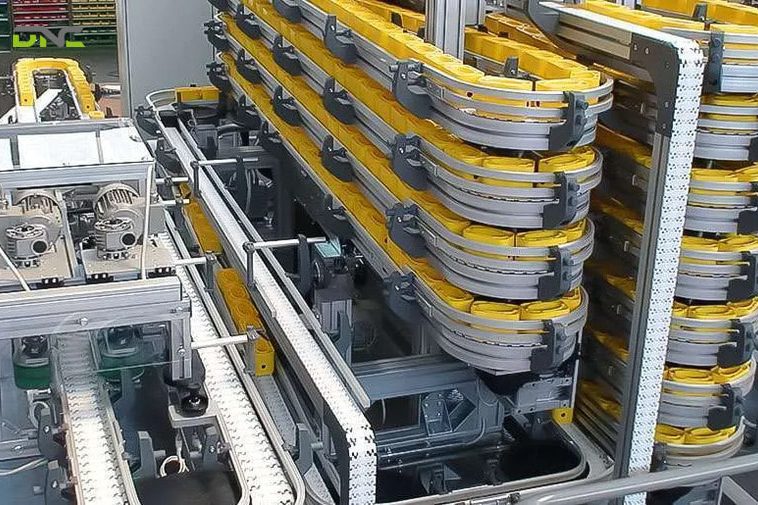
FlexLink Conveyor — Reconfigurable Material Flow for Malaysia’s High-Mix Manufacturers
FlexLink conveyor systems — both the Swedish brand FlexLink and the broader category of flexible-link chain conveyors — solve the single biggest material-handling problem in high-mix Malaysian manufacturing: a production layout that locks you into yesterday’s product mix. Factories in Penang’s pharmaceutical cluster, Selangor’s F&B facilities, and Malaysia’s fast-growing personal care sector regularly change SKUs, packaging formats, and line configurations. Rebuilding welded-steel conveyor systems for every layout change takes days of downtime and tens of thousands of ringgit in engineering labor. Flexible-link chain conveyors on aluminium T-slot profiles reconfigure in hours, not days, using 1,500+ compatible accessories that bolt onto a universal extrusion system without cutting or welding. This article explains how flexlink conveyor systems work, what types exist, and how Malaysian manufacturers are using them to achieve the agility that NIMP 2030 smart factories demand.
What Is a FlexLink Conveyor?
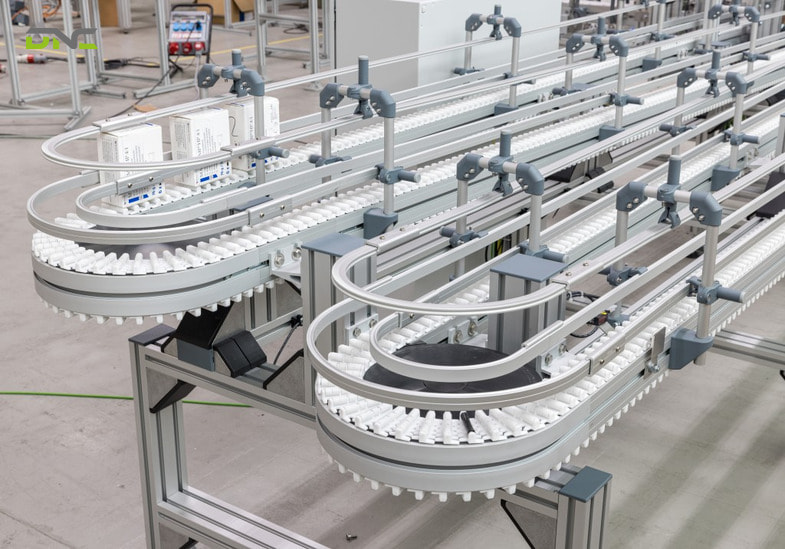
A FlexLink conveyor is a modular chain-driven conveying system built on aluminium extrusion profiles, where the primary conveying element is a flexible-link chain — a series of hinged, interlocking plastic or stainless steel links that form a continuous, low-friction carrying surface capable of navigating horizontal curves, inclines, and multi-level transfers without dedicated curved conveyor sections.
The term “FlexLink” refers both to the Swedish brand FlexLink (founded in the 1980s, now operating as part of the Covestro/Wallenberg industrial group) and, generically, to the entire product category of flexible-link chain conveyors built on modular aluminium profile systems. The brand pioneered this conveyor architecture and remains the global benchmark; the generic category includes compatible systems engineered to the same aluminium T-slot standard. This article addresses both the brand and the category.
Flexible-link chain conveyors distinguish themselves from traditional slat, roller, or belt conveyors by the chain’s inherent lateral flexibility. Unlike a straight-run roller conveyor that requires a separate 90° curved section to change direction, a flexlink chain can navigate a 90° horizontal curve within the same profile system — the chain links simply pivot at the curve without any additional mechanical components beyond a curved wear rail insert.
How Does a FlexLink Conveyor Work?
FlexLink conveyor operation combines a modular aluminium profile beam, a flexible plastic or stainless steel link chain, a compact drive unit, and a comprehensive range of guidance and support accessories into a system that can be assembled, disassembled, and reassembled in any configuration without specialized tooling.
Step 1 — Aluminium Profile Beam Assembly
Aluminium T-slot extrusion beams form the structural skeleton of every flexlink system. The T-slot profile accepts standard M8 bolts at any position along the beam length, allowing accessories — side guides, supports, drive units, sensors, pneumatic stops, diverters — to be mounted and repositioned without drilling. Beam cross-sections range from compact (WL 40 series, 40 mm wide) to heavy-duty (X85 series, 85 mm profile). DNC Automation fabricates support structures from the same aluminium extrusion system, creating a unified framework that is both lightweight and structurally rigid.
Step 2 — Flexible Chain Installation and Routing
The flexible-link chain is fed into the aluminium beam’s integrated chain guide channel. The chain’s lateral flexibility — achieved by the pivot geometry of each individual link — allows it to navigate curves by differential steering within the guide channel. Standard horizontal curves are available in 45°, 90°, and 180° radii from 100 mm to 1,000 mm. The chain is joined end-to-end by inserting a joining pin, forming a continuous loop without bonding agents or vulcanizing equipment. This joinability means a chain can be cut to exact length on-site with a chain-splitting tool in under two minutes.
Step 3 — Drive Unit Connection
Drive units on a flexlink system are compact, self-contained motor-gearbox assemblies that bolt onto the aluminium beam at any drive position — typically at the tail end for simple lines or at intermediate positions on long circuits. Drive unit motor ratings range from 0.09 kW to 2.2 kW depending on load and speed requirements. Belt speed is continuously variable from 0.5 m/min to 60 m/min via a frequency inverter — Siemens SINAMICS drives are DNC Automation’s standard specification for variable-speed flexlink installations.
Step 4 — Guide Rail and Lateral Constraint System
Side guide rails of UHMW-PE or stainless steel are mounted in the beam’s T-slots to contain products on the chain surface and prevent lateral movement at curves. Guide width is adjusted by loosening the T-slot bolt, sliding the guide to the new position, and re-tightening — a 30-second operation. For lines handling multiple product widths (common in high-mix SKU environments), guide positions are marked on the beam with millimetre tape for rapid changeover. This is the specific capability that makes flexlink conveyors the preferred choice for Penang’s pharmaceutical contract manufacturers, who change between blister-pack format and bottle format on the same line multiple times per week.
Step 5 — Accessory Integration and System Commissioning
System commissioning on a flexlink conveyor involves connecting the drive units to the control panel (typically a Siemens S7-1200 or S7-1500 PLC in DNC-built systems), calibrating sensor positions for product detection and accumulation logic, and verifying chain tension and tracking under full load. DNC Automation’s 35+ engineers commission flexlink systems from single-zone lines to multi-loop factory-wide material transport circuits, with full SCADA integration for production monitoring under NIMP 2030 smart-factory standards.
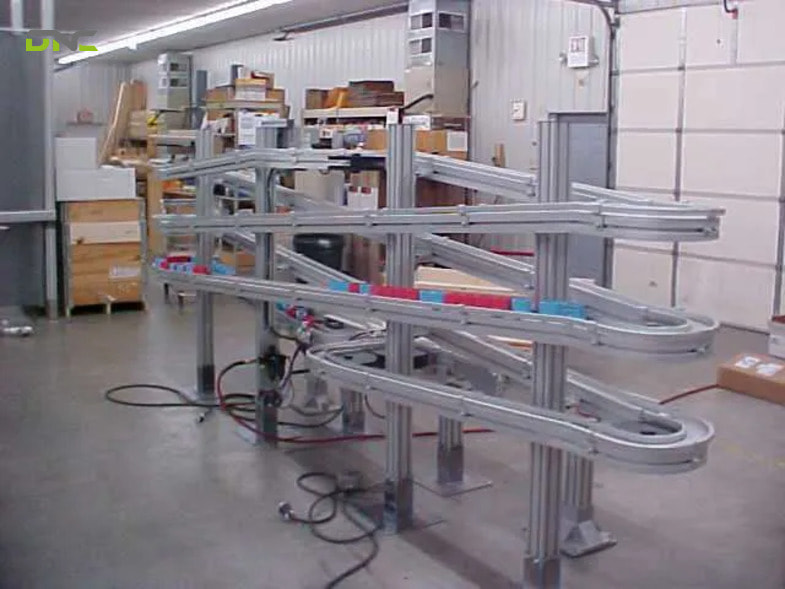
How Does a FlexLink Conveyor Work?
Types of FlexLink Conveyor
FlexLink conveyor variants cover every production environment from hygienic food processing to heavy automotive part transport, each engineered around the same aluminium extrusion and flexible-link chain platform.
Flat-Top Chain Conveyor (Standard Series)
Flat-top chain flexlink conveyors are the most widely deployed variant globally, handling packaged goods, bottles, cartons, and consumer products at speeds from 0.5 to 60 m/min. The chain’s flat upper surface provides a stable, low-friction carrying platform; standard link materials are acetal (POM) for food-adjacent and packaging environments and polypropylene for general industrial use. Load capacity is up to 50 kg/m of chain length on standard profiles, rising to 120 kg/m on X85 heavy-duty profiles. These are used by Malaysian personal care and cosmetics manufacturers in Selangor for high-speed secondary packaging lines.
Pallet System (WL Series)
WL pallet systems elevate the flexlink platform into precision assembly and test automation. Aluminium pallets — ranging from 80 mm × 80 mm to 400 mm × 400 mm — circulate on the chain conveyor and carry products through assembly, testing, and inspection stations. Each pallet carries a unique RFID tag or barcode that the PLC reads at each station, enabling flexible routing: Pallet A goes to Station 2, Pallet B is diverted to rework Station 7. This is the enabling infrastructure for Industry 4.0 mixed-model assembly lines. DNC Automation has deployed WL pallet systems for electronics assembly clients in Penang, where PCB variants are simultaneously assembled on the same physical line routed by pallet identity.
Wash-Down Stainless Steel Series
Stainless steel flexlink conveyors use 304 or 316L stainless chain links, stainless aluminium-equivalent profiles, and IP69K-rated drive units for food-production environments requiring daily high-pressure, high-temperature wash-down. F&B manufacturers operating under HACCP and ISO 22000 — including DNC clients such as F&N and Ramly Burger — specify the stainless wash-down series for product-contact zone conveyors. The aluminium extrusion beams are anodised and sealed; all fasteners are A4 stainless steel.
X85 Heavy-Duty Series
X85 flexlink conveyors use an 85 mm wide aluminium profile with dual chain lanes for carrying loads up to 120 kg/m at speeds up to 30 m/min. Applications include medical device component transport, heavy packaged goods (cases of 24-can beverage packs weighing 12+ kg), and automotive sub-assembly parts. The X85’s aluminium extrusion beam maintains the same T-slot accessory compatibility as the standard series, preserving layout flexibility even at heavy-duty load ratings.
Z-Conveyor (Vertical Elevating Conveyor)
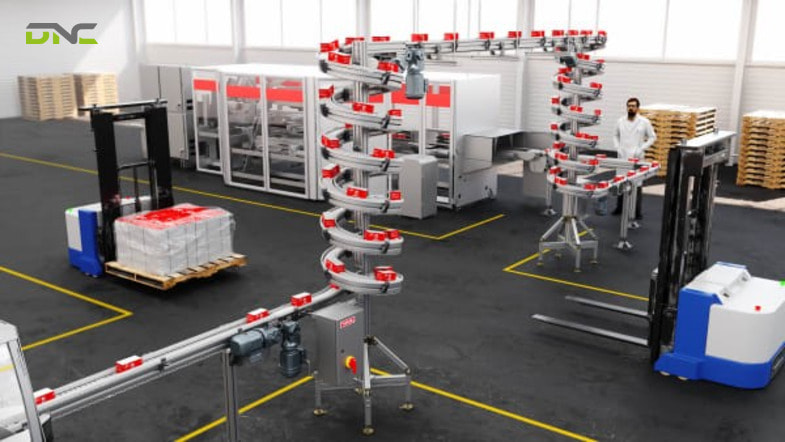
Z-conveyor (vertical flexlink conveyor) uses the same chain system in a Z-shaped profile to elevate or lower products between floor levels without a separate incline conveyor. Products ride on the chain’s flat surface through the inclined section, guided by lateral rails, and transition smoothly to the horizontal output section. Z-conveyors replace separate staircase-style incline conveyors in factories where floor space is constrained — a significant advantage in Penang’s high-value, high-density electronics manufacturing buildings.
Comparison Table: FlexLink Variants by Application
| Variant | Chain Material | Speed (m/min) | Load (kg/m) | Best Application |
| Flat-Top Standard | POM / PP | 0.5–60 | 50 | Packaging, bottles, consumer goods |
| WL Pallet System | POM with aluminium pallet | 0.5–30 | 100 (pallet) | Precision assembly, test, routing |
| Wash-Down SS | 316L Stainless | 0.5–40 | 50 | Food, pharma, beverage |
| X85 Heavy-Duty | POM | 0.5–30 | 120 | Medical devices, heavy cases |
| Z-Conveyor | POM / PP | 0.5–20 | 30 | Vertical level transfer |
Key Components of a FlexLink Conveyor System
A complete flexlink conveyor system is an ecosystem of precisely engineered components, each designed for tool-free installation into the T-slot aluminium profile.
Aluminium extrusion beam — The structural backbone. Available in lengths of 150 mm to 6,000 mm and joined with precision splice connectors for unlimited run length. The T-slot grooves accept M8 nuts at any position.
Flexible-link chain — POM, PP, stainless steel, or carbon-filled ESD-safe materials. Pitch is typically 25.4 mm or 50.8 mm depending on series. Chain is cut to length with a standard chain-splitting tool; no grinding, welding, or adhesive required.
Drive unit — Motor-gearbox assemblies in 0.09–2.2 kW ratings. IEC motor frames accept Siemens or ABB motors; frequency-inverter compatible. Mounting orientation — horizontal, vertical, left-side, right-side — all achievable with the same drive unit housing.
Idler (tail) unit — Provides chain tension and return path guidance at the non-drive end. Integrated chain tension adjustment via screw mechanism on the tail shaft bearing block.
Wear strips — UHMW-PE inserts that line the chain guide channel, providing low-friction chain support and absorbing chain wear. Replaceable without disassembling the beam.
Side guides and product guides — Available in straight, curved, angled, and offset profiles in UHMW-PE, POM, and stainless steel. Mounted in T-slots and repositioned in seconds for product changeover.
Stops, diverters, and sensors — Pneumatic stop cylinders, pop-up diverter blades, and photoelectric or inductive sensors all mount directly to the T-slot profile, connecting to the PLC for automated routing logic.
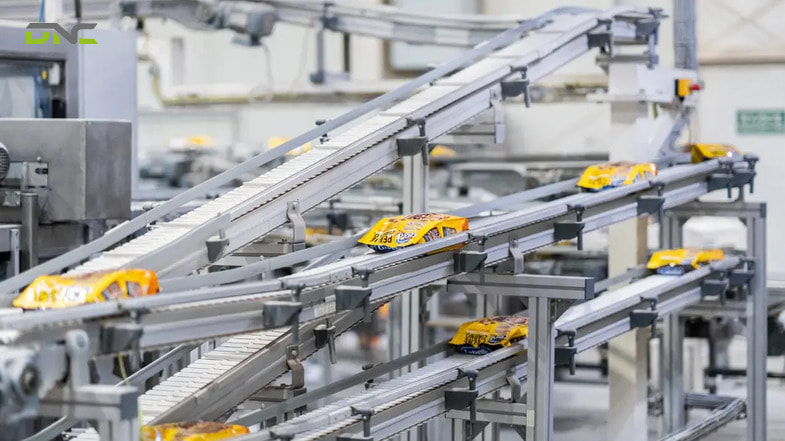
Key Components of a FlexLink Conveyor System
Applications: Where FlexLink Conveyors Are Used in Malaysian Manufacturing
FlexLink conveyor system applications in Malaysia concentrate in four sectors: pharmaceutical and medical devices, F&B packaging, electronics EMS, and personal care.
Pharmaceutical and Medical Device Manufacturing — Penang
Penang’s pharmaceutical cluster includes multinational CMOs and domestic pharmaceutical manufacturers producing tablets, capsules, injectables, and diagnostic devices. Flexible-link chain conveyors connect blister-pack machines, cartoners, case-packers, and labellers in a layout that FDA and EU GMP auditors can inspect for cleanability and product traceability. WL pallet systems carry individual product batches through serialisation stations where each unit is scanned, weighed, and assigned a unique serial number. The layout-reconfiguration capability is critical because Penang pharma factories regularly add new product registrations that require new line configurations. A factory that previously needed 3 days of downtime per reconfiguration now achieves the same in 6 hours using flexlink aluminium profiles.
F&B Packaging Lines — Selangor
F&B packaging operations at manufacturers such as F&N and Ramly Burger — both DNC clients — use wash-down stainless flexlink conveyors to transport filled bottles, pouches, and trays from filling machines to labellers, checkweighers, and case-packers. SKU changeovers in F&B (switching from 250 mL to 500 mL bottle format, for example) require guide-rail repositioning — a 15-minute operation on a flexlink system versus 4–6 hours of tooling changes on a fixed-steel conveyor. Under Malaysia’s labor shortage reality, where the minimum wage has increased to RM 1,500/month (2024) and skilled maintenance workers command premium rates, reducing changeover labor directly improves profitability.
Electronics EMS and PCB Assembly — Penang
Penang’s electronics manufacturing sector contributes 58% of Malaysia’s E&E exports — approximately USD 47 billion annually. EMS factories assembling PCBs, hard drives, and semiconductor modules require clean-room-compatible conveyors with ESD-safe (carbon-filled) chain materials to prevent static discharge damage to sensitive components. FlexLink’s carbon-filled POM chain variant provides surface resistivity of 10^5–10^9 Ω, meeting IPC-A-610 ESD requirements. DNC Automation deploys these systems with Siemens S7-1500 PLCs and PROFINET connectivity for real-time WIP (work-in-progress) tracking that feeds into factory MES systems.
Personal Care and Cosmetics — Selangor
Personal care manufacturing in Selangor — shampoos, lotions, cosmetics — shares the high-mix, fast-changeover challenge with F&B. Flexlink’s rapid guide reconfiguration handles bottle formats from 50 mL travel sizes to 1L salon bottles on the same conveyor infrastructure, supporting the SKU proliferation that modern retail demands. The Malaysia SAG Grant (up to RM 1 million, MIDA 70:30 matching) covers flexlink conveyor installations integrated with automated labelling and vision inspection — DNC Automation assists Selangor manufacturers through the full grant application process.
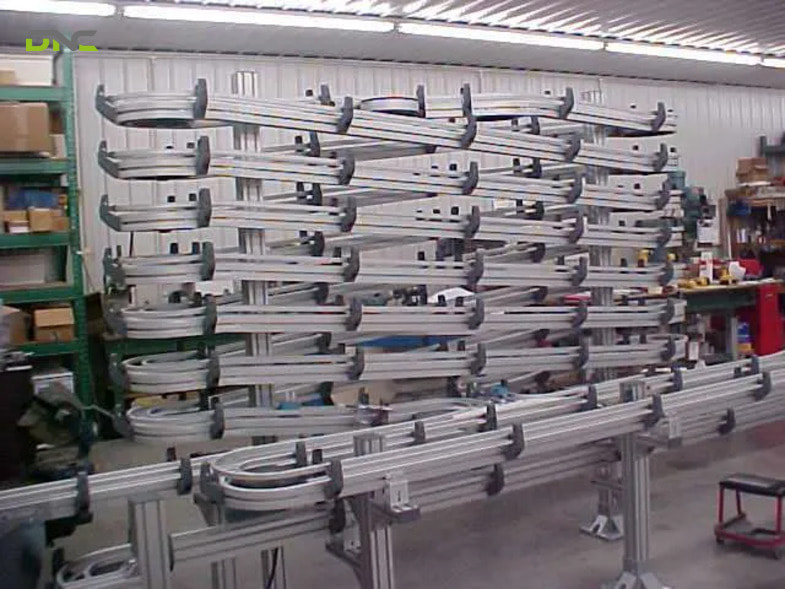
Where FlexLink Conveyors Are Used in Malaysian Manufacturing
Benefits of FlexLink Conveyors for Malaysian Factory Operations
FlexLink conveyor systems deliver four categories of measurable benefit that make them one of the highest-ROI conveyor investments available.
Layout change time reduced from days to hours — A standard 10-metre welded-steel conveyor line takes 2–3 days to reconfigure (cut, weld, repaint, reinstall). The equivalent flexlink system reconfigures in 4–8 hours by repositioning T-slot accessories and adjusting chain length. For a factory running 20 production hours per day, this saves 32–52 hours of lost production per reconfiguration event.
Productivity increase of up to 50% — DNC Automation’s installations demonstrate that eliminating production losses from lengthy changeovers and layout freezes directly recovers OEE. Factories that previously operated 2 product lines for separate SKUs (because their conveyors could not be reconfigured economically) consolidate onto 1 flexible flexlink line, doubling utilisation of the capital asset.
Maintenance cost reduction through modularity — Drive units, wear strips, and chain sections are replaced as discrete components. Total conveyor maintenance cost per year is 30–45% lower than equivalent fixed-steel conveyor systems, based on DNC Automation’s service data from Malaysian installations.
NIMP 2030 smart-factory readiness — FlexLink’s T-slot accessory ecosystem includes integrated sensor mounts, RFID readers, and vision camera brackets that directly support the Industry 4.0 data-capture requirements of Malaysia’s NIMP 2030 programme. Every component of a DNC-designed flexlink system can be connected to a Siemens TIA Portal automation framework with full SCADA and OPC-UA connectivity.
Benefits of FlexLink Conveyors for Malaysian Factory Operations
How to Choose the Right FlexLink Conveyor for Your Factory
Selecting the correct flexlink conveyor variant starts with five questions: What product are you conveying? What is the required speed and throughput? What is your hygiene requirement? How frequently do you change layouts? And what control integration does your factory require?
Product characteristics drive chain and guide selection — Lightweight bottles and cartons: flat-top POM chain. Precise assembly parts: WL pallet system. Food-contact products requiring wash-down: stainless wash-down series. Heavy cases above 50 kg/m: X85 series.
Speed requirement determines drive unit sizing — Lines above 30 m/min require larger drive units and more frequent chain wear inspection intervals. DNC Automation uses Siemens frequency inverters on all variable-speed installations to provide soft-start, smooth acceleration, and PLC-controlled speed profiling.
Hygiene requirement specifies frame and chain materials — IP69K-rated drive units, 316L stainless chain, anodised profiles, and food-grade lubricant for HACCP/ISO 22000 lines; standard anodised aluminium and POM chain for pharma clean-room applications.
Reconfiguration frequency justifies investment — Factories changing layouts more than once per quarter achieve payback on flexlink’s premium over fixed-steel conveyors within 18–24 months. Factories with stable, unchanging layouts may find fixed-steel conveyors more cost-effective for their specific situation — an honest assessment DNC Automation provides during free consultation.
Control integration requirements — Siemens S7-1200 for simple speed control and basic stop/go logic; Siemens S7-1500 with PROFINET for pallet-routing, RFID, and MES connectivity on high-mix assembly lines.
How to Choose the Right FlexLink Conveyor for Your Factory
Frequently Asked Questions About FlexLink Conveyors
What is the difference between a FlexLink conveyor brand and a generic flexible-link chain conveyor?
FlexLink (the Swedish brand) is the originator and largest global supplier of aluminium T-slot modular chain conveyors, with the widest range of accessories (1,500+ catalogue items) and the most comprehensive application engineering support. Generic flexible-link chain conveyors from Asian or European manufacturers use the same aluminium T-slot concept at lower capital cost but with more limited accessory ranges and less application engineering depth. DNC Automation assesses both options during consultation and recommends based on each client’s reconfiguration frequency and integration complexity.
Can a FlexLink conveyor run in a food-production environment with daily wash-down?
Yes — the wash-down stainless steel series uses IP69K-rated drive units, 316L stainless chain, sealed aluminium profiles, and A4 stainless fasteners throughout. All food-contact materials are compliant with EC Regulation 1935/2004 and FDA 21 CFR. DNC Automation has delivered wash-down flexlink systems to F&N and Ramly Burger, both of which operate under ISO 22000 and HACCP certification.
What speed does a FlexLink conveyor operate at?
Standard flat-top flexlink conveyors operate from 0.5 m/min (slow accumulation) to 60 m/min (high-speed packaging). The WL pallet system operates at 0.5–30 m/min to maintain pallet position accuracy. Speed is controlled via Siemens frequency inverter with 0.1 m/min resolution, allowing precise synchronisation between multiple conveyor zones in a linked production line.
How long does it take to reconfigure a FlexLink conveyor layout?
A standard 10-metre flexlink line with guide rail adjustments and one diverter reposition takes 4–8 hours for two technicians using standard tools. A full line redesign — changing from linear to U-shaped layout, adding or removing a Z-elevator section, splitting one line into two — takes 1–2 days depending on scope. This compares to 3–5 days minimum for equivalent welded-steel conveyor reconstruction.
Does DNC Automation supply FlexLink conveyors or build custom flexible-link chain systems?
DNC Automation (dnc-automation.com) engineers complete flexible-link chain conveyor systems for Malaysian manufacturers, including both FlexLink brand systems and custom-engineered modular aluminium conveyor systems. All DNC conveyor projects include Siemens PLC control panels, sensor integration, SCADA connectivity, and full commissioning. DNC’s ISO 9001:2015 certification and 35+ engineers ensure delivery to the same quality standard as the brand-name system.
Is the SAG Grant applicable for a FlexLink conveyor system?
MIDA’s Smart Automation Grant (SAG) covers automation capital expenditure including conveyor systems integrated with PLC control, RFID tracking, and MES connectivity. A flexlink conveyor system supplied by DNC with Siemens PLC integration, production monitoring software, and documented productivity improvement evidence qualifies under SAG criteria. DNC Automation guides clients through the SAG application process, which provides up to RM 1 million on a 70:30 matching basis.
What maintenance does a FlexLink conveyor system require?
Routine maintenance includes monthly chain lubrication (food-grade NSF H1 lubricant on food-contact lines), quarterly wear strip inspection and replacement if wear exceeds 2 mm, annual drive unit gearbox oil change, and periodic chain tension adjustment. DNC Automation provides maintenance service contracts for all conveyor systems installed in Malaysia, with 24-hour emergency response for production-critical lines.
How does a FlexLink conveyor support NIMP 2030 smart factory requirements?
FlexLink’s T-slot accessory ecosystem directly supports NIMP 2030 smart factory infrastructure: RFID pallet tracking provides real-time WIP visibility; Siemens S7-1500 PLC integration enables OPC-UA data export to factory MES; vision inspection camera brackets mount without drilling; and the modular platform can be extended incrementally as the factory’s automation level advances from manual to semi-automated to fully automated over the NIMP 2030 investment timeline.
Conclusion
FlexLink conveyor systems — whether the Swedish brand or the broader category of flexible-link chain conveyors on aluminium T-slot profiles — represent the most agile material-handling investment available to Malaysian manufacturers operating in high-mix, fast-changeover production environments. For Penang’s pharmaceutical and electronics clusters, Selangor’s F&B and personal care sector, and any factory targeting NIMP 2030 smart-factory transformation, the combination of rapid layout reconfiguration, modular maintenance, and seamless Siemens PLC integration makes flexlink the benchmark conveyor platform.
DNC Automation (dnc-automation.com) — Malaysia’s No. 1 factory automation company since 2005, ISO 9001:2015 certified with 35+ engineers — designs, builds, and commissions complete flexlink conveyor systems for Malaysian manufacturers across every industry. Get a Free Consultation today and let our engineers assess your current layout, changeover frequency, and production goals to specify the right flexible-link conveyor solution.
Related reading: Explore DNC Automation’s full range of conveyor automation solutions including plastic modular belt systems, transfer conveyors, and Siemens-integrated conveyor control panels.
- 12 views
- 0 Comment
Recent Comments