



Mobile Manipulator Robot: AGV and AMR with Robotic Arm
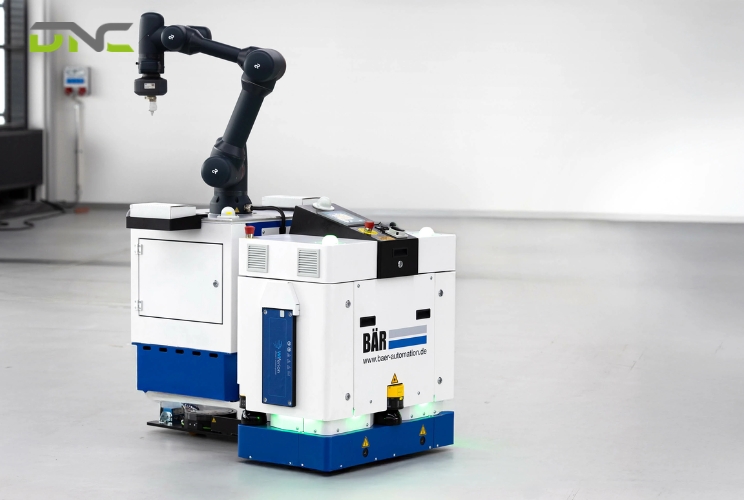
Mobile manipulator robots mount industrial or collaborative robotic arms on autonomous mobile platforms — creating machines that navigate to workstations and perform physical tasks without human intervention. An AGV with robotic arm follows guided paths between machines; an AMR with robot arm navigates dynamically using SLAM-based intelligence. Both configurations deliver the same fundamental capability: a robot that transports itself to where work needs to be done, then executes manipulation tasks — loading machines, picking parts, inspecting components, or assembling products — before moving to the next assignment. Malaysian manufacturers seeking to automate multi-station operations find mobile manipulator robots particularly compelling because a single system replaces both material transport labor and workstation-specific handling labor simultaneously.
What Is a Mobile Manipulator Robot?
A mobile manipulator robot — also called a mobile robot with arm or mobile robotic arm system — consists of two integrated subsystems. The mobile base (AGV or AMR) provides autonomous locomotion throughout a facility. The robotic arm (collaborative or industrial, typically 6-axis) provides physical manipulation capability at workstations. A unified control system coordinates navigation and arm operation so that the complete system executes complex tasks autonomously: travel to machine A, open the door, remove the finished part, insert a new workpiece, close the door, start the cycle, carry the finished part to inspection station B, present the part for measurement, then proceed to machine C.
The mobile robot arm concept extends the reach of robotic automation beyond the fixed workstation paradigm. Traditional industrial robots — including collaborative robots — are bolted to a single location. Each workstation requiring robotic handling needs its own dedicated robot. A mobile manipulator replaces multiple fixed installations with one mobile system that serves a circuit of workstations sequentially, achieving comparable throughput at significantly lower capital investment when machine cycle times allow sequential service.
How Does a Mobile Manipulator Work?
Platform Navigation
The mobile base navigates using standard AGV or AMR technologies. AGV-based mobile manipulators follow magnetic tape, wire, or laser-guided paths — delivering high positional accuracy (±1–5 mm) at each workstation through proven, deterministic guidance. AMR-based mobile manipulators use SLAM and LiDAR for dynamic, infrastructure-free navigation — offering route flexibility at the cost of slightly lower native docking accuracy (±10–30 mm).
Precision Docking
Arm manipulation tasks demand higher positional accuracy than transport tasks. A robotic arm loading a CNC chuck requires ±1–2 mm positioning; standard AMR navigation delivers ±10–30 mm. Mobile manipulators bridge this gap through precision docking systems:
Visual servoing uses a camera on the arm or platform to detect fiducial markers (AprilTags, QR codes, or calibration targets) mounted at each workstation. The system calculates the position offset and drives the platform and arm to the exact required position with sub-millimeter accuracy.
Mechanical docking uses physical alignment features — V-groove guides, pin-and-hole aligners, or magnetic docking plates — that center the platform precisely when it contacts the workstation docking fixture.
3D camera alignment uses depth cameras to measure the spatial relationship between the arm’s end-effector and the workpiece or fixture, providing real-time correction during approach and positioning.
Arm Operation
Once docked, the robotic arm executes its task program. The arm controller interfaces with the workstation’s machine PLC for handshaking — receiving signals (machine ready, door open, cycle complete) and sending commands (start cycle, part loaded, emergency stop). The arm’s end-of-arm tool (EOAT) — gripper, vacuum pad, camera, or specialized fixture — performs the physical interaction with workpieces, machines, and inspection equipment.
Collaborative robotic arms (cobots) used on mobile manipulators feature force and torque sensors that detect unexpected contact with humans or objects, immediately limiting force to safe levels per ISO/TS 15066. This safety architecture enables mobile manipulator operation in shared workspaces without safety fencing.
Task Sequencing and Fleet Coordination
Fleet management software schedules mobile manipulator assignments across all served workstations. The scheduler monitors machine cycle states (via PLC signals), robot battery levels, and workstation priorities to dispatch the right robot at the right time. When multiple mobile manipulators operate in a fleet, the scheduler manages traffic, prevents collisions, and load-balances workstation service across available robots.
Types of Mobile Manipulator Robots
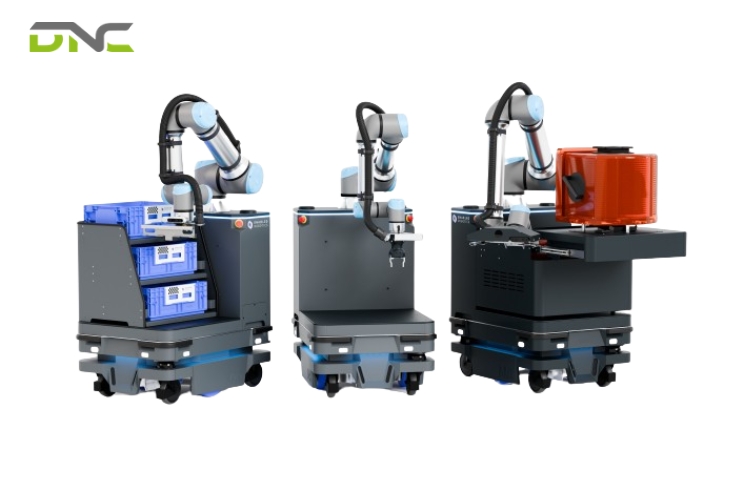
AMR + Collaborative Arm
The most common mobile manipulator configuration pairs an AMR platform with a collaborative robot arm. This combination delivers flexible navigation (SLAM-based, infrastructure-free) with safe human-collaborative manipulation (force-limited arm).
Typical specifications:
- Platform payload: 100–500 kg
- Arm payload: 3–16 kg
- Arm reach: 500–1,300 mm
- Navigation: SLAM (2D LiDAR + cameras)
- Docking: Visual servoing or mechanical
- Safety: ISO 3691-4 (platform) + ISO/TS 15066 (arm)
Leading examples: Omron LD series + TM cobot (the Omron mobile manipulator), MiR250 + Universal Robots cobot, KUKA KMR iiwa.
AGV + Collaborative Arm
AGV-based mobile manipulators sacrifice navigation flexibility for native precision. Laser-guided or magnetic-tape AGVs deliver ±1–5 mm docking accuracy without additional alignment systems — sufficient for many machine tending and precision pick-and-place tasks.
This configuration suits facilities with stable layouts where workstation positions do not change. The AGV’s fixed-path predictability also simplifies safety assessment: operators know exactly where the mobile manipulator will travel and can plan workspace zones accordingly.
AMR + Industrial Arm
For applications requiring higher arm payload (20–50 kg), faster cycle times, or extended reach beyond cobot limitations, mobile manipulators mount industrial robot arms on heavy-duty AMR platforms. These systems require safety fencing or area scanners that create dynamic safety zones during arm operation — the industrial arm does not have the built-in force-limiting features of collaborative arms.
Industrial arm mobile manipulators serve heavy-part machine tending (engine blocks, transmission housings, steel castings), large-part palletizing, and applications where arm speed and payload exceed collaborative robot specifications.
Wireless Mobile Robotic Arm
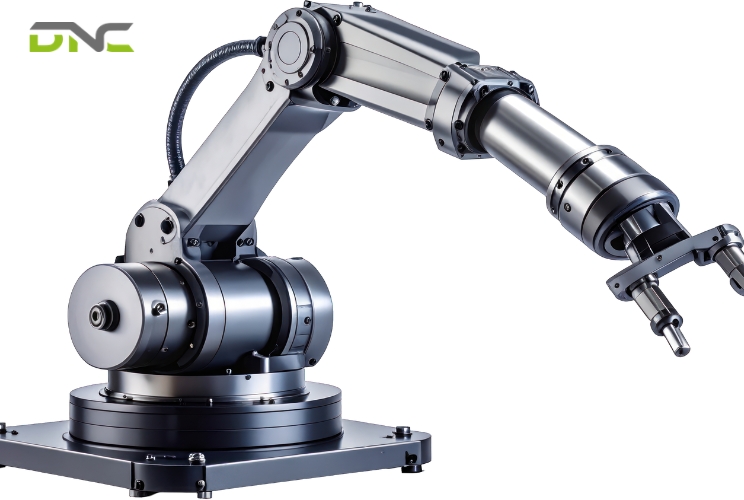
Wireless mobile robotic arm systems — a term used to describe mobile manipulators that operate without wired connections to external power or data — are standard across modern mobile manipulator platforms. Onboard batteries power both the platform and the arm; Wi-Fi provides fleet communication; and the arm operates from stored programs and real-time fleet manager commands. The “wireless” aspect is inherent to the mobile manipulator concept rather than a distinct configuration.
Key Specifications to Evaluate
| Specification | Why It Matters | Typical Range |
| Platform payload capacity | Must support arm weight + workpiece + tooling | 100–600 kg |
| Arm payload | Maximum workpiece + EOAT weight | 3–50 kg |
| Arm reach | Must access all points in workstation work zone | 500–1,800 mm |
| Docking accuracy | Determines whether precision tasks are feasible | ±1–30 mm |
| Battery runtime | Must complete full service circuit + charging | 8–16 hours |
| Navigation type | SLAM (flexible) vs guided (precise) | Application-dependent |
| Safety standard | ISO/TS 15066 for cobot; fencing for industrial | Mandatory compliance |
| Communication | Wi-Fi to fleet manager + PLC interface | Industrial Wi-Fi + I/O |
Applications in Malaysian Manufacturing
CNC Machine Tending
Malaysian job shops and contract manufacturers operate banks of CNC lathes, mills, and grinding machines. A mobile manipulator serving 4–8 CNC machines handles the complete load/unload cycle at each machine: approach, open door, remove finished part, insert raw workpiece, close door, signal cycle start. One mobile manipulator replaces 2–3 operators across shifts while enabling unmanned night and weekend production.
DNC Automation integrates mobile manipulator systems with Siemens and Mitsubishi CNC controllers commonly deployed in Malaysian metalworking shops — handling door control, chuck operation, cycle start/stop, and part-present verification through standard PLC handshaking protocols.
Injection Molding Machine Service
Plastic injection molding factories across Johor and Selangor run banks of molding machines producing components for automotive, electronics, and consumer goods. Mobile manipulators extract molded parts from machines, trim sprues, place parts on conveyors or into bins, and repeat across multiple machines. The cyclic, repetitive nature of molding machine service makes it an ideal mobile manipulator application.
Quality Inspection Rounds
Mobile manipulators equipped with vision-integrated EOAT perform quality inspection across multiple production cells. The arm positions a camera or measurement probe at predefined inspection points on workpieces, captures dimensional data or surface images, and uploads results to the quality management system. This autonomous inspection round replaces manual quality checks performed by roving inspectors.
Electronics Component Handling
Penang’s electronics manufacturing cluster uses mobile manipulators for sensitive component handling — picking populated PCBs from SMT line outputs, transporting them between inspection stations, and placing them in packaging fixtures. The mobile platform’s SLAM navigation adapts to the frequent production cell reconfigurations that characterize high-mix electronics manufacturing.
Multi-Station Assembly
Mobile manipulators perform light assembly tasks across dispersed assembly cells — inserting fasteners, applying adhesive, positioning components, or operating manual tools. The robot travels between cells, performs its assigned operation at each station, and proceeds to the next. This approach suits assembly operations where each station requires only intermittent robotic assistance rather than continuous robot presence.
Benefits of Mobile Manipulator Robots
Capital efficiency. One mobile manipulator serving 6 workstations costs USD 100,000–250,000 — significantly less than 6 fixed cobots (USD 150,000–480,000 total) performing the same tasks. The mobile architecture converts a 6-robot investment into a 1-robot solution.
Utilization maximization. Fixed cobots at workstations with long cycle times sit idle during machine processing — utilization may reach only 10–20%. A mobile manipulator spends its idle time traveling to and serving other workstations, maintaining 80–90% utilization throughout its operating shift.
Unmanned production capability. Mobile manipulators enable lights-out manufacturing during nights and weekends. Machines run unattended while the mobile manipulator performs all loading, unloading, and inter-process transport. This extends productive hours by 40–80% without additional labor — a critical advantage in Malaysia’s tight manufacturing labor market.
Flexible redeployment. When production requirements change — new products, different machines, modified layouts — the mobile manipulator adapts through software reprogramming and EOAT changes. No physical reinstallation or workstation modification is required.
Reduced floor space requirement. Eliminating fixed robot installations at every workstation frees valuable floor space for additional machines, staging areas, or work zones. The mobile manipulator occupies floor space only temporarily while servicing each station.
How to Evaluate a Mobile Manipulator Investment
Map your workstation circuit. Identify all candidate workstations where the mobile manipulator will operate. Measure the distance between stations, the time required at each station (arm task duration + machine cycle time), and the total circuit time. The circuit must fit within your production takt time — if not, consider adding a second mobile manipulator.
Verify physical access. Each workstation must be physically accessible: clear floor path for the mobile platform, adequate clearance for the arm’s work envelope, no overhead obstructions within the arm’s reach zone, and a viable docking position that allows the arm to reach all required pickup and placement points.
Specify EOAT requirements. Different workstations may require different grippers, vacuum tools, or fixtures. Plan for automatic tool change systems if the circuit includes stations with different EOAT requirements, and design tool storage points along the mobile manipulator’s route.
Evaluate integration complexity. Each workstation’s machine requires PLC-level integration for handshaking signals. Assess your existing machine PLC platforms and determine the integration effort per station. Facilities with standardized PLC architectures (all Siemens, or all Mitsubishi) simplify integration; mixed PLC environments require additional protocol bridging.
Calculate ROI against alternatives. Compare the mobile manipulator investment against three alternatives: manual labor (baseline), fixed cobots at each station, and fixed cobots at high-priority stations only. The mobile manipulator typically wins when serving 4+ stations with cycle times that permit sequential service, and when the capital allocation does not support fixed robots at every station.
Cost Structure
| Component | Cost Range (USD) |
| AMR platform (250 kg class) | 40,000–100,000 |
| Cobot arm (6-axis, 5–10 kg) | 25,000–50,000 |
| End-of-arm tooling | 3,000–20,000 |
| Vision system + docking | 8,000–30,000 |
| Auto tool changer (if needed) | 5,000–15,000 |
| Fleet management software | 10,000–30,000 |
| Integration + commissioning | 15,000–50,000 |
| **Total system** | **110,000–295,000** |
Malaysian manufacturers accessing MIDA automation incentives (Pioneer Status, investment tax allowances) can reduce effective costs by 15–30%.
Frequently Asked Questions About Mobile Manipulators
What Is the Difference Between a Mobile Manipulator and a Fixed Robot?
A fixed robot is permanently installed at one workstation and performs tasks only at that location. A mobile manipulator mounts a robotic arm on a mobile platform (AGV or AMR), enabling it to travel between multiple workstations and perform manipulation tasks at each. The mobile manipulator trades the fixed robot’s continuous presence for multi-station flexibility and higher capital efficiency.
How Accurate Is a Mobile Manipulator for Machine Tending?
Mobile manipulators achieve ±1–2 mm operational accuracy using precision docking systems — visual servoing, mechanical alignment, or 3D camera correction. This accuracy is sufficient for CNC machine tending (chuck loading/unloading), injection molding part extraction, and most industrial pick-and-place tasks. AGV-based platforms provide native ±1–5 mm accuracy; AMR-based platforms use additional docking systems to achieve equivalent precision.
Can a Mobile Manipulator Change Tools Automatically?
Yes — mobile manipulators equipped with automatic tool changers (ATCs) swap end-of-arm tooling between workstations. The ATC stores multiple tools on the robot platform or at tool stations along the service route. When the mobile manipulator arrives at a workstation requiring a different tool, it docks at the tool station, releases the current tool, picks up the required tool, and proceeds to the workstation. This capability is essential for circuits serving machines with different part geometries or handling requirements.
How Many Machines Can One Mobile Manipulator Serve?
A single mobile manipulator typically serves 4 to 8 machines, depending on machine cycle time, arm task duration, and travel distance. For CNC machines with 3–5 minute cycle times, a mobile manipulator completes its arm task (30–90 seconds) plus travel time between machines (30–60 seconds) and can service 6–8 machines before the first machine completes its cycle. Shorter machine cycle times reduce the number of machines per robot.
Is Omron Mobile Manipulator Available in Malaysia?
Omron mobile manipulator systems — combining Omron LD-series mobile robots with Omron TM-series collaborative arms — are available through authorized system integrators in Malaysia. DNC Automation provides alternative mobile manipulator solutions using Comau and Doosan collaborative arms on both AGV and AMR platforms, offering flexible platform selection matched to your specific application requirements and investment scope.
What Industries Use Mobile Manipulators Most?
Automotive manufacturing (machine tending, assembly), electronics (component handling, inspection), metalworking (CNC machine service), plastics (injection molding extraction), and logistics (piece picking) represent the highest-adoption industries for mobile manipulators. In Malaysia, CNC machine tending in contract manufacturing and injection molding service in automotive/electronics component production offer the strongest ROI for mobile manipulator investment.
Conclusion
Mobile manipulator robots eliminate the tradeoff between transport automation and workstation automation by combining both capabilities in a single system. An AGV or AMR with robotic arm navigates between workstations and performs manipulation tasks at each — replacing manual operators on multi-station circuits at a fraction of the cost of deploying fixed robots at every station. Malaysian manufacturers running CNC machine shops, injection molding banks, and multi-cell assembly operations gain capital-efficient, flexible automation that extends production into unmanned hours.
DNC Automation integrates mobile manipulator systems using Comau and Doosan robot arms on AGV and AMR platforms for Malaysian manufacturers. Our 35+ engineers handle everything from workstation assessment and arm specification through PLC integration and ongoing support.
- 7 views
- 0 Comment
Recent Comments