


Beyond the Assembly Line: How End-of-Line Automation Redefines Packaging Efficiency
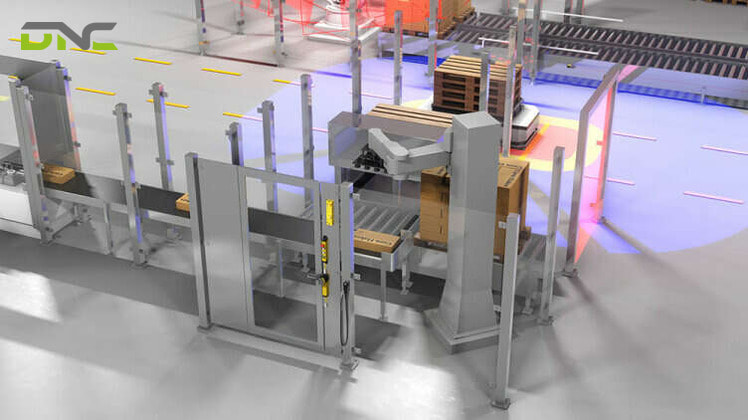
End of line packaging automation is the set of automated systems that handle the final processing stage of a production line – the point where finished products are formed into shipping cases, labeled with batch and dispatch data, palletized, and secured for transport. In the context of the full manufacturing production flow, “end of line” refers to operations that begin once a product has left its primary or secondary packaging station and must be prepared for distribution.
The most widely applied industry definition places EOL automation within the final 30% of a production line – from the case erecting station through to pallet wrapping and dispatch staging. This separates EOL systems from midline automation (filling, capping, cartoning) and from inline inspection systems that operate within the production sequence itself. An EOL automation system takes over precisely where manual labor is most physically intensive: lifting cases, stacking pallets, and applying labels at line speed.
For Malaysian manufacturers, the end of the line is where automation investment delivers the fastest return. Rising minimum wages and structural labor scarcity in factory roles – across food and beverage, glove manufacturing, and electronics assembly – mean the wage baseline against which ROI is calculated shifts consistently in automation’s favor. A packaging line that required six workers per shift five years ago now must justify that headcount against a materially higher wage base. End of line packaging automation resolves that equation directly, and DNC Automation’s engineering teams see it as the most common entry point for manufacturers beginning their Industry 4.0 implementation.
The Core Components of End of Line Packaging Equipment
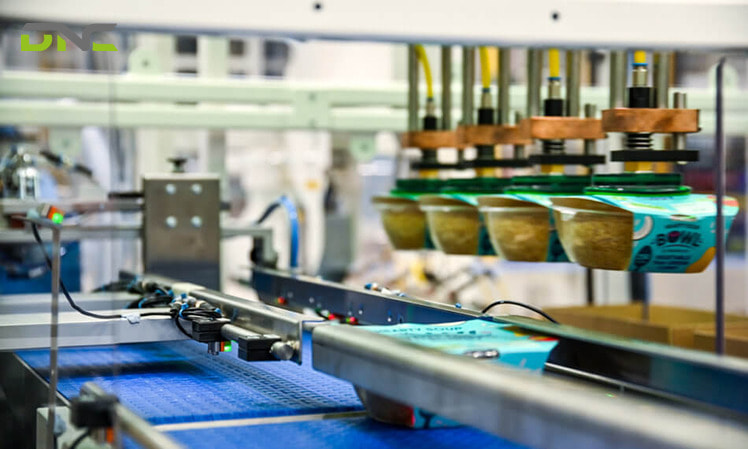
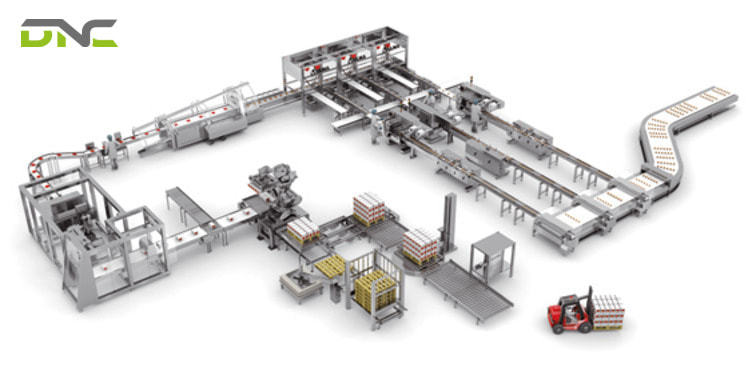
End of line packaging equipment is the collective term for the machines that execute each station in the EOL sequence – from box formation through to pallet dispatch. Six equipment types form the foundation of most EOL automation systems, and each plays a distinct role in the production flow.
Case Erectors
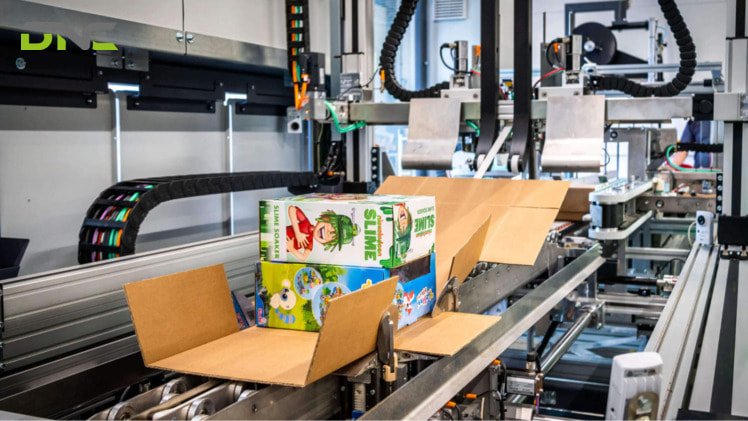
A case erector forms flat-packed cardboard blanks into open-top cases ready for product loading. The machine draws blanks from a magazine, folds them into box geometry, seals the bottom flaps with tape or hot-melt adhesive, and transfers the formed case to the downstream packing station. High-speed case erectors handle 20–40 cases per minute. Output quality – consistent fold geometry, secure base sealing – directly affects downstream packing accuracy and case integrity during transit.
Case Packers
A case packer places finished products into the formed case in a defined arrangement pattern. Systems range from manual-assist conveyors with pick-and-place robots to fully automatic drop-packers and wrap-around packers. The packing pattern – rows, layers, orientations – is programmed per SKU, so changeover between product types requires only a recipe selection rather than mechanical reconfiguration on modern servo-driven systems. Packing accuracy at this station determines whether downstream palletizing runs without case jams or misalignments.
Robotic Palletizers
A robotic palletizer uses a programmable robot arm to pick stacked cases from the end of the packing conveyor and arrange them on a pallet in a predetermined load pattern. The palletizer is the highest-volume manual labor replacement in most EOL systems – stacking heavy cases repeatedly across a shift is the task most directly linked to musculoskeletal injury risk and throughput inconsistency between shifts.
Robotic palletizing cells built around industrial robot arms – including Comau robot arms that DNC Automation engineers and commissions in Malaysian facilities – handle throughput rates from 10 to 100 cycles per minute depending on system configuration and case weight. Mixed-SKU pallet patterns, where different product types must be stacked on a single pallet, are managed through layer-pattern programming without physical tooling changes.
Stretch Wrappers
A stretch wrapper secures the completed pallet load by wrapping it with stretch film under controlled tension. The wrapping programme – number of film layers, overlap percentage, top-sheet coverage – is set per pallet type. Rotary arm stretch wrappers handle unstable or light loads without the turntable rotation that can shift product. The cost justification is direct: a facility wrapping more than 10–15 pallets per day typically reaches ROI within two years of replacing manual wrapping, and film usage per pallet is more consistent and economical under automated application.
Labeling Systems
An automated labeling system applies shipping labels, batch codes, regulatory marks, and barcode data to cases or pallets at line speed. Print-and-apply systems generate labels on-demand from upstream ERP or WMS data feeds, eliminating the pre-printed label handling that creates traceability errors in manual lines. Pharmaceutical, F&B, and glove manufacturing lines add serialization and track-and-trace requirements at this station – handled through integration with production MES or ERP systems, a capability DNC Automation integrates into EOL builds as part of broader smart manufacturing systems.
Conveyor Systems
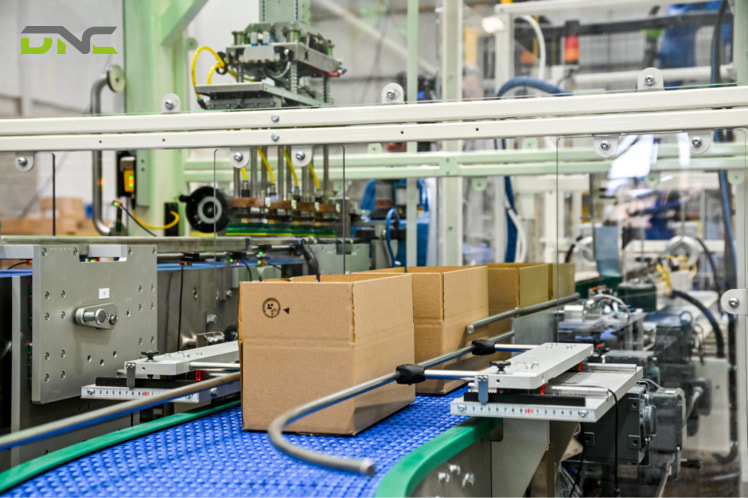
Conveyor systems connect every station in the EOL sequence, controlling product flow rate, buffer accumulation between stations, and transfer across facility layouts. In an integrated EOL line, the conveyor is not a passive transfer belt – it is a flow control system that prevents upstream stations from starving and downstream stations from jamming. DNC Automation’s conveyor system solutions include accumulation conveyors, incline conveyors, and transfer tables specified as part of the EOL integration layout rather than added as afterthoughts.
The table below summarizes the six core equipment types, their primary functions, and typical throughput ranges.
| Equipment | Primary Function | Throughput Range |
| Case Erector | Forms flat-pack cardboard into shipping cases | 20–40 cases/min |
| Case Packer | Loads products into cases in programmed patterns | 5–30 cases/min |
| Robotic Palletizer | Stacks cases onto pallets at programmed load patterns | 10–100 cycles/min |
| Stretch Wrapper | Secures pallet loads with stretch film | 30–70 pallets/hr |
| Labeling System | Applies shipping, traceability, and regulatory labels | Up to 600 labels/min |
| Conveyor System | Transfers and buffers product between EOL stations | Matched to line speed |
These six components work as a system – not as independent machines. The value of end of line packaging equipment comes from the integration layer that coordinates their operation and keeps the full sequence running at the rate the line requires.
The EOL Packaging Line Automation Sequence
A packaging line automation sequence runs continuously once initiated, with each station operating in coordination through conveyor control and PLC-managed synchronization. The following sequence describes a standard integrated EOL line from product intake to pallet dispatch.
- Finished products enter the EOL section via a transfer conveyor from the last midline station – filling, capping, or cartoning – at the rate set by that station’s output speed.
- The case erector forms a box and transfers it to the case packer in-feed conveyor, timed to match the product infeed rate.
- The case packer fills the box with the programmed product count and arrangement pattern, then transfers the filled case to the sealing station.
- The case sealer closes and secures the top flaps – tape or hot-melt – and moves the sealed case forward.
- The labeling station applies required marks – shipping label, batch code, expiry date, and any regulatory serialization – reading upstream production data from the line’s PLC or MES integration.
- The palletizer picks and stacks cases onto pallets in the programmed load pattern, cycling until the target pallet height or case count is reached.
- The stretch wrapper secures the completed pallet with the specified film programme, then transfers the wrapped pallet to the dispatch staging area.
- The dispatch conveyor or AGV moves the pallet to the outbound dock or warehouse storage location.
Throughout each station, DNC integrates Siemens PLC and SCADA monitoring – tracking throughput per station, fault states, and OEE data in real time. This integration layer is what converts a set of individual EOL machines into a smart manufacturing system where production managers identify rate mismatches, predict maintenance intervals, and report shift output without manual data entry. The result is an EOL line where information flows as consistently as product does.
Summary: EOL Equipment and Sequence
End of line packaging automation is delivered through six core equipment types – case erectors, case packers, robotic palletizers, stretch wrappers, labeling systems, and conveyor systems. Each station in the EOL sequence hands off to the next through PLC-managed conveyor synchronization, from product intake to pallet dispatch. The integration of Siemens SCADA monitoring across each station converts individual machines into a coordinated packaging line automation system where throughput, faults, and OEE data are visible in real time. This foundation – the equipment and the sequence – is what the business case, industry applications, and implementation planning in the following sections are built on.
The Business Case: Benefits of EOL Automation Systems for Manufacturers
EOL automation systems deliver returns across five operational dimensions – and for manufacturers in Malaysia, the labor economics of several of these dimensions have strengthened materially over the past three years.
Throughput and Shift Productivity
Throughput gains at the EOL stage are the most immediately measurable benefit of automation – automated EOL systems run continuously between scheduled maintenance windows, with no fatigue, pace variation, or shift changeover gaps. The result is a consistent throughput rate that is measurable, predictable, and independent of headcount. Manufacturers who commission well-specified EOL systems typically document 40–50% productivity increases at the EOL stage compared to their manual baseline – a range that reflects the shift-duration advantage of continuous automated operation over a crew that slows across a 10- or 12-hour shift.
The speed differential at individual stations is quantifiable. A fully automatic case sealer completes in under 10 seconds what takes a manual operator two to four minutes when accounting for tape handling, alignment, and positioning. At 200 cases per shift, that difference compounds into hours of productive capacity recovered per day.
Labor Cost Reduction
End of line packaging is labor-intensive by design – its manual form requires workers to lift, orient, fill, and carry repetitively across a full shift. Automating this stage reduces packaging errors by 75–80% compared to manual baseline operations and eliminates the labor overhead that drives the largest variable cost component of most Malaysian manufacturing operations.
The business case intensifies against the current Malaysian cost structure. Minimum wage increases and structural labor scarcity in factory roles mean the wage baseline against which ROI is calculated rises year on year. Manufacturers that delay EOL automation lock in a higher labor cost position while competitors absorb the capex and begin compounding the savings. DNC’s engineering consultants use current wage projections – not historical figures – when calculating ROI timelines for EOL investment proposals, and the resulting models have consistently shortened the breakeven period compared to analyses done three years prior.
Quality and Consistency
Quality and consistency at the EOL stage are functions of mechanical repeatability – every EOL automation system performs each station task in exactly the same way, every cycle. Case sealing torque, label placement position, pallet layer pattern, and stretch film tension are applied identically whether the system is processing its first case or its five-thousandth. Consistency at the EOL stage eliminates the most common cause of outbound quality claims – damaged cases, misapplied labels, and unstable pallet loads – that manual teams produce through accumulated fatigue over a shift.
Workplace Safety
Workplace safety improvements at the EOL stage are among the most direct consequences of automation – end of line tasks such as lifting filled cases, stacking pallets, and applying heavy stretch film rolls are consistently among the highest-risk manual operations in a manufacturing facility. Work-related musculoskeletal injuries from repetitive lifting and packing account for roughly one-third of occupational injuries in manufacturing environments. Robotic palletizers and automated case packers remove workers from those tasks entirely, reducing compensation exposure and improving the facility’s DOSH compliance profile – a factor that increasingly affects workforce retention in the current Malaysian labor market.
OEE Visibility and Data
Modern EOL automation systems generate continuous performance data – cases per hour, pallet cycle times, downtime events, and fault classifications – through integrated PLC and SCADA layers. This data feeds OEE (Overall Equipment Effectiveness) dashboards that give production managers a real-time view of EOL output against target. For facilities where DNC has implemented Siemens SCADA integration alongside EOL equipment, warehouse automation systems and production scheduling platforms receive dispatch data automatically – eliminating the manual reconciliation that delays shipment processing in partially automated lines.
Industries with the Highest ROI from End of Line Solutions
End of line solutions generate the highest return in industries where packaging volume is high, product weight creates physical labor risk, or regulatory requirements demand traceable labeling at line speed. In the Malaysian manufacturing context, five industries stand out.
Food and Beverage
F&B manufacturing operates at high volume with strict hygiene requirements and seasonal demand peaks that manual EOL teams cannot absorb without temporary headcount. Automated case packers and robotic palletizers in food facilities are built to food-grade specifications – sealed conveyor surfaces, washdown-compatible motor housings, hygienic structural frames – and sustain throughput rates that maintain distribution commitments through peak periods without overtime dependency.
Glove and Medical Device Manufacturing
Glove manufacturing in Malaysia operates at a scale that makes EOL automation a production necessity – Malaysia is the world’s largest producer of examination gloves, accounting for more than 60% of global supply. EOL automation in this industry centers on high-speed carton packing, batch serialization, and robotic palletizing of carton cases – a high-volume, high-repeatability workflow that runs continuously across three shifts in major glove facilities. DNC Automation has engineered EOL systems for the glove manufacturing environment across facilities in Selangor and Johor, where carton weights, packing patterns, and regulatory labeling requirements differ meaningfully from general consumer goods lines.
Pharmaceutical
Pharmaceutical EOL lines carry the strictest regulatory requirements of any manufacturing sector – serialization, track-and-trace compliance, GMP-compatible materials, and validated equipment qualification. End of line solutions in pharma must integrate tightly with upstream MES and downstream logistics systems to maintain the audit trail required by regulators. Automated labeling with vision verification and case-level serialization are standard at this EOL stage, and the cost of a labeling error in pharmaceutical – recall exposure, regulatory penalty – makes automation a risk management decision as much as an efficiency one.
Home Appliances and Electronics
Consumer electronics and home appliance manufacturers package products that are high-value, damage-sensitive, and often multi-component. Industrial robotic solutions at the EOL stage handle these products with programmed gentle pick parameters and protective packing patterns that manual teams cannot replicate consistently across a full shift. The return here is driven less by labor volume and more by damage rate reduction – a single percentage point improvement in outbound product integrity across high-ASP product lines generates significant margin recovery.
Edible Oils and Oleochemicals
Edible oil and oleochemical manufacturing in Malaysia involves heavy-load palletizing – 5-litre (1.3-gallon) jerry cans, 20-litre (5.3-gallon) drums, 25 kg (55 lb) industrial containers – that exceeds safe manual lifting limits per shift. Robotic palletizers at the EOL stage are not optional in this environment; they are the only viable route to consistent, injury-free palletizing at production volumes. Stretch wrapping requirements for heavy mixed-weight pallets also differ from light-goods applications and require specific wrapper configurations that DNC specifies as part of the EOL system design for oleochemical facilities.
Summary: Benefits and Industries
EOL automation systems deliver across five dimensions: throughput productivity gains of 40–50%, packaging error reduction of 75–80%, quality consistency through mechanical repeatability, workplace safety improvement by removing heavy manual lifting, and real-time OEE visibility through SCADA integration. In the Malaysian manufacturing context, the industries with the fastest ROI from end of line solutions are glove and medical device manufacturing, food and beverage, pharmaceutical, home appliances and electronics, and edible oils and oleochemicals – each combining high packaging volume with either physical labor intensity or regulatory traceability requirements. The implementation section below addresses how to translate this return potential into a structured EOL automation plan.
Key Challenges and Considerations Before Automating Your Packaging Line
Key challenges in packaging line automation appear before a single machine is specified – the most common mistake is automating one EOL station without evaluating how it connects to the rest of the line.
Initial capital expenditure is the challenge most manufacturers raise first. A full EOL automation system represents a significant engineering investment, and the scope of that investment needs to be tied to a clear ROI model – not a general expectation of savings. The ROI window for well-specified EOL automation in Malaysian manufacturing is 2–4 years, but that range depends on current labor cost, shift structure, production volume, and which stations are being automated. A single stretch wrapper ROI timeline differs from a full case-packing and palletizing cell, and both differ from a comprehensive EOL integration with labeling and SCADA. DNC’s engineers build station-level ROI models before any project scope is confirmed.
Integration complexity is the challenge that trips most mid-project. Connecting new EOL machines to existing PLC infrastructure, upstream line controls, ERP systems, or WMS requires system integration expertise – not just machine commissioning. A palletizer that operates in isolation is less valuable than one that receives pallet dispatch instructions from the WMS and reports completion data to the MES. The integration layer is where the real operational value lies, and it is where underspecified projects run into cost overruns and commissioning delays.
Product variation and changeover requirements are frequently underestimated during specification. Facilities with multiple SKUs, seasonal packaging format changes, or mixed-weight product lines need EOL systems that handle changeover through recipe-based programming rather than mechanical adjustment. Specifying the wrong case packer or palletizer for a high-SKU environment creates a system that runs efficiently on one product and becomes a bottleneck on everything else – a problem that is expensive to retrofit and easy to avoid at the specification stage.
Maintenance and technical capability need to be planned before commissioning, not after. Automated EOL systems require preventive maintenance schedules, trained operators for recipe management, and a clear escalation path for fault resolution. DNC’s post-commissioning scope includes operator training, maintenance documentation, and service agreements for ongoing technical support – because an EOL line that degrades through neglected maintenance in its first year generates neither the ROI nor the operational stability the investment was designed to produce.
A Practical Packaging Automation Guide: EOL Implementation in 5 Steps
Planning an EOL automation implementation begins with a line audit – not an equipment catalogue.
Step 1 – Audit Your Current EOL Line.
Map every station from the last midline output point to pallet dispatch. Measure throughput rate per station, manual headcount per station, error rate, and downtime frequency. Identify the rate-limiting station – the one that constrains the rest of the line – and the highest-labor station. These are not always the same point, and the discrepancy determines whether the first automation investment should address throughput or labor cost.
DNC’s engineering team runs a structured EOL assessment evaluating current layout, bottleneck stations, and integration points before specifying any equipment. The on-site audit typically takes one to two days and produces a station-level baseline that anchors the ROI model for every subsequent investment decision.
Step 2 – Define Your Throughput Target.
Set a cases-per-hour or pallets-per-shift target based on your dispatch schedule and projected growth volume – not your current manual output. A common error is specifying an EOL system to match current throughput, then finding it under-specified within 18 months as order volumes grow. For Malaysian manufacturers, factor the trajectory of minimum wage costs into the ROI projection: the breakeven point shifts forward each time the wage base increases, which means a system specified today becomes more economically justified with every passing year.
Step 3 – Select Your Entry Point.
For manufacturers beginning EOL automation, DNC recommends starting with the station that combines the highest manual labor intensity with the most consistent product flow – typically robotic palletizing or case packing. Stretch wrappers are the most common single-station entry point for smaller operations: at 10–15 pallets per day, the ROI is measurable within two years, the installation footprint is contained, and the operational change management required is minimal. Each entry-point station is specified with downstream expansion in mind so additional automation can be added without retrofitting the first installation.
Step 4 – Plan Your System Integration.
Specify how new EOL equipment will connect to existing infrastructure before selecting equipment models. Key integration questions: What PLC platform controls the existing line? Does the facility run an ERP or WMS that should receive dispatch data? Are there upstream line speed constraints that limit the EOL infeed rate? Answering these questions before procurement prevents the mismatches that generate project delays and integration costs post-installation. DNC’s EOL builds use Siemens PLC architecture as standard, with OPC-UA communication interfaces for ERP and WMS connectivity.
Step 5 – Commission, Monitor, and Optimise.
Post-installation, establish OEE baseline measurements at 30, 60, and 90 days. Benchmark actual throughput, fault frequency, and labor hours per shift against the pre-automation baseline documented in Step 1. Set improvement targets at each interval – because an EOL system that is commissioned but not monitored drifts from its design performance as recipes are modified informally, maintenance windows are skipped, and operator practices diverge from trained procedure. DNC’s post-commissioning engagement includes OEE dashboard configuration and a 90-day performance review as part of the standard turnkey scope.
Malaysian manufacturers investing in EOL automation before 2028 may be eligible for automation capex grants under NIMP 2030 and MIDA’s Industry 4.0 incentive frameworks. The grant application process requires engineering documentation – scope specifications, investment value, productivity impact projections – that DNC’s engineering consultants assist with as part of the project planning phase.
If your facility is ready to assess its EOL packaging line, DNC Automation’s engineers can run a structured line audit and produce a specification-grade implementation plan – get a free consultation to begin the assessment.
FAQ – End of Line Packaging Automation
Frequently asked questions about end of line packaging automation cover definition, equipment scope, ROI timelines, industry applications, and system integration – the following answers address each in the context of Malaysian manufacturing operations.
What is end of line packaging automation?
End of line packaging automation is the set of automated systems that handle the final stage of a manufacturing production line – specifically the operations that prepare finished products for shipment, including case packing, case sealing, labeling, palletizing, and stretch wrapping. EOL automation takes over where manual labor is most physically intensive and most directly constrained by throughput requirements. In the Malaysian manufacturing context, this stage is where labor cost savings from automation are most immediately measurable against current wage and headcount baselines.
What equipment is used in an EOL packaging system?
The six core equipment types in a standard EOL packaging system are:
- Case erectors – form flat-pack cardboard into open-top shipping cases
- Case packers – load finished products into cases in programmed patterns
- Robotic palletizers – stack and arrange cases onto pallets using programmed load patterns
- Stretch wrappers – secure palletized loads with stretch film
- Labeling systems – apply shipping, traceability, and regulatory labels at line speed
- Conveyor systems – transfer and buffer product between all EOL stations
Specific configurations – machine models, throughput ratings, integration interfaces – depend on the facility’s product mix, line speed, and automation scope.
How long does it take to see ROI from EOL automation?
ROI from EOL automation reaches positive territory within different timeframes depending on scope – for most Malaysian manufacturing operations, a well-specified EOL system reaches payback within 2–4 years – with the timeline determined by current labor costs, production volume, and which stations are being automated. Single-station entry points such as stretch wrappers reach ROI faster than full-line EOL implementations; at 10–15 pallets per day, the stretch wrapper ROI window is typically under two years. Higher-volume operations and facilities where multiple labor-intensive stations are automated simultaneously see faster payback because savings accumulate across more cost lines concurrently.
Which industries benefit most from end of line solutions?
Industries with high packaging volumes, heavy manual handling requirements, or strict traceability regulations see the strongest returns from end of line solutions. In Malaysia specifically, the industries where DNC Automation most frequently engineers EOL systems are food and beverage, glove and medical device manufacturing, pharmaceutical, home appliances and electronics, and edible oils and oleochemicals. Each combines high shift volume with either physical labor intensity or regulatory labeling requirements – the two conditions that produce the fastest ROI from EOL automation investment.
How does EOL automation integrate with SCADA and ERP systems?
EOL automation integrates with SCADA and ERP systems through PLC-level communication interfaces – typically OPC-UA for real-time data exchange and database API connections for order and dispatch data. In a fully integrated EOL line built by DNC Automation, Siemens PLC controllers at each station communicate throughput, fault state, and cycle count data to a SCADA layer that aggregates performance across the full EOL sequence. The ERP or WMS receives pallet completion events, label data, and dispatch confirmation automatically, eliminating the manual data entry that delays shipment processing and introduces traceability errors in partially automated lines.
What is the difference between inline packaging and end of line packaging?
Inline packaging refers to packaging operations integrated directly into the production sequence – primary steps such as filling, capping, blister-packing, or cartoning that happen as the product is being formed or filled. End of line packaging begins after the product has completed its primary and secondary packaging and focuses on consolidation and dispatch preparation: grouping units into cases, stacking cases onto pallets, applying shipment labels, and securing loads for transport. EOL automation operates at a different point in the production flow, typically at higher case-handling volumes and lower product-level precision requirements than inline packaging systems.
- 85 views
- 0 Comment
Recent Comments