


Cobot Palletizer: Complete Guide for Malaysian SME Manufacturing
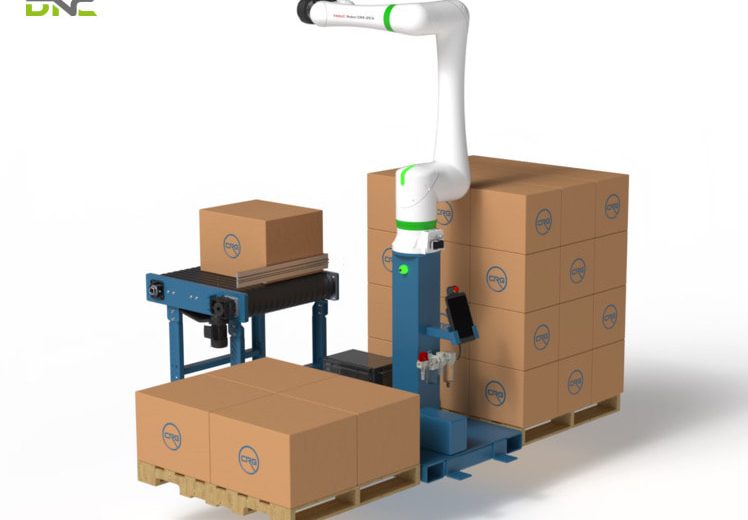
Cobot palletizers use collaborative robots — force-limited to automate pallet stacking in spaces as small as 1.5 × 2 metres, at investment levels starting from RM 150,000. These systems handle payloads of 5–30 kg at 5–15 cycles per minute, require no safety fencing (ISO/TS 15066 compliant), and can be programmed by line operators with zero robotics experience using drag-and-drop teach pendants. For Malaysian SMEs navigating the RM 1,500 minimum wage, chronic foreign worker shortages, and NIMP 2030 automation incentives, a cobot palletizer delivers the fastest ROI in end-of-line automation — typically 8–17 months payback with minimal disruption to existing workflows. DNC Automation, as Doosan Robotics’ certified integrator in Malaysia, designs and deploys cobot palletizing solutions that transform manual packaging lines into automated cells within days, not months.
What Is a Cobot Palletizer?
A cobot palletizer is a collaborative robot system specifically configured for end-of-line pallet stacking, where a force-limited robotic arm picks products from a conveyor or staging area and places them onto pallets in programmed patterns — all without safety fencing separating the robot from human workers. The term “cobot” (collaborative robot) refers to the robot’s inherent safety design: built-in force and speed monitoring that automatically stops the arm upon contact with a person, per ISO/TS 15066 power and force limiting requirements.
Collaborative palletizers differ from industrial robotic palletizing systems in three fundamental ways. First, cobots operate at reduced speeds (maximum 1,000 mm/s vs 2,000–4,000 mm/s for industrial robots), which limits throughput but enables fenceless operation. Second, cobots carry lighter payloads (5–30 kg vs 20–700 kg for industrial robots), restricting them to lighter products. Third, cobots require dramatically smaller footprints — a complete cobot palletizing cell occupies 1.5 × 2 metres compared to 4 × 5 metres minimum for a fenced industrial robot cell.
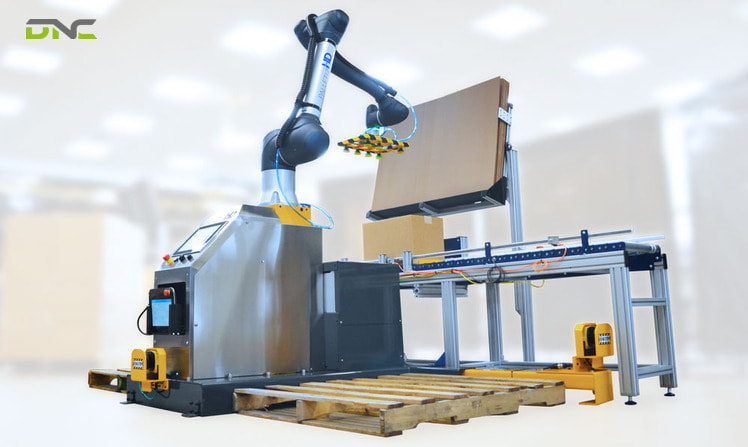
The cobot palletizer ecosystem includes the collaborative arm, a lightweight end-of-arm tool (EOAT), a mobile or fixed pedestal, pallet positioning fixtures, and a tablet-based or pendant-based programming interface. Pre-built cobot palletizing kits from manufacturers reduce deployment time to 2–5 days, making collaborative palletizing the most accessible automation entry point for Malaysian manufacturers with no prior robotics experience.
DNC Automation integrates Doosan M-series cobots (5–25 kg payload range) with custom EOAT and intuitive software to deliver turnkey cobot palletizing solutions for Malaysian F&B, pharmaceutical, cosmetics, and general manufacturing operations.
How Does a Cobot Palletizer Work?
Product Staging and Pick Preparation
Cobot palletizer operation begins at the product staging point. Products arrive from the packaging line — either on a short conveyor, a gravity roller section, or a simple staging table. Unlike industrial robotic palletizing systems that require precision-indexed conveyors with accumulation zones, cobot palletizers typically work with basic product presentation: an operator or simple conveyor places products at a fixed pick point, and the cobot picks from that consistent location.
Vision-equipped cobots (Techman TM series with built-in camera, or Doosan with add-on vision) can pick from variable positions — detecting product location on a conveyor belt and adjusting pick coordinates automatically. This vision capability eliminates the need for precise mechanical alignment, further simplifying the infeed system.
Collaborative Pick-and-Place Cycle
The cobot arm moves to the pick position at collaborative speed (typically 500–1,000 mm/s), engages the EOAT to grip the product, lifts to a safe transit height, moves to the programmed pallet placement position, and releases. The entire cycle takes 4–12 seconds per pick depending on travel distance, product weight, and placement precision requirements.
Force-torque sensors in every joint continuously monitor external forces during the entire cycle. If the cobot contacts a person or unexpected obstacle, it stops within milliseconds — applying no more than 150 N of force (the ISO/TS 15066 threshold for transient contact on the human body). This safety behaviour enables operators to work alongside the cobot: loading products onto the staging point, removing full pallets, or adjusting pallet positions without shutting down the system.
Pattern Programming Through Teach Pendant
Cobot palletizer programming replaces traditional robot code with visual interfaces. The operator defines a pallet pattern by:
- Teaching the pick point — physically guiding the cobot arm to the product pick location and pressing “save”
- Teaching the first place point — guiding the arm to the first product position on the pallet
- Defining the pattern — entering rows, columns, layers, and layer offset in the palletizing software
- Setting parameters — product dimensions, pallet size, layer height, grip/release timing
The palletizing software (Doosan Palletizing Solution, Robotiq Palletizing Solution, or third-party options) automatically generates the complete multi-layer stacking sequence from these inputs. A new pattern takes 15–30 minutes to programme; pattern changeover for an existing SKU takes under 60 seconds by selecting from saved patterns on the teach pendant.
This programming simplicity is what makes cobot palletizers accessible to SMEs without automation engineers on staff — a line supervisor can create and modify palletizing patterns after a 2-hour training session.
Pallet Handling
Cobot palletizing systems use simple pallet fixtures — floor-mounted L-brackets or adjustable pallet guides — to position pallets consistently. When a pallet is full, the cobot pauses, the operator removes the full pallet with a hand pallet jack or forklift, places an empty pallet, and presses “resume.” More advanced setups include dual-pallet stations where the cobot fills one pallet while the operator exchanges the other, eliminating pause time.
Automated pallet dispensers are available for cobot cells but are less common than in industrial robotic cells — the cost of an automated dispenser (RM 40,000–80,000) represents a significant percentage of the total cobot cell investment, so many SMEs opt for manual pallet exchange as a practical compromise.
The simplicity of cobot palletizer operation connects directly to the different cobot platforms available, each offering distinct capabilities for various application requirements.
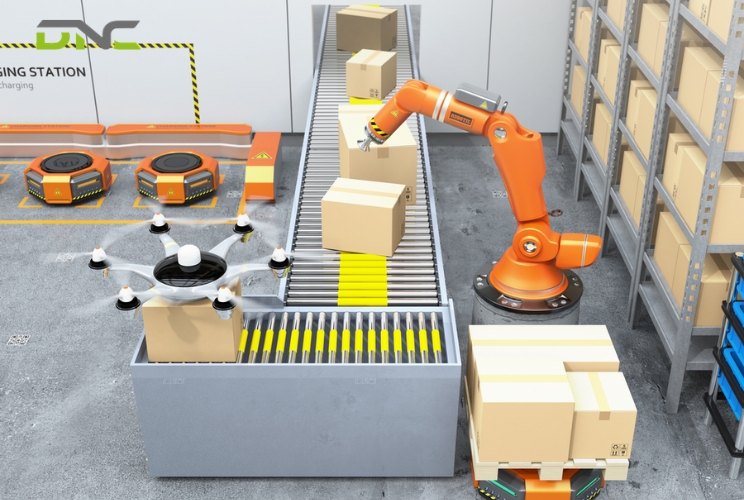
Cobot and Industrial Robot Palletizers
Types of Cobot Palletizers
Single-Arm Cobot Palletizers
Single-arm cobot palletizers — the most common configuration — use one collaborative arm on a fixed or height-adjustable pedestal. The cobot picks from one infeed point and places onto one or two pallet positions. This configuration suits single-line applications with moderate throughput requirements.
Typical specifications:
- Payload: 10–25 kg (Doosan M1013: 10 kg; Doosan H2515: 25 kg; UR20: 20 kg)
- Reach: 1,300–1,700 mm
- Speed: 5–12 cycles per minute
- Footprint: 1.5 × 2 m (including pallet position)
- Cost: RM 150,000–350,000 (complete cell)
Single-arm cobot palletizers handle cartons, small bags, pouches, shrink bundles, and lightweight pails. DNC Automation’s standard Doosan cobot palletizing cell uses the M1013 (10 kg) or H2515 (25 kg) with vacuum EOAT, achieving 8–10 cycles per minute for typical carton palletizing.
Column-Lift Cobot Palletizers
Column-lift cobot palletizers mount the collaborative arm on a vertical linear actuator (7th axis) that raises and lowers the robot base to achieve full pallet height without exceeding the cobot’s native reach. Standard cobots have 1,300–1,700 mm reach — insufficient to stack pallets above 1,500 mm from a floor-mounted position. The column lift adds 800–1,200 mm of vertical travel, enabling pallet stacks of 1,800–2,000 mm.
Typical specifications:
- Payload: 10–20 kg (reduced from arm rating due to column dynamics)
- Reach: equivalent to 2,100–2,900 mm from floor
- Speed: 5–10 cycles per minute (column travel adds 1–3 seconds per cycle)
- Footprint: 1.5 × 2.5 m
- Cost: RM 200,000–400,000
Column-lift configurations are the standard for cobot palletizing in Malaysian F&B and pharmaceutical operations where full-height pallet loads (1,600–1,800 mm) are required for warehouse racking compatibility and shipping efficiency.
Dual-Station Cobot Palletizers
Dual-station cobot palletizers position two pallet locations within the cobot’s reach envelope. While the cobot stacks one pallet, the operator exchanges the other — maintaining continuous production without robot pause time. The cobot automatically switches to the second pallet when the first reaches full height.
Typical specifications:
- Throughput: same as single-arm (5–12 cycles/min) but higher uptime (95%+ vs 80–85%)
- Footprint: 2 × 3 m (larger to accommodate two pallets)
- Cost: RM 200,000–400,000 (primarily adds pallet fixtures and software, not hardware)
Dual-station configurations maximise the cobot’s productive time — critical for lines where the 2–5 minutes of pallet exchange downtime per pallet significantly impacts shift output.
Mobile Cobot Palletizers
Mobile cobot palletizers mount the collaborative arm on a wheeled platform — either manually repositioned or autonomously navigated (AMR-mounted). The mobile configuration enables one cobot to serve multiple production lines, wheeling between lines on a scheduled or on-demand basis.
Typical specifications:
- Payload: 5–16 kg (limited by mobile platform stability)
- Setup time: 2–5 minutes per line (manual); automatic (AMR-mounted)
- Lines served: 2–4 (time-shared)
- Cost: RM 250,000–500,000 (includes mobile platform)
Mobile cobot palletizers suit Malaysian SMEs running 3–5 short production runs per day on different lines — common in contract manufacturing and multi-product facilities. Rather than investing in a dedicated cobot per line, one mobile unit serves all lines during their respective production windows.
Each cobot palletizer type relies on the same fundamental components, which determine the system’s capability and reliability.
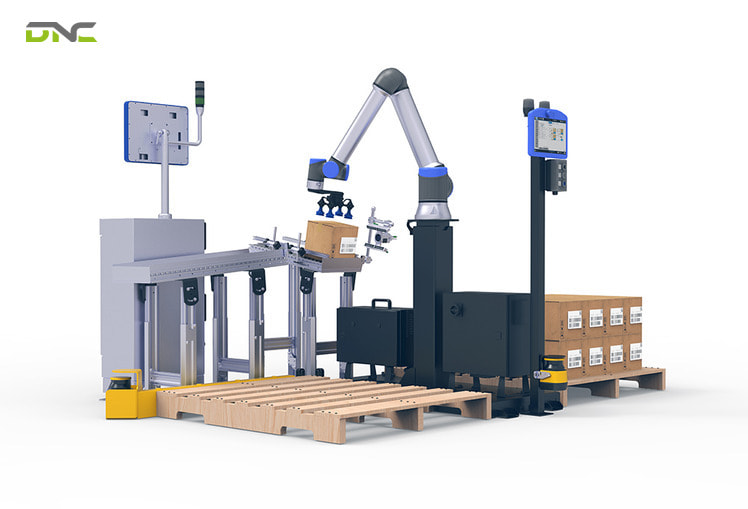
Cobot palletizing automates the process of stacking boxes, bags, or cartons
Key Components of a Cobot Palletizer
Collaborative Robot Arm
The collaborative arm is the motion platform — a 6-axis articulated robot with integrated force-torque sensing in every joint, rounded exterior surfaces (no pinch points), and power/force-limited operation per ISO/TS 15066. Leading cobot palletizing platforms include Doosan M-series (10–25 kg payload), Universal Robots UR10e/UR20 (12.5–20 kg), FANUC CRX-10iA/CRX-25iA (10–25 kg), and Techman TM12/TM16 (12–16 kg). DNC Automation standardises on Doosan cobots for palletizing applications — their 25 kg payload (H2515) is the highest in the collaborative class, covering the widest product range.
End-of-Arm Tooling (EOAT)
Cobot EOAT must be lightweight (under 3 kg to preserve payload capacity for the product) yet reliable. Vacuum grippers dominate cobot palletizing — foam-pad vacuum tools. Mechanical finger grippers handle bags and pouches. Hybrid tools combine vacuum and mechanical gripping for mixed-product applications. DNC Automation designs EOAT weighing 1.5–2.5 kg using aluminium frames and compact vacuum generators, maximising the payload available for product weight.
Pedestal and Column Lift
The mounting structure positions the cobot at the correct working height. Fixed pedestals (steel tube, 800–1,000 mm height) suit applications where full pallet height falls within the cobot’s reach. Column lifts (servo-driven linear actuators with 800–1,200 mm stroke) extend vertical reach for full-height palletizing. The pedestal or column must be rigidly mounted to the floor — any base compliance reduces placement accuracy and triggers the cobot’s force-monitoring safety stops.
Software and User Interface
Palletizing software translates simple operator inputs (product size, pallet layout, layer count) into complete motion programmes. Doosan’s Palletizing Solution, Robotiq’s palletizing software, PalletSolver run on the cobot’s teach pendant or a connected tablet, providing visual pattern editors, 3D pallet previews, and one-touch pattern switching. No programming language knowledge is required — the interface is designed for production operators, not robotics engineers.
Safety System (Built-In)
Unlike industrial robotic palletizing systems requiring external safety fencing, scanners, and safety PLCs, the cobot palletizer’s safety system is built into the robot itself. Joint-level force monitoring, configurable speed limits, and safety-rated monitored stop (per ISO 13849 PLd) provide intrinsic safety without additional infrastructure cost. DNC Automation conducts a risk assessment per ISO 12100 for every cobot installation — verifying that the specific product, EOAT, and operating environment meet collaborative safety requirements.
These components enable cobot palletizers to serve a growing range of applications across Malaysian manufacturing, particularly in the SME segment.
Applications of Cobot Palletizers in Malaysian Manufacturing
SME Food and Beverage Operations
SME F&B manufacturers — bakeries, snack producers, beverage startups, sauce makers, frozen food packers — represent the fastest-growing cobot palletizer market in Malaysia. These operations typically run 1–3 packaging lines producing 200–800 cartons per shift, with 2–4 workers dedicated to manual palletizing. A single cobot palletizer replaces these workers at a fraction of the cost of an industrial robotic system.
Cobot palletizers in Malaysian SME F&B handle lightweight cartons (2–15 kg), pouches, shrink-wrapped bundles, and small pails. The fenceless operation allows the same workers who previously palletized manually to now manage the cobot — loading products, exchanging pallets, and monitoring quality — increasing their productivity from 4–6 cases per minute (manual) to 8–12 cases per minute (cobot-assisted).
DNC Automation has deployed Doosan cobot palletizers in Malaysian SME food operations achieving payback within 10–14 months through direct labour savings and reduced overtime costs.
Pharmaceutical and Cosmetics Packaging
Pharmaceutical and cosmetics manufacturers require gentle product handling, cleanroom compatibility, and frequent SKU changes. Cobot palletizers excel in these applications: the collaborative arm’s force-limited motion handles fragile packaging without crushing, the compact footprint fits into existing cleanroom layouts without modification, and the visual programming interface enables operators to add new product patterns as frequently as daily.
Malaysian pharmaceutical companies (particularly in Bangi, Rawang, and Kulim industrial zones) deploy cobot palletizers at the end of cartoning and case-packing lines where throughput requirements (3–10 cases per minute) align perfectly with cobot capability. The absence of safety fencing simplifies cleanroom validation — no additional enclosed space to qualify for GMP compliance.
E-Commerce and Third-Party Logistics (3PL)
E-commerce fulfilment centres and 3PL warehouses handle extremely high SKU counts with variable order volumes — making traditional automation impractical. Cobot palletizers deployed in Malaysian 3PL operations palletize mixed-size cartons onto shipping pallets, adapting to different box sizes through vision-guided picking or operator-selected patterns.
The mobility advantage of wheeled cobot platforms fits the 3PL model where palletizing demand shifts between different zones within a warehouse. One mobile cobot serves 3–4 dispatch stations, moving where demand is highest.
Contract Manufacturing and OEM Packaging
Contract manufacturers running short production batches (500–5,000 units per SKU) for multiple brand owners need automation that changeovers fast. Cobot palletizers with 30–60 second pattern switching handle the batch-to-batch product changes that make industrial robotic systems inefficient. Malaysian contract packagers in the Klang Valley and Penang FTZs increasingly adopt cobot palletizers to maintain competitiveness against rising labour costs while preserving the flexibility their business model demands.
Halal Product Manufacturing
Halal-certified production lines benefit from cobot palletizers through reduced human contact with products after packaging. The cobot handles sealed products from the packaging line to the pallet without human touching — supporting halal integrity documentation. The fenceless design allows halal supervisors to observe and verify the palletizing process without entering restricted zones.
The practical benefits of cobot palletizers in these applications translate directly into measurable financial and operational returns.
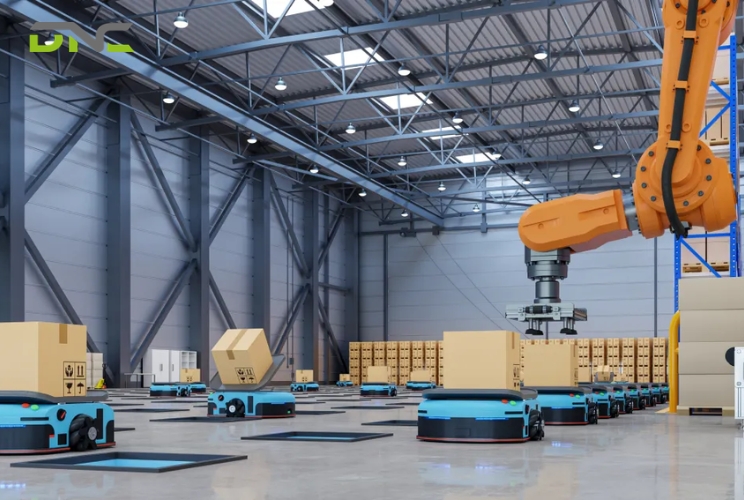
Applications of Cobot Palletizers in Malaysian Manufacturing
Benefits of a Cobot Palletizer
Lowest automation entry cost makes cobot palletizers accessible to SMEs with limited capital budgets. Complete cobot palletizing cells start at RM 150,000 — less than half the cost of the cheapest industrial robotic palletizing system. For Malaysian SMEs qualifying for MIDA automation incentives or NIMP 2030 grants, the effective cost drops further.
Fastest ROI in palletizing automation results from the low investment combined with significant labour savings. Replacing 2–4 manual palletizers (RM 2,500–3,000 per worker per month fully loaded, across 2 shifts = RM 10,000–24,000 monthly savings) delivers payback in 8–17 months. DNC Automation documents ROI calculations for every proposal, with verified payback periods from completed Malaysian installations.
Smallest footprint — 1.5 × 2 metres for a complete cell — fits cobot palletizers into existing production layouts without facility modification. Malaysian factories with tight floor plans, particularly SMEs in older industrial estates, deploy cobot palletizers in spaces that cannot accommodate any other automation technology.
No safety fencing cost or space eliminates RM 20,000–50,000 of fencing infrastructure and the 30–50% additional floor space that fencing demands. This cost and space saving compounds the financial advantage over industrial robotic systems.
Operator-level programming eliminates dependence on robotics engineers for day-to-day operation. Line supervisors create new palletizing patterns in 15–30 minutes using visual drag-and-drop interfaces. This self-sufficiency is critical for Malaysian SMEs that cannot justify employing dedicated automation engineers.
Redeployable asset — cobots can be physically moved between production lines, departments, or even facilities. If a product line is discontinued, the cobot palletizer redeploys to another line within hours. This flexibility protects the investment against production changes.
Worker safety and ergonomics — cobot palletizers eliminate repetitive lifting of 5–30 kg products, reducing musculoskeletal injury risk. The collaborative operation model upgrades workers from manual labour to machine supervision — a meaningful workforce development step aligned with Malaysia’s NIMP 2030 vision for upskilled manufacturing workers.
Realising these benefits requires selecting the right cobot palletizer configuration for each specific application.
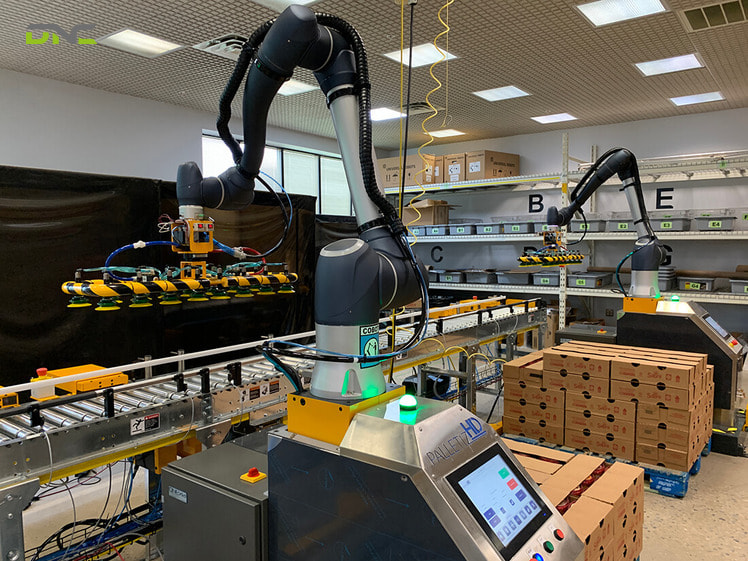
Cobot palletizers offer a flexible, cost-effective bridge between manual handling and full industrial automation.
How to Choose a Cobot Palletizer
Verify Product Weight Compatibility
Product weight is the first filter. Cobot palletizers handle 5–30 kg per pick — subtract the EOAT weight (typically 1.5–3 kg) to determine usable payload. If the heaviest product in the line exceeds the cobot’s net payload, an industrial robotic palletizing system is required instead. DNC Automation tests every product on the proposed Doosan cobot during the evaluation phase to verify handling reliability before commitment.
Match Throughput to Line Output
Cobot palletizers deliver 5–15 cycles per minute — suitable for lines producing up to 900 units per hour. If the packaging line outputs more than 12–15 cases per minute continuously, a cobot cannot keep pace and an industrial robot is the correct solution. For lines with variable output (bursts of high speed followed by changeover pauses), a cobot’s average throughput may suffice even if peak line speed exceeds cobot capacity.
Evaluate Reach and Pallet Height Requirements
Standard cobots reach 1,300–1,700 mm from base. Full-height pallets (1,600–1,800 mm) require a column lift unless the cobot is mounted on an elevated pedestal (which reduces low-level reach). Define the complete pallet stack height, including the pallet itself (150 mm), and verify the cobot can reach both the lowest and highest placement positions. DNC Automation specifies Doosan cobots with column lifts for all palletizing applications requiring stacks above 1,400 mm.
Assess Programming Capability On-Site
Cobot palletizers are designed for operator-level programming — but someone on-site must own the process. Assess whether line supervisors have the aptitude and availability for 2–4 hours of training and ongoing pattern management. DNC Automation provides on-site training and creates the initial pattern library for every cobot palletizer installation, ensuring production readiness from day one.
Compare Total Cost of Ownership
Total cost of ownership includes the cobot cell (RM 150,000–500,000), annual maintenance (RM 5,000–15,000), replacement EOAT consumables (vacuum cups, gripper pads: RM 2,000–5,000 annually), and energy (cobots consume 300–500 W — negligible compared to industrial robots at 3–8 kW). Compare this total against the manual labour cost it replaces over 3–5 years to validate the business case.
Select a Certified Integrator
The integrator’s role in cobot palletizing is primarily EOAT design, software configuration, and risk assessment — the cobot hardware is standardised. Choose an integrator with proven cobot palletizing deployments, certified partnership with the cobot manufacturer (Doosan, UR, FANUC), and local service capability. DNC Automation’s Doosan partnership ensures direct access to technical support, spare parts inventory in Malaysia, and firmware updates.
Prospective buyers commonly raise specific questions about cobot palletizers — the following answers address the most frequent concerns.
Challenges and Limitations of Cobot Palletizing
Frequently Asked Questions About Cobot Palletizers
How much does a cobot palletizer cost in Malaysia?
Complete cobot palletizer systems in Malaysia range from RM 150,000 to RM 500,000. A basic single-arm setup with Doosan M1013 (10 kg payload), vacuum EOAT, fixed pedestal, and palletizing software starts at approximately RM 150,000–200,000. A column-lift configuration with the Doosan H2515 (25 kg payload) and dual pallet stations ranges from RM 250,000–400,000. Mobile cobot palletizers with autonomous navigation reach RM 400,000–500,000. DNC Automation provides itemised quotations and ROI calculations for every proposal.
What is the ROI payback period for a cobot palletizer?
Cobot palletizer payback periods in Malaysia typically range from 8–17 months. A RM 200,000 cobot cell replacing 3 manual workers across 2 shifts saves approximately RM 15,000–18,000 per month in labour costs (at RM 2,500–3,000 fully loaded cost per worker), delivering payback in 11–13 months. Adding productivity gains (consistent 8–10 cycles per minute vs declining manual rates) and reduced product damage shortens effective payback further. SMEs accessing MIDA automation grants can reduce net investment by 30–50%, bringing payback below 8 months.
Can a cobot palletizer work without safety fencing?
Cobot palletizers operate without safety fencing when the complete application — including the product, EOAT, and operating environment — meets ISO/TS 15066 power and force limiting requirements. The cobot arm itself is inherently safe (force-limited joints, rounded surfaces), but the EOAT and product must not create pinch points or sharp edges that could injure a person during contact. DNC Automation conducts a formal risk assessment per ISO 12100 for every installation to confirm that fenceless operation is safe for the specific application. In some cases, area scanners (not full fencing) may be recommended to slow or stop the cobot when a person enters the working zone.
How fast is a cobot palletizer compared to an industrial robot palletizer?
Cobot palletizers operate at 5–15 cycles per minute; industrial robotic palletizers operate at 8–30 cases per minute. The 2–3x speed difference reflects the cobot’s force-limited operation (maximum 1,000 mm/s movement speed vs 2,000–4,000 mm/s for industrial robots). For lines producing up to 600–900 units per hour, a cobot palletizer matches the requirement. For lines exceeding 900 units per hour, an industrial robotic palletizing system is necessary.
How difficult is it to programme a cobot palletizer?
Cobot palletizer programming requires no coding or robotics expertise. Operators programme new patterns in 15–30 minutes using a visual interface: teach the pick point by physically guiding the arm, enter product dimensions and pallet layout in a touchscreen form, and the software generates the complete stacking programme. Switching between saved patterns takes under 60 seconds. DNC Automation provides 4–8 hours of on-site training covering pattern creation, modification, troubleshooting, and basic maintenance — sufficient for line supervisors to operate independently.
Can a cobot palletizer handle bags, not just cartons?
Cobot palletizers handle bags weighing up to 25–30 kg using mechanical clamp grippers or bag-specific EOAT with adjustable jaw width. Pillow bags, gusseted bags, and valve bags require different gripping approaches — DNC Automation designs bag-handling EOAT with conformable grip surfaces that accommodate bag deformation during lifting. Bag palletizing with cobots runs at 5–8 cycles per minute, lower than carton palletizing due to the additional grip-verification time needed for deformable products.
What happens if the cobot contacts a person during operation?
The cobot stops within milliseconds of detecting unexpected contact. Joint-level force-torque sensors continuously compare expected forces (from the known product weight and motion profile) against actual forces. Any deviation exceeding the safety threshold (configurable, typically 50–150 N depending on body region per ISO/TS 15066) triggers an immediate protective stop. The operator presses “resume” on the teach pendant to restart after clearing the cause. No injury results from compliant contact — the force levels are below the threshold for pain or bruising on any body part.
Is a cobot palletizer a good first automation investment for an SME?
Cobot palletizers rank among the highest-ROI first automation investments for Malaysian SMEs. The combination of low capital requirement (RM 150,000–250,000), fast payback (8–17 months), minimal facility modification (no fencing, no floor anchors in basic setups), operator-level programming (no automation engineer needed), and redeployability (move to another line if needs change) addresses every common SME objection to automation. DNC Automation recommends cobot palletizing as the entry point for SMEs with 1–3 packaging lines producing 200–800 cases per shift.
Conclusion
Cobot palletizers bring industrial-grade automation to Malaysian SMEs at investment levels, footprints, and complexity thresholds that were previously impossible. The technology is proven, the ROI is documented, and the programming is accessible to any production team — no robotics degree required. For manufacturers producing up to 900 cases per hour with products weighing under 25 kg, a cobot palletizer eliminates manual stacking labour, improves pallet quality, and frees workers for higher-value tasks. DNC Automation, as Doosan Robotics’ certified integrator in Malaysia, delivers complete cobot palletizing solutions from evaluation through deployment and ongoing support.
Get a Free Consultation — Talk to our engineers about cobot palletizing for your production lines. Call DNC Automation or visit [dnc-automation.com](https://dnc-automation.com) to schedule a live demonstration with your actual products and receive a detailed ROI analysis.
- 92 views
- 0 Comment
Recent Comments