


Bottle Case Packer Machine Guide | DNC Automation Malaysia
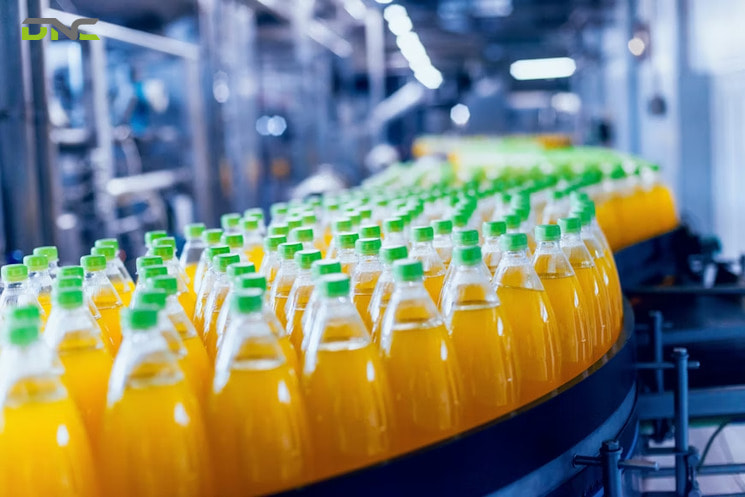
Bottle case packer machines handle the specific challenges of packaging liquid containers — glass bottles, PET plastic bottles, HDPE bottles, and aluminium cans — into corrugated shipping cases. Bottles introduce variables that general case packing equipment must specifically accommodate: round profiles that roll or fall when not constrained, weight that affects acceleration limits, and label or cap surfaces that damage under high-friction contact.
Malaysian beverage and food manufacturers — producing bottled water, carbonated drinks, cooking oil, sauces, dairy products, and nutritional supplements — represent a major segment of the regional market for bottle case packer machines. The right bottle case packer for a Malaysian F&B operation depends on container type, fill level, line speed, and whether the product ships in corrugated cases or retail display trays.
What Is a Bottle Case Packer Machine?
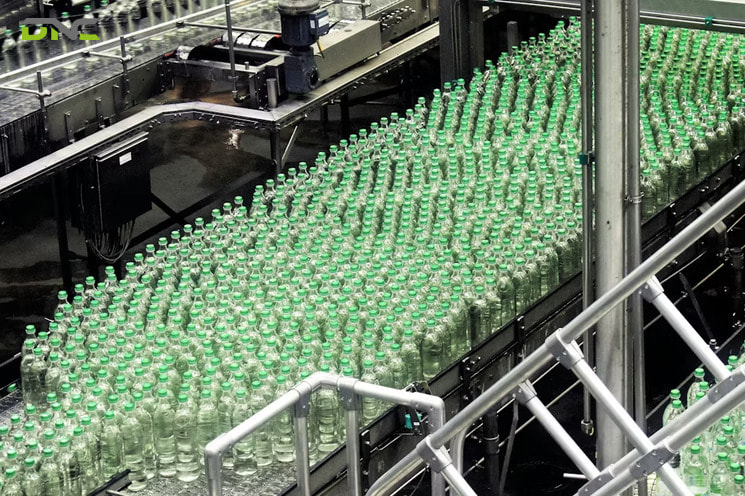
A bottle case packer machine groups filled, capped, and labelled bottles into a pack configuration and loads them into corrugated shipping cases or display trays. The machine handles the transition from single-bottle flow (from the filling and capping line) to grouped case format (ready for palletizing and shipment).
Bottle case packers sit at the end of the bottling line — after the filler, capper, labeller, and date coder — and before the palletizer. Their throughput must match the bottling line output rate; undersized bottle case packers create the primary end-of-line bottleneck in Malaysian beverage operations.
Three factors differentiate bottle case packing from general case packing:
- Round profile handling: Circular container cross-sections require lane guides, star wheels, and conveyor systems designed to control lateral movement. Flat-sided cartons or pouches stay aligned under gravity; bottles roll if not constrained.
- Fill stability: Filled bottles have a high centre of gravity (liquid above the bottle’s halfway point). High-acceleration product handling causes tipping — bottle case packers use gentler acceleration profiles and constrained infeed systems to maintain bottle stability.
- Surface sensitivity: Glass bottles, labelled PET bottles, and capped containers have surfaces that scuff or scratch under high-friction contact. Case packer tooling and guide materials must use low-friction coatings or soft contact materials where bottle surfaces are at risk.
What Is a Bottle Case Packer Machine?
Bottle Case Packer Machine Types
Automatic Bottle Case Packer (Side Load)
Automatic side load bottle case packers are the standard configuration for high-speed Malaysian beverage operations. Bottles travel from the labeller via a multi-lane infeed conveyor; a collating system groups bottles into the case configuration (e.g., 3×4 = 12 bottles per case); a linear pusher loads the group horizontally into the waiting case.
How it handles bottles: Lane dividers on the infeed conveyor separate the single-lane bottle flow into multiple lanes matching the case column count. Dead plate guides at the collating zone hold bottles upright during the transition from moving conveyor to stationary collating zone. The pusher guide — typically polyethylene or nylon contact surface — pushes the bottle group without scratching labels.
Throughput: 15–60 CPM depending on case configuration and bottle size.
Best for: High-speed bottled water and carbonated beverage lines in Malaysian Selangor and Johor operations. A 36,000 BPH (bottles per hour) water bottling line with 12-bottle cases requires minimum 50 CPM at the case packer — achievable with a high-speed continuous-motion side load configuration.
Automatic Bottle Case Packer (Top Load)
Top load bottle case packers place bottles from above into open RSC or tray cases. Servo-controlled pick-and-place heads — or robotic arms for premium applications — grip each bottle via neck handling or body gripper tooling and lower it into the case in the correct position and orientation.
How it handles bottles: Neck handling (gripping under the bottle cap or neck ring) is the most common approach — it avoids label contact entirely. Body grippers use soft polyurethane pads on the bottle shoulder or body. Both systems maintain upright bottle orientation throughout the placement motion.
Throughput: 5–25 CPM per loading head.
Best for: Premium glass bottle products, sauce bottles requiring upright orientation in the case, and multi-SKU operations where bottle diameter varies significantly between products (height-adjustable top load heads accommodate diameter variation more easily than side load lane guides).
Robotic Bottle Case Packer
Robotic bottle case packers use delta robots (for small lightweight bottles) or six-axis robots (for heavier or fragile bottles) to pick and place bottles into cases. The vision system identifies bottle position and orientation on the infeed conveyor; the robot adjusts its pick path to compensate for positional variation.
How it handles bottles: Delta robots with suction cup EOAT designed for bottle caps or shoulders are the standard robotic configuration for small PET bottles (250 ml–1.5 L range). For glass bottles, SCARA or six-axis robots with neck-handling grippers provide the precision and gentleness that prevents breakage.
Throughput: 30–120 picks per minute for delta robots on small lightweight bottles; 10–30 CPM for six-axis robotic systems on heavier or fragile bottles.
Best for: Premium glass bottle products requiring no surface contact during loading, mixed-SKU bottling operations with frequent bottle size changes, and manufacturers with high SKU diversity where robotic recipe flexibility reduces changeover cost.
Semi-Automatic Case Packer for Bottles
Semi-automatic bottle case packers require an operator to load bottles into a product positioning fixture or to place bottles manually into an open case held by the machine. The machine automates the case handling and sealing steps while the operator handles the product placement.
How it works: The operator places bottles into a positioning fixture or directly into the open case; the machine counts bottles using sensors; when the correct count is reached, the machine closes the case and feeds it to the discharge conveyor for sealing.
Throughput: 3–12 CPM (operator-limited).
Best for: Small-volume operations, contract packers handling multiple clients with small individual order quantities, and manufacturers where the capital cost of a fully automatic system cannot be justified at current production volumes.
Automatic Tray Packer: Retail Display Alternative to Case Packing
Automatic tray packers load bottles into shallow corrugated trays — used for retail shelf display or club store presentation — rather than fully enclosed cases. The tray format exposes the bottle tops and sometimes the bottle bodies for retail visibility, eliminating the need to uncase products before shelf stocking.
How Automatic Tray Packers Work
Tray packers either use pre-formed trays from a tray magazine or form trays from flat blanks. Bottles are grouped to match the tray configuration (typically 2×3, 3×4, or 4×6 arrangements). The bottle group is loaded into the tray from above or the side; the tray may have a shrink film overwrap applied at the next station to secure bottles in transit.
Tray vs. case format selection for Malaysian manufacturers:
| Factor | Corrugated Case | Display Tray |
| Transit protection | Full enclosure — high protection | Partial — bottles exposed top and sides |
| Retail handling | Must be uncased at store | Goes directly to shelf |
| Board cost | Higher (full case) | Lower (tray uses less board) |
| Required shrink film | No | Often yes (for transit security) |
| Best for | Export, ambient and cold chain, heavy products | Local retail, club stores, promotional display |
Malaysian food retailers and hypermarkets (Giant, Aeon, Mydin) increasingly specify retail-ready packaging (RRP) — tray-packed products that require no repackaging before shelf display. Automatic tray packers produce this format at the bottle filling operation, eliminating handling steps in the retail distribution chain.
Shrink Tray Packer
Shrink tray packers combine the tray formation and product loading with downstream shrink film application. Bottles are loaded into the tray; a shrink film sleeve is applied over the tray and bottles; the assembly passes through a heat tunnel where the film shrinks tight against the bottle group and tray, creating a stable, transit-worthy package.
Application in Malaysia: Malaysian beverage manufacturers producing for Klang Valley retail chains use shrink tray packing for bottled water, carbonated drinks, and juice multi-packs. The shrink tray format is recognisable on retail shelves — the bottle multipack with visible product and a thin film overwrap.
Automatic Tray Packer: Retail Display Alternative to Case Packing
Bottle Size and Weight Considerations
PET Bottles (Small Format: 250 ml–1.5 L)
Small-format PET bottles are the highest-volume bottle category in Malaysian beverage manufacturing. Their light weight (50–100 g per bottle unfilled) allows delta robot picking at high speed. Side load case packers handle small PET bottles well — the uniform cylindrical profile rolls predictably, and the bottle weight is low enough that high-acceleration laning does not cause tipping.
Typical case configuration: 24 × 500 ml bottles per case (4 rows × 6 columns, single layer) or 12 × 1.5 L bottles (3 rows × 4 columns).
PET Bottles (Large Format: 2 L–5 L)
Large PET bottles have higher centre of gravity and greater tipping tendency than small-format bottles. Infeed lane guides must constrain the bottle profile more closely; collating zone acceleration profiles must be lower to prevent tip-over. Top load case packers handle large PET bottles by lowering them into the case — eliminating the lateral instability risk.
Typical case configuration: 6 × 5 L bottles or 9 × 2 L bottles per case.
Glass Bottles
Glass bottles require the most careful handling in case packing — impact between glass bottles causes breakage, and label surfaces scuff under metal-to-glass contact. Glass bottle case packers use:
- Soft-contact lane guides (polyurethane or UHMWPE)
- Reduced conveyor and collating zone acceleration rates
- Neck handling tooling (for robotic top load applications) to eliminate bottle-to-bottle contact during loading
- Anti-slip conveyor belt surfaces to maintain bottle upright without aggressive gripping
Malaysian context: Malaysian sauce and condiment manufacturers (soy sauce, chilli sauce, cooking oil in glass) use top load case packers with soft tooling for glass bottle case packing. The slower throughput (5–15 CPM) is acceptable for these lower-volume products.
Aluminium Cans
Aluminium cans differ from bottles in two key ways: they are fully rigid (no fill-stability concern) and their cylindrical profile with flat ends makes them very stable in stacked configurations. Can case packers are typically side load or wraparound configurations running at high throughput — Malaysian carbonated beverage can lines run 40–80 CPM case packers to match high-speed filling lines.
Semi-Automatic vs. Fully Automatic: The Investment Decision for Malaysian Manufacturers
When Semi-Automatic Makes Sense
Semi-automatic case packers remain appropriate for Malaysian manufacturers in specific circumstances:
- Volume below 500 cases per shift: At this volume, a fully automatic case packer’s capital cost (RM 80,000–200,000) cannot be recovered within 3 years at current labour rates.
- Highly variable bottle sizes: If your operation runs 15+ different bottle sizes with frequent changeovers, the mechanical adjustment time on a fully automatic machine may offset its speed advantage.
- Trial production or market entry: Manufacturers entering new product categories or markets at low initial volume correctly use semi-automatic case packing before investing in full automation.
When Fully Automatic Is the Correct Choice
A fully automatic bottle case packer is the correct investment when:
- Volume exceeds 800 cases per shift: Labour cost savings on a two-shift operation justify the capital investment within 18 months in most Malaysian scenarios.
- Labour shortage is a constraint: If you cannot reliably staff case packing positions — a common challenge for Malaysian manufacturers in Selangor and Penang industrial areas — automation is the only solution.
- Export requirement: Export customers and international retail chains require consistent packing quality that manual operations cannot reliably deliver.
- NIMP 2030 alignment: Malaysian manufacturers qualifying for Industry 4.0 status under NIMP 2030 need documented automation investment — fully automatic case packing lines contribute to this qualification.
Integration: Connecting Bottle Case Packers to Your Filling Line
Infeed Conveyor Design
Bottle case packers connect to the filling line via a series of conveyors that transition bottles from single-lane high-speed flow to the multi-lane, controlled-spacing arrangement the case packer requires.
Transition elements:
- Divider conveyor: Expands single-lane flow into multiple lanes
- Timing screw or star wheel: Creates precise bottle spacing for the collating system
- Buffer conveyor: Absorbs upstream speed variation, providing a constant-rate feed to the case packer
Speed Matching
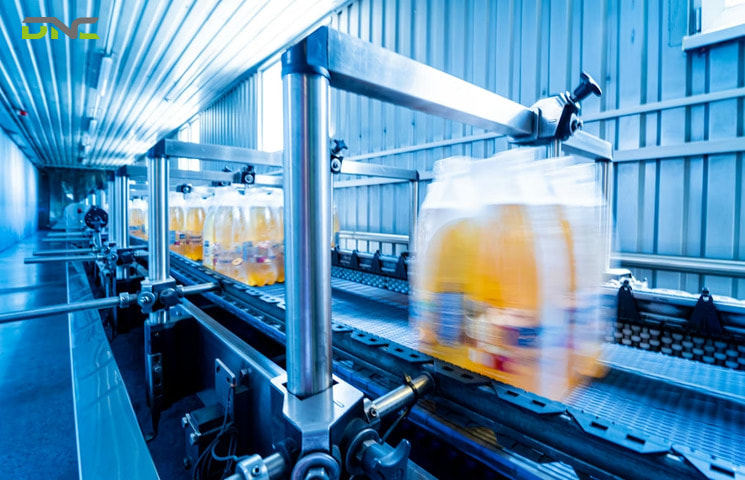
The case packer’s infeed speed must match the filling line output. Mismatched speeds cause either product accumulation (filling line faster than case packer — bottles pile up) or starvation (case packer faster than filling line — machine waits, productivity lost).
DNC Automation designs the infeed system to achieve matched speeds with a controlled buffer — the buffer conveyor holds approximately 2–3 minutes of production as a surge absorber, compensating for the minor speed fluctuations all filling equipment exhibits.
Washdown Compatibility
Malaysian food and beverage manufacturing facilities operating under HACCP or GMP requirements need case packing equipment that withstands regular cleaning. Specify:
- IP65 minimum electrical enclosure rating for all electrical components
- Stainless steel 304 frame and product contact surfaces
- Drainage slots in horizontal frame members
- No hollow tubes where water can accumulate and stagnate
Standard carbon steel case packers are not suitable for food production environments subject to cleaning chemicals or high humidity. DNC Automation specifies and installs hygienic-design case packing equipment for Malaysian F&B clients operating under food safety certification.
Frequently Asked Questions
What bottle sizes can a bottle case packer machine handle?
Industrial bottle case packers handle diameters from approximately 40 mm (small condiment bottles) to 130 mm (large PET bottles) and heights from 100 mm to 350 mm. Specific size range depends on the machine model. Multi-size operations require mechanical adjustment or robotic configuration for size flexibility.
DNC Automation designs the infeed system to achieve matched speeds with a controlled buffer
Cost Structure: Bottle Case Packer Machine in Malaysia
Capital Cost by Configuration
| Configuration | Capital Cost (RM) | Best Application |
| Semi-automatic | 20,000–55,000 | Low volume, mixed SKU |
| Auto side load (intermittent) | 80,000–180,000 | 15–30 CPM uniform bottles |
| Auto side load (continuous-motion) | 150,000–320,000 | 30–60 CPM high-speed lines |
| Auto top load (servo) | 100,000–220,000 | Fragile/upright products |
| Robotic top load (delta) | 180,000–380,000 | High-speed flexible operation |
| Automatic tray packer | 90,000–250,000 | Retail-ready tray format |
Add 20–25% for infeed laning system, downstream case sealer interface, and commissioning.
Running Cost Comparison: Case vs. Tray Format
The choice between case packing and tray packing has significant ongoing cost implications beyond machine capital:
| Cost Factor | RSC Case | Display Tray |
| Board material per unit | RM 1.00–2.50 | RM 0.50–1.20 |
| Shrink film (tray) | Not applicable | RM 0.20–0.50/pack |
| Downstream handling | Uncasing required at retail | Direct to shelf |
| Return/recycle logistics | Case return not standard | Tray return not standard |
| Export suitability | Full enclosure — export-ready | Limited to domestic or short-haul |
For Malaysian manufacturers supplying both export and domestic channels, a hybrid approach — case packing for export volume, tray packing for domestic retail — often provides the best total cost outcome. DNC Automation designs hybrid line configurations where the same bottle infeed serves both a case packer and a tray packer via divert conveyor, with the production schedule determining which machine runs at any given time.
Malaysian Beverage Industry Throughput Benchmarks
Malaysian beverage manufacturing throughput requirements are driven by filler line output — the case packer must match filler speed or become the production constraint. Based on DNC Automation’s project experience across Malaysian F&B operations:
| Product | Typical Filler Speed | Cases/Min Required | Recommended Configuration |
| Bottled water 500 ml (12/case) | 18,000–36,000 BPH | 25–50 CPM | Continuous side load |
| Carbonated drink 325 ml can (24/case) | 24,000–60,000 CPH | 17–42 CPM | High-speed side load |
| Soy sauce 500 ml (12/case) | 3,600–7,200 BPH | 5–10 CPM | Auto top load or servo |
| Cooking oil 1 L (12/case) | 4,800–9,600 BPH | 7–13 CPM | Side load (auto) |
| UHT milk 1 L carton (12/case) | 6,000–12,000 PPH | 8–17 CPM | Side load (auto) |
| Nutritional supplement bottle (6/case) | 1,200–3,600 BPH | 3–10 CPM | Robotic top load |
*BPH = bottles per hour; CPH = cans per hour; PPH = packs per hour*
These benchmarks are derived from actual installed DNC Automation systems and real-world Malaysian production data — not OEM specification maximums.
Hygiene and Washdown Requirements for Malaysian F&B Bottle Case Packers
Malaysian food and beverage manufacturers operating under HACCP, GMP, or BRC/IFS certification must specify case packing equipment that meets hygiene design standards applicable to their production zone classification.
Zone Classification and Equipment Specification
Dry ambient zone (Zone 3/4): General manufacturing area, no direct product contact, no wash-down required. Standard carbon steel frame with paint or powder coat is acceptable. IP54 minimum electrical enclosure rating.
Low-moisture zone (Zone 2): Indirect risk of product contamination; periodic dry cleaning. Stainless steel 304 for product contact surfaces; IP54–IP65 electrical enclosures; sloped horizontal surfaces to prevent dust accumulation.
Wet zone (Zone 1): Bottling areas subject to regular cleaning with water and cleaning chemicals; condensation environments. Full stainless steel 304/316 construction; IP65 minimum electrical enclosures; drainage slots in all hollow sections; no lubricant application points above conveyor surfaces; washdown-rated motors.
Most Malaysian bottled water and beverage filling areas classify as wet zones. DNC Automation specifies and installs hygienic-design bottle case packing equipment meeting the Malaysian Food Act 1983 (Act 281) equipment hygiene requirements and applicable GMP standards.
Cleaning Validation
For pharmaceutical and nutraceutical bottle case packing operations — where product contact contamination is a regulatory concern — DNC Automation provides cleaning validation support: documenting cleaning procedure effectiveness for the specific case packing machine configuration, surface material, and cleaning agent combination.
Can the same case packer handle both glass and PET bottles?
Yes, with appropriate tooling and guide material specification. Glass bottles require softer guide materials and lower acceleration rates than PET. A case packer configured for both glass and PET will run at the lower acceleration profile for glass — meaning you lose some throughput efficiency on PET runs. For operations primarily running glass with occasional PET, accept this trade-off. For operations running primarily PET with occasional glass, consider separate equipment or a flexible robotic configuration.
How fast does a bottle case packer work?
Semi-automatic: 3–12 CPM (operator-limited). Automatic side load: 15–60 CPM. Automatic top load: 5–25 CPM. Robotic (delta, small bottles): 30+ effective CPM per robot head. The correct throughput specification for your line is your filling line BPH divided by your bottles-per-case count, multiplied by 1.25 safety margin.
What is an automatic tray packer?
An automatic tray packer groups bottles into a shallow corrugated tray — rather than a fully enclosed case — for retail display or club store presentation. Tray packing produces retail-ready packaging that goes directly to the shelf without uncasing. Many Malaysian beverage manufacturers use tray packers for domestic retail supply and standard case packers for export and cold chain supply.
What is a semi-automatic case packer?
A semi-automatic case packer partially automates the case packing process — typically automating case handling and sealing while requiring an operator to place bottles into the case or positioning fixture. Semi-automatic systems are appropriate for lower volumes (under 500 cases/shift) or high-mix operations where full automation capital cost is not justified at current production scale.
Does DNC Automation supply bottle case packers for Malaysian beverage manufacturers?
DNC Automation integrates bottle case packing lines as part of end-of-line automation projects for Malaysian F&B manufacturers. Our engineering team specifies the correct machine type for your bottle profile, designs the infeed handling system, commissions the downstream case sealer and palletizer interface, and integrates the complete system with your facility control architecture. DNC has delivered end-of-line automation projects for Malaysian F&B clients across Selangor, Johor, and Penang.
Plan Your Bottle Case Packing Line
Bottle case packer machine selection requires understanding your specific bottle profile, fill volume, line speed, case format, and market destination. DNC Automation’s engineering team conducts production line assessments — at no cost — to specify the correct bottle case packer configuration for your Malaysian operation.
We assess your filling line throughput, bottle dimensions and weight, case format requirements, washdown specifications, and export market compliance requirements. From this assessment, we develop a complete end-of-line proposal: infeed system design, bottle case packer specification, downstream case sealer and palletizer integration, and PLC/SCADA connectivity — delivered as a single turnkey project.
Talk to Our Engineers — describe your bottle profile, line speed, and case packing requirement. We respond within 3 working days with a configuration recommendation.
Request a Quote — for complete bottle case packing line integration from filling line discharge through palletizer.
*DNC Automation | Malaysia Top #1 Factory Automation Solution Company | ISO 9001:2015 Certified | 35+ Engineers | Serving Malaysia’s Food, Beverage, and Manufacturing Sectors*
- 50 views
- 0 Comment
Recent Comments