


Automated Cold Storage Warehouse | DNC Automation
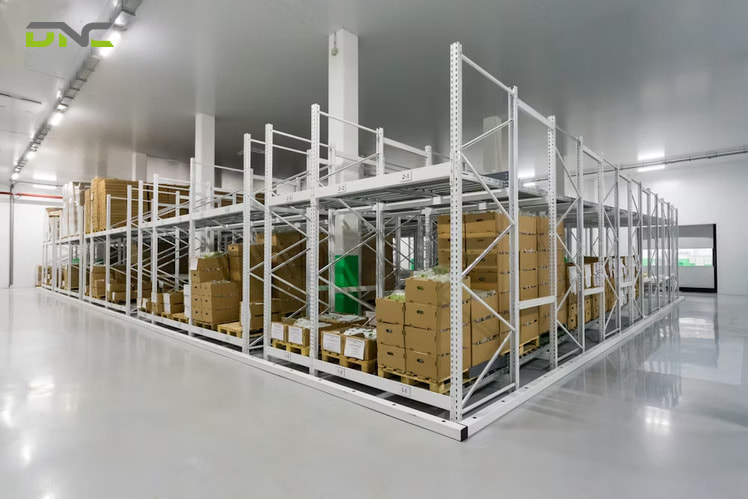
An automated cold storage warehouse combines refrigerated or frozen storage infrastructure with ASRS (Automated Storage and Retrieval Systems) to manage temperature-sensitive inventory — frozen food, pharmaceutical products, dairy, and other cold chain goods — without requiring sustained human presence in the cold zone. Automation eliminates the labour, energy waste, and product safety risks associated with manual operation in frozen and chilled environments.
In Malaysia, where the cold chain sector is growing rapidly to support food export, pharmaceutical distribution, and e-commerce grocery fulfilment, automated cold storage is becoming the operational standard for warehouses above 3,000 pallet positions.
DNC Automation Malaysia designs and integrates automated cold storage solutions — from pallet shuttle systems to full ASRS high-bay cold stores — with WMS cold chain management and IoT temperature monitoring.
The Case for Cold Storage Automation in Malaysia
Labour and Safety in Cold Environments
Manual cold store operations in Malaysia face three compounding challenges:
Worker health limits: Occupational health guidelines (and DOSH regulations) limit continuous exposure of workers to frozen environments (-18°C and below). Workers typically rotate out of the cold zone every 30–40 minutes, requiring larger headcounts to cover continuous operations and creating safety risks during transitions.
PPE and productivity: Workers in frozen environments must wear insulated clothing and gloves, reducing dexterity and slowing all manual handling tasks. Picking accuracy and productivity are inherently lower than in ambient operations.
Labour availability: Cold store workers command premium wages in Malaysia — typically RM 3,000–4,500/month versus RM 2,000–2,800 for ambient warehouse roles — and experience higher turnover due to working conditions.
Automated cold storage eliminates sustained human presence in the cold zone entirely. Operators work in ambient-temperature control rooms and transfer points; only scheduled maintenance requires cold zone entry.
Energy Efficiency
Cold storage energy cost is the second largest operating expense after labour. Manual cold stores experience frequent and prolonged door opening, creating warm air infiltration that forces refrigeration compressors to work harder.
Automated cold storage eliminates unnecessary door openings:
- Goods enter and exit through small, insulated transfer openings at ASRS crane interfaces
- Conveyor transfer points use air curtains or insulated flap systems to minimise cold loss
- ASRS cranes do not require aisle lighting (darkness reduces heat load)
Measured energy savings from cold store automation range from 20–40% per pallet stored versus equivalent manual cold stores — a significant ongoing operating cost reduction.
Density and Footprint
Cold storage construction cost in Malaysia ranges from RM 800–1,500 per m² for insulated panel construction, plus refrigeration plant. Every square metre of cold storage floor space is expensive to build and to refrigerate.
ASRS cold storage achieves 3–5 pallets per m² versus 1.0–1.5 for forklift-operated cold stores. A 10,000-pallet automated cold store occupies 2,000–3,500 m² versus 7,000–10,000 m² for manual operation — a footprint reduction of 65–75%.
ASRS Technologies for Cold Storage
Pallet Shuttle System (Cold-Rated)
Shuttle systems are the most widely deployed ASRS technology in cold storage globally and in Malaysia, for three reasons:
- Deep-lane storage: Shuttles operate within racking lanes 5–20 pallets deep, maximising storage density without wide crane aisles
- Redundancy: Multiple shuttles per level — failure of one shuttle does not stop the entire system
- Cold performance: LiFePO4 shuttle batteries maintain 75–85% capacity at -25°C (vs. 50–60% for standard lithium-ion)
A multi-level shuttle system in a 20-metre high Malaysian frozen food warehouse achieves:
- Storage density: 4.0–5.0 pallets/m²
- Throughput: 200–500 pallet moves per hour per aisle
- Temperature: reliable operation to -25°C
Stacker Crane ASRS (Cold-Rated)
Single-mast or double-mast stacker cranes can be cold-rated for operation in frozen environments with:
- Cold-rated gearboxes and lubricants (synthetic lubricants rated to -40°C)
- Heated electrical enclosures and cabinets
- Cold-rated cable and connector specifications
- Anti-condensation heating in camera and sensor housings
Cold-rated pallet cranes achieve similar throughput to ambient cranes (50–100 pallet moves per crane per hour) at heights up to 35 metres.
Application: High-bay cold stores with 15,000+ pallet positions where the storage height advantage justifies the higher cost of single-crane solutions.
Automated Vertical Carousel (Cold Zone)
Vertical carousels rated for chilled environments (2–8°C) serve pharmaceutical cold chain and chilled food operations. The enclosed nature of the carousel reduces cold air exposure during access.
Application: Pharmaceutical cold chain — vaccine storage, cold-chain drug distribution — where small-volume, high-value items require FEFO management and access control in a chilled environment.
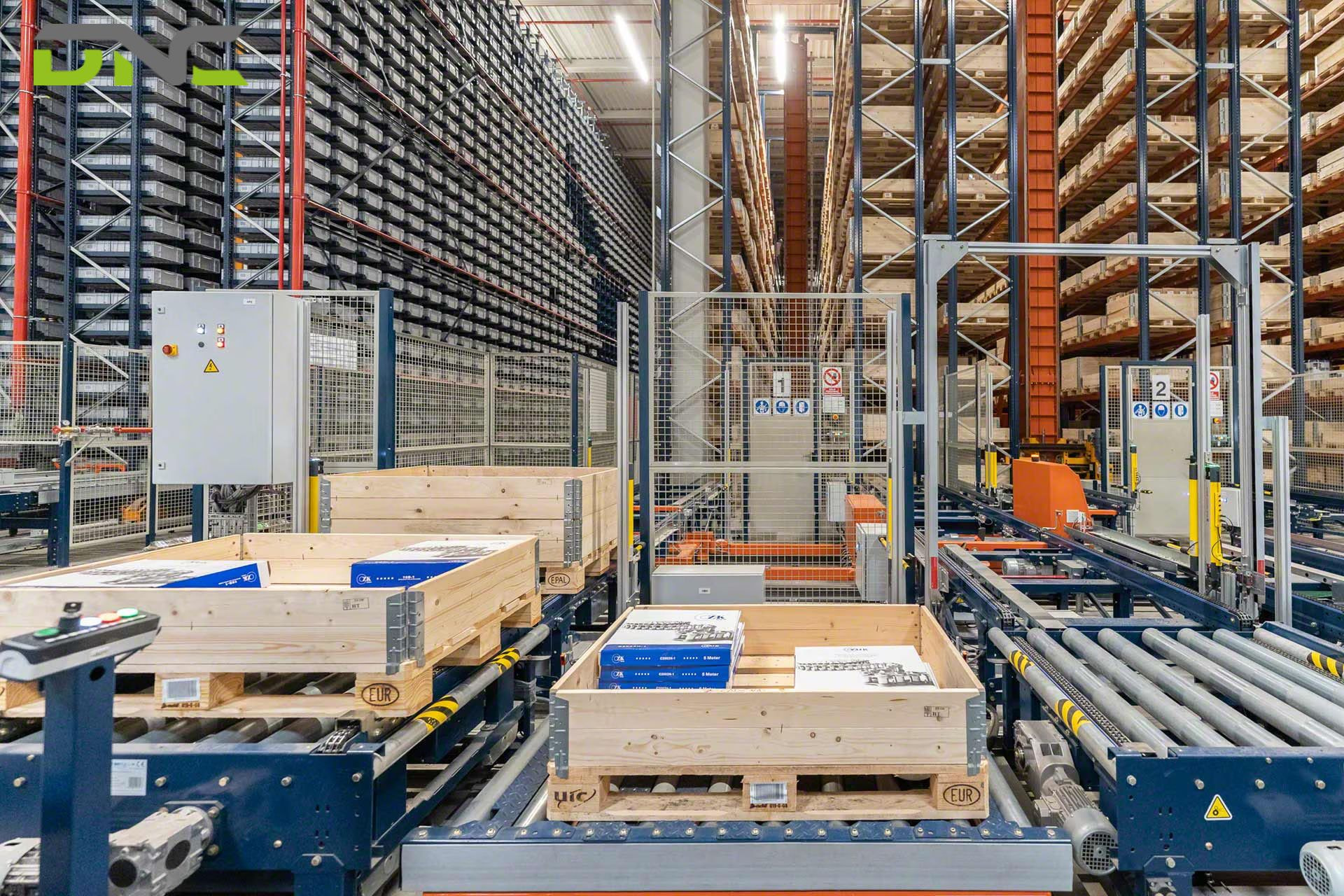
Automated Vertical Carousel (Cold Zone)
Cold Chain WMS Requirements
Warehouse management software for cold storage must go beyond standard WMS functionality:
FEFO (First Expired, First Out) Management
Unlike ambient warehousing, cold storage for food and pharmaceutical products must retrieve inventory in expiry date order — FEFO — not just FIFO. The WMS assigns storage locations to enforce FEFO:
- All pallets of the same SKU in a lane are stored in expiry date sequence
- The WMS always retrieves the nearest-to-expiry pallet first
- Alerts are triggered for products approaching expiry date (configurable threshold — e.g., 60 days remaining)
Lot and Batch Traceability
Food safety regulations (Malaysian Food Act, halal certification) and pharmaceutical GDP require complete lot traceability — every pallet in the cold store is identified by lot/batch number, tracked from receipt through storage to shipment. ASRS confirmation at every transaction point provides this traceability automatically.
Temperature Condition Recording
The WMS (or integrated IoT platform) maintains a continuous temperature record for every storage location, with timestamp and product association. This record is:
- Exportable for food safety audit (Jabatan Keselamatan Makanan Malaysia)
- Required for pharmaceutical GDP compliance (NPRA)
- Available in real time to QA managers on SCADA dashboards
Cold Zone Inventory Visibility
Maintenance of accurate cold zone inventory without physical counting is a core WMS function for automated cold stores. Because ASRS confirms every pallet movement electronically, inventory accuracy in automated cold stores exceeds 99.97% without any manual cycle counting.
Automated Cold Storage Design: Malaysian Requirements
Building Specification
Cold storage buildings in Malaysia must comply with:
- Bomba: Fire protection design including in-rack sprinkler systems (required for cold stores above 7 metres high) with approved sprinkler heads rated for cold environments
- MIDA/MITI: If applying for halal food cold store certification under JAKIM, specific segregation and access control requirements apply
- Structural: Cold store ASRS imposes significant point loads on the insulated floor — floor heating elements (to prevent frost heave in frozen stores) must be designed around ASRS racking base loads
Floor Heating
Frozen storage floors without heating develop frost heave — the ground beneath the floor freezes, expands, and distorts the floor slab. This is catastrophic for ASRS crane rail alignment.
All frozen automated cold stores in Malaysia use electric floor heating mats or glycol pipe circuits beneath the floor slab, controlled by thermostat to maintain floor temperature above freezing. DNC Automation specifies and coordinates floor heating design with the building contractor as part of cold store ASRS projects.
Insulated Doors and Transfer Points
Product entry and exit from the cold store must minimise cold air loss. DNC Automation designs transfer points with:
- Motorised insulated roller shutter doors (opening time < 10 seconds)
- Air curtain blowers above door openings
- Insulated vestibule airlocks for high-traffic transfer points
- Automatic door close signals from conveyor system PLC
Refrigeration Plant Integration
ASRS control systems generate heat within the cold zone (crane motors, electrical equipment). Refrigeration plant sizing must account for this additional heat load. DNC Automation provides thermal load specifications for each ASRS component to the refrigeration engineer.
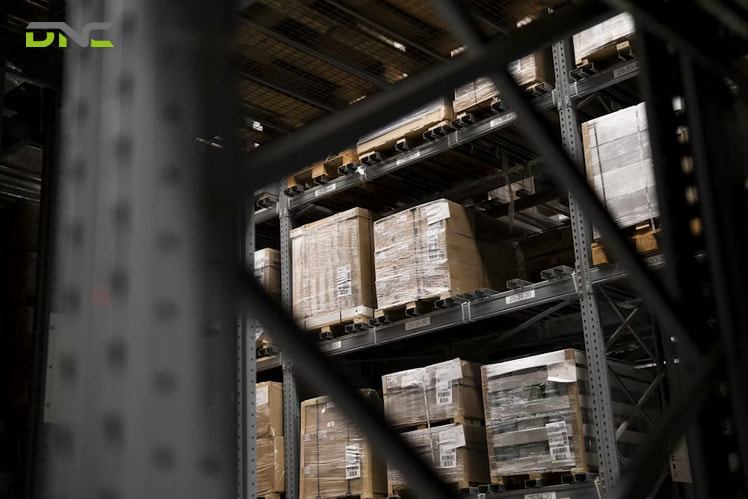
Automated Cold Storage Design: Malaysian Requirements
Automated Cold Storage ROI in Malaysia
Case Study — Malaysian Frozen Food Distributor
A Malaysia-based frozen food distributor with 8,000 pallet positions converted from manual to automated cold storage:
Before (manual):
- 60 cold store workers across 3 shifts (RM 3,000/month average)
- Energy consumption: 2.8 kWh per pallet stored per month
- Inventory accuracy: 97.2%
- Pallet positions per m²: 1.2
- Building footprint: 6,700 m²
After (shuttle ASRS cold store, 8,000 positions):
- 12 operators (system operation) + 4 maintenance technicians
- Energy consumption: 1.7 kWh per pallet per month (−39%)
- Inventory accuracy: 99.98%
- Pallet positions per m²: 4.1
- Building footprint: 1,950 m²
Annual financial impact:
- Labour saving: RM 1,584,000 (44 operators × RM 3,000 × 12)
- Energy saving (8,000 pallets × 12 months × 1.1 kWh × RM 0.50/kWh): RM 528,000
- Inventory accuracy benefit: RM 220,000
- Rental saving (new building vs. expansion of existing): RM 1,140,000
- Total annual benefit: RM 3,472,000
Investment: RM 14M (shuttle ASRS + cold-rated building + WMS + IoT)
Payback: 4.0 years
IRR (15 years): 22%
DNC Automation’s Cold Storage ASRS Services
DNC Automation Malaysia delivers automated cold storage projects from concept through commissioning:
System design: Cold zone ASRS selection, thermal load analysis, building integration specification, and financial model.
Cold-rated ASRS supply: Shuttle systems, pallet cranes, and VLMs with cold-rated components and Malaysian warranty support.
WMS cold chain configuration: FEFO management, lot traceability, temperature record integration, and NPRA/JAKIM compliance documentation.
IoT temperature monitoring: Continuous cold zone temperature logging with SCADA display and automated alerts.
Installation and commissioning: Cold store ASRS installation coordinated with building contractor, refrigeration plant, and fire protection system — DNC as single project manager.
MIDA application support: Capital allowance and automation grant documentation for cold storage ASRS investments.
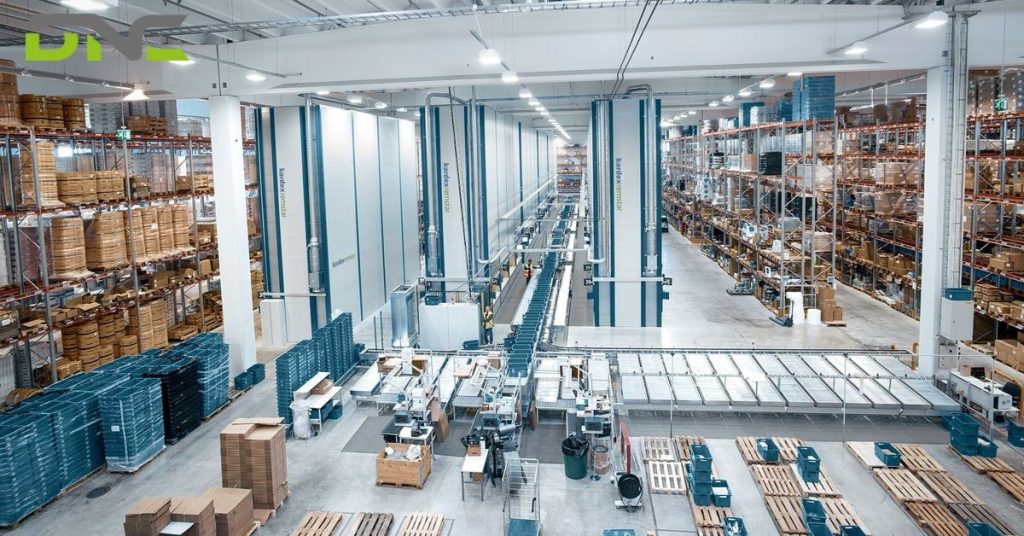
DNC Automation’s Cold Storage ASRS Services
Frequently Asked Questions
What is the minimum scale for cold storage automation to be cost-effective?
For pallet shuttle systems, approximately 3,000–5,000 pallet positions is the practical minimum for positive ROI in a Malaysian cold store paying market-rate labour and energy costs. VLMs for cold zone small-parts storage are cost-effective from a single unit.
How is ASRS maintenance performed in a frozen environment?
Scheduled maintenance is designed to occur during planned warm-up cycles (typically once per week for 4–8 hours). Maintenance technicians wear appropriate PPE for cold zone access. DNC designs maintenance access provisions into the ASRS layout — crane service platforms, shuttle extraction points — to minimise cold exposure during routine maintenance.
Can automated cold storage achieve Malaysian halal certification?
Yes. ASRS systems enforce product segregation through software rules — the WMS can be configured to prevent halal and non-halal products from sharing the same storage lane or zone. DNC Automation has designed JAKIM-compliant automated cold store layouts for Malaysian halal food manufacturers.
What happens if the refrigeration plant fails in an automated cold store?
If refrigeration fails, the WMS and ASRS can prioritise outbound retrieval of temperature-sensitive products to preserve cold chain integrity — a capability that manual cold stores cannot match at equivalent speed.
Conclusion
Automated cold storage warehouses combine the space efficiency and accuracy of ASRS with cold-rated engineering to deliver operational and financial performance that manual cold stores cannot match. In Malaysia’s expanding cold chain sector, automated cold storage investment delivers measurable payback through labour savings, energy efficiency, density improvement, and food safety compliance.
DNC Automation Malaysia designs and implements automated cold storage solutions — from cold-rated shuttle systems to fully integrated high-bay cold stores — with WMS cold chain management, IoT monitoring, and MIDA incentive support.
Contact DNC Automation Malaysia to discuss automated cold storage for your facility.
Cold Storage Warehouse Automation: Implementation Timeline
A full automated cold storage ASRS project — from project kick-off to live operation — follows this timeline:
Phase 1: Design and Engineering (4–6 months)
- Operational analysis: SKU profile, throughput requirements, temperature zones, halal segregation requirements
- Building design: Insulated panel specification, refrigeration plant sizing, floor heating design, in-rack sprinkler design
- ASRS design: Shuttle or crane selection, lane layout, level count, conveyor routing, WCS specification
- WMS design: FEFO rules, lot traceability configuration, NPRA/JAKIM compliance documentation approach
- Permitting: Building plan submission to local authority, Bomba plan approval, DOSH machinery registration preparation
Phase 2: Civil Construction (8–14 months, parallel with equipment manufacturing)
- Ground preparation, piling if required
- Insulated building structure
- Floor heating installation and concrete slab
- Refrigeration plant installation
- In-rack sprinkler installation
Phase 3: ASRS Installation (3–5 months)
- Racking structure erection
- Shuttle vehicles or crane installation
- Lift installation
- Conveyor system installation
- Electrical MCC and cabling
Phase 4: Commissioning (2–3 months)
- Refrigeration plant commissioning (cooling down to operating temperature)
- ASRS cold-rated testing at operating temperature
- WCS software commissioning
- WMS cold chain configuration and testing
- IoT temperature monitoring system commissioning
- FAT, SAT, and performance testing
Phase 5: Training and Go-Live (1–2 months)
- Operator training in cold-rated PPE environment
- Maintenance technician cold zone training
- Parallel run with existing operation
- Full cutover and live operation commencement
Total typical project duration (greenfield cold store): 18–30 months
Cold Storage Automation: Regulatory Summary for Malaysia
JAKIM Halal Requirements
For halal-certified cold storage operations, JAKIM MS 1500:2019 requires:
- Physical segregation of halal and non-halal products (separate storage zones, separate equipment)
- ASRS WMS configuration must prevent halal and non-halal products from sharing the same storage lane
- Access control to halal storage zones
- Muslim-supervised loading and unloading procedures at product transfer points
DNC Automation designs ASRS zone assignments and WMS halal segregation rules as part of cold store projects for halal-certified operators.
NPRA Good Distribution Practice (Pharmaceutical Cold Chain)
NPRA’s GDP guidelines for pharmaceutical cold chain require:
- Validated storage temperature within 2–8°C (chilled) or -15 to -25°C (frozen) with continuous monitoring
- Full lot traceability from supplier receipt through customer delivery
- Deviation recording and quarantine management
- Access-controlled storage for narcotic and controlled drug products
- Annual GDP audit with full temperature record evidence
DNC Automation’s WMS cold chain configuration addresses all NPRA GDP requirements, with automated temperature excursion alerts and continuous digital logging exported in GDP-compliant report formats.
Jabatan Keselamatan Makanan (Food Safety)
Malaysia’s Department of Food Safety (JKDM) Regulations require cold storage facilities handling food products to maintain documented temperature records and pest control logs. Automated cold storage with IoT temperature monitoring provides:
- Continuous temperature logs (replacing manual 2× daily spot checks)
- Automated alerts for deviation, triggering corrective action before product safety is compromised
- Exportable temperature records in JKDM-required formats
Conclusion (Extended)
Automated cold storage warehouses represent the convergence of refrigeration engineering, ASRS technology, and intelligent WMS software. For Malaysian cold chain operators — in food, pharmaceutical, and e-commerce grocery sectors — automation delivers energy savings, labour reduction, accuracy improvement, and regulatory compliance simultaneously.
DNC Automation Malaysia designs and implements automated cold storage projects that meet Malaysian JAKIM, NPRA, and JKDM requirements, with cold-rated ASRS, WMS cold chain configuration, and IoT temperature monitoring as an integrated solution.
Contact DNC Automation Malaysia to discuss automated cold storage for your facility and receive a feasibility assessment.
Automated cold storage warehouses represent the convergence of refrigeration engineering
Cold Storage Automation: Energy Management and Sustainability
Energy cost is the second-largest operating expense in cold storage after labour. Automated cold stores reduce energy cost through system design — and smart warehouse technologies optimise it further during operation.
Refrigeration Plant Optimisation
The refrigeration plant represents 60–75% of cold store energy consumption. Automation enables:
Demand-responsive compressor management: ASRS operations generate predictable heat loads — crane motors, shuttle batteries, conveyor drives. The refrigeration control system can anticipate heat load based on ASRS throughput data from WCS and pre-cool the storage zone before heavy throughput periods.
Night-rate energy scheduling: Malaysian TNB electricity tariffs are lower during off-peak hours (11 PM–8 AM). Smart cold store systems schedule ASRS operations to maximise throughput during off-peak periods, reducing average energy cost per pallet move by 15–20%.
Defrost cycle optimisation: Traditional time-based defrost cycles waste energy by defrosting at fixed intervals regardless of actual ice accumulation. Demand-defrost systems use airflow sensors to detect actual ice buildup and trigger defrost only when needed — reducing defrost frequency by 20–30%.
ASRS Energy Efficiency in Cold Storage
Cold-rated ASRS equipment is designed for energy efficiency in frozen environments:
Motor selection: Premium efficiency motors (IE3 or IE4 rating) are specified for cold store ASRS — the efficiency improvement is proportionally more valuable in a cold environment where motor heat must be removed by the refrigeration plant.
Energy regeneration: Modern stacker crane drives include energy regeneration — the crane’s hoisting motor acts as a generator when lowering loads, recovering energy back to the DC bus. For a crane completing 80 cycles per hour, regeneration recovers 15–25% of hoisting energy.
Variable frequency drives (VFDs): All cold store ASRS crane and shuttle drives use VFDs for speed control — eliminating the energy waste of fixed-speed motor operation during acceleration and deceleration.
LED lighting: Cold store ASRS aisles operate in darkness — crane-mounted work lights activate only during maintenance access. This eliminates aisle lighting energy cost (typically RM 30,000–80,000/year in equivalent manual cold stores).
ESG Reporting for Cold Store Automation
Malaysian manufacturers subject to Bursa Malaysia sustainability reporting requirements or multinational customer ESG audits need cold store energy data:
DNC Automation’s smart warehouse IoT platform provides:
- Energy consumption per pallet stored (kWh/pallet-month)
- Carbon footprint calculation (energy × grid emissions factor)
- Year-on-year efficiency trend
- Comparison against industry benchmarks (published by ASHRAE and IIR for cold storage)
This data supports Bursa Malaysia’s Sustainability Reporting Framework, GHG Protocol Scope 2 reporting, and customer ESG questionnaire responses.
Cold Storage ASRS: Maintenance in Frozen Environments
Maintaining ASRS equipment in frozen environments (-18°C to -25°C) requires specialised procedures and protocols different from ambient ASRS maintenance.
Cold Zone Entry Protocol
Before entering the frozen storage zone for maintenance:
- Don insulated coveralls, boots, and gloves rated to -30°C
- Inform the operations supervisor and enter name in the cold zone entry log
- Take a charged two-way radio
- Maximum continuous cold zone exposure: 30 minutes at -18°C; 20 minutes at -25°C
- Exit the cold zone immediately if feeling numbness, dizziness, or disorientation
Maintenance During Warm-Up Cycles
The most effective approach for sustained cold zone maintenance is a planned warm-up cycle:
- Refrigeration plant switched to minimum cooling mode
- Cold zone temperature allowed to rise to 0–5°C over 4–6 hours
- Maintenance activities performed in the warmed zone (standard clothing, no time limit)
- Refrigeration plant returned to full operation; zone cooled down over 6–8 hours
For larger preventive maintenance tasks (crane wheel replacement, rail inspection), a planned warm-up cycle minimises cold exposure while allowing the work to proceed safely.
Cold-Rated Lubricants and Components
ASRS maintenance in cold storage requires:
- Synthetic lubricants: Mineral-based lubricants solidify below -10°C. Fully synthetic lubricants (PAO or ester base) maintain viscosity to -40°C.
- Cold-rated grease: NLGI Grade 0 or 00 for cold environments (versus Grade 2 for ambient applications)
- Stainless steel fasteners: Carbon steel fasteners develop rust in freeze-thaw cycles; stainless steel fasteners prevent corrosion-related maintenance issues
- Anti-condensation heaters: Electrical enclosures within the cold zone require anti-condensation heaters to prevent moisture from condensing on electronics during temperature transitions
DNC Automation’s maintenance contracts for cold store ASRS specify cold-rated lubricants and replacement components, and our maintenance technicians are trained in cold zone work protocols.
Cold Store ASRS: Common Questions from Malaysian Operators
Can the ASRS operate during a power outage?
Shuttle systems equipped with UPS (uninterruptible power supply) can complete their current cycle and park safely during a power outage. Stacker cranes with regenerative drives can use gravity-lowering to deposit a load safely before stopping. Full UPS backup for 15–30 minutes of operation is available for critical operations. DNC Automation specifies UPS requirements during system design based on the critical inventory type and acceptable response time.
What is the minimum aisle clearance around the ASRS cold store for maintenance?
DOSH requires a minimum maintenance clearance around ASRS structures — typically 600mm to 1,200mm depending on equipment type. Crane aisles require end-of-aisle maintenance platforms for safe technician access to crane rail ends and buffers. DNC Automation designs maintenance access provisions into all ASRS layouts.
How does automation handle product recalls in a cold store?
WMS lot traceability identifies every pallet containing the recalled lot number within seconds. The WMS issues retrieval commands to the ASRS to extract all affected pallets to a quarantine staging area. For an 8,000-position cold store, complete quarantine of a recalled lot is achievable in 2–4 hours — dramatically faster than manual cold store lot tracing (typically 12–24 hours for large stores).
Cold Store Automation: Operator Roles After Automation
After automated cold storage is commissioned, the operator role profile changes significantly. Planning for this change reduces resistance and improves operational performance.
Before automation (manual cold store):
- 15–25 forklift operators and pickers working in the cold zone
- Physical handling of frozen goods in -18°C to -25°C environment
- High injury risk (cold-related illness, forklift accidents, heavy lifting)
After automation (ASRS cold store):
- 3–5 WMS console operators working in an ambient temperature control room
- 2–3 maintenance technicians (cold zone entry for scheduled maintenance only)
- 1–2 marshalling operators at the ASRS infeed/outfeed points (ambient temperature work)
The skill requirement shifts from physical ability to technical aptitude. Former cold store operators who cannot transition to WMS operator or maintenance roles need to be redeployed or supported through the workforce transition.
DNC Automation provides change management support as part of cold storage automation implementation — including operator information sessions, aptitude assessment for internal candidates, and retraining programme design.
The safety improvement: Eliminating sustained cold zone work reduces workplace injury risk significantly. Cold-related illnesses, frostbite incidents, and forklift accidents in confined cold zones have caused serious injuries in Malaysian frozen food facilities. Automation removes this risk by removing workers from the hazardous environment.
- 94 views
- 0 Comment
Recent Comments