


Case Packer Machines | DNC Automation Malaysia
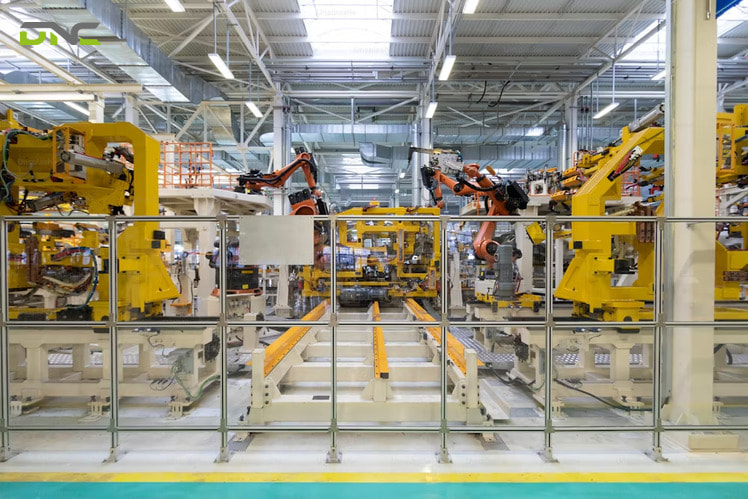
Case packer machines load products into corrugated cases at the end of a production line — automating the step that otherwise requires the most manual labour in Malaysian packaging operations. A case packer receives individual products from an upstream conveyor, counts and groups them into the correct pack configuration, forms or opens a corrugated case, and deposits the product group into the case — ready for sealing, labelling, and palletizing.
The variety within the case packer machine category is substantial. Wraparound case packers, top load case packers, side load case packers, and robotic case packers all perform the same primary function — transferring product from single unit flow to grouped case format — but through fundamentally different mechanical approaches. Each configuration suits different product types, production speeds, and case formats.
This guide maps out every case packer machine type available for Malaysian manufacturing operations, explains the selection criteria that determine which type fits each production scenario, and covers the integration requirements that govern whether a new case packing machine delivers its intended capacity increase.
What Is a Case Packer Machine?
A case packer machine — also called a case packaging machine, box packer machine, or packing machine in Malaysian manufacturing contexts — is an automated system that places products into corrugated shipping cases. The machine handles three core functions:
- Product infeed and grouping: Products arrive in a continuous stream from upstream filling, labelling, or primary packaging equipment. The case packer counts products and groups them into the case configuration (e.g., 12 bottles per case, 24 pouches per case, 6 cartons per case).
- Case handling: The case packer either erects flat corrugated blanks into open cases (wrap-around and flat-blank erecting styles) or opens pre-glued, pre-formed cases from a magazine.
- Case loading: Products are transferred into the case via one of several mechanisms — top loading (products dropped or placed from above), side loading (products pushed horizontally into the open case end), or wraparound (the corrugated blank wraps around the product group and is glued).
After case loading, the filled case exits the machine to a case sealer for top flap closing and taping or gluing, then to a palletizer.
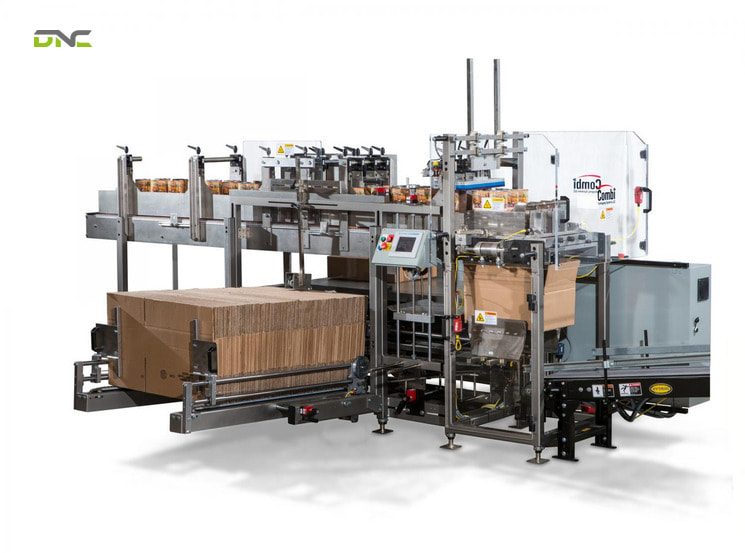
What Is a Case Packer Machine?
Case Packer Machine Types
Wraparound Case Packer
Wraparound case packers start with a flat corrugated blank rather than a pre-formed case. The machine forms the blank around a pre-grouped set of products — wrapping the corrugated sheet around the product layer and gluing or interlocking the end flaps to create a fully enclosed case.
Mechanical process: Products are grouped on an infeed platform. A corrugated blank is retrieved from a flat-pack magazine and positioned beneath or beside the product group. Folding arms wrap the blank around the group; hot melt glue or mechanical locks secure the case closed. The formed, filled, and closed case exits on the discharge conveyor — without requiring a separate sealing step.
Advantages:
- Lowest corrugated material consumption: flat blanks use less board than pre-formed cases because there are no overlapping glue flaps
- Tightest case-to-product fit: the blank wraps to the product, not the other way around — resulting in minimal void space and superior transit protection
- No separate case sealer required in most configurations
- High throughput: 20–60 cases per minute on high-speed beverage and F&B lines
Limitation: Wraparound case packers are less flexible for product size changes — the blank dimensions are fixed to a specific product group footprint. Mixed-SKU operations require blank changeover.
Top Load Case Packer
Top load case packers load products vertically into an open-top case. The case arrives pre-formed (opened from a flat blank or from a pre-glued magazine); products are placed or dropped from above through the open case top, then the case moves to a sealer for top flap closure.
Mechanical process: Cases travel on a conveyor with the top open. Above the conveyor, products arrive via a product handling system — which may use vacuum suction cups, mechanical grippers, or controlled drop guides depending on product fragility. The product handling system deposits the correct product count and configuration into each passing case. Filled cases exit to the case sealer.
Advantages:
- High flexibility: products can be loaded in multiple orientations (standing upright, on their side, layered)
- Suitable for fragile products: vacuum and servo-controlled placement systems handle products with near-zero drop impact
- Can handle multiple layers of products per case
- Wide product size accommodation without major mechanical changeover
Application fit: Pharmaceutical carton packing (inserting individual medicine boxes into shipper cases), food packaging where products must stand upright (yoghurt cups, sauce bottles), home appliance accessory kitting, and any application where product orientation in the case matters for presentation or stability.
Throughput: 5–30 cases per minute depending on the number of products per case and the complexity of the loading pattern.
Side Load Case Packer
Side load case packers push product groups horizontally into the open end of a pre-formed case. The case is held stationary with one end flap open; a product infeed system groups products on a platform aligned with the case opening; a pusher mechanism slides the product group into the case; the end flap is then closed and sealed.
Mechanical process: Products accumulate in a collating zone until the correct count and pattern is achieved. A linear pusher — pneumatic, servo-driven, or mechanical cam — transfers the product group sideways into the waiting case. The loaded case moves to an end flap folder and sealer.
Advantages:
- Continuous-motion side load case packers achieve very high throughput (30–80 cases per minute)
- Gentle handling: products are pushed rather than dropped, suitable for items prone to impact damage
- Compact footprint in the product flow direction
- Well-suited to uniform product shapes (bottles, cans, pouches) that flow predictably
Application fit: High-speed beverage canning and bottling lines, shrink-wrapped multi-packs loaded into cases, and any high-volume uniform product stream. Malaysian carbonated beverage and dairy producers running high-speed lines use side load case packers to match their filler throughput.
Limitation: Product must be capable of horizontal sliding — products that tip, interlock awkwardly, or require specific top-face-up orientation in the case are better suited to top load systems.
Robotic Case Packer
Robotic case packers replace the fixed mechanical product handling system with one or more industrial robots. The robot — typically a delta robot (for high-speed light products), a SCARA robot (for medium-speed precision placement), or a six-axis articulated arm (for flexible heavy-duty packing) — picks products from an infeed conveyor and places them into cases according to a programmed packing pattern.
Advantages:
- Maximum flexibility: packing pattern, product orientation, and case size are all reprogrammable via the robot controller — no mechanical changeover
- Can handle multiple product types on the same line with recipe switching
- Scalable: additional robot heads can be added as throughput requirements grow
- Minimal mechanical wear compared to cam-driven mechanical case packers
Application fit: Operations with frequent SKU changes, mixed-product case packing (gift assortments, promotional packs), or products requiring delicate placement that mechanical systems cannot replicate. DNC Automation’s robotic systems integration capability — including Comau robot arms — makes robotic case packing a natural extension of the DNC automation portfolio for Malaysian manufacturers.
Throughput: 10–60 picks per minute per robot head. Multiple robot heads in parallel achieve higher case throughput.
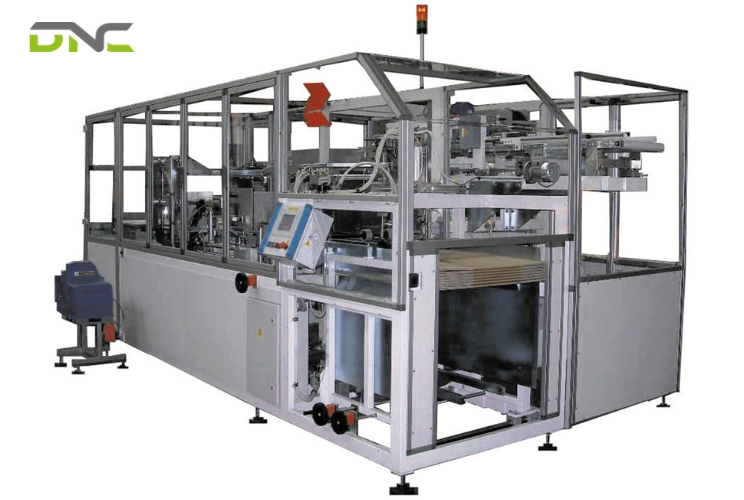
Robotic Case Packer
Selection Criteria: Which Case Packer Machine Fits Your Line?
Production Speed
Match the case packer’s rated CPM (cases per minute) to your line speed requirement, with a minimum 25% safety margin:
| Required CPM | Suitable Case Packer Type |
| 5–15 CPM | Top load (servo), robotic |
| 15–30 CPM | Side load, wraparound, top load (high-speed) |
| 30–60 CPM | Wraparound, continuous-motion side load |
| 60+ CPM | High-speed wraparound, multi-head robotic |
Product Characteristics
| Product Type | Recommended Packer |
| Bottles (round, oval) | Side load or wraparound |
| Cartons (flat, rectangular) | Top load or side load |
| Pouches, sachets | Top load with lay-flat infeed |
| Fragile items | Robotic top load (servo-controlled) |
| Mixed SKU | Robotic |
| Irregular shapes | Robotic |
Case Format
| Case Format | Compatible Packer |
| Regular Slotted Container (RSC) | Side load, top load |
| Wraparound (WA) flat blank | Wraparound case packer only |
| Half-slotted container (HSC) | Top load |
| Pre-glued tray + lid | Top load (tray denesting) |
SKU Changeover Frequency
| Changeover Frequency | Recommended Configuration |
| Once per week or less | Mechanical (side load or wraparound) |
| Daily | Top load with adjustable guides |
| Multiple per shift | Robotic with recipe management |
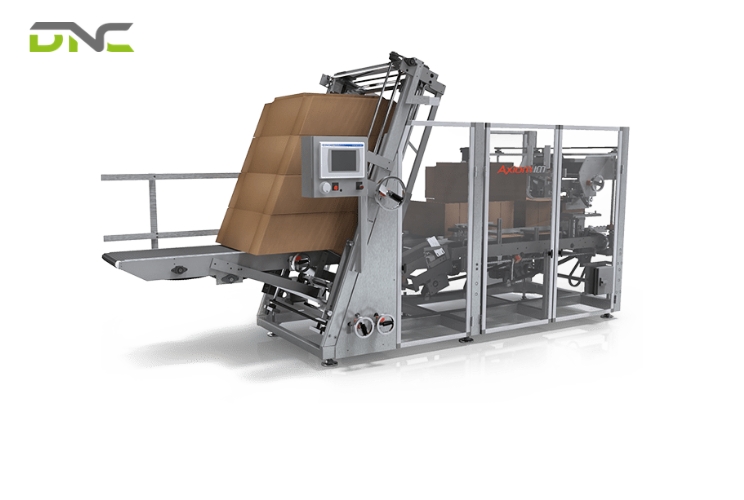
Horizontal Case Packer
Integration: Connecting Case Packers to Your Production Line
Upstream Integration
Case packer machines interface with upstream primary packaging equipment — fillers, labellers, carton packers, or wrapping machines. Key integration parameters:
Infeed conveyor speed matching: The case packer must receive products at a consistent rate. Upstream equipment that feeds at variable rate (e.g., manual packing stations, intermittent fillers) requires a buffer conveyor or product accumulation table between the upstream machine and the case packer infeed.
Product orientation at infeed: Products must arrive at the case packer infeed in the correct orientation for the packing pattern. Upending conveyors, turning guides, and laning systems organise product flow upstream of the case packer. DNC Automation designs these infeed handling systems as part of every case packer integration project.
Line speed communication: The case packer PLC should receive a speed reference signal from the upstream filler or primary packaging line master PLC. This synchronisation prevents product accumulation during upstream slowdowns and prevents starving during upstream speed increases.
Downstream Integration
After case packing, filled cases flow to:
- Case sealer — for top flap closing (tape or hot melt). Conveyor height and speed must match the case packer discharge.
- Checkweigher — to verify case weight within tolerance. Positioned immediately after the case sealer.
- Print and apply labeller — for case shipping label application.
- Palletizer — for layer stacking and stretch wrapping.
DNC Automation designs and integrates the complete downstream sequence as a single engineered system. Sourcing individual machines from separate suppliers and integrating them independently typically adds 3–6 weeks to commissioning and introduces interface risks at each connection point.
Control System Architecture
For Industry 4.0-aligned Malaysian manufacturers, case packer integration goes beyond mechanical and electrical connection. DNC Automation implements:
- OEE monitoring: The case packer reports cases per minute, uptime percentage, and fault code history to the facility SCADA or MES system.
- Case count tracking: Production order reconciliation — cases produced vs. target — is tracked in real time.
- Predictive maintenance triggers: Cycle count-based maintenance alerts prompt technicians before wear-induced failures occur.
Malaysia’s NIMP 2030 initiative and Industry 4.0 grant programmes under MIDA specifically fund this level of digital integration. DNC Automation’s project team assists clients in structuring their automation projects to qualify for available incentives.
Case Packing Machine: Malaysian Industry Applications
Food and Beverage
Malaysia’s F&B manufacturing sector — particularly beverage producers in Selangor and Johor — runs some of the highest case packer throughput rates in Southeast Asia. Carbonated beverage lines run side load case packers at 40–80 CPM; juice and dairy producers use wraparound case packers for board cost efficiency; premium beverage brands specify robotic top load systems for mixed product configurations.
Key F&B case packing requirement in Malaysia: washdown compatibility. Case packers operating in wet zones must have IP65 or IP67-rated electrical enclosures, stainless steel product contact surfaces, and drainage-optimised frame designs. Standard case packers are not rated for wet zone operation.
Pharmaceutical and Healthcare
Malaysian pharmaceutical manufacturers — producing OTC products, dietary supplements, and medical devices for export — require case packing machines with GMP-compliant design. Key requirements: documented material of construction certificates for product contact parts, electronic batch records (case count per production order), and integration with upstream vision inspection to reject non-conforming product before case loading.
Glove Manufacturing
Malaysian glove manufacturers — the world’s largest glove production base — pack examination and surgical gloves in counted boxes (typically 100 or 200 gloves per box), then case-pack the boxes into shipping cases. Top load case packers or robotic systems handle the glove box case packing step, with throughput requirements driven by the glove dipping line output (often 40,000–80,000 pieces per hour per line).
Warehouse and Logistics
Distribution centres in Selangor’s logistics corridor (Shah Alam, Port Klang, Puchong area) use case packers for secondary packaging of imported goods and e-commerce fulfilment. The mixed-SKU nature of distribution operations makes robotic case packers the appropriate technology — programmable packing patterns handle product variety without mechanical changeover downtime.
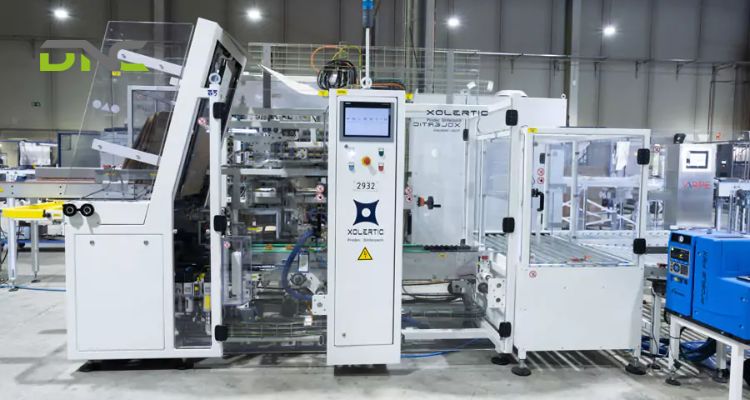
Componetns of Automatic Case Packing
Case Packer Machine Cost Structure: Capital, Operating, and ROI in Malaysia
Capital Cost by Configuration
| Case Packer Type | Capital Cost (RM) | Notes |
| Semi-automatic (manual load) | 15,000–50,000 | Operator-dependent; low volume |
| Mechanical top load (auto) | 80,000–200,000 | Servo pick head; 5–25 CPM |
| Mechanical side load (auto) | 100,000–300,000 | High throughput; 15–60 CPM |
| Wraparound (auto) | 120,000–350,000 | Board-efficient; 20–60 CPM |
| Robotic (single head) | 180,000–450,000 | Maximum flexibility |
Add 20–30% for infeed handling system and commissioning. For projects exceeding RM 500,000 in total automation scope, MIDA’s Smart Automation Grant provides up to 50% matching grant for qualifying Malaysian manufacturers.
Operating Cost Drivers
Corrugated case material dominates operating cost. A case packing line running 25 CPM on two shifts consumes approximately 24,000 cases per day. At RM 1.20–2.50 per case, annual material cost ranges from RM 10.5 million to RM 21.9 million. Even a 3% case cost reduction through specification optimisation or supplier renegotiation saves RM 315,000–657,000 annually — dwarfing any other operating cost category.
Maintenance on a well-maintained automatic case packing machine: RM 20,000–50,000 per year for parts and scheduled labour on a two-shift operation. Robotic configurations add RM 15,000–25,000 for robot-specific maintenance (servo inspection, joint lubrication, vision calibration).
Labour post-automation: one monitoring operator per shift manages one or two case packing lines. At Malaysian manufacturing wages, this costs RM 25,000–35,000 per year per operator — typically a 70–80% reduction from the 4–6 workers that manual case packing requires.
Payback Period Framework
| Operation Type | Manual Annual Labour Cost | Auto Case Packer Investment | Payback |
| 2-shift, 4 manual workers | RM 168,000 | RM 200,000 (incl. install) | ~15 months |
| 3-shift, 6 manual workers | RM 252,000 | RM 250,000 | ~12 months |
| 2-shift, robotic (mixed SKU) | RM 200,000 + changeover cost | RM 450,000 | ~22 months |
Changeover cost savings (eliminating 30–45 min manual changeover per SKU change) further compress payback for robotic configurations in mixed-SKU operations.
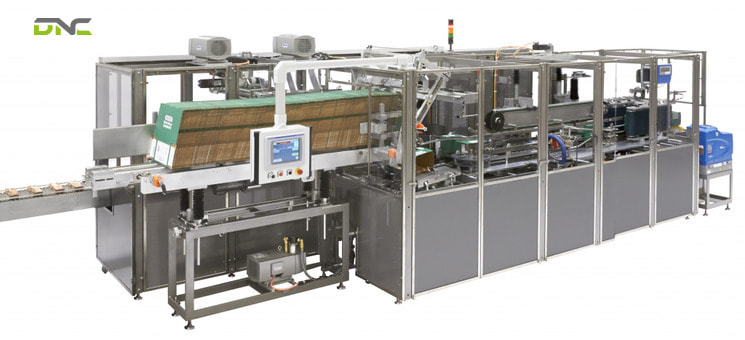
Case Packer Machine Cost Structure
Case Packer Machine Selection: Avoiding the Five Costliest Mistakes
Malaysian manufacturers spend RM 80,000–400,000 on automatic case packing machines and then discover post-installation that the machine does not perform as expected. Five mistakes account for the majority of these outcomes:
- Specifying throughput at nominal carton size only. Case packers perform differently at minimum and maximum carton sizes. A machine rated at 30 CPM for 300 mm × 200 mm × 200 mm cases may only achieve 18 CPM at 500 mm × 400 mm × 300 mm cases on the same line. Specify throughput at your actual largest case dimension, not your average.
- Ignoring corrugated board sourcing flexibility. Case packing machines calibrated for one board grade may malfunction with alternative suppliers. Malaysian manufacturers who have only one approved corrugated board supplier are exposed to supply disruption risk on production-critical lines. Specify machines that accommodate ±1 flute grade variation without tool changes.
- Purchasing without an infeed handling scope. The case packer datasheet shows CPM at the machine output — not at the upstream production line discharge. Getting products from the upstream equipment into the case packer at the correct rate, count, and orientation requires infeed handling engineering. Omitting this from the project scope creates a post-installation integration problem.
- Under-sizing the case magazine capacity. A 50-case magazine at 20 CPM requires replenishment every 2.5 minutes — meaning a dedicated case loading operator. At 100 cases/magazine, replenishment every 5 minutes. Specify magazine capacity based on your acceptable replenishment interval and staffing plan.
- Neglecting to qualify the corrugated box supplier. The case packer performance is only as good as the cases it processes. Malaysian corrugated box quality varies significantly between suppliers — dimensional tolerances, board moisture content, and manufacturer’s joint strength all affect machine reliability. DNC Automation provides a case acceptance test protocol for qualifying new corrugated box suppliers against your case packer’s specifications.
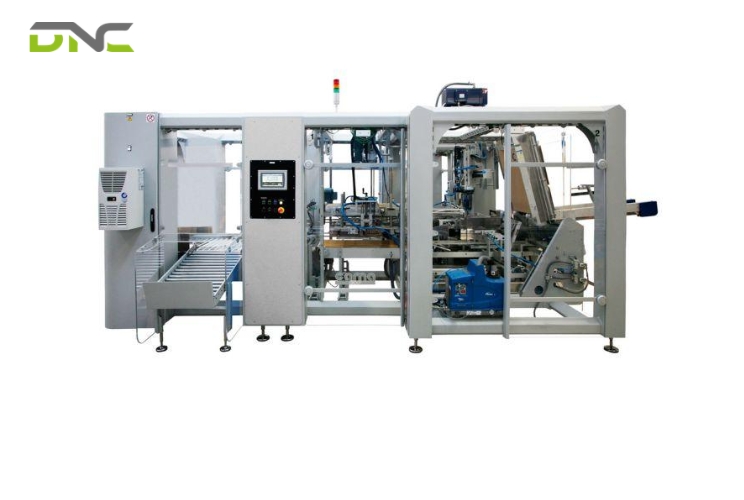
Industry Applications for RSC Case Packers
Frequently Asked Questions
What is the difference between a case packer and a case sealer?
A case packer machine loads products into a corrugated case. A case sealer closes and seals the filled case with tape or hot melt glue. These are two distinct machines that operate in sequence on the production line. Some wraparound case packers incorporate the sealing step (the blank is glued closed during the wrapping process), but conventional RSC-format case packers require a separate case sealer downstream.
How fast does a case packer machine work?
Case packer throughput ranges from 5 cases per minute (robotic top load with complex packing patterns) to 80+ cases per minute (high-speed continuous-motion side load or wraparound). The correct throughput specification is your required daily case output divided by your production hours, multiplied by 1.25 for safety margin.
What products can a case packer machine handle?
Case packer machines handle bottles (glass and PET), cans, cartons, pouches, trays, tubes, jars, and most rigid or semi-rigid primary packages. The correct machine type depends on product shape, fragility, size, and the required packing configuration. Irregular, fragile, or frequently changing products are best handled by robotic case packers.
Can a case packer machine handle multiple product sizes?
Yes — robotic case packers handle multiple sizes via recipe programming. Mechanical case packers (side load, top load, wraparound) can be adjusted for different sizes but require mechanical changeover time. The time-cost of changeover determines whether robotic flexibility justifies the higher capital cost for your operation.
What is RSC case packing?
RSC stands for Regular Slotted Container — the most common corrugated case format in Malaysian logistics. RSC cases have four flaps on the top and four flaps on the bottom; all flaps meet at the centre when closed. Most case packers handle RSC format. RSC case packers open pre-formed RSC cases from a magazine, load products, and discharge filled open-top cases to a downstream case sealer.
Does DNC Automation supply turnkey case packing lines?
DNC Automation engineers and integrates complete case packing lines — including product infeed handling, the case packer machine, downstream case sealer, checkweigher, labeller, and palletizer. With 35+ engineers and ISO 9001:2015 certification, DNC delivers the complete end-of-line system as a single integrated project rather than individual machine supply.
How long does case packer installation and commissioning take?
Mechanical installation of a standard automatic case packer: 2–3 days. Electrical and PLC commissioning: 2–4 days. Product acceptance trials (running your actual product through the machine to verify packing quality at rated speed): 1–2 days. Total: 5–9 working days for a standard non-robotic installation. Robotic case packer installations add 3–7 days for robot teaching, vision calibration, and safety system validation. Complex integrations involving SCADA connectivity or custom infeed handling may extend commissioning by 1–2 additional weeks.
What spare parts should I stock for a case packer machine?
Recommended minimum spare parts inventory for an automatic case packer: 2× conveyor belts (infeed and discharge), 1× vacuum pump service kit (if top load), 2× sets vacuum cups, 1× pusher guide rail (side load), 1× set servo drive fuses, 1× HMI touchscreen (for high-criticality lines). These components cover the most common failure modes. DNC Automation provides a recommended spare parts list and minimum stock quantities specific to each installed machine configuration.
How does DNC Automation handle case packer projects for Malaysian SME manufacturers?
DNC Automation works with Malaysian SME manufacturers as well as large enterprises. For SMEs, DNC provides phased implementation approaches — beginning with the case packer and downstream case sealer, then adding infeed automation as production volume justifies the investment. MIDA and SME Corp grant programmes have supported multiple DNC Automation projects at Malaysian SME clients; DNC’s project team assists with grant documentation and application as part of the project scope.
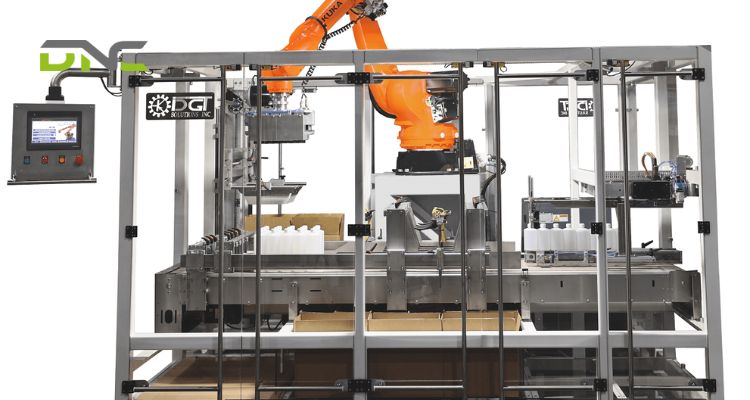
A case packer machine loads products into a corrugated case
Working With DNC Automation on Case Packer Integration
Case packer machine selection requires a detailed production line assessment — not a catalogue selection. The correct machine type, throughput specification, and case format handling depends on your specific product, your upstream line speed, your case format requirements, and your SKU changeover frequency.
DNC Automation’s engineering team conducts production line surveys at Malaysian manufacturing facilities, documents all relevant parameters, and delivers a turnkey case packing line proposal. Our project scope covers mechanical installation, conveyor integration, PLC programming, SCADA connectivity, and operator training — as a single integrated deliverable.
Talk to Our Engineers — describe your case packing requirement. Our team responds with a configuration recommendation within 3 working days.
Request a Quote — for complete case packing line integration from product infeed to palletizer discharge.
*DNC Automation | Malaysia Top #1 Factory Automation Solution Company | ISO 9001:2015 Certified | 35+ Engineers | 1,000+ Projects Delivered*
- 87 views
- 0 Comment
Recent Comments