


What Is Pallet Racking? Components, Types, and How the System Works
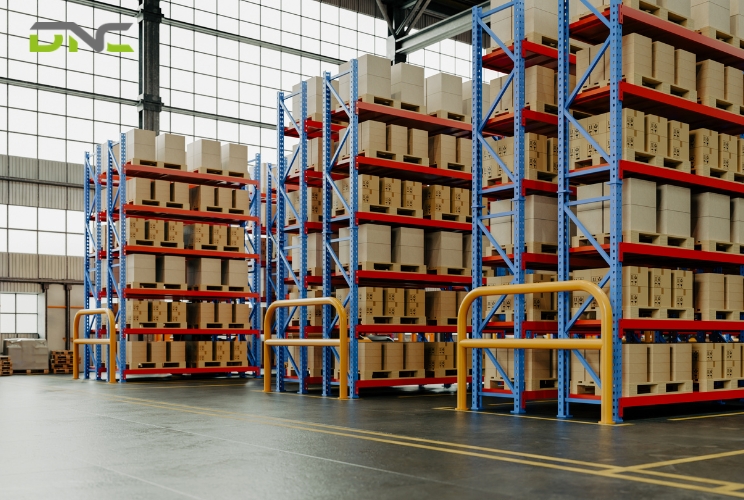
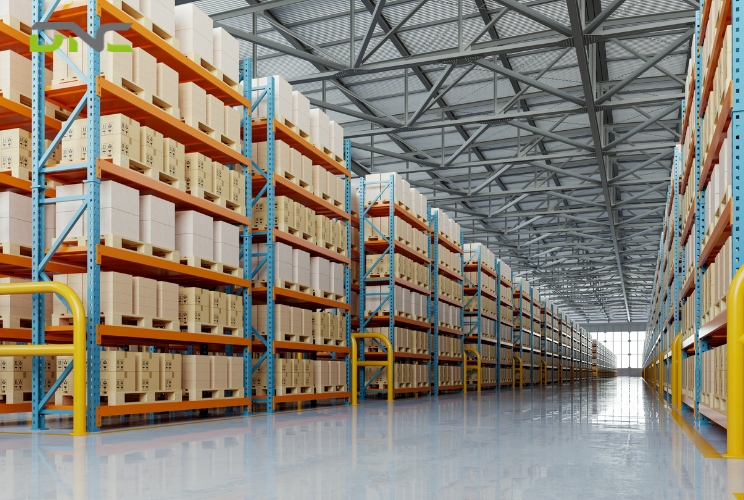
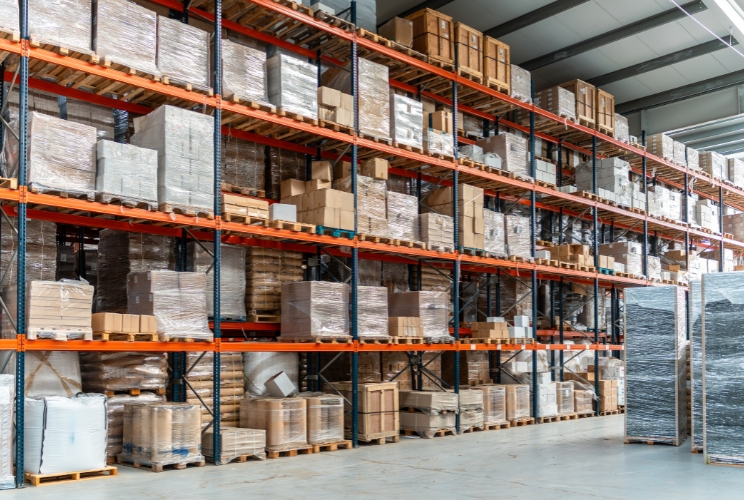
Pallet racking is a structural storage system engineered to hold loaded pallets on horizontal beam levels supported by vertical upright frames, giving forklifts direct access to every storage position. A pallet racking system converts unused vertical airspace into active storage capacity – the defining function that separates it from floor-stacking or fixed shelving. Each system is an assembly of load-bearing steel components: upright frames anchored to the warehouse floor, cross-braced for lateral stability, with horizontal beams connecting pairs of uprights at configurable heights to form individual pallet positions. The engineering logic is straightforward: load travels from pallet to beam, from beam to upright, from upright to base plate, and into the concrete floor. Pallet racking is not a single product – it is a system category that includes selective racking, drive-in racking, push-back racking, pallet flow racking, mobile racking, and narrow-aisle configurations, each designed for a specific combination of storage density, inventory rotation method, and forklift access requirement. For Malaysian manufacturers integrating warehouse automation, pallet racking specification is the foundational decision – the wrong racking type makes ASRS and AGV integration impossible without costly retrofitting.
Common misconception: Pallet racking is often treated as a commodity purchase – any rack that fits the floor plan will do. In practice, racking type, upright load rating, beam span, and anchor specification are all engineering decisions. A standard off-the-shelf system installed without load verification can fail structurally or block future automation integration entirely.
What Does a Pallet Racking System Consist of?
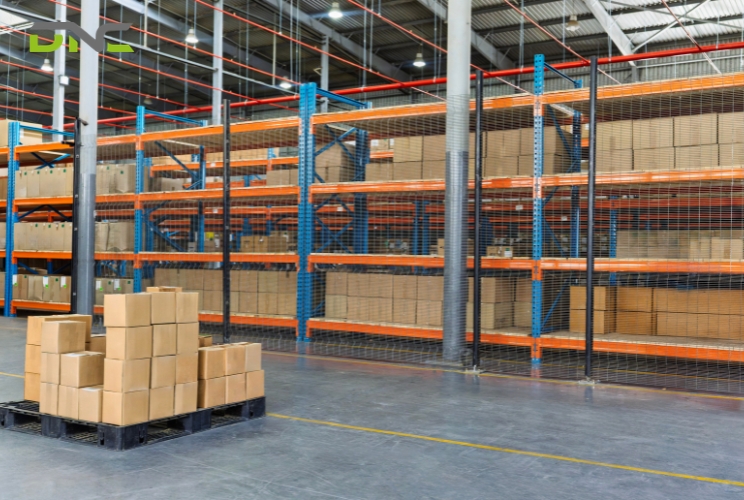
A pallet racking system consists of two categories of components: structural members that carry the load through a defined load path, and accessory components that ensure safety, stability, and long-term operational integrity.
Structural Components
The structural components of a pallet racking system form the load-bearing skeleton – five core parts that carry every pallet load from storage position to floor:
Upright frames are the vertical steel columns that carry all storage loads down to the floor. Each frame is a welded assembly of two upright posts connected by horizontal and diagonal bracing members – forming a single rigid panel. Upright frames come in fixed heights, with warehouse installations ranging from 2,000 mm (~6.5 ft / 78.7 in) for low-bay facilities to 12,000 mm (~39.4 ft / 472 in) for high-bay automated storage. The depth of the upright frame – measured front-to-back – determines how deep the pallet sits in the bay.
Beams (also called load beams or horizontal beams) connect pairs of upright frames and directly support the pallet load. Beams are the horizontal members you place pallets onto, and their rated load capacity – the maximum weight per beam level – is the most critical specification in any racking system. Beam capacity varies widely across system types, from lighter-duty configurations supporting around 500 kg per beam level to heavy industrial systems rated for up to 10,000 kg per level. Each beam clips or bolts into the upright frame at the desired height using a locking connection.
Base plates are the steel footings welded to the bottom of each upright. They distribute the column’s point load across a wider surface area and include bolt holes for floor anchoring. Base plate size increases with load rating – a larger base plate improves stability under heavy loads and seismic conditions.
Cross bracing and diagonal struts are the internal members that connect the two uprights within a single frame assembly. Horizontal bracing resists lateral forces; diagonal struts resist racking (sideways distortion) under load. Together they give the upright frame its rigidity. Cross bracing between adjacent frames – called row bracing or plan bracing – ties the row into a continuous structure.
Anchor bolts secure the base plate to the concrete floor. This is a mandatory installation requirement for any racking system carrying live pallet loads. Anchor torque specification varies by base plate size and load – a correctly torqued anchor bolt guards against frame tipping under forklift impact or seismic load.
Safety and Accessory Components
Beyond the structural skeleton, a complete pallet racking system includes several accessory components:
Safety pins and beam clips lock the beam into the upright frame connector. Every beam end should have a positive locking mechanism – a safety pin, spring clip, or bolt lock – that blocks the beam from lifting out of its connector under impact or vibration.
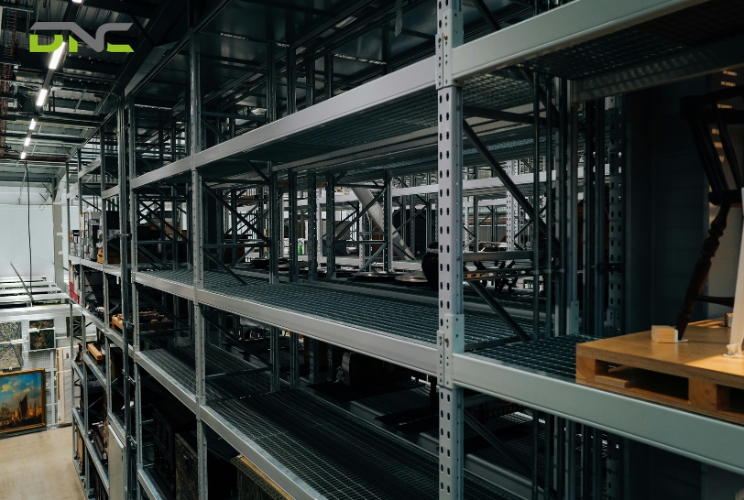
Wire decking and shelf panels are optional horizontal surfaces installed between beams to support smaller or irregular loads. Wire decking allows water from sprinkler systems to pass through, making it the standard choice in fire-code compliant warehouses. Alternatives include metal mesh panels, galvanized sheet panels, and chipboard panels for lighter applications.
Row spacers maintain the correct gap between back-to-back racking rows and prevent the structures from pressing against each other.
Upright protectors and column guards are bolt-on steel or polymer sleeves fitted around the base of each upright. They absorb low-speed forklift contact – the most common cause of racking structural damage – and lower the frequency of costly upright replacements.
Shims are leveling plates inserted under the base plate when the warehouse floor is not perfectly flat. Correct shimming ensures the upright stands plumb and load distributes evenly across both uprights in a frame.
Load capacity plaques are signage attached to each racking bay, displaying the maximum bay load, beam level load, and any installation-specific restrictions. Under standard DOSH occupational safety guidelines in Malaysia, these plaques are expected to be present and updated whenever the racking configuration changes – in cases where the configuration changes without updating the plaques, the posted load limits no longer reflect the installed system.
Every component in this list is load-path critical – in cases where any single part is omitted or substituted without engineering verification, the system’s rated capacity may no longer apply to the installed configuration.
How Does Pallet Racking Work?
Pallet racking works on a defined structural load path principle: weight transfers from the loaded pallet, down through the horizontal beams, laterally into the vertical upright frames, and finally into the concrete floor through anchored base plates – in most installations, without requiring any intermediate support columns in the storage area.
A forklift drives into the aisle fronting a bay, raises its forks to the correct beam level height, and slides the pallet onto the beams. The pallet now rests on two parallel beams – each beam carrying half the pallet’s load. That load travels along the beam to the beam-to-upright connection, then vertically down the upright frame, and distributes into the floor through the base plate and anchor bolts.
The system’s structural integrity depends on two conditions being maintained simultaneously: the beams must be rated for the pallet weight at the stored position, and the upright frame must be rated for the total cumulative load of all beam levels above the base plate. In cases where either condition is exceeded – typically through overloading a single beam level or through impact damage to an upright – the system’s load-carrying capacity is reduced, and the installation may no longer meet its original structural specification.
Aisle width between racking rows is not arbitrary. It is determined by the turning radius and mast height of the forklift type used. Standard counterbalance forklifts require aisles of 3,000 mm (~9.8 ft / 118 in) to 3,500 mm (~11.5 ft / 138 in) for safe pallet placement. Reach trucks operate in narrower aisles – around 2,500 mm (~8.2 ft / 98 in) to 2,800 mm (~9.2 ft / 110 in). Very Narrow Aisle (VNA) turret trucks bring aisle width down to 1,600 mm (~5.2 ft / 63 in) to 1,800 mm (~5.9 ft / 71 in), maximizing storage density at the cost of specialized equipment.
The system’s load capacity is not fixed at installation – it is configuration-specific. Moving a beam to a different height, adding beam levels, or changing pallet weights all affect whether the installed uprights remain within their rated capacity. This is why racking specifications in Malaysia should be engineered per facility layout, not selected from a standard catalog without load verification.
What Are the Main Types of Pallet Racking?
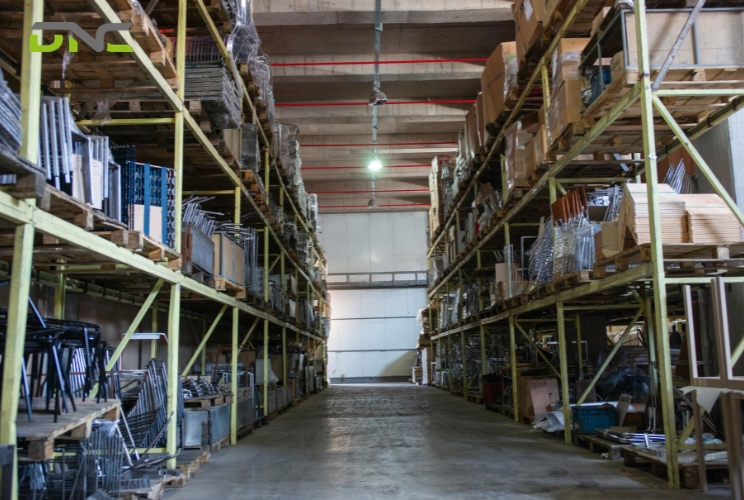
The six primary pallet racking types differ by storage density, inventory rotation method (FIFO or LIFO), and the level of direct access they provide to each stored pallet.
| Racking Type | Access | Rotation | Density | Best For |
| Selective Pallet Racking | Direct (every pallet) | FIFO or LIFO | Low–Medium | High-SKU, high-pick operations |
| Drive-In Racking | Block (last-in) | LIFO | High | Low-SKU, bulk storage |
| Drive-Through Racking | Block (both ends) | FIFO | High | Cold storage, perishables |
| Double-Deep Racking | 2 pallets deep | LIFO | Medium–High | Medium-SKU, paired SKUs |
| Push-Back Racking | Gravity-fed rear | LIFO | High | Medium-SKU, high-density |
| Pallet Flow Racking | Gravity-fed front | FIFO | High | Perishables, fast-moving goods |
| Mobile Pallet Racking | Direct (via aisle) | FIFO or LIFO | Very High | Cold storage, high-value goods |
Selective pallet racking is the most widely installed system worldwide and the starting point for most Malaysian warehouse projects. Every pallet position is independently accessible from a forklift aisle – no other pallets block access. This direct-access design makes selective racking the natural choice for operations with large SKU counts, frequent picking, and FIFO inventory rotation requirements. Its lower storage density compared to block systems is the trade-off.
Drive-in and drive-through racking eliminate aisles between storage positions by allowing the forklift to enter the racking structure itself. Pallets are stored on rails rather than beams, stacked multiple positions deep. Drive-in systems have one entry point – LIFO only. Drive-through systems open at both ends, enabling FIFO rotation. These systems deliver the highest storage density of any non-automated rack type, making them the standard choice for homogeneous loads (single SKU, large quantities) such as raw material buffers in glove manufacturing or beverages in F&B facilities.
Push-back racking uses gravity-fed carts on inclined rails to store pallets two to five positions deep behind the pick face. When the front pallet is removed, the carts behind roll forward automatically. Push-back operates on LIFO rotation and delivers high density without requiring a forklift to enter the structure.
Pallet flow racking uses inclined roller lanes to move pallets from a loading aisle at the rear to a picking aisle at the front. Gravity does the work – loaded pallets roll forward as front positions are cleared. This FIFO system is the correct specification for perishable goods, pharmaceuticals, or any product with strict date-rotation requirements.
Mobile pallet racking mounts selective racking rows on motorized carriages that traverse a floor rail system. Aisles are created on demand by driving the carriages apart. The result is maximum storage density in a fixed footprint – at the cost of slower access times and higher installation investment. Mobile racking is standard in cold storage warehouses where floor space is expensive to condition.
The choice between these systems is not a preference question – it is an engineering decision based on SKU count, throughput volume, inventory rotation protocol, and forklift equipment already in the facility.
How Do You Choose the Right Pallet Racking System?
Choosing the right pallet racking system starts with four questions: SKU count, inventory rotation method, pick frequency, and forklift type.
In most warehouse projects, these four answers immediately narrow the viable system types from six to one or two.
SKU count and product variety is the primary filter. High SKU count – where each pallet position holds a different product – demands direct access to every position. This rules out block storage systems (drive-in, push-back) and points toward selective racking. Low SKU count with large quantities per SKU is where drive-in and push-back systems become viable.
Inventory rotation method determines whether FIFO or LIFO is acceptable. FIFO requirements are non-negotiable for perishables and any goods with expiry dates – this rules out drive-in racking and push-back racking, both LIFO. FIFO-compatible options are selective racking, drive-through racking, pallet flow racking, and mobile racking.
Pick frequency – how often individual pallet positions are accessed per shift – affects aisle layout and equipment type. High-frequency picking operations need wide aisles and fast forklift access. Low-frequency bulk storage can tolerate the slower access of drive-in or push-back configurations.
Forklift type and aisle width must be specified before finalizing racking layout. The racking system and the material handling equipment are interdependent – changing the forklift type after installation often requires changing the aisle width, which changes the entire racking layout. DNC Automation’s warehouse specification process anchors this decision first, before any racking type is proposed.
For Malaysian manufacturers running ASRS or AGV systems – or planning to integrate them – the racking specification must also account for the structural tolerances required by automated retrieval machines. ASRS cranes require precise vertical alignment, specific load beam profiles, and clear aisle widths that standard manually-specified racking may not provide.
How Does Pallet Racking Connect to Warehouse Automation?
Pallet racking is the physical foundation of every warehouse automation system – and specifying the wrong racking type before integration is the most common reason ASRS, AGV, and WMS projects stall or require costly retrofitting.
An Automated Storage and Retrieval System (ASRS) runs its crane or shuttle through the racking structure. The crane or shuttle requires precise rail installation at specific heights, structural uprights with dimensional tolerances tighter than standard commercial racking, and load beams rated for the combined weight of the ASRS mechanism and the pallet load. Standard off-the-shelf selective racking is rarely adequate for ASRS integration without engineering modification.
AGV and autonomous mobile robot (AMR) systems navigate warehouse aisles. Their path planning depends on consistent aisle widths, predictable pallet face positions, and clear floor zones around racking footings. A facility that installs racking without planning for AGV turning radii – or with inconsistent beam overhang – creates navigation conflicts that the AGV software cannot compensate for.
Warehouse Management System (WMS) integration requires every racking location to be addressable: each bay, each beam level, and each pallet depth assigned a unique location ID. This is a data architecture requirement, not a physical one – but it must be incorporated into the racking layout plan before installation, not retrofitted into an existing layout afterward.
DNC Automation’s warehouse automation projects begin with racking specification as Step 1, because the racking layout determines what automation is physically possible. Our 35+ engineers have integrated ASRS and AGV systems across automotive, food and beverage, and glove manufacturing facilities throughout Malaysia – and the consistent finding is that facilities with engineer-specified racking complete automation integration faster and with fewer change orders than those that purchased racking independently before engaging an integrator.
If your facility is evaluating pallet racking as part of a broader warehouse automation plan, the right sequence is: define your inventory profile and throughput targets → specify the racking system → then design the automation around it. Get a Free Consultation with DNC Automation’s engineers to start with that sequence.
Frequently Asked Questions About Pallet Racking
What Is the Difference Between Pallet Racking and Shelving?
The difference between pallet racking and shelving is structural and load-path fundamental: pallet racking is engineered for loaded pallets accessed by forklifts, with beam levels rated for 500 kg to several tonnes per position. Standard shelving supports hand-picked, lighter loads without forklift access and carries far lower load ratings. The structural members, connection systems, and load path engineering of these two storage categories are not interchangeable.
Does Pallet Racking Need to Be Bolted to the Floor?
Yes – floor anchoring is required for any pallet racking system carrying live pallet loads under standard installation practice. Unanchored racking presents a structural hazard under forklift impact or seismic movement, and in cases where anchoring is absent, the system is generally classified as non-compliant. Malaysian DOSH workplace safety guidelines specify that racking be installed and anchored per the manufacturer’s specification, with load capacity plaques posted at each bay. Anchor bolt torque is verified at commissioning and re-checked periodically in high-traffic operations.
Can Pallet Racking Be Reconfigured After Installation?
Yes – pallet racking is reconfigurable after installation in most selective systems, with engineering verification required for each change. Beams clip into punched holes in the upright at standard pitch intervals, allowing height reconfiguration without full disassembly. However, any change to beam height, beam level count, or maximum pallet weight should be re-verified against the upright frame’s rated capacity before the new configuration carries load. In cases where reconfiguration occurs without load verification, the installation may no longer conform to its original certified load ratings under Malaysian occupational safety requirements.
What Is the Load Capacity of a Pallet Racking System?
Load capacity varies by system type, upright rating, and beam span – from approximately 500 kg per beam level for light-duty configurations to over 10,000 kg per beam level for heavy industrial ASRS-integrated systems. The load rating applies per beam level, not per bay: a four-level bay with 1,000 kg beam levels holds up to four tonnes total per bay. Specifying load capacity correctly requires knowing the actual pallet weight, pallet dimensions, and the load distribution across the beam span.
What Causes Pallet Racking Collapse?
Pallet racking collapse follows three primary causes – in order of frequency: forklift impact damage to uprights, beam level overloading beyond rated capacity, and missing or corroded floor anchors. In cases where upright damage is present, a single deformed column lowers the frame’s load-carrying capacity – often to the point where it requires immediate removal from service, independent of whether visible collapse has occurred. Regular racking inspections – at minimum annually, and after any recorded impact incident – are standard practice in compliant Malaysian warehouses operating under DOSH guidelines.
How Does Pallet Racking Support ASRS Integration?
Pallet racking specified for ASRS integration requires tighter dimensional tolerances, specific load beam profiles, and structural stiffness than standard commercial racking – in cases where these requirements are not met, the ASRS crane cannot be commissioned without structural modification. ASRS cranes require precise vertical rail alignment – typically within ±2 mm over the full height of the installation. Standard selective racking specified without ASRS in mind will require modification or replacement before an ASRS crane can be commissioned. Specifying racking and automation together, from the start, removes this cost and avoids the 3–6 month retrofit delays that frequently occur when the two decisions are made independently.
- 24 views
- 0 Comment
Recent Comments