


Warehouse Automation Guide: Systems, Technologies, and How to Start
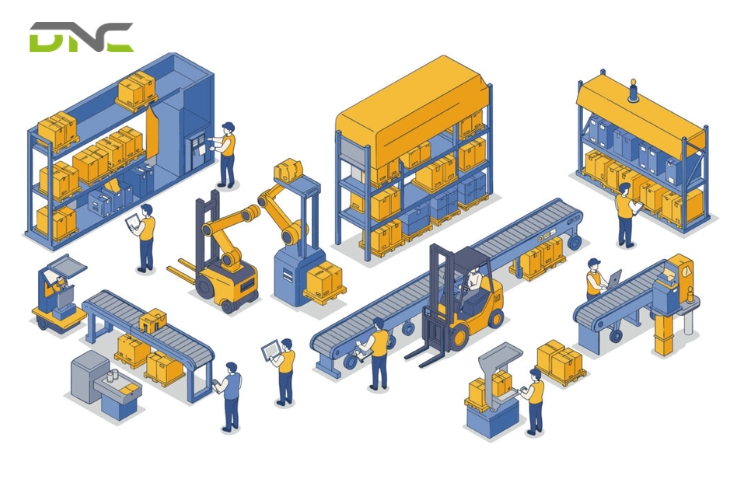
Warehouse automation is the application of mechanical, robotic, and software systems to execute warehousing tasks – receiving, storage, picking, packing, and shipping – with reduced human intervention. In Malaysian manufacturing, where labor costs at production facilities in Selangor, Johor, and Penang continue to rise against a backdrop of persistent skilled-worker shortages, warehouse automation is no longer a capital expenditure reserved for multinationals. Mid-size manufacturers running three to ten product lines are commissioning their first automated systems – starting with a conveyor and WMS integration, then adding AGVs for pallet transport, then ASRS for high-density storage – as individual phases in a multi-year roadmap. The entry point for warehouse automation is not a fully robotic facility; it is a single process bottleneck – repetitive sorting, manual pallet moves, inaccurate inventory counts – addressed by one well-chosen system, integrated cleanly with what already exists. That first system, when engineered to the correct specifications, delivers measurable throughput gains that justify the next phase.
Common misconception: Many Malaysian manufacturers assume warehouse automation requires a complete facility redesign or a greenfield build. In practice, most automation projects begin in a working facility by targeting one process – manual palletizing, forklift-dependent pallet moves, or paper-based inventory – and engineering a solution around existing floor layout constraints.
What Is Warehouse Automation and What Does It Cover?
Warehouse automation covers every system and technology that transfers physical or informational warehouse tasks from manual operators to machines, software, or a combination of both. The warehouse automation definition spans hardware – conveyors, robots, ASRS cranes, AGVs – and the software control layer that instructs, monitors, and optimizes them.
Four categories define the automation maturity spectrum in warehousing:
Basic automation handles individual repetitive tasks – barcode scanning, label printing, conveyor transport – without connecting systems. A standalone conveyor line moving finished goods from a production line to a staging area is basic automation.
System automation connects individual machines through a control layer. A Warehouse Management System (WMS) that tracks inventory location across storage zones, instructs pickers via RF scanners, and interfaces with ERP represents system-level automation.
Mechanized automation deploys physical machines – robotic palletizers, ASRS cranes, sortation systems – that handle material flow autonomously within defined parameters. Mechanized automation typically requires facility-level engineering: structural load analysis, electrical supply upgrades, and floor flatness verification.
Advanced automation integrates physical and digital systems under AI-driven orchestration. Autonomous Mobile Robots navigating dynamic floor environments, vision-guided robotic picking systems handling mixed SKUs, and predictive maintenance systems monitoring motor health via IIoT sensors all operate at the advanced tier.
Most Malaysian manufacturers in their first warehouse automation engagement operate between basic and mechanized, with WMS integration as the connector between tiers.
What Types of Warehouse Automation Systems Exist?
Warehouse automation systems divide into two categories: physical systems that move or store goods, and digital systems that control, track, and optimize the operation.
Physical Warehouse Automation Systems
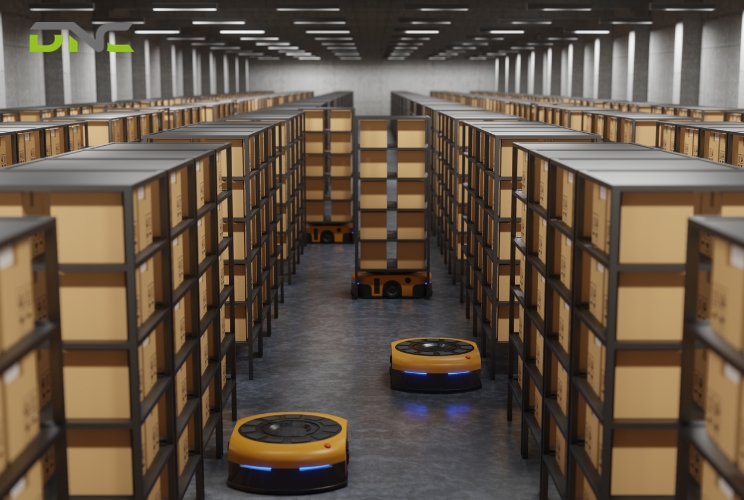
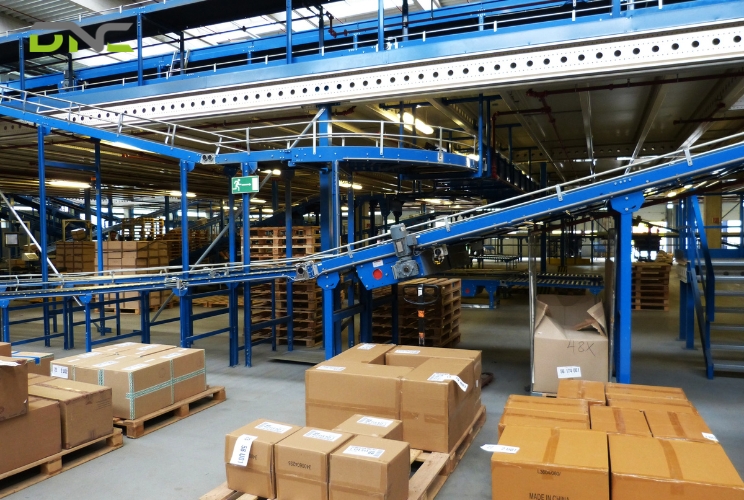
Physical warehouse automation systems handle every material movement task – storage, transport, picking, and palletizing – without manual intervention. Conveyor and sortation systems form the backbone of automated material flow. Products travel on belt, roller, or chain conveyors between workstations. Sortation systems – using diverters, pop-up wheels, or sliding shoes – route each unit to its correct destination based on barcode, RFID, or vision data. Conveyor systems connect production lines to palletizing stations, palletizers to stretch wrapping, and dispatch to staging without manual pallet jack movement.
Automated Storage and Retrieval Systems (ASRS) use cranes, shuttles, or vertical lift modules to store and retrieve pallets, totes, or individual items in high-density racking structures. A pallet-handling mini-load ASRS in a 12,000 mm (~39.4 ft / 472 in) racking structure delivers storage density three to four times higher than equivalent floor space in conventional selective racking. ASRS pairs with a Warehouse Management System that assigns storage locations and issues retrieval commands.
Automated Guided Vehicles (AGVs) and Autonomous Mobile Robots (AMRs) handle pallet and tote transport across the warehouse floor. AGVs follow fixed magnetic or optical paths; AMRs navigate dynamically using SLAM (simultaneous localization and mapping) and onboard sensors. Both systems replace forklift movement between storage zones, production lines, and docks. In facilities where [AGV/AMR systems](https://www.dnc-automation.com/agv-amr/) replace forklift moves between ASRS output conveyors and shipping lanes, aisle width drops to 1,800 mm (~5.9 ft / 71 in) versus the 3,500 mm (~11.5 ft / 138 in) required for counterbalance forklifts – recovering significant floor area.
Robotic picking and palletizing automates two of the most labor-intensive warehouse tasks. Robotic picking systems use vision guidance and programmable end-of-arm tools to pick individual items or cases from storage locations. Robotic palletizers stack outbound goods onto pallets at speeds and consistency levels no manual team can sustain across three shifts. DNC Automation’s [robotic solutions](https://www.dnc-automation.com/robotic-solutions/), built on Comau-platform cells, integrate both functions within turnkey end-of-line cells commissioned to client-specific throughput and footprint requirements.
Automated sortation systems classify, divert, and route inbound or outbound goods at high speed – up to several thousand units per hour on high-capacity crossbelt sorters. They are central to distribution centers managing multiple channels or SKUs requiring different downstream processes.
Digital Warehouse Automation Systems
Warehouse Management Systems (WMS) are the software layer that directs all warehouse activity: receiving, putaway, picking, packing, and shipping. WMS assigns storage locations, generates pick paths, tracks inventory in real time, and communicates with ERP and physical automation controllers.
Warehouse Execution Systems (WES) sit between WMS and physical systems, issuing real-time work orders to conveyors, sorters, and robotic cells based on current system status. WES handles the dynamic orchestration that WMS, designed for order-level planning, cannot execute at machine speed.
Warehouse Control Systems (WCS) operate at the device level – communicating directly with PLCs, conveyor drives, and sorter controls to coordinate moment-to-moment movement of goods through the physical system.
Industrial IoT (IIoT) platforms collect sensor data from motors, drives, and conveyors across the facility, feeding dashboards and predictive maintenance algorithms that flag equipment health issues before they cause unplanned downtime.
Summary: Warehouse Automation Systems by Category
The table below maps each warehouse automation system to its category and primary function for quick comparison.
| Category | System | Primary Function |
| Physical | Conveyor + Sortation | Material flow between stations |
| Physical | ASRS | High-density storage and retrieval |
| Physical | AGV / AMR | Floor-level pallet and tote transport |
| Physical | Robotic picking / palletizing | Case picking and pallet building |
| Digital | WMS | Inventory management, work direction |
| Digital | WES | Real-time execution between WMS and hardware |
| Digital | WCS | Device-level machine control |
| Digital | IIoT | Sensor data collection, predictive maintenance |
What Technologies Power Smart Warehouse Solutions?
Smart warehouse solutions combine physical automation with intelligence layers that learn, adapt, and optimize over time – moving beyond programmed machines toward systems that respond to variability.
AI and machine learning enable warehouse systems to handle non-standard conditions: vision-guided robots adjusting grip position for unlabeled or irregular items, demand-forecasting algorithms pre-positioning high-velocity SKUs near dispatch areas, and WES engines dynamically rebalancing work assignments when one station falls behind.
RFID and advanced identification systems move beyond barcode scanning to enable simultaneous reading of hundreds of tags at dock doors, enabling real-time inventory updates as full pallets pass through a gate rather than requiring individual item scans.
Pick-to-light and put-to-light systems reduce picking errors in high-SKU environments by illuminating the exact bin location and displaying the required quantity. These systems operate without barcode scanners, increasing pick speed and accuracy in pick-face and batch-picking zones.
Voice picking and directed work systems guide operators through picking tasks via audio instruction, freeing both hands and visual attention for the physical task. Voice systems reduce pick errors and integrate with WMS to ensure sequence compliance.
Digital twins create virtual models of the physical warehouse that simulate throughput under different scenarios – new product mix, additional SKU, facility expansion – before physical changes are made. They are particularly valuable during the planning phase of a new automation phase.
Predictive maintenance monitors motor torque, vibration, and temperature on conveyors, cranes, and robotic cells. Early fault detection – a conveyor drive showing abnormal vibration 72 hours before bearing failure, for example – converts emergency downtime into a planned maintenance window.
What Are the Key Benefits of Warehouse Automation?
Warehouse automation benefits compound across labor, accuracy, throughput, space, and safety dimensions. For Malaysian manufacturers targeting NIMP 2030 Industry 4.0 compliance, these benefits align directly with national productivity benchmarks.
Labor efficiency. Automation transfers repetitive material-handling tasks to machines, allowing warehouse headcount to be redirected to supervision, quality verification, and exception handling rather than physical movement. DNC Automation’s commissioned projects have delivered productivity increases in the 40–50% range for end-of-line automation deployments, replacing manual pallet-building and transport tasks with automated cells.
Picking and inventory accuracy. Manual picking in a warehouse with hundreds of SKUs produces errors that generate customer returns, stock discrepancies, and re-pick labor. WMS-directed picking combined with scan-verification or pick-to-light brings picking error rates from the 1–3% range typical in manual operations down to below 0.1% in well-implemented automated systems.
Throughput consistency. Automated systems operate at rated capacity regardless of shift, day of week, or workforce availability. A robotic palletizer running at 10 cycles per minute performs identically on Monday morning and Friday night. A three-shift AGV fleet moves the same pallet count per hour at 02:00 as at 14:00. This consistency is the primary operational argument for automation in facilities with contractual shipping windows or production-line feeding commitments.
Space utilization. ASRS and narrow-aisle systems extract significantly higher storage density from the same footprint. Vertical storage in ASRS structures brings product to 10,000 mm (~32.8 ft / 394 in) height – recovering floor area that conventional racking, limited to forklift reach height of 6,000–7,000 mm, cannot access. [Warehouse automation](https://www.dnc-automation.com/warehouse-automation/) designs at DNC address vertical utilization as a primary engineering constraint, not an afterthought.
Workplace safety. Forklift-pedestrian interactions are the leading cause of warehouse injuries in Malaysian manufacturing facilities. Segregating human zones from AGV operating zones – via physical barriers, light curtains, or geofenced AMR speed limits – removes that category of injury from the hazard register rather than simply mitigating it. Robotic palletizing removes repetitive heavy-lift tasks that cause musculoskeletal injury over time.
NIMP 2030 alignment. Malaysia’s National Investment Master Plan 2030 identifies Industry 4.0 adoption – smart manufacturing, automation, and digital integration – as a national economic priority. Manufacturers implementing warehouse automation systems integrated with smart manufacturing platforms are positioned for Industry 4.0 certification and the preferential treatment it carries in public procurement and investment attraction.
How Do You Build a Warehouse Automation Roadmap?
Choosing the right warehouse automation roadmap requires an honest assessment of your current state before any system is selected.
Step 1 – Map your bottlenecks, not your aspirations. Identify the three highest-cost or highest-error processes in your current warehouse operation. Measure them: units per hour, error rate, labor hours per 1,000 units, downtime incidents per month. These measurements are the baseline against which automation ROI is calculated – and they identify where automation delivers the fastest payback.
Step 2 – Audit integration prerequisites. No physical automation system operates in isolation. A conveyor needs a trigger signal. An AGV needs a destination address. An ASRS needs a location management system. Before selecting hardware, verify that your WMS can communicate with automation controllers, that your ERP provides the inventory visibility the WMS needs, and that your facility infrastructure – electrical supply, floor flatness, structural loading – supports the target system. DNC Automation’s preflight engineering assessment covers these prerequisites as a distinct project phase before any equipment is specified.
Step 3 – Phase the investment. A full smart warehouse is built in phases, not purchased in a single project. Phase 1 typically addresses the highest-cost bottleneck with a single system – a palletizer, a WMS, an AGV fleet – and generates the ROI that funds Phase 2. Phase 2 connects the Phase 1 system to adjacent processes. Phase 3 adds intelligence layers over the physical infrastructure Phase 1 and 2 built.
Step 4 – Engineer for integration, not just function. The most common warehouse automation failure mode is a correctly specified machine that does not integrate with existing systems. A palletizer that cannot receive pallet-full signals from the upstream case packer. An ASRS whose WCS cannot communicate with the client’s WMS because communication protocols were not specified in the purchase order. Integration engineering – not machine selection – is where turnkey delivery differs from equipment supply.
Frequently Asked Questions
What Is the Definition of Warehouse Automation?
Warehouse automation, by definition, is the application of mechanical, robotic, and software systems to execute warehousing tasks – receiving, storage, picking, packing, and shipping – with reduced reliance on manual labor. It ranges from basic conveyor transport to fully integrated smart warehouse systems controlled by AI-driven execution platforms.
What Are the Main Types of Warehouse Automation Systems?
Warehouse automation systems divide into physical systems (conveyors, ASRS, AGV/AMR, robotic picking and palletizing, sortation) and digital systems (WMS, WES, WCS, IIoT). Physical systems handle material movement and storage; digital systems direct, track, and optimize the operation.
Does Warehouse Automation Deliver Measurable ROI for Malaysian Manufacturers?
Warehouse automation delivers measurable ROI for Malaysian manufacturers through multiple benefit streams: 40–50% productivity increases in automated end-of-line operations, picking accuracy below 0.1% error rate with WMS-directed systems, throughput consistency across all shifts, higher storage density through ASRS and vertical systems, and alignment with NIMP 2030 Industry 4.0 requirements.
What Technologies Are Used in Smart Warehouse Solutions?
Smart warehouse solutions use AI and machine learning for adaptive operations, RFID for real-time inventory tracking, pick-to-light and voice picking for accuracy in picking zones, IIoT sensors for predictive maintenance, digital twins for planning and simulation, and integrated WMS/WES platforms for execution management.
Is Warehouse Automation Suitable for Mid-Size Malaysian Manufacturers?
Warehouse automation is suitable for mid-size Malaysian manufacturers, not only large multinationals. The entry point is a single high-cost process – manual palletizing, forklift-dependent pallet moves, or inaccurate inventory counts – addressed by one well-specified system. Quantify the current baseline, identify the automation system that delivers the shortest payback, and engineer it with full integration to adjacent processes before moving to the next phase.
How Long Does Warehouse Automation Take to Implement?
Warehouse automation implementation time depends on system complexity and integration scope. A standalone robotic palletizer cell typically commissions in 8–16 weeks from order to production-ready operation. A WMS integration project runs 12–24 weeks. An ASRS installation in an existing facility – including civil preparation, structural work, and system integration – typically runs 6–12 months. Phased roadmaps spread this timeline across 2–4 years, with each phase becoming operational before the next begins.
- 32 views
- 0 Comment
Recent Comments