


Vertical Lift Module Warehouse | DNC Automation Malaysia
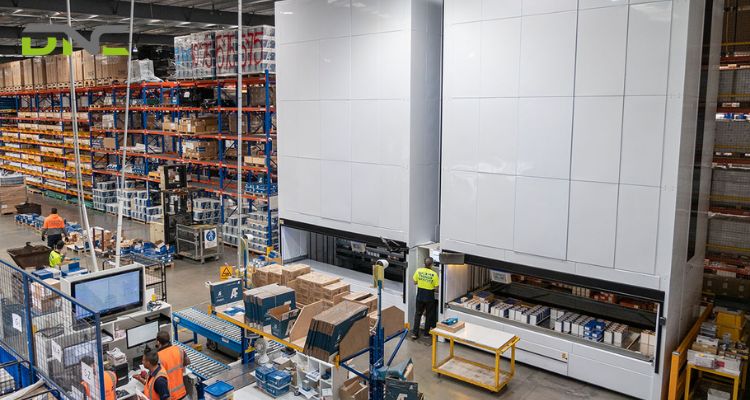
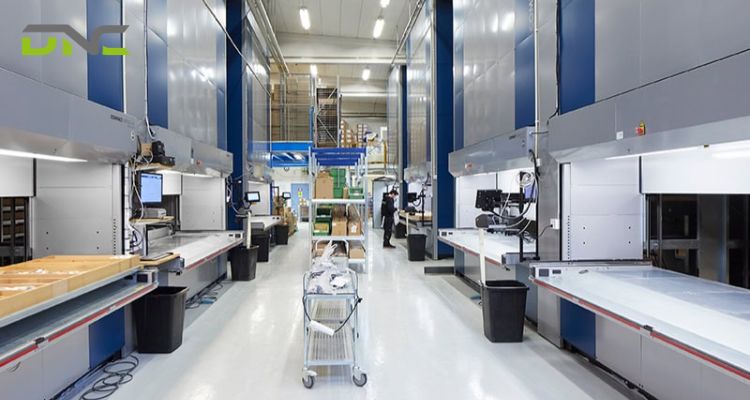
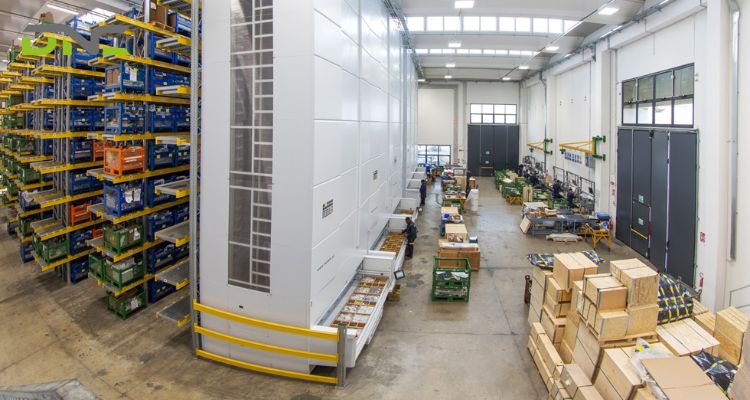
Vertical lift modules (VLMs) are automated storage units that use a central extractor mechanism to retrieve and deliver trays of inventory to an operator at an ergonomic access opening. In warehouse and factory environments, VLMs replace conventional static shelving with a high-density, goods-to-person storage system that reduces floor space consumption by 60–85%, improves picking accuracy, and eliminates the time operators spend walking and searching through storage aisles.
DNC Automation integrates VLMs as standalone systems and as part of larger warehouse automation architectures in Malaysia, connecting them to WMS platforms, conveyor systems, and production line picking stations.
How a Vertical Lift Module Works
A VLM contains two columns of storage trays facing each other with a vertical gap between them. An automated extractor mechanism travels up and down this gap, retrieving a specified tray and lowering it to the access opening — typically at waist height for ergonomic picking.
The operating sequence:
- Operator or WMS initiates a request: A pick order arrives at the VLM control unit via the WMS interface, or the operator manually keys in a tray or SKU reference.
- Extractor locates the tray: The extractor travels to the stored tray position within the VLM column.
- Tray is retrieved and presented: The tray travels to the access window at operator level. A light pointer or pick-to-light indicator shows exactly which position on the tray to pick from.
- Operator picks and confirms: The operator picks the required quantity, confirms at the terminal (or via barcode scan), and the tray is automatically returned to its storage position.
- Inventory is updated: The WMS updates inventory in real time.
The entire cycle — from pick request to tray presentation — typically takes 15–45 seconds depending on the VLM height and tray position.
VLM Storage Density Advantage
The space efficiency of a VLM is its most immediately compelling feature. A comparison:
Conventional shelving (6-tier, 2-metre high):
- Footprint: 1 m × 4 m bay = 4 m²
- Usable storage volume: approximately 4.8 m³ per bay
- Aisle space required: 1.5–2 m aisle alongside each bay
- Effective storage density including aisles: 1.6–2.4 m³ per gross m²
VLM unit (10-metre tall, 3 m × 1.5 m footprint):
- Footprint: 4.5 m² (including operator access area)
- Usable tray area: 400–600 m² of effective tray surface
- Aisle space required: 0 (operator stands at fixed access point)
- Effective storage density: 8–12 m³ per gross m²
For a 200 m² storage area, replacing conventional shelving with VLMs typically reduces the required floor space to 30–60 m² while storing the same or greater inventory volume.
In Malaysian warehouses and factories where floor space is charged at RM 3–8 per square foot per month, this density improvement translates directly to reduced occupancy cost.
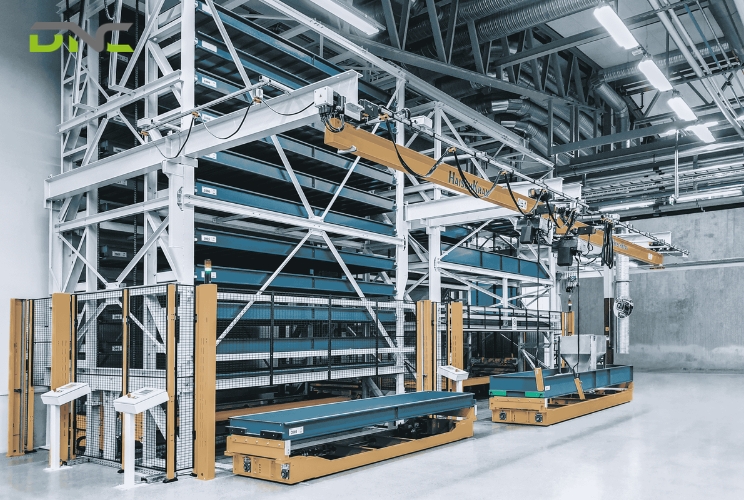
VLM Types and Configurations
Standard VLM
The standard configuration has one access opening at the front base of the unit. A single operator picks from one side. Height ranges from 4 to 20 metres depending on building clearance.
This configuration suits:
- Spare parts and MRO stores in manufacturing plants
- Small-parts picking in electronics assembly
- Document and archival storage
Dual-Access VLM
A dual-access configuration has openings on both the front and rear of the unit. In a manufacturing application, this allows loading on one side (from the receiving area) and picking on the other side (from the production floor), with the VLM acting as an automated goods buffer between the two zones.
Integrated VLM Pod with Conveyor
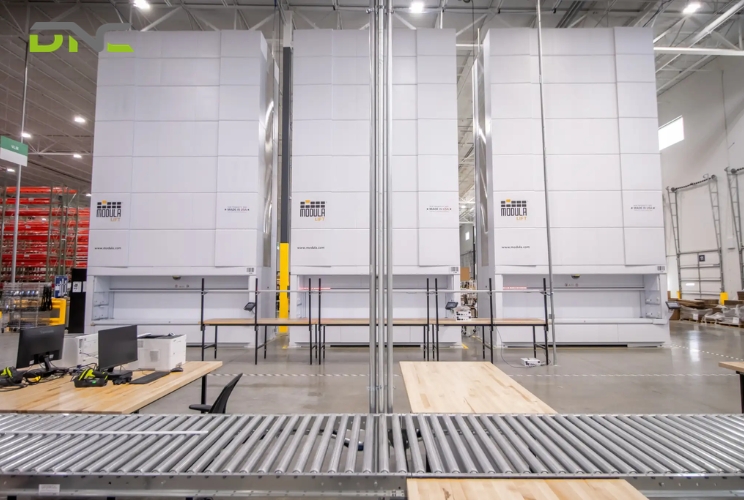
Multiple VLMs connected by conveyor systems allow a single operator to manage several VLMs simultaneously. While one VLM is presenting a tray, the next unit is already retrieving its tray in preparation. Throughput in a 3-VLM pod with interleaving software typically achieves 300–500 pick lines per operator per hour — 4–6 times the rate achievable with conventional static shelving.
VLM with Robotic Picking Arm
The highest automation tier integrates a robotic arm at the VLM access opening. The arm picks specified items from the tray and places them onto a conveyor or sortation system, achieving fully unattended operation. This configuration is suited to pharmaceutical dispensing and high-volume e-commerce picking operations.
VLM vs. Alternative Storage Solutions
VLM vs. Static Shelving
Static shelving is the baseline against which VLMs are measured. Shelving has the lowest capital cost but the highest total operating cost due to:
- Labour time spent walking and searching (estimated at 40–60% of a picker’s time in a manual shelving operation)
- Lower accuracy (pick errors from similar-looking parts stored in adjacent bins)
- No real-time inventory tracking at the bin level
VLM eliminates walk time entirely (goods come to the operator) and, with WMS integration, tracks every pick and return transaction in real time.
Break-even comparison: A VLM unit costing RM 250,000–400,000 typically breaks even against manual shelving within 2–4 years in operations with 2 or more operators picking for multiple shifts, factoring in labour savings, floor space savings, and accuracy improvement.
VLM vs. Horizontal Carousel
Horizontal carousels rotate on an oval track to bring bins to a fixed pick point. They offer comparable throughput to VLMs in pod configurations but occupy more floor space (carousels are horizontal, VLMs are vertical). VLMs are preferred when:
- Building height exceeds 5 metres (VLM utilises height; carousels cannot)
- Variable tray heights are needed (VLMs auto-adjust tray spacing)
- Floor footprint is severely constrained
Horizontal carousels are preferred when building height is limited and horizontal floor space is available.
VLM vs. Mini-Load ASRS
Mini-load ASRS and VLMs both deliver totes or trays to operators, but at different scales:
- VLMs are self-contained units suitable for 500–5,000 storage locations
- Mini-load systems handle 5,000–50,000+ storage locations across full warehouse aisles
For operations with fewer than 3,000 SKUs and a footprint need under 200 m², VLMs are typically more cost-effective. Larger operations benefit from mini-load systems.
VLM Applications in Malaysia
MRO and Spare Parts Management
In manufacturing plants across Selangor, Penang, and Johor, VLMs replace disorganised open shelving in maintenance stores. The benefits are immediate:
- Technicians retrieve parts via WMS-driven pick lists instead of searching manually
- Minimum stock levels trigger automatic replenishment alerts
- Parts consumption is tracked by work order, providing accurate maintenance cost data
- High-value parts are stored in locked VLM bays with access control
For a typical manufacturing plant with 2,000–8,000 spare parts SKUs, one to three VLMs replace an entire mezzanine-level parts store.
Electronics Component Storage
Penang and Johor electronics manufacturers use VLMs for:
- ESD-sensitive component storage in anti-static trays
- PCB assembly kitting — VLM presents all components for a specific assembly job
- Work-in-progress (WIP) buffer between assembly stages
VLMs eliminate the risk of mixed or mislabelled component trays that cause costly assembly errors.
Pharmaceutical Dispensing
Pharmaceutical distributors and hospital pharmacies require strict FIFO management, lot number traceability, and access control per product. VLMs with WMS integration enforce:
- FIFO retrieval — oldest lot number retrieved first
- Lot and batch tracking per pick transaction
- User access logging (who picked what, when, for which order)
- Temperature-monitored storage zones within the VLM for specific product categories
Tool Crib Management
Manufacturing plants with large cutting tool inventories (CNC tooling, inspection gauges, fixtures) use VLMs to manage issue and return of high-value tooling. VLM control software tracks which tool is assigned to which machine or operator, calculates utilisation, and triggers reconditioning or replacement when usage hours are reached.
WMS Integration for VLM Systems
VLM units operate most effectively when integrated with a warehouse management system. The integration architecture:
Standalone VLM Control
Each VLM has an onboard control computer that manages tray inventory, extractor sequencing, and pick confirmation. At the basic level, VLMs can operate with their own proprietary software without external WMS integration.
This is suitable for small operations (one or two VLMs, limited SKU count) where the additional integration cost is not justified.
WMS-Driven VLM
The preferred configuration for operations with multiple VLMs or integration with ERP:
- ERP sends replenishment orders or pick orders to WMS
- WMS assigns pick lines to VLM control systems
- VLM retrieves tray and presents to operator with pick-to-light guidance
- Operator confirms pick; VLM control sends completion to WMS
- WMS updates inventory and closes order line in ERP
Real-Time Inventory Visibility
With WMS integration, VLM inventory is visible in real time to purchasing, production planning, and finance. Minimum stock level alerts, cycle count scheduling, and ABC velocity analysis can all be driven from WMS data.
VLM Installation Requirements
Building Height
VLMs require a minimum clear height of 1.0–1.5 metres above the VLM unit height for tray insertion and maintenance access. A 10-metre VLM needs 11–12 metres of clear internal building height. Standard Malaysian industrial buildings (typically 8–10 metres eaves height) accommodate VLMs of 7–9 metres.
Floor Loading
VLMs exert high point loads on the floor through their four corner supports. A fully loaded VLM may exert 15–25 tonnes total weight. Floor bearing capacity and load distribution must be verified by a structural engineer before installation.
DNC Automation includes a floor assessment in every VLM project proposal.
Power Supply
VLMs require 3-phase power supply (typically 15–30 kVA per unit) and a stable network connection for WMS integration. Power quality — particularly voltage stability — affects long-term reliability of VLM control systems.
Access Clearance
The operator access opening requires approximately 1.5–2 metres of clear space in front of the VLM. This space is the working zone for picking and must be kept clear of obstructions.
VLM Cost and ROI in Malaysia
Equipment Cost
VLM pricing in Malaysia depends on height, capacity, and automation level:
| VLM Configuration | Height | Approx. RM Cost |
| Standard single-access | 5–7 m | RM 150,000–220,000 |
| Standard single-access | 8–12 m | RM 220,000–350,000 |
| Dual-access | 8–12 m | RM 300,000–450,000 |
| VLM with robotic picking arm | Any | RM 500,000–900,000 |
Prices include the VLM unit, installation, commissioning, and basic WMS integration. Custom tray configurations and advanced integration projects carry additional costs.
ROI Drivers
For a Malaysian manufacturer replacing 500 m² of manual shelving with 6 VLMs:
Labour savings: 3 pickers replaced across 2 shifts = RM 216,000/year
Floor space saving: 400 m² freed up (valued at RM 3/sq ft/month) = RM 144,000/year
Accuracy improvement: 2% error rate reduced to 0.02% (on RM 5M parts throughput) = RM 100,000/year
Total annual benefit: RM 460,000/year
VLM investment: RM 1.5M (6 units + integration)
Simple payback: 3.3 years
DNC Automation’s VLM Service
DNC Automation delivers VLM projects from site survey through post-commissioning support:
Site assessment: Floor loading verification, height measurement, power capacity check, and workflow analysis to determine optimal VLM positioning.
System design: Tray configuration, storage zoning (by product category, velocity class, or temperature zone), and pick-to-light layout.
WMS integration: Connection to existing WMS or ERP systems, or supply of a standalone VLM management software system.
Installation and commissioning: Full mechanical installation, electrical connection, software configuration, and operator training.
Preventive maintenance: Annual or biannual maintenance contracts with inspection of extractor mechanism, tray alignment, and control system health checks.
Frequently Asked Questions
How many SKUs can a single VLM store?
A 10-metre VLM with standard trays stores 500–2,000 SKUs depending on item size and tray configuration. Custom tray inserts (dividers, foam pockets, ESD trays) are used to optimise storage for specific item profiles.
Can VLMs be used in cold storage environments?
Yes. Cold-rated VLMs are available for chilled (2–8°C) and light-frozen (down to -10°C) environments. Fully frozen (-20°C and below) VLMs are available but at significant cost premium; shuttle-based ASRS is often more cost-effective for large frozen storage volumes.
What is the maintenance requirement for a VLM?
VLMs require annual preventive maintenance covering extractor mechanism lubrication, belt tension adjustment, sensor calibration, and control system diagnostics. Downtime for planned maintenance is typically 4–8 hours per unit per year. Critical spare parts (belts, sensors) should be stocked on-site.
Can VLMs be relocated if the facility moves?
Yes. VLMs are modular and can be disassembled, transported, and reinstalled at a new facility. Relocation cost is typically 20–30% of original installation cost.
Conclusion
Vertical lift modules deliver substantial improvements in storage density, picking productivity, and inventory accuracy in warehouse and factory environments. For Malaysian manufacturers and distributors managing high-value, mixed-SKU inventory in constrained floor space, VLMs provide a well-proven, cost-effective entry point into goods-to-person warehouse automation.
DNC Automation Malaysia designs, supplies, integrates, and maintains VLM systems — from single units in MRO stores to multi-VLM picking pods integrated with WMS and conveyor systems.
Contact DNC Automation Malaysia to arrange a VLM site assessment and storage density analysis for your facility.
VLM Operational Best Practices
Maximising return from a VLM installation requires attention to operational procedures alongside hardware and software setup:
Inventory Organisation Within VLM Trays
VLM storage is most efficient when tray positions are logically organised:
- ABC velocity zoning: Fast-moving items assigned to trays closest to the access opening (lowest travel distance in the extractor column). Slow-moving items assigned to top and bottom trays with longer travel times.
- Ergonomic positioning: Heavy items stored at mid-height tray positions to reduce operator lifting strain. This requires WMS-driven tray assignment that accounts for item weight and ergonomic guidelines.
- Family grouping: Related items (components of a kit, parts for the same product family) stored on the same tray to minimise extractor cycles for multi-line pick orders.
Wave Planning for VLM Pods
In a multi-VLM pod configuration, order waves must be sequenced to maximise throughput:
- Orders are sorted into pick waves; the wave planning software distributes pick lines across VLMs
- Each VLM pre-positions its next tray while the operator picks from the current tray in another VLM
- Wave release timing is adjusted based on VLM queue depth to prevent operator waiting
DNC Automation configures wave planning parameters at commissioning and reviews them at 30-day, 90-day, and 6-month intervals post-go-live to fine-tune throughput.
Replenishment Management
VLM trays require periodic replenishment as inventory is picked. Best practice:
- Replenishment triggers set in WMS at minimum stock level (e.g., 2-day supply for fast-movers)
- Replenishment picks batched to occur during lower-activity periods (lunch breaks, shift changes) to avoid competing with pick demand
- Replenishment confirmed via barcode scan to maintain inventory accuracy
VLM Applications in Malaysian Manufacturing: Extended Examples
Case 1 — Automotive Tooling Store, Shah Alam
An automotive component manufacturer in Shah Alam replaced a 400 m² manual tool crib with 4 VLMs (10-metre height each, 450 m² total tray area).
Before:
- 2 dedicated tool crib attendants per shift (3 shifts)
- Tool search time: 4–8 minutes per issue
- Tool utilisation tracking: manual logbook (incomplete data)
- Annual tool loss/unaccounted: RM 120,000
After:
- 0 dedicated attendants (machine operators access VLMs directly with employee badge)
- Tool retrieval time: 45 seconds average
- Complete tool utilisation data by machine, operator, and shift in WMS
- Annual tool loss: RM 8,000 (99% reduction)
Investment: RM 780,000 (4 VLMs + WMS integration)
Annual saving: RM 480,000 (labour) + RM 112,000 (tool loss) = RM 592,000
Payback: 1.3 years
Case 2 — Nutraceutical Warehouse, Johor Bahru
A nutraceutical company distributing 3,200 SKUs in mixed-pick carton quantities installed 6 VLMs connected by conveyor to a packing station.
Before:
- 3,200 SKUs spread across 600 m² of static shelving across 3 mezzanine levels
- 6 pickers walking up to 20 km per shift
- Pick accuracy: 98.1%
After:
- 6 VLMs in 120 m² footprint (80% floor space reduction)
- 2 operators at fixed pick stations
- Pick accuracy: 99.96%
- Picks per operator per hour: 65 → 320
Investment: RM 1.35M (6 VLMs + conveyor + WMS)
Annual saving: RM 580,000
Payback: 2.3 years
VLM Safety and Compliance in Malaysia
DOSH Registration
VLMs are classified as machinery under Malaysia’s Factories and Machinery Act. Each unit requires DOSH machinery registration with a valid Certificate of Fitness (CF), maintained through annual inspection.
DNC Automation prepares all DOSH documentation — technical files, risk assessments, CE or equivalent declarations — and coordinates DOSH inspection scheduling as part of the VLM installation project.
Emergency Stop and Access Safety
VLMs are designed with multiple safety interlocks:
- Access opening light curtain: Stops extractor movement if the operator’s hand enters the machine during retrieval
- Emergency stop buttons: Located at the access opening and at the rear maintenance access
- Manual mode: Technicians can control the extractor manually from a maintenance panel for tray recovery procedures
DNC Automation conducts a safety walkthrough with customer health and safety personnel at commissioning, documenting all safety features and operator procedures.
Fire Safety
VLMs storing flammable materials (aerosols, solvents, certain chemicals) may require fire suppression systems. DNC Automation advises on the need for in-VLM suppression (CO₂ or water mist) based on the stored materials’ MSDS classification and Bomba requirements.
Integrating VLMs with Production Lines
Beyond warehouse applications, VLMs are used directly on manufacturing floors to manage production-adjacent inventory:
Point-of-Use Storage
VLMs positioned adjacent to assembly lines or CNC machining cells store the specific materials, tools, and fixtures needed for production at that cell. Operators retrieve exactly what they need for the current job — eliminating trips to a central stores, reducing WIP accumulation, and improving material traceability to production work orders.
Kanban Replenishment Trigger
VLMs integrated with production planning systems can serve as kanban triggers: when tray stock falls below a defined minimum, the WMS automatically generates a replenishment request to purchasing or stores. This supports lean manufacturing material management without manual stock monitoring.
Quality Control Sample Storage
In pharmaceutical and electronics manufacturing, quality control samples must be retained for defined periods (often 2–5 years after production). VLMs provide dense, access-controlled, traceable storage for QC samples — far more efficient than dedicated sample storage rooms.
- 288 views
- 0 Comment
Recent Comments