


AGV vs AMR: Which Is Right for Your Factory?
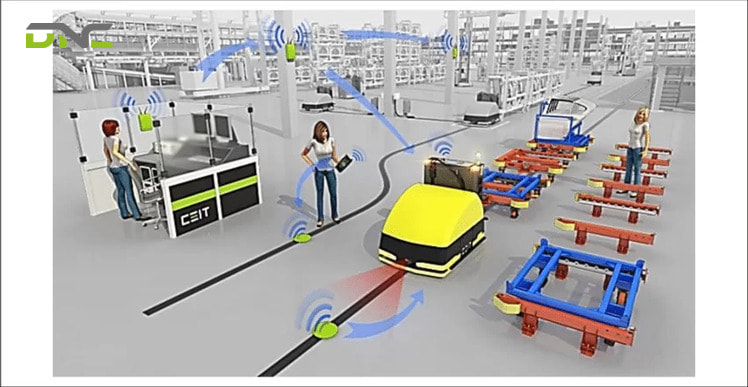
AGV and AMR technologies both automate material transport in manufacturing and warehouse environments — but they approach the task with fundamentally different navigation philosophies, infrastructure requirements, and cost structures. Automatic guided vehicles (AGVs) follow fixed paths defined by physical infrastructure; autonomous mobile robots (AMRs) navigate dynamically using onboard intelligence. Malaysian manufacturers evaluating AGV vs AMR for their facilities need to understand where each technology excels, where it falls short, and which operational scenarios justify one over the other — or a hybrid deployment combining both. This guide delivers a direct, technical comparison across every dimension that matters to your engineering and operations teams.
AGV and AMR: Core Definitions
An AGV (automatic guided vehicle) is a driverless industrial robot that transports materials along predetermined, fixed paths. Navigation relies on physical infrastructure embedded in or mounted throughout the facility — magnetic tape on the floor, wires under the surface, laser reflectors on walls, or QR codes at fixed positions. The AGV reads these guides continuously and follows the prescribed route without deviation. When an obstacle blocks the path, the AGV stops and waits for clearance.
An AMR (autonomous mobile robot) is a self-navigating industrial robot that transports materials using onboard sensors and SLAM (Simultaneous Localization and Mapping) algorithms. The AMR builds a digital map of the facility, localizes itself within that map in real time, and calculates optimal routes dynamically. When an obstacle appears, the AMR calculates an alternative path around it and continues to its destination without human intervention.
Both AGV and AMR serve the same fundamental purpose — moving materials without human operators — but the underlying technology creates significant differences in flexibility, cost, deployment speed, and operational behavior.
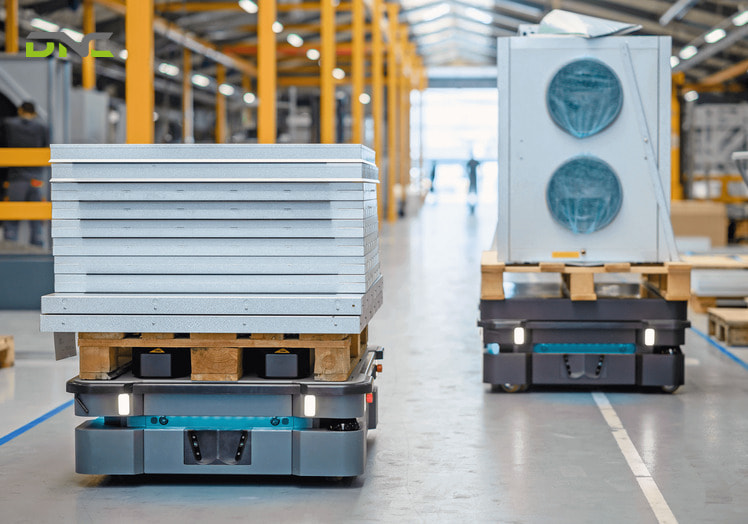
AGVs and AMR boost productivity and cost-efficient operations
Key Differences: AGV vs AMR Head-to-Head
Navigation and Path Flexibility
AGV navigation depends entirely on physical infrastructure. Magnetic tape AGVs follow ferrite strips adhered to the floor. Wire-guided AGVs track electromagnetic signals from embedded wires. Laser-guided AGVs triangulate positions from reflective targets mounted on walls and columns. Changing an AGV’s route means physically modifying this infrastructure — laying new tape, cutting new wire channels, or repositioning reflectors. Route changes require production downtime for installation work.
AMR navigation depends on software and onboard sensors. SLAM algorithms build and maintain a digital facility map from LiDAR scan data. Route changes require only a software update — an operator modifies the map or adds new destination points through the fleet management interface. No physical infrastructure modification is needed. The AMR adapts to the updated environment immediately.
Winner for flexible, frequently changing layouts: AMR. Winner for fixed, stable routes: AGV — simpler, more predictable, and less dependent on computational reliability.
Obstacle Handling
AGV obstacle response is binary: detect and stop. When a safety sensor detects an obstruction in the AGV’s fixed path, the vehicle decelerates and stops. It remains stationary until the obstacle clears. In busy manufacturing environments where forklifts, carts, and workers frequently cross transport corridors, AGV throughput degrades because every obstruction creates a full stop-and-wait cycle.
AMR obstacle response is intelligent: detect, evaluate, and reroute. When the AMR’s perception system identifies an obstacle, the path planning algorithms calculate whether the obstruction is temporary (a passing person) or persistent (a parked pallet). For temporary obstacles, the AMR may wait briefly; for persistent obstacles, it calculates and executes an alternative route around the obstruction. Throughput remains consistent because the AMR rarely experiences full stops.
Winner: AMR — particularly in mixed-traffic environments where people and other vehicles share the same floor space.
Infrastructure Requirements
AGV deployment requires physical infrastructure installation before the first vehicle operates. Magnetic tape systems need surface preparation, tape laying, and calibration — typically 2 to 5 days for a moderate route network. Wire-guided systems require floor cutting, wire embedding, and resurfacing — a construction project measured in weeks. Laser systems need reflective targets mounted at precise positions throughout the facility. All approaches require ongoing infrastructure maintenance: tape wears, wires can be damaged during floor repairs, reflectors accumulate dust.
AMR deployment requires no physical infrastructure modification. An operator drives the AMR through the facility once while SLAM software builds the navigation map — a process that typically takes 1 to 2 days for a standard manufacturing floor. The AMR operates on the existing floor surface without any embedded guides, surface markers, or mounted reflectors.
Winner: AMR — faster deployment, zero infrastructure cost, zero maintenance burden on facility infrastructure.
Accuracy and Repeatability
AGV positional accuracy depends on the guidance technology. Wire-guided AGVs achieve ±1 mm — the highest precision available in automated transport. Magnetic tape delivers ±5 mm. Laser guidance provides ±1–5 mm. This precision is absolute and repeatable: the AGV arrives at the exact same position, within tolerance, every single time.
AMR positional accuracy depends on SLAM algorithm performance and sensor quality. Typical industrial AMRs achieve ±10–30 mm positional accuracy — sufficient for most transport tasks but inadequate for applications requiring sub-millimeter docking precision. Environmental factors — reflective surfaces, glass walls, highly dynamic environments — can degrade SLAM accuracy.
Winner: AGV — significantly higher precision and repeatability, critical for automated docking, machine loading, and precision positioning applications.
Deployment Speed
AGV systems require infrastructure installation, vehicle commissioning, fleet software configuration, route programming, and integration testing. Total deployment timeline for a 5-vehicle magnetic tape system: 4 to 8 weeks. For laser-guided systems with full WMS integration: 8 to 16 weeks.
AMR systems require facility mapping (1–2 days), fleet software configuration, vehicle commissioning, and integration testing. Total deployment for a 5-vehicle AMR fleet: 1 to 4 weeks. The elimination of infrastructure installation is the primary time-saver.
Winner: AMR — 2x to 4x faster deployment than equivalent AGV systems.
Cost Comparison
AGV per-unit hardware costs are generally lower than equivalent AMR platforms. A magnetic-tape-guided tugger AGV starts around USD 25,000–60,000; a comparable AMR platform starts at USD 30,000–80,000. However, AGV systems carry significant infrastructure costs — tape installation (USD 5,000–15,000 per route network), wire embedding (USD 10,000–50,000), laser reflectors (USD 5,000–20,000), plus ongoing maintenance.
AMR systems eliminate infrastructure costs entirely but carry higher per-unit hardware and software costs. Fleet management software licensing for AMRs (USD 10,000–80,000) is typically more sophisticated — and more expensive — than standard AGV fleet control software.
Total cost of ownership over 5 years favors AMR in facilities with frequent layout changes (infrastructure rework costs accumulate for AGVs) and favors AGV in facilities with stable, fixed routes (lower per-unit cost with minimal infrastructure maintenance).
| Cost Factor | AGV | AMR |
| Per-unit hardware | USD 25K–150K | USD 30K–300K |
| Infrastructure | USD 5K–50K | USD 0 |
| Fleet software | USD 15K–50K | USD 10K–80K |
| Deployment labor | 4–16 weeks | 1–4 weeks |
| Route change cost | Physical rework | Software update |
| 5-year maintenance | Infrastructure + vehicle | Vehicle only |
| **Best TCO scenario** | **Fixed routes, stable layout** | **Dynamic routes, changing layout** |
Scalability
AGV scalability requires infrastructure expansion: new tape runs, additional reflectors, or extended wire networks for every new route. Adding vehicles to existing routes is straightforward, but extending the route network involves physical construction work.
AMR scalability requires only additional vehicles and fleet software updates. New routes are created by mapping — an operator drives the AMR through the new area once, and the fleet manager incorporates the expanded map. Adding vehicles to existing routes requires zero infrastructure change.
Winner: AMR — scaling up or down is a software exercise, not a construction project.
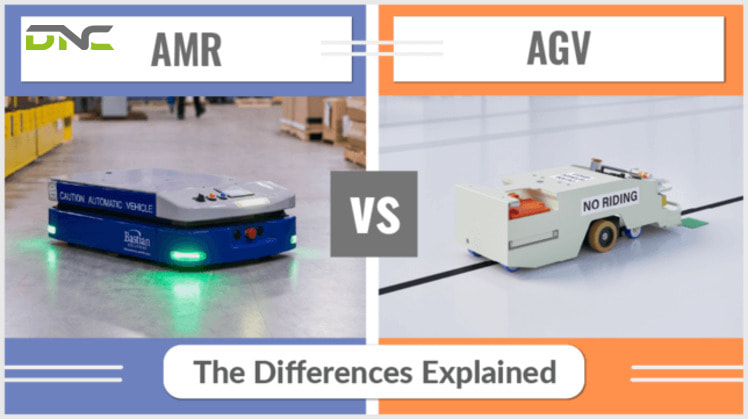
8 Key Differences Between AGV and AMR
When to Choose AGV
AGV technology delivers superior value in specific operational scenarios:
High-volume, fixed-route transport. Facilities with stable production layouts where the same routes operate continuously for years. Automotive assembly lines with fixed station sequences, high-bay warehouses with permanent racking layouts, and continuous-process manufacturing plants (palm oil mills, chemical plants) where transport routes are determined by fixed equipment positions.
Precision-critical applications. Automated machine loading, precision docking at workstations, and integration with fixed conveyor transfer points where ±1–5 mm accuracy is mandatory. AGV positional repeatability eliminates the docking tolerance issues that can arise with SLAM-based AMR navigation.
Capital-constrained initial deployment. When capital allocation limits per-unit spending, a magnetic-tape AGV fleet provides automated transport at the lowest upfront investment. The infrastructure cost is modest for straightforward route networks; the per-unit vehicle cost is typically 20–40% lower than comparable AMR platforms.
Structured, predictable environments. Facilities with minimal human-vehicle interaction, few cross-traffic intersections, and stable floor conditions where the stop-and-wait obstacle behavior of AGVs does not significantly impact throughput.
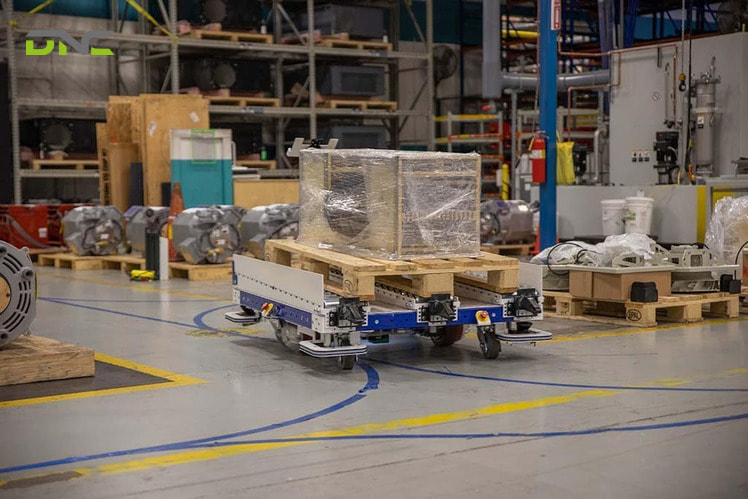
AGV (Automated Guided Vehicle) and AMR (Autonomous Mobile Robot)
When to Choose AMR
AMR technology delivers superior value in these operational scenarios:
Dynamic, frequently reconfigured facilities. Contract manufacturers, multi-product plants, and seasonal operations where production layouts change regularly. AMR routes update through software; AGV infrastructure would require repeated physical rework.
Mixed-traffic environments. Facilities where AMRs share floor space with human workers, manual forklifts, and other mobile equipment. Dynamic obstacle avoidance maintains AMR throughput in environments that would cause frequent AGV stop-and-wait cycles.
Rapid deployment requirements. Operations that need automated transport operational within weeks, not months. New facility startups, peak-season capacity additions, and urgent automation projects driven by sudden labor shortages — all scenarios where AMR deployment speed delivers critical time-to-benefit advantage.
Multi-zone, complex routing. Facilities where materials move between many origin-destination pairs across a complex floor plan. AMR path planning optimizes routes dynamically across the entire facility; AGV systems would require an extensive, complex infrastructure network to cover the same transport permutations.
Scalability-first strategy. Operations planning phased automation rollout — starting with 2–3 vehicles and scaling to 20+ as demand grows. AMR scaling requires no infrastructure investment per expansion phase; AGV scaling requires infrastructure extension at each phase.
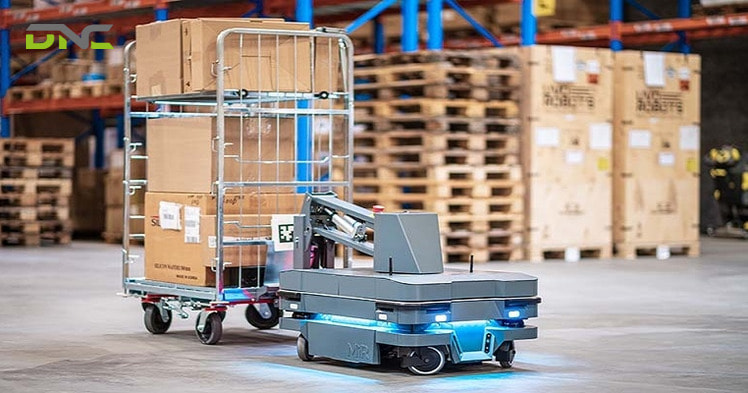
Pallet transport between receiving, storage, and shipping zones.
Hybrid Approach: Deploying AGV and AMR Together
Many manufacturing facilities discover that neither AGV nor AMR alone covers every material transport requirement. A hybrid approach deploys each technology where it performs best:
AGVs for backbone transport corridors — high-volume, fixed routes between major zones (warehouse to production, production to shipping) where precision docking and maximum throughput justify infrastructure investment.
AMRs for flexible last-mile delivery — dynamic routes from staging areas to individual workstations, variable production cells, and multi-stop delivery sequences where layout changes occur frequently.
Unified fleet management — modern fleet management platforms can coordinate both AGV and AMR vehicles within a single system, managing traffic, task assignment, and charging across mixed fleets. This unified approach prevents the operational silos that arise when AGV and AMR systems operate on separate, uncoordinated control platforms.
DNC Automation implements hybrid AGV-AMR systems that match each technology to its optimal transport task — maximizing automation ROI while maintaining the flexibility Malaysian manufacturers need to respond to changing production demands.
AGV and AMR in the Malaysian Manufacturing Context
Malaysia’s manufacturing sector faces a specific set of conditions that influence the AGV vs AMR decision:
Labor scarcity. Structural labor shortages in manufacturing — accelerated by demographic shifts and competition from service-sector wages — create urgent demand for automated material handling regardless of technology choice. Both AGV and AMR address this pain point; the choice depends on operational requirements, not labor availability.
NIMP 2030 and Industry 4.0 incentives. The National Industrial Master Plan 2030 targets manufacturing automation as a national priority. MIDA offers Pioneer Status tax incentives and automation grants that apply to both AGV and AMR investments. DNC Automation assists clients with incentive applications as part of the project planning process.
Production variety. Malaysian manufacturing is characterized by high product mix — contract manufacturers serving multiple customers, multi-model automotive plants, and electronics facilities running varied product lines. This production variety generally favors AMR flexibility over AGV fixed-path rigidity for intra-facility transport.
Cost sensitivity. While Malaysia’s manufacturing sector is cost-conscious, the decision framework should evaluate total cost of ownership over the system’s operational life — not just upfront capital expenditure. AMR systems with higher per-unit costs frequently deliver lower TCO than AGV systems when infrastructure installation, maintenance, and route change costs are included in the analysis.
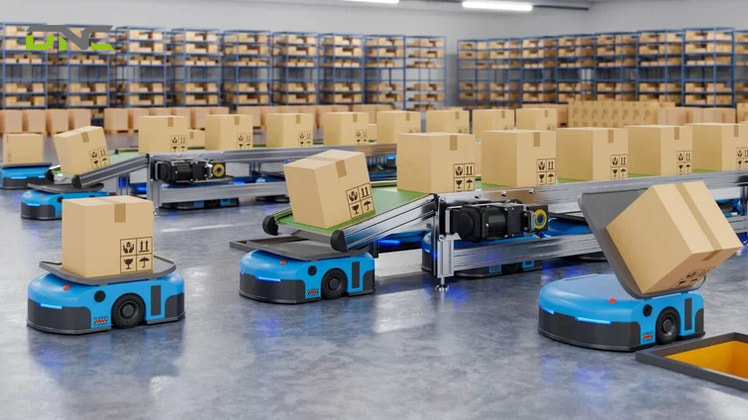
Integrating AGVs and AMRs into existing digital ecosystems can be challenging.
Frequently Asked Questions: AGV vs AMR
Is an AMR Just a More Advanced AGV?
AMR technology represents a fundamentally different navigation approach — not simply an upgraded AGV. AGVs follow external guides; AMRs navigate autonomously using onboard intelligence. However, modern AGV systems increasingly incorporate SLAM-capable navigation options, and some AMR platforms offer the ability to follow virtual fixed paths when precision is required. The technologies are converging, but their core architectural differences remain relevant for system selection.
Can I Convert My Existing AGV Fleet to AMR?
Converting existing AGVs to AMR functionality is generally not practical — the hardware architectures, sensor suites, and onboard computing platforms differ significantly. However, facilities can deploy AMRs alongside existing AGVs through unified fleet management platforms that coordinate both vehicle types within a single traffic management system. This phased approach protects existing AGV investment while adding AMR flexibility where needed.
Which Has a Lower Total Cost of Ownership?
TCO depends entirely on your operational scenario. AGVs deliver lower TCO for fixed-route, stable-layout operations running 5+ years without significant route changes. AMRs deliver lower TCO for dynamic operations with annual or more frequent layout changes, facilities requiring rapid deployment, and operations that scale fleet size regularly. Calculate your specific TCO using actual infrastructure costs, deployment timelines, expected route changes, and scaling plans.
Can AGVs and AMRs Operate in the Same Facility?
Yes — hybrid deployments are increasingly common and operationally effective. AGVs handle high-volume backbone routes where precision and fixed-path reliability deliver maximum throughput. AMRs handle flexible, variable-route transport where dynamic navigation provides value. Unified fleet management software coordinates both vehicle types, managing traffic, task assignment, and charging across the mixed fleet.
Which Is Safer: AGV or AMR?
Both technologies meet ISO 3691-4 safety requirements for driverless industrial trucks when properly configured. AGVs rely on fixed-path predictability — workers know exactly where AGVs will travel and can plan accordingly. AMRs rely on dynamic perception — they detect, evaluate, and respond to obstacles in real time. AMR obstacle avoidance behavior (rerouting rather than stopping) can reduce the frequency of workers waiting for stopped vehicles in corridors — a practical safety advantage in high-traffic environments. Neither technology is inherently safer; both require proper safety system configuration and facility risk assessment.
How Do I Decide Between AGV and AMR for My Malaysian Factory?
Start with a material flow analysis: map every transport route, payload, frequency, and routing pattern. Classify each route as fixed (same path, high volume, stable layout) or dynamic (variable destinations, changing layout, mixed traffic). Fixed routes favor AGVs; dynamic routes favor AMRs. For facilities with both route types, evaluate a hybrid deployment. Engage a system integrator with experience in both technologies — DNC Automation provides free consultations that include material flow analysis, AGV vs AMR assessment, and system design recommendations tailored to your specific facility and operational requirements.
Conclusion
AGV and AMR technologies are not competitors — they are complementary tools for different material transport challenges. AGVs deliver precision, cost efficiency, and proven reliability on fixed, high-volume routes. AMRs deliver flexibility, rapid deployment, and dynamic intelligence for variable, obstacle-rich environments. Malaysian manufacturers should evaluate both technologies against their specific operational requirements — and consider hybrid deployments that leverage the strengths of each.
DNC Automation’s engineering team designs AGV, AMR, and hybrid material transport systems for manufacturers across Malaysia. Our 35+ engineers deliver technology-agnostic recommendations based on your facility’s material flow requirements — not vendor allegiances.
- 200 views
- 0 Comment
Recent Comments