

Robotics in Warehouse Automation | DNC Automation Malaysia
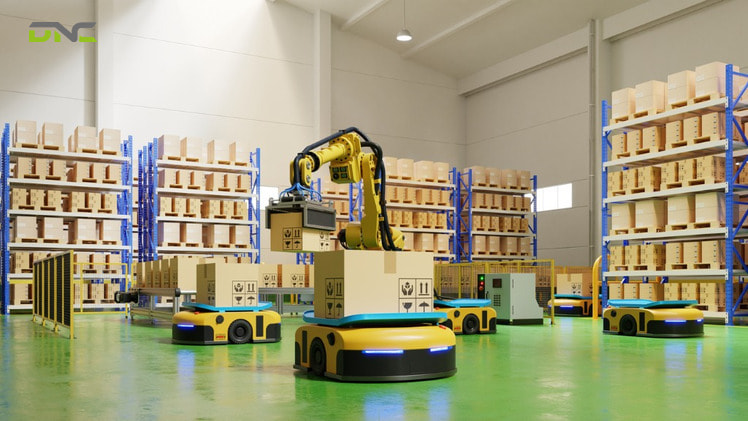
Robotics in warehouse automation encompasses the full spectrum of robotic technologies applied to intralogistics — from autonomous mobile robots (AMRs) that transport goods across warehouse floors, to articulated robot arms that pick, pack, and palletise, to collaborative robots (cobots) that work alongside human operators at picking stations. Together, these technologies are reshaping what is possible in Malaysian warehouse operations: higher throughput, lower labour dependency, and 24/7 operation in environments challenging or hazardous for human workers.
DNC Automation Malaysia designs and integrates robotic warehouse solutions — AMR fleets, robotic picking cells, palletising robots, and cobot workstations — as standalone systems and as components of integrated warehouse automation solutions.
Why Warehouse Robotics? The Malaysian Context
Malaysia’s warehouse and logistics sector faces three structural pressures that are accelerating robotic adoption:
Labour scarcity and cost: Manufacturing and logistics in Malaysia competes for a limited pool of industrial workers. Foreign worker dependency creates operational risk, visa cost, and management complexity. Warehouse robots eliminate the labour scarcity problem in the automated zone.
Operational hours: Human workers require shift management, breaks, and rest days. Robots operate 24/7 with scheduled maintenance windows, enabling warehouses to match throughput to demand rather than to shift schedules.
Accuracy demands: As Malaysian manufacturers supply global customers with zero-defect and traceability requirements, the 1–2% error rates of manual picking are no longer acceptable. Robotic systems with vision confirmation achieve 99.97%+ accuracy.
Malaysia’s MIDA Automation Capital Allowance (200% capital allowance on qualifying equipment) and smart manufacturing incentives make robotics investment significantly more financially attractive than in markets without comparable industrial automation support.
Autonomous Mobile Robots (AMR) in Warehouses
How AMRs Work
Autonomous mobile robots are self-navigating vehicles that transport goods — bins, totes, pallets, shelving pods — across warehouse floors without fixed rails or infrastructure. Unlike the older AGV (automated guided vehicle) technology that follows fixed tracks, AMRs use LIDAR, cameras, and onboard AI to:
- Map their environment autonomously on first deployment
- Navigate dynamically, avoiding obstacles (forklifts, operators, fallen goods)
- Reroute in real time when the path is blocked
- Charge autonomously at charging stations during idle periods
AMR Types
Shelf-to-person AMR: The robot carries a portable storage shelf from a storage zone to a fixed operator picking station. The operator picks items from the shelf and sends the robot back. This approach eliminates all operator walking — the primary labour cost in manual picking.
Bin-carrying AMR: Similar to shelf-to-person, but the robot carries individual storage bins or totes. Suited to small-parts picking in electronics and pharmaceutical warehouses.
Pallet-carrying AMR: Heavy-duty AMRs carry full pallets (up to 1,500 kg) between production lines, storage areas, and dispatch docks. They replace forklifts for structured routes within the facility.
Sortation AMR: A fleet of small AMRs each carry individual parcels to sortation destinations on a grid floor. This approach is common in parcel hub operations and e-commerce fulfilment.
AMR vs. AGV
Older AGV systems follow magnetic strips or optical markers embedded in the floor — inexpensive but inflexible. AMRs:
- Require no floor infrastructure modification
- Can be deployed in weeks vs. months for AGV installations
- Adapt to layout changes by remapping the environment
- Avoid obstacles dynamically (AGVs stop when path is blocked)
For Malaysian warehouses that need flexibility — seasonal layout changes, frequent product introductions — AMRs are now the preferred technology over AGVs.
AMR Fleet Management
A fleet of 10–100+ AMRs requires fleet management software that:
- Assigns tasks to available robots
- Manages robot traffic at intersections
- Optimises charging schedules to maintain continuous operation
- Provides real-time fleet visibility on operator dashboards
- Integrates with WMS for task dispatch and inventory confirmation
DNC Automation’s AMR integration team connects fleet management software to existing WMS and ERP platforms, ensuring AMR operations are fully reflected in inventory and order management systems.
Robotic Picking
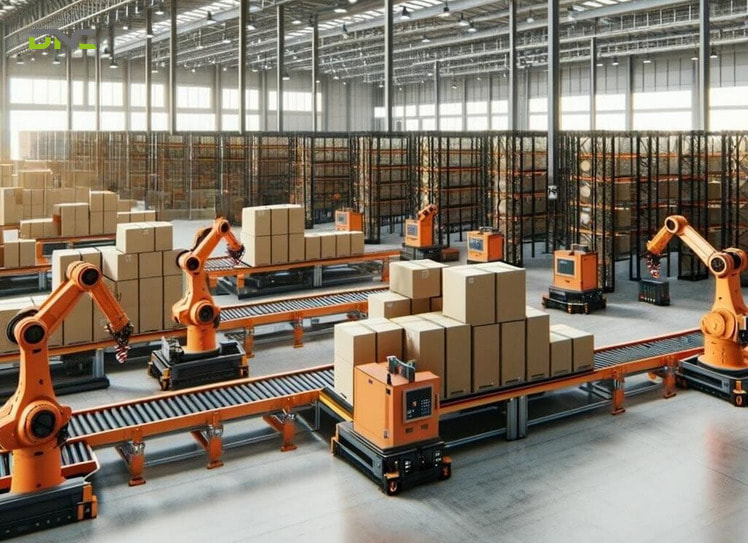
Articulated Robot Arms for Picking
Industrial 6-axis robot arms with vision systems and flexible end-of-arm tooling (EOAT) pick individual items from storage and place them into order containers. Key technologies:
Vision system: 2D or 3D cameras identify item position, orientation, and dimensions in real time. AI-driven object recognition handles mixed SKUs and non-uniform packaging.
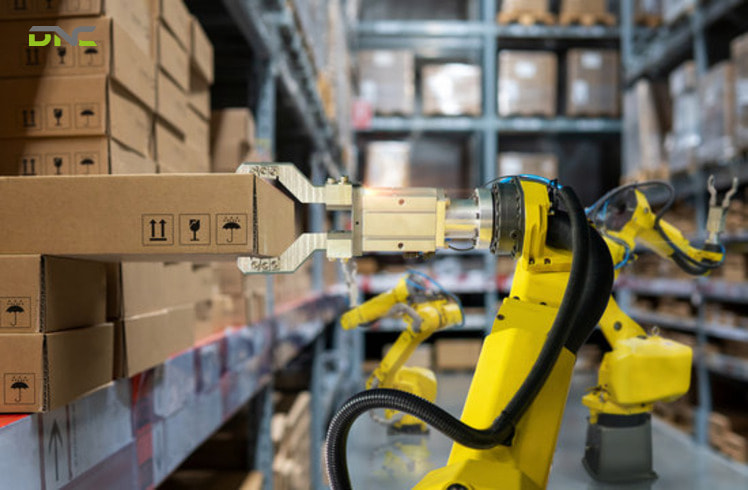
End-of-arm tooling: Suction cup grippers handle smooth-surfaced items (cartons, cans, bottles). Mechanical grippers handle irregular or flexible items. Multi-tool changers allow one robot to handle diverse product types.
Pick planning software: Calculates optimal pick sequence, approach angle, and grasp point for each item — a computationally intensive task solved in real time by dedicated AI processors.
Applications
Carton and case picking: Robot arms pick cases from warehouse storage and place them onto pallets or into shipping containers. Throughput: 500–1,500 cases per hour per robot cell, depending on item size and uniformity.
Each picking (piece-level): Picking individual items from storage totes or shelves for e-commerce orders. This is the most challenging application due to shape diversity. Modern vision-AI systems handle 80–95% of SKU profiles unattended; items outside this range are routed to a human pick station.
Pharmaceutical dispensing: Robot arms pick individual drug packages from storage shelves, verify barcode, and place into patient medication bags. Accuracy requirements are absolute — zero picks acceptable.
Cobot (Collaborative Robot) Picking
Collaborative robots are designed to work alongside human operators without safety caging. They operate at lower speeds than industrial robots but within shared space, supporting tasks that benefit from both robot consistency and human adaptability:
- Cobot presents a storage tote to an operator; the operator performs the complex pick; the cobot moves the tote to the next station
- Cobot handles heavy or repetitive lifting at picking stations, reducing operator fatigue
- Cobot performs inspection (barcode scan, weight check) on items picked by operators
In Malaysia, cobots are deployed in electronics assembly and pharmaceutical kitting as a transitional technology — extending automation into pick-and-place tasks while retaining human judgement for exceptions.
Palletising and Depalletising Robots
Palletising robots build stable pallet loads from cases, cartons, or bags coming off production lines or conveyor systems. They are one of the most established robotic applications in Malaysian manufacturing:
Palletising Robot Capabilities
- Speed: 1,000–2,000 cases per hour (single robot), scalable with multiple heads or dual-arm configurations
- Patterns: Robot controller calculates optimal stacking patterns for stability and maximum pallet cube utilisation
- SKU flexibility: One palletising robot handles multiple product SKUs by switching EOAT and loading the appropriate stacking pattern from the WMS
- Integration: Palletising robots connect to conveyor infeeds from production and to pallet ASRS storage or stretch wrapping stations outbound
Depalletising for Inbound
Depalletising robots unload incoming supplier pallets — mixed or uniform — onto conveyor systems feeding into storage. Vision-guided depalletising handles mixed-SKU pallets, a historically difficult application that now achieves reliable operation with AI vision systems.
Applications in Malaysia
Malaysian food and beverage, personal care, and consumer goods manufacturers widely use palletising robots:
- End-of-line palletising after packaging lines
- Multi-line palletising (one robot serves 2–4 production lines with a robotic gantry or rotary table)
- Cold storage depalletising (robot handles frozen product without fatigue or cold exposure risk)
Robotic Sorting and Goods-to-Person Systems
Robotic Sortation
Cross-belt sortation using AMRs — each carrying an individual parcel on a small conveyor belt — creates flexible, scalable sorting systems for parcel hubs and e-commerce fulfilment. The AMR fleet replaces traditional sliding shoe or tilt tray sorters with:
- No fixed conveyor infrastructure (lower civil cost)
- Dynamic route assignment (sortation destinations can be changed in software)
- Scalability (add more AMRs to increase throughput)
Robotic Goods-to-Person
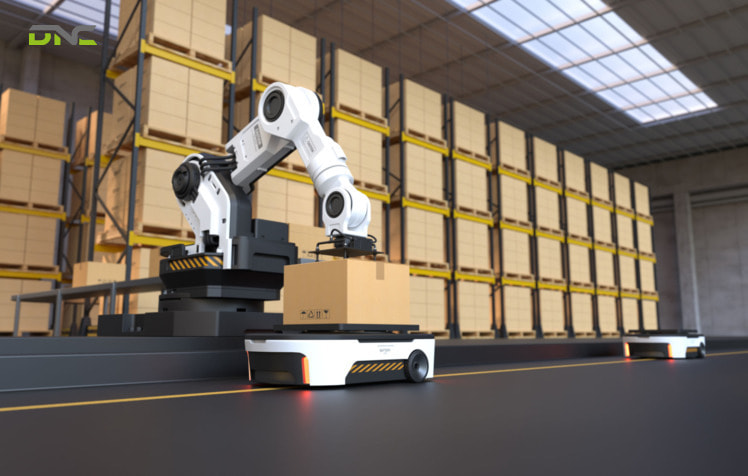
The most automated goods-to-person configuration pairs ASRS or AMR storage with a robotic picking arm at the workstation. Storage totes arrive at the workstation automatically (ASRS or AMR-delivered); the robot arm picks specific items from the tote and places them into order containers without human involvement.
This configuration is deployed in pharmaceutical dispensing, high-value consumer goods, and e-commerce fulfilment for operations seeking fully unattended picking.
Integration of Robotics with WMS and ASRS
Warehouse robotics must integrate with the broader warehouse management architecture:
AMR fleet → WMS: The WMS releases task assignments to the AMR fleet management system. The fleet management system dispatches robots. Completed tasks are confirmed back to WMS for inventory update.
Robotic picking cell → WMS/WCS: The WCS sequences tote delivery to the robotic picking cell from ASRS. The picking cell confirms each picked item to the WMS. Exception items (robot cannot grasp) are routed to a manual operator pick station.
Palletising robot → WMS: The WMS issues pallet build instructions (which SKUs, in what quantities, in what stacking pattern) to the palletising robot controller. The completed pallet is confirmed to WMS and assigned to ASRS storage or dispatch.
DNC Automation’s software integration team designs and implements these integration interfaces using standard protocols (REST API, OPC-UA, MQTT) for reliable, maintainable data exchange.
Robotics ROI in Malaysia
AMR Fleet (Shelf-to-Person Picking)
A Malaysian consumer goods distributor deploying 20 AMRs for shelf-to-person picking:
- Picking productivity: 80 picks/hour → 250 picks/hour per operator
- Operator count reduced from 24 to 9 pickers
- Annual labour saving: RM 540,000
- AMR fleet investment: RM 1.6M
- Payback: 3.0 years
Palletising Robot (End-of-Line)
A food manufacturer replacing 3 manual palletising operators per shift:
- Throughput: 800 cases/hour vs. 350 cases/hour per manual team
- Labour saving: 12 operators across 4 shifts = RM 432,000/year
- Palletising robot investment: RM 350,000
- Payback: 9.7 months
DNC Automation’s Robotics Capabilities
DNC Automation Malaysia integrates warehouse robotics as part of complete automation solutions:
AMR systems: AMR fleet selection, deployment, fleet management software, and WMS integration for shelf-to-person, bin-carrying, and pallet-carrying applications.
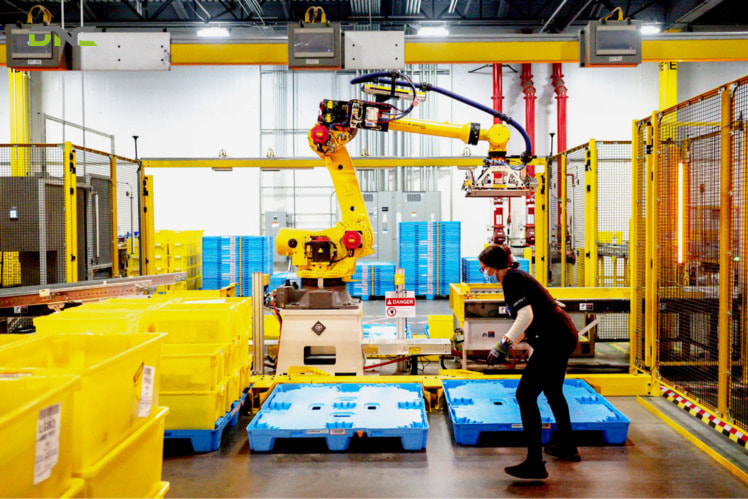
Robotic picking: Articulated robot arm picking cells with vision systems, EOAT selection, and WMS/WCS integration for case, carton, and each-picking applications.
Palletising and depalletising: End-of-line palletising robot integration with production conveyors and warehouse ASRS.
Cobot workstations: Collaborative robot integration at picking and assembly workstations.
System integration: Full WMS, WCS, and ERP integration for all robotic systems.
Frequently Asked Questions
How quickly can an AMR fleet be deployed?
AMR deployment is significantly faster than fixed ASRS installation. A fleet of 20–50 AMRs can be operational in 8–16 weeks from order placement — the robots map the warehouse environment and integrate with WMS within the first 2–4 weeks of on-site deployment.
Can robotic picking handle all product types?
Modern robotic picking with AI vision handles 70–95% of typical warehouse SKU profiles reliably. Items outside this range — very soft, irregular, or extremely fragile items — require human picking or specialised EOAT. DNC designs hybrid systems where robots handle the majority and human operators handle exceptions.
How is robot safety managed in Malaysia?
Industrial robots in Malaysia are subject to DOSH (Department of Occupational Safety and Health) regulations under the Factories and Machinery Act and Occupational Safety and Health Act. DNC Automation designs safety systems (light curtains, safety scanners, safety-rated PLCs) compliant with ISO 10218 (industrial robots) and ISO/TS 15066 (collaborative robots), and manages DOSH registration for all robotic equipment.
Conclusion
Robotics in warehouse automation — AMRs, robotic picking, palletising robots, and cobots — delivers the combination of throughput capacity, accuracy, and labour independence that Malaysian manufacturers need to compete in an increasingly demanding market. The technology has matured sufficiently to deliver proven ROI across a range of operations, from large FMCG distributors to mid-sized electronics manufacturers.
DNC Automation Malaysia integrates robotic warehouse solutions — as standalone systems or as components of complete warehouse automation — with full WMS connectivity, DOSH compliance, and MIDA incentive support.
Contact DNC Automation Malaysia to discuss robotic warehouse solutions for your facility.
Robotics Implementation: Readiness Assessment
Before investing in warehouse robotics, Malaysian operations should complete a readiness assessment:
Operational Readiness
Floor quality: AMRs require smooth, level floors with consistent surface quality. Floor transitions, expansion joints above 5mm, and contaminated surfaces (oil, water pooling) affect AMR navigation reliability. DNC Automation conducts floor surveys as part of AMR project scoping.
Rack layout: Shelf-to-person AMR systems require standardised shelving that AMR robots can access reliably — height-consistent bins, stable rack anchoring, and adequate aisle width (typically minimum 1.2 metres for small AMRs, 2.0 metres for pallet AMRs).
Network coverage: AMRs communicate via Wi-Fi or 5G. Reliable, low-latency wireless coverage throughout the operational area is mandatory. DNC Automation specifies Wi-Fi 6 access point placement for AMR operations to ensure adequate coverage and handoff performance.
ERP/WMS integration: Robotics deliver full value only when integrated with WMS for task dispatch and inventory confirmation. Verify that your WMS has an API available for integration before committing to a robotics project.
Process Readiness
Task definition: Robotic systems perform defined, repeatable tasks reliably. Operations with highly variable, judgement-dependent tasks — complex pick sequences, fragile item handling, multi-step kitting — require process redesign before robotics can be applied.
Exception management: All robotic systems generate exceptions — items the robot cannot handle, navigation obstacles, technical faults. Well-defined exception procedures, with clear escalation paths and operator response roles, are essential before go-live.
Change management: The introduction of robots requires cultural as well as process change. Operators who have performed manual picking for years may resist automation. DNC Automation’s go-live support includes operator change management activities — communicating the rationale, demonstrating the system, addressing concerns — alongside technical training.
Robotics in Cold Storage and Hazardous Environments
AMRs in Cold Storage
Pallet-carrying AMRs certified for cold storage operation (down to -25°C) are available from several manufacturers. Cold-rated AMRs differ from ambient models in:
- Battery chemistry (LiFePO4 for cold performance)
- Motor and controller thermal management
- Connector materials (rated for repeated thermal cycling)
- Navigation sensor performance (LIDAR performance in fog/condensation environments)
Cold storage AMRs reduce manual handling in frozen zones — a high-priority safety and productivity improvement for Malaysian frozen food operators.
Robotics in Hazardous Material Zones
For warehouses storing hazardous materials (flammable liquids, aerosols, reactive chemicals), Zone 2 or Zone 1 classified areas require ATEX-rated robotic equipment (explosion-proof motors, intrinsically safe electronics). ATEX-rated AMRs and conveyor systems are available from specialist manufacturers and may be specified for Malaysian chemical storage facilities subject to DOSH OSHA regulations.
DNC Automation specifies and sources ATEX-rated equipment for hazardous zone automation projects, with full documentation for DOSH CIMAH (Control of Industrial Major Accident Hazards) compliance.
Future of Warehouse Robotics in Malaysia
5G-Enabled Robotics
5G network deployment in Malaysian industrial zones (announced in MITI’s Perindustrian initiative) will enable dense AMR fleets with lower latency than current Wi-Fi 6 networks. 5G’s deterministic latency (sub-1ms for ultra-reliable low-latency communications) will support coordination of larger AMR fleets in complex environments without the coverage and handoff limitations of Wi-Fi.
AI Vision Advances
The limiting factor for robotic picking — handling irregular, flexible, or mixed-presentation items — is being progressively addressed by advances in AI vision. Models trained on large-scale synthetic data sets can now generalise to unseen item shapes with 90%+ reliability, extending robotic picking applicability to a wider range of Malaysian warehouse SKU profiles each year.
Human-Robot Collaboration
The future Malaysian warehouse is neither fully manual nor fully robotic — it is a collaborative environment where robots handle the predictable, repetitive, high-volume tasks and humans handle the judgement-intensive, variable, and exception-resolution tasks. DNC Automation designs systems that optimise this collaboration — clear physical interface points, well-defined task allocation, and intuitive operator interfaces for monitoring and exception response.
Conclusion
Warehouse robotics — AMRs, robotic picking, palletising robots, and cobots — have moved from experimental to mainstream in Malaysian warehouse operations. The technology delivers proven ROI across a broad range of operations and industries, and the Malaysian incentive environment (MIDA capital allowances, smart manufacturing grants) makes robotic investment significantly more compelling.
DNC Automation Malaysia designs and integrates warehouse robotic solutions — from standalone AMR deployments to fully integrated robotic picking cells connected to ASRS, conveyor, and WMS — with local engineering support, DOSH compliance, and 24/7 maintenance coverage.
Contact DNC Automation Malaysia to discuss warehouse robotics solutions for your operation and receive a preliminary feasibility assessment.
- 140 views
- 0 Comment
Recent Comments