


Material Handling Equipment: Types, Classifications & Industrial Systems Guide
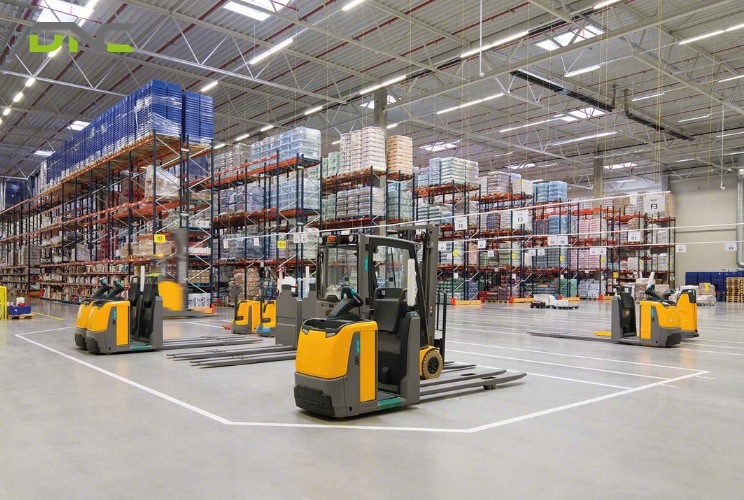
Material handling equipment (MHE) names every mechanical device, vehicle, and automated system a manufacturing or warehousing facility deploys to move, store, control, and protect materials – from inbound receiving through production to outbound dispatch. It covers a wide operational range: manual pallet trucks a single operator guides across a warehouse aisle, conveyor systems connecting receiving docks to production cells, AGVs navigating autonomously between stations, and ASRS (Automated Storage and Retrieval Systems) that retrieve inventory without human intervention. The Material Handling Institute defines the discipline as “the art and science of moving, protecting, storing and controlling material and products.” Four internationally recognized MHE classifications – storage and handling equipment, industrial trucks, bulk material handling equipment, and engineered systems – frame how facilities identify, specify, and integrate these tools. For Malaysian manufacturers operating under rising labor costs, structural workforce shortages, and NIMP 2030 digitalization targets, the shift from manual to engineered MHE carries direct throughput and compliance implications.
What Is Material Handling Equipment?
Material handling equipment is the collective term for all mechanical devices, vehicles, and integrated systems a facility uses to transport, store, control, and protect materials through the production and distribution cycle.
MHE appears at every stage of the operational flow. Inbound: forklifts unload containers, conveyor systems receive and sort pallets. In-process: tugger trains move components between assembly stations, overhead cranes position heavy tooling. Storage: pallet racking holds finished goods at defined load capacities; ASRS retrieves them on demand. Outbound: palletizers stack goods automatically, dock levelers bridge the gap to shipping vehicles.
Three points define what counts as MHE.
First, MHE is defined by function – movement, storage, protection, control – not by power source or automation level. A manual hand truck and a fully autonomous mobile robot are both MHE.
Second, MHE is distinct from production equipment. A CNC machine that cuts metal is not MHE. The conveyor that moves metal billets to the CNC machine is.
Third, MHE operates within a system. A forklift purchased in isolation and an ASRS integrated with a WMS are both MHE, but their operational impact differs by a significant factor. The distinction between buying individual equipment versus commissioning an integrated material handling system determines whether full factory automation is achievable at all.
In Malaysian manufacturing facilities, DNC’s engineering team regularly encounters operations where manual MHE was selected for low upfront cost but now creates a bottleneck that blocks any ASRS or AGV integration upstream. Specifying MHE requires planning from the system level down – not from the individual unit up.
The four MHI classifications provide the framework for that system-level view.
What Are the 4 Standard MHE Classifications?
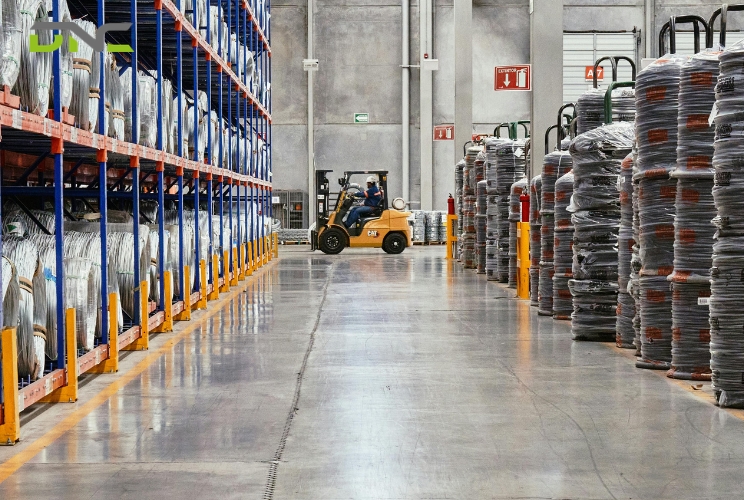
The MHI (Material Handling Institute) 4-category classification is the industry-standard framework for organizing material handling equipment types across manufacturing, warehousing, distribution, and industrial applications.
Every MHE procurement decision, facility audit, and automation integration plan references this taxonomy. The four categories are: storage and handling equipment, industrial trucks and vehicles, bulk material handling equipment, and engineered systems. Each addresses a distinct operational function.
Storage and Handling Equipment
Storage and handling equipment covers all static and semi-static systems used to hold materials between operational steps – from raw material waiting for production to finished goods awaiting shipment.
This category is the foundational infrastructure layer. Its selection determines whether AGV, ASRS, and WMS integration are possible at all. Common types include:
- Pallet racking systems – selective rack, drive-in rack, push-back rack, pallet flow rack. Load capacities range from 500 kg to 10,000 kg per beam level depending on system type and upright frame specification.
- Mezzanines – semi-permanent elevated platforms that add usable floor area between the existing floor and ceiling, typically used for pick operations or light assembly.
- Bins, totes, and containers – standardized containers for sub-pallet storage, available in open-top, lidded, stackable, and nestable configurations.
- Shelving systems – boltless rivet shelving, wire shelving, and mobile shelving for lighter unpalletized items.
- Pallet cages (wire mesh containers) – steel-framed containers for irregular or returnable goods, compatible with forklifts and pallet trucks.
For facilities planning ASRS integration, the racking specification must be engineered to ASRS aisle width and load position tolerances – a constraint that eliminates certain racking types before any other selection criterion applies.
Industrial Trucks and Vehicles
Industrial trucks are all powered and unpowered vehicles used to transport materials horizontally or across short vertical distances within a facility.
This category is where most facilities start – and where most manual MHE bottlenecks form when operations scale. Core equipment types:
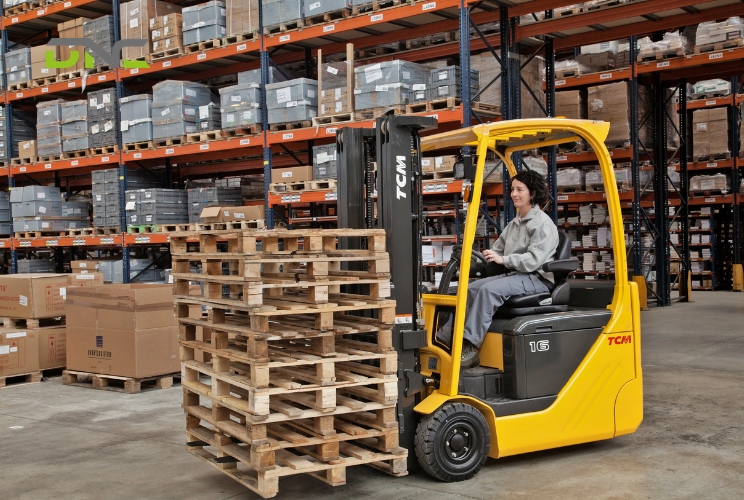
- Forklifts (counterbalance) – standard warehouse forklifts handle loads from 1,500 kg (3,300 lbs) to 5,000 kg (11,000 lbs) and lift to 6–8 m (20–26 ft). Heavy-duty models exceed 10,000 kg capacity.
- Reach trucks – for narrow-aisle high-bay racking, operating in aisles as narrow as 2.8 m with lift heights up to 12 m.
- Order pickers – raise the operator to shelf height for manual picking; typical load capacity around 1,200 kg with lifts up to 10 m.
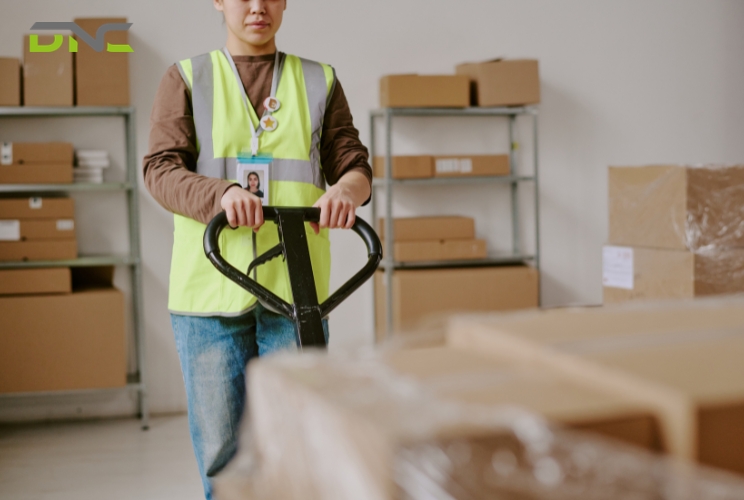
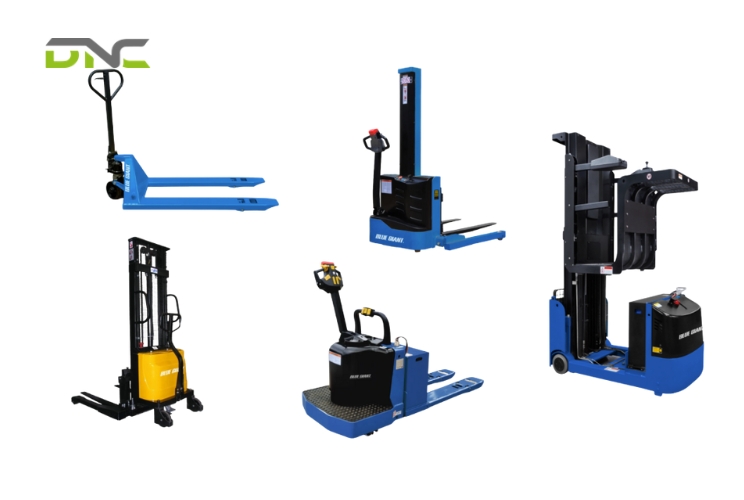
- Pallet trucks (manual and electric) – ground-level transport of palletized loads. Electric models handle 1,500–2,500 kg; manual versions max around 2,000 kg.
- Walkie stackers – operator-behind stacking units for loads up to 1,800 kg, suited to facilities with insufficient aisle space for counterbalance forklifts.
- Tugger trains / AGT (Automated Guided Tuggers) – tow multiple carts in sequence between fixed points, commonly used in automotive assembly line supply.
The transition from manual industrial trucks to autonomous variants – specifically AGVs and AMRs – is the single most common MHE automation upgrade DNC engineers for Malaysian manufacturing clients. Both categories are detailed in the engineered systems section below.
Bulk Material Handling Equipment
Bulk material handling equipment moves, stores, and processes materials in loose or unpackaged form – granular, liquid, or powder – at volumes too large or impractical for palletized handling.
This category is most relevant to food and beverage, chemical processing, agricultural, and mining industries. For industrial manufacturing, the intersection with bulk handling typically occurs in raw material receiving and processing. Key equipment types:
- Conveyor belt systems – continuous horizontal or inclined material transport; belt type, speed, and load capacity configured per material type and throughput requirement.
- Pneumatic conveyors – pipe-based systems for powders and granules using air pressure or vacuum; common in food processing and pharmaceutical production.
- Bucket elevators – vertical transport of flowable bulk materials (grain, fertilizer, mineral ore) using a series of buckets on a continuous belt or chain.
- Stackers and reclaimers – outdoor bulk storage management for commodities like coal, ore, and woodchips; the stacker piles material, the reclaimer feeds it to a conveyor.
- Silos and hoppers – high-volume storage for granular or powder materials; hoppers discharge via bottom gates onto conveyor belts for downstream processing.
- Dump trucks and bulk-handling cranes – used for outdoor construction, mining, and large-scale material transfer where conveyor infrastructure is unavailable.
For Malaysian food and beverage and oleochemical manufacturers – two industries DNC regularly serves – conveyor and pneumatic handling integration forms a core part of the production line automation scope.
Engineered Systems
Engineered systems are fully integrated, largely automated material handling solutions that combine multiple equipment types, control systems, and software to execute movement, storage, and retrieval tasks with minimal or zero manual intervention.
This is the highest-capability MHE category and the area where industrial automation delivers the most measurable productivity impact. Core systems:
- ASRS (Automated Storage and Retrieval Systems) – robotic crane or shuttle systems that place and retrieve pallets or totes from high-density racking automatically, guided by a WMS. Unit Load ASRS handles full pallets; Mini Load ASRS handles totes and cartons.
- Conveyor systems (integrated) – multi-zone conveyor networks with sorters, diverters, accumulation zones, and barcode scanning – designed as a complete material flow architecture, not standalone belt runs.
- AGV (Automated Guided Vehicles) – autonomous floor vehicles that follow pre-programmed routes via magnetic tape, QR codes, laser triangulation, or wire guidance. Used for pallet transport, tugger routes, and dock-to-storage transfer.
- AMR (Autonomous Mobile Robots) – more advanced than AGVs: AMRs map their environment in real time using LIDAR and camera sensors, navigate dynamically around obstacles, and re-route without infrastructure changes. Suited for mixed-traffic environments.
- Palletizers – robotic or mechanical systems that stack products onto pallets at line-end, replacing manual stacking for repeat-pattern loads. Throughput rates from 10 to 100+ cycles per minute depending on configuration.
- Sortation systems – high-speed conveyor-based systems that identify items via barcode or RFID and route them to designated chutes or zones automatically.
- Warehouse robots (goods-to-person systems) – mobile shelving robots (e.g., Kiva-type) that bring storage pods to stationary pick stations, eliminating picker walking time.
For DNC clients pursuing Industry 4.0 certification under NIMP 2030, engineered systems integration – ASRS connected to WMS, AGVs synchronized with production schedules via SCADA – is the core project scope. These are not bolt-on additions; they require the entire facility’s storage infrastructure and layout to be engineered around the system’s specifications from the start.
MHE Summary – 4 Categories, One System
The four MHI categories map directly to the four operational functions every industrial facility performs: store materials between process steps (storage and handling), move them between locations (industrial trucks), process them in bulk form (bulk handling), and automate the entire flow (engineered systems). For Malaysian manufacturers, the practical question is not which category applies – all four do – but which automation tier within each category delivers the right throughput-to-investment ratio at the current stage of the facility’s Industry 4.0 journey. A facility that starts with correctly specified selective racking and electric forklifts retains a clear upgrade path to ASRS and AGV without rebuilding the storage infrastructure. A facility that starts with mismatched racking or undersized industrial trucks faces a retrofit cost that often exceeds the original equipment saving.
Which Material Handling Equipment Types Are Used in Industrial Manufacturing?
Industrial manufacturing applies MHE differently from pure warehousing. The priority shifts from storage density to production flow continuity – keeping components moving to machines without stoppages.
The following 8 equipment types consistently appear in DNC’s engineering assessments across automotive, food and beverage, glove, and electronics manufacturing facilities in Malaysia.
Conveyor systems are the circulatory system of a production facility. Roller conveyors, belt conveyors, overhead chain conveyors, and monorail systems move work-in-progress (WIP) between stations at controlled speeds. In automotive manufacturing, overhead conveyors carry body-in-white units through paint and assembly. In food processing, sanitary belt conveyors transfer product between filling, sealing, and packaging stations.
Forklifts and reach trucks handle inbound raw material receipt, in-process pallet movement between storage and production lines, and outbound finished goods staging. Most manufacturing facilities operate a fleet of 3–12 units depending on throughput.
Pallet racking systems structure the storage zones for raw materials, WIP buffers, and finished goods. Selective racking gives direct forklift access to every position; drive-in racking maximizes density for high-volume, low-SKU storage. The racking specification anchors every downstream automation decision.
Pallet trucks and walkie stackers handle short-distance movement – replenishing production line feeder racks, moving bins between work cells, and staging at dock doors. Electric versions reduce operator fatigue and increase cycle frequency.
Overhead cranes and jib cranes are essential for heavy machinery handling – lifting tooling, dies, motors, and large fabricated components that exceed forklift capacity. Load capacities start at 500 kg for workshop jib cranes and reach 50,000+ kg for bridge cranes in heavy industry.
AGVs (Automated Guided Vehicles) now replace tugger trains and forklift routes that are repetitive, predictable, and high-frequency. A Johor Bahru automotive component manufacturer deploying 6 AGVs on a fixed pallet-loop route eliminated 3 forklift operator positions and reduced inter-station transfer time. DNC’s [Automated Guided Vehicles & Autonomous Mobile Robots Malaysia](/agv-amr/) service covers full AGV system design, path programming, and commissioning.
Palletizers replace manual end-of-line stacking – a high-injury, high-fatigue task. Robotic palletizers handle mixed SKU stacking patterns; layer palletizers handle high-speed uniform products. For a Penang electronics manufacturer, a robotic palletizer running at 18 cycles per minute replaced 4 manual operators across 3 shifts.
ASRS provides the highest storage density with the fastest retrieval speed for high-SKU operations. A 12 m (39 ft) high-bay ASRS in a 2,000 m² (21,500 sq ft) footprint delivers the equivalent storage capacity of a 6,000 m² ground-level warehouse. DNC’s [Warehouse Automation](/warehouse-automation/) engineering scope includes ASRS specification, racking design, crane commissioning, and WMS integration.
What Distinguishes a Material Handling System from Individual Equipment?
A material handling system is an engineered integration of multiple MHE types, control software, and facility infrastructure that operates as a coordinated unit – not a collection of separately purchased machines sharing a floor.
The operational difference is significant. A facility that buys a forklift, a pallet jack, and a racking system has individual MHE. A facility where an ASRS retrieves pallets, releases them onto a powered roller conveyor, routes them through a pick station, and hands off to an AGV for dispatch staging has a material handling system.
Three factors define system-level integration.
Control connectivity. Individual equipment operates independently. A material handling system runs on a unified control layer – WMS directs ASRS retrieval, SCADA monitors conveyor throughput, AGV dispatch is triggered by production schedule data. Every subsystem communicates with the others.
Material flow continuity. Individual equipment creates handoff gaps – a forklift drops a pallet and the next machine waits. A system eliminates those gaps: the pallet flows from one subsystem to the next without human intervention or idle time.
Scalability architecture. A system is designed to scale. Adding a second ASRS aisle, extending a conveyor zone, or increasing AGV fleet size is an engineering change within an existing architecture. Individual equipment additions require layout changes, clearance renegotiation, and operator retraining.
For Malaysian manufacturers evaluating NIMP 2030 automation grants, this distinction is material. The grant framework rewards integrated system investments – conveyor + ASRS + WMS – not individual equipment purchases. DNC engineers the full system scope from layout specification through [Conveyor System Solutions for Factory Automation](/conveyor-system/) and AGV integration to WMS commissioning.
How Do You Select Material Handling Equipment for Your Facility?
Material handling equipment selection follows four specification inputs: material characteristics, throughput requirement, facility constraints, and automation investment threshold.
The sequence matters. Selecting equipment before confirming throughput requirements produces undersized systems. Selecting automation level before confirming facility floor load ratings produces installation conflicts.
Step 1 – Define material characteristics. What is being moved? Unit weight, dimensions, fragility, temperature sensitivity, and packaging format determine which equipment categories are feasible. A 1,200 kg steel coil requires an overhead crane, not a pallet truck. A 500 kg corrugated case load on a standard EUR pallet fits most MHE types.
Step 2 – Establish throughput requirements. How many units, pallets, or tonnes per hour must the system handle at peak? This determines conveyor speeds, forklift fleet size, ASRS crane count, and palletizer cycle rates. Undersizing throughput is the most common cause of post-installation MHE failure.
Step 3 – Audit facility constraints. Floor load rating, available ceiling height, aisle widths, door clearances, and structural column positions all limit which MHE configurations are viable. A 5 m ceiling height eliminates most high-bay ASRS options. A 2.5 m aisle eliminates counterbalance forklifts.
Step 4 – Set the automation investment threshold. Manual MHE has lower upfront cost and higher ongoing labor cost. Automated MHE inverts that ratio. For Malaysian manufacturers, the calculation has shifted: minimum wage increases and structural labor shortages have reduced payback periods for automated MHE systems to 2–4 years in most mid-volume applications. NIMP 2030 capital grant access (via MIDA) further compresses that payback window for qualifying projects.
A fifth input applies specifically to facilities planning future automation expansion: system compatibility. Racking specified today must accommodate ASRS integration if that is on the 3–5 year roadmap. AGV floor paths must account for door clearances and column positions. Equipment chosen without system-level foresight creates expensive retrofit constraints.
DNC’s engineering assessments start with Steps 1–4 before any equipment is recommended. Based on project data from 1,000+ automation installations across Malaysian and SEA manufacturing facilities, facilities that skip Step 4 tend to over-invest in manual MHE and face a second capital cycle within 3 years.
What Role Does Automation Play in Modern Material Handling?
Automation transforms material handling from a labor-dependent cost center into a programmable throughput system – and for industrial facilities targeting above 200 pallet movements per day, it is now the baseline specification, not a premium option.
The transition from manual to automated MHE has accelerated across three dimensions.
AGV and AMR adoption. Five years ago, AGVs in Malaysian manufacturing were primarily found in automotive tier-1 suppliers. Today, DNC’s project pipeline includes AGV deployments for food and beverage, glove, and electronics manufacturers at facility scales from 5,000 m² to 40,000 m². AMRs – with their dynamic navigation capability – are entering environments where AGV fixed-route infrastructure was previously impractical.
ASRS density and cost compression. High-bay ASRS systems that once required 10,000 m² facilities now scale to smaller footprints via compact shuttle ASRS and vertical lift modules (VLMs). A VLM occupying 4 m² of floor space can store the equivalent of 15–20 m of conventional shelving. For Malaysian facilities in Selangor and Penang where industrial land cost has risen significantly, that density trade-off carries real financial weight.
Integration depth. The current engineering standard is not a standalone AGV or a standalone ASRS – it is a connected system where WMS, SCADA, ERP, and MHE operate as a single data-driven network. Material location is tracked in real time. Retrieval is triggered by production schedule, not by a forklift operator reading a pick list. Throughput is monitored and adjusted automatically.
For Malaysian manufacturers, the external pressure driving this integration is direct. NIMP 2030 defines smart factory certification tiers, and material handling automation – connected, monitored, data-integrated – is a core requirement for the higher certification levels that unlock government support. Facilities that delay automated MHE commissioning narrow their window for incentive-supported implementation.
DNC’s approach to MHE automation draws on 20 years of integration experience and engineering partnerships with Siemens and Comau – both of which contribute control platform and robotic system depth to complex MHE integration projects. The 35-engineer team at DNC’s 25,000 sq ft (2,322 m²) production facility handles system design, fabrication, commissioning, and post-installation training under one scope.
Material Handling Equipment – Summary
Material handling equipment classification establishes a common language for specifying, purchasing, and integrating MHE across any industrial facility. The four MHI categories – storage and handling, industrial trucks, bulk handling, and engineered systems – cover the full operational range from a manual hand truck to a fully automated ASRS-AGV-conveyor network.
For industrial manufacturing, the key transition is from individual equipment procurement to system engineering. The equipment types that matter most – conveyors, racking, forklifts, AGVs, ASRS, palletizers – only deliver their full throughput and accuracy potential when specified and integrated as a system, not purchased as separate line items.
Malaysian manufacturers have a time-bounded incentive window under NIMP 2030 to commission those integrated systems with grant support. The facilities that act on that window now will hold a structural cost advantage over those that defer.
Frequently Asked Questions
What does MHE stand for?
MHE stands for Material Handling Equipment – the collective term for all mechanical devices, vehicles, and automated systems used to move, store, control, and protect materials in manufacturing, warehousing, and industrial operations.
What are the 4 types of material handling equipment?
The 4 MHI classifications of material handling equipment are: (1) Storage and Handling Equipment – racking, shelving, bins, mezzanines; (2) Industrial Trucks – forklifts, pallet trucks, reach trucks, order pickers; (3) Bulk Material Handling Equipment – conveyor belts, bucket elevators, stackers, silos; (4) Engineered Systems – ASRS, AGV, AMR, palletizers, sortation systems.
What is the difference between AGV and AMR in material handling?
AGVs (Automated Guided Vehicles) follow fixed pre-programmed routes defined by physical guidance infrastructure (magnetic tape, wire, QR codes). AMRs (Autonomous Mobile Robots) navigate dynamically using onboard LIDAR and cameras – they map their environment, detect obstacles in real time, and reroute without infrastructure changes. AGVs are suited to high-repetition fixed routes; AMRs are suited to variable-path environments or facilities where route flexibility is required.
How do you choose between manual and automated material handling equipment?
The selection depends on throughput volume, labor cost trajectory, and the facility’s 3–5 year automation roadmap. Facilities handling above 200 pallet movements per day or operating 2–3 shift schedules typically find automated MHE pays back within 2–4 years at current Malaysian labor cost levels. The NIMP 2030 capital grant framework (via MIDA) further reduces the net investment for qualifying automation projects.
What is a material handling system integrator?
A material handling system integrator engineers, supplies, and commissions complete MHE systems – specifying racking, conveyor layout, AGV routes, ASRS configuration, and WMS integration as a single coordinated scope – rather than selling individual equipment units. An integrator is required when the project involves multiple MHE types that must operate as a connected system, particularly when ASRS, AGV, and conveyor automation are combined within a single facility.
- 108 views
- 0 Comment
Recent Comments