



Types of Mobile Robots in Industrial Automation

Mobile robots — self-propelled machines capable of moving through physical environments to perform tasks — have become the backbone of automated material handling in modern manufacturing. Every movable robot deployed on a factory floor falls into a distinct classification defined by its locomotion method, drive configuration, navigation system, and application domain. Malaysian manufacturers evaluating mobile robot investments need to understand these classifications to match the right robot type to their specific operational requirements. This guide breaks down the four main categories of mobile robots, the drive systems that power wheeled industrial platforms, and the application scenarios where each type delivers the strongest return on investment.
What Is a Mobile Robot?
A mobile robot is a programmable machine equipped with locomotion mechanisms that enable it to move through its operating environment — a factory floor, warehouse, outdoor terrain, or aerial space. Unlike fixed industrial robots bolted to a single workstation, mobile robots transport themselves (and often payloads) between locations to perform material handling, inspection, surveillance, or manipulation tasks.
Mobile robots in industrial settings share three core functional layers. The locomotion system provides physical movement — wheels, tracks, legs, or rotors. The navigation system determines position and plans paths — using SLAM, GPS, magnetic guides, or inertial sensors depending on the platform type. The task execution system performs the robot’s assigned work — carrying loads, picking items, inspecting surfaces, or operating attached tools. These three layers combine differently across mobile robot types, creating the diversity of platforms available to manufacturers.
The global mobile robot market reached approximately USD 6.1 billion in 2024, driven by labor shortages, rising wages, and Industry 4.0 automation mandates across manufacturing economies — including Malaysia’s NIMP 2030 initiative.
The 4 Main Types of Mobile Robots
Mobile robots divide into four primary categories based on locomotion method. Each category contains multiple subtypes optimized for specific environments and tasks.
1. Wheeled Mobile Robots
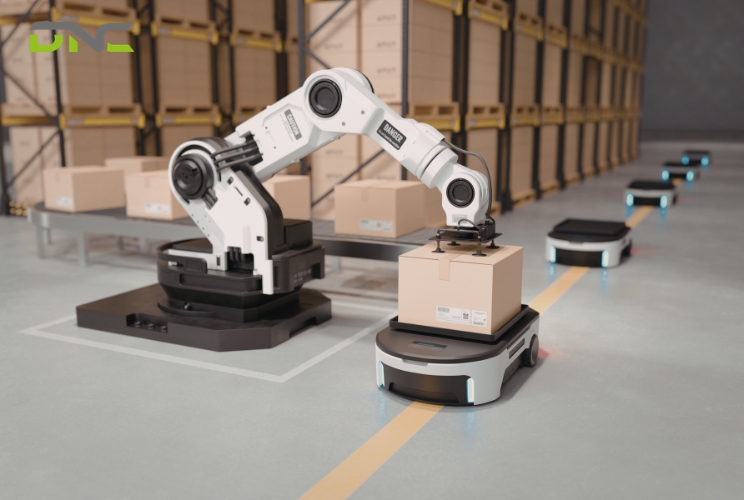
Wheeled robots are the dominant type in industrial automation — AGVs, AMRs, and the vast majority of factory-floor mobile platforms use wheels for locomotion. Wheels provide the highest energy efficiency on smooth, hard surfaces; the lowest mechanical complexity; and the easiest speed and direction control through differential motor commands.
Wheeled mobile robots excel in structured indoor environments — manufacturing plants, warehouses, distribution centers, cleanrooms, and logistics facilities — where floors are flat, clean, and load-bearing. Their limitation is terrain adaptability: standard wheeled robots cannot traverse stairs, rough outdoor surfaces, or heavily obstructed environments.
Malaysian manufacturing facilities — with their polished concrete and epoxy-coated factory floors — provide ideal operating surfaces for wheeled mobile robots. The overwhelming majority of AGV and AMR deployments in Selangor, Johor, and Penang industrial zones use wheeled platforms.
2. Tracked Mobile Robots
Tracked robots use continuous tracks (similar to tank treads) instead of wheels for locomotion. Track systems distribute the robot’s weight over a larger surface area, providing superior traction on loose, uneven, or soft terrain — sand, gravel, mud, slopes, and debris-covered surfaces.
Tracked mobile robots serve outdoor industrial applications: mining operations, agriculture, military reconnaissance, disaster response, and outdoor facility inspection. In manufacturing, tracked platforms appear primarily in heavy-industry outdoor logistics — steel yard material transport, quarry operations, and construction site automation.
For indoor Malaysian manufacturing environments, tracked robots are rarely the optimal choice. The higher floor wear, greater energy consumption, and slower speed compared to wheeled platforms make tracks a specialized solution for rough-terrain applications only.
3. Legged Mobile Robots
Legged robots use articulated limbs — bipedal (two legs), quadrupedal (four legs), or hexapodal (six legs) — to walk, climb, and traverse irregular terrain. These platforms navigate stairs, step over obstacles, and operate on surfaces that would stop wheeled and tracked robots.
Quadrupedal platforms like Boston Dynamics’ Spot robot inspect industrial facilities — climbing stairs, entering confined spaces, and traversing catwalks that wheeled inspection robots cannot access. Hexapodal robots provide stable locomotion for research and specialized industrial inspection tasks.
Legged robots remain specialized tools in manufacturing — used primarily for facility inspection, remote monitoring of hazardous environments, and research applications. Their slower speed, lower payload capacity, and higher cost per unit compared to wheeled platforms limit their adoption for routine material transport tasks.
4. Aerial Mobile Robots (Drones/UAVs)
Aerial mobile robots — unmanned aerial vehicles (UAVs) or drones — operate above the ground surface, providing a three-dimensional operational envelope that ground-based robots cannot access. Multi-rotor drones, fixed-wing UAVs, and hybrid VTOL platforms serve different aerial mobility requirements.
In manufacturing and warehouse environments, aerial robots perform inventory scanning (flying over racking to read barcodes or RFID tags), facility inspection (roof structures, high ceilings, overhead cranes), and perimeter security surveillance. Amazon, DHL, and other logistics companies have piloted drone-based inventory counting systems that scan warehouse racks 50–100x faster than manual methods.
For Malaysian manufacturers, aerial robots offer the highest value in large warehouse inventory auditing, outdoor facility inspection, and estate management for plantation-linked manufacturing operations (palm oil mills, rubber processing facilities).
| Robot Type | Locomotion | Best Environment | Payload | Speed | Industrial Use |
| Wheeled | Wheels | Indoor, flat floors | 50–100,000 kg | 0.5–2.5 m/s | Material transport, AGV/AMR |
| Tracked | Continuous tracks | Outdoor, rough terrain | 100–50,000 kg | 0.3–1.5 m/s | Mining, construction |
| Legged | Articulated limbs | Stairs, irregular terrain | 5–50 kg | 0.5–1.5 m/s | Inspection, research |
| Aerial | Rotors/wings | Airspace, above obstacles | 0.5–25 kg | 5–30 m/s | Inventory, inspection |
Types of Wheeled Mobile Robots by Drive System
Wheeled mobile robots — the primary category for manufacturing automation — subdivide further by drive configuration. The drive system determines a wheeled robot’s maneuverability, speed, accuracy, and suitability for specific transport tasks.
Differential Drive Robot
Differential drive is the most common drive configuration in industrial mobile robots. Two independently powered wheels mounted on a common axis — plus one or two passive caster wheels for stability — provide locomotion and steering. The robot turns by varying the speed between left and right drive wheels: equal speed moves straight, speed differential creates a turning arc, and opposite speeds spin the robot in place (zero-radius turn).
Differential drive mobile robots dominate AGV and AMR applications because the configuration is mechanically straightforward, highly reliable, and provides good maneuverability in standard factory aisles. Most industrial AMR platforms — including models from major manufacturers serving the Malaysian market — use differential drive.
Advantages: Straightforward, reliable, cost-effective, zero-radius turning capability, well-understood control algorithms.
Limitations: Cannot move laterally (sideways) without turning first; caster wheels may cause minor path deviations on uneven floors.
Omnidirectional Mobile Robot (Mecanum/Swedish Wheels)
Omnidirectional robots use specialized wheels — Mecanum wheels or Swedish wheels — that enable movement in any direction without changing the robot’s orientation. Mecanum wheels feature angled rollers mounted around the wheel circumference; coordinated speed and direction commands to four Mecanum wheels produce forward, backward, lateral, diagonal, and rotational movement.
Omni directional mobile robots deliver superior maneuverability in tight spaces — they can strafe sideways to dock at workstations, rotate in place while maintaining position, and navigate narrow aisles without multi-point turning maneuvers. Semiconductor wafer transport, cleanroom logistics, and precision assembly cell material handling use omnidirectional platforms where positioning accuracy and spatial efficiency are critical.
Advantages: Movement in any direction, precise positioning, excellent for tight spaces and precision docking.
Limitations: Higher mechanical complexity, lower payload efficiency, Mecanum wheels wear faster than standard wheels, higher cost per unit.
Tricycle (Ackermann) Drive Robot
Tricycle drive — also called Ackermann steering — uses one steered front wheel and two fixed rear drive wheels, mimicking the steering geometry of a car. This configuration provides smooth, stable locomotion at higher speeds and over longer distances than differential drive; steering accuracy is high because the geometry is deterministic.
Tricycle drive robots serve long-corridor transport applications, outdoor material handling, and facilities where transport routes involve extended straight runs with gentle curves. The configuration is common in automated towing vehicles and large-format AGVs that pull multi-cart trains through manufacturing plants.
Advantages: Stable at higher speeds, efficient for long-distance transport, smooth path tracking.
Limitations: Larger turning radius than differential drive, cannot spin in place, less maneuverable in tight spaces.
Four-Wheel Drive / Skid-Steer Robot
Four wheel robots with skid-steer drive power all four wheels simultaneously, steering by creating speed differentials between left-side and right-side wheel pairs — similar to how a tracked vehicle steers. This configuration provides excellent traction, high payload capacity, and robust operation on rough or outdoor surfaces.
Skid-steer wheeled robots serve outdoor logistics, agriculture, construction material transport, and industrial yards where floor conditions range from concrete to packed earth. Indoor manufacturing applications are limited because skid-steering causes tire scrub — lateral tire sliding during turns that wears tires quickly and marks floor surfaces.
Advantages: High traction, robust on rough surfaces, proven drivetrain, good payload capacity.
Limitations: Tire scrub causes floor marking and tire wear, lower precision than differential drive, higher energy consumption during turns.
| Drive System | Wheels | Maneuverability | Best For | Malaysian Use Case |
| Differential | 2 driven + casters | Good, zero-radius turn | Standard AGV/AMR | Most factory transport |
| Omnidirectional | 4 Mecanum | Excellent, any direction | Precision, tight spaces | Cleanroom, electronics |
| Tricycle | 1 steered + 2 driven | Moderate, car-like | Long corridors | Automotive, large warehouse |
| Skid-steer | 4 driven | Good on rough surfaces | Outdoor, yard logistics | Plantation mills, construction |
Key Components Shared Across Mobile Robot Types
Regardless of locomotion type, industrial mobile robots share a common set of functional components:
Sensors for perception and safety. LiDAR scanners (2D or 3D) provide distance mapping for navigation and obstacle detection. Depth cameras add visual perception. Ultrasonic sensors detect close-range obstacles. Safety-rated sensors create certified protective zones around the robot for human-collaborative operation. Wheel encoders measure distance traveled and provide odometry input.
Onboard computing. The robot’s controller runs navigation algorithms, motor control, safety logic, and communication protocols. Industrial mobile robots use PLC-based controllers (AGVs) or industrial PC platforms with multi-core processors (AMRs) depending on computational requirements. GPU-accelerated computing appears in platforms running machine learning for advanced perception.
Battery and power system. Lithium-ion batteries dominate modern mobile robot platforms — displacing legacy lead-acid batteries through superior energy density, cycle life, and charge speed. Opportunity charging, wireless inductive charging, and autonomous docking to charging stations keep robots operational through extended shifts.
Communication. Industrial Wi-Fi provides the primary communication channel between mobile robots and fleet management servers. 5G connectivity is emerging for high-bandwidth, low-latency applications. Bluetooth and RFID provide short-range identification and data exchange at pickup/drop-off stations.
Fleet management software. Multi-robot coordination, task assignment, traffic management, charging scheduling, and performance analytics — all managed through a central software platform that integrates with your facility’s WMS, MES, and ERP systems.
Applications of Mobile Robot Types in Malaysian Manufacturing
Automotive Plants
Wheeled mobile robots — both AGVs and AMRs — handle the bulk of material transport in automotive manufacturing. Towing AGVs deliver parts trains to assembly lines in Shah Alam and Rawang plants. Collaborative AMRs provide flexible just-in-time delivery to variable assembly stations. Assembly line AGVs carry vehicle bodies through welding and painting sequences. Manufacturers like Toyota, UMW, and Inokom leverage wheeled mobile robots to maintain production cadence while reducing manual handling labor across their Malaysian operations.
Electronics and Semiconductor
Omnidirectional wheeled robots and cleanroom-rated AMRs serve Penang’s electronics manufacturing corridor. Precision lateral docking at wafer processing stations requires the maneuverability that Mecanum-wheeled platforms provide. Standard differential-drive AMRs transport PCB panels and component reels between production zones where SLAM navigation adapts to the frequent line reconfiguration that characterizes high-mix electronics manufacturing.
Food and Beverage
F&B manufacturers deploy stainless-steel-finished wheeled robots for hygienic material transport. Unit load AGVs and collaborative AMRs move palletized products between production, cold storage, and shipping in IP65-rated configurations that withstand washdown cleaning protocols. The controlled indoor environments of F&B plants — level floors, defined traffic lanes, regulated temperature — create ideal operating conditions for wheeled mobile robots.
Warehouse and Logistics
Goods-to-person AMRs, autonomous forklift AGVs, and sorting AMRs transform warehouse operations across Malaysia’s logistics corridors. The combination of high order volumes, rising labor costs, and e-commerce-driven SKU proliferation makes wheeled mobile robots the highest-ROI automation investment for warehouse operators seeking to maintain competitiveness.
Outdoor and Plantation-Linked Manufacturing
Palm oil mills, rubber processing facilities, and timber yards — industries connected to Malaysia’s plantation sector — present unique mobile robot challenges: outdoor terrain, dust, heat, and mixed indoor-outdoor transport routes. Tracked robots and ruggedized wheeled platforms with all-terrain capability serve outdoor material handling tasks that standard factory-floor robots cannot address.
Benefits of Deploying Mobile Robots in Manufacturing
Labor cost reduction. Mobile robots operating 20+ hours per day replace multiple shift operators, eliminating salary, benefits, training, overtime, and turnover costs. A single wheeled AGV or AMR typically replaces 2–3 manual material handlers across a three-shift operation.
Workplace safety. DOSH Malaysia records thousands of manufacturing injuries annually, with material handling incidents among the leading categories. Mobile robots equipped with certified safety systems reduce collision risk to near zero while eliminating the ergonomic injuries associated with manual pushing, pulling, and lifting.
Consistent throughput. Mobile robots deliver the same transport performance at 3:00 AM as at 3:00 PM — no fatigue, no breaks, no concentration lapses. Production lines receive materials on schedule, every shift, every day.
Operational flexibility. AMR-type mobile robots adapt to layout changes, new products, and variable production schedules through software updates rather than infrastructure modifications. This flexibility matches the high-mix production environments common in Malaysian contract manufacturing.
Data-driven optimization. Fleet management systems generate continuous data on transport volumes, cycle times, vehicle utilization, and energy consumption — enabling your operations team to identify bottlenecks, optimize routes, and plan capacity expansions based on evidence rather than estimates.
How to Choose the Right Mobile Robot Type
Match locomotion to your environment. Indoor, flat-floor manufacturing: wheeled robots. Outdoor or rough terrain: tracked or ruggedized wheeled robots. Multi-level facilities requiring stair access: legged robots for inspection. Large warehouse inventory auditing: aerial drones.
Match drive system to your space constraints. Standard factory aisles (2.5 m+): differential drive. Tight spaces requiring lateral movement: omnidirectional. Long corridors with gentle curves: tricycle drive.
Match navigation to your layout stability. Fixed routes with minimal change: AGV-type guided navigation. Dynamic routes with frequent changes: AMR-type SLAM navigation. Most facilities benefit from evaluating both approaches.
Calculate ROI per application. High-frequency, repetitive transport routes deliver the fastest payback regardless of robot type. Map your material flows, quantify transport frequency and labor costs, and calculate ROI for the highest-impact routes first.
DNC Automation’s engineering team evaluates your facility’s specific environment, material handling requirements, and integration needs to recommend the optimal mobile robot type and configuration — backed by 20+ years of factory automation experience across Malaysian manufacturing sectors.
Frequently Asked Questions About Mobile Robot Types
What Are the 4 Types of Mobile Robots?
The four main types of mobile robots classified by locomotion method are: wheeled robots (wheels on flat surfaces — AGVs, AMRs), tracked robots (continuous tracks for rough terrain), legged robots (articulated limbs for stairs and irregular surfaces), and aerial robots (rotors or wings for flight-based operation). Wheeled robots dominate industrial manufacturing due to their energy efficiency, payload capacity, and reliability on factory floors.
What Is a Wheeled Robot?
A wheeled robot is a mobile platform that uses powered wheels for locomotion. Industrial wheeled robots include AGVs (automatic guided vehicles) and AMRs (autonomous mobile robots) that transport materials across manufacturing floors and warehouses. Wheeled robots offer the highest energy efficiency and payload-to-weight ratio of any mobile robot type on smooth indoor surfaces.
What Is a Holonomic Mobile Robot?
A holonomic mobile robot can move instantaneously in any direction without first reorienting its body. Omnidirectional robots using Mecanum wheels or Swedish wheels are holonomic — they move forward, backward, sideways, and diagonally while maintaining their current heading. Standard differential-drive robots are non-holonomic — they must turn to change direction. Holonomic platforms provide superior maneuverability in tight spaces but cost more and require more complex control algorithms.
Which Mobile Robot Type Is Best for Manufacturing?
Wheeled mobile robots are the best type for manufacturing material transport. Specifically, differential-drive platforms (as either AGVs or AMRs) handle the vast majority of factory transport tasks — pallet movement, parts delivery, finished goods transport, and inter-process material handling. Omnidirectional wheeled robots add value in precision-positioning applications. The choice between AGV and AMR navigation depends on your route flexibility and layout change frequency.
How Much Do Industrial Mobile Robots Cost?
Industrial mobile robot costs vary by type and capability: standard wheeled AGVs start at USD 25,000–60,000 per unit; collaborative AMRs range from USD 30,000–100,000; autonomous forklifts cost USD 60,000–300,000; and mobile manipulators (AMR + robotic arm) range from USD 100,000–250,000. Fleet management software adds USD 10,000–100,000 depending on fleet size. For Malaysian facilities, MIDA automation grants and NIMP 2030 incentives can offset 15–30% of the initial investment.
Can Different Types of Mobile Robots Work Together in One Facility?
Yes — modern fleet management platforms coordinate multiple robot types within a single facility. A manufacturer might deploy towing AGVs for high-volume backbone transport corridors, collaborative AMRs for flexible workstation delivery, and autonomous forklifts for pallet stacking — all managed through unified fleet software that handles traffic, task assignment, and charging across the mixed fleet. DNC Automation designs and integrates multi-type mobile robot systems for Malaysian manufacturing facilities.
Conclusion
Mobile robot technology spans four main categories — wheeled, tracked, legged, and aerial — with wheeled platforms dominating industrial manufacturing applications. Within the wheeled category, differential drive, omnidirectional, tricycle, and skid-steer configurations serve different maneuverability and environment requirements. Malaysian manufacturers should match robot type and drive system to their specific facility conditions, material handling tasks, and operational flexibility needs.
DNC Automation provides expert guidance on mobile robot selection, system design, and integration for manufacturers across Malaysia. Our 35+ engineers evaluate your facility requirements and recommend the optimal mobile robot solution — whether that involves a single platform type or a coordinated multi-type fleet.
- 4 views
- 0 Comment
Recent Comments