



Modular Belt Conveyor: Types, Materials, Food Grade Specs, and Applications
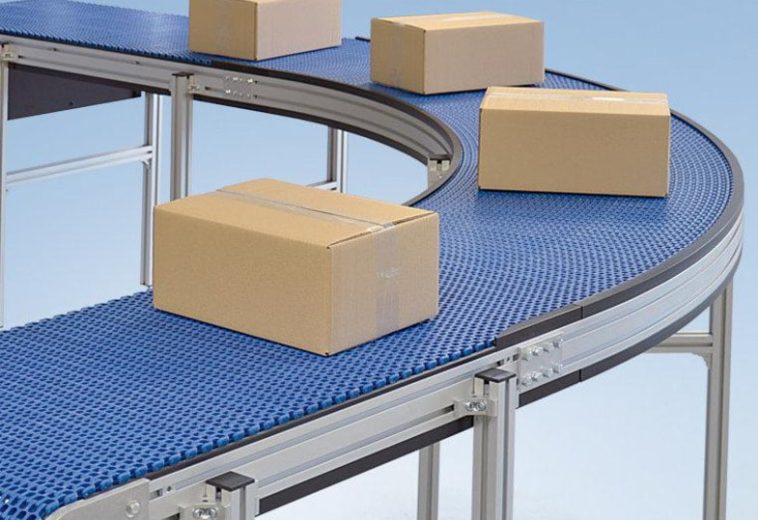
A modular belt conveyor uses a belt formed from interlocking plastic modules — assembled in a brick-lay pattern and connected by hinge rods — instead of a continuous rubber or PVC belt. Each module is an independent piece that can be removed and replaced individually. The modular construction allows the belt to navigate horizontal curves, to be configured with different surface textures (flat, roller inserts, friction pads, open grid), and to be repaired module-by-module in minutes without removing the entire belt.
In Malaysian food processing, pharmaceutical, and electronics manufacturing, modular belt conveyors have replaced rubber belt conveyors in applications requiring washdown hygiene, horizontal curve capability, or module-level repairability — offering lower lifecycle costs despite higher initial investment.
How a Modular Belt Conveyor Works
Individual plastic modules (typically 25–100 mm in the direction of travel, matching the belt “pitch”) interlock via moulded hinge eyes — aligned across the belt width — with a continuous stainless steel or acetal hinge rod threaded through. The hinge rod is retained at each belt edge by end rods or clips.
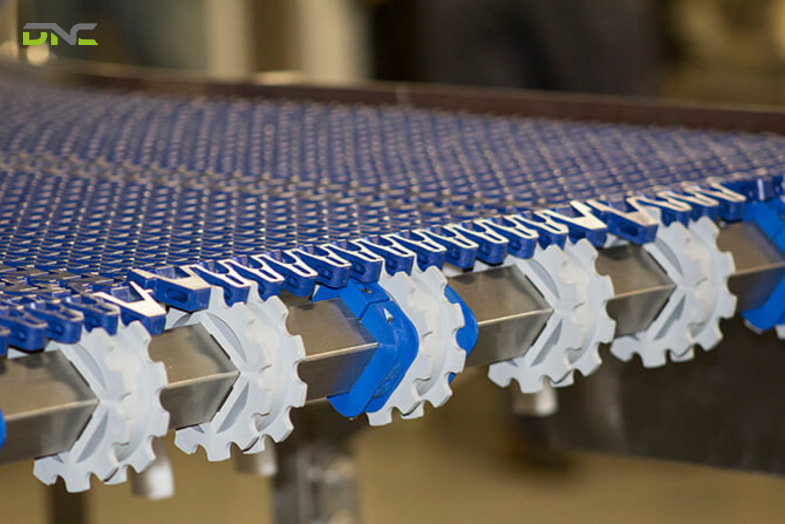
The belt is driven by a sprocket wheel at the head — sprocket teeth engage with the module’s drive lugs on the underside. The return strand runs below on return rails or rollers. At the tail end, the belt wraps around an idler sprocket or nose bar.
Key difference from rubber belts: Because modules are individually connected (not a bonded continuous structure), the belt can articulate in plan view — bending laterally to navigate horizontal curves. Side-flexing modular belts use modules with reduced width on one side, allowing the belt to curve left or right with a defined minimum radius. This enables a single belt to navigate straight runs, curves, and straight runs again without transfer units between sections.
Module Pitch and Configuration
Module pitch (length in direction of travel): 12.7 mm (0.5″), 25.4 mm (1″), 38.1 mm (1.5″), 50.8 mm (2″) are the most common.
- Shorter pitch (12.7–25.4 mm): Better surface contact for small products, smoother belt surface, tighter curve radius capability.
- Longer pitch (38.1–50.8 mm): Lower belt weight, higher open area percentage, greater drainage and airflow.
Belt width: 100 mm to 3,048 mm (10 feet) — assembled module-by-module to the required width.
Module Surface Configurations
Flat-Top
Smooth, continuous flat surface across the belt width. Standard for carton, container, and rigid product conveying.
Applications: Packaging line product transfer, carton accumulation, assembly line product transport. Most widely used configuration in Malaysian food packaging lines.
Open-Grid / Perforated
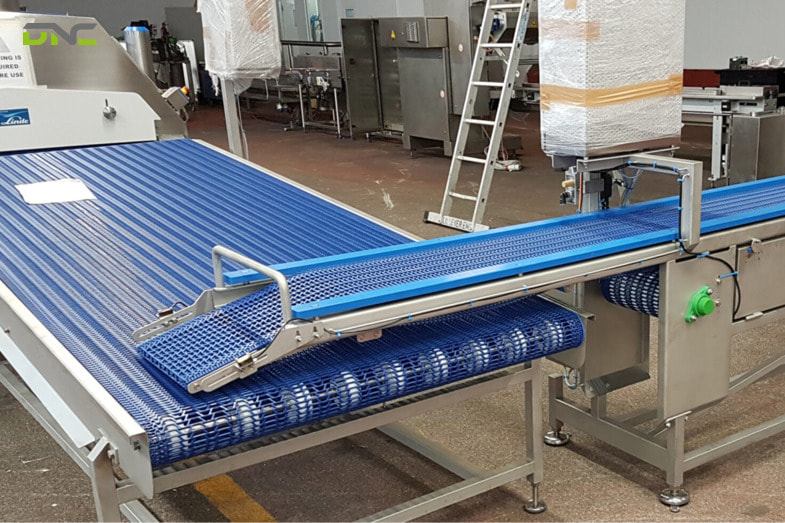
Modules with large openings or holes in the belt surface — allowing water, steam, air, or liquids to pass through the belt in both directions.
Applications: Product cooling (airflow through belt), product washing (water spray through belt to product underside), liquid drainage in food processing (excess water from washing falls away). Essential for seafood, poultry, and vegetable processing in Malaysia.
Roller-Top
Stainless steel or acetal balls or rollers embedded in the module surface — creating a low-friction rolling surface for product. The rollers allow accumulated products to be pushed laterally (for orientation/turning) or reduce the back-pressure force during accumulation.
Applications: Accumulation zones before merge/divert stations; product rotation/orientation; box accumulation without scratching the carton bottom.
Friction-Top / Grip-Top
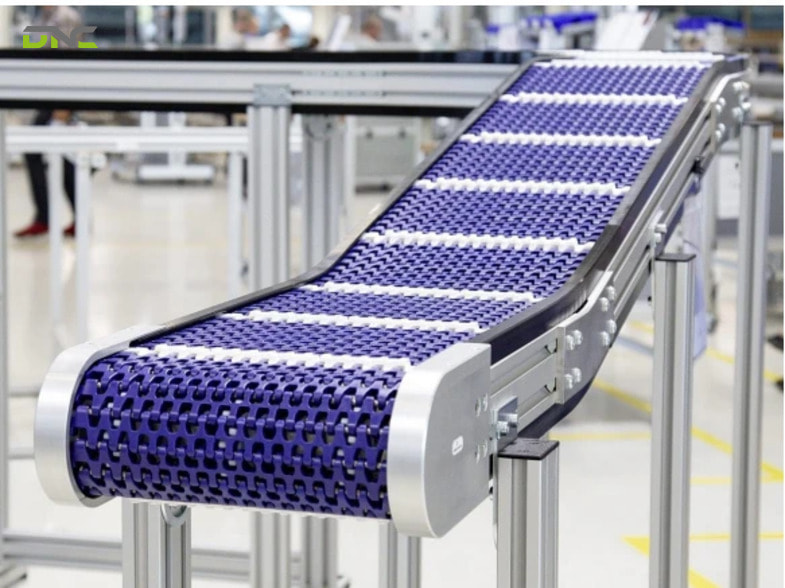
Rubber or polyurethane inserts in the module surface create high-friction contact — necessary for incline conveying above 15° or for controlled product positioning.
Applications: Incline conveying of pouches and flexible packaging; product gripping for vision inspection under lateral force; controlled-speed accumulation.
Side-Flexing (Radius Bend)
Modules with tapered or asymmetric geometry allowing the belt to navigate horizontal curves within a single run — without a separate curved belt section or transfer unit.
Minimum radius: 300 mm (tight radius, small products) to 3,000 mm (gentle radius, large cartons).
Malaysian application: Beverage filling lines (F&N, Carlsberg, Heineken facilities) route product flow through multiple curves in compact plant layouts using a single continuous side-flex modular belt — replacing 4–6 straight belt sections with curved transfers between them.
Module Surface Configurations
Module Materials
| Material | Temp Range | FDA Food Contact | Best For |
| Polypropylene (PP) | -10°C to +90°C | Yes | Food, packaging, ambient temp |
| Acetal (POM) | -40°C to +90°C | Yes | Electronics, pharma, self-lubricating |
| UHMWPE | -50°C to +80°C | Yes | Freezer, abrasion, low friction |
| Nylon (PA) | -20°C to +140°C | Yes (some grades) | High temp food, hot-fill, baking |
| Stainless steel | -200°C to +900°C | Yes | Extreme temp, chemical resistance |
For Malaysian food applications: PP (food-grade white or blue) is the standard module material for food contact conveying at ambient temperature. UHMWPE for freezer and blast-freeze applications (-18°C to -40°C). Nylon for hot-fill beverage lines and post-oven cooling at up to 120°C.
Monolithic Belt vs. Modular Belt: Selection Comparison
| Parameter | Monolithic (PVC/PU) Belt | Modular Plastic Belt |
| Horizontal curves | Not possible (separate curved belt needed) | Native capability (side-flex belt) |
| Repair | Full belt replacement or re-splicing | Module-by-module, 30 min on-site |
| Wash-down | Limited at edges and splice | Full IP69K compatible |
| Surface options | Limited (flat, rough-top, cleated) | Flat, grid, roller, friction, perforated |
| Temperature range | -20°C to +80°C (PU) | -50°C to +140°C (by material) |
| Initial cost | Lower | 20–40% higher |
| Lifecycle cost | Higher (full belt replacement) | Lower (module replacement) |
| Product contact | Smooth continuous surface | May show module join lines (not for some applications) |
Choose modular belt when: Horizontal curves needed, wash-down required, long service life critical, varied surface configurations needed.
Choose monolithic belt when: Very smooth continuous surface required (thin films, delicate products), horizontal curves not needed, lowest initial cost priority.
Hygienic Design for Food and Pharmaceutical Applications
Modular belt conveyors for food and pharma applications must comply with EHEDG (European Hygienic Engineering and Design Group) and 3-A Sanitary Standards guidelines:
Frame design: Sloped surfaces (minimum 3°) for drainage; no horizontal dead zones; open-leg frame for full cleaning access below conveyor; stainless steel 316L for all food contact surfaces.
Belt cleaning: CIP (Clean-in-Place) capability — fixed spray nozzles clean belt during operation or between runs; belt runs through the wash zone before starting next product. Validated cleaning protocol required for HACCP CCP documentation.
Drive and tail design: Open-access head and tail sprockets — no enclosed housing that traps food residue; sprockets must be removable without tools for inspection and replacement.
IP rating: All motors, drives, and junction boxes: IP69K for high-pressure hot-water wash-down (70°C water at 10 bar pressure).
Hygienic Design for Food and Pharmaceutical Applications
Modular Belt Conveyor Maintenance
Weekly:
- Inspect modules for cracks, missing hinge rods, or broken inserts
- Check sprocket teeth for wear — replace at 25% tooth reduction
- Verify belt tracking (should run centrally on sprockets without lateral drift)
- Check tension — belt should show minimal sag between return rail supports
Monthly:
- Inspect and clean return rail channels — product residue and worn plastic accumulate and increase chain pull force
- Measure drive motor current versus baseline — increase indicates elevated chain pull (worn rails or over-tensioned belt)
- Lubricate rail contact surfaces (NSF H1 food-grade lubricant for food applications)
Annual:
- Full module replacement assessment — inspect for stress cracking at hinge eyes (typically visible under UV light inspection in food applications)
- Replace hinge rods showing wear or corrosion
- Assess sprocket and drive shaft wear; replace if pitch mismatch developing
Malaysian Applications
Beverage Production (F&N, Carlsberg, Heineken)
Side-flex modular belt conveyors route bottles and cans through multiple curves on filling and packaging lines — reducing the floor footprint of filling line layout by eliminating straight-conveyor-plus-transfer-unit combinations.
Seafood and Poultry Processing
Open-grid PP modular belt conveyors allow wash water and ice to drain away from product at the freezing and sorting stages — mandatory for HACCP-compliant seafood processing in Malaysia’s export facilities.
Pharmaceutical Packaging
Acetal (POM) modular belt conveyors transfer blister packs, cartons, and tablet containers between packaging stations — food-grade, self-lubricating, easy to clean, no metal contamination risk.
Electronics Manufacturing
Modular acetal belt conveyors on PCB assembly lines provide ESD-safe transport (ESD-grade acetal modules available) with open-hinge design that allows visual inspection of belt underside for PCB fragments.
DNC Automation’s Modular Belt Conveyor Solutions
DNC Automation designs, fabricates, and commissions modular belt conveyor systems for Malaysian food, pharmaceutical, and electronics manufacturers — integrating Intralox, Uni-Chain, and Ammeraal Beltech modular belts with stainless steel hygienic frames and Siemens PLC control.
Capabilities: Full system design (curve layout, chain pull calculation, belt selection), SS316L frame fabrication, IP69K drive integration, CIP system design, and HACCP compliance documentation.
MIDA SAG: Modular belt conveyor systems for food safety and production automation qualify for MIDA’s Strategic Automation Grant (up to RM 1 million, 50% qualifying capex).
Contact DNC Automation for modular belt conveyor assessment and proposals.
DNC Automation’s Modular Belt Conveyor Solutions
Summary
Modular belt conveyors deliver the combination of horizontal curve capability, full wash-down hygiene, and module-level repairability that rubber belts cannot match for food processing, pharmaceutical, and electronics applications. Material selection (PP, POM, UHMWPE, nylon) determines temperature range and chemical resistance; surface configuration (flat, grid, roller, friction) determines product handling capability. Higher initial cost versus rubber belts is recovered through lower replacement cost (module-by-module vs. full belt) and reduced maintenance downtime over the 5–10 year service life.
- 6 views
- 0 Comment
Recent Comments