



Pallet Truck with Scales: Weighing Pallet Jack Guide

Pallet trucks with scales integrate precision load cells directly into the fork assembly — weighing every pallet during the lift-and-transport cycle without requiring separate floor scale stations. For Malaysian warehouses and factories processing 200–2,000+ pallets daily, weigh-scale pallet trucks eliminate the double handling, queueing delays, and floor space consumption of standalone weighing stations while capturing accurate weight data (±0.1–0.5%) for inventory management, shipping verification, and regulatory compliance. This guide covers the weighing mechanism, accuracy specifications, data integration capabilities, and operational ROI that make scale pallet trucks a high-value investment for receiving docks, shipping operations, production batching, and inventory counting. DNC Automation designs material handling solutions that integrate weigh-scale data with WMS and production systems — connecting the simplest handling tool to the smart factory data architecture.
What Is a Pallet Truck with Scales?
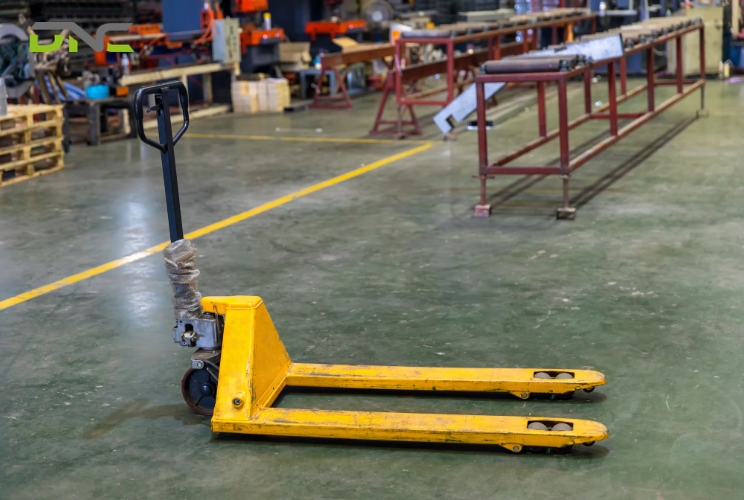
A pallet truck with scales — also called a weighing pallet truck, scale pallet jack, or weigh-scale pallet truck — is a standard hydraulic pallet truck with integrated load cells that measure the weight of the pallet load during normal lifting and transport operations. When the operator pumps the forks to lift a pallet, the load cells register the weight and display it on a digital indicator mounted on the truck handle.
The weighing function is passive — it adds zero time to the pallet handling cycle. The operator lifts and moves the pallet exactly as they would with a standard truck; the weight reading appears automatically. This integration eliminates the separate weighing step that traditional workflows require: pick up pallet → transport to floor scale → place on scale → wait for reading → record weight → pick up pallet → transport to destination. With a weigh-scale truck, the workflow becomes: pick up pallet (weight displayed) → transport to destination. One step instead of seven; 30–60 seconds saved per pallet.
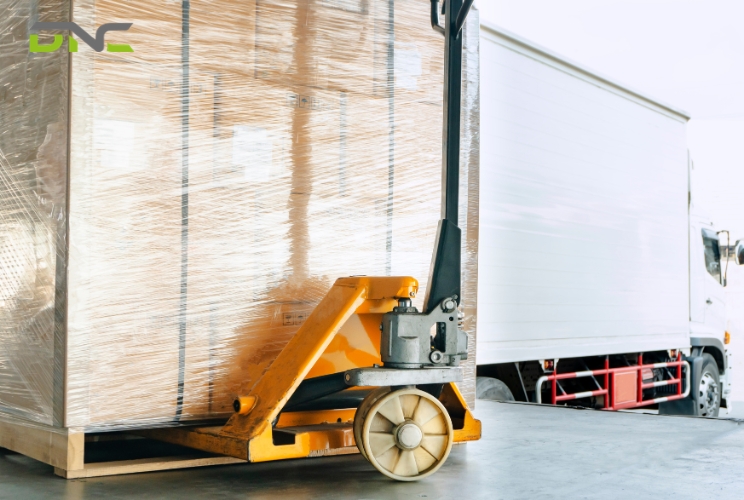
Weigh-scale pallet trucks use the same hydraulic lifting mechanism as standard pallet trucks — the load cells are bonded to the fork assembly or integrated into the pivot points between the forks and the chassis. This positioning ensures the cells measure the total pallet load accurately regardless of load distribution on the forks.
In the Malaysian market, weigh-scale pallet trucks serve receiving inspection (verifying incoming goods weight against purchase orders), shipping verification (confirming outbound pallet weights for logistics compliance), production batching (measuring ingredient quantities by pallet weight), and inventory counting (weighing as a proxy for piece counting of uniform items).
How Does a Pallet Truck with Scales Work?
Load Cell Technology
Load cells are strain-gauge-based force sensors that convert mechanical deformation (caused by the pallet load) into an electrical signal proportional to the applied force. Each weigh-scale pallet truck contains 2–4 load cells positioned at strategic points in the fork assembly where they measure the total vertical force.
Strain gauge operation: The load cell contains a metal element (aluminium or stainless steel) with bonded foil strain gauges. When the pallet load compresses the element, the strain gauges deform — changing their electrical resistance. A Wheatstone bridge circuit converts this resistance change into a voltage signal that the digital indicator processes into a weight reading.
Load cell placement: Two common configurations:
- Fork root load cells — positioned where the forks join the chassis. Two cells measure the total load transferred from both forks to the hydraulic cylinder.
- Fork beam load cells — embedded within each fork beam. Four cells (two per fork) provide higher accuracy and load distribution data.
Digital Indicator and Display
The digital indicator processes load cell signals through an analogue-to-digital converter (ADC) with 20,000–50,000 internal divisions. The display shows weight in kilograms or pounds with resolution of 0.2–1.0 kg depending on capacity and accuracy class.
Standard functions:
- Tare: Zero the display with an empty pallet on the forks — subsequent readings show net product weight only
- Hold: Lock the displayed weight for recording even after the load is removed
- Accumulate/Total: Sum multiple pallet weights for batch or shipment totals
- Overload alarm: Visual/audible warning when load exceeds rated capacity
Display types: LED (high visibility in outdoor/dock environments), LCD (lower power consumption for battery-powered indicators), and colour touchscreen (premium models with data entry capability).
Accuracy and Calibration
Weigh-scale pallet truck accuracy is specified as a percentage of full scale or actual reading:
| Accuracy Class | Tolerance | Application |
| ±0.5% FS | ±10 kg at 2,000 kg | General warehouse |
| ±0.2% FS | ±4 kg at 2,000 kg | Shipping verification |
| ±0.1% FS | ±2 kg at 2,000 kg | Production batching, trade use |
“Trade use” (legal-for-trade) certification requires compliance with OIML R76 or local metrology standards. In Malaysia, trade-use weighing instruments must be verified by SIRIM (Standards and Industrial Research Institute of Malaysia). Not all weigh-scale pallet trucks hold trade-use certification — verify before specifying for applications where weight determines commercial value (buying/selling by weight, freight charging).
Calibration frequency: Every 6–12 months using certified test weights. Environmental factors affecting accuracy: temperature variation (±0.01%/°C for standard cells), floor slope (> 1° affects reading), and hydraulic system pressure variation (quality trucks compensate; budget trucks do not).
Data Output and Connectivity
Modern weigh-scale pallet trucks offer multiple data output options:
Wired: RS-232 serial port connecting to printers, computers, or PLC systems. Standard for fixed-station applications.
Wireless: Bluetooth (BLE) connecting to mobile devices and tablets; Wi-Fi connecting directly to WMS/ERP systems; RFID integration reading pallet tags while weighing.
Printed: Built-in thermal printer producing weight tickets with date, time, weight, pallet ID, and operator ID.
DNC Automation integrates weigh-scale pallet truck data with WMS platforms — every pallet weight is recorded automatically in the inventory system at the point of handling, eliminating manual data entry and its associated errors.
Types of Weigh-Scale Pallet Trucks
Manual Weigh-Scale Pallet Truck
Standard hand-pumped hydraulic pallet truck with integrated load cells and digital indicator. No motor, no propulsion battery — only a small battery (rechargeable or replaceable) powering the indicator electronics.
Specifications:
- Weighing capacity: 1,000–3,000 kg
- Accuracy: ±0.1–0.5% FS
- Fork length: 1,150–1,220 mm
- Indicator battery life: 40–100 hours
- Cost: RM 3,000–8,000
Best for: Dock receiving verification, shipping spot-checks, inventory cycle counting where transport distances are short (< 30 m).
Electric Weigh-Scale Pallet Truck
Battery-powered pallet truck with integrated weighing. Electric drive handles propulsion; electric pump handles lifting; load cells provide continuous weight reading during transport.
Specifications:
- Weighing capacity: 1,500–2,500 kg
- Accuracy: ±0.1–0.5% FS
- Travel speed: 4–6 km/h
- Drive battery: 24V lithium-ion, 8–12 hour operation
- Cost: RM 8,000–25,000
Best for: High-volume receiving and shipping operations (100+ pallets/shift) where operators handle pallets continuously. The electric drive eliminates fatigue; the scale eliminates the separate weighing step.
High-Precision Weigh-Scale Truck
Premium units with ±0.1% accuracy, OIML R76 / SIRIM-certifiable load cells, and environmental compensation (temperature, floor level). Suitable for trade-use applications where weight determines commercial value.
Specifications:
- Accuracy: ±0.1% FS (OIML Class III equivalent)
- Resolution: 0.2–0.5 kg
- Environmental compensation: –10°C to +40°C operating range
- Cost: RM 8,000–15,000
Best for: Trade-use weighing (buying/selling by weight), production batching requiring ingredient weight accuracy, and regulatory compliance applications.
Stainless Steel Weigh-Scale Truck
Stainless steel construction (304 or 316 grade) with IP67/IP68-rated indicator and load cells. Washdown-compatible for food manufacturing, pharmaceutical, and chemical environments.
Specifications:
- Material: 304 SS or 316 SS
- IP rating: IP67 indicator, IP68 load cells
- Weighing capacity: 1,000–2,500 kg
- Cost: RM 10,000–25,000
Best for: Malaysian F&B manufacturers operating under MeSTI, HACCP, and halal certification requiring washdown-compatible handling equipment in production areas.
Key Components
Load Cells
Hermetically sealed aluminium or stainless steel strain gauge transducers. Rated capacity matches truck rated load. Protection class: IP65 (standard), IP67 (washdown), IP68 (submersible for extreme environments). Overload protection: 150–200% of rated capacity without permanent damage.
Digital Indicator
Microprocessor-based weight processor with ADC, display, keyboard, and communication interfaces. Power: rechargeable lithium-ion battery (40–100 hour operation), 240V AC adapter for charging. Environmental rating: IP54 (standard), IP65 (outdoor/dock), IP67 (washdown).
Hydraulic System
Standard pallet truck hydraulic pump and cylinder. Quality weigh-scale trucks isolate the load cells from hydraulic system pressure variations — ensuring weight accuracy is not affected by partial pump strokes or slow hydraulic leaks. Budget trucks may allow hydraulic pressure drift to affect weight readings.
Communication Module
Optional Bluetooth, Wi-Fi, or RS-232 module enabling automatic weight data transmission to WMS, ERP, or label printers. DNC Automation configures wireless data integration as part of the weigh-scale truck deployment — connecting the truck’s weight data to the facility’s information systems.
Applications in Malaysian Operations
Receiving Dock Verification
Warehouse receiving operations verify incoming pallet weights against purchase order quantities and supplier-declared weights. Weigh-scale pallet trucks enable operators to verify weight at the moment of unloading — before pallets enter storage — catching discrepancies (short shipments, incorrect products, packaging errors) at the earliest possible point.
ROI impact: Catching a 5% short shipment on a RM 50,000 delivery saves RM 2,500 per incident. Facilities receiving 20+ deliveries daily find weight discrepancies in 3–8% of shipments.
Shipping Weight Compliance
Malaysian logistics companies and exporters must declare accurate pallet weights for:
- SOLAS VGM (Verified Gross Mass): International shipping containers require verified container weight. Pallet-level weighing aggregated to container total provides VGM compliance without separate container weighing.
- Road transport limits: Malaysian road weight limits require accurate load declaration. Over-weight penalties: RM 2,000–10,000 per offence.
- Air freight charges: Air cargo charges by weight — inaccurate weights cause billing disputes and surcharges.
Production Batching
Food, chemical, and pharmaceutical manufacturers use weigh-scale pallet trucks to measure ingredient quantities during production batching. A pallet of flour tared at empty-pallet weight provides net ingredient weight — directing the operator to deliver the correct quantity to the mixing station without separate weighing.
Inventory Cycle Counting
For products with uniform unit weight (beverages, canned goods, bagged products), weighing a pallet provides a fast, accurate piece count: pieces = (net pallet weight) ÷ (unit weight). Weigh-scale pallet trucks enable cycle counting during normal warehouse movements — no separate counting station required.
Quality Control Sampling
Production quality checks often include weight verification. Weigh-scale trucks at the end-of-line staging area capture finished goods weights for SPC (Statistical Process Control) without interrupting material flow.
Benefits
30–60 seconds saved per pallet by eliminating the separate weighing step. At 500 pallets/day, this saves 250–500 minutes (4–8 operator hours) daily — equivalent to RM 30,000–60,000/year in labour cost.
Floor space recovery. Eliminating 1–2 floor scale stations recovers 4–8 m² of warehouse floor — space that can be used for additional staging or storage.
Error reduction. Manual weight recording introduces 1–3% data entry error rate. Automated wireless data transmission from weigh-scale trucks to WMS eliminates transcription errors entirely.
Discrepancy detection at source. Weight verification at the receiving dock catches short shipments, wrong products, and packaging errors before they enter inventory — preventing downstream problems in storage, picking, and customer delivery.
Dual-purpose tool. The weigh-scale truck handles normal pallet transport AND weighing — no need to purchase and maintain separate pallet trucks and floor scales. Capital savings: RM 5,000–15,000 per floor scale eliminated.
Regulatory compliance. SOLAS VGM, road weight limits, and trade-use weight certification requirements are met at the point of handling — no separate compliance workflow required.
How to Choose a Weigh-Scale Pallet Truck
Determine Accuracy Requirement
- General warehouse verification: ±0.5% FS sufficient (RM 3,000–8,000)
- Shipping compliance / inventory counting: ±0.2% FS recommended (RM 5,000–12,000)
- Trade-use / production batching: ±0.1% FS with SIRIM certification (RM 8,000–15,000)
Select Manual vs. Electric
- < 50 pallets/shift, < 30 m transport: Manual (RM 3,000–8,000)
- 50–200 pallets/shift, 30–100 m transport: Electric (RM 8,000–25,000)
- > 200 pallets/shift: Consider conveyor-integrated weighing instead
Specify Data Connectivity
If weight data must enter WMS/ERP automatically: require Wi-Fi or Bluetooth with compatible software. If weight tickets are sufficient: built-in thermal printer. If no data integration needed: standard display-only indicator.
Consider Environment
- Standard warehouse: Powder-coated steel, IP54 indicator
- Outdoor/dock: Galvanised steel, IP65 indicator
- Food/pharma: Stainless steel, IP67 indicator and IP68 load cells
- Cold room: Verify load cell operating temperature range (standard cells may lose accuracy below 0°C)
FAQ — Pallet Truck with Scales
What is a pallet truck with scales?
A pallet truck with scales is a hydraulic pallet jack with integrated load cells that weigh the pallet load during normal lifting and transport. The weight displays on a digital indicator mounted on the truck handle. Accuracy ranges from ±0.1% to ±0.5% with capacities of 1,000–3,000 kg. Cost: RM 3,000–25,000 depending on accuracy, power type (manual/electric), and construction material.
How accurate are weigh-scale pallet trucks?
Standard models achieve ±0.5% of full scale (±10 kg at 2,000 kg capacity). High-precision models achieve ±0.1% (±2 kg at 2,000 kg). Accuracy depends on load cell quality, indicator ADC resolution, calibration frequency, and environmental conditions (floor level, temperature). For trade-use applications requiring legal metrological certification, specify OIML R76-compliant models verified by SIRIM.
Can weigh-scale pallet trucks connect to WMS?
Modern weigh-scale pallet trucks offer Bluetooth, Wi-Fi, and RS-232 data output. Weight data transmits automatically to WMS, ERP, or label printing systems — eliminating manual data entry. DNC Automation configures wireless weight data integration as part of material handling system deployments, connecting weigh-scale trucks to the facility’s information infrastructure.
How much does a weighing pallet truck cost in Malaysia?
Manual weigh-scale: RM 3,000–8,000. Electric weigh-scale: RM 8,000–25,000. High-precision (±0.1%): RM 8,000–15,000. Stainless steel: RM 10,000–25,000. Price depends on accuracy class, capacity, power type, construction material, and data connectivity features. Annual calibration service: RM 200–500.
Do weigh-scale pallet trucks need calibration?
Calibration every 6–12 months using certified test weights is recommended for all weigh-scale pallet trucks. Trade-use (legal-for-trade) applications may require more frequent calibration per SIRIM requirements. Calibration verifies accuracy across the full capacity range and corrects for any drift caused by load cell ageing, mechanical wear, or environmental changes.
Can I replace floor scales with weigh-scale pallet trucks?
For most warehouse weighing applications (receiving verification, shipping checks, inventory counting), weigh-scale pallet trucks replace floor scales entirely — saving RM 5,000–15,000 per floor scale eliminated plus 4–8 m² of floor space. However, for high-accuracy applications requiring ±0.05% or better (trade-certified weighing, laboratory measurement), dedicated floor scales remain necessary. Evaluate your accuracy requirement against the weigh-scale truck’s certified accuracy class.
Are weigh-scale trucks suitable for cold rooms?
Standard weigh-scale trucks operate in temperature ranges of –10°C to +40°C. Cold room applications below –10°C require cold-rated load cells with compensation circuits and cold-rated indicator electronics. Some manufacturers offer cold-room-specific models rated to –25°C. Verify the operating temperature range in the specifications before deploying in cold environments — inaccurate weight readings in cold rooms can cause batch errors and compliance failures.
Conclusion
Pallet trucks with scales represent one of the highest-ROI investments in warehouse material handling — delivering weight data at the point of pallet handling without adding time, labour, or floor space to the operation. For Malaysian warehouses processing 200+ pallets daily, the combination of time savings, error reduction, regulatory compliance, and floor scale elimination justifies the modest RM 3,000–25,000 investment within months.
DNC Automation integrates weigh-scale pallet truck data into broader material handling and warehouse management systems — ensuring the weight captured at the dock, production line, or staging area flows directly into WMS, ERP, and quality systems without manual data entry. From the simplest manual scale truck to automated conveyor-integrated weighing, we design material handling solutions where every measurement counts.
- 7 views
- 0 Comment
Recent Comments