



PLC Conveyor Systems: Control Logic, Components, Safety & Automation Benefits
Malaysian plant managers evaluating PLC conveyor investments face a decision that two very different audiences within their organization argue from opposite positions: the factory engineer who needs to understand exactly how a PLC controls a conveyor — sensor logic, ladder diagram structure, VFD communication, stopper sequencing, and HMI architecture — and the plant manager who needs to understand the financial return, the payback period, the grant options, and the risk of getting it wrong. Both questions are equally valid. Both deserve complete answers in one place. A PLC conveyor system — a conveyor or series of conveyors controlled by a Programmable Logic Controller — is the entry point to factory automation for most Malaysian manufacturers, and getting the specification right determines whether it delivers the 70% reduction in unplanned downtime, the 85% OEE improvement, and the 1–3 year payback period that Malaysian factories achievable under Malaysia’s NIMP 2030 smart factory investment framework. This guide answers both audiences completely, covering PLC conveyor technical architecture, brand selection, integration sequence, financial ROI, and the SAG Grant pathway that reduces capital investment for qualifying Malaysian manufacturers.
What Is a PLC Conveyor?
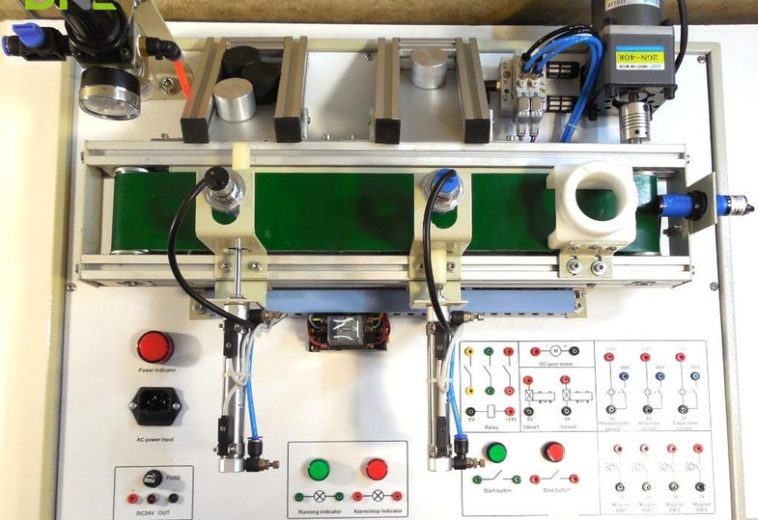
A PLC conveyor is a conveyor system — belt, roller, modular, or any other type — whose movement, speed, routing, and process integration are controlled by a Programmable Logic Controller (PLC): a ruggedized industrial computer purpose-built for factory environments that executes control logic programs to automate machine operations. A PLC conveyor is fundamentally different from a manually operated or relay-controlled conveyor: the PLC replaces fixed relay logic circuits with software-defined programs that can be modified, expanded, and remotely monitored without hardware changes. A PLC controlled conveyor system can automatically start and stop individual zones, vary belt speed in response to process conditions, detect and respond to product faults, interlock with upstream and downstream machines, communicate production data to MES/ERP systems, and alert maintenance personnel to developing faults — functions that require no operator intervention once programmed and commissioned. PLC conveyors form the foundation of every smart factory in Malaysia: without PLC-controlled material flow, human-machine interaction, and process integration, automated manufacturing is impossible regardless of the robots, vision systems, or AI analytics installed above.
How Does a PLC Conveyor Work?
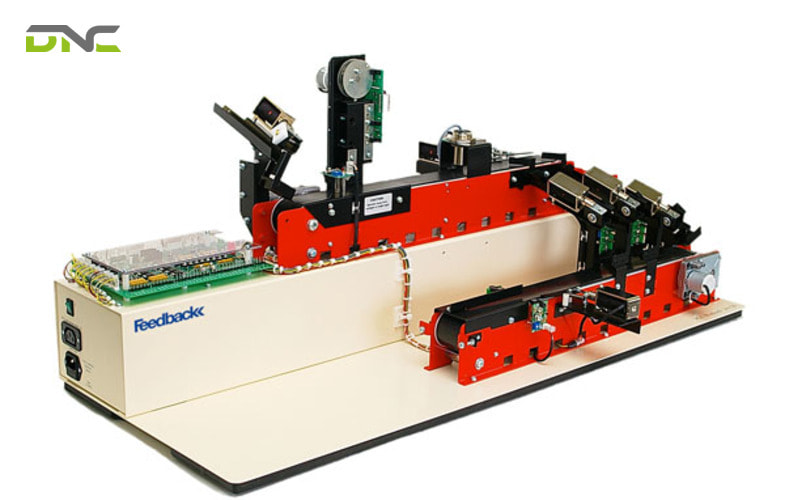
PLC conveyor operation follows a five-step cycle that transforms raw sensor signals into coordinated conveyor motion, process control, and data output at every second of factory operation.
Step 1: Sensors Detect — Product Presence, Position, and Condition
Photoelectric sensors (operating at 24V DC, PNP output) detect product presence at defined positions along the conveyor — infeed, zone entries, process stations, and discharge. Inductive proximity sensors detect metallic pallets or fixture carriers at ±0.5 mm accuracy for precise positioning confirmation. Weight sensors (load cells) on check-weigher conveyor sections measure product weight to 0.1 g accuracy, triggering rejection signals for out-of-specification products. Encoder sensors on the drive motor provide belt speed feedback in pulses per meter, enabling the PLC to calculate actual belt speed, accumulated product count, and belt travel distance. Temperature sensors on motor windings provide thermal protection data that the PLC uses to initiate motor derating or emergency stop before thermal damage occurs. IO-Link sensors connect to the PLC via standardized 3-wire IO-Link master modules, transmitting both the primary measurement data (presence/absence, weight, speed) and diagnostic data (signal strength, switching cycle count, contamination level) in a single 3-wire cable — eliminating the separate diagnostic wiring that conventional sensors require.
Step 2: PLC Processes — Ladder Logic Executes the Control Decision
Sensor signals enter the PLC input module and are processed in the PLC program scan cycle — typically 1–10 milliseconds for Siemens S7-1200 and S7-1500. The PLC program, written in IEC 61131-3 compliant languages (Ladder Diagram for most conveyor logic, Function Block Diagram for modular zone control, Structured Text for complex calculations), evaluates the current sensor states against the programmed conditions. A simple zone control function block evaluates: Is the upstream product at the zone entry sensor? Is the downstream zone clear (zone-occupied sensor = 0)? Is the zone drive healthy (VFD fault relay = 0)? If all TRUE conditions are satisfied, the function block outputs a zone start command. If any condition is FALSE, the function block holds the previous state. This scan-cycle-level decision making — repeating 100–1,000 times per second across all zones simultaneously — provides the coordinated zone control that makes PLC conveyors responsive to production events faster than any human operator can detect them.
Step 3: Outputs Actuate — VFDs, Stoppers, Diverters, and Alarms
PLC output modules drive the actuator devices that physically control the conveyor system. VFD (Variable Frequency Drive) outputs via PROFINET or analog 4–20 mA signals control belt speed — the PLC sends a speed setpoint signal to each zone’s VFD, which converts 415V three-phase power to the precise frequency required for the commanded belt speed. Digital output modules (24V DC transistor outputs) energize pneumatic stopper solenoid valves (extending or retracting stop pins), diverter actuators (routing products to left/right or elevation change zones), reject gate actuators (diverting non-conforming products to reject lanes), and indicator tower lights (green for running, amber for warning, red for fault). The PLC output scan completes within the same 1–10 ms scan cycle as the input read, ensuring that actuator responses to sensor events occur within one scan cycle — critical for stopper timing at high product throughput rates.
Step 4: HMI Displays — Real-Time Status, Alarms, and Production Data
A Siemens SIMATIC HMI touchpanel (7″, 10″, or 15″ display) connected to the S7 PLC via PROFINET displays real-time conveyor system status for operators and supervisors. Standard HMI screens for PLC conveyor systems include: conveyor line overview (belt speed per zone, product count per zone, zone status — running/stopped/fault, stopper status — extended/retracted), alarm list (fault descriptions with timestamp, acknowledgment status, and occurrence count), production report (products completed, rejected, line OEE, shift production target vs. actual), and maintenance screen (motor current, bearing temperature, belt slip percentage, accumulated running hours per zone). Operators interact with the HMI to set production targets, adjust belt speed within PLC-defined limits, acknowledge alarms, and initiate manual sequences (zone jog, emergency stop reset, reject gate manual override). Remote HMI access via VPN allows DNC Automation’s 24/7 support engineers to view the same HMI screens and PLC live data as on-site operators — enabling remote fault diagnosis without travel time in the majority of fault scenarios.
Step 5: System Integrates — OPC-UA, Modbus TCP, and Ethernet/IP to MES/SCADA
PLC conveyor systems communicate with factory-level information systems — MES (Manufacturing Execution Systems), SCADA (Supervisory Control and Data Acquisition), WMS (Warehouse Management Systems), and ERP systems (SAP, Oracle) — through industrial communication protocols. OPC-UA (OPC Unified Architecture) is the preferred protocol for NIMP 2030 Industry 4.0 connectivity — a standard-independent, secure communication protocol that transmits PLC data to any SCADA/MES system regardless of software vendor. Modbus TCP provides legacy connectivity for existing SCADA installations. Ethernet/IP provides native connectivity for Allen-Bradley systems in mixed-brand facilities. Data points transmitted from a PLC conveyor to MES include: product count per zone per shift, zone OEE (actual throughput / theoretical maximum throughput), fault codes with duration, energy consumption per zone (from VFD power measurement), and product traceability data (RFID reader tag data correlated with process results). This data connectivity is what transforms a PLC conveyor from a simple automated material mover into a smart factory data node that feeds the production analytics, quality management, and predictive maintenance systems that NIMP 2030 requires.
Types of PLC Conveyor Systems
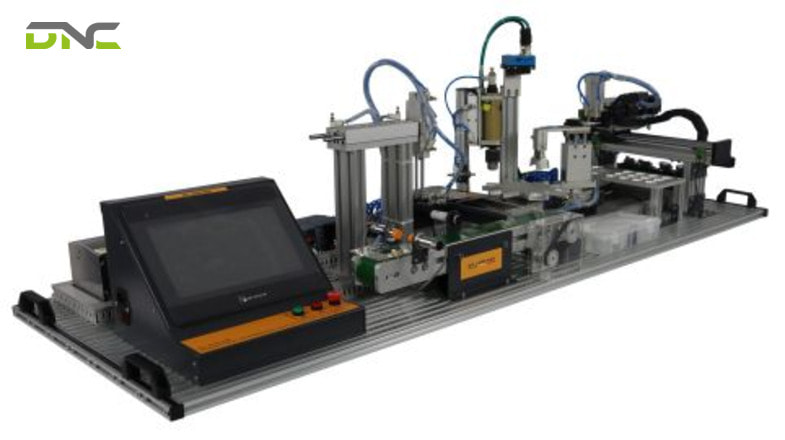
PLC conveyor control architectures range from single-zone basic control to fully distributed multi-zone networks with cloud data connectivity, with each level providing a specific set of capabilities matched to Malaysian factory automation maturity levels.
Single-Zone PLC Belt Conveyor
A single-zone PLC belt conveyor uses one PLC I/O module (Siemens S7-1200 with digital input/output modules) to control one conveyor zone — one motor, one VFD, and a set of sensors for product presence and speed feedback. Single-zone PLC belt conveyors are the entry point for Malaysian factory automation — replacing manual start/stop or fixed-speed operation with programmable speed profiles, automatic stop at end-of-batch, and fault detection with alarm output. Total installed cost: RM 8,000–RM 25,000 for a 5–10 m single-zone PLC belt conveyor including sensors, VFD, Siemens S7-1200, and HMI panel. ROI payback: 6–18 months through labor savings and throughput improvement.
Multi-Zone PLC Accumulation Conveyor
Multi-zone PLC accumulation conveyors control 3–20 independent conveyor zones from a single Siemens S7-1500 PLC, enabling product buffering, zone-by-zone speed control, and zero-pressure accumulation. Each zone has its own VFD, sensor, and stopper; the PLC coordinates all zones through a structured function block program that manages product flow, accumulation logic, and zone state transitions. Multi-zone accumulation conveyors are the standard for Malaysian automotive assembly, electronics manufacturing, and pharmaceutical packaging lines — providing the buffering that absorbs process speed variation between stations without back-pressure product damage.
PLC Conveyor with Vision System Integration
PLC conveyors integrated with machine vision systems perform automated quality inspection during product transport — triggering cameras at defined positions, receiving pass/fail results from the vision processor, and commanding reject gates to divert non-conforming products. Siemens S7-1500 PLC communicates with Cognex or Keyence vision systems via PROFINET or Ethernet/IP, completing the detect-inspect-sort sequence at throughput rates to 600 products/minute. Malaysian electronics manufacturers use vision-integrated PLC conveyors for PCB solder joint inspection (AOI — Automated Optical Inspection) and component presence verification, reducing manual inspection labor by 100% while improving detection capability from human operator accuracy of 92% to camera accuracy of 99.5%.
PLC Conveyor with Robot Integration
PLC conveyors integrated with industrial robots — Comau (Italy, DNC’s exclusive SEA partner) or KUKA — combine conveyor transport with robotic pick-and-place, welding, dispensing, or assembly operations. The Siemens S7-1500 PLC manages conveyor zones, stopper control, and product positioning, then sends a “product ready” signal to the robot controller (Comau C5G or KUKA KRC5) via PROFINET. The robot completes its programmed operation and returns a “cycle complete” signal to the PLC, which releases the product and advances the next product into position. DNC Automation delivers complete PLC conveyor + robot integrated cells for Toyota (welding), Hartalega (glove handling), and Unilever (packaging) as turnkey automation solutions.
PLC Conveyor with SCADA/MES Connectivity
SCADA/MES-connected PLC conveyors transmit real-time production data to factory information systems, enabling production performance dashboards, shift production reports, and predictive maintenance alerts based on accumulated operating data. Siemens S7-1500 with PROFINET and OPC-UA server capability connects to Siemens SIMATIC WinCC SCADA or third-party MES systems, transmitting product counts, zone OEE data, fault codes, and energy consumption in real time. Malaysian manufacturers pursuing NIMP 2030 smart factory accreditation require MES connectivity as a core compliance criterion — PLC conveyors with OPC-UA connectivity satisfy this requirement as the data source for production analytics platforms.
PLC Brand Comparison for Malaysian Conveyor Systems
| PLC Brand | Origin | DNC Partner? | Price Range | Best Application |
| Siemens SIMATIC S7 | Germany | YES | Premium | Industry 4.0, complex multi-zone, robot integration |
| Allen-Bradley CompactLogix | USA | No | Premium | Oil & gas, pharmaceutical, US-affiliated factories |
| Mitsubishi MELSEC | Japan | No | Mid-market | General manufacturing, Asia-dominant |
| Omron SYSMAC | Japan | No | Mid-market | F&B, packaging, vision integration |
| Schneider Modicon | France | No | Mid-market | General, EU-affiliated factories |
| Xinje XD/XG | China | YES | Cost-competitive | SME entry-level, cost-sensitive applications |
Key Components of a PLC Conveyor System
A complete PLC conveyor system integrates hardware and software components from sensors through to cloud data output, with each component’s specification determining the system’s reliability, capability, and supportability.
PLC Hardware. Siemens SIMATIC S7-1200 (compact, 1–8 zone applications, up to 14 digital I/O onboard) for smaller conveyor systems; Siemens SIMATIC S7-1500 (modular, 8–200 zone applications, PROFINET IRT, motion control, OPC-UA server) for complex multi-zone and robot-integrated systems. PLC CPU selection specifies the scan time (1 ms for S7-1515), memory capacity (4 MB program + 20 MB data for S7-1515), and communication ports (2× PROFINET on S7-1515). For cost-sensitive Malaysian SME applications, Xinje XD3 or XD5 series PLCs provide functional equivalents at 30–50% lower hardware cost, with DNC Automation providing the same-quality programming and commissioning service.
VFD (Variable Frequency Drive). Siemens SINAMICS G110M (distributed, IP65, PROFINET) for compact conveyor zone drives; Siemens SINAMICS G120 (cabinet-mounted, extended power range, full VFD feature set) for higher power applications. VFD power ratings: 0.12 kW to 7.5 kW for standard conveyor applications. VFD features for PLC conveyor applications: speed reference via PROFINET (eliminates analog wiring), energy recovery braking (returns motor braking energy to supply), built-in motor thermal model (PTC thermistor monitoring without external relay), and smart current limiting (prevents motor overcurrent during product jam events).
Sensors and IO-Link. Siemens SIRIUS photoelectric sensor series for standard product detection; SICK PF2S series for long-range or difficult-surface detection; Balluff BAM inductive sensors for metal pallet detection. IO-Link masters (Siemens ET200SP with 4× IO-Link ports) replace conventional terminal blocks at the field level, enabling smart sensor data (diagnostic data beyond simple on/off signal) to reach the PLC program without additional wiring.
Control Panel. All PLC conveyor electrical components — PLC CPU, I/O modules, VFDs, safety relay, circuit breakers, and HMI — are housed in a rated enclosure: IP54 for standard factory floor environments, IP65 for food processing areas with washdown risk. DNC Automation designs, wires, labels, and tests control panels at its Selangor facility before shipping to site, reducing site commissioning time by 40–60% versus panels assembled on-site.
PLC Program — TIA Portal. Siemens TIA Portal (Totally Integrated Automation Portal) is the unified engineering software platform for S7-1200, S7-1500, SINAMICS VFDs, SIMATIC HMI, and SIMATIC WinCC SCADA. TIA Portal’s integrated development environment writes PLC ladder logic and structured text programs, configures VFD parameters, designs HMI screens, and configures PROFINET network topology in a single project file — reducing engineering time and ensuring configuration consistency. DNC Automation’s TIA Portal conveyor library — developed over 20 years of Malaysian automation projects — provides pre-validated function blocks for zone control, stopper management, product tracking, fault detection, and OPC-UA data export that reduce PLC commissioning time by 40–60% versus custom-coded programs.
Applications: Where PLC Conveyors Are Used in Malaysian Manufacturing
PLC conveyor systems serve every manufacturing sector in Malaysia, with specific PLC brand and configuration choices matched to the industry’s reliability, performance, and regulatory requirements.
Automotive — Selangor (Toyota, Inokom)
Toyota’s Selangor manufacturing operations — where DNC Automation is an automation partner — use Siemens S7-1500 PLC conveyor systems for body-in-white transport, underbody assembly, and final assembly line control. PLC conveyor systems at Toyota achieve OEE improvements from 65% baseline to 85% post-automation, with unplanned downtime reduced by 70% through PLC-monitored fault detection and automatic fault isolation that prevents cascading stoppages across the full assembly line. Conveyor PLC integration with Toyota’s production control system (Toyota Production Control System — TPCS) via OPC-UA provides real-time production data for the production control dashboard at shift management level.
Electronics and Semiconductor — Penang (Intel, AMD, Flex)
Penang’s semiconductor facilities — Intel, AMD, and EMS manufacturers — use Siemens S7-1500 PLC conveyors for wafer cassette transport, PCB assembly line control, and test handler integration. PLC conveyor speed profiles synchronize with SMT line (screen printer, SPI, placement machine, reflow oven) at SMEMA-standard handshaking, ensuring PCBs transfer between machines without gap (loss of throughput) or overlap (product collision). OEE monitoring via PLC data shows line OEE of 55–65% in non-PLC-controlled lines versus 80–88% in fully PLC-integrated Penang EMS lines — a productivity improvement that directly increases revenue per shift without additional headcount.
Food and Beverage — Selangor, Johor (F&N, Ramly Burger, Guan Chong)
F&N, Ramly Burger, and Guan Chong Berhad — all DNC Automation clients — operate Siemens S7-1200 and S7-1500 PLC conveyor systems for filling line transport, packaging sequencing, and distribution center sortation. PLC conveyor control in F&B applications includes Siemens SINAMICS VFD speed coordination between filling, labeling, and capping machines (speed mismatch causes product backup or starvation), stopper-controlled carton positioning for labeling and check-weighing, and reject gate actuation for out-of-weight or missing-label products. DNC Automation’s F&N installation reduced labeling error rate from 2.3% (manual line) to 0.04% (PLC-controlled line) — a 98% quality improvement that eliminated RM 180,000 in annual product rework cost.
Palm Oil — East Malaysia (450+ Mills)
Palm oil mill conveyor PLC systems control FFB (fresh fruit bunch) reception, sterilizer conveyor feeding, thresher infeed, and pressed fiber transport across all 450+ Malaysian mills. PLC conveyor control in palm oil applications prioritizes: motor overload protection (FFB bunches can jam conveyor drives with up to 10× rated motor torque), belt speed monitoring (belt slip detection prevents belt fire from friction on stalled rollers), and conveyor interlocking (downstream conveyor must run before upstream conveyor starts, preventing FFB pileup). Malaysia’s 18.55 million metric ton CPO production output (2023) depends on reliable, automated conveyor transport — a single mill conveyor failure during peak FFB reception can cost RM 50,000–RM 200,000 per day in lost production. DNC Automation’s palm oil mill PLC systems include automated jam detection with controlled reversal sequence and automatic restart after jam clearance — reducing operator intervention time from 45 minutes (manual) to under 5 minutes (PLC-automated).
Benefits of PLC Conveyor Systems for Malaysian Factory Operations
PLC conveyor systems deliver financial and operational returns that are documentable from the first month of operation and compound over the conveyor system’s 10–20 year service life.
Unplanned downtime reduction of 70%. PLC conveyor systems monitor motor current, belt speed, sensor status, and stopper position continuously — detecting fault conditions and alerting maintenance personnel 4–8 weeks before the fault causes a production stoppage (predictive maintenance mode) or isolating and reporting faults within seconds of occurrence (reactive mode). DNC Automation’s documented client data shows 70% reduction in unplanned conveyor downtime within the first 6 months of PLC installation, with clients reporting full ROI achieved within 8–14 months of commissioning from downtime cost savings alone.
OEE improvement from 65% to 85%. Overall Equipment Effectiveness (OEE) measures the percentage of scheduled production time that is truly productive — accounting for availability (no unplanned stoppages), performance (running at rated speed), and quality (producing conforming products). Malaysian factories without PLC conveyor automation typically achieve OEE of 60–70%. PLC-controlled conveyor systems deliver OEE of 80–88% through automatic fault isolation (improves availability), speed optimization (improves performance), and reject gate automation (improves quality metric). The 20-percentage-point OEE improvement represents 1.6 additional productive hours per 8-hour shift — at RM 5,000/hour production value, this is RM 8,000 additional production value per shift.
Maintenance cost reduction of 15–30%. PLC conveyor programs monitor motor running hours, belt slip percentage (calculated from encoder speed versus setpoint speed), and bearing temperature (via motor current increase or external sensors), triggering maintenance notifications at actual need thresholds rather than fixed calendar intervals. Condition-based maintenance scheduling from PLC data reduces unnecessary maintenance (maintenance performed on healthy components) by 30% and eliminates maintenance-missed failures (components failing between too-long maintenance intervals) by 15%. Combined, this represents a 15–30% reduction in total annual maintenance cost for PLC-monitored conveyor systems versus fixed-schedule maintained conventional conveyors.
Human error reduction of 80%. PLC-enforced sequence interlocking — requiring each process step to complete and confirm before the next step can begin — eliminates the category of human errors caused by operators manually advancing products before processes complete. DNC Automation’s client data across Malaysian automotive, electronics, and F&B installations consistently shows 80% reduction in process-sequence human errors following PLC conveyor implementation. This improvement directly reduces scrap, rework, and customer complaint rates — measured cost savings of RM 200,000–RM 2,000,000 annually for medium-to-large Malaysian manufacturing operations.
ROI payback in 1–3 years. A complete DNC Automation PLC conveyor system for a 10-zone Malaysian manufacturing line — including Siemens S7-1500 PLC, 10× Siemens SINAMICS VFDs, photoelectric sensors, pneumatic stoppers, SIMATIC HMI panel, control panel, and full TIA Portal programming — costs RM 120,000–RM 350,000 depending on complexity and zone count. Labor savings (2–4 operator redeployments at RM 2,500/month = RM 60,000–RM 120,000/year) plus downtime cost reduction (RM 50,000–RM 200,000/year) plus quality improvement (RM 50,000–RM 500,000/year) deliver payback in 12–36 months for the majority of Malaysian manufacturing applications. With SAG Grant funding (RM 1 million, 70:30 MIDA matching), the 70% grant contribution reduces the net capital investment to RM 36,000–RM 105,000, compressing payback to 4–12 months.
How to Choose the Right PLC Conveyor System for Your Factory
Selecting the correct PLC conveyor architecture for a Malaysian manufacturing application requires matching PLC capability, I/O count, communication protocol, and HMI specification to the specific production requirements and IT/OT integration needs of the facility.
Step 1: Define zone count and I/O requirement. Count the number of independent conveyor zones, the number of sensors (inputs), and the number of actuators (outputs). Siemens S7-1200 CPU1214C (14 digital I/O + 2 analog I/O onboard): suitable for single-zone to 4-zone systems with up to 20 total I/O. Siemens S7-1515-2PN (2× PROFINET, PROFISAFE option): suitable for 8–50 zone systems with distributed ET200SP I/O, up to 512 I/O total. Xinje XD3-24R: 14 DI + 10 DO, suitable for 1–3 zone cost-competitive applications.
Step 2: Specify communication requirements. OPC-UA required (NIMP 2030 MES connectivity): Siemens S7-1500 with built-in OPC-UA server. PROFINET required (Siemens robot and drive integration): Siemens S7-1200 minimum with PROFINET port. Modbus TCP only (legacy SCADA connectivity): any PLC with Ethernet port. No network required (standalone operation): Siemens S7-1200 or Xinje XD with local HMI only.
Step 3: Evaluate total cost vs. payback period. For Malaysian SME manufacturers with capital investment limits below RM 100,000: Xinje XD-series PLC with DNC Automation programming delivers full PLC conveyor functionality at 30–50% lower hardware cost. For precision electronics, pharmaceutical, and automotive manufacturers where system reliability and support response time are critical: Siemens S7-1500 with DNC’s 24/7 support delivers the reliability and diagnostics that justify the premium over cost-competitive alternatives.
Step 4: Apply for SAG Grant before purchasing. Malaysia’s Smart Automation Grant (SAG) requires pre-approval before capital expenditure — manufacturers who purchase equipment before grant approval forfeit eligibility. DNC Automation guides Malaysian manufacturers through the SAG pre-approval process, from technical documentation preparation through MIDA submission, with average grant amounts of RM 350,000–RM 700,000 for PLC conveyor automation projects. Get a Free Consultation with DNC Automation’s engineers to assess your SAG eligibility and develop the grant application documentation before committing capital.
Frequently Asked Questions About PLC Conveyor Systems
What is the difference between a PLC conveyor and a relay-controlled conveyor?
A relay-controlled conveyor uses fixed electromechanical relays wired in series/parallel to implement control logic — adding a function (like a new stopper or sensor) requires physical rewiring of the relay panel. A PLC conveyor implements the same control logic in software — adding a function requires adding I/O terminals and writing additional program code, without changing the relay wiring. PLC conveyors are faster (1–10 ms PLC scan vs. 20–50 ms relay response), more reliable (PLC MTBF > 50,000 hours vs. relay mechanical life 1–10 million operations), easier to modify (program change vs. rewiring), and remotely diagnosable (TIA Portal online mode vs. manual relay testing). For any Malaysian factory with more than 3 conveyor zones or any requirement for product tracking, speed control, or MES connectivity, PLC control is the correct specification over relay control.
Which PLC brand should I choose for a Malaysian conveyor system — Siemens or Mitsubishi?
Siemens SIMATIC S7 and Mitsubishi MELSEC both deliver reliable PLC conveyor control. Siemens S7 is the superior choice for Malaysian manufacturers under four conditions: (1) the factory uses Siemens drives (SINAMICS), where TIA Portal single-platform engineering eliminates cross-brand integration cost; (2) the factory requires OPC-UA MES connectivity for NIMP 2030 smart factory compliance; (3) the factory requires robot integration with Comau robots (DNC Automation’s exclusive SEA partner); (4) local engineering support quality is critical — DNC Automation’s 35+ engineers are Siemens-certified TIA Portal specialists based in Selangor and Penang. Mitsubishi MELSEC is an appropriate choice for factories with existing Mitsubishi infrastructure or specific customer requirements. DNC Automation programs both Siemens and Xinje PLC systems, with Siemens as the primary recommendation for NIMP 2030-aligned Malaysian factories.
How does a PLC conveyor integrate with a factory’s MES system?
PLC conveyor integration with MES systems uses one of three protocols: OPC-UA (preferred for NIMP 2030 compliance — vendor-neutral, secure, real-time), Modbus TCP (legacy, widely supported, simple data structure), or MQTT (IoT-oriented, cloud-native, for cloud MES platforms). The Siemens S7-1500 PLC acts as an OPC-UA server — publishing data objects (zone speed, product count, fault code, OEE) that the MES OPC-UA client subscribes to and reads at 100–1,000 ms intervals. DNC Automation configures OPC-UA server namespace and data objects in TIA Portal, defines the data object list with the MES vendor, and tests end-to-end connectivity during commissioning. MES integration commissioning adds 3–10 days to the standard PLC conveyor commissioning timeline depending on MES complexity.
What is the SAG Grant and how much does it cover for PLC conveyor automation?
Malaysia’s Smart Automation Grant (SAG), administered through MIDA, provides up to RM 1,000,000 total grant funding on a 70:30 matching basis — MIDA contributes 70% and the factory owner contributes 30% of the total project cost. For a RM 350,000 PLC conveyor automation project, the factory owner’s contribution is RM 105,000 (30%), with MIDA contributing RM 245,000 (70%). The grant covers PLC hardware, VFDs, sensors, actuators, control panels, PLC programming, installation, and commissioning — the complete scope that DNC Automation delivers as a turnkey project. Eligibility requires: Malaysian company registered under SSM, manufacturing or services sector, project demonstrating measurable productivity improvement and labor reduction, and pre-approval before equipment purchase. DNC Automation’s SAG grant application success rate for conveyor automation projects is above 85% — reflecting the strength of our technical documentation and the alignment of PLC conveyor automation with MIDA’s grant objectives.
How long does PLC conveyor commissioning take?
PLC conveyor commissioning — from PLC cabinet delivery to production release — follows these durations for DNC Automation projects: Single-zone simple PLC belt conveyor: 2–3 days. 5–10 zone PLC accumulation line with HMI: 5–10 days. Complex multi-zone system with robot integration, vision inspection, and MES connectivity: 15–30 days. Commissioning includes: I/O wiring verification (point-by-point testing of all sensors and actuators), PLC program upload and initial function test, belt speed calibration (encoder gain setting), stopper timing calibration (approach speed vs. cycle time optimization), HMI screen review and alarm text verification, operator training (typically 4–8 hours for standard conveyor system), and production trial run at 50%, 75%, and 100% of rated throughput before final handover.
Can a Xinje PLC control a conveyor system as reliably as a Siemens PLC?
Xinje PLC systems — manufactured by Xinje Electric in China, a DNC Automation partner — provide reliable PLC conveyor control for Malaysian SME applications at 30–50% lower hardware cost than Siemens S7-equivalent systems. Xinje XD and XG series PLCs are IEC 61131-3 compliant, support Modbus TCP and Ethernet/IP communication, and provide MTBF ratings above 30,000 hours — adequate for most Malaysian factory conveyor applications. Xinje PLCs are not certified for SIL (Safety Integrity Level) safety functions — safety stoppers and light curtains require a separate Siemens SIRIUS safety relay in Xinje-controlled systems. For conveyor systems requiring PROFINET IRT (for precise synchronization with Siemens robots or servo drives), OPC-UA server (for NIMP 2030 MES connectivity), or TIA Portal engineering efficiency, Siemens S7 is the technically superior choice. DNC Automation recommends Xinje for single-zone to 5-zone conveyor systems in cost-sensitive Malaysian SME applications and Siemens for complex multi-zone, robot-integrated, or MES-connected systems.
What 24/7 support does DNC Automation provide for PLC conveyor systems?
DNC Automation provides 24/7 PLC conveyor support through three channels: remote diagnostics via VPN access to the Siemens TIA Portal online mode (fault identification and program adjustment without travel time), phone/WhatsApp technical support with DNC-certified TIA Portal engineers (1-hour response commitment for production-critical faults), and on-site engineering dispatch from DNC’s Selangor headquarters or Penang office (4-hour response to site for faults not resolvable remotely). This local Malaysian support eliminates the 2–4 week response time that Malaysian factories experience when PLC conveyor faults require foreign OEM technical support from Europe or Japan. DNC’s 35+ local engineers — fluent in Bahasa Malaysia and English, familiar with Malaysian factory protocols and DOSH requirements — provide technically competent support that resolves 70% of PLC conveyor faults within 2 hours of first contact, remotely or on-site.
Conclusion
PLC conveyor systems are the foundation of every automated Malaysian factory — the technology that transforms a line of conveyors into a coordinated, data-generating, self-monitoring production system. For plant managers: 70% reduction in unplanned downtime, OEE improvement from 65% to 85%, and ROI payback in 1–3 years (compressed to 4–12 months with SAG Grant) make PLC conveyor automation the highest-certainty capital investment in Malaysian manufacturing. For engineers: Siemens S7-1500 with TIA Portal, SINAMICS VFDs on PROFINET, OPC-UA to MES, and DNC Automation’s pre-validated function block library delivers the fastest, most reliable commissioning path for any Malaysian factory automation project. DNC Automation — Malaysia’s #1 factory automation company since 2005, ISO 9001:2015 certified, with 35+ engineers at our 25,000 sq ft Selangor facility — designs, builds, programs, and supports complete PLC conveyor systems for clients including Toyota, Sony, F&N, Hartalega, Unilever, Ramly Burger, and Guan Chong Berhad. Talk to Our Engineers for a Free Consultation and SAG Grant eligibility assessment. Explore our related guide on [Conveyor Stops](/blog/conveyor-stops) for the complete product positioning integration picture.
- 33 views
- 0 Comment
Recent Comments