



Robotic Palletizing System: Complete Guide for Malaysian Manufacturing
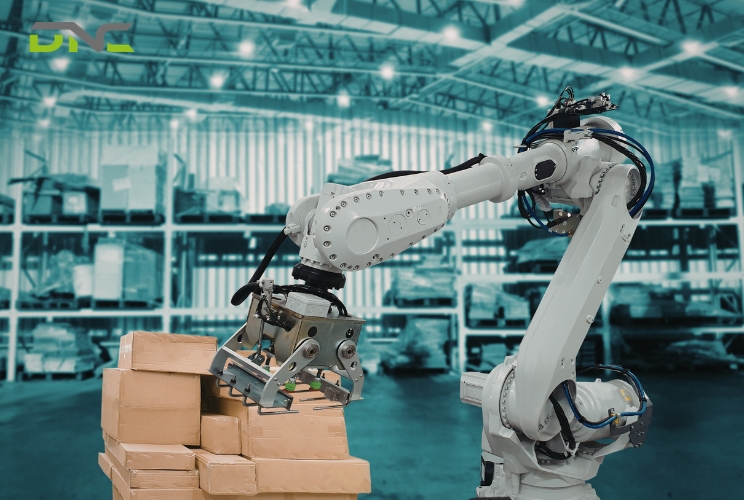
Robotic palletizing systems use industrial articulated robots — 4-axis and 6-axis arms from Comau, FANUC, ABB, and KUKA — to pick products from production lines and stack them onto pallets at speeds of 8–30 cases per minute with payloads ranging from 20 kg to 700 kg. These systems replace 4–8 manual workers per shift, reduce stacking errors by up to 80%, and operate continuously across three shifts without fatigue-related quality degradation. For Malaysian manufacturers contending with persistent labour shortages, the RM 1,500 minimum wage, and NIMP 2030 automation targets, a robotic palletizing system delivers measurable ROI within 12–24 months through direct labour savings, throughput gains, and reduced product damage. DNC Automation — Comau’s exclusive Southeast Asia robotics partner with 20+ years of integration experience and 35+ engineers — designs, builds, and commissions robotic palletizing systems across F&B, pharmaceutical, chemical, and general manufacturing sectors in Malaysia.
What Is a Robotic Palletizing System?
A robotic palletizing system is an automated end-of-line solution that uses one or more industrial articulated robot arms equipped with custom end-of-arm tooling (EOAT) to pick individual products or product groups from conveyor infeed lines and place them onto pallets in pre-programmed stacking patterns. The system encompasses the robot itself, the EOAT, infeed conveyors, pallet dispensers, safety fencing, PLC controls, and pattern-generation software — all integrated into a single coordinated cell.
Robotic palletizing differs fundamentally from conventional mechanical palletizers (which use sweeps, layer-forming tables, and elevators) and from cobot palletizers (which use lightweight, force-limited collaborative arms). The industrial robotic palletizing system occupies the performance middle ground: faster and more flexible than cobots, more adaptable to product changes than conventional machines.
The core advantage of a robotic palletizing system lies in multi-SKU flexibility. A single robot can handle 10–50 different product types — cartons, bags, pails, bottles, shrink bundles, trays — by switching stacking patterns through software alone, without any mechanical changeover. This flexibility makes robotic palletizing the default choice for Malaysian manufacturers running mixed-product lines where changeover frequency has historically created bottlenecks.
Robotic palletizing systems operate within safety-fenced cells compliant with ISO 13849 and ISO 10218, ensuring operator protection while the robot moves at full industrial speed. DNC Automation integrates Comau robots with proprietary EOAT designs, PLC-based cell controllers, and vision systems to deliver turnkey robotic palletizing systems tailored to each client’s product mix, throughput targets, and facility constraints.
How Does a Robotic Palletizing System Work?
Product Infeed and Detection
Every robotic palletizing system begins with product infeed. Products arrive on conveyors from upstream packaging — case packers, shrink wrappers, bag sealers, or filling lines. Photoelectric sensors and encoders detect product presence, measure spacing, and communicate position data to the robot controller. In high-speed applications (20+ cases per minute), the infeed conveyor incorporates accumulation zones to buffer products and prevent starvation or overfeeding of the robot cell.
Barcode scanners or vision cameras mounted above the infeed identify product SKU, orientation, and quality. This data feeds the palletizing software, which selects the correct stacking pattern and EOAT configuration for each product type — enabling automatic changeover without operator intervention.
Robot Pick Operation
The articulated robot arm — mounted on a rigid steel pedestal within the safety cell — receives pick coordinates from the cell controller. The robot accelerates to the pick position, the EOAT engages the product (vacuum suction, mechanical clamp, or fork lift), the robot confirms grip through pressure or proximity sensors, and the arm retracts to a safe transit height.
Four-axis robots (SCARA-type palletizing arms) execute pick-and-place in four degrees of freedom: X, Y, Z translation plus wrist rotation. These robots handle standard palletizing tasks — uniform cartons, bags, and bundles — at maximum speed. Six-axis robots add two additional rotation axes, enabling complex product reorientation mid-cycle: rotating products 90° or 180° for interlocked patterns, tilting for angled placement, or reaching around obstacles in tight cell layouts.
Pattern Execution and Layer Building
Robotic palletizing software calculates the optimal placement sequence for each layer based on the pallet footprint (1,000 × 1,200 mm standard Malaysian pallet or 1,016 × 1,219 mm export pallet), product dimensions, weight, and stack stability requirements. The software generates patterns including:
- Column stack patterns — identical orientation every layer, fastest cycle but lower stability
- Interlocked patterns — alternating 90° rotation between layers, standard for F&B cartons
- Pinwheel patterns — rotational symmetry within each layer, used for asymmetric products
- Mixed-SKU patterns — different products within one pallet, common in retail distribution
The robot places products one at a time (single-pick) or in groups of 2–4 (multi-pick with wide EOAT), building each layer according to the programmed pattern. Layer sheet insertion — placing cardboard or plastic separators between layers — integrates into the cycle as an additional pick-and-place step using a dedicated sheet dispenser.
Pallet Handling and Discharge
Pallet dispensers automatically feed empty pallets from a stack of 10–15 pallets positioned within the robot’s reach. When one pallet is full (typically 5–12 layers high, 1,000–1,800 mm stack height), the robot signals completion. The pallet conveyor or turntable discharges the full pallet to a stretch wrapper or forklift pickup zone, and a new empty pallet moves into position — maintaining continuous operation.
In multi-line configurations, one robot serves 2–4 infeed conveyors simultaneously, picking from whichever line has products ready. This multi-line serving maximises robot utilisation — typically achieving 85–95% uptime compared to 60–70% for single-line configurations.
Safety and Control Architecture
Safety fencing surrounds the robotic palletizing cell, with interlocked access gates per ISO 13849 Performance Level d (PLd). Light curtains at pallet entry/exit points allow conveyor throughput while detecting human intrusion. The safety PLC monitors all interlocks and triggers a controlled stop if any perimeter is breached.
The cell controller — typically a Siemens S7-1500 or Allen-Bradley ControlLogix PLC — coordinates the robot, conveyors, sensors, pallet dispenser, and safety system. HMI touchscreens provide operators with pattern selection, production counters, alarm management, and diagnostic screens. DNC Automation programs every cell controller to integrate with the factory’s existing SCADA or MES systems for production data logging and OEE tracking.
Understanding the operating cycle of a robotic palletizing system establishes the foundation for comparing the different robot types available for palletizing applications.
Types of Robotic Palletizing Systems
4-Axis Palletizing Robot Systems
Four-axis palletizing robots are purpose-built for palletizing — and palletizing only. Their kinematic structure (base rotation, shoulder, elbow, wrist rotation) provides the four degrees of freedom needed for standard pick-and-place: reach to infeed, pick product, move to pallet position, place product, and rotate wrist for pattern orientation.
Key specifications:
- Payload: 20–700 kg (Comau PAL 180 handles 180 kg; FANUC M-410iC/700 handles 700 kg)
- Reach: 2,500–3,300 mm
- Speed: 12–30 cases per minute (single-pick)
- Repeatability: ±0.5 mm
Four-axis robots dominate high-speed, high-volume palletizing lines where product variety is moderate and products do not require complex reorientation. Their simpler kinematics mean lower acquisition cost (RM 250,000–600,000 for the robot alone), faster cycle times, and lower maintenance compared to 6-axis alternatives.
6-Axis Articulated Robot Systems
Six-axis robots provide full spatial freedom — reaching any point in their work envelope at any orientation. This capability unlocks applications that 4-axis robots cannot handle: products requiring 180° inversion, palletizing from floor-level infeed to overhead pallet positions, or reaching around physical obstacles in constrained cell layouts.
Key specifications:
- Payload: 20–500 kg (Comau NJ 220; ABB IRB 660; KUKA KR QUANTEC PA)
- Reach: 2,500–3,500 mm
- Speed: 8–25 cases per minute
- Repeatability: ±0.1 mm
- Axes: 6 (base, shoulder, elbow, wrist pitch, wrist yaw, wrist roll)
Six-axis robotic palletizing systems cost 15–30% more than equivalent 4-axis systems (RM 300,000–800,000 for the robot alone) due to the additional servo motors, reducers, and control complexity. DNC Automation specifies 6-axis Comau robots when applications require multi-angle product handling, dual-cell configurations, or future flexibility for non-palletizing tasks (machine tending, case packing).
Multi-Robot Palletizing Cells
Multi-robot palletizing cells deploy 2–4 robots within a single safety-fenced enclosure, serving 4–8 production lines simultaneously. Each robot handles designated infeed lines, with intelligent load-balancing software redistributing work when one line runs faster than others.
Key specifications:
- Throughput: 30–80+ cases per minute (combined)
- Footprint: 8×10 m to 12×15 m
- Investment: RM 800,000–2,500,000 (complete cell)
Multi-robot cells suit high-volume Malaysian F&B plants — beverage bottling, instant noodle packaging, cooking oil filling — where multiple packaging lines converge at the palletizing stage. DNC Automation has deployed multi-robot Comau cells handling 6 infeed lines with 3 robots, achieving combined throughput of 60 cases per minute with 92% uptime.
Vision-Guided Robotic Palletizing Systems
Vision-guided systems add 2D or 3D camera systems to the robotic palletizing cell, enabling the robot to detect product position, orientation, and condition without fixed mechanical guides. The vision system captures images of products on the infeed conveyor, calculates precise pick coordinates, and transmits them to the robot controller in real time.
Key applications:
- Random product arrival (non-indexed conveyors)
- Mixed-SKU infeed with automatic product identification
- Quality inspection before palletizing (reject damaged products)
- De-palletizing (picking products from incoming pallets)
Vision-guided robotic palletizing systems add RM 50,000–150,000 to the cell cost but eliminate the need for precise mechanical product alignment — reducing infeed conveyor complexity and enabling faster line changeovers.
Each robot type addresses different production scenarios, and the choice between them depends on the specific components that make up the complete system.
Key Components of a Robotic Palletizing System
Industrial Robot Arm
The robot arm is the central motion element — an articulated manipulator with 4 or 6 axes, servo-driven joints, and a wrist flange for EOAT mounting. Leading palletizing robot manufacturers include Comau (PAL series, NJ series), FANUC (M-410iC, R-2000iC), ABB (IRB 660, IRB 760), KUKA (KR QUANTEC PA), and Yaskawa (MPL series). Robot selection depends on payload requirement, reach envelope, cycle speed, and protection class (IP65 minimum for dusty environments, IP67 for washdown).
End-of-Arm Tooling (EOAT)
End-of-arm tooling is arguably the most critical component — the interface between robot and product. EOAT types include vacuum grippers (for cartons, shrink bundles, flat-top products), mechanical clamp grippers (for bags, irregular shapes), fork/shovel tools (for heavy bags, unstable products), and magnetic grippers (for ferrous containers). DNC Automation custom-designs every EOAT in-house, using 3D CAD simulation to verify grip reliability before fabrication. A well-designed EOAT accounts for 30–40% of system reliability.
Infeed Conveyor System
Infeed conveyors transport products from the packaging line to the robot pick zone. These include belt conveyors, roller conveyors, or accumulation conveyors with sensor-controlled spacing. The infeed design must match the robot’s cycle time — delivering products at a rate the robot can sustain without starvation or overflow.
Pallet Dispenser and Discharge System
Pallet dispensers store 10–15 empty pallets in a magazine and feed them one at a time into the palletizing position. Discharge systems — powered roller conveyors, chain conveyors, or turntables — move full pallets out of the cell to stretch wrapping or pickup zones. Automated pallet handling eliminates forklift entry into the robot cell, maintaining safety and cycle continuity.
Safety Fencing and Control System
Safety fencing (welded mesh panels, typically 2,100 mm high) encloses the robot cell with interlocked access gates. The safety-rated PLC (Siemens F-CPU or equivalent) monitors all interlocks, light curtains, and emergency stops per ISO 13849 PLd. The cell controller PLC coordinates all components — robot, conveyors, dispenser, EOAT, and safety system — through industrial Ethernet (PROFINET or EtherNet/IP).
These components come together in complete systems deployed across Malaysian manufacturing facilities, where industry-specific requirements shape system configuration.
Applications of Robotic Palletizing Systems in Malaysian Manufacturing
Food and Beverage Industry
F&B manufacturers represent the largest robotic palletizing market in Malaysia. Beverage plants (F&N, Fraser & Neave, Spritzer, Coca-Cola Malaysia) palletize shrink-wrapped bottle bundles, cartons, and cans at 15–25 cases per minute per robot. Instant noodle manufacturers (Mamee, Maggi) handle lightweight cartons at high speeds. Cooking oil producers palletize 5-litre jerrycans and 1-litre bottle packs with vacuum EOAT.
Robotic palletizing systems in Malaysian F&B operations typically handle 8–12 SKUs per line, with software changeover completing in under 30 seconds. Hygienic requirements demand stainless steel EOAT, IP65-rated robots, and washdown-compatible cell construction. DNC Automation has integrated Comau palletizing cells in Malaysian F&B plants achieving 20+ cases per minute with 94% uptime.
Pharmaceutical and Medical Products
Pharmaceutical palletizing demands precision, traceability, and gentle handling. Robotic palletizing systems pick individual cartons from serialisation-equipped lines, verify barcodes via integrated vision, and place products in validated stacking patterns. Payload requirements are modest (5–30 kg per pick) but placement accuracy must achieve ±1 mm to maintain carton integrity and barcode readability for track-and-trace compliance.
Malaysian pharmaceutical manufacturers (Duopharma, CCM Pharmaceuticals, Hovid) investing in robotic palletizing cite GMP compliance and serialisation integration as primary drivers — beyond the standard labour savings.
Chemical and Petrochemical Industry
Chemical palletizing handles heavy, hazardous products: 25–50 kg bags of chemical powders, 200-litre drums of solvents, 20-litre pails of adhesives. Robotic palletizing systems in chemical plants require ATEX-rated robots (explosion-proof) or at minimum IP67 protection with chemical-resistant EOAT materials (HDPE, stainless steel 316, PTFE coatings).
Malaysian chemical manufacturers in Pasir Gudang, Gebeng, and Tanjung Langsat industrial zones deploy robotic palletizing to eliminate worker exposure to hazardous materials during manual stacking — addressing DOSH (Department of Occupational Safety and Health) compliance requirements alongside productivity goals.
Building Materials and Cement
Cement bags (50 kg), tile adhesive bags (25–40 kg), and morite bags require robust palletizing at 10–15 bags per minute. Four-axis robots with fork or clamp EOAT dominate this application. The dusty environment demands IP67-rated robots with positive-pressure cabinets for controllers. Malaysian cement producers (CIMA, YTL Cement, Lafarge Malaysia) automate bag palletizing to address the severe labour shortage in physically demanding stacking roles.
Consumer Goods and FMCG
Consumer goods manufacturers — detergent, personal care, household products — palletize mixed-SKU loads for retail distribution. Robotic palletizing systems build rainbow pallets (multiple product types on one pallet) for direct-to-store delivery, eliminating distribution centre re-palletizing. This application leverages the robot’s software-driven pattern flexibility to handle 20–50 SKUs on a single line.
The benefits that these Malaysian manufacturers realise from robotic palletizing systems extend across operational, financial, and workforce dimensions.
Benefits of a Robotic Palletizing System
Labour cost reduction stands as the primary financial driver. A robotic palletizing system replaces 4–8 manual palletizers per shift. At Malaysia’s RM 1,500 minimum wage plus EPF, SOCSO, and overtime, each manual worker costs approximately RM 2,500–3,000 per month fully loaded. Replacing 6 workers across 3 shifts (18 positions) saves RM 45,000–54,000 monthly — RM 540,000–648,000 annually.
Throughput consistency eliminates the productivity variance inherent in manual palletizing. Robots maintain 8–30 cases per minute continuously, every shift, every day. Manual palletizers typically achieve 4–8 cases per minute with declining output through each shift. This consistency translates to 50–100% throughput increase on lines previously bottlenecked by manual palletizing.
Product damage reduction saves 2–5% of product value lost to manual stacking errors — dropped cartons, misaligned layers, crushed products, and unstable pallet loads. Robotic precision (±0.5 mm placement) produces consistently square, stable pallet loads that survive transport without shift or collapse.
Workplace safety improvement removes workers from repetitive heavy lifting — the leading cause of musculoskeletal injuries in Malaysian packaging operations. Eliminating manual palletizing of 25–50 kg products directly reduces SOCSO claims, medical leave costs, and DOSH compliance risk.
Multi-SKU flexibility enables manufacturers to run more product variants without proportional labour increases. Software pattern changes take 10–30 seconds compared to 15–30 minutes for mechanical changeover on conventional palletizers.
24/7 operation capability means the robotic palletizing system runs three shifts without additional headcount, overtime premiums, or shift-change productivity losses.
These benefits materialise fully only when the system is correctly specified for the application — making the selection process a critical investment decision.
How to Choose a Robotic Palletizing System
Define Throughput Requirements
Throughput specification begins with cases per minute — the primary determinant of robot selection. Measure the peak output rate of each production line feeding the palletizing cell, add 15–20% buffer for future capacity, and specify accordingly. A single 4-axis robot handles 12–30 cases per minute; multi-robot cells extend to 80+ cases per minute.
Match Payload to Product Range
Payload capacity must accommodate the heaviest product in the product mix — including the EOAT weight. If the heaviest product weighs 30 kg and the EOAT weighs 25 kg, the robot needs minimum 55 kg payload capacity. Specify for the worst case, not the average.
Evaluate Product Variety and Changeover Frequency
Product variety determines whether a 4-axis or 6-axis robot is required and shapes the EOAT design. Lines running 1–5 similar products suit 4-axis robots with fixed EOAT. Lines running 10–50 diverse products may require 6-axis robots with quick-change EOAT adapters.
Assess Floor Space and Cell Layout
Robotic palletizing cells range from 4×5 m (single robot, single line) to 12×15 m (multi-robot, multi-line). Measure the available floor area including safety zone clearances (minimum 500 mm from fencing to any obstruction). DNC Automation conducts facility surveys and produces 3D cell layouts before quotation to verify spatial feasibility.
Calculate ROI and Payback Period
Total investment for a robotic palletizing system in Malaysia ranges from RM 400,000 for a basic single-robot cell to RM 1,500,000+ for multi-robot, multi-line configurations. Calculate payback by dividing total investment by annual savings (labour + damage reduction + throughput value). Typical payback periods: 12–24 months for high-volume lines, 18–30 months for moderate-volume applications.
Select an Experienced System Integrator
System integrator capability determines whether the robotic palletizing system achieves its performance targets. Evaluate track record in your industry, robot brand partnerships (OEM-level access to support and spare parts), in-house EOAT design capability, and post-commissioning service infrastructure. DNC Automation’s 25,000 sq ft facility, ISO 9001:2015 certification, and Comau exclusive partnership ensure full lifecycle support from concept through commissioning and preventive maintenance.
Choosing the right system raises practical questions that Malaysian manufacturers commonly ask — addressed in the following section.
Frequently Asked Questions About Robotic Palletizing Systems
What is the typical cost of a robotic palletizing system in Malaysia?
A complete robotic palletizing system in Malaysia costs between RM 400,000 and RM 1,500,000 depending on configuration. A single 4-axis robot cell with one infeed line, standard EOAT, pallet dispenser, and safety fencing starts at approximately RM 400,000–600,000. A 6-axis robot cell with vision guidance, multi-line infeed, and advanced EOAT ranges from RM 600,000–900,000. Multi-robot cells serving 4–8 lines reach RM 1,000,000–1,500,000 or more. These costs include design, fabrication, installation, commissioning, and operator training. DNC Automation provides detailed quotations after facility surveys and product testing.
How many cases per minute can a robotic palletizing system handle?
Robotic palletizing systems handle 8–30 cases per minute per robot, depending on product weight, pick complexity, and cycle distance. Lightweight cartons (under 10 kg) achieve 20–30 cases per minute with 4-axis robots. Heavy bags or pails (25–50 kg) reduce speed to 8–15 cases per minute. Multi-pick EOAT that grabs 2–4 products simultaneously can increase effective throughput to 40+ cases per minute equivalent. Multi-robot cells achieve combined throughput exceeding 80 cases per minute.
How does a robotic palletizing system differ from a cobot palletizer?
Robotic palletizing systems use full-speed industrial robots (4-axis or 6-axis) inside safety-fenced cells, handling payloads of 20–700 kg at 8–30 cases per minute. Cobot palletizers use force-limited collaborative robots (5–30 kg payload) at 5–15 cycles per minute without safety fencing. Robotic systems cost RM 400,000–1,500,000; cobots cost RM 150,000–500,000. Choose robotic palletizing for high throughput, heavy products, and multi-line operations. Choose cobots for low-volume lines, space-constrained areas, and SME budgets. DNC Automation integrates both — Comau robots and Doosan cobots — and recommends based on application requirements.
What products can a robotic palletizing system handle?
Robotic palletizing systems handle virtually any unitised product: cardboard cartons, shrink-wrapped bundles, bags (pillow, gusseted, valve), pails, drums, bottles, cans, trays, and bales. The EOAT design determines product compatibility — vacuum grippers for flat-top products, clamp grippers for bags and irregular shapes, fork tools for heavy or unstable products, and magnetic grippers for ferrous containers. DNC Automation tests every product on the proposed EOAT design during the engineering phase to verify reliable grip before system fabrication.
What maintenance does a robotic palletizing system require?
Robotic palletizing system maintenance follows the robot manufacturer’s preventive maintenance schedule — typically every 5,000–10,000 operating hours. Maintenance tasks include servo motor greasing, reducer oil changes, cable harness inspection, brake testing, and calibration verification. EOAT maintenance (vacuum cup replacement, clamp pad replacement, sensor cleaning) occurs more frequently — monthly or quarterly depending on product abrasiveness. Total annual maintenance cost runs RM 15,000–40,000 including parts and service labour. DNC Automation offers preventive maintenance contracts covering robots, EOAT, conveyors, and controls.
What is the expected lifespan of a robotic palletizing system?
Industrial palletizing robots deliver 50,000–100,000 operating hours before major overhaul — equivalent to 8–15 years at typical utilisation rates. The EOAT lifespan depends on product type and environment: vacuum cups last 6–12 months, clamp pads 12–24 months, and structural frames 5–10 years with proper maintenance. Conveyors, pallet dispensers, and safety systems match or exceed the robot’s lifespan. The most common upgrade trigger is not mechanical failure but capacity expansion or product line changes requiring different EOAT or additional robots.
Can one robotic palletizing system serve multiple production lines?
One robot can serve 2–4 production lines simultaneously through multi-line cell configurations. The robot alternates picks between infeed conveyors based on product availability, with accumulation conveyors buffering products when the robot is serving another line. Multi-line configurations maximise robot utilisation (85–95% vs 60–70% for single-line) and reduce per-line investment cost. DNC Automation designs multi-line cells using simulation software to verify that combined throughput targets are achievable before commitment.
Is a robotic palletizing system suitable for halal-certified production?
Robotic palletizing systems fully support halal-certified production environments. The robot and EOAT materials (stainless steel, food-grade silicone, FDA-compliant vacuum cups) meet halal manufacturing requirements. The enclosed safety cell prevents foreign material contamination. Automated palletizing eliminates human contact with products after packaging — a significant halal compliance advantage. Malaysian halal F&B manufacturers increasingly specify robotic palletizing as part of their halal assurance programme.
Conclusion
Robotic palletizing systems deliver the throughput, flexibility, and reliability that Malaysian manufacturers need to compete under NIMP 2030 automation mandates, rising labour costs, and persistent workforce shortages. Whether the application demands a single 4-axis robot handling cartons at 25 cases per minute or a multi-robot cell serving six production lines, the technology is mature, proven, and financially justified within 12–24 months for most Malaysian manufacturing operations. DNC Automation, as Comau’s exclusive Southeast Asia robotics partner, provides end-to-end robotic palletizing solutions — from feasibility study and 3D cell design through fabrication, commissioning, and long-term maintenance support.
Get a Free Consultation — Talk to our engineers about your palletizing requirements. Call DNC Automation or visit [dnc-automation.com](https://dnc-automation.com) to schedule a facility assessment and receive a detailed proposal tailored to your production lines, product mix, and throughput targets.
- 4 views
- 0 Comment
Recent Comments