


Warehouse Conveyor Systems: Types, Benefits, Costs, and Trusted Providers

Warehouse conveyor systems are mechanised material handling systems that transport goods — pallets, cartons, totes, or individual items — along defined paths within a warehouse or distribution centre. They form the physical backbone that connects receiving docks, storage systems (ASRS), picking stations, packing areas, and shipping docks into a continuous, automated flow.
In Malaysian warehouse automation, conveyor systems are rarely installed in isolation. They are the integration layer that binds ASRS storage, robotic picking, sortation, and dock management into a single coordinated system — enabling throughput levels that no amount of forklift and manual handling can match.
DNC Automation designs, supplies, and installs warehouse conveyor systems as standalone projects and as integral components of complete warehouse automation solutions for Malaysian manufacturers and distributors.
Types of Warehouse Conveyor Systems
Roller Conveyor
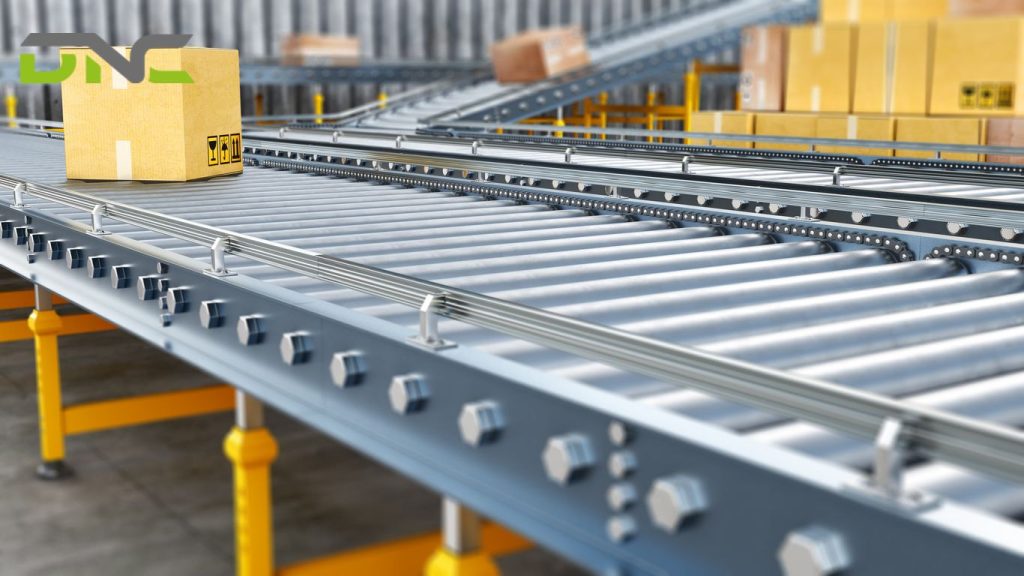
Roller conveyors use a series of cylindrical rollers mounted on a frame to support and transport cartons, totes, or pallets. Rollers may be gravity-fed (inclined, no drive) or powered (motorised drive).
Motorised Driven Rollers (MDR): Each zone of MDR conveyor is independently driven by a small motor inside one of the rollers. Zones activate only when a product is present — reducing energy consumption by 50–70% compared to belt conveyors and providing inherent product accumulation capability.
Applications: Carton and tote transport between ASRS stations, picking workstations, and pack lanes. The primary workhorse conveyor in Malaysian distribution centres.
Belt Conveyor
Belt conveyors use a continuous belt surface moving over rollers. They handle items that would not sit stably on rollers — irregular shapes, small parcels, polybags — and provide smooth, vibration-free transport for fragile items.
Applications: Parcel and small-item transport, incline and decline between floor levels, sortation infeeds and takeaways.

Pallet Conveyor
Pallet conveyors handle full pallets weighing 500–2,000 kg. Types include:
- Chain pallet conveyor: Two parallel chains with pallet-width spacing carry pallets between ASRS crane positions and truck loading docks
- Roller pallet conveyor: Heavy-duty powered rollers rated for pallet loads
- Lift/lower: Vertical pallet transfer between floor levels
Pallet conveyors are integral to unit load ASRS systems — connecting the crane outfeed to the palletising area, shrink-wrap station, and shipping dock.
Overhead Conveyor
Overhead conveyors hang from ceiling-mounted tracks, freeing floor space below. Used for:
- Garment conveyors in textile and fashion distribution
- Tote conveyors above aisles in pharmacy and cosmetics warehouses
- Production sub-assembly transport in manufacturing plants

Sortation Conveyor
Sortation conveyors divert items to specific destinations based on barcode scan or RFID read at an identification point. Types:
Cross-belt sorter: Individual carrier units, each with a small belt conveyor, divert items by running their belt transversely. The highest-speed and most gentle sortation technology — suitable for fragile items and high throughput (10,000–20,000 items/hour).
Sliding shoe sorter: Array of small plastic shoes embedded in the belt surface slide diagonally to push items off the belt into chutes or lanes. High speed (8,000–15,000 items/hour) and robust for cartons.
Tilt tray sorter: Trays mounted on a carousel tilt to deposit items. Suited to small parcels and polybags in parcel hubs.
Pop-up divert: A small section of the conveyor rises or pivots to redirect items to a side lane. Lower cost for low-throughput divert applications.
Warehouse Conveyor System Design
Designing a warehouse conveyor system requires analysis of:
Throughput Requirements
The maximum number of items (cartons, totes, or pallets) that must transit the conveyor per hour at peak demand determines conveyor speed, width, and sortation capacity. DNC Automation models peak throughput based on your order profile and designs systems with 20–30% headroom above peak.
Item Profile
Conveyor specification depends on what is being transported:
- Weight: Conveyor frame, drive capacity, and bearing selection
- Dimensions: Belt or roller width, surface type (to prevent items falling between rollers)
- Packaging type: Polybags require belt; cartons can use rollers; pallets require pallet-specific equipment
- Fragility: Fragile items require belt conveyors with gentle acceleration/deceleration
Conveyor Layout
The physical layout of the warehouse — column locations, dock positions, ASRS crane positions, mezzanine levels — defines the conveyor routing. DNC’s engineers produce 2D and 3D layout designs that optimise conveyor routing within building constraints.
Integration with ASRS
When conveyor systems connect to ASRS, the interface points must be designed precisely:
- Crane outfeed conveyor position and height must align with the crane’s pallet handling mechanism
- Conveyor speed must match ASRS throughput to avoid accumulation or starvation
- Control system handshake (ASRS WCS to conveyor PLC) must be specified in the interface design
DNC Automation manages the full ASRS-conveyor interface as the single system integrator, eliminating the coordination risk of separate ASRS and conveyor vendors.
Barcode and RFID Identification
Every item entering the conveyor system must be identified — by barcode scan (1D, 2D, or RFID) — at the induction point. The WMS assigns the item to its outbound destination; the conveyor control system routes it accordingly.
Identification stations include:
- Fixed-beam barcode scanners for cartons with consistent label placement
- Multi-sided scanner tunnels (5-sided or 6-sided) for cartons with variable label orientation
- RFID gates for pallets with RFID tags

Warehouse Conveyor Systems and ASRS Integration
Conveyor systems are most powerful when integrated with ASRS — together they form a continuous automated flow from receiving to shipping:
Inbound Flow (Receiving → ASRS)
- Pallets or cartons arrive at receiving dock
- Operator places goods on conveyor infeed
- Barcode/RFID scan identifies the item and confirms putaway instruction from WMS
- Conveyor transports goods to ASRS crane interface
- ASRS crane receives pallet and stores at assigned location
Outbound Flow (ASRS → Shipping)
- WMS releases outbound order to ASRS
- ASRS crane retrieves pallet/tote and deposits on outfeed conveyor
- Conveyor transports to picking or packing station (with identification and order assignment)
- At picking station, items are picked, confirmed, and packed
- Packed cartons are inducted to sortation conveyor
- Sortation identifies cartons and diverts to assigned shipping lane
- Cartons accumulate in shipping lane for truck loading
Goods-to-Person Integration
When ASRS connects to goods-to-person picking workstations via conveyor:
- The WCS sequences tote or carton delivery from ASRS to workstations in pick-wave order
- Conveyors run at speeds matched to picking throughput to avoid workstation starvation
- Return conveyors carry picked totes back to ASRS for storage
DNC Automation designs the complete flow — ASRS crane, conveyor routing, workstation layout, and software sequence — as an integrated system.
Conveyor Systems for Cold Storage
Conveyor systems in cold storage (chilled 2–8°C, frozen -20°C to -25°C) require:
Cold-rated components: Stainless steel frames for washdown zones, cold-grade lubricants in bearings and gearboxes, cold-rated motor windings, and heating elements in electrical enclosures to prevent moisture condensation.
Defrost compatibility: Conveyor frames and drives must be designed for regular defrost cycles without damage to electrical or mechanical components.
Hygiene design: In food production and distribution environments, conveyor surfaces and frames must be cleanable without water ingress into drives and bearings. IP65 or IP69K protection ratings for motors and electrical components.
HACCP compliance: Conveyor design must avoid product contamination risks — no overhead lubrication points above product, no rust-prone components in food contact zones, cleanable frame profiles with no internal cavities.
DNC Automation designs and supplies cold storage conveyor systems for Malaysian frozen food and pharmaceutical cold chain customers, with full compliance to Malaysian food safety and pharmaceutical GDP requirements.
Conveyor System Maintenance
Preventive Maintenance Schedule
A well-maintained warehouse conveyor system achieves 99%+ mechanical uptime. DNC Automation’s recommended preventive maintenance programme:
| Frequency | Tasks |
| Daily | Visual inspection of belt tracking, roller condition, accumulation zones |
| Weekly | Lubrication of chain drives and bearings, drive belt tension check |
| Monthly | Gearbox oil level, motor temperature check, sensor calibration verification |
| Quarterly | Drive belt replacement (high-wear zones), full chain tension survey |
| Annual | Full mechanical inspection, conveyor alignment survey, electrical insulation test |
IoT-Enabled Conveyor Monitoring
DNC Automation integrates vibration and temperature sensors on conveyor drives and gearboxes, feeding data to the warehouse SCADA system. Trend monitoring detects bearing wear and overloading before failure, enabling predictive maintenance scheduling instead of reactive repair.
Spare Parts Management
DNC maintains a local spare parts inventory for all conveyor brands it supplies, with critical spare parts (MDR rollers, drive belts, sensors, gearboxes) held at DNC’s Malaysian warehouse for next-day delivery to customer sites.
Conveyor System ROI
A Malaysian FMCG distributor replacing a manual carton-handling operation with an integrated conveyor and sortation system:
Before:
- 12 operators manually handling cartons between receiving, storage, picking, and shipping
- Throughput: 600 cartons/hour peak
- Sorting error rate: 1.8%
After:
- 4 operators (system operation and induction) + 2 maintenance
- Throughput: 4,000 cartons/hour
- Sorting accuracy: 99.99%
Annual savings:
- Labour (8 operators × 2 shifts): RM 576,000
- Sorting error reduction: RM 180,000
- Overtime elimination: RM 120,000
- Total saving: RM 876,000/year
Investment: RM 2.8M (conveyor + sortation + controls)
Payback: 3.2 years
DNC Automation’s Conveyor System Services
DNC Automation Malaysia delivers complete conveyor system projects:
Concept design: Throughput analysis, item profile assessment, and conveyor system concept with preliminary layout.
Detailed engineering: Full conveyor design, electrical design, PLC programming specification, and ASRS integration interface design.
Supply and installation: Equipment procurement, mechanical installation, electrical connection, and commissioning.
WMS integration: Barcode/RFID identification station integration with WMS for product routing and inventory confirmation.
Maintenance contracts: Preventive maintenance programmes and emergency response SLAs for Malaysian customers.
Frequently Asked Questions
How long does conveyor system installation take?
A simple carton conveyor system in an existing warehouse installs in 4–8 weeks. A complete pallet conveyor and sortation system integrated with ASRS requires 12–20 weeks for installation and commissioning.
Can conveyors be installed in a running warehouse?
Yes, but requires careful planning. DNC Automation designs phased installation sequences that maintain warehouse operations during conveyor installation — typically using weekend or night-shift work windows for critical cutovers.
What is the energy consumption of a conveyor system?
MDR (motorised driven roller) conveyors consume 50–70% less energy than traditional belt conveyors because individual zones are only powered when a product is present. For a 500-metre conveyor system, MDR technology typically reduces energy cost by RM 80,000–150,000/year compared to belt conveyor.
Can existing conveyors be connected to a new ASRS?
Sometimes. DNC Automation evaluates existing conveyor capacity, height compatibility, and control system compatibility before recommending integration vs. replacement. Older conveyors with legacy PLC controls often require replacement of control systems to enable reliable ASRS integration.
Conclusion
Warehouse conveyor systems are the essential integration layer that transforms individual automation components — ASRS, picking systems, sortation — into a coordinated, high-throughput operational system. For Malaysian manufacturers and distributors, conveyor investment delivers compounding returns: each additional automation component connected to the conveyor network multiplies overall system efficiency.
DNC Automation Malaysia designs, supplies, and maintains complete warehouse conveyor systems — from simple carton lines to complex multi-level pallet conveyor and sortation installations — integrated with ASRS and WMS for complete warehouse automation.
Contact DNC Automation Malaysia to discuss conveyor system design for your warehouse or distribution centre.
Warehouse Conveyor Systems: Industry-Specific Configurations
Food and Beverage Conveyor Systems
Malaysian F&B manufacturing requires conveyor systems designed for hygiene and food safety compliance:
Washdown-rated equipment: Stainless steel conveyor frames, IP69K motors, and cleanroom-grade belts that withstand high-pressure hot water cleaning (80°C, >100 bar) without structural or electrical damage.
HACCP compliance: No overhead lubrication points above product flow paths. No internal cavities that trap food particles. All surfaces slope to drain (no pooling). Frame profiles easy to disassemble for deep cleaning.
Allergen zoning: Conveyor layout separates allergen-containing products from allergen-free zones, with physical barriers or dedicated conveyor lanes per allergen category. JAKIM halal certification requires similar segregation for halal/non-halal production.
Metal detection integration: In-line metal detectors positioned at critical control points (CCPs) on outbound conveyor, automatically diverting non-conforming product to a rejection lane. DNC integrates metal detector signals into the WMS for automatic lot rejection recording.
Pharmaceutical Conveyor Systems
GMP-compliant design: All surfaces in product contact zones are 316L stainless steel, crevice-free, electropolished. Conveyor design validated per ISPE Baseline Guide Volume 6 (pharmaceutical engineering).
Serialisation integration: Pharmaceutical serialisation systems (track-and-trace) require conveyor systems with precise speed control and consistent product spacing for camera-based barcode capture and rejection of unreadable codes.
Temperature-controlled zones: For cold chain pharmaceutical conveyors, insulated conveyor tunnels maintain product temperature during transfer between cold zones and ambient packing areas.
Automotive Conveyor Systems
Heavy load capacity: Automotive subassembly conveyors handle loads of 200–2,000 kg per carrier — far exceeding standard carton conveyor ratings. Chain and slat conveyors with heavy-duty drives are standard.
Just-in-time sequencing: Automotive assembly requires parts to arrive in production sequence (not just the right part, but the right part at the right time in the right order). WMS-controlled conveyor sequencing buffers handle the reordering of incoming components to match the assembly line’s build sequence.
Traceability integration: Each production order is barcoded on a carrier. Conveyor scanners read the carrier barcode and report position in real time to the WMS, enabling production planners to monitor WIP flow through the facility.
Conveyor System Uptime and Business Continuity
Calculating the True Cost of Conveyor Downtime
In a warehouse where conveyor connects ASRS to shipping docks, conveyor downtime directly stops outbound shipments. The cost of one hour of conveyor downtime:
- Lost throughput: If the conveyor handles 2,000 cartons/hour and the selling margin per carton is RM 5, one hour of downtime costs RM 10,000 in delayed shipment opportunity
- Carrier penalty: Missing carrier loading deadlines triggers next-day redelivery surcharges (typically RM 500–2,000 per missed truck)
- Customer service: In B2B relationships, repeated late shipments trigger penalties or contract renegotiation
- Labour waste: Picking operators and dock staff are idle during conveyor downtime — their labour cost continues
For a 500-metre conveyor system handling 1,500 cartons/hour, the business case for a preventive maintenance contract (RM 80,000–150,000/year) vs. reactive maintenance (lower PM cost, but higher downtime risk) typically favours PM contracts by RM 200,000–400,000 over a 5-year period.
Redundancy Design
Critical conveyor routes — particularly the main outbound sortation line — should be designed with redundancy:
Bypass routing: Alternative conveyor paths that can carry full throughput if the primary route is down for maintenance. This is particularly important in 24/7 operations.
Manual bypass positions: Designated floor areas where goods can be staged manually if conveyor is completely stopped, allowing dock operations to continue (at reduced throughput) during extended conveyor downtime.
Spare drive units: Conveyor drive motors are standard industrial components with short lead times. Keeping one spare drive unit per conveyor line type (typically 1.5 kW and 5.5 kW are the most common) enables same-day repair of most drive faults.
Conveyor Systems and Malaysian Industry 4.0
Modern conveyor systems generate operational data that was previously unavailable — a valuable source of process intelligence:
Throughput analytics: Photocell sensors at key points count carton flow in real time. Comparison against planned throughput identifies bottlenecks immediately rather than in the end-of-day report.
Conveyor health monitoring: Current monitoring on drive motors detects belt slip, jams, and overloads that precede failure. DNC Automation’s SCADA integration captures this data continuously, with alerts triggered before operators notice a fault.
Order tracking: Each carton’s barcode is read at multiple points on the conveyor journey. This creates a complete transit record — when each order left the pick zone, when it was inducted to the sorter, when it was diverted to the shipping lane, when it was loaded. This data feeds WMS and supports proof-of-shipment documentation.
Energy metering: Smart metering on conveyor drives provides energy consumption data by zone and time period. Operations teams use this data to identify high-energy inefficiency periods (belt wear, overloading) and to optimise conveyor speed during off-peak periods (lower speed = lower energy).
Conclusion (Extended)
Warehouse conveyor systems are not commodity equipment — they are precision-engineered material handling solutions that must be matched to the specific product profile, throughput requirements, ASRS interface, and regulatory environment of each operation. In Malaysia’s manufacturing sector, where F&B, pharmaceutical, automotive, and electronics operations have very different conveyor requirements, this specificity is essential.
DNC Automation Malaysia designs, supplies, and maintains conveyor systems that integrate seamlessly with ASRS, WMS, and sortation into complete warehouse automation solutions. Our local engineering team, Malaysian regulatory expertise, and 24/7 maintenance support ensure Malaysian customers receive the reliability and performance their operations depend on.
Contact DNC Automation Malaysia to discuss conveyor system design and integration for your warehouse or manufacturing facility.
Conveyor System Specification: Technical Parameters for Malaysian Projects
Accurate technical specification before procurement prevents costly scope changes during installation. Malaysian procurement teams should understand the key parameters that drive conveyor system cost and capability.
Throughput Specification
Design throughput vs. peak throughput: Conveyors must be specified for peak throughput, not average throughput. A distribution centre averaging 1,000 cartons/hour but peaking at 2,500 cartons/hour during Hari Raya or year-end must be specified at 2,500 cartons/hour — with 20% design headroom (3,000 cartons/hour design point).
Throughput profile: Specify both inbound and outbound peak throughput separately — these often peak at different times of day.
Growth factor: Specify a growth factor for throughput increase over the system’s life (typically 15–20 years). A system designed at 110% of today’s peak may be at 80% capacity in 10 years. DNC Automation models throughput growth in the system design.
Carton Dimension and Weight Specification
Conveyor specification requires minimum and maximum dimensions:
- Minimum item: The smallest item the conveyor must transport (influences roller pitch — minimum item length must span 3 rollers)
- Maximum item: The largest item (influences conveyor width and frame strength)
- Maximum weight: Heaviest single item (influences roller and frame rating)
- Most common item: The item the conveyor handles 80% of the time — optimise for this, not for extremes
Speed Specification
Conveyor belt or roller speed must be matched to throughput requirement:
- Belt speed = throughput (items/hour) × item length (m) + minimum gap between items (0.2–0.3m)
- Example: 2,000 cartons/hour, average carton length 0.4m, gap 0.25m = (0.4 + 0.25) × 2,000/3,600 = 0.36 m/s
For sortation systems, conveyor speed must also match sortation device throughput capacity.
Control Architecture
Centralised PLC: One PLC controls all conveyor zones. Simpler to programme, single point of failure, limited scalability.
Distributed PLC (MDR): Each conveyor zone has an independent motor controller (typically IO-Link or EtherNet/IP). Zone failure does not stop the entire system. More complex to network but higher reliability.
DNC Automation recommends distributed MDR control architecture for all production conveyor systems serving ASRS — the reliability advantage outweighs the cost difference for systems where downtime is costly.
Conveyor Layout Optimisation: Reducing Travel Distance and Energy
Conveyor layout design directly affects both capital cost (total conveyor length) and operating cost (energy consumption × distance). DNC Automation’s layout optimisation approach:
Flow Path Analysis
Before designing conveyor layout, map all product flows in the warehouse:
- Receiving dock locations → ASRS inbound conveyor
- ASRS outbound conveyor → picking stations
- Picking stations → packing tables
- Packing tables → sortation conveyor
- Sortation → shipping lanes/dock doors
The optimal conveyor layout minimises total product travel distance while respecting building constraints (columns, doors, height restrictions).
Building Constraint Integration
Malaysian industrial buildings (typically 9–15 metre high, 24–30 metre bay width) impose specific layout constraints:
- Column spacing limits conveyor routing paths
- Dock door positions determine receiving and shipping conveyor endpoints
- Structural loads limit elevated conveyor routes (mezzanine conveyors require structural design)
DNC Automation’s engineers produce AutoCAD 2D and 3D layouts that show the conveyor routing within the building structure, verified against structural loads before installation.
Software-Based Layout Optimisation
For complex multi-route conveyor systems, DNC Automation uses discrete event simulation to model product flow through the proposed layout:
- Identify bottleneck conveyor sections under peak load
- Verify that accumulation zone capacity is sufficient to prevent back-pressure to ASRS
- Test alternative layouts to identify the lowest-cost configuration that meets throughput targets
Simulation-validated layouts reduce the risk of post-commissioning performance shortfalls that require expensive conveyor additions.
- 196 views
- 0 Comment
Recent Comments