

Warehouse Shuttle System | DNC Automation Malaysia
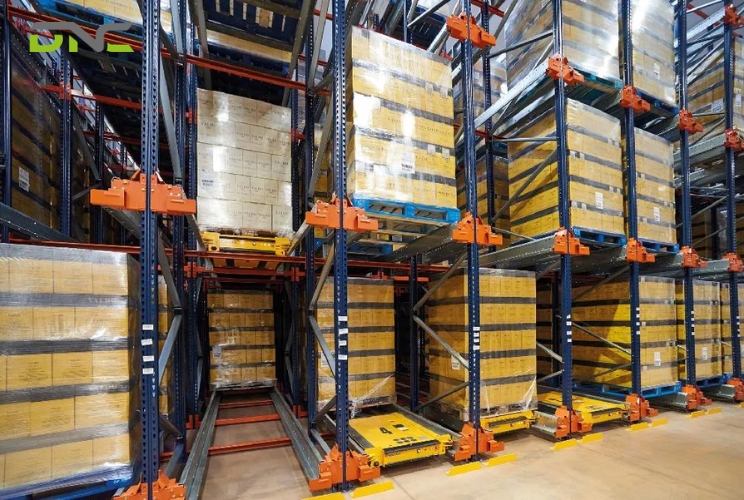
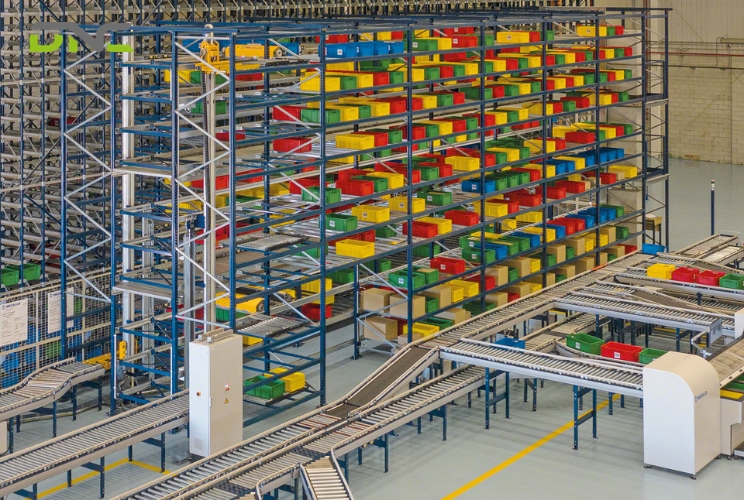
A warehouse shuttle system is an automated storage and retrieval mechanism in which battery-powered robotic shuttles travel on rails within racking lanes to store and retrieve pallets, totes, or cartons. Unlike stacker crane ASRS — where a single crane services an entire aisle — shuttle systems can deploy multiple shuttles simultaneously, achieving significantly higher throughput and offering better operational redundancy.
In Malaysia’s high-density manufacturing and cold storage sectors, warehouse shuttle systems have become the preferred ASRS architecture for operations requiring throughput rates above 200 pallet moves per hour or storage in deep-lane high-density configurations.
How a Warehouse Shuttle System Works
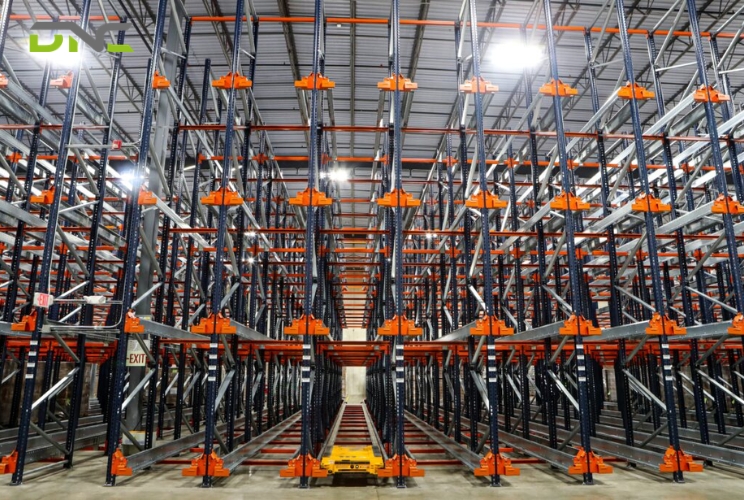
The shuttle system operates within a racking structure that defines storage lanes — rows of pallets stored end-to-end in channels extending 5–40 metres deep. A battery-powered shuttle vehicle enters a lane, travels to the target pallet position, and either deposits a new pallet or retrieves an existing one.
The operating cycle:
- WMS sends a storage or retrieval command to the shuttle system controller.
- The shuttle controller assigns the task to an available shuttle on the appropriate level.
- The shuttle enters the racking lane, travels to the target position (guided by lane rails and internal positioning sensors), and performs the storage or retrieval operation using an internal pallet lift mechanism.
- The pallet is transported to a conveyor or lift at the lane end, which connects to the outfeed conveyor system and shipping dock.
- The transaction is confirmed to the WMS, updating inventory location in real time.
The entire cycle — from task initiation to pallet delivery at the conveyor — typically takes 60–180 seconds depending on lane depth and shuttle speed.
Types of Warehouse Shuttle Systems
Single-Level Shuttle (Pallet Shuttle)
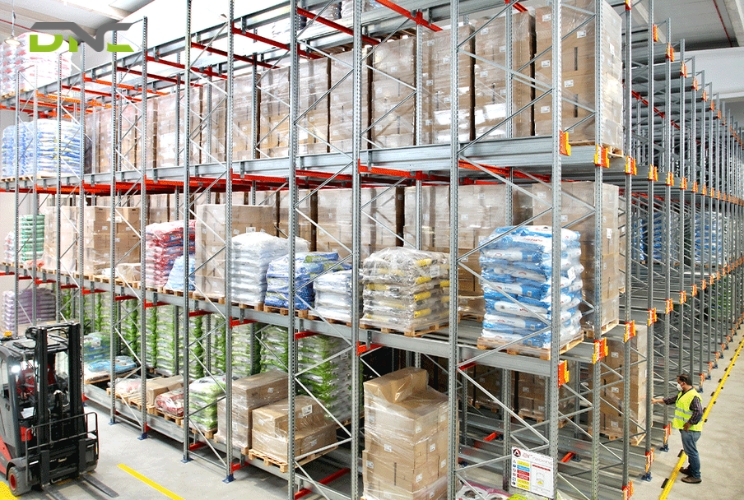
In a single-level configuration, one shuttle is assigned to each lane or serves a single level. The shuttle remains within its lane or level; a separate transfer vehicle (aisle crane or forklift) lifts the shuttle to the required level and transfers it between aisles.
Characteristics:
- Lower capital cost per lane
- Simple operation — shuttle management is straightforward
- Suited to operations with few SKUs and deep storage lanes (LIFO or FIFO per lane)
- Common in cold storage with 5–20 lane positions per level
Single-level pallet shuttles are widely used in Malaysian frozen and chilled food warehouses, where the combination of deep-lane storage, high density, and minimal manual handling in cold zones is required.
Multi-Level Shuttle with Lifts
Multi-level shuttle systems assign a dedicated shuttle to each level of the racking structure. Lifts at the aisle end transport pallets vertically between levels and deliver them to an outfeed conveyor.
Characteristics:
- High throughput — all levels operate simultaneously
- Redundancy — the failure of one shuttle on one level does not stop the rest of the system
- Suitable for high-SKU operations with mixed pallet profiles
- Requires more complex shuttle management software
Multi-level shuttle systems in Malaysia typically achieve 200–600 pallet moves per hour per aisle — 3–6 times the throughput of a single stacker crane.
Autonomous Mobile Shuttle (Free-Roaming)
The latest generation of shuttle systems uses autonomous mobile robots (AMRs) that carry portable racking pods to fixed operator pick stations — the “goods-to-person” model. Unlike rail-guided shuttles, these systems can reroute dynamically and scale by adding robots without modifying racking infrastructure.
Characteristics:
- Maximum flexibility — no fixed rails
- Rapid scalability (add more robots to increase throughput)
- Best suited to e-commerce and mixed-SKU consumer goods fulfilment
- Higher per-robot cost than rail-guided shuttles
Tote Shuttle (Mini Shuttle)
For carton and tote storage rather than pallet storage, mini shuttle systems use smaller shuttle vehicles on tighter rail grids. These systems serve mini-load ASRS applications, delivering cartons and totes to picking stations at throughput rates of 500–1,200 tote moves per hour per aisle.
Shuttle System vs. Stacker Crane ASRS
Both shuttle systems and stacker cranes are established ASRS technologies. Selecting between them depends on throughput requirements, storage depth, and investment profile:
| Factor | Stacker Crane | Shuttle System |
| Throughput per aisle | 50–120 pallet moves/hr | 150–600 pallet moves/hr |
| Storage depth | Typically 1–2 deep | 5–40+ deep (deep-lane) |
| SKU flexibility | High (random storage) | Lower (channel-based) |
| Redundancy | Low (crane failure = aisle down) | High (one shuttle failure = partial) |
| Cold storage suitability | Good | Excellent |
| CapEx per pallet position | Lower for tall, shallow storage | Lower for deep-lane, lower buildings |
Rule of thumb: Stacker cranes outperform shuttles in tall (20+ metre), shallow (1–2 deep) storage configurations with diverse SKU profiles. Shuttle systems outperform cranes in dense, deep-lane configurations with fewer SKUs and high throughput requirements.
Warehouse Shuttle Systems for Cold Storage
Cold storage presents specific challenges for warehouse automation:
- Temperature: Frozen storage at -20 to -25°C degrades battery performance, lubricant viscosity, and sensor accuracy
- Condensation: Temperature transitions between cold zone and ambient cause condensation on mechanical parts and electronics
- Human access: Operators cannot work in frozen zones for extended periods
Shuttle systems are particularly well-suited to cold storage automation for several reasons:
Battery performance in cold: Modern shuttle batteries use lithium iron phosphate (LiFePO4) chemistry specifically rated for -25°C operation, with performance derating of only 15–25% versus ambient temperature — significantly better than older lead-acid or standard lithium-ion batteries.
Reduced human exposure: Shuttles operate continuously within the cold zone without operator entry. Loading and unloading occurs at ambient-temperature transfer points at the aisle entrance, where operators work normally.
High density: Cold storage is expensive to build and operate. Deep-lane shuttle storage maximises pallet positions per cubic metre of refrigerated space, directly reducing energy cost per pallet stored.
FIFO control: Shuttle systems enforce FIFO rotation per lane automatically — the control software ensures older pallets are retrieved before newer ones in each lane, critical for food safety and FEFO (first expired, first out) pharmaceutical management.
In Malaysia, automated cold storage shuttle systems have been adopted by major frozen food distributors in Klang Valley and Johor, achieving energy savings of 20–35% compared to equivalent manual cold warehouses due to reduced door opening frequency and optimised refrigeration duty cycles.
Shuttle System Integration: WMS and WCS
A warehouse shuttle system requires two software layers to operate effectively:
Warehouse Control System (WCS)
The WCS is the real-time traffic manager for the physical shuttle system. It:
- Assigns storage and retrieval tasks to specific shuttles and lifts
- Manages shuttle charging (returning shuttles to charging stations when idle)
- Detects and handles faults (shuttle stuck in lane, lift malfunction)
- Optimises task sequencing to minimise travel time and maximise throughput
- Provides real-time status of every shuttle, lift, and lane position to operators
Warehouse Management System (WMS)
The WMS sits above the WCS and handles inventory logic:
- Where each SKU is stored (lane, level, position)
- Which pallets to retrieve for outbound orders
- FIFO/FEFO enforcement rules
- Inventory count and cycle count management
- Interface to ERP for order receipt and inventory transactions
DNC Automation integrates shuttle system WCS with existing WMS and ERP platforms. For customers without an existing WMS, DNC provides WMS software recommendations and implementation as part of the automation project.
Shuttle System Design Parameters
Before designing a shuttle system, DNC Automation conducts a detailed operational analysis covering:
Inventory profile:
- Number of SKUs
- Pallet dimensions and weights
- Inventory depth per SKU (how many pallets per SKU are typically stored)
- ABC velocity classification (fast-moving, medium, slow)
Throughput requirements:
- Peak inbound receipts per hour
- Peak outbound pallet moves per hour
- Order wave patterns (batch pick vs. continuous)
Storage requirements:
- Total pallet positions required
- Temperature zones (ambient, chilled, frozen)
- Special handling requirements (hazardous materials, high-value security)
Building constraints:
- Available floor area and ceiling height
- Column spacing (affects lane layout)
- Existing dock locations (determines conveyor routing)
From this data, DNC models shuttle system configurations — number of aisles, lanes per aisle, levels per lane, number of shuttles per level — and validates throughput capacity using simulation software before committing to a design.
Shuttle System ROI in Malaysia
Capital Investment Range
Shuttle system capital costs in Malaysia depend on scale and configuration:
| System Scale | Pallet Positions | Approx. CapEx (RM) |
| Small (single aisle) | 2,000–5,000 | RM 3M–6M |
| Medium (3–5 aisles) | 8,000–20,000 | RM 8M–18M |
| Large (10+ aisles) | 30,000+ | RM 25M–60M+ |
Cold storage shuttle systems carry a 15–25% premium on ambient systems due to cold-rated components.
Key ROI Drivers
Storage density: Deep-lane shuttle storage achieves 3–5 pallet positions per m² of floor area versus 1.0–1.5 for conventional forklift warehouses. For Malaysian cold storage at RM 200–400 per m² per month to build and operate, this density improvement is highly valuable.
Labour elimination: A shuttle system serving a 10,000-pallet cold store eliminates 8–12 cold store pickers and forklift operators across two shifts, saving RM 576,000–864,000 per year in labour cost.
Throughput capacity: A 5-aisle shuttle system delivers 500–1,000 pallet moves per hour — throughput that would require 15–25 forklifts and operators to match manually.
Accuracy: Shuttle systems confirm every pallet location electronically, achieving 99.97%+ location accuracy versus 98–99% for well-managed manual operations.
Payback period: Malaysian shuttle system projects typically achieve simple payback in 5–8 years, with IRR of 14–20% over 15 years. Cold storage applications with high real estate costs often achieve payback of 4–6 years.
MIDA Incentives for Shuttle Systems
Shuttle systems qualify for the MIDA Automation Capital Allowance, allowing manufacturers to claim 200% capital allowance on qualifying automation equipment. This significantly reduces the effective capital cost and shortens payback.
DNC Automation provides MIDA application documentation as part of the project delivery package.
DNC Automation’s Shuttle System Capabilities
DNC Automation delivers shuttle system projects with the following scope:
System design and simulation: Throughput modelling and system configuration validation before project commitment.
Procurement and supply: Shuttle vehicles, racking, lifts, and conveyor systems sourced from qualified manufacturers with proven cold storage and ambient track records.
Installation and commissioning: Full site installation, electrical integration, WCS software configuration, and FAT/SAT testing.
WMS and ERP integration: Connection to SAP, Oracle, Microsoft Dynamics, or standalone WMS platforms.
Operator and maintenance training: System operator training (WCS interface, fault response), maintenance technician training (shuttle servicing, battery management, rail alignment).
Post-commissioning support: Preventive maintenance contracts, remote monitoring, and emergency response SLA for Malaysian customers.
Frequently Asked Questions
How fast does a warehouse shuttle travel?
Typical pallet shuttle travel speed within lanes is 1.5–3.0 metres per second. Modern high-performance shuttles reach 4.0 m/s in long lanes, significantly reducing cycle time in deep-lane configurations.
How long does a shuttle battery last?
Shuttle batteries are designed for continuous multi-shift operation with opportunity charging at the lane end during idle periods. Full battery charge takes 20–40 minutes; most shuttle systems use fast-charge protocols to maintain 80%+ charge without removing the shuttle from service.
What happens if a shuttle breaks down inside a lane?
Shuttle systems include a manual recovery procedure — a maintenance technician can enter the aisle via a designated access point, retrieve the shuttle, and restore service to the lane. DNC designs shuttle recovery procedures and provides dedicated training for maintenance teams.
Can a shuttle system be expanded after installation?
Yes. Additional aisles, lanes, and shuttles can be added to an existing system as throughput and storage requirements grow. This scalability is one of the key advantages of shuttle systems over fixed-crane ASRS.
Conclusion
Warehouse shuttle systems deliver the combination of high throughput, deep-lane storage density, operational redundancy, and cold storage capability that stacker crane ASRS cannot match for demanding operations. In Malaysia’s manufacturing and cold chain sectors, shuttle systems represent the technology of choice for high-volume, high-density automated warehousing.
DNC Automation Malaysia designs, supplies, integrates, and maintains warehouse shuttle systems — from single-aisle pallet shuttle installations to large multi-aisle cold storage systems — with full WMS integration and MIDA incentive support.
Contact DNC Automation Malaysia to discuss your warehouse shuttle system requirements and receive a system feasibility study.
- 38 views
- 0 Comment
Recent Comments