



Conveyor Roller Types: The Definitive Guide | DNC Automation Malaysia
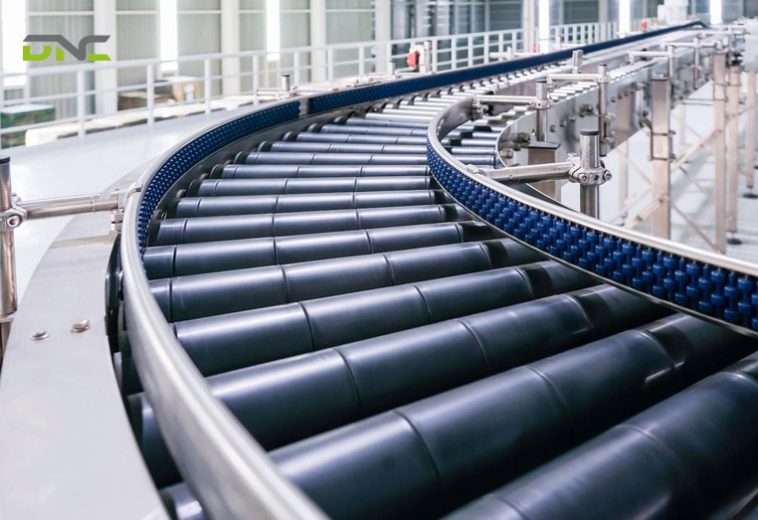
Malaysian factory engineers face a specific challenge that European or American counterparts rarely deal with at the same scale: selecting conveyor rollers that perform reliably in tropical humidity averaging 80–95% RH, often in harsh environments ranging from palm oil processing plants in Sabah to semiconductor cleanrooms in Penang. The wrong conveyor roller type causes catastrophic belt mistracking, accelerated bearing failure, and unplanned stoppages that erase productivity gains within months. This guide covers all 8 primary conveyor roller types — carrying idlers, return idlers, impact rollers, gravity rollers, motorized drive rollers, anti-buildup rollers, guide/training idlers, and rubber-lagged pulleys — with engineering specifications, environment-to-material matching, and selection criteria refined through DNC Automation’s 20+ years of Malaysian conveyor projects.
What Is a Conveyor Roller?
A conveyor roller is a cylindrical component mounted on a fixed frame that supports, guides, or drives a conveyor belt or the products carried upon it. Conveyor rollers rotate freely around a central shaft using bearings housed at each end, reducing friction between the moving belt and the stationary structure. Without conveyor rollers, belt conveyors would generate excessive heat and friction, making continuous operation impossible at industrial speeds. Conveyor rollers are classified by their function — carrying, returning, impacting, guiding, or driving — and by their construction materials, bearing class, and shell diameter, which range from 63 mm for light-duty workstation systems to 219 mm for heavy bulk material handling in Malaysian mining and palm oil sectors.
Understanding the specific conveyor roller type required for a given application is the single most important decision in conveyor design. Each roller type serves a distinct mechanical purpose, and substituting one for another — such as using a flat return roller where a rubber-disc return roller is required — results in belt damage, premature wear, and avoidable maintenance costs that accumulate over months and years of continuous operation.
How Does a Conveyor Roller Work?
Conveyor rollers function through a straightforward mechanical principle, but the engineering behind reliable roller performance across millions of rotations in harsh Malaysian factory environments demands precise component selection and assembly.
Step 1: Load Distribution Across the Belt Width
Carrying rollers are arranged in sets called idler stations, typically in groups of three (troughing sets) that form a trough shape beneath the belt. The center roller sits horizontal while the two wing rollers angle upward at 20°, 35°, or 45° depending on the bulk density of the material and the required containment profile. This trough geometry increases the cross-sectional area of material the belt carries — a 35° trough angle at 1,200 mm belt width can carry 3.2× more material per meter than a flat arrangement. Load per roller station is calculated using CEMA (Conveyor Equipment Manufacturers Association) tables, which factor in belt speed, material density, lump size, and idler spacing.
Step 2: Rotation via Precision Bearings
Each roller shell rotates around a fixed shaft through sealed or shielded radial ball bearings pressed into end caps. CEMA classifies conveyor bearings into classes C, D, E, and F — C for light-duty intermittent operations, D for standard continuous duty at belt speeds to 3.5 m/s, E for heavy-duty high-speed or high-load continuous operations, and F for extreme-duty applications such as underground mining and heavy bulk handling. In Malaysian palm oil mills and bulk port handling, CEMA Class E or F bearings are standard. In Penang electronics manufacturing, CEMA Class C or D suffices for light precision assemblies.
Step 3: Energy Transfer and Belt Support
Return rollers support the empty belt on its return path beneath the conveyor frame. Because the return belt carries no load, return rollers are typically spaced at 2.5–4× the spacing of carrying idlers, reducing the total number of rollers required. Flat rubber-disc return rollers are preferred in applications where material carries back on the belt underside — common in palm oil, cement, and mineral processing — because the rubber disc spacing allows material to drop through rather than build up on the roller shell, which would cause belt camber and mistracking.
Step 4: Drive and Control
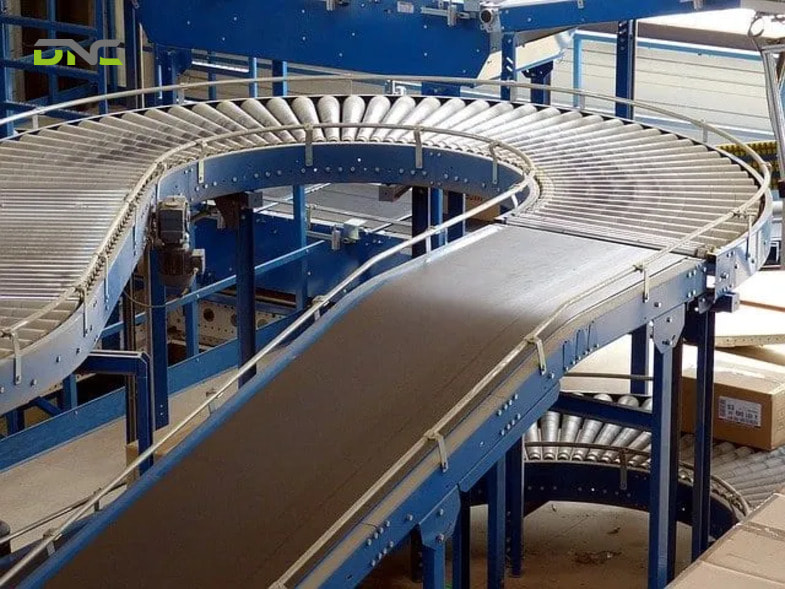
Drive pulleys — either rubber-lagged or bare steel — transfer motor torque to the belt through friction. Motorized drive rollers (MDRs) integrate the motor and gearbox inside the roller shell itself, eliminating external drives and enabling zone-by-zone control across accumulation conveyors. The drive roller’s surface condition, lagging hardness, and belt tension determine the maximum torque transferable without slippage. DNC Automation’s engineers calculate drive requirements using the CEMA formula for effective belt tension, accounting for slope, material weight, belt mass, and rolling resistance of all idler stations combined.
Types of Conveyor Rollers
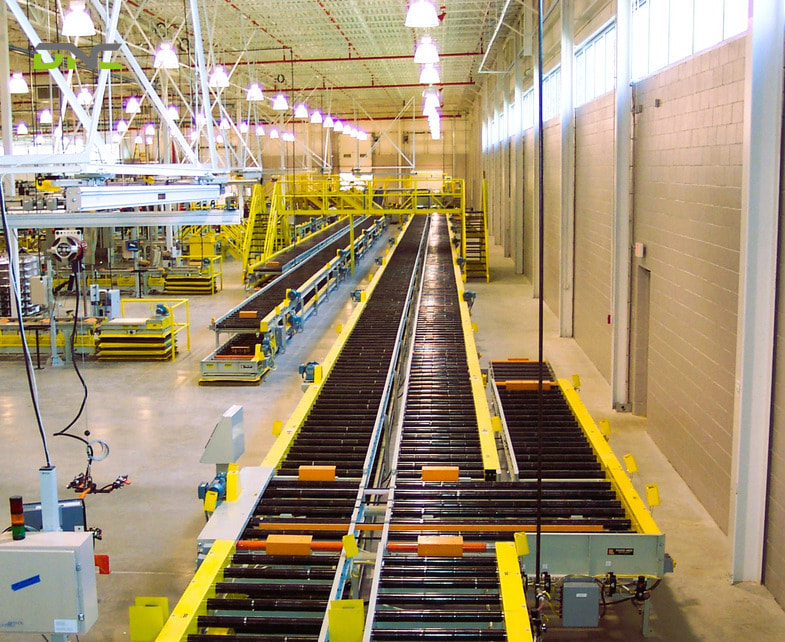
The 8 primary conveyor roller types cover every function from initial belt support through impact absorption, self-cleaning, and precise belt alignment. Selecting the correct type for each position in a conveyor system determines both operational reliability and total cost of ownership over the conveyor’s lifecycle.
1. Carrying / Troughing Idler Roller
Carrying idler rollers, also called troughing idlers, are the most numerous rollers in any belt conveyor system and the primary load-bearing component of the entire structure. Arranged in three-roller troughing sets at angles of 20°, 35°, or 45°, carrying idlers support the loaded belt and form the trough that contains bulk materials. Standard shell diameters are 89 mm, 108 mm, 133 mm, and 159 mm for most Malaysian bulk handling applications. Idler spacing ranges from 1.0 m to 1.5 m for standard loads, decreasing to 0.5 m in high-impact or high-density loading zones. Shell materials include carbon steel (standard dry indoor), galvanized steel (moderate humidity), stainless steel 304 (food processing, palm oil), and HDPE (food-grade, corrosive environments). DNC Automation specifies CEMA Class D minimum for all continuous-duty Malaysian factory installations, with Class E for bulk material handling at ports and palm oil mills in East Malaysia.
2. Return Idler Roller
Return idler rollers support the empty belt on the underside return run between the tail and head pulleys. Standard return idlers are flat (single-roller), mounted at 2.5–4× the carrying idler spacing because the belt carries no load on the return. Two primary return idler constructions serve Malaysian factories: the steel flat return idler for clean dry environments and the rubber-disc return idler for applications with material carry-back. Rubber-disc return idlers feature a series of rubber rings spaced along the shaft that allow sticky materials — palm oil fruit residue, wet cement, clay — to fall through the gaps rather than accumulate on a solid shell. This self-clearing action prevents belt camber from material build-up, a common failure cause in East Malaysian bulk handling operations.
3. Impact / Garland Roller
Impact rollers absorb the kinetic energy of material falling onto the belt at loading zones, protecting both the belt carcass and the conveyor structure from the shock loads generated during loading. A garland impact roller assembly consists of multiple short rubber-cushioned roller segments hung in a garland formation that conforms to belt sag, allowing the belt to flex downward on impact rather than transmitting the full load to the rigid frame. Rubber cushions on impact rollers absorb 70–90% of lump impact energy, extending belt life by 3–5× compared to steel idlers in loading zones. Impact roller sets are specified wherever material drop height exceeds 300 mm or where lump size exceeds 100 mm. In Malaysian coal terminals and palm oil fresh fruit bunch (FFB) transfer points, impact rollers are mandatory rather than optional. Shell diameter is typically 133–159 mm to maintain adequate mass for impact resistance.
4. Gravity Roller
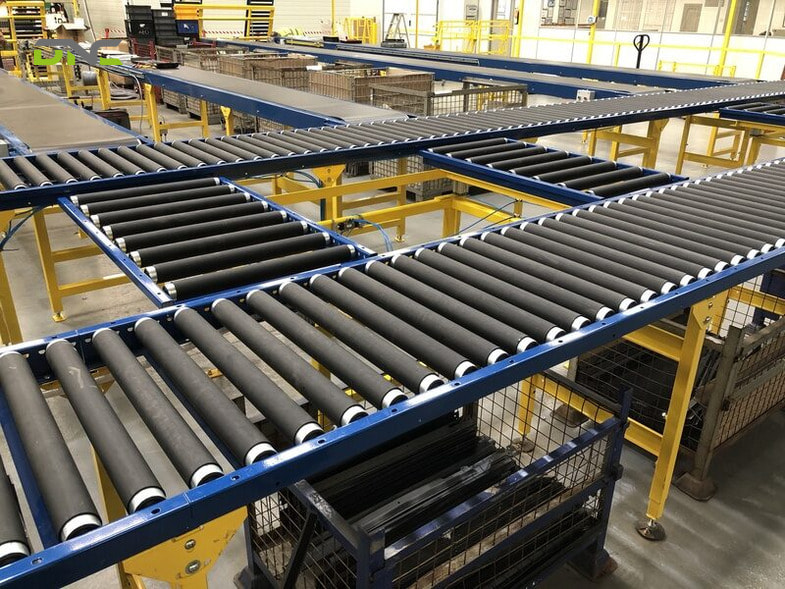
Gravity rollers are free-spinning, un-driven rollers mounted on a slightly inclined frame — typically 1.5°–5° slope — allowing products to move under their own weight without any motor drive. A gravity roller conveyor requires no electrical power for product movement, making it the lowest-cost material transport method for workstation-to-workstation flow, manual picking operations, and accumulation lanes between powered conveyor sections. Standard gravity roller diameters are 50 mm, 60 mm, and 76 mm for light-to-medium product weights, with 89 mm and 108 mm for heavier loads. Roller pitch (spacing between rollers) must be less than one-third the product length to ensure stable transport — a 300 mm product requires rollers at maximum 100 mm pitch. Malaysian automotive and F&B factories use gravity roller lanes extensively for carton accumulation, tote staging, and finished goods packing areas where powered transport is unnecessary.
5. Drive Motorized Roller (MDR)
Drive motorized rollers (MDRs) integrate a 24V DC brushless motor, planetary gearbox, and encoder directly inside the roller shell, creating a self-contained drive unit that requires no external motor, gearbox, or drive shaft. MDRs enable zone-controlled accumulation conveyors where each zone operates independently without a variable frequency drive (VFD) per zone — the 24V DC controller handles individual zone speed and start/stop logic. Standard MDR diameters are 50 mm, 60 mm, and 80 mm, rated for loads of 50–100 kg per zone. MDR systems carry IP54 ratings as standard and IP67 for washdown environments, making them suitable for food processing applications where hose-down cleaning is required. MDR technology is gaining rapid adoption in Penang EMS (Electronics Manufacturing Services) factories — Benchmark, ESCATEC, Flex, QDOS — where zone control and quiet operation (MDRs operate at 55–65 dB vs. 75–85 dB for belt conveyors) are critical for precision electronics assembly environments.
6. Wing / Spiral Anti-Buildup Roller
Wing rollers and spiral anti-buildup rollers solve the material build-up problem that causes belt mistracking, roller seizure, and structural damage in applications handling sticky, wet, or fine-particle materials. Wing rollers feature angled rubber wings extending from the shell that contact only the belt edge, preventing material from accumulating on the roller surface while still providing support. Spiral rubber rollers feature a continuous rubber helix that sweeps material outward toward the belt edges with each rotation. Both designs are specified in Malaysian palm oil processing (fresh fruit bunch juice, steam condensate), cement operations (raw meal dust), mining (wet ore), and food processing (dough, wet produce). DNC Automation recommends anti-buildup rollers at all points in palm oil mill conveyors where FFB residue or sterilizer condensate contacts the belt — a modification that reduces belt cleaning frequency from daily to weekly in documented client installations.
7. Guide / Training Idler
Guide rollers, also called training idlers or belt tracking idlers, correct belt mistracking by applying a lateral corrective force to the belt before misalignment causes edge damage. Passive training idlers pivot on a vertical axis — when the belt drifts to one side and contacts the guide frame, the differential friction causes the roller to swivel and apply a steering force back toward center. Active training idlers use sensors to detect belt position and mechanically actuate the corrective angle before the belt reaches the frame. Training idlers are mounted on both the carrying run and return run, typically at 30–60 m intervals on long conveyors and immediately after any curve or transition section. Belt mistracking is the single most common conveyor failure mode in Malaysian factory environments, frequently caused by uneven loading, worn or mis-aligned idlers, and belt splice irregularities. DNC Automation includes training idlers at minimum three positions — head end, tail end, and midpoint — on all conveyor systems longer than 15 m.
8. Rubber-Lagged Pulley
Rubber-lagged pulleys are not idler rollers in the strictest classification, but they are a critical roller component of every belt conveyor drive system and are specified through the same engineering process as conveyor rollers. The drive (head) pulley and tail pulley are coated in vulcanized rubber lagging to increase the coefficient of friction between the pulley surface and the belt, enabling torque transfer without slippage. Lagging hardness ranges from 40 Shore A (soft, for wet applications — higher grip) to 70 Shore A (hard, for abrasive dry applications — longer wear life). Diamond-groove lagging patterns channel water away from the belt contact surface in wet applications. In Malaysian palm oil and food processing environments where pulleys are regularly wetted by process fluids and cleaning water, 40–50 Shore A grooved rubber lagging is standard. DNC Automation supplies and installs rubber-lagged pulleys with ceramic embedded lagging for high-tension, high-slip-risk applications at bulk material terminals.
Conveyor Roller Type Comparison Table
| Roller Type | Diameter Range | Shell Material | Environment | Drive Required | Primary Function |
| Carrying/Troughing | 89–159 mm | Carbon steel / SS304 | All | No | Load support |
| Return Idler | 89–133 mm | Steel / rubber disc | All | No | Empty belt support |
| Impact/Garland | 133–159 mm | Rubber cushioned | Loading zones | No | Shock absorption |
| Gravity Roller | 50–108 mm | Steel / PVC / SS | Light-medium | No | Gravity flow |
| MDR Motorized | 50–80 mm | Steel, IP54/67 | All, incl. washdown | 24V DC internal | Zone control |
| Wing/Anti-Buildup | 108–159 mm | Rubber wing/spiral | Sticky/wet materials | No | Self-cleaning |
| Guide/Training | 89–133 mm | Steel / polymer | All (tracking zones) | No | Belt alignment |
| Rubber-Lagged Pulley | 200–800 mm | Steel + rubber | Drive/tail positions | Yes (external) | Torque transfer |
Key Components of a Conveyor Roller System
A complete conveyor roller system is more than individual rollers — it is an integrated assembly of mechanical, structural, and material components that function together to deliver reliable belt support and drive across the conveyor’s full operating life.
Roller Shell. The cylindrical outer tube that contacts the belt or product. Shell thickness ranges from 3.0 mm for light-duty 63 mm diameter rollers to 6.0 mm for heavy-duty 219 mm diameter bulk material idlers. Shell materials — carbon steel, galvanized steel, SS304, SS316, HDPE, or rubber-coated — are selected based on the chemical environment, temperature range, food safety requirements, and load conditions.
Bearings and Bearing Housing. Each roller end cap houses a radial ball bearing — 6205 or 6305 series for standard duty, 6308 or 6310 for heavy duty — pressed into a cast iron or steel housing machined to tight tolerances. Bearing life follows the L10 calculation: at 500 RPM under rated load, a CEMA Class D bearing delivers a minimum 30,000-hour L10 life. Incorrect bearing selection is the leading cause of premature roller failure in Malaysian factories.
Seals. Triple-lip labyrinth seals prevent process dust, humidity, and contaminants from entering the bearing cavity. In Malaysian environments exceeding 80% RH, seal integrity is non-negotiable — even a minor seal compromise admits moisture that initiates corrosion pitting in bearing raceways within 6–8 weeks. DNC Automation specifies triple-lip seals with IP66-equivalent protection for all factory floor roller installations.
End Caps and Shaft. Cold-rolled steel or cast iron end caps retain the bearings and connect the roller to the frame via fixed or spring-loaded shafts. Shaft diameters of 20 mm, 25 mm, and 30 mm are standard across CEMA-compliant roller ranges. Spring-loaded shafts in carrying idler sets allow quick roller replacement without tools — a maintenance time reduction of 60–80% versus bolted shaft designs.
Frame and Idler Station Structure. Galvanized or stainless steel frame brackets maintain roller spacing and trough angle. Frame rigidity directly affects belt support quality — inadequate frame stiffness causes frame flex under load, which transfers dynamic forces to roller bearings as a lateral load, dramatically reducing bearing L10 life.
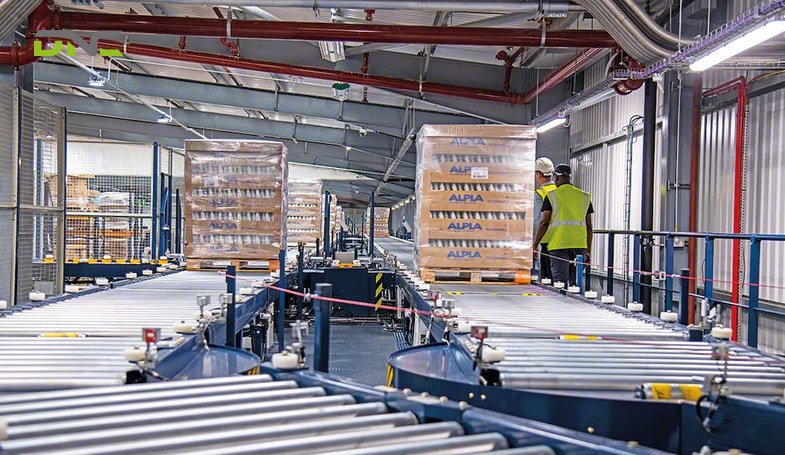
Applications: Where Conveyor Roller Types Are Used in Malaysian Manufacturing
Malaysian manufacturing spans environments as diverse as tropical coastal palm oil mills and ultra-clean semiconductor fabs, each demanding specific conveyor roller type selections.
Palm Oil Processing — East Malaysia and Peninsular Mills
Palm oil mills across Sabah, Sarawak, and peninsular Malaysia present the most aggressive corrosive environment for conveyor rollers: steam, condensate, FFB juice, 95%+ RH, and temperatures reaching 120°C at sterilizer discharge. Carrying idlers in FFB reception and processing areas must be SS304 or SS316 shell with triple-lip seals. Return rollers must be rubber-disc style to handle FFB residue carry-back. Impact rollers at FFB dump hoppers absorb lump impacts from bunches weighing 25–50 kg each. Wing anti-buildup rollers prevent the notorious roller seizure caused by FFB oil and fiber build-up — a failure mode that leads to belt fires in documented Malaysian mill incidents. DNC Automation has commissioned conveyor roller systems across more than 30 Malaysian palm oil facilities, with preventive maintenance programs that have extended average roller service life from 8 months to 28 months.
Semiconductor and Electronics — Penang
Penang’s semiconductor cluster — Intel, AMD, HP, Flex, and dozens of EMS providers — uses conveyor rollers in very different conditions: clean, climate-controlled, static-sensitive. MDR motorized rollers are the preferred choice for PCB and semiconductor component handling, offering zone accumulation without belt static generation. Gravity rollers with HDPE or chrome-plated shells handle finished goods staging between assembly and test. Anti-static roller coatings are standard for any roller contacting electronics packaging in Penang factories. CEMA Class C or D bearings are sufficient at the low speeds (0.1–0.5 m/s) typical of electronics assembly lines.
Automotive Manufacturing — Selangor
Selangor’s automotive manufacturing cluster — with Toyota as a DNC Automation client — uses heavy-duty carrying idlers (CEMA Class E) on body-in-white assembly lines, rubber-lagged pulleys on engine component conveyors, and MDR-controlled accumulation zones on door panel assembly lines. Guide/training idlers are critical on automotive underbody conveyor lines where belt widths of 800–1,200 mm demand precise tracking at speeds of 1.0–2.0 m/s.
Food and Beverage — Selangor and Johor
F&N, Ramly Burger, and Guan Chong Berhad — all DNC Automation clients — operate conveyor systems where food safety regulations under HACCP MS 1480 mandate SS304 roller shells and HDPE end caps in food-contact zones. Gravity rollers with SS304 shells handle carton accumulation. MDR-controlled accumulation zones provide gentle product handling for fragile food packaging. All roller bearings in direct food-contact zones are food-grade grease-filled (NSF H1 certified).
Benefits of Correct Conveyor Roller Type Selection for Factory Operations
Selecting the correct conveyor roller type for each application position delivers measurable operational and financial returns that extend across the conveyor’s full 10–20 year operating life.
Bearing life extension. Correct roller type and bearing class selection extends L10 bearing life from a typical 8,000–12,000 hours (wrong specification) to 30,000+ hours (CEMA-correct specification), reducing bearing replacement frequency by 60–75% and cutting annual roller maintenance labor costs by up to 50%.
Belt life extension. Correct impact rollers at loading zones reduce belt carcass fatigue — the primary cause of longitudinal belt cracking — extending belt service life by 3–5×. In Malaysian factories, a conveyor belt replacement costs RM 15,000–RM 150,000 depending on length and belt grade; correct impact roller specification pays for itself in belt savings within the first operational year.
Unplanned downtime reduction. DNC Automation’s documented client data shows that correctly specified conveyor roller systems reduce unplanned conveyor stoppages by up to 70% compared to under-specified or incorrectly specified baseline systems. For a Malaysian factory running two shifts at RM 5,000/hour production value, avoiding 6 hours of monthly unplanned downtime saves RM 360,000 annually.
Energy efficiency. Low-resistance CEMA Class D/E sealed roller bearings with precision-machined end caps reduce rolling resistance by 15–25% versus worn or under-specified rollers. DNC Automation’s energy efficiency audits on palm oil mill conveyor systems have documented motor current reductions of 8–18% following roller system upgrades — a direct reduction in electricity costs for facilities running conveyors 24 hours per day.
NIMP 2030 Alignment. Malaysia’s National Investment Master Plan 2030, with its RM 8.2 billion smart factory budget, mandates measurable factory efficiency improvements. Correct conveyor roller specification is the foundational infrastructure step that enables subsequent automation — MDR rollers with zone control are the entry point to Industry 4.0 conveyor intelligence. DNC Automation supports Malaysian manufacturers in qualifying roller system upgrades under the SAG Grant (RM 1 million, 70:30 MIDA matching) as part of broader factory automation investments.
How to Choose the Right Conveyor Roller Type for Your Factory
Selecting conveyor roller types for a Malaysian factory installation follows a structured engineering decision process that prevents both under-specification (early failure) and over-specification (unnecessary cost).
Step 1: Define the conveyor function. Establish whether each roller position is carrying (loaded belt), return (empty belt), loading zone (impact), drive (pulley), or tracking (guide). Each function maps directly to a specific roller type — this step eliminates all non-applicable options immediately.
Step 2: Calculate load per roller. Using CEMA calculation methods, determine the load (in kg) each roller station must support, factoring in belt weight, material weight at design capacity, and the selected idler spacing. The resulting load per roller determines the minimum shell diameter, shell thickness, and bearing class required. CEMA tables provide minimum L10 life requirements — 30,000 hours for Class D, 60,000 hours for Class E — that must be met or exceeded.
Step 3: Select shell material for the environment. Malaysian environments demand specific shell material choices: dry indoor light-duty → galvanized carbon steel; food processing → SS304 or HDPE; palm oil processing → SS304 or SS316; high-humidity outdoor → SS304 or HDPE; cleanroom electronics → HDPE or chrome-plated steel. DNC Automation’s standard recommendation for any Malaysian installation within 50 km of coastal areas or in F&B/palm oil environments is SS304 minimum — galvanized steel corrodes to functional failure within 3–5 years in these conditions.
Step 4: Determine seal rating. Factory floor installations require IP55 minimum sealing. Washdown environments (food processing, pharmaceutical) require IP67. Outdoor coastal installations require IP66 with additional labyrinth seal depth. Palm oil mill installations with steam exposure require IP67 plus silicone sealed grease-packed bearings.
Step 5: Specify MDR where zone control is required. Any accumulation conveyor, buffering system, or zone-controlled assembly line should specify MDR rollers rather than belt-driven zones with VFDs. MDR systems reduce total installed cost by 20–35% versus equivalent VFD-per-zone systems on accumulation lengths up to 30 m, while enabling independent zone control that protects products and reduces wear.
Step 6: Consult DNC Automation’s engineering team. DNC Automation’s 35+ engineers have specified conveyor roller systems for Toyota, Sony, F&N, Hartalega, Unilever, Ramly Burger, and Guan Chong Berhad, across every major Malaysian manufacturing environment. A free consultation will identify the correct roller types, materials, bearing classes, and quantities for your specific application — preventing the costly mistakes that result from generic catalog selection without site-specific engineering review.
Frequently Asked Questions About Conveyor Roller Types
What are the most common conveyor roller types used in Malaysian factories?
Carrying/troughing idler rollers are the most numerous roller type in any bulk material handling conveyor, followed by return idlers. In Malaysian manufacturing facilities specifically, MDR motorized rollers are the fastest-growing category, driven by adoption in Penang EMS factories and Selangor automotive assembly lines. Gravity rollers remain the most cost-effective choice for manual workstation flow between powered sections.
What is the difference between CEMA Class C, D, E, and F conveyor rollers?
CEMA bearing classes define the bearing size, load rating, and sealing for conveyor idler rollers. Class C rollers use smaller bearings (6204–6205 series) rated for light-duty, low-speed, or intermittent operation. Class D rollers use 6205–6305 series bearings for standard continuous-duty factory conveyors at belt speeds to 3.5 m/s. Class E rollers use heavy-duty 6308–6310 series bearings for high-load or high-speed continuous operation — mandatory for Malaysian palm oil mills and bulk handling. Class F rollers carry the heaviest bearing specifications for extreme-duty underground mining applications. Mismatching bearing class to application is the primary cause of premature roller failure in Malaysian factories.
How often should conveyor rollers be replaced in Malaysian factory conditions?
Correctly specified CEMA Class D rollers in standard Malaysian factory environments (indoor, moderate humidity) should achieve 30,000+ hours of L10 bearing life — approximately 3.4 years at 24/7 continuous operation. In harsh environments (palm oil mills, outdoor coastal, high-temperature), correctly specified SS304 or SS316 rollers with IP67 sealing should achieve 15,000–20,000 hours. Incorrectly specified galvanized carbon steel rollers in palm oil or coastal environments typically fail at 6,000–12,000 hours, representing a 50–60% premature failure rate relative to correct specification.
Why do conveyor rollers seize up and how is this prevented?
Conveyor roller seizure results from bearing contamination (moisture or process dust bypassing seals), inadequate lubrication, overloading beyond bearing capacity, or material build-up on the roller shell causing eccentric rotation and bearing overload. Prevention measures include triple-lip labyrinth seals rated for the process environment, pre-lubricated sealed bearings matched to the process temperature range, shell material selection that prevents corrosive material adhesion, and anti-buildup roller designs (wing or spiral) in sticky material applications. DNC Automation’s preventive maintenance programs include roller condition monitoring using vibration analysis to detect bearing deterioration 4–8 weeks before seizure occurs.
What diameter conveyor roller should I specify for my application?
Roller diameter selection follows the CEMA calculation for minimum roller diameter: larger diameter rollers rotate more slowly at a given belt speed, reducing bearing RPM and extending bearing life. At 2.5 m/s belt speed, a 89 mm diameter roller rotates at approximately 535 RPM while a 133 mm roller rotates at 358 RPM — the larger roller runs cooler and delivers significantly higher bearing L10 life. Standard Malaysian factory guideline: use 89 mm minimum for belt widths to 600 mm, 108 mm for 600–900 mm belts, 133 mm for 900–1,200 mm belts, and 159 mm for belts wider than 1,200 mm.
What is the difference between a gravity roller and an MDR motorized roller, and which should I choose?
Gravity rollers are free-spinning with no power source — products move by gravity slope or manual push. MDR motorized rollers contain an internal 24V DC motor and provide powered, zone-controlled transport. Gravity rollers cost RM 25–80 each; MDR rollers cost RM 350–900 each. Choose gravity rollers for workstation accumulation lanes, picking aisles, and buffer zones where gravity slope is achievable (minimum 1.5° incline). Choose MDR rollers for horizontal accumulation, automated zone sequencing, product indexing, and any application where precise start/stop control is required. The productivity difference is significant: MDR zone control eliminates product-on-product contact pressure (zero-pressure accumulation), reducing product damage rates by 85–95% in fragile goods handling.
Can DNC Automation supply and install all 8 types of conveyor rollers?
DNC Automation supplies, installs, and maintains all 8 conveyor roller types across Malaysian factory environments. As Malaysia’s #1 factory automation company since 2005, DNC’s 35+ engineers have delivered complete conveyor systems — from roller specification through PLC-controlled drive integration — for clients including Toyota, Sony, F&N, Hartalega, Unilever, Ramly Burger, and Guan Chong Berhad. DNC sources rollers from certified manufacturers meeting CEMA, DIN, and ISO standards, and provides full material certification (mill certs, material test reports) for food-grade and regulated applications.
How does Malaysia’s SAG Grant apply to conveyor roller system upgrades?
Malaysia’s Smart Automation Grant (SAG), administered through MIDA with RM 1 million maximum funding on a 70:30 matching basis, covers factory automation investments that measurably improve productivity and reduce manual labor dependency. Conveyor roller system upgrades — particularly from manual or semi-automated systems to MDR-controlled smart accumulation systems with PLC integration — qualify as automation upgrades under SAG criteria. DNC Automation assists Malaysian manufacturers through the entire SAG application process, from technical documentation to commissioning reports. Factories that have upgraded conveyor systems with DNC’s support have documented productivity increases of 50% and human error reductions of 80%, meeting the measurable improvement standards required for SAG validation.
Conclusion
Conveyor roller type selection is not a catalog exercise — it is an engineering decision that determines whether a Malaysian factory’s conveyor system delivers 3 years or 15 years of reliable service. From carrying idlers bearing the full weight of bulk palm oil FFB to MDR motorized rollers enabling Industry 4.0 zone accumulation in Penang semiconductor fabs, each of the 8 roller types has a specific role, specification range, and environment requirement. DNC Automation’s engineers match roller type, diameter, shell material, bearing class, and sealing to your exact application — preventing the premature failures and production losses that result from under-specified or incorrectly specified systems.
- 172 views
- 0 Comment
Recent Comments