



Scraper Chain Conveyor: Types, Specs & Palm Oil Use | DNC Automation Malaysia
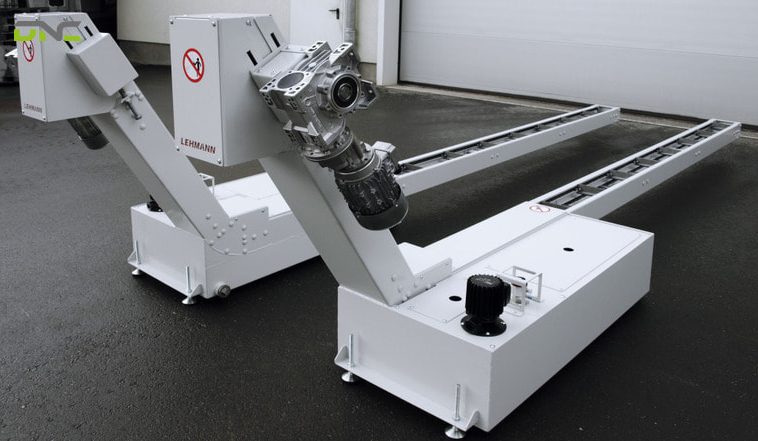
Scraper Chain Conveyor — The Complete Guide for Malaysian Palm Oil and Industrial Bulk Handling
Scraper chain conveyors are the backbone of Malaysia’s palm oil industry — every one of the 450+ palm oil mills operating across Sabah, Sarawak, Pahang, Perak, and Johor relies on at least one scraper conveyor to move Fresh Fruit Bunches (FFB) from the loading ramp to the sterilizer. Understanding scraper chain conveyor types, design specifications, wear failure modes, and correct selection criteria is essential for any Malaysian factory engineer or mill manager responsible for bulk material handling uptime.
DNC Automation, Malaysia’s Top #1 Factory Automation Company since 2005, has designed, fabricated, and commissioned scraper chain conveyor systems for palm oil mills, food processing plants, and heavy-industry facilities across Peninsular Malaysia and East Malaysia. The 25,000 sq ft fabrication facility in Malaysia, staffed by 35+ specialist engineers, produces custom scraper conveyor assemblies to match specific mill throughput requirements — from a single horizontal drag conveyor at 45 TPH to complete FFB reception-to-sterilizer conveyor lines rated at 150 TPH with Siemens VFD drive control.
This guide covers every aspect of scraper chain conveyor technology that a Malaysian engineer needs to specify, procure, or maintain the correct system for their application.
What Is a Scraper Chain Conveyor?
A scraper chain conveyor is a bulk material handling machine that uses rigid scraper flights — flat metal bars or paddles — welded or bolted to one or two strands of drag chain, which drag loose bulk material through a steel trough from the loading point to the discharge point. The entire assembly moves in a continuous loop: the loaded strand drags material along the trough floor while the return strand travels back (either inside the same trough below the material, or externally on a return track).
Scraper chain conveyors differ from belt conveyors in two critical ways. First, the conveying element is a chain-and-flight assembly, not a continuous belt — meaning the material is dragged rather than carried. Second, the enclosed steel trough contains the material on all sides, eliminating spillage and enabling operation on steep inclines, in dusty environments, and with wet or oily materials that would damage a rubber belt.
The scraper chain conveyor is classified as a mechanical bulk conveying device, separate from pneumatic conveyors (air-conveyed) or screw conveyors (auger-conveyed). For materials with large particle size, high moisture content, abrasive properties, or high bulk density — such as FFB (Fresh Fruit Bunches), Empty Fruit Bunches (EFB), rice husks, wood chips, minerals, and clinker — the scraper chain conveyor consistently outperforms alternative conveying methods on total cost of ownership and reliability in tropical Malaysian operating conditions.
How Does a Scraper Chain Conveyor Work?
Step 1: Material Loading at the Inlet
Material enters the scraper chain conveyor through a loading hopper or chute positioned above the trough inlet. In palm oil applications, FFB are tipped from lorries via a hydraulic tipping ramp, and the bunches fall into the conveyor trough under gravity. The loading zone is designed so material distributes evenly across the trough width — an important factor because uneven loading accelerates chain wear on one side.
Step 2: Chain and Flight Drive Assembly Engages
An electric gearmotor — typically fitted with a Siemens-controlled Variable Frequency Drive (VFD) for speed regulation — rotates the drive sprocket at the discharge end. The drive sprocket engages the chain link pitch, pulling the loaded upper strand forward through the trough while the return strand travels back. Chain velocity is engineered to match capacity requirements: a 150 TPH double-strand palm oil scraper conveyor runs at 0.302 m/s while a lower-capacity 45 TPH design runs at 0.40 m/s (slower chains handle lighter burdens more efficiently in terms of chain wear rate per ton conveyed).
Step 3: Scraper Flights Drag Material Through the Trough
Scraper flights — cross-bars welded to the chain at regular pitch intervals — contact the material sitting on the trough floor and drag it progressively toward the discharge end. The material moves as a sliding bed between consecutive flights. Trough width, flight height, chain pitch, and chain velocity together determine the volumetric capacity (m³/h), which is then multiplied by bulk density (kg/m³) to yield mass throughput (TPH).
Step 4: Material Discharges at the Outlet
At the discharge end, the scraper flights travel over the drive sprocket and the trough terminates, allowing material to fall through the discharge opening into a chute, sterilizer cage, bin, or next conveyor. The discharge can be at the end of the conveyor (end discharge) or through gates in the trough floor at intermediate points (intermediate discharge — used in plants with multiple receiving stations).
Step 5: Return Strand Completes the Loop
After discharge, the empty chain-and-flight assembly returns to the loading end via the return path. In a standard enclosed trough design, the return strand travels inside the trough below the material level (bi-directional trough), separated by a central partition. In heavy-duty designs (particularly for large FFB bunches), the return strand runs beneath the trough in an external return housing.
Step 6: Tensioning Maintains Chain Alignment
A tail end tension assembly — typically a screw tensioner or hydraulic take-up — maintains correct chain tension throughout the operating cycle. Insufficient tension causes chain sag (catenary effect), which leads to chain-flight contact with the trough sides, accelerated wear, and eventual jamming. Over-tension accelerates pin-bushing wear and increases motor load.
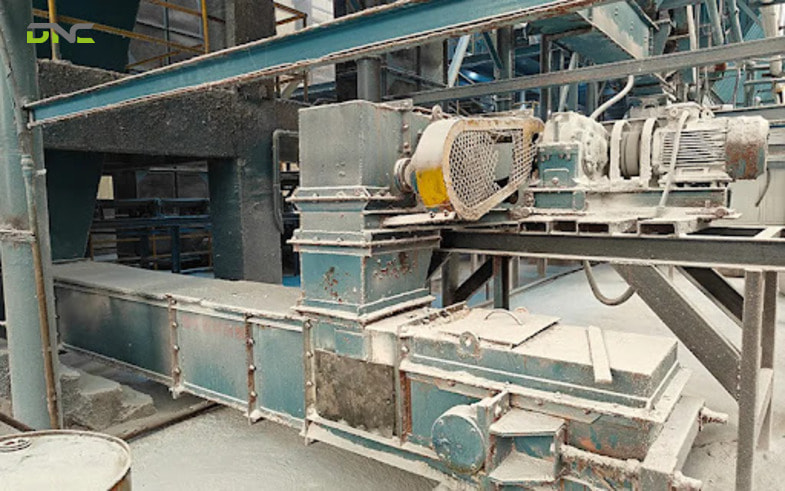
How Does a Scraper Chain Conveyor Work?
Types of Scraper Chain Conveyor
1. Single-Strand Scraper Conveyor
Single-strand scraper conveyors use one central chain strand with scraper flights mounted symmetrically on both sides. This design is suited to light-duty applications handling granules, flour, rice, seeds, and fine powders. Typical capacity ranges from 5 to 40 TPH. The compact drive assembly and narrower trough make single-strand conveyors the standard choice for food-grade grain processing, milling operations, and compound feed manufacturing across Selangor and Johor.
Food-grade versions use stainless steel drag chain (SS304 or SS316) with HDPE or SS304 trough lining, meeting HACCP MS 1480 and FDA requirements. DNC Automation supplies food-grade single-strand scraper conveyors with Siemens PLC control for automated start-stop, overload protection, and remote monitoring.
2. Double-Strand Scraper Conveyor
Double-strand scraper conveyors use two parallel chain strands with heavy cross-bar scraper flights bolted between them. This configuration handles large, irregular-shaped material — FFB, EFB, wood chunks, rock — without the flights twisting or tipping under uneven load. Double-strand is the palm oil mill standard: every FFB reception conveyor, EFB conveyor, and fruit distribution conveyor in Malaysian palm oil mills is a double-strand scraper conveyor.
Specifications for heavy-duty double-strand palm oil scraper conveyors built by DNC Automation:
- Capacity: 60–150 TPH FFB
- Chain velocity: 0.302 m/s at 150 TPH; 0.40 m/s at 45 TPH
- Maximum incline: 25° (standard horizontal-to-incline configurations)
- Trough construction: Q235B carbon steel U-trough; 6–8mm floor plate; HARDOX 400 replaceable wear liners
- Chain type: Hardened alloy double-strand palm chain; 152.4mm pitch; case-hardened pins and bushings
- Drive: Electric gearmotor + Siemens SINAMICS VFD; alternative: hydraulic motor drive for mill hydraulic systems
- Lubrication: Auto-lube system with 12-hour interval; or manual grease nipples on chain pins at maintenance schedule
3. En Masse Drag Chain Conveyor
En masse drag chain conveyors operate on a fundamentally different principle from standard scraper conveyors. The material fills the entire trough cross-section — not just the space between scraper flights — and moves as a continuous en masse body. The chain-and-flight assembly acts as a drag element within the material body rather than on top of an empty trough floor.
En masse operation delivers three advantages over standard scraping: first, highest capacity per unit of drive power (material-on-material friction is lower than flight-on-trough-bottom friction); second, gentlest material handling (grain, seed, pellet, and powder applications where breakage or segregation must be minimized); third, completely enclosed dust-tight operation (the trough is fully sealed, and the material itself forms an air-tight plug at inlet and outlet).
En masse drag chain conveyors are specified for malt barley handling in F&B breweries, compound animal feed, granular fertilizer, and pharmaceutical bulk powders. DNC integrates en masse conveyors with dust extraction systems and Siemens PROFIBUS/PROFINET instrumentation networks.
4. Submerged Scraper Conveyor
Submerged scraper conveyors operate with the chain-and-flight assembly running entirely submerged within a liquid-filled trough. The liquid medium is typically water, oil, or a process slurry. Applications include: palm oil mill effluent (POME) sludge transport, wet ash handling in boiler plants, oil-contaminated metal chip conveyance from CNC machining sumps, and food processing (transporting blanched vegetables through a water bath).
Construction requirements for submerged operation differ significantly from dry-duty conveyors: all bearings must be IP67 or higher (fully submersible); chain is specified in SS316 or specialty alloy for corrosion resistance; seals are replaced with labyrinth barriers or mechanical face seals; and trough liners account for accelerated hydraulic abrasion.
5. Vertical Drag Chain Conveyor
Vertical drag chain conveyors elevate bulk material at angles from 60° to 90°. The chain-and-flight assembly travels vertically within a rectangular enclosed casing, with the material effectively plugged between consecutive flights and lifted to discharge at the top. Unlike bucket elevators (which carry material in cups), vertical drag conveyors handle wet, sticky, and lumpy materials that would jam bucket elevators.
Capacities up to 80 TPH are achievable vertically. Malaysian palm oil mills use vertical drag conveyors for lifting palm kernel from the nut-cracking station to the kernel storage silo, and for vertical FFB transfer between adjacent levels in multi-story processing buildings.
6. Steep Incline Scraper Conveyor
Steep incline scraper conveyors are designed for 25°–45° incline angles — beyond the practical maximum for standard belt conveyors (typically 18–22° for FFB). The high-angle configuration is the standard solution for loading FFB from the reception pit into the sterilizer cage inlet, where the geometry of the sterilizer building typically demands a 30°–40° elevation.
Steep incline designs use deeper scraper flights (150–250mm flight height versus 80–120mm for horizontal units), reduced chain pitch, and reinforced trough side plates to contain the rolling forces generated by large FFB bunches on steep inclines.
Comparison Table: Scraper Chain Conveyor Types
| Type | Capacity Range | Max Incline | Best Application | Trough Type |
| Single-strand | 5–40 TPH | 25° | Grain, flour, granules | Open or enclosed |
| Double-strand | 60–150 TPH | 25° | FFB, EFB, lumpy bulk | U-trough, heavy-duty |
| En masse | 10–200 TPH | 45° | Fragile bulk, dust-tight | Fully enclosed |
| Submerged | 5–50 TPH | 20° | Wet/oily/sludge material | Flooded trough |
| Vertical drag | 5–80 TPH | 90° | Vertical lift — kernel, grain | Enclosed vertical casing |
| Steep incline | 30–100 TPH | 45° | FFB to sterilizer loading | Reinforced U-trough |
Key Components of a Scraper Chain Conveyor System
Drive Head Assembly — The drive head contains the gearmotor, drive shaft, and drive sprockets. The Siemens SINAMICS VFD mounted on the drive panel regulates chain speed continuously, enabling soft-start to prevent chain shock loads and variable throughput matching to upstream process rates. For palm oil mills, the drive head is designed for IP55 minimum protection given the high humidity and steam present in the sterilizer building.
Drag Chain and Scraper Flights — The drag chain is the highest-wear component in any scraper conveyor. DNC Automation specifies hardened alloy steel chain (HRC 55–60 surface hardness) with sealed pin-bushing joints for palm oil applications. Scraper flights are welded to attachment links using certified welders; flight material is Q345B or higher for abrasion resistance. Flight pitch spacing (the distance between consecutive scraper bars) determines the material fill ratio between flights.
U-Trough with Wear Liner System — The trough is the structural housing that contains the material. DNC fabricates troughs from Q235B carbon steel (6–8mm base plate, 5–6mm side plates) with replaceable HARDOX 400 wear liner plates on the trough floor. HARDOX 400 hardened steel delivers approximately 2× the wear life of mild steel Q235B at the same thickness — extending trough service life from 12–18 months to 30–36 months in abrasive FFB handling.
Tail End and Tensioning Assembly — The tail end houses the tension sprocket (or tail shaft with sprockets) and the chain tensioning mechanism. DNC installs screw-type tensioners for conveyors up to 20m and hydraulic automatic take-ups for longer or higher-capacity conveyors. Correct tension setting is documented in the commissioning report and verified at each planned maintenance visit.
Rock Trap / Stone Trap — A rock trap installed upstream of the conveyor inlet catches stones, soil clods, and metal debris before they enter the chain-and-trough system. Without a rock trap, stones wedge between the chain and trough bottom, fracturing chain pins and requiring emergency shutdown. All DNC palm oil scraper conveyor systems include a rock trap as a standard component.
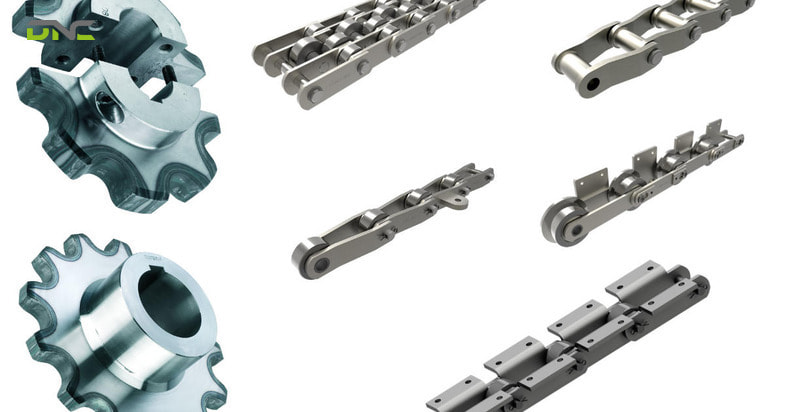
Key Components of a Scraper Chain Conveyor System
Applications: Where Scraper Chain Conveyors Are Used in Malaysian Manufacturing
Palm Oil Milling — The Dominant Application
Malaysia’s palm oil industry — the world’s second-largest producer with 18.55 million metric tons of CPO produced in 2023 — requires scraper chain conveyors at multiple critical stages in every mill. The 450+ palm oil mills operating in Sabah, Sarawak, Pahang, Perak, and Johor collectively represent the largest installed base of scraper chain conveyors in Southeast Asia.
FFB reception conveyors (horizontal + steep incline to sterilizer) are the first scraper conveyors in the mill process flow. After sterilization, EFB (Empty Fruit Bunches) must be conveyed out of the sterilizer station and to the EFB composting or fiber boiler area — again using scraper chain conveyors rated for the high-moisture, compressed bundle form of EFB. Palm mesocarp fiber conveyors (after screw pressing) and palm kernel conveyors (after nut cracking and winnowing) complete the set of scraper conveyor applications within a single palm oil mill.
DNC Automation supplies complete Siemens-controlled scraper conveyor systems to palm oil mills, including motor control panels, VFDs, proximity switches for chain speed monitoring, and torque overload protection relays.
Biomass and Boiler Fuel Handling
Palm shell, EFB fiber, wood chips, and rice husks are burned in biomass boilers across Malaysian agro-industrial facilities. Scraper chain conveyors transfer these solid fuels from outdoor storage to boiler feed hoppers. Moisture content of 30–55% and large particle size variation (wood chips from 10mm to 200mm) make scraper chain conveyors the only viable mechanical conveying solution for this duty.
Flour Milling and Grain Processing
Single-strand scraper conveyors are used in Selangor and Johor flour milling and compound feed plants for moving wheat, maize, soybean meal, and premix materials between milling, tempering, and bin loading stages. Food-grade SS304 construction with HACCP-compliant design ensures product integrity.
Mineral and Construction Material Processing
Quarry operations and cement plants in Perak and Pahang use heavy-duty double-strand scraper conveyors for limestone, clinker, and aggregate handling — particularly for below-ground pit extraction where belt conveyors are impractical.
Benefits of Scraper Chain Conveyor for Factory Operations
Enclosed Bulk Containment — Zero Spillage — The steel U-trough encloses material on three sides (floor and two walls), with a cover plate available for full enclosure. Palm oil mills achieve zero FFB spillage losses using scraper conveyors versus open belt conveyors, which lose 2–5% of FFB to spillage and contribute to fire hazards from accumulated fiber.
Incline Capability to 45° — Scraper chain conveyors outperform belt conveyors on incline angle capacity. A steep incline scraper conveyor at 40° replaces a belt conveyor that would require 2× the horizontal length to achieve the same vertical rise — a critical space-saving advantage in compact palm oil mill buildings.
Abrasion Resistance Through Wear Liner Selection — HARDOX 400 wear liner plates in DNC-supplied conveyors reduce wear-related downtime by approximately 50% compared to mild steel troughs. Mill managers report trough liner replacement intervals extending from 12 months to 30+ months after upgrading to HARDOX 400 liners.
VFD Speed Control Reduces Energy Consumption — Siemens SINAMICS VFDs installed on DNC scraper conveyor drives reduce energy consumption by 15–30% compared to direct-on-line starters by matching chain speed to actual throughput rather than running at fixed maximum speed during partial-load periods.
DNC’s Automation Integration Reduces Human Error by 80% — Full PLC automation of scraper conveyor sequences (start-stop interlocking, speed feedback, chain break detection, overload protection) eliminates manual intervention errors. DNC Automation clients report an 80% reduction in human error-related conveyor downtime after full PLC integration, alongside a 50% increase in production throughput.
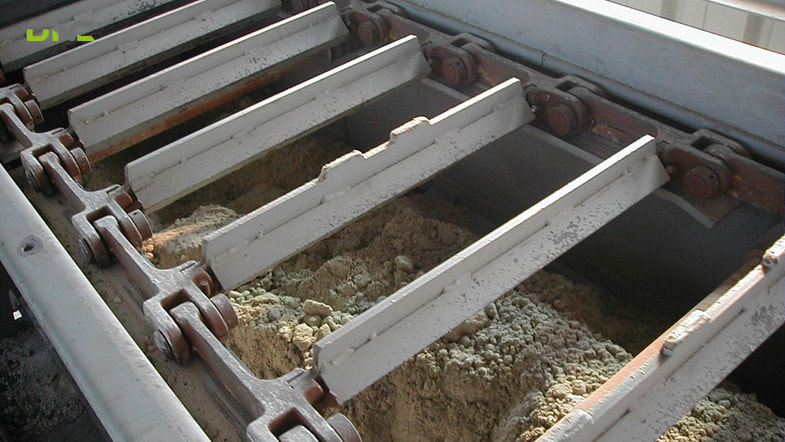
Benefits of Scraper Chain Conveyor for Factory Operations
How to Choose the Right Scraper Chain Conveyor for Your Factory
Step 1 — Define Material Properties. Specify the material’s bulk density (kg/m³), maximum particle size (mm), moisture content (%), abrasiveness (Mohs scale), and temperature range. FFB bulk density is approximately 550 kg/m³ with maximum bunch size 450mm. Wheat grain is 750–850 kg/m³ at 10–14% moisture. These parameters determine trough cross-section, flight height, chain pitch, and trough liner material.
Step 2 — Determine Required Capacity. Calculate mass throughput (TPH) and verify against the process balance: a palm oil mill rated at 60 MT FFB/hour requires a scraper conveyor minimum capacity of 65–75 TPH (adding 8–25% surge factor). For en masse conveyors, calculate volumetric capacity (m³/h) using bulk density and check the fill ratio does not exceed 75%.
Step 3 — Select Conveyor Type. Match the six conveyor types against your material properties and layout. Double-strand for heavy palm oil duty. En masse for fragile granules or dust-tight requirements. Submerged for wet or liquid-contaminated material. Vertical drag or steep incline for elevation challenges.
Step 4 — Specify Wear and Corrosion Protection. Abrasive materials (FFB, minerals, clinker) mandate HARDOX 400 trough liners and hardened chain. Wet or food-grade environments require SS304/316 trough and chain. Outdoor installations in Malaysia’s tropical climate require IP55+ motor and bearing protection and anti-corrosion coating on all carbon steel components.
Step 5 — Select Drive and Control System. Siemens SINAMICS VFDs with TIA Portal PLC integration deliver the most complete automation capability: remote start-stop, speed feedback monitoring, chain elongation alarm, and integration with plant-wide SCADA. DNC Automation provides full drive panel engineering, wiring, and commissioning as part of the conveyor supply package.
Step 6 — Engage DNC Automation for Engineering Review. DNC’s 35+ specialist engineers review your application parameters, verify capacity calculations, recommend optimal type and specification, and provide fabrication drawings and quotation. Malaysia’s NIMP 2030 smart factory initiative and the SAG Grant (RM 1 million at 70:30 MIDA co-funding) support capital investment in automated conveyor systems — DNC assists clients in preparing grant documentation.
Frequently Asked Questions About Scraper Chain Conveyors
Q: What is the difference between a scraper chain conveyor and a drag chain conveyor?
Drag chain conveyor and scraper chain conveyor are used interchangeably in Malaysian industry. Both refer to the same family of conveyors where a chain-and-flight assembly drags material through a trough. Some engineers use “drag chain conveyor” specifically for en masse designs and “scraper conveyor” for flight-type designs — but in practice, both terms are applied to both designs. DNC Automation uses “scraper chain conveyor” to describe all flight-and-trough chain conveying systems for clarity with clients.
Q: How do I know when to replace the chain on my scraper conveyor?
Chain elongation is the standard measurement for replacement decision. DNC Automation recommends replacement at 3% chain elongation (measured over 10 consecutive link pitches). A new 152.4mm pitch chain measures 1,524mm over 10 pitches; replacement is triggered at 1,570mm (3% elongation). Elongation beyond 3% causes chain-to-sprocket meshing errors, accelerating both chain wear and sprocket tooth wear, and risks sudden chain failure.
Q: Why is HARDOX 400 specified for trough liners instead of ordinary mild steel?
HARDOX 400 is a Swedish-manufactured hardened wear steel with Brinell hardness of 370–430 HBW, compared to Q235B mild steel at 120–160 HBW. The hardness ratio of approximately 2.5:1 translates to trough liner wear life approximately 2× longer than mild steel under the same FFB abrasion conditions. HARDOX 400 liner plates are fabricated as bolt-in replaceable sections — only the worn section is replaced, not the entire trough, reducing maintenance material cost.
Q: Can a scraper chain conveyor handle wet or oily FFB in the Malaysian rainy season?
Double-strand palm oil scraper conveyors are specifically designed for wet FFB handling. The Q235B steel trough with drain holes at the lowest point allows free drainage of rain water and palm oil pressing fluids. Chain pins and bushings in sealed heavy-duty design maintain lubrication under wet conditions. IP65 sealed bearings prevent water ingress into bearing housings in the high-humidity, rain-exposed operating environment of Malaysian palm oil mill reception areas.
Q: What causes bearing failure on scraper chain conveyors in Malaysian conditions?
Bearing failure in Malaysian tropical conditions is primarily caused by moisture ingress (condensation and steam in palm oil mills), combined with palm oil contamination and iron oxide dust from the trough wear process. DNC Automation specifies IP65 sealed spherical roller bearings with two-lip polymer seals for all conveyor shaft bearings. Maintenance schedule includes grease replenishment every 500 operating hours.
Q: How does a scraper chain conveyor integrate with a Siemens PLC system?
DNC Automation programs scraper conveyor control in Siemens TIA Portal using SIMATIC S7-1200 or S7-1500 PLCs. Typical I/O points include: motor run feedback, VFD speed reference and actual speed feedback, chain speed proximity sensor (underspeed alarm at <70% setpoint), head shaft torque monitor (overload trip at 130% full load torque), tail shaft rotation sensor (chain break detection), and emergency pull-cord switches (E-stop at any point along the conveyor). The complete conveyor control program integrates with the mill-wide SCADA or plant HMI via PROFIBUS DP or PROFINET.
Q: What is the expected maintenance cost of a scraper chain conveyor per year?
Annual maintenance costs for a 100 TPH double-strand palm oil scraper conveyor in Malaysian conditions are typically comprised of: chain replacement (RM 8,000–15,000 per strand per replacement cycle, 24–36 month intervals with hardened chain); HARDOX 400 wear plate replacement (RM 4,000–8,000 per replacement, 30–36 month intervals); drive sprocket replacement (RM 1,500–3,000 per set, 18–24 month intervals); bearing replacement (RM 500–1,500 per set, 24 month intervals); lubrication consumables (RM 800–1,200 per year). Total annual maintenance cost: approximately RM 10,000–18,000 per 100 TPH unit, compared to RM 25,000–40,000 for mild steel trough systems with standard chain.
Q: Does Malaysia’s SAG Grant cover scraper chain conveyor upgrades?
Smart Automation Grant (SAG) under MIDA covers automation technology upgrades including motorized, sensor-equipped, and PLC-controlled conveyor systems. A palm oil mill upgrading from manual-tipping FFB reception to a fully automated Siemens-controlled scraper conveyor system with VFD drives, PLC sequencing, and SCADA monitoring qualifies as an automation upgrade under the SAG framework. DNC Automation has assisted multiple Malaysian manufacturers in preparing successful SAG Grant applications. The SAG Grant provides up to RM 1 million at 70% MIDA funding with 30% client co-investment.
Conclusion
Scraper chain conveyors are the dominant bulk material handling solution for Malaysia’s palm oil industry and a key mechanical conveying technology across food processing, biomass, and mineral handling sectors nationwide. Selecting the correct type — double-strand for FFB, en masse for fragile grain, submerged for wet slurry, steep incline for vertical elevation challenges — and specifying the right wear materials (HARDOX 400 liners, hardened alloy chain) determine the difference between a conveyor system that runs for 36 months between major maintenance cycles and one that fails monthly.
DNC Automation, Malaysia’s Top #1 Factory Automation Company (Est. 2005 | ISO 9001:2015), designs, fabricates, and commissions scraper chain conveyor systems from our 25,000 sq ft facility with Siemens-integrated control systems. Get a Free Consultation with our 35+ specialist engineers to size and specify the right scraper chain conveyor for your Malaysian factory or palm oil mill — contact DNC Automation at dnc-automation.com.
- 5 views
- 0 Comment
Recent Comments